My brother, are you waiting and earnestly longing for the Lord Jesus to be revealed in the clouds of heaven? There is a great work yet to be done before that can take place; for this gospel of the kingdom shall be preached in all the world for a witness unto all the nations; and then shall the end come.
If you could only be with us here at one of our stations in inland China for a single day, you would have opportunity to see something of the great work that yet remains to be done. Here we have three fourths of China's four hundred and twenty-six millions, and only nine workers to preach the message.
It is true we are getting a start in the very center of China, and the location in many ways is strategic. We are in the center of the oldest inhabited portion of China, and have access to both railroad and river, so we can push out in all directions. It is also strategic in reference to the language, for the language here, known as Central Mandarin, gives us access to all the fifteen Mandarin-speaking provinces. But what concerns us most, and leads us to pray most earnestly, is that we have not more people here in training for this work.
After the missionary reaches the field, there are many days before him ere he can do much in preaching the gospel. The people and the language must both be learned before he can begin work. We long to see reinforcements coming out to help us. You know this blessed truth, and what other call do you want to lead you out into the regions beyond? The missionary activity of Seventh-day Adventists is the best index of their faith in the soon coming of the Lord. Those who feel and know that he is soon coming, will be using every energy to proclaim the gospel message to those who are yet in darkness. If all the young men and women in our training-schools had this conviction, what an incentive it would be to their work! They would be in no danger of becoming engrossed in any of the false sciences and speculative philosophies that side-track some of our young people. How to win men to trust the Saviour is a science that even angels are desirous of looking into.
So, my brother or sister, as you are surrounded by all the comforts of home life, and are planning to settle down in some enterprise simply for the sake of making a comfortable living, will you not think of China's millions that are perishing for a knowledge of the truth which makes your heart glad? The great mass of people in inland China do not know what it means to live comfortably. They do not say, “How do you live?” but the expression is, “How do you pass the days?” It is simply a matter of existence with them; nothing to live for, and no hope to banish the fear of dying. And so it is that we find them committing suicide on the most trivial provocation. There is scarcely a month passes that we do not have several suicide cases to treat. I was called to a suicide case last week that I had twice rescued from opium poisoning.
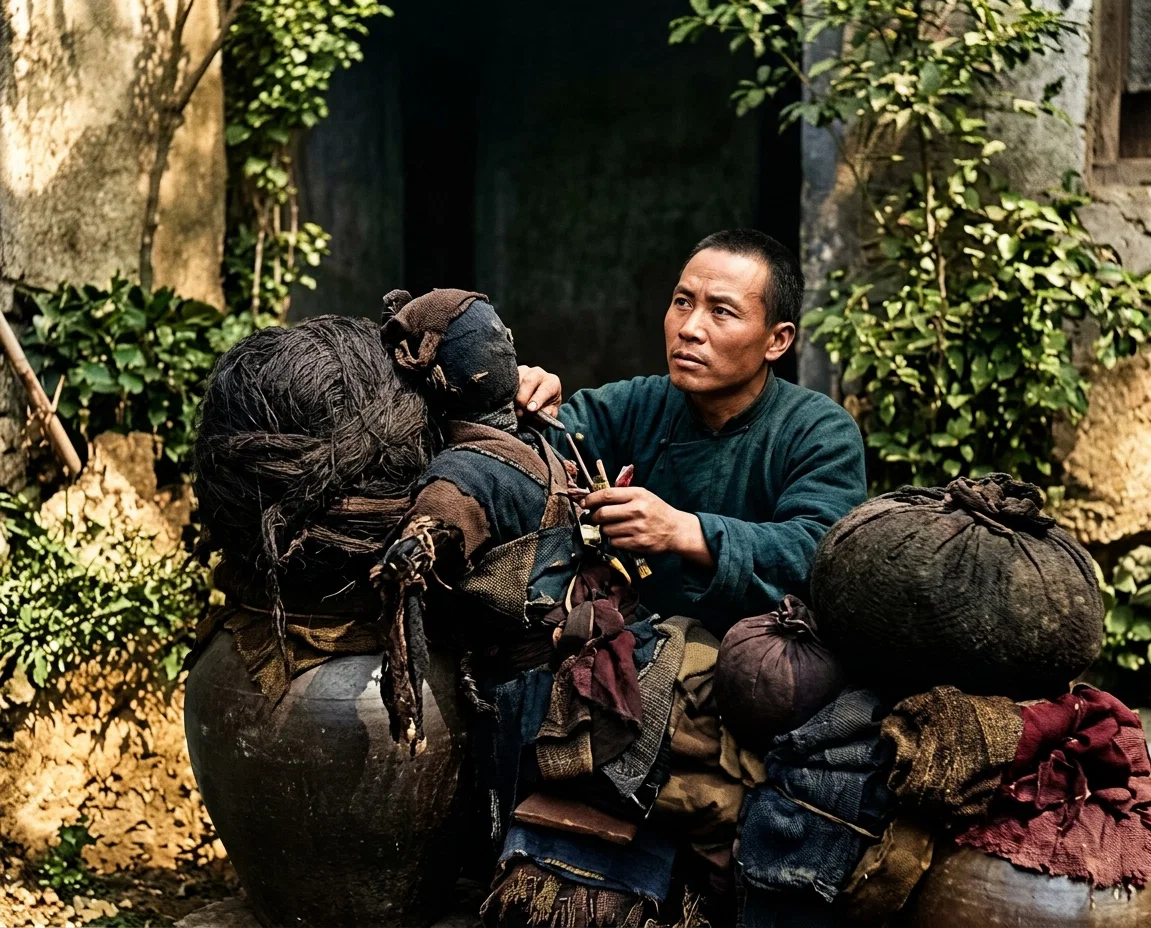
SCORCHING THE RAIN GOD
As you look at the Chinese that are to be found in the laundries throughout the country, do not judge the whole nation by them. They have left their home land with the sole and only purpose of amassing wealth, and have no other motive. The majority of them, in fact all of them, are from the large open ports, where they have come in contact with foreigners, chiefly business men and speculators, and they have seen nothing desirable in these men, but have quickly learned to copy their vices. So in the majority of cases they are not a representative class of Chinese. But here we find the people changed very little from what they have been for hundreds of years. And while they are not by any means waiting for the gospel with open arms, yet they are easier to reach than many of those who have come in contact with modern, Western ideas.
The accompanying picture will give some idea of how blind the people really are, and how much they need the truth. The picture was taken last summer during a dry period. The crops were suffering for rain, and after praying for days to the rain god, without avail, they took him out of the temple, and seated him on a table exposed to the hot sun. A wreath of withered leaves was placed on his head, and some withered branches before him, to show him how dry it was. This method was used to coerce him to send rain. If your next-door neighbor went to such extremes of folly as this, would you not do all in your power to point out the true God to him? The fact that China is a few thousand miles from you does not lessen your responsibility; for if you do not go, who will?
Siang Cheng, Via Hankow, China.
Po, Lotu
By C. H. Parker
C. H. PARKER
THIS is a religious service which is confined solely to the Lau (eastern) District of Fiji, as it is not practised in any other part of Fiji. It was formerly borrowed from Tonga. It is held at night on the first Sunday of each month. This service is generally held in the district chief’s town. All the people of the district, whether church-members or not, attend it. They all come dressed in their best and gayest colors. The meeting begins about eight o’clock, and lasts many times till long after midnight.
The meeting is opened with singing and prayer, after which a teacher of one of the towns enters the church, followed by a number of the best singers of his church, who sing as they enter. They are then assigned a place. The teacher then prays long and loud. After this his choir sing to their greatest lung capacity. They must give place to another teacher and his choir, who now enter. In the prayer and singing they try to outdo those that have preceded them. This example is followed by all the teachers and choirs of the towns of the district. Display is the one thing which seems to be sought for, not that God shall receive glory and honor. Tongan songs are generally sung, which, to most of those that sing and listen, is an unknown tongue. Yet the congregation are profuse in saying, Vinaka, vinaka (good, good) malo, malo (thanks, thanks).
The more devoted will have nothing to do with this service, as they say it is filled with corruption and lies; for it matters not how vile or deceitful a man may be, his testimony—“I am on the road to heaven, and be it known to you if I should die before morning, I would be in heaven”—is just as welcome as one coming from a real Christian.
This meeting gives occasion for many to deliberately violate the seventh commandment, yet they think they are doing God service. The writer attended one of these services, but was not able to endure the things he saw, or the impression13that another led the meeting, instead of the Crucified One. He was forcibly reminded of 2 Tim. 3:2-7: “For men shall be lovers of their own selves, covetous, boasters, proud, blasphemers, disobedient to parents, unthankful, unholy, without natural affection, . . . lovers of pleasures more than lovers of God; having a form of godliness, but denying the power thereof: from such turn away. For of this sort are they which creep into houses, and lead captive silly women laden with sins, led away with divers lusts, ever learning, and never able to come to the knowledge of the truth.”
Mualevu, Loma Loma, Lau, Fiji.
Along the Way in South America
By William Ambrose Spicer
W. A. SPICER
After the union conference meeting in Argentina, I accompanied Elder J. McCarthy to the newly organized mission field of Uruguay. Crossing the Rio Plata from Buenos Ayres, we reached Rosario Oriental by a coach ride of about thirty-five miles.
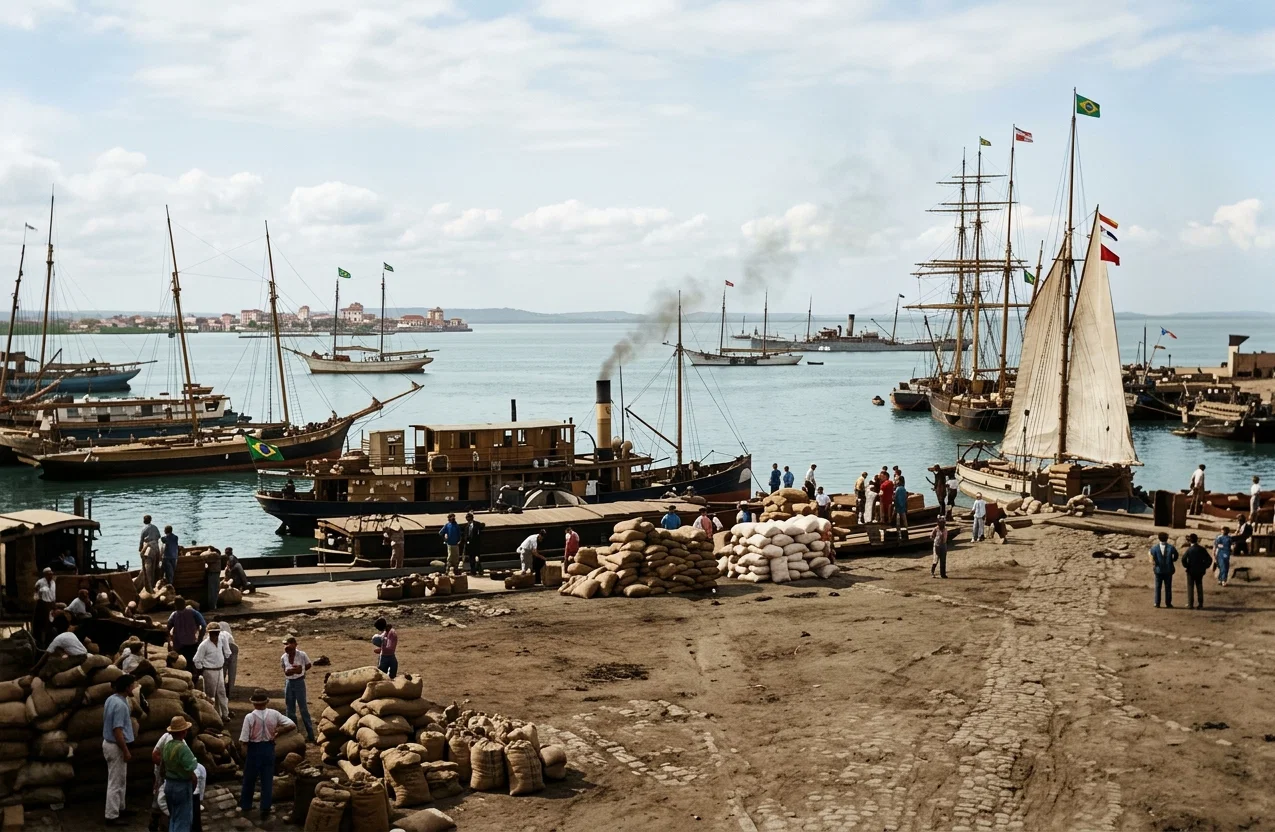
ON THE LAKE FRONT AT PORTO ALEGRE, THE CAPITAL OF RIO GRANDE DO SUL
This part of Uruguay is more pleasing to look at than the level plains of Argentina. Here the country is rolling, and to North American eyes the trees and hedges give a homelike look to the farms. Dairy farming is Uruguay’s specialty. Now, however, the country is suffering under a prolonged drought, and cattle are suffering for lack of food.
Our meeting place was in the edge of one of Uruguay’s Swiss colonies. Most of our people in this country are German-Swiss. Our services were translated into both Spanish and German. The young people of these Swiss colonies learn Spanish as they grow up, and from among these we are getting laborers for the Spanish-speaking peoples of South America.
About thirty-five adult believers were present, with a goodly number of children. We had a good Sabbath together. These brethren are hearty believers in the message, and will do their best, I believe, to carry out the plans for Uruguay in the general program of the forward movement in South America.
Uruguay has less than a hundred believers. But there are good interests developing. They propose to add one more laborer, making three, and then to develop their work as their own resources may increase. This field will soon grow into a conference, with the blessing of the Lord.
I was glad to greet these brethren, and renew acquaintance with Elder McCarthy, who was the first Sabbathkeeper from South America whom we saw in North America. He received the truth in the days of the pioneer canvassing work done by Brethren Stauffer, Snyder, and Nowlin, and came up to Battle Creek in 1893 to study the truth. He is of good courage still in this work.
Returning to Buenos Ayres, I joined Brethren Westphal, Graf, and Spies in the voyage to our first general meeting in southern Brazil. We experienced some of the inconveniences of travel in this vast field, with its few railway facilities We made the port of Rio Grande do Sul all right, but had to lie off the city three days, waiting for the lake steamer that was to take us to Porto Alegre at the upper end of Lake Patos. At last our boat came in, having been delayed on a sand-bar. On our own voyage upward the lake steamer again stuck fast in the sand, holding us back twelve hours. We reached Porto Alegre at last, on Friday morning, only to find that, being Good Friday, no river boats were running to take us on up the Taquary River to the place of meeting. The conference was to begin that night, but no reasonable offer could secure us transportation on Good Friday, and there was nothing to do but to wait, and so arrive a day late at Taquary.
The brethren are rejoiced that the reorganization of the territory, dividing it into several conferences and mission fields, will considerably lessen the amount of traveling on the part of those in charge of the work. Here is a pretty country, of rivers and hills and semitropical fruits. It is not so prosperous as Argentina, but more beautiful to look upon.
Porto Alegre, where we waited for our river boat, is a fine city of eighty thousand inhabitants. Once we had a German church here, but nearly all have moved away. In these cities there is much work to be done in Portuguese, and now our Brazilian work is turning more and more toward the twenty millions of Portuguese-speaking people.
Porto Alegre is the capital of the State of Rio Grande. It is evidently a prosperous city, a distributing point for one of the best farming States in Brazil. These cities are much alike. There is always the central plaza, or square, where the band plays and the people stroll, and then the streets lined with white plastered shops and houses, mostly low, with a liberal distribution of Catholic church buildings.
On this Friday we saw a typical religious procession, the people crowding the main street full from pavement to pavement. In front was carried a sheet, stained with blood, and then came a coffin to represent the tomb of Christ, followed by images of the saints. The whole city was given up to this modern idolatry. Flags on houses and shipping were at half-mast. Yet with all the religious earnestness, there is nothing that touches the life. And now that the Spirit of the Lord is stirring up honest hearts to inquire for truth, our people find Catholic hearts that long for something that has life and power to save.
At last we secured passage to Taquary, six hours up the river from Porto Alegre, and here our first Brazilian conference is opening with the blessing of the Lord. It is the largest meeting Brazil has ever had, and apparently all the brethren see light and encouragement in the plans for the future of the work in Brazil.
Taquary, Rio Grande.
Commendable Missionary Zeal
By Wm. Penniman
WM. PENNIMAN
We quote the following paragraphs from the Stanford Morning Star of February 13:—
“The Christian Church, or Disciples of Christ, number 1,220,831, a gain of 33,464 during the past year. The churches number 10,983, or a gain over one year ago of 126. The ministers number 6,507. In comparatively a few years this church has come to be one of the largest religious bodies of the country; nor is that all. Last year this people raised $681,065 for missions, $339,000 for education, $575,000 for new church buildings, $345,000 for literature, $915,000 for incidental church expenses, $4,270,000 for support of ministers of the church, or a grand total for all purposes of $7,125,065. These are certainly interesting figures.
“The Foreign Christian Missionary Society of this church, which does work14in foreign lands only, was not organized till 1875. Since that time it has raised and expended $2,032,833. It does work in Japan, China, India, Africa, Turkey, England, Norway, Sweden, Denmark, Cuba, Hawaii, Philippine Islands, and Tibet. The receipts last year were $210,000. An effort is being made, with bright prospects of success, to raise a quarter of a million dollars this year. The number of missionary workers employed by this society is four hundred and seven. Last year forty-two schools were supported in foreign lands, with an attendance of about two thousand, and sixteen hospitals and dispensaries were conducted by eleven medical missionaries, and nearly seventy thousand patients were treated. The number gathered into the Sunday-school is about seven thousand. Last year the converts in the mission fields in foreign lands raised nearly thirty thousand dollars for the work.
“The time for the offering in all the churches of this denomination for this great and important work is the first Sunday in March. That is always a great day, to which the members look forward with great expectancy and joy. The ministers preach their best sermons, and the churches give most generously.”
It will be seen from the preceding that there is a united, systematic, aggressive, and zealous effort by this people in missionary work. They are looking for a temporal millennium, and think the world is growing better. If this church has so much zeal, believing as they do, how much greater should Seventh-day Adventists have, who are looking for Christ in this generation! We are glad to see what the other churches are doing, as it is all preparing the way for the closing message.
We can not better close this article than to quote briefly from a paper entitled, “A Plea for Our Missions,” as follows:—
“The purpose of this plea for our missions is to sound a trumpet call to the whole denomination to turn their attention to this problem. Think of our missions. Read the reports that come from them. Pray for their prosperity. Study their conditions and needs. Give steadily and liberally for their support. If all our churches would become fired with a burning zeal in behalf of our missions, what a change would come over the denomination! Let no one fear that this would mean the neglect and ruin of the home work. Through the spirit of prophecy the Lord emphatically declares:—
“‘The home missionary work will be further advanced in every way when a more liberal, self-denying, self-sacrificing spirit is manifested for the prosperity of foreign missions; for the prosperity of the home work depends largely, under God, upon the reflex influence of the evangelical work done in countries afar off. It is in working actively to supply the necessities of the cause of God that we bring our souls in touch with the Source of all power.’”
Costa Rica
By H. Louie Mignot
THE work is onward because it is of God. Since my last writing, two have been buried with their Lord in baptism. “Through the faith of the operation of God, who hath raised” them above their sins, they have been thus enabled to walk in newness of life. Five others have been led into the way of truth, who, we trust, after they shall have been fully instructed, will bring forth fruits worthy of repentance, and so put on their Lord. We have had our little difficulties to meet, but we are not discouraged, as they “are not worthy to be compared with the glory which shall be revealed in us” hereafter.
I am very glad that the way has been opened so that a Spanish worker has now entered this most needy field. He is now located in San Jose, the capital of this republic. I believe that a good work will be done among these poor people. A people must be prepared from among them to see “the King in his beauty.” These people are truly drunken with Rome’s wine. Many among them are longing for something better. There is nothing that will be able to satisfy such longings, save the indwelling principles of the third angel’s message, through faith in our Saviour. Remember this field in your prayers.
H. LOUIE MIGNOT.
J. O. MILLER
By J. O. Miller
Ohio
DAYTON.—This city is noted for its clean streets and high buildings. Also two national institutions are located here, the National Cash Register and the National Soldiers' Home. The latter contains five thousand seven hundred inmates, to whom we are not permitted to sell religious literature.
Since my connection with the work here, January 14, eight have been taken into the church, seven of whom I had the pleasure of baptizing in the Miami River. One of these was a young Catholic lady, who now rejoices that she has become acquainted with the Saviour. I have a number to whom Bible studies are given each week, the most interesting of whom are a Scotchman and his wife, who recently came from Scotland to Canada, and from there to this place. They are well educated, and receive the truth understandingly. We trust that erelong they, too, will unite with us. Pray for the work and the one hundred thousand people of this city.
I am just in receipt of a letter from my son, Dr. H. W. Miller, in Shang-tsai, China, saying that he is well, but in spite of his efforts he gets quite lonesome without his companion. Brother Allum and his wife, from Australia, expect to reach him about July 25, then he hopes to let his bowl of rice and chopsticks rest awhile, and try Sister Allum's cooking. How we need more workers there! Brethren, remember Sabbath, June 30. Let us show forth our gratitude to God by swelling the amount of our offering to such a magnitude that our previous offerings will be insignificant in comparison. Why should we put our brethren in so hard a place and let them remain year after year, when the Lord is telling us to hasten his coming? The giving of our means is one of the ways his work in righteousness will be shortened.
J. O. MILLER
China
By W. C. Hankins
AMOY.—Not long ago a young native preacher, Tan Hu by name, came in from the country, and, after thoroughly investigating the points of truth held by us as a people, accepted the truth, and began to preach it to others. Later, he went to Canton with Brother Keh, where he was baptized. Returning to this province, he again took up his work in the country.
He went from village to village, preaching the truth. And often his wife would strap her young babe on her back, and go with him, she talking to the women while he preached to the men.
A short time ago, however, a neighboring family took sick with the plague, and he nursed them. They died, and in a few days he, too, took the disease, and on Sabbath, February 3, died. Although he knew he must die, he was cheerful and happy to the end. He exhorted the members of his father's family to watch and pray, lest Satan should rob them of their eternal life. He told them that the Lord was soon coming, and warned them to get ready to meet him. He asked them not to sorrow for him, for he was ready to die.
So, while our hearts are grieved at his sudden death, we are comforted by the thought that we may hope to meet him on the resurrection morning. We all loved him like a brother, and his death is a sad blow to us. He gave promise of developing into a strong worker for the Master, and so we can only say that, while we do not understand why he should be taken from us and from the work just now, yet we are sure that our Heavenly Father will bring good out of it, and that even his death will in some way be used to advance the cause he loved.
May the Lord impress the last words of this dear brother upon the hearts of his relatives and friends, and help them to prepare to meet him when the Lord comes.
LATER.—I have just received some news which I am sure will be of interest.
Tan Hu's father has begun to keep the Sabbath. The Sabbath after Tan Hu died, his father went over to the village where his son had succeeded in bringing together about twenty people, who met each Sabbath to worship God, and there, of his own accord, took up the work his son laid down.
One of our workers went over a few days ago, to see what condition things were in at this place, and returned last evening with the above news.
I understand that the whole family is with him in this step, as his daughter, who formerly came to the London Mission15Girls' School here in Kulangsu, does not come now, on account of the Sabbath.
Thus we see how Tan Hu's faithful life and brave death are already bearing fruit. The way God is working here is marvelous in our eyes; and every day seems to bring fresh evidence of his power, and fresh surprises to us who see the results. W. C. HANKINS.
Spain
By Frank S. Bond
REUS.—After a very pleasant voyage, I, in company with my wife and little boy, arrived in Barcelona on the morning of May 13. We thank our Heavenly Father for his care over his children. We are thankful for the privilege of being once more at the battle's front, and trust that by the help of him who has never lost a battle, we may be the means of warning many.
The work in Barcelona and Sabadell, in which my brother and his wife have been engaged during the past six months, is gradually going forward. Several dear souls have recently begun to walk in the light, and quite a number of others are much interested.
Last Monday morning my brother, two of our canvassers, and I started on a canvassing tour with a good supply of the tract, “The Signs of Our Times.” We stopped in the town of Villanueva, where we worked until about noon to-day. We met with a good degree of success, and we pray that as the seed is watered by the Spirit, some fruit may be the result of our diligent effort.
My brother returned to Barcelona to-day to do some visiting, and to carry on the regular weekly meetings which are held on Thursday and Sunday evenings and Sabbath morning in Barcelona, and on Sabbath afternoon and evening in Sabadell.
The rest of our company came on to Reus. This is quite an enterprising city of about thirty-five thousand inhabitants. It is about one hundred and twenty kilometers south of Barcelona, and is located in a large fruit country. The surroundings are beautiful, but after getting a good start in selling tracts we found that the enemy had been at work in a very vigorous manner. The chief of police chanced to be where we were selling, and upon learning what we were doing, forbade our selling any more without permission from the mayor. He even threatened us with imprisonment should we go on selling. I assured him that we wished to be in harmony with the government. We called at the city hall twice, and at the private office of the mayor once, and after the officials had read a part of the tract and discussed its contents, we were finally informed, by the secretary of the council, that at present they have more of their own religion than they need, and that they could not grant us permission to carry on our work. Tarragona is the capital of this province, and if we can get permission from the governor, who resides there, then we shall also be able to work this place.
Our prayer is that the Lord may give us wisdom in meeting these men in high official standing. We ask the prayers of God's people for the work in Spain, and for these young canvassers that they may not become discouraged. This has afforded us food for much thought in our evening devotions. We are of good courage. FRANK S. BOND.
Portugal
By C. E. Rentfro
CARCAVELLOS.—We are of good courage in the Lord. We are enabled to put out our second Bible reading,—No. 6 of The Family Bible Teacher,—and should be glad to fill orders at the rate of one hundred for fifty cents, that the thousands of Portuguese in California, Massachusetts, and elsewhere, may learn of the Saviour’s soon coming. Five or ten cents should be added, on account of the bad exchange.
For two months we have had a singing school for the Portuguese, to learn the hymns. It is held weekly, and is attended by from fifteen to thirty children, and a few grown people. The priest, on learning of this, was quite angry, and gave orders for them not to come any more, saying that he would not allow them to be buried in the cemetery when they died, and making many other threats. We were told that once the names of all in attendance were posted in the church, and the parents were to appear before the tribunal in the county seat. I told the people not to be alarmed, and that should they be forced to go, I would go along, and help them out. A few are frightened into remaining away, but the rest are learning to sing nicely, accompanied by my violin. We should be very thankful if some kind friend would send us money to buy an organ.
In December an employee of the British and Foreign Bible Society in Lisbon wrote to our office in Brazil for a copy of each pamphlet on the nature and destiny of man. His card was sent me by Elder Spies, and I went to see the man. I sold him a copy of everything we have in the language, and he says when we have anything fresh, he wants it. I had a number of Bible studies with him, and had thought of having regular studies; but the illness of his wife and himself hindered it. On some things he is in harmony with us, but when I last heard from him, he was still confused in regard to the Sabbath. I pray that he may yet accept all the faith.
One Sunday evening I attended a meeting in the Methodist mission, and heard a good sermon on the duty of the Christian. To keep God’s ten commandments was the main duty, the speaker said. What a contrast between the saying and the doing! As I left rather hurriedly, in order to catch a train, I forgot a pair of gloves. The next day I returned, in search of them, and was met by a young professor, who desired a copy of all our tracts, especially those on the nature and destiny of man.
We believe that God is putting in the minds of these the desire to know truth, and we pray that he may help us to be in a condition to teach it to them.
One week ago I listened to a sermon on the importance of Sunday-keeping. The speaker made many assertions,—without any Bible proof, of course. After the meeting, I went to the minister, and asked him if he believed it was necessary to keep the ten commandments. He replied, “No!” Then followed a spirited conversation on the Sabbath question. His statements show plainly to what lengths a man will go when he does not have a “Thus saith the Lord” to back him up.
I have been conducting weekly studies with two Portuguese families, and one noble German family. The biweekly lectures for the English failed, for the want of attendance. They are all members of the Church of England or of the Presbyterian Church, and it can be said of the majority, “Lovers of pleasures more than lovers of God; . . . having a form of godliness, but denying the power thereof.” For these we have a club each of the Signs, Youth’s Instructor, and Little Friend, and when these clubs expire, we will ask our friends to help pay for a large club of our Portuguese paper. If there are any who would like to help us in this way, they may send their donations to the Mission Board, who will forward them to the office of the Arauto da Verdade.
On the thirteenth of February we had the pleasure of a short visit from Elder W. A. Spicer. He was on his way to Argentina, and was able to spend two hours with us. His presence brought much cheer, and we were encouraged by his kind words of counsel. We hope he can stop longer on his return.
We still have much to learn in the language; yet the Lord has greatly blessed us in acquiring a vocabulary. On account of few tracts, and a costly way of getting them in from outside the country, we do not make a promiscuous scattering of tracts, but use them for distributing to acquaintances, or those with whom I can begin work.
Mrs. Rentfro often has a call to look after the sick. So by all these means we are trying to sow the seed, expecting that God will give the increase. Pray for the work in Portugal.
C. E. RENTFRO.
J. GERSHOM DASENT
By J. Gershom Dasent
Barbados
St. James.—This, the smallest of the eleven parishes that go to make the island of Barbados, yet about the most important from a historic standpoint, runs along a portion of the western coast of the island about seven miles. To the north of it is the parish of St. Peter, and St. Michael's parish is its southern boundary.
The capital or chief town of St. James is Holetown, formerly Jamestown, built on the coast line, and is noted as being the first landing place of Great Britain's representatives about three hundred years ago.
As in other parts of the island, the greater number of the inhabitants of this place are of the laboring class, and as laborer's wage is quite low here, the people are very poor, and it is with a great struggle that many succeed in getting a livelihood; yet they are charitable and hospitable, a people that love the Lord, and a few are willing to lay their little all upon the altar of sacrifice.
About six different denominations are represented in this parish, which may be subdivided into two sects—the Changed-Law Sect and the No-Law Sect; the latter is in the minority.
Feb. 22, 1906, the writer, accompanied by a little band of believers from Speights Town,—the second town on the island,—who helped in the singing, entered St. James with the last message of warning, the Lord leading the way. We had succeeded a week before in securing a small hall in a village called16The Garden, about two miles from Holetown, which was made ready for the services; and in faith, with prayer and much perseverance, service was held night after night, Saturday night excepted, in spite of the workings of the enemy. The Family Bible Teacher was very helpful.
After three months of hard labor, we were able to organize a Sabbath-school of about twenty-two members, including children, and some have already begun to pay tithe and make offerings. Let us return thanks to God for the victory gained, and pray that the Lord may keep these new believers steadfast in the faith.