Your ShelfYour Projects

Signs of the Times, Vol. 26, No. 3.

A SERMON TO ONE

Signs of the Times

Jan 17, 1900

Pacific Press Publishing Company · OAKLAND, CALIFORNIA · Jan 17, 1900

A SERMON TO ONE.
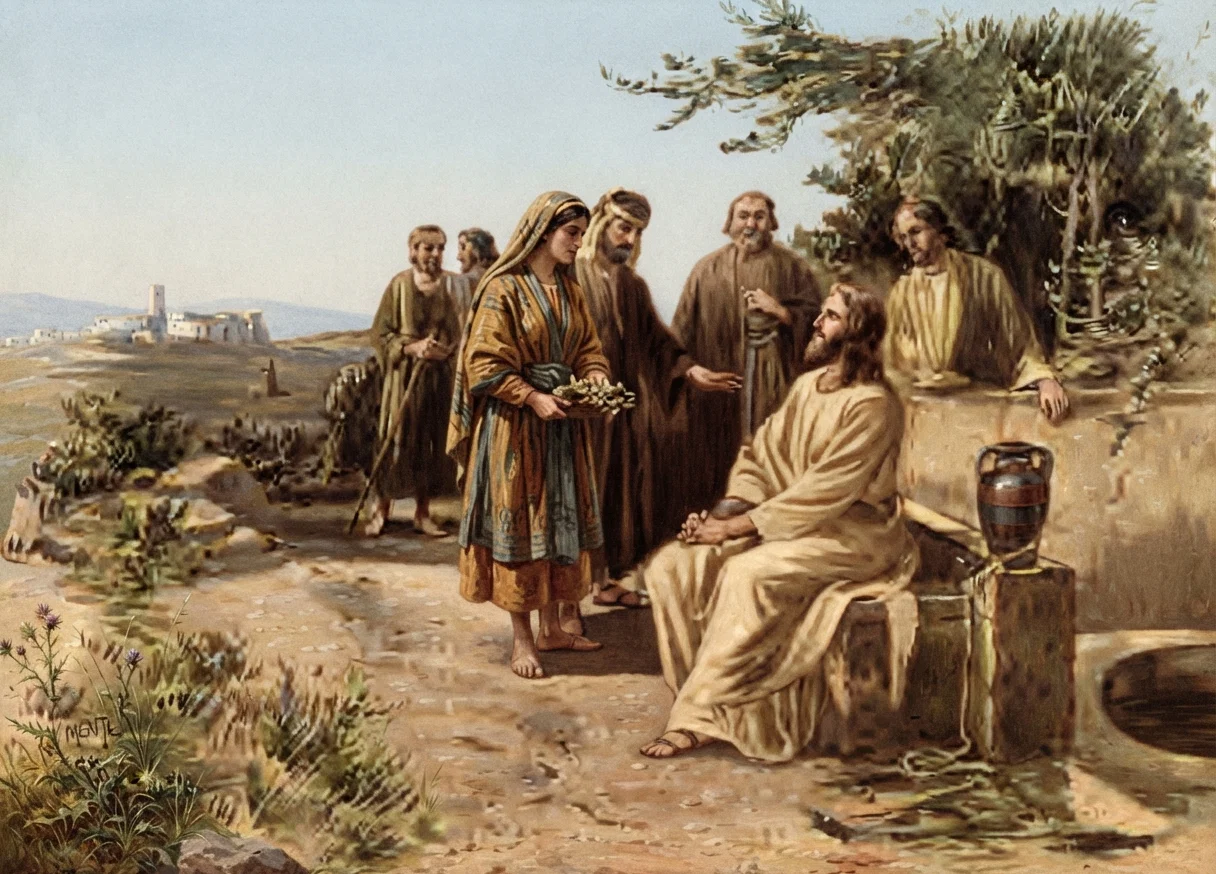
ONE of the greatest sermons ever preached was delivered to a lone woman by a well. But before the results of that meeting were finished, almost a whole village had turned to the Lord.
WE can hardly say, however, that that remarkable meeting has ceased to produce results, even to this present day, altho it was held almost two thousand years ago; for men are still reading the reports of it, and their hearts are being melted and turned to Christ.
ONLY a part of what was said in that wonderful meeting has been recorded. But enough is given to show its effect and power. It is in its simplicity a wonderfully eloquent record, and is worthy of much study. It is found in John 4:3-42, as follows:—
"He left Judea, and departed again into Galilee. And He must needs go through Samaria. Then cometh He to a city of Samaria, which is called Sychar, near to the parcel of ground that Jacob gave to his son Joseph. Now Jacob's well was there. Jesus therefore, being wearied with His journey, sat thus on the well; and it was about the sixth hour. There cometh a woman of Samaria to draw water;
"Jesus saith unto her, Give Me to drink. (For His disciples were gone away unto the city to buy meat.) Then saith the woman of Samaria unto Him, How is it that Thou, being a Jew, askest drink of me, which am a woman of Samaria? for the Jews have no dealings with the Samaritans.
"Jesus answered and said unto her, If thou knewest the gift of God, and who it is that saith to thee, Give Me to drink; thou wouldest have asked of Him, and He would have given thee living water.
"The woman saith unto Him, Sir, Thou hast nothing to draw with, and the well is deep; from whence then hast Thou that living water? Art Thou greater than our father Jacob, which gave us the well, and drank thereof himself, and his children, and his cattle?
"Jesus answered and said unto her, Whosoever drinketh of this water shall thirst again; but whosoever drinketh of the water that I shall give him shall never thirst, but the water that I shall give him shall be in him a well of water springing up into everlasting life.
By the Well of Samaria. John 4:3-42.
"The woman saith unto Him, Sir, give me this water, that I thirst not, neither come hither to draw.
"Jesus saith unto her, Go, call thy husband, and come hither.
"The woman answered and said, I have no husband.
"Jesus said unto her, Thou hast well said, I have no husband; for thou hast had five husbands; and he whom thou now hast is not thy husband; in that saidst thou truly.
"The woman saith unto Him, Sir, I perceive that Thou art a prophet. Our fathers worshiped in this mountain; and ye say, that in Jerusalem is the place where men ought to worship.
"Jesus saith unto her, Woman, believe Me, the hour cometh, when ye shall neither in this mountain, nor yet at Jerusalem, worship the Father. Ye worship ye know not what; we know what we worship; for salvation is of the Jews. But the hour cometh, and now is, when the true worshipers shall worship the Father in spirit and in truth; for the Father seeketh such to worship Him. God is a Spirit; and they that worship Him must worship Him in spirit and in truth.
"The woman saith unto Him, I know that Messias cometh, which is called Christ; when He is come, He will tell us all things.
"Jesus saith unto her, I that speak unto thee am He.
"And upon this came His disciples, and marveled that He talked with the woman; yet no man said, What seekest Thou? or, Why talkest Thou with her? The woman then left her water-pot, and went her way into the city, and saith to the men, Come, see a man, which told me all things that ever I did; is not this the Christ? Then they went out of the city, and came unto Him.
"In the meanwhile His disciples prayed Him, saying, Master, eat. But He said unto them, I have meat to eat that ye know not of. Therefore said the disciples one to another, Hath any man brought Him aught to eat? Jesus saith unto them, My meat is to do the will of Him that sent Me, and to finish His work. Say not ye, There are yet four months, and then cometh harvest? behold, I say unto you, Lift up your eyes, and look on the fields; for they are white already to harvest. And he that reapeth receiveth wages, and gathereth fruit unto life eternal; that both he that soweth and he that reapeth may rejoice together. And herein is that saying true, One soweth, and another reapeth. I sent you to reap that whereon you bestowed no labor; other men labored, and ye are entered into their labors."And many of the Samaritans of that city believed on Him for the saying of the woman, which testified, He told me all that ever I did. So when the Samaritans were come unto Him, they besought Him that He would tarry with them; and He abode there two days. And many more believed because of His own word; and said unto the woman, Now we believe, not because of thy saying; for we have heard Him ourselves, and know that this is indeed the Christ, the Saviour of the world."
JESUS was weary, says the foregoing record, and sat down upon the well of Jacob. One lone woman came to the well to draw, and He who had formed the mountains, the seas, and the rivers of water, said to her, "Give Me to drink."
JESUS was seeking for opportunities to reach hearts; He knew that the "Jews have no dealings with the Samaritans," but He was not the author of the malice that had made this condition of things, so He ignored the malicious and wicked custom, and asked her for water.
THE woman was surprised to hear a Jew ask her for a drink, so she began to question Him. This was just the thing that Jesus was seeking. He then engaged with her in earnest conversation, and step by step led her to the place where she heartily acknowledged Him as the Messiah.
THIS woman was living in sin. She was unlawfully living with a man who was not her husband. She sought to conceal this by saying to Jesus, "I have no husband." But He promptly unfolded before her the history of her life, thus showing her that she was standing in the presence of One who was able to search the innermost secret thoughts of the mind and read them as an open book.
AND yet as the woman stood in the searching presence of the One who was reading her secret life deeds to her, she did not become alarmed or affrighted and flee away. There was that inexpressible love of the Master beaming all over His countenance; there was the gentle, sympathetic music of His voice; everything in His manner showed that He was indeed the sinner's Friend. And while He could not tolerate the sin, yet He loved the sinner, and was yearning to redeem her from her evil life.
THIS woman, sinful tho she was, received the Lord and acknowledged Him as the Messiah so joyfully that she forgot her errand to the well, and, leaving her water-pot, hastened back to the city, to say to all she met, "Come, see a man, which told me all things that ever I did; is not this the Christ?"
SHE was so earnest, and had such positive faith in the message she was bearing, that "many of the Samaritans of that city believed on Him for the saying of the woman, which testified, He told me all that ever I did." And the good work did not end there; for "many more believed because of His own word; and said unto the woman, Now we believe, not because of thy saying; for we have heard Him ourselves, and know that this is indeed the Christ, the Saviour of the world."
WHAT a grand missionary this woman was! She did not wait for the ardor of her first love for Christ to cool down to the place where she could remember that she had gone to the well with a water-pot for water. O, she had found the "living water," and her physical thirst was all swallowed up in the joys of that first quaff from the fathomless fountain of sin-pardoning love!
SHE did not need to be urged; she did not need to be appointed by some board or special organization, important tho boards and organizations may be in their spheres; but she rushed away to the nearest needy fellow-sinners that she could find, not with a pitcher of water from Jacob's well, but with a heart in which had been newly placed the "well of water springing up into everlasting life."
JESUS seemed to be preaching to one—only one—woman at Jacob's well. If He had been a less skillful teacher, He might have said, The congregation is so small I think it will not pay to put forth much of an effort to-day. But He was not speaking to one only; He was giving the Gospel to a missionary that would soon call a whole city to stand as grateful learners at His feet.
THERE are grand lessons in everything that Jesus did or said. And, whatever else we may neglect, we should not fail to devotedly study the blessed Bible—the one book in all the world that is the Book of books. T.

BEFORE ANNAS AND CAIAPHAS.

THEN the band and the captain and officers of the Jews took Jesus, and bound Him, and led Him away to Annas first. In deference to his age, Annas, the head of the reigning priestly family, was recognized by the people as the high priest. His counsel was sought and carried out as the voice of God. He must first see Jesus a captive to priestly power. He must be present at the examination of the prisoner, for fear that the less-experienced Caiaphas might fail to secure the object for which they were working. His artifice, cunning, and subtlety must be used on this occasion; for at all events Christ's condemnation must be secured.
Christ was to be tried formally before the Sanhedrin, but he was subjected to a preliminary trial before Annas, that the priest might gratify his masterly spirit and show his superiority. Some delay was required in order to assemble the Sanhedrin, and, burning with a desire to hurry matters, Annas waited with ill-concealed impatience. While the members of the counsel were coming together, he asked Jesus of His disciples and His doctrine, hoping that the prisoner would say something that would give him material upon which to work. He thought that he could readily entangle Christ, and secure His condemnation, on the ground that His own words proved Him to be a disturber of the peace and a creator of insurrection.
Christ read the priest's purpose as an open book. As if reading the inmost soul of His questioner, He denied that there was between Him and His followers any secret bond or union, or that He gathered them secretly and in the darkness, to conceal His designs. "I spake openly to the world," He declared; "I ever taught in the synagogue, and in the temple, whither the Jews always resort; and in secret have I said nothing. Why askest thou Me? ask them which heard Me, what I have said unto them; behold, they know what I said."
Annas was silenced by the decision of the answer. Fearing that Christ would say something regarding his own course of action that he would prefer to keep covered up, he said nothing more to Him at this time. One of his officers, filled with wrath as he saw Annas silenced, struck Christ on the face, saying, "Answerest Thou the high priest so?" This action was unlawful; it was contrary to law to offer any one the least insult until he had been tried. But the clouds of wrath were gathering ready to burst. From that time till Christ cried out,
"It Is Finished,"
insults were offered to Him. The actions of His persecutors were those of barbarians, rather than of civilized human beings professing godliness.
To the question of the officer, Christ replied calmly, "If I have spoken evil, bear witness of the evil; but if well, why smittest thou Me?" He spoke no burning words of retaliation. His answer came from a heart sinless, patient, and gentle, that would not be provoked. In His serenity and heavenly dignity He was in that hardened, passionate throng as a star in the midnight darkness.
The whole history of Christ's life on earth is a narrative of sacrifice and suffering. Through transgression man severed his connection with God, and, as a result, he lost the image of God. He cherished the sentiments and the attributes of the apostate. Christ must take human nature, and live the law of God, in order that the one who is the originator of transgression might be unmasked. He came to this earth, and here He suffered, being tempted.

His Suffering Was Proportionate to the Perfection

of His holiness and His hatred of sin. At the hands of the beings He had created and for whom He was making an infinite sacrifice, He received every indignity. His trial by men who acted as fiends act, was to Him a perpetual sacrifice. To be surrounded by beings under the control of Satan was revolting to Him.
Christ might have stood forth in godlike dignity, and asked His persecutors, as He asked Job, "Shall he that contendeth with the Almighty instruct Him? he that reproveth God, let him answer it." "Gird up thy loins now like a man; I will demand of thee, and declare thou unto Me. Wilt thou also disannul My judgment? wilt thou condemn Me, that thou mayest be righteous?" But He who could have doomed His enemies to death, bore with their cruelty. His love for His Father, and His pledge, made from the foundation of the world, to become the sin-bearer that He might save all who came to Him in faith, induced Him to bear patiently and uncomplainingly the coarse treatment of those in whose behalf He had clothed His divinity with humanity.
The angels witnessed every movement against their loved Commander. Not long before this Christ had said to Peter: "Put up again thy sword into his place; for all they that take the sword shall perish with the sword. Thinkest thou that I can not now pray to My Father, and He shall presently give Me more than twelve legions of angels?" Why, then, thought the disciples, does He not save Himself and us? And in answer to their unspoken thought, He said, "But how then shall the Scriptures be fulfilled, that thus it must be?"

Under God the Angels Are All-Powerful.

They are mighty, and they excel in strength. On one occasion, in obedience to the command of Christ, they slew in one night one hundred and eighty-five thousand men of theAssyrian army. They can, and will, soon visit the earth with judgments. In quick succession one angel after another will pour out vials of wrath upon the inhabitants of the earth. How easily could the angels, beholding the shameful scene of the trial of Christ, have testified to their indignation by consuming the adversaries of God! But they were not commanded to do this.
From Annas the Saviour was hurried to the palace of the officiating high priest, Caiaphas. Here He was falsely accused by His persecutors, and sneeringly questioned by the priests. But while enduring this mockery of an examination, He was pierced by a keener pang than it was in the power of His enemies to inflict. Whose is that voice He hears, denying the Saviour? Is it Judas?—No; it is Peter, apparently His firmest disciple, who but a few hours before had declared that he would never deny his Lord, but if need be would go with Him to prison and to death. But now, with bitter oaths, He is saying, "I know not the Man." The abuse of the Jews can not cause Christ such pain as this denial. The cock crew as the words were spoken, and, turning, Christ looked His disciple in the face. His look expressed sorrow, yet it was full of compassion and forgiveness. Unable to bear the sight, Peter rushed from the room, but at every step he took, his Master's face, that precious, suffering, and yet compassionate face, was mirrored before him.
"And as soon as it was day, the elders of the people and the chief priests and the scribes came together, and led Him into their council, saying, Art Thou the Christ? tell us. And He said unto them, If I tell you, ye will not believe; and if I also ask you, ye will not answer Me, nor let Me go. Hereafter shall the Son of man sit on the right hand of the power of God. Then said they all, Art Thou then the Son of God? And He said unto them, Ye say that I am. And they said, What need we any further witness? for we ourselves have heard of His own mouth."

The Words of Christ Will Be Fulfilled.

By using their God-given faculties to cause suffering and distress to the Son of God, the priests and rulers decided their eternal destiny. They showed that they had chosen to stand on the side of the great apostate. When Christ comes the second time, not as a prisoner surrounded by a rabble will they see Him. They will see Him as heaven's King, surrounded by a fitting body-guard. Christ will come in His own glory, in the glory of His Father, and in the glory of the holy angels. Ten thousand times ten thousand, and thousands of thousands of angels, the beautiful and triumphant sons of God, possessing surpassing loveliness and glory, will escort Him on His way. Then the priests and rulers will remember distinctly the scene in the judgment-hall. Every circumstance will appear before them as if written in letters of fire. Then the whole world will know and understand. They will realize who and what they, poor, feeble, finite human beings, have been warring against.
"And the men that held Jesus mocked Him, and smote Him. And when they had blindfolded Him, they struck Him on the face, and asked Him, saying, Prophesy, who is it that smote Thee? And many other things blasphemously spake they against Him."
This is a representation of what priests and rulers will do when Satan controls them. Every soul in his army he leads against good. It was necessary that Christ should suffer this treatment, that he who was once an angel in the heavenly courts, but who apostatized, and who was now endeavoring to clothe his deformity with the garments of an angel of light, might be unmasked, and his true character be revealed through the men he had inspired.
After reading this history, will any of the people of God confederate with the powers of darkness, prostituting their God-given faculties to Satan's work? From this lesson all may learn

What Little Trust Humanity Can Place in Humanity,

even in those who fill the highest positions of trust. These things are recorded for the benefit of all who shall be called upon to suffer similar scorn and derision for Christ's sake. God's people will suffer because of the delusion that will come upon men's minds. Because some conscientiously differ with them on subjects of Bible truth, men will repeat the actions which were done to Christ. But none are to retaliate, or to feel that God has left them to suffer when He might deliver them. "If ye were of the world," Christ declared, "the world would love his own, but because ye are not of the world, but I have chosen you out of the world, therefore the world hateth you. Remember the word that I said unto you, The servant is not greater than his lord. If they have persecuted Me, they will also persecute you; if they have kept My saying, they will keep yours also. But all these things will they do unto you for My name's sake, because they know not Him that sent Me."
All those who in our day turn the truth of God into a lie by their human traditions, will surely set up their human laws to counteract the laws of God. These laws will be made as vigorous as ever the self-righteous Pharisees made their traditions. Men will strive to disguise their ungodly deeds and want of piety by making laws to compel the conscience of others, and in their false religious zeal to enforce these laws they will oppress their fellow-men.
History will be, and even now is being, repeated. The same power from beneath that worked in Christ's day is making itself known. Oppressive laws, which have not in them a particle of the Spirit of God, are being enacted. And the less men submit themselves in obedience to the law of God, the more zealously will they try to enforce human laws. They will teach for doctrine the commandments of men.
Our chief interest should be to seek for the truth as for hidden treasure, that we may live by every word that proceedeth out of the mouth of God. We are to consider carefully how to build, for human nature is a cruel tyrant when not under the control of God's Spirit.

Our Part Is to Follow Our Saviour in Obedience

to all His commandments. We need daily to understand every lesson in the life of Christ, taking heed lest we allow the world, with its forms and practises, its laws and standards, to be our criterion, and draw us away from our Saviour. Let those who love God keep the example of Christ ever before them. Let them remember the many lessons He gave to those whom He had chosen as His representatives. He taught them not to retaliate or resist oppression. In His name they were to approach His Father and their Father, and pour out their sorrows and griefs to Him. He would answer them; for He would be touched with the feeling of their infirmities.
"Enoch also, the seventh from Adam, prophesied of these, saying, Behold, the Lord cometh with ten thousand of His saints, to execute judgment upon all, and to convince all that are ungodly among them of all their ungodly deeds which they have ungodly committed, and of all their hard speeches which ungodly sinners have spoken against Him. These are murmurers, complainers, walking after their own lusts; and their mouth speaketh great swelling words, having men's person in admiration because of advantage. But, beloved, remember ye the words which were spoken before of the apostles of our Lord Jesus Christ; how that they told you there should be mockers in the last time, who should walk after their own ungodly lusts. These be they who separate themselves, sensual, having not the Spirit. But ye, beloved, building up yourselves on your most holy faith, praying in the Holy Ghost, keep yourselves in the love of God, looking for the mercy of our Lord Jesus Christ unto eternal life."
MRS. E. G. WHITE.

THE BLOOD OF GOD'S EVERLASTING COVENANT.

CHRIST is "the Lamb slain from the foundation of the world." He brought Divinity from the courts of glory into fallen humanity, that fallen humanity might take hold upon Divinity and thus be a partaker of God's everlasting covenant. The blood of Christ, offered in the Garden of Gethsemane, shed upon the cross, became the eternal pledge of the covenant to the Father and before the whole universe of God. The price of man's salvation cost nothing less than this. In humanity He wove out a garment of righteousness without a thread of selfishness; and He offers this garment freely to us in the everlasting covenant. In it lies the assurance of perfecting every soul, and making righteous every one who will accept Christ. "Now the God of peace, that brought again from the dead our Lord Jesus, that great Shepherd of the sheep, through the blood of the everlasting covenant, make you perfect in every good work to do His will, working in you that which is well-pleasing in His sight, through Jesus Christ; to whom be glory forever and ever. Amen." Heb. 13:20, 21.
There is virtue in the blood of Christ to remove every stain of sin, to cleanse the conscience from dead works, and connect the soul with God. "For if the blood of bulls and of goats, and the ashes of an heifer sprinkling the unclean, sanctifieth to the purifying of the flesh; how much more shall the blood of Christ, who through the eternal Spirit offered Himself without spot to God, purge your conscience from dead works to serve the living God?" Heb. 9:13, 14. It brings a restoration of the image of God in man, and restores all that was lost by sin. The prophet caught a view of this as he saw Christ riding into Jerusalem for the last time, and broke out in these words: "Rejoice greatly, O daughter of Zion; shout, O daughter of Jerusalem; behold, thy King cometh unto thee; He is just, and having salvation; lowly, and riding upon an ass, and upon a colt the foal of an ass. . . . He shall speak peace unto the heathen; and His dominion shall be from sea even to sea, and from the river even to the ends of the earth. As for Thee also, by the blood of Thy covenant I have sent forth thy prisoners out of the pit wherein is no water." Zech. 9:9-11.
The men of God of all ages were familiar with this truth. Noah was righteous before God. To him God said: "Behold, I establish My covenant with you, and with your seed after you; and with every living creature that is with you, of the fowl, of the cattle, and of every beast of the earth with you." "I may remember the everlasting covenant between God and every living creature of all flesh that is upon the earth." Gen. 9:9, 10, 16. Even the land itself can not be cleansed of the blood that is shed therein save by the blood of him that shed it. It was Christ's blood in our stead in the everlasting covenant that not only purchased the salvation of man, but a restoration of all that was lost by Adam. See Num. 35:33, 34; Ps. 104:25-31; Rom. 8:18, 24; Ps. 103:17, 18. These are some of the blessings and promises contained in God's everlasting covenant. Upon man can be conferred no greater honor than the privilege of entering into this covenant which God established withNoah, Abraham, Isaac, Jacob, David; and their righteous seed are sealed with the blood of Christ. It is the privilege purchased by the precious blood of our Saviour for every son and daughter of Adam.
When Christ took upon Himself flesh and blood, He became "near of kin unto us," one that hath a right to redeem. In order to redeem, His genealogy must have been of the pure stock, and the prince of this world have nothing in Him. This relationship He has never laid down. At the right hand of God, in the heavenly courts, we have an elder Brother, who still bears in His body the marks of the crucifixion. "Sing, O heavens; and be joyful, O earth; and break forth into singing, O mountains; for the Lord hath comforted His people, and will have mercy upon His afflicted. But Zion said, The Lord hath forsaken me, and my Lord hath forgotten me. Can a woman forget her sucking child, that she should not have compassion on the son of her womb? yea, they may forget, yet will I not forget thee. Behold, I have graven thee upon the palms of My hands; thy walls are continually before Me." Isa. 49:14-16. Can it be true that "He hath made with me [even me] an everlasting covenant, ordered in all things, and sure; for this is all my salvation, and all my desire"? The experience of such an one will "be as the light of the morning, when the sun riseth, even a morning without clouds; as the tender grass springing out of the earth by clear shining after rain." 2 Sam. 23:4, 5.
S. N. HASKELL.

THE GOSPEL OF FORCE IS OF MEN NOT OF GOD.

JESUS CHRIST came unto His own, and His own received Him not. Neither did He use force to compel them. The nature of His earthly work was fivefold. In Isaiah He says, "The Spirit of the Lord God is upon Me; because the Lord hath anointed Me to preach good tidings unto the meek; He hath sent Me to bind up the broken-hearted, to proclaim liberty to the captives, and the opening of the prison to them that are bound." This He faithfully did for three and a half years, without once appealing to the State for protection, notwithstanding the whole pagan system and Jewish theocracy were against Him; and if there was ever a time when deception, intrigue, and the clamor for innocent blood would justify the use of force, it was in Gethsemane, on that memorable night of His betrayal. But hear His words to Peter at this time, "Put up again thy sword into his place; for all they that take the sword shall perish with the sword." Christ was a living example of the principle, "Render therefore unto Caesar the things which be Caesar's, and unto God the things which be God's." He is the Christian's perfect pattern, our example in all things. The only power that God can use and be God, or that He has ever delegated to any one, is love. The power of force tends to murder, and this is of Satan. John 8:44. Whether it be by man, organization, or nation, whenever and wherever the blade of steel is used for the spread of the Gospel and the protection of the cause of Christ, it has and will prove a failure; and, tho those who resort to this method may be zealous and clamorous, as was Peter, in vowing allegiance to the Master's cause, yet the record stands to all eternity—that night "Peter followed afar off."
I would that there were more Pauls to-day who, through a daily death, could say, "I determined not to know anything among you, save Jesus Christ, and Him crucified." And, what was more beautiful, he lived it, and so became not only a noted preacher, but an instructor, not alone to old, but to the young! Hear his advice to Timothy, "Preach the Word; be instant in season, out of season." What advice! What an instructor! What qualifications Paul, were he living to-day, would have for secretary of the Epworth League of the great city of New York, we do not presume to say, but feel certain that he would not seek to tickle President McKinley's ears as they may have been tickled at the Ocean Grove camp-meeting on August 27, when a visit from the President called forth the following remarks from Dr. A. E. Schell, of New York, corresponding secretary of the Epworth League.
"The church militant salutes the nation militant and recognizes that their mission and duty is to-day identical,—the civilization and evangelization of the world."
He further says:—
"There are more than one million young men in the Epworth League alone. No Alexander or Caesar ever had an army like that. We aspire to be the tenth legion for any campaign."
These remarks need no comment. The religious decay and moral decline are too apparent. These misguided souls have a zeal that is not according to knowledge. The wielding of the sword in behalf of religion is an old principle, but it is of heathen origin. The Romans fought to establish their religion, and Gibbons, in his "History of Rome," speaking of the conquered, says, "To resist was fatal, and to fly was impossible." Constantine, who, in A.D. 311, secured the support of the church by espousing its cause, successfully used the sword to extend his new belief; but his whole career was that of a hypocritical despot, who murdered many, even of his own household; and at the time of his death, in A.D. 337, his hypocrisy had been so subtle that both Christians and pagans each claimed him as their convert and leader.
Clovis, king of the Franks, secured the title of "Most Holy King," because, in a hard-pressed battle with the Allemanni, he, as a last resort, invoked the blessing of his wife's god. He gained the battle, and compelled thousands of his army to be baptized, and with his Christian army stoutly defended the new faith.
The rapid spread of Mohammedanism was due to the undaunted courage of its followers, inspired by their aspiring leaders. The favorite battle-cry of one of these was, "Fight, fight, paradise, paradise." We look with contempt on the work of the Crusaders, in which hundreds of thousands of the youth of Europe perished, and which almost ruined the country, because they tried to extend God's kingdom by the sword. Yet in this enlightened age Mr. Schell says, "He [the President] has our prayers to-day; he can have our money tomorrow; and the whole million will enlist the day after if we are needed." Why?—Because the "mission and duty of the Epworth League and the President are identical to-day,—the civilization and evangelization of the world."
O that we had men like Roger Williams, who could define the rights of the State, and the privileges of the Christian, but, alas, his followers are drilling soldiers right in the church! Why does the church need a brigade when the Lord says, "Not by might, nor by power, but by My Spirit, saith the Lord of hosts" (Zech. 4: 6)? Where are the followers of the humble Wesley, the saintly Fletcher, and the eloquent Whitefield? Have they finished the Gospel work, so that from henceforth their attention must be turned to national affairs? Listen: "Humanity, honesty, virtue, reason, liberty, civilization, and Christianity demand the expulsion of this last consummate specimen of the criminal cruelties of a Latin civilization from the island whose shores are touched by the same ideas that wash the coast of this republic." From the report of the committee on national affairs rendered yesterday at the New York Methodist Conference, N. Y. Journal, April 6, 1898.
Reader, be not deceived. The voice of God comes not in the roar of booming cannon, the rattling of musketry, nor the thundering of America's artillery, but it was the still small voice that caused Elijah to cover his head; and every one may hear that same voice, "Stand still, and know that I am the Lord."
W. E. HUBBARD. 77 De Sales Place, Brooklyn, N. Y.
Continue reading: NECESSITY OF BEING "BORN AGAIN."