THE Lord blesses some men for the sake of others. He blessed Isaac for Abraham's sake. He sent prosperity to the house of Potiphar for the sake of Joseph. His blessing was on all the land of Egypt because of his servant Joseph. There was prosperity in Babylon for the sake of Daniel. All on board the ship which was wrecked in the Mediterranean Sea were delivered because Paul was among them. It is a good thing to have a good man on board in time of trouble. One man in the community who lives near to God is a great blessing to his neighbors. One good man in a city will bring down the blessing of heaven on all the people. The Lord told Abraham that he would spare Sodom if he could find ten righteous men in it. Men and women of God are the salt of the earth. Blessed is the man who lives so near to God as to bring a blessing to all those who are about him.—Christian Advocate.
In Egypt and Syria
By L. R. Conradi
(Concluded)
L. R. CONRADI
HAIFA is a growing city of about fourteen thousand inhabitants. It is probably one of the cleanest cities in all Turkey. It surely seems to have a promising future; for its harbor is much better than that of Jaffa, and there is now in process of construction a railroad from here to Mȗzerib, where it will connect with the line to Damascus, and will thus be a natural highway to Damascus, to Jerusalem, and to the Jordan Valley.
Leaving Haifa in the afternoon of Tuesday, we followed this railway quite a distance, going up the valley of the Kishon. See 1 Kings 18:40. We at length crossed the stream, and entered the hills of Galilee. As there is quite a good wagon road, we made the twenty-four miles from Haifa to Nazareth in about five hours, reaching the latter place at nine in the evening.
Nazareth lies in the midst of hills. It is not mentioned in the Old Testament, and in the time of Christ it was an insignificant place. To-day there are many missions here, and the city is rapidly growing. It has about twelve thousand inhabitants.
After midnight we left Nazareth, pressing on toward Tiberias. We soon passed through Cana, where the marriage supper was, and at about eight o’clock in the morning we were able to look down upon the surface of the beautiful Sea of Gennesaret, which lies about twenty miles from Nazareth. My small instrument which measures altitudes, showed that we were nine hundred feet above the level of the Mediterranean. However, we rapidly descended until we were six hundred and fifty feet below the sea-level, and had reached Tiberias, which lies upon the shore of the Sea of Galilee. This town to-day has about four thousand inhabitants, two thirds of whom are Jews. It is still surrounded by walls. There are many ruins around the city, testifying of its ancient greatness. As to the lake, its greatest depth is one hundred and fifty feet. It has the shape of an irregular oval. In its widest part it is six miles across, while its greatest length is fourteen miles. In the afternoon we took a bath in the hot springs one mile south of the city. The water here gushes out of the mountain so hot that one can not bear his hand in it. In the evening we took a boat ride on the lake. As we came down to the city in the morning, we passed by a place on the mountainside that seemed admirably adapted to accommodate the hundreds who were present at the time the sermon on the mount was spoken. The lake, the city,
and the surrounding villages were in plain sight. Away in the distance, up on the mountain, we could see Safed. In this rare atmosphere, a good, strong voice could be heard by thousands of people, without difficulty.
JAFFA
Here we had to change our method of travel, as there is no good wagon road to the south. Brethren Krum and Zarub decided to go north via Safed, to visit some interested persons, and thus they would return to Beirut through the mountains; while the other five of us bargained with three mule drivers for our transportation to Jerusalem. As these men had a cargo of fish, we secured quite reasonable figures from them. To mount the broad Arabic stirrup saddle, was a new experience to us, as well as was also the attempt to direct a mule without a bridle. Thus far we had been favored with wonderfully dry roads for this season of the year. Had it not been for this, we certainly could not have carried so many in the wagon.
During the night it had rained, and it was still threatening weather as we started out in the morning, about five o’clock. We ascended the mountains again, but soon turned toward the south, past Mount Tabor. This mountain has a round top. In Ps. 89:12 it is mentioned in connection with Mount Hermon, while tradition calls it the mount of the transfiguration. We passed near the village of Endor, and then crossed a mountain range, and descended to the Plain of Esdraelon, going to Jennin, leaving the mountains of Gilboa to our left. We were in the saddle thirteen hours, breaking our journey for only a few minutes. Our mules were sure-footed creatures, and did well ascending and descending the steeps and the rocky mountainsides. While we were on the mountain range, suddenly we found ourselves in the midst of a great storm, with lightning and thunder and wind and hail and rain. In a few minutes the ground was white with large hailstones. Our mules refused to face the storm. Two of them turned their backs toward the stones of ice, and ran away. The fury of the storm reminded us of Job’s reference to the commotion of the heavens, in the thirty-eighth chapter, beginning with the twenty-second verse.
Between Tiberias and Jennin there were very few villages or towns. The latter place is a small Arabic settlement, with only eighteen hundred inhabitants. It is over thirty-five miles from Tiberias. It has only one hotel, a truly Arabic building, and no family lives there. It is supposed that the traveler will furnish his own bed, as well as everything else. It offers shelter only. It is without stoves or the comforts of hotels as found in European cities. But wet as we were, and tired and cold and hungry, we were only too thankful to reach shelter and a place of rest. We let the supplied blankets serve us as fire to warm us during the night.
Next morning at eight we continued our journey over the mountains of Samaria. I noticed that at the least, three times we crossed mountain passes as high as two thousand or two thousand five hundred feet, and one does not wonder why the Turks have not thus far completed a wagon road through this part of the land. It is sparsely settled, and the country is very rough. In the forenoon we passed the village of Taluza. This is said to be the site of ancient Tirzah. See 1 Kings 16:8. It was for a time the capital of the northern kingdom. Not far from there we could see the tops of Ebal and Gerizim, and finally, Nablus, the old Shechem. We reached this city about four o’clock Friday afternoon. It is a growing place, and has about twenty-four thousand inhabitants. Its people are still noted for their quarrelsomeness. There are a number of mosques in the town. The streets inside are narrow, as are the streets in Jerusalem. As large as the city is, there is no hotel. The Catholic13
monks keep a sort of lodging-house. We went to them, but they asked one dollar for each of us, should we lodge with them and take breakfast, and then they demanded that we leave Sabbath morning, as they were expecting a party of twenty that had been announced to arrive at that time. As we had passed by the Church of England hospital on entering the town, and the doctor in charge had kindly greeted us, we determined to see if we might not stay with them over Sabbath. Upon learning that we were American missionaries, they made room for Brethren Dail, Jespersson, and Hoerner in one of the hospital buildings, and the doctor himself opened his house to Elder Wakeham and me.
MOUNT OF OLIVES
The doctor had been a missionary in Persia for several years, and he was pleased to meet those who had been acquainted with his home language and country, and were interested in missionary work. We much enjoyed our stay, and above all, the kind hospitality of these friends. Sabbath morning we visited their hospital, and found it contains about forty patients. They are certainly doing a good work for humanity. The hospital is quite new. They also have a church building here. They would receive no compensation for their kindness.
We were now ready to ascend Mount Gerizim, where we saw the ruins of the old Samaritan temple, and could look down upon Jacob’s well and Joseph’s tomb, and see the village of Sichar. We had a splendid view of the mountains of Samaria, and could see snow-covered Lebanon far to the north. Ebal is somewhat higher than Gerizim, but by the time we had visited the well which Jacob dug, and the tomb where lay the bones of Joseph, and the village of Sichar, the day was far spent. Jacob’s well now belongs to the Greeks, and it is surrounded by a modern wall. It is about seventy feet deep, and has a diameter of eight feet, and is walled almost to the top. But there is no water in it. This seemed to us the more remarkable because Nablus is well provided with streams from the mountainside, and
right near this well there is a superabundance of this water running through a small aqueduct. We were asked to write our names in the register, and we felt free to write these words: “While Jacob’s well is dry, the fountain of God is full of water.” Half a mile distant is Joseph’s tomb (Joshua 24:32); the building here is modern. Sichar is now called Askar, and it is probably a mile distant from Jacob’s well, at the foot of Mount Ebal.
On Sabbath Brother Jespersson had an attack of fever. We were glad he had such good quarters at the hospital, and yet we were very anxious to press on to Jerusalem. However, our drivers said they did not consider the road safe enough to start out that night, but would wait until about three o’clock in the morning.
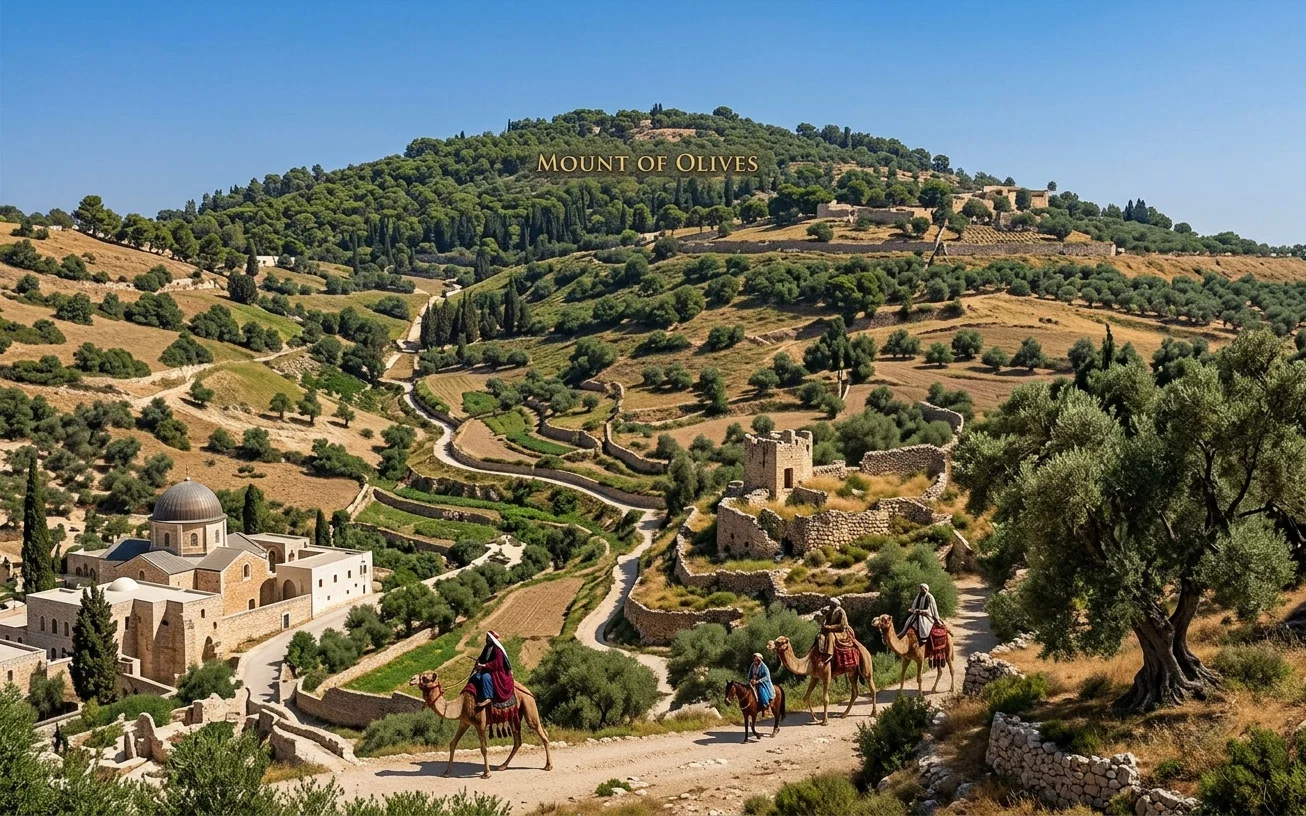
From Nablus south there is a good wagon road for about ten miles, and the next five miles are unfinished, over the worst and steepest mountain passes, and then on to Jerusalem, about twenty-three miles further, is also a good road. When this road is completed, it will make the journey from Samaria to Jerusalem comparatively easy; then it must not be forgotten that there is now a good wagon road from Nablus to Jaffa and Haifa, and that the railroad is in process of construction from Haifa to the Jordan Valley. From Nablus to Jerusalem we crossed still higher hills, reaching an elevation of two thousand seven hundred feet. We had a very good view of Shiloh from our mountain pass; there remain but ruins of that ancient place. As we come into the territory of Ephraim, we find it truly a lovely country, as the mountainsides are covered with large olive groves; but when we pass Bethel and go into Judea, the mountain slopes become very stony. When we reached Er-Ram, or ancient Ramah, as our mules were very tired, we were glad to abandon them for a cheap ride by wagon to Jerusalem, whose towers were already in sight. And when we reached the health home in Jerusalem, Sunday evening about six o’clock, we were very glad for a place of rest.
We could notice a difference in the temperature of the highlands of Judea and the lowlands of the country of the Philistines and Jaffa. The air was chilly, especially in the evening. This last winter they had such a heavy snowfall in Jerusalem that quite a number of the olive branches were broken.
We spent several days in the holy city, counseling with reference to the health home there, and also visiting the temple site. Quite a number of buildings have been erected in Jerusalem since my first visit, in 1901. In order to visit the temple site, one goes to the consul of his country, and secures the kawass, or the official guard of the embassy. He in turn engages the services of a Turkish soldier, and with this protection, one is free to visit the ancient temple site, and the Mohammedan mosques erected there. I was surprised at the great space in the temple place, and still more was I impressed with the Mosque of Omar. While the Catholics and the Greeks and the Protestants vie with one another in having the finest churches and monasteries, the Mohammedans are surely still in the lead. They consider the Mosque of Omar second only to that found in Mecca. The mosque stands on an irregular platform about ten feet high, to which steps lead up from all four sides of the compass. The vast temple court is planted with quite a number of cypress and olive trees. The mosque is a large octagon. The lower part is of the finest marble, and the upper part is decorated with porcelain tiles, every one of which was specially and separately made, and many of them contain inscriptions from the Koran. The center of the structure is occupied by the large rock upon which Abraham offered up Isaac. As old Jerusalem is covered by a threefold layer of ruins and debris, this rock and the rock in the Church of the Holy Sepulcher are the only places where one can see the real stones of the actual surface of ancient Jerusalem. Of course the Mohammedans can show you in this temple and upon this rock the places where David and Solomon and Mohammed and Abraham anciently prayed. They believe that the judgment will be held here in the last days, and that God will place his throne here on this rock, and therefore Mohammed says that a prayer offered on this rock is better than a thousand prayers offered elsewhere. He himself had prayed in the cave below the rock, and then his body made a round hole in the ceiling of the cavern, which is shown to-day; as the rock wanted to cling to Mohammed, as he ascended to heaven, it was necessary for the angel Gabriel to seize hold of it with his hands, and keep the massive rock in its place: the imprints of Gabriel’s hands are still to be seen! Ere we left the mosque, we were shown a jasper stone, in which Mohammed had placed nineteen spikes of a peculiar make—there are no other such nails in existence. They are miraculously taken out from time to time; and when they are all pulled, then the end of the14
world will come. Of the nineteen, only three and one half now remain, so the dervish told us, and therefore the end of the world is near, according to their belief.
Farther to the south is the Mosque of L-Aksa. It is two hundred and seventy feet long, and one hundred and seventy feet wide. Below there is really another mosque, and away in the south-eastern corner, they even show you the stone cradle of Christ, and a little farther on, to the right, are Solomon’s stables. Underneath the pavement of the temple place, there are many cisterns. Off to the eastern side, is the Golden Gate, which has been closed from ancient times. The Arabs walled this up, and there is a tradition of the Moslems that some Friday a Christian conqueror will enter this gate, and then the Mohammedan power in Jerusalem will fall.
To the north of the temple is the Pool of Bethesda. This is in the hands of the Roman Catholics. They have excavated the largest part of it, and have also erected a seminary here for the Greek Catholics. The monk in charge of the pool showed us their small, but very valuable museum. Here they have many things that were dug up while they were making their excavations. Among them is a genuine talent-weight. It is a stone that weighs 42 kilo or 84 pounds.
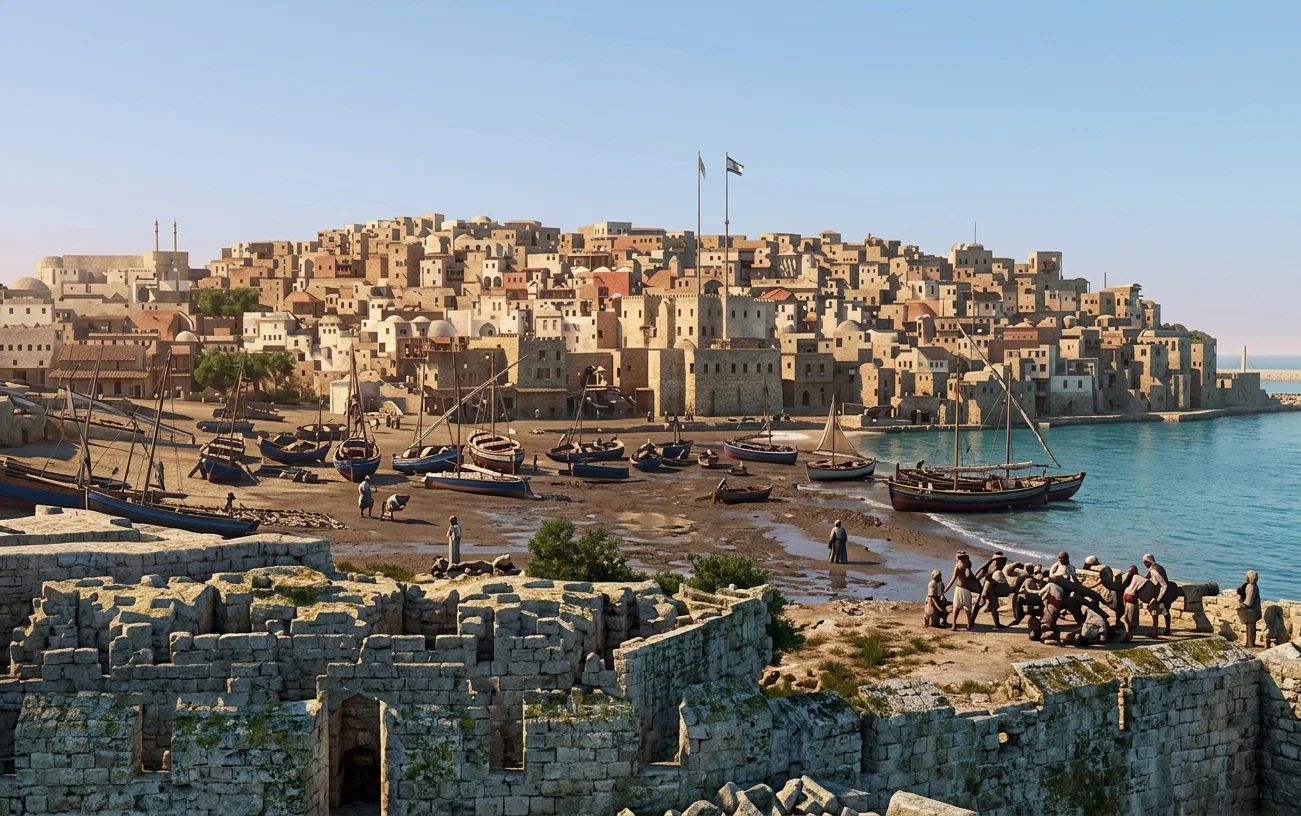
Wednesday morning we left Jerusalem by train for Jaffa, passing the cave where Samson probably lived, and from which he came forth to trouble the Philistines.
We had a few more meetings in Jaffa. We were glad when we learned that on Friday we could get a Russian steamer from Jaffa to Port Said. We hoped the sea would be calm enough to allow our embarking, and sure enough, we were so favored that we were able to make the journey during the night. We are very much pleased that the truth has gained a foothold in Palestine, and while as yet no great things have been accomplished there, yet we are happy that God has set his seal to our efforts, and we are more and more hopeful for the future. While the whole world is seeking to gain a foothold in the holy land, we surely ought to do our best, not only to warn those who sit in darkness in this dark land, but also to help the many pilgrims who come here from all parts of the earth.
Cuba
By G. H. Baber
G. H. BABER
With a prayerful desire not to deceive any one in regard to the merits or demerits of Cuba, I will give the readers of the REVIEW AND HERALD a few facts concerning this famous island. History states that it was discovered by Christopher Columbus, Oct. 28, 1492. He landed in or near the present bay of Nuevitas, on the north coast of the province of Puerto Principe, and gave it the name of Juana, in honor of Prince John. Later it was called Fernandina, then Ave Maria, and finally it took the name Cuba, which was given it by the natives before the time of Columbus.
In 1511, Diego Columbus, a son of Christopher, and Diego Velasquez, with three hundred men, landed at Baracoa, on the northeast coast, and began the first permanent settlement of the island. It is well to note that in age it has advantage over the United States of about one hundred years.
The early settlers of the island engaged in cattle raising, also in the culture of tobacco and sugar-cane. These three enterprises are still the principal ones of the island. The soil and the climate seem to be especially adapted to them. But these, with every other enterprise, were almost entirely destroyed by the almost constant wars carried on by the revolutionists against Spain. It would be difficult to describe the desolation of the country brought about by the policy of destruction carried on by both sides in the struggle. But now, thanks to the strong arm of the United States, there are appearances of a new life. Many sugar-mills are being started up again, so that, during the present year they hope to produce about one million tons of sugar.
Cattle are being shipped into the island from Colombia and Mexico, and in a very short time they bear a living testimony to the nutritious quality of the grasses with which the island is largely covered. The provinces of Santa Clara and Puerto Principe are especially adapted to cattle-raising.
The province of Pinar del Rio is the famous tobacco-producing region; however, Habana, Santa Clara, and Santiago also produce a commercial quality of this indigenous weed. The tobacco industry is second in importance only to that of sugar. The plant went to Europe through Spain, but the habit of smoking it was introduced into England by Ralph Lane, the first governor of Virginia. How much of human suffering that introduction will be responsible for, statistics will never show.
The most serious impediment to the development of the island is the lack of good roads. During the rainy season it is almost impossible to travel the roads, except on horseback, and the lack of bridges makes this dangerous.
The climate seems to be surpassingly fine. The thermometer rarely rises higher than ninety degrees. The highest on record in Habana is one hundred and six tenths degrees, and the lowest forty-nine and six tenths degrees. The mean annual temperature is seventy-seven degrees. “The range of temperature between the mean of the hottest month and that of the coldest month is from eighty-two degrees to seventy-one degrees, or only eleven degrees.” A constant breeze makes the summer months less oppressive than they are in the United States. The mean annual rainfall is about fifty-two inches.
There are what they call the wet and dry seasons. The former begins with May, and continues until October, during which time about two thirds of the annual rainfall is received. Scarcely so much as a month ever passes without rain.
With good soil and such a climate, one would naturally expect a great variety of vegetation. There are said to be more than 3,350 different kinds of native plants in the island. There are many kinds of precious wood, such as the mahogany, ebony, cedar, walnut, ceiba, lignum-vitae, pal, etc. About thirteen million acres,—nearly half of the entire area,—are still clothed with the original forest.
There are many other items of interest which will be considered in future articles.
To those who would like to make investments with a view to living here, it will probably be sufficient for the present to say that the land can be bought at very low rates only in large tracts. If any desire to correspond with me, address me, enclosing postage, until August 1, as follows: Calle C, entre 21 y 23, Vedado, Habana, Cuba.
Mission Notes
THE Rhenish Missionary Society, after sixteen years of hard labor and sacrifices of life and property in German New Guinea, at last rejoices in the baptism, at Bogadjim Station, of the “first fruits” among the Papuans.
Are You a Jesus Man?
IN Korea a correspondent of the London Daily Mail, following the Japanese army, was astonished more than once by seeing villagers come smiling forth from their hiding places to ask him, “Are you a Jesus man?” This childish belief that safety and good-will is the atmosphere surrounding the “Jesus man” is a testimony to the character of the Christians whom the Korean villagers have known.
A Captain’s New Testament
A JAPANESE pastor recently visited his brother, whom he had not seen for a number of years, and who was a captain in the army. The pastor with some inward trepidation presented his brother with a New Testament, and urged him to study it. The captain laughed, and going to a drawer in his desk, took out a little book which he handed to the evangelical brother. It was a New Testament, well worn with reading! Neither knew the other's views on religion.
Telugu Baptist Church Organized in Natal
FAMINE four years ago drove Telugus from India to seek employment in Natal, South Africa. The Telugu Christians connected with the American Baptist Mission in India then sent a missionary of their own to labor among the emigrants. The result is that the first Telugu Baptist church of Kearsney, Natal, has recently been organized. The faith of those who stood by the “lone star” mission in its early days is certainly justified through its children’s children.
Mississippi
By H. G. Thurston
ON Sabbath, July 2, five souls were buried by baptism at Laurel, and one week later, July 9, five others were baptized at Ellisville. On the next Sunday these and others were organized into a church—seventeen in all. Some others expect to unite later; this will increase the number to more than twenty. We praise God to see his great truth gaining converts in Mississippi.
It seems as though the work goes rather slowly, yet we are grateful for the success already given, and it is our only desire to live and work for souls as they who must give an account.
Elders Owen and Blake will soon engage in tent work, and we pray they may win many souls. Though I expect to be from home for some time, visiting our highly favored people in the north to interest them in the Huntsville school, my address will be Meridian, Miss. I hope to return home in September.
H. G. THURSTON.
Northeastern Jamaica
By Hubert Fletcher
“Thy people shall be willing in the day of thy power.”
THE word of the Lord is literally fulfilled here in this island. Although we are still suffering from the effects of the recent hurricane, the work of the third angel's message has not been hindered. It is true that we are somewhat financially embarrassed; for the banana trade (which is the chief revenue of our island) has not yet revived, and crops in general have not given a good yield. But our people have learned the lessons, and are putting their shoulders to the wheel. Their hearts are willing; for we are in the “day of his power,” and the grand charge for victory is made. Like Gideon's band, we are breaking our pitchers so that the lights may shine forth; and with our eyes fixed on the enemy, the Captain of the Lord's host going before, we are sure of victory.
Two of the churches that suffered from the hurricane are rebuilt. The Moore Park Church was re-dedicated on Sunday, May 1. It was a quiet and interested congregation that listened to the address of Elder J. A. Strickland. The house is a neat one. Many exulted when they saw the former building destroyed, but on the same spot now stands a neater house, an evidence that the eternal truths of God can not be destroyed, but will endure forever.
We are building another church at Hart Hill. Two weeks ago we started the building. It is now raised, and we are awaiting the covering. Work is also going forward on the Port Antonio and Sherwood Forest buildings. Encouraging reports of the progress of the work are coming from all parts of the conference.
My heart rejoices as I see the grand third angel's message plowing its course, majestically and calmly along. She has been through fierce storms of trial and persecution, of doubt and ridicule. She is now nearing her haven of rest, passing through the last fierce conflict; but still she glides along, bearing safely all who will board her, into the quiet haven of peace.
HUBERT FLETCHER.
Africa
By Minnie A. Chaney
BLOEMFONTEIN, ORANGE RIVER COLONY.—We are here on our way to Basutoland, where we have been appointed to take charge of the work. We stopped here to spend a few weeks canvassing, the proceeds of which are to be used for the Basuto mission. At Harrismith the Lord was truly with us during our stay. It is only a small place of about three thousand inhabitants. I was just getting over a severe illness when I went there, and could not put in much time. All told, I canvassed sixty-three and one-half hours, including calls and visits, spending some little time doing personal work, and seeking the Lord with souls. During this time I took one hundred and twenty-five orders for books, besides fifty-four dollars' worth of helps, and sold one hundred and fifty-four papers. I delivered one hundred and seventy-three books, including helps. The value of these, including the papers, was £32 13s 3d, or about one hundred and sixty dollars. In addition to these, I sold a dozen or more books from our private library, and gave away a number of tracts and papers. In the six weeks Mr. Chaney sold about six hundred and thirteen dollars' worth of books. This was our first effort as canvassers. We had no one to instruct us but the Lord, but he is the very best we could have.
From Harrismith we were called to Maritzburg, to attend the annual meeting of the Natal-Transvaal and South African Union Conference. While there, Mr. Chaney finished transcribing the translation of “Steps to Christ” into the Zulu. As our health was not good, we went to Plumstead near Cape Town for the summer. Here we found a delightful resting-place, where it was cool most of the time. We were much benefited in health while there; and as we are now going to a more healthful climate than where we formerly were, we hope not only to remain in better health, but to keep on improving. We are glad to accept the call to Basutoland, and earnestly hope to do a definite work for the Lord in winning souls for him there. Pray for us; we need your prayers.
MINNIE A. CHANEY.
En Route to South America
By Frank H. Westphal
We have almost finished our journey to England, and after twenty-four hours we shall land in Liverpool, if the Lord is willing. We have had a pleasant voyage so far, and none of us were seasick. The sea was as smooth as a lake in fair weather. If the journey from Liverpool, England, is as favorable, we shall be very thankful. We have crossed the water once, but the greatest part of our journey still remains before us. Our party consists of Brother William Steele and his wife and my family. We number seven in the party. We are bound for the west coast of South America.
Although our voyage so far was very pleasant, yet there was a sad occurrence connected with it. After we had been nearly three days on the voyage, a man fell overboard. It was at dinner time, and nearly all hands were engaged, when suddenly the cry was heard that a man had fallen overboard. The ship immediately stopped, and an earnest effort was made to save the drowning man. Lifeboats were let down. The ship made two or three circles where the man fell, but all was in vain. There was a man standing at the railing when the man fell into the water, and he might have thrown out a life-line. There was a buoy near him, but he did not think to take it and throw it into the water in time to reach the drowning man. He simply cried to others to help him. When he saw that the drowning man could not be found and saved, he was filled with remorse. He accused himself bitterly. “O,” he said, “had I but thrown out the buoy, he might have been saved!” He said that the man stretched forth his hands for help in the water. It was impossible to help him after the ship had passed him, for he was left far behind in a very few minutes; and when the ship returned, he had sunk, not to rise again. We finally sailed on without him.
This experience has taught me a lesson. Our work is to save the perishing, and there is a dying world stretching out its hands for help. We know that the last cry for help is now being heard, and soon the world will sink, never to rise again. The gospel ship is sailing on, and Seventh-day Adventists are passing many a sinking man and woman and child. Who is throwing out the life-line?
We are on our way to South America to teach the message to the people there. Christ is soon coming, and the world ought to know it, and it is our aim that the people of South America shall know it. Will you, dear brethren, simply say that it is right that we are going to South America to work there, and you16do nothing to save the people of other countries? I know that you will not do this, but you will send your means to help the people of other lands as well as those of your own country. I know that God does not require you all to leave your homes and go into the far away countries. Many of you are situated very pleasantly and comfortably in your homes, and it may please the Lord for you to remain in them just now, but you might do the least that you can, and send some of your means into foreign lands to help the work onward. May the Lord bless you, dear brethren, in doing this work. Our address for the present will be Pua, Prov. de Malleco, Chili, South America. We would be glad to hear from any who are interested in the spread of the gospel. A few cheering words would be of great help to the workers.
F. H. WESTPHAL.
Society Islands
By L. A. Roth
PAPEETE, TAHITI.—We ought to be able to scatter our French literature all over this island, but we have hardly any to scatter. And as this is a place full of atheists, our literature is needed more than anything else. We are working all we can to tell the people of Christ's near coming; but they are in darkness, and seem to enjoy the darkness better than light. It makes our hearts ache to see how unwilling they are to listen to the word of God. It is indeed true here that entire darkness covers the people. I shall be satisfied only when I know that all here have been warned of the fate that awaits those who refuse to obey God in keeping his commandments.
May our dear Lord open the hearts of our people, that they may see their duty toward those who are in such hard fields, with almost everything going against their efforts to scatter the truth as it is in Christ Jesus. The ammunition of the soldier of Christ in such fields of labor is not only money, but literature. We could use much of this in the French language. Remember us in your prayers.
L. A. ROTH.
The Latin Union Field
By Benjamin G. Wilkinson
DURING the last six weeks we have baptized fifty-six in this field. In the past two months I have been called to make several extensive trips in the field, and I find the work very encouraging.
In Belgium, where Elder Curdy has been working, he has lately baptized five in connection with the church of Jemeppe. He has also been encouraged in evangelical work during the past year in the large city of Charleroi; although no baptisms have yet taken place, yet there is quite an interest in the truth, and some results of this work are expected soon. One quite wealthy lady who was strongly in favor of our work, and has recently died, in her legacy made provision for a chapel to be erected in that place for the Adventists.
We have also baptized our first convert in Paris, in the Seine River, in the city. A number of others are ready for baptism, as they have fully accepted the truth, but circumstances have hindered their going forward in this ordinance.
On one trip to the south, I visited the church in Valence, where we baptized five. On the same journey, I visited Mazamet, where one of our young men, who has lately entered the work, is laboring. A good interest was manifested there; the last evening I spoke, in fact, the two evenings when I held meetings, the hall was crowded, and some were seated in the hallway and on the stairway.
I also made a short visit to Spain, where I baptized three. Some others are quite favorably disposed toward the truth, and among them are two who are much exercised in reference to their receiving baptism. In this place, Brethren Frank and Walter Bond have been working the past year, and they have lately been joined by Brother W. Robinson, of Wales.
In French Switzerland, in Geneva, about twelve have lately been baptized. Here Elder L. P. Tieche, president of the conference, has been laboring. He has been assisted by a young man, Brother J. Rey, who was a student at our Geneva and Paris schools. During the winter, Brother Tieche has also been holding weekly meetings in Lausanne, where six have been baptized.
Among those baptized in Geneva was a young lady who accepted the message in Noyon, as a result of the labors of Brother D. Lecoultre and Sister Perrin. Eleven were baptized in Vevey, by Brother Tieche. At the close of our Lausanne meeting last year, Sister Bourquin was sent to Vevey as a Bible worker, where she prepared the way for the meetings, so that when she was joined later by Brother Augsbourger, this interest was more fully developed, and as a result, a small church of fifteen members was organized.
In Tramelan, Brother Provin, a Bible worker, has been laboring since last February, and as a result of his work, eight persons were baptized by the elder of the church, and added to this church, which is the oldest we have in Europe. Also as a result of the missionary work of the church at Chaux-de-fonds, and of visits paid to that church, three have been baptized and added to its list.
After an absence of fifteen months, I went to Rome to see how the workers there were prospering. Brother Conradi met me there, on his return trip from German East Africa. We found much to encourage us in the work at Rome, and what has been done demonstrates that much can be done. While no baptisms have actually taken place, Brother Everson expects soon to bury with our Lord in this solemn rite the first believers in the third angel's message in this ancient city of renown. While we were there, we had a council respecting the work in Italy, and it was decided that Brother Everson, with an Italian who has recently entered the work, should continue labor in the city, while another young worker from the French field, who made considerable progress in the Italian work at Rome, was designated to open up the work in some of the lesser cities near by.
The new tract on the war in the East, notice of which appeared in the REVIEW AND HERALD some time ago, had a sale of ten thousand copies of the first edition, almost before it came from the press.
It might also be of interest to know that the sales of the publishing house of the Latin Union the past year have amounted to between five and six thousand dollars. The tithes were more than four thousand dollars.
In comparison with the other unions of the European General Conference, it is recognized that the advance in membership in the Latin Union has been most encouraging. Like all other work, the beginning is hard; but the workers are of good courage, and their hopes are high that as the proclamation of the message attains more and yet more adherents, a wider base will promise a larger building.