WE would fain believe that the world is growing better from year to year—that the race is progressing upward toward some ideal goal; for we have no pleasure in degeneracy nor in the chronicling of the same. We take no pleasure in the fact that misery, want, woe, sorrow, poverty, oppression, and vice are rampant in the world to-day. Neither can we close our eyes to the facts in the case, and declare the existence of a progress that does not materialize. Education is now more general than at any other time in the history of the race. But the education of the world can not make character, can not stem the tide of degeneracy.
The Word of God plainly indicates that in the time of the end a condition of things would obtain similar to that which brought upon the world destruction by a flood of waters. Gluttony, sensual pleasures, greed, rioting, extortion, bribery, lack of natural affection, truce-breaking, religion in form without the power, lack of faith in the Word of God, disputes between laborer and capitalist—all are pointed out in the Word as signs of the ripening for the great harvest. The existence of these things in the heart of man when the earth is filled with education as never before, shows a degeneracy in the human heart which is accented by the “enlightenment” of the age. Let us look at a few12facts which show the tendency of the times in the matter of the progress or retrogression of the race.
We have referred before in these columns to the increase of insanity in general, the terrible headway which it is making in all parts of the world; but of late some have been studying the cause of insanity among women. Its increase among women is a matter of much importance to the race, because of the influence of the mother upon her offspring. The increase of insanity among women is a very important factor in the general increase of insanity. Professor Zimmer, of Berlin, who has been making investigations in this matter, has come to the conclusion that this increase is due largely to the increased competition of women in the trades. He finds that the percentage of women teachers who become insane is almost double that of men teachers. In the other trades such as the telegraph and telephone service, clerking, and watchmaking, a far larger proportion of women than men succumb to mental disorders. It is also a fact that women are being employed in such occupations to a much greater extent than formerly. And, as a natural consequence, this means more insanity among the women and among their children. This means degeneracy.
There has been a remarkable increase in crime in recent years. The records of the police departments of various cities show a remarkable increase in crime, especially among the youth of both sexes. Recent reports from the Department of Justice of Spain show a like condition there. The number of cases instituted in 1900 reached a total of over eighty-three thousand, or more than twice as many as the records of seventy years ago show. This is out of all proportion to the increase of the population in Spain. Crime among women in that country has also greatly increased during that time, their share in the criminal records for that period having risen from five to thirteen per cent; minors, from five to eight per cent. In 1838 the number of suicides in Spain was twenty-five, while the number in 1900 was 551. Public Opinion, in speaking of the cause of this, says:—
The Heraldo de Madrid does not believe that this tremendous increase in crime can be laid to the lack of education, but on the other hand, declares its belief that the bad social conditions prevailing at present are the great cause. Although the economic conditions are powerful forces, perhaps the most powerful, in engendering evil passions, the lack of public conscience is another significant cause. Hypocrisy has increased, while the power of the gospel and of altruism has diminished.
Now “the power of the gospel” is just as great as it ever was. The trouble lies in the fact that people are refusing to yield to it, and accept its principles. It is that that is creating “the lack of a public conscience;” and in the wake of that lack come all the distressing retrogressions indicated by the crimes committed.
There is no greater instrument of degeneracy than alcoholic drink. A writer in Good Health, speaking of juvenile crime and its increase and cause, says:—
This increase of juvenile crime is charged to alcohol, which has been shown to act, not only directly, but indirectly, through heredity. Alcoholic insanity is increasing with great rapidity in Paris. Alcohol is perhaps more active than any other agent in producing human degeneracy, and is one of the most direct and potent causes of criminality and insanity. The children of drunkards are very liable to be epileptic and idiotic, as well as criminal. The children of alcohol-drinking parents, when young, do not appear different from other children, but about the age of puberty their criminal instincts begin to manifest themselves.
With a decrease in the use of alcoholic beverages we might hope for a betterment of this condition. What is the fact?—Alcoholic beverages are being manufactured and consumed as never before. In the year 1902 the people of Germany paid $750,000,000 for the liquors which they drank, of which $500,000,000 was for beer. These figures are from a report to the emperor by a commission appointed to inquire into the matter. That commission has informed the emperor that drinking is rapidly on the increase, the increase having amounted to $125,000,000 in the last ten years. In the United States the consumption of liquor nearly doubled in the fifteen years ending with 1900. In 1885 it amounted to 688,632,415 gallons. In 1900 it had increased to 1,349,176,033 gallons. In England, France, and Russia also there has been enormous increase in the amount of liquor consumed, though we have not the exact figures at hand. There is every reason to believe that what is true of these countries is also true of the other nations; and while alcohol is a recognized degeneracy producer, it is folly to deny its results, and claim progress in manhood and womanhood when the agency is growing at such a prodigious rate.
Opium, the drug habit in general, and the deadly cigarette in particular, are eating into the vitals of the race, benumbing conscience, stifling moral instincts, and thus throwing open the door to crime and more crime. These things and the herding of children of tender years into the great, busy factories of the world, without a chance for physical or mental development, are aiding and abetting the other great demoralizers of the race. So the work goes on, and so the world is ripening for its reaping.
C. M. S.
Our Most Valuable Asset
By W. T. Knox
The statistical reports published by the denomination are studied with interest by large numbers of our membership, as it is from these we learn most surely of the standing of our conferences and institutions. Every Seventh-day Adventist is encouraged when these reports indicate progress and stability. Sadness, with many times accompanying discouragement, results when the statements reveal that for any cause the financial standing of any institution has been impaired by the loss of some portion of its assets.
Carefully as these statistical reports are compiled, there is always one class of assets that is omitted; yet they are by far the most valuable of all. The worth of our young men and women can not be computed in dollars and cents, nor yet in precious stones. They have been secured to the cause of God by the precious blood of Christ, and each one is counted by him as a pearl beyond price, to gain which he gave all that he possessed, including his life.
The possession of each particular jewel was desired by Christ, not alone to adorn his diadem and grace his kingdom, but also that each one might actively participate in his great work in the earth of revealing his Father’s glory, and proclaiming to all men his saving grace. For all time it will be true that the young people of the denomination must be recognized as the great factor in this our work. They are needed in every phase of our efforts. From them the ranks of the ministry must be replenished and very greatly strengthened. They must also furnish a strong army of Bible workers and canvassers. The call for recruits for the medical branch of the work is continually increasing, and can only be supplied from the ranks of the youth. Without a consecrated, well-trained body of young people, the army of God’s workers must of necessity continually decrease in numbers and efficiency. They are therefore, when properly trained and vitalized by the Holy Spirit, our greatest asset—of far more value than all our institutions combined.
What is becoming of the scores of young men and women who every year are sent forth from our schools? It seems that far too small a number enter into active connection with the Lord’s work. Some are attracted by the lure of the world. Others become discouraged when they realize that, after all, they have not that practical preparation that enables them to enter some branch of the work with confidence; while others doubtless fail for lack of some one to put them to work. And in the meantime, every conference and mission field is suffering for lack of laborers of all13classes, and the voice of God continues to call to us to hasten his work, and compel men to come to the marriage supper of the Lamb.
The Foreign Mission Seminary has been established to meet the great need of the hour—the speedy training of consecrated young men and women of maturity, for the work of God in such a place as they seem best adapted to fill, and thus to help supply the constantly increasing needs of the fields at home and abroad. Great care has been exercised in securing for the Seminary the strongest and most suitable faculty available, and also in adopting a curriculum that will give to each student that preparation needed for his future work.
It is hoped most earnestly that the young men and women who to-day are debating within themselves as to their future, with the many inviting fields of the world before them, will give earnest attention to God’s call for workers. To all who are inclined to accept the invitation of Christ to follow him, whether into the great cities of America or the dark lands of heathenism, every encouragement should be given to obtain that preparation and training that will best qualify them for their future work. I believe the Foreign Mission Seminary will be a great help to any such, in whatever capacity they may desire to labor in the message.
It has afforded great satisfaction both to the Seminary faculty and the General Conference Committee to see the class of 1911 all leaving the Seminary to engage in the work either at home or abroad. The General Conference Committee believe that in the future this institution will largely solve the problem of supplying recruits for the great mission fields, and at the same time save to the cause the talents of many of our young people.
Those who desire to enter the Seminary, or who would like information concerning it, should correspond with Prof. M. E. Kern, Takoma Park, D. C.
W. T. KNOX.
Pass It On
By Stella Cole Putnam
STELLA COLE PUTNAM
Do you have a happy thought?
Pass it on.
To the hearts with sorrow fraught,
Pass it on.
Take sunshine where'er you go,
Give alike to friend and foe,
Help to lighten others' wo,—
Pass it on.
Have you means at your command?
Pass it on.
Calls are coming from all lands,
Pass it on.
Far across the mighty deep,
Weary ones now wait and weep,
Faithful records angels keep,—
Pass it on.
Christ is coming, he who died,
Pass it on.
Sound the message far and wide,
Pass it on.
Lift your voices, shout and sing,
Let the mighty chorus ring;
Say to earth, “Behold your King!”
Pass it on.
Montavilla, Ore.
German East Africa
By A. C. Enns
A. C. ENNS
“If we have sown unto you spiritual things, is it a great thing if we shall reap your carnal things? if others be partakers of this power over you, are not we rather? Nevertheless we have not used this power; but suffer all things, lest we should hinder the gospel of Christ.” 1 Cor. 9:11, 12.
The last year has indeed been full of hard work and many obstacles, with interesting experiences which have been of the greatest encouragement.
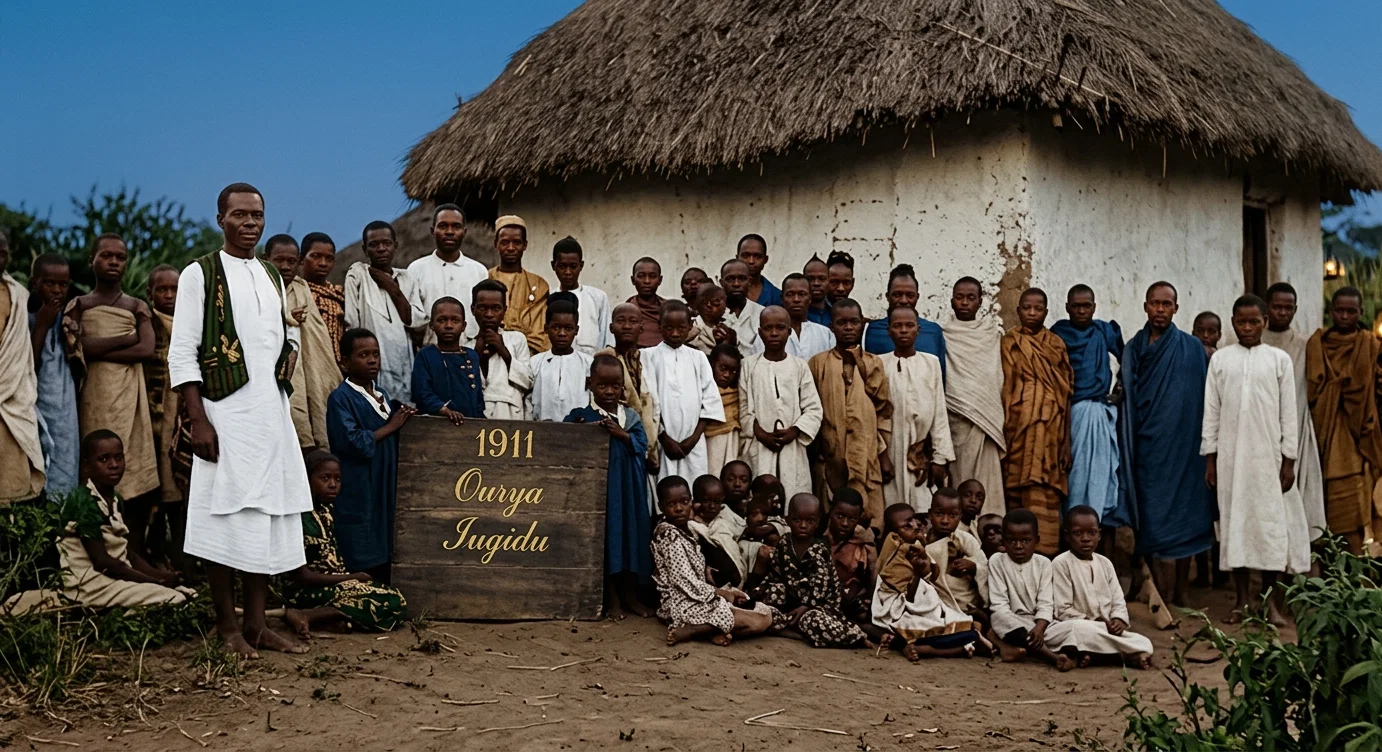
Those who have read the REVIEW will remember that at Majita, where I have been, it was necessary for me to refuse, although reluctantly, between six and seven hundred boys at once, later on about one hundred twenty-five girls, so that the number attending school (three hundred) could be waited upon in one session in my schoolhouse, 18 x 54 feet. It was not only on this account that I had to refuse these others entrance to our school, as I could have handled that many again in a second daily session; but being all alone at the station, I had all the general work to look after.
A few words of explanation will show how pioneer work crowds in Africa, and some of the experiences that come to one who is starting work among the native peoples. For instance, I had the large chapel (40 x 90 feet) to build, which was intended to provide room for our school and for Sabbath meeting.
For this I secured stone-masons; but I had to show them how to lay the stones, and that, too, for five full months before they caught the idea of building. Yet they think they are architects not to be beaten! The men carrying the stone, and the men in the quarry breaking stone, would do nothing as soon as they were out of sight, and so with all the others. These made up one group of workers.
Then there were the brick-makers, with their crew of helpers, who must be carefully watched and their work constantly superintended. About two miles away the sawyers were at work, and I must supervise their work and help them with it. Often the planks were spoiled because it was impossible for me to be with them all the time. Besides this, the mission boys and I were building a house 24 x 95 feet, of sun-dried brick, which was intended for a boys’ dormitory; but which, after it was finished, was welcomed as a mission house by the new helpers who arrived just at that time, and for whom there was no house. This building has two suites of three rooms each, of 13 x 20, 13 x 13, and 10 x 13 feet respectively; one room 13 x 13 feet; and a guest-room. After it was plastered and whitewashed, we were indeed well pleased with the fine, sturdy building.
I have seen many buildings thus erected, but have not had the privilege of living in a plastered room more than seven months at a time since I left Germany, in 1903; tents and grass huts have been my abode. I have had hundreds of malarial attacks, being seven months in bed with relapsing fever, two weeks each with paralysis and mercury-poisoning, and five times I have looked into the grave with the dreaded blackwater fever. Would I now leave Africa?—Indeed, I would not; there is something else that keeps me here. When I see the field white for the harvest, I am overwhelmed with the mighty work to be done. East Africa has hundreds of thousands of souls who have never dreamed of any hope of salvation; who have never been told about the God who made heaven and earth, nor about Jesus who died to save them from fear and destruction. When I feel safe with Christ, and see these millions on the road to destruction, I arouse myself anew to work more earnestly, and help them in their physical wants, at the same time telling them about their Creator and Redeemer.
If I were a beginner, I should be discouraged by the first experience; I should say: These people do not want help, they are not grateful for the help14given them. But such is not the case; these natives for centuries have been, and still are, deceived and frightened. All through their childhood they are told fictitious stories about ghosts and wizards. And these tales must be paid for with goats, and in some cases with the life of him who has dared to aggravate the one above him who has a little more power. For this reason the people are very suspicious. They are always in fear that the one who is pretending to help them is only seeking a reason for destroying them later. When this suspicion is once removed, the victory is won. And those easiest won are the children; for as yet these things are not so stamped on their minds as on those of the grown people.
There is another kind of encouragement which by far outweighs our physical work of building and planting, and that is the success in replacing the satanic power in the hearts of the people with the power of Christ. Then it is that the most wonderful gratitude reveals itself.
Outside of the day-school and the daily work, I have had refreshing meetings at night. Four times a week the mission boys and five men of middle age assembled, three of whom brought their wives, so that the majority of those attending were grown people. This is quite unusual in Africa. All were much interested, but especially one man, who always gave his testimony. He would say to the others: ‘Now see here, have there ever been told words which strengthen and gladden the heart as these do? I never feel tired at night. I can not stop reading these words until my eyes see no more.’ I had given him a New Testament some time before, and by studying evenings he had learned to read.
These Bible readings and prayer-meetings have not been without results. This man asked me many questions which showed that God was working on his heart. One Sabbath, after meeting, I entered my room, and was surprised to see him and his wife seated there. On asking what their wishes were, they looked at each other without answering. So I took my chair and sat down, thinking there would be, as usual, some difficult question; and yet it puzzled me what she could want, as she had never seemed to go faster than the rest. While I was thinking thus, he rose from his seat, placed a rupee on the table, and kneeled down; she did the same, and each said a short prayer. I thanked God for having touched their hearts. ‘If we have sown unto you spiritual things, is it a great thing if we shall reap your carnal things?’ Indeed, it is not so great a thing, and if the heart is converted, that is the natural fruit; for if we have faith, then our works will testify of it. This is one of the experiences which gives a person courage, and also helps him to forget the many things which tend to discourage in this field, where it is so hard to win souls. I would not miss one such experience for a furlough home.
I am glad for these two who have decided to stand on the side of Christ, and who have demonstrated their determination by a voluntary act, no hint ever having been given that they were expected to do this. Such a deed we consider a sure sign of genuineness.
May God grant that Majita will soon have a church; I do not mean a building, but a church of native Christians. I ask all our brethren and sisters in America who have an interest in these souls to pray for the work here. And praying, give. Don’t let these poor black people put to shame those of us who are in a much better condition. Let me suggest to you that to kneel down before God when you give your offering, might tend to multiply your loaves; for we read: ‘Cast thy bread upon the waters: for thou shalt find it after many days.’
Majita.
AN OUT-SCHOOL IN GERMAN EAST AFRICA
The End Very Near
THAT is the conviction of our workers in the most populous and least worked fields. From a letter written by Brother Frederick Lee, of the province of Anhwei, China, we quote:—
Signs of the end are fast fulfilling in China. When I look at these things, and then at the map of China, marking out where our little stations are, here all and there, it causes me to feel that God must indeed help us to get over the territory quickly. Our lights so far are so few and faint in comparison with the millions in darkness that they seem but to show the dense darkness we have not yet pierced. But with more workers and greater consecration we have faith that the work will be done.
The Persian Fast of Mourning
By F. F. OSTER
F. F. OSTER
The population of Persia consists almost entirely of Shiah Mohammedans, as opposed to the Sunnites, or Traditionalists. They differ from the latter in that they regard Ali and his descendants as the rightful successors of Mohammed, while the Sunnites reject him. For this reason the Persians celebrate a number of fasts and feasts not observed by the great majority of Mohammedans. One of the most important of these is the ten days’ season of mourning for the Imam Husein.
The Persians reckon time by the lunar year; hence their festivals, according to the solar system, fall on dates eleven or twelve days earlier on each succeeding year. This year the fast of Husein came in January, and was celebrated with much enthusiasm by the thousands of Persians residing in Baku.
It is observed in commemoration of the martyrdom of Husein, whom they regard as the rightful successor of the assassinated Ali. He was on his way to Kufa to receive the califate; but before he reached that place, he was attacked by his rival, and with seventy of his followers was slain. The Persians annually commemorate this event by the performance of the tazia, or passion-play, which is said to date from the tenth century.
During the first several days of this fast, a number of ceremonies well calculated to excite the fanaticism of the people, are gone through. By the time the tenth day is reached, the people are worked up to feverish excitement. The young men are the principal actors. Our teachers directed us to a place where we obtained a good view of the proceedings.
A long line of men walking sidewise made their appearance. Each clasped with his left hand the waistcoat of the one following. The leader asked questions concerning Husein, and the men replied in unison, accompanying each answer with an emphatic downward jerk of the hands and a stamp of the foot. Now and then the fists came down heavily upon their pates. Unmindful of the freezing temperature, many pounded their naked chests until they were blue. They marched several rounds, and then left the street.
Next came two lines of men and boys dressed in black, singing a dirge. They walked with a slow, steady pace, and swayed from side to side. Each carried a staff, at the end of which was fastened a number of chains. Every other step they would bow slightly, allowing the chains to alight gently on their right shoulders. They sang a very sweet and touching melody. The words told of the fate of Husein. The whole scene was very pathetic; strong men sobbed on every side. Several other companies followed, with increasing excitement.
The climax was reached when a long line of white-robed men entered the street. Frenzy had now reached its zenith. They were ready to do any inhuman act. Their voices were hoarse, continually shouting, “Husein!” “Husein!” They waved their swords in the air; and as they neared us, let them come down upon their shaven crowns. Blood flowed profusely over their white gowns, presenting a scene too disgusting to look at. Some pounded their mangled heads with their fists; others were prevented from taking their own lives by having their swords taken from them. Sugar-water was freely passed around to moisten the parched lips. Men with bandages were busy binding up the wounds. Others were leading the faint to their homes. Should one die, as often15happens, he is believed to go directly to paradise. These men were such as were under vows, and desired special merit; the greater the self-infliction, the greater the favor supposed to be received.
In the midst of this company was a horse mounted by a three-year-old boy. His little head also was covered with blood, but he uttered no cry, doubtless being overawed by the excitement. Around him were several men who gently caressed him and the horse. He represented the little children who were slain with Husein. The people all wept as he came in view. Tears are considered very meritorious. Behind the horse was a crowd of men throwing dust into the air.
At the close the crowd gathered in front of the mosque, to listen to a discourse by the mollah, and then disbanded.
Touching tales are related, and many tears are shed, but not because of the sins of the people. Their religion is one of works; they depend upon their good deeds for salvation, and seek the favor of God by means of deeds of self-mortification. Through long centuries they have been educated in that way, and few of them know any better. Only the gospel of Jesus Christ can free them from these chains of error. We must carry the glad tidings to them; for after witnessing such scenes one can the better appreciate the salvation that is found in Jesus alone.
Baku, Russia.
J. W. WESTPHAL
By J. W. Westphal
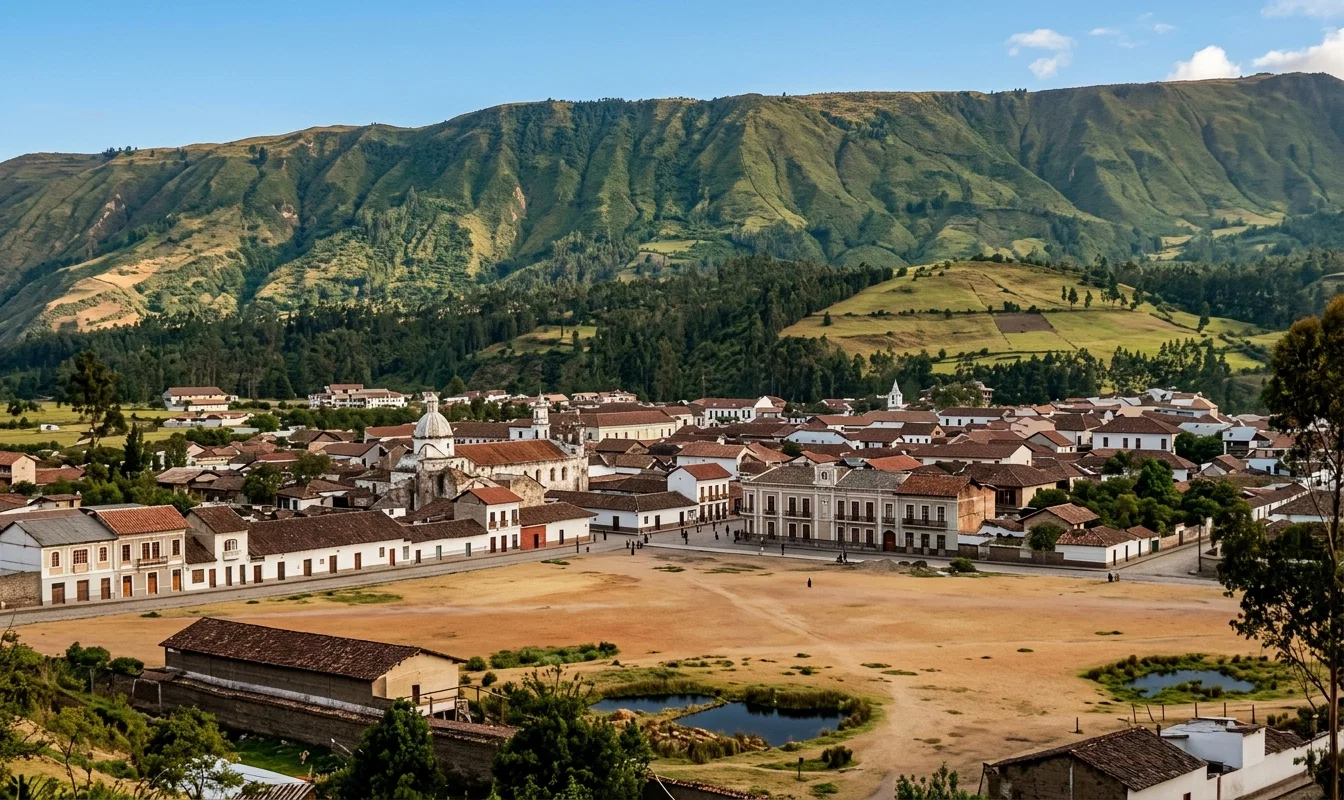
VIEW OF AMBATO, ECUADOR
Ecuador
J. W. WESTPHAL
I AM glad to report progress in the work in Ecuador. The necessary changes in laborers have very naturally retarded its progress, yet the truth has made impressions, and we are now beginning to reap the benefits. That which has effected the most lasting good is the literature distributed, the Señales giving us the quickest results. One brother in Guayaquil has been living the truth for more than four years; two have been baptized on the coast in different localities, and two others, we have reason to believe, have died in the hope of a part in the first resurrection—largely the fruit of our literature.
A man in another place is calling for help; but, owing probably to the work of enemies, it has been impossible to communicate with him. At Ambato a young man, a telegrapher, has accepted the truth and desires baptism. Another bright young man believes the message, and in part is obeying it. At Quito, the capital, a family who have known the distorted side of the message for a number of years in Peru, and who have consequently opposed it, recently began to keep the Sabbath. A day's journey north of Quito, by mule, a man writes that he is keeping the Sabbath; he is calling for help.
Both Elder W. W. Wheeler and Brother Osborne suffered from malaria on their visit to the coast; hence they will not risk another trip there until the dry season. They hope soon to respond to the call to the north of Quito.
Nearly since the opening of the Ecuador Mission, the laborers have lived at Ambato, considered one of the most healthful places of the world. During this time they have made many friends among all classes. For two months Brother and Sister Osborne have done considerable work in giving treatments to the sick, with excellent results. Cases which physicians had not benefited received immediate relief from the treatments given. This has increased the friendship of the people, and some are recommending their work very highly. Since one family had begun to keep the Sabbath at Quito, and in view of the fact that the situation seemed especially favorable to begin the work of treating the sick, it was decided that Brother Osborne and family move to this place, and labor as the way might open. Brother and Sister Wheeler will continue to reside in Ambato.
The most urgent need in Ecuador is the need of canvassers. There should be at least two who would devote all their time to the circulation of our literature. They must be men who will endure hardness as good soldiers; they must be able to make themselves one with the people, to leave behind all Americanism, and to be Christians only. If the work opens in Quito, as we have reason to hope, there will soon be need for more nurses.
The laborers are of good courage in the Lord. They are in love with their field and work. They have no inclination to return home. Their special desire is for more help.
What Our Books Are Doing in India
By Percy C. Poley
PERCY C. POLEY
It is certain that the angels who hold commission from the court of heaven to direct the missionary operations of our people, are charged with weighty responsibilities in that department of missionary endeavor which we call the publishing and canvassing work; and that these faithful agents have not fully discharged their trust in directing only the movements of our canvassers, but that they have a special care over those seeds of truth which our canvassers drop.
Quite recently a young man, who at the time was a sergeant on the clerical staff of the British army in India, stationed at Poona, in the Bombay Presidency, became acquainted with our missionaries in that district. He was also an active member of the local Young Men's Christian Association, and a member of the Methodist Episcopal Church; but his intimacy with the Seventh-day Adventist workers at Poona had not, up to that time, led to any change in his religious convictions. In April, 1910, he went to Mussoorie for a vacation. On a shelf in the Soldiers' Furlough Home at which he stayed, he found an old book, bearing the title “Bible Readings for the Home Circle,” but did not know that it was a part of our denominational literature. When he lighted upon the reading called “The New Testament Sabbath” and similar studies, he imagined that he would find some facts which would refute the doctrinal positions of his Seventh-day Adventist friends at Poona. According to his own narration of the incident, he found the book was not against them, but in their favor, and he left Mussoorie with the conviction that the Adventists had the truth so far as he had studied. Then followed some Bible readings under Elder G. F. Enoch, of Poona, resulting in the complete establishment of our brother in the truths of this message.
To my mind, that journey of one thousand miles across country from Poona, in the west, to Mussoorie, in the Himalayas of the north, to find a book where he would have time and leisure to read it, was the result of a heaven-born plan. However, that is not all the story. Our brother decided to obtain his discharge from the army, in order that he might engage in the work of giving to others the truths he himself had received. He is now a regular canvasser for the India Union Mission, and is selling our English books with a good degree of success among both the English and the educated native populations of India.
Experiences in Bolivia
By Otto H. Schulz
AFTER working sometime in Cochabamba with our books, I left for Oruro in midsummer, at the end of January, taking the route over the mountains. After climbing for three days, I found myself fifteen thousand feet above sea-level, in the region of perpetual snow and cold. Many times I had to cross the cold, rushing mountain streams,—sometimes from forty to sixty in a day. I had to follow a narrow path, leading along the sides of the steep mountains. Sometimes this path was not more than six inches wide. I could hear the thundering of the mountain stream hundreds of feet below, and could look down on people who seemed to be only a few inches tall. Many times I shut my eyes in order not to become dizzy, and at times I had to hold on to whatever I could grasp to keep from falling.
Along this trail one finds no houses nor shelter to protect one from the inclement weather. The mountains are perfectly bare, save for moss, which serves as food for the llamas. One day, tired, hungry, and cold, I reached an Indian hut. Stepping inside, I found a company of drunken Indians with their wives, drinking and making hideous noises blowing on cow-horns. With this noise, they kept me awake all night.
In many places the Indians are half wild, and they are very dirty and lazy. They spend their time in drinking, chewing coca, and smoking. Going on from there, I came to the town of Challa, a very fanatical place. Knowing that I was a Protestant, the people peered at me from every side. Some began to scoff and call me bad names. Three years before, as three North Americans were passing through this place, the priests stirred up the people to persecute them, because he said they were Protestants. I knew that at any moment a mob might arise against me, but I showed no fear. Stepping up to the house where the people scoffed at me, I asked: “What do you want? Do you know who I am? Please let me alone!” They seemed astonished and said no more to me, though one Indian grabbed my hat, and wanted to fight.
To impress upon the people that I had no fear, I walked up and down the main street so boldly that no one threatened me again. The Lord was on my side, and sent his angels to guard me.
The priest had told the Indians that if a gringo (foreigner) came through the town, they were to give him nothing to eat, because such were heretics. I could not even buy food. One family promised to make me a rice soup for supper, but it was never brought to me.
That night I lay upon the ground in a house, with a stone under my head, but the cold and hunger would not allow me to close my eyes. I asked God to give me food; and in a little while, a white man came to the place, knocked on the door, and brought me some food and a lighted candle. So God answered my prayer again.
In Oruro, Brother Stahl and I had difficulty with the authorities in canvassing for “Home and Health” and “Patriarchs and Prophets;” but we thank God that he has protected us up to the present. Our health is good.
We have great trouble here in keeping a place in which to live, as the Catholics will not allow us to remain in their houses when they find we are Protestants,—in their eyes, heretics. We must, therefore, move sometimes as often as every month. The owner of the house in which we now live, a very kind woman, told my wife that the bishop of Cochabamba had given orders that we must get out, because I am canvassing for religious literature. He himself bought a copy of “Home and Health,” and says it is a good book. If I would canvass for health literature only, he would have nothing against me; otherwise, we can not stay in the house. It is very hard to find rooms. The people will ask such questions as these: “Are you Protestants? Do you believe in the Virgin Mary? Do you confess to the priest? What is your work?” etc.
Two women have tried to convert my wife to the Catholic faith; but she in turn has given them lessons from the Bible, trying to point them to Jesus as our only Saviour.
I very much need a good brother whose trust is in the Lord, to accompany me in the work here. It would be a great help and strength to me when I am alone among these people, who have such a hatred against Protestants. Who will come? Who will leave his home and friends to take up the work with a struggling brother in a land where the people are in a condition that is worse than heathenism?
Bolivia needs workers to bring light and truth to lost souls, and to tell them that Jesus will soon return to this earth again. Otto H. Schulz.
Eastern Canada
By Wm. Guthrie
PORT HOPE, ONTARIO.—The past year has been one in which our hearts have drawn near to the Lord, and he has come very near to us. As the days have passed, and our work has progressed, his presence has been with us, giving fruit for our labor.
During 1910 we sought the Lord for a definite number of souls to accept this truth, and he heard us, giving a large per cent of what we asked of him. We rejoice to say that the number added to the believers in this union conference during last year is equal to the results of the two previous years' work. The workers have exercised greater faith in the saving power and presence of Jesus. It is true we have been dependent on the General Conference to make appropriations for no small part of our support; and for this support we have been very grateful. We are praying that this year may witness such an ingathering of souls that soon we shall, as a union, be entirely self-supporting.
Our workers are nearly all in the field, intent on gathering souls for the kingdom. Some changes have been made; but while some have been called to other parts of the field, we hope that the cause will continue to make advancement.
Feeling the need of earnest work in this conference, and knowing that we should make advance moves in our publishing work, and realizing the shortness of funds, I have decided not to attend the council in Europe, although it was voted that I go. Our lack of funds will prevent filling many calls that come to us from the different parts of the field, but we trust means will be provided for the finishing of the work.
The people are of one mind and one heart to finish the work in this generation. There are many obstacles to be met in this north country, but the Lord can not be bound about by such things, and in him we put our confidence. He will do a quick work, and cut it short in righteousness. His coming is near, and this work will soon close in triumph. Wm. GUTHRIE.