Your ShelfYour Projects

Review and Herald, Vol. 79, No. 36.

The Harvest Is the End of the World

Review and Herald

Sep 9, 1902

Seventh-day Adventist Publishing Association · Battle Creek, Mich. · Sep 9, 1902

The Harvest Is the End of the World
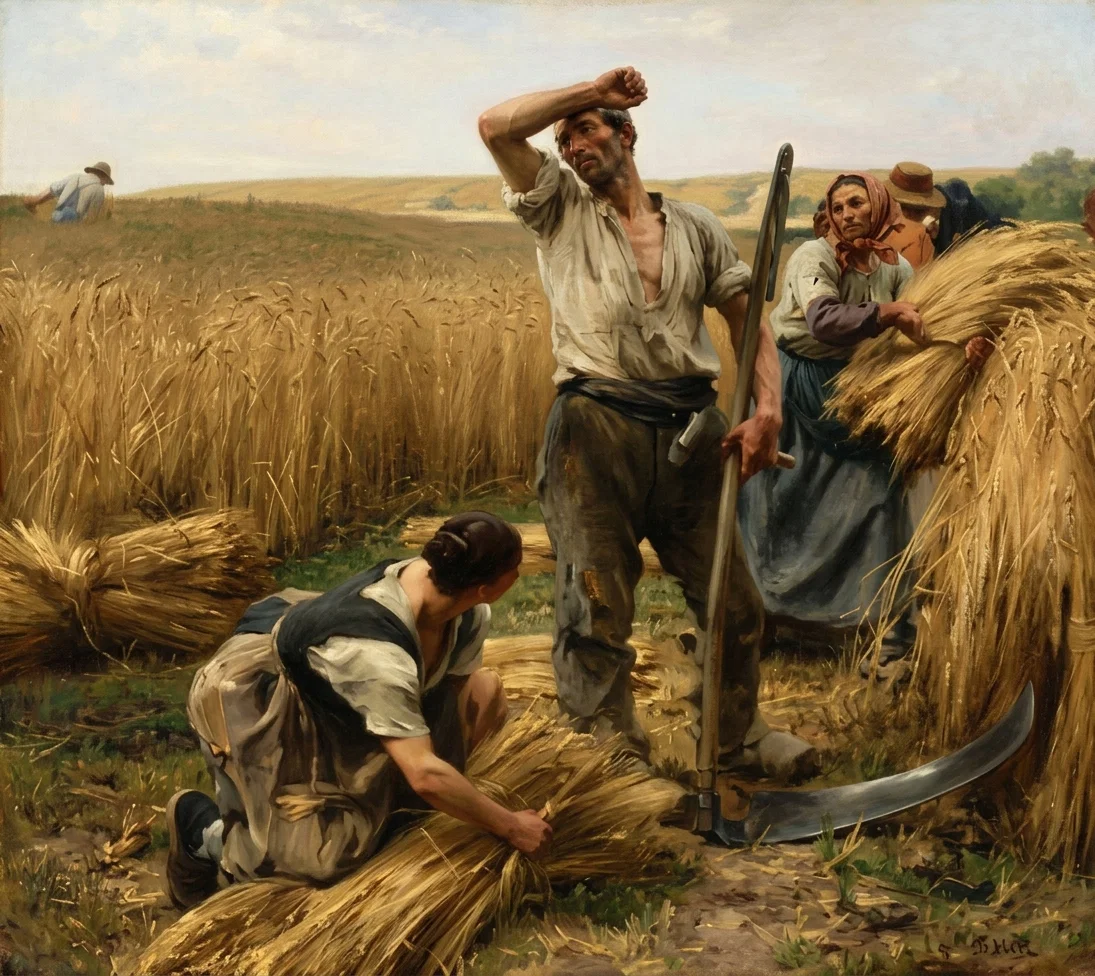
THE HARVESTERS
THE HARVESTERS
So is the kingdom of God, as if a man should cast seed upon the earth; And should sleep and rise night and day, and the seed should spring up and grow, he knoweth not how. The earth beareth fruit of herself; first the blade, then the ear, then the full corn in the ear. But when the fruit is ripe, straightway he putteth forth the sickle, because the harvest is come.

“The Harvest Is the End of the World.”

SCHOOL WILL SOON OPEN.

Buy your books now, and buy the best. Only books of fact, not fiction, are of real worth.

A New Series of Physiologies.

By J. H. KELLOGG, M. D.
In two books. These two books constitute an entirely new and thoroughly graded series for the study of physiology and hygiene in schools. The aim of the author in their preparation has been to present in a concise and comprehensive form only such facts as are of practical value, and to arrange these facts in a form suitable for class instruction and recitation. They will also be found very valuable for home study, as they treat the subject in a practical, clear-cut manner.
BOOK ONE.
Cloth, 12mo, 174 pages; illustrated. Price, 40 cts.
BOOK TWO.
Cloth, 12mo, 291 pages; illustrated. Price, 80 cts.

Ecclesiastical Empire

contains the account of all the principal events that have affected the civil governments and tended to the establishment of ecclesiastical authority from the time of the fall of Rome to the publishing of this book, in 1901. It contains a good history of the Reformation; a compendium of the principles of true Christianity; the reason for our national apostasy, and a full treatise upon the union of church and state.
This book contains 874 pages; substantially bound in cloth. Price, $2.50.

The Great Empires of Prophecy,

From Babylon to the fall of Rome.
By ALONZO T. JONES.
“The Great Empires of Prophecy” is the history that is foretold in the prophecies of the great empires in the book of Daniel,—Babylon, Medo-Persia, Grecia, Rome, and the ten divisions of the Roman empire.
More than eighty of the standard historians and authorities on the history of the respective empires of the prophecy, speak in the book in their own language; so that it is fairly a cyclopedia of history in fulfillment of the prophecies of the book of Daniel.
Every student of the book of Daniel and every student of history needs this book. It contains 712 large pages, besides 22 full-page maps, made especially for the book by the author, and printed in from three to thirteen colors.
The book is issued in one style of binding, cloth, $2.00.

The Scriptural Foundations of Science.

A book written for the purpose of inspiring faith in the Bible as a guide in all scientific investigation.
The intent of the book is to answer all such questions as, “How can the Bible be a guide in science when it does not mention many of the simple facts of science?”
In this work the author has cleared away the theories of false science, and has plainly revealed the great foundation of all wisdom; God’s Word, and the Author of all truth, whose created works constantly testify to the infallibility of his Word.
Beautifully bound in cloth, elaborately illustrated by special original drawings by the author. Size, 5x7x½ inches; contains 272 pages. Price, 75 cts.

The Empires of the Bible,

From the time of the flood to the Babylonian captivity.
By ALONZO T. JONES.
Recent research in Babylon and Egypt has brought to light many valuable historical records that were inscribed in stone by the very men living in those ancient times. These records and the Bible history of the same time are woven together in one connected story. Another important feature of the book is the tracing, in a series of twenty-one maps, of the course of those empires. The design of the book is unique, and every student either of the Bible or of history will find it invaluable. Cloth, $1.50.

The New WEBSTER DICTIONARY and Complete Vest-Pocket Library.

A work of extraordinary interest to all classes of progressive people. Adopted for use in the State Normal School, Oswego, N. Y. Others of the foremost educational institutions, including Harvard, Yale, Brown, Chicago, and other universities, as well as colleges, academies, and normal schools, place this book in stock, being convinced upon examination that it is a safe and reliable guide, and the best thing of the kind that has ever been placed on the market. Used personally by educators of the highest rank, and commended by them in highest terms.
It will be found very useful for the home and church school, as well as the academy and college.

STYLES AND PRICES.

Elegant cloth, red edges $ .25
Morocco, gold stamp, gold edges .50
Extra quality morocco, with calendar, memorandum, and stamp holder .60
All three styles are indexed.
Order From Your State Tract Society, or the REVIEW & HERALD PUB. CO., Battle Creek, Mich.

Worldly Christians

Editorial

Worldly Christians

DID you ever hear of black whiteness? Such a use of words seems like a contradiction of terms. Is it not really just as much of a contradiction to talk about worldly Christians? A Christian is a follower of Christ. A worldly man is one who loves the world. But “if any man love the world, the love of the Father is not in him.” “He that is not with me is against me.” “Ye cannot serve God and mammon.” “Thou shalt love the Lord thy God with all thine heart, and with all thy soul, and with all thy might.”
“True-hearted, whole-hearted, Saviour all glorious! Take thy great power and reign there alone, Over our wills and affections victorious, Freely surrendered and wholly thine own.”

The Second Time

THE coming of the Lord is the subject of many prophecies. It may perhaps be correct to say that it is the one subject of the prophecies. This inference seems to be a natural one from the words of the martyr Stephen when he saw the purpose of his hearers: “Which of the prophets have not your fathers persecuted? and they have slain them which showed before of the coming of the Just One.” This is more directly stated by the apostle Peter in his talk with the people who gathered about him after he had healed the lame man: “Yea, and all the prophets from Samuel and those that follow after, as many as have spoken, have likewise foretold of these days.” The constant and all-absorbing theme of the prophets was the coming of the Lord, but they did not, in direct terms, distinguish between a first and a second coming. They spoke of events which we can now see clearly involve a manifestation of himself in the world as a sacrifice for sin, with his glory veiled in sinful flesh, and another manifestation of himself to gather his people, a coming “with power and great glory.” But after he had appeared once in the world, and had returned to the Father, the direct promise is made that “unto them that look for him shall he appear the second time without sin unto salvation.” It is for this second appearing that we look in this generation. He has visited this world once. He was rejected by his own people, and was put to death. He “was raised up from the dead by the glory of God the Father.” To the apostles whom he had chosen “he showed himself alive after his passion by many infallible proofs,” and “he was seen of above five hundred brethren at once.” While blessing his disciples, “he was parted from them, and carried up into heaven.” It is now more than eighteen centuries since he said, “If I go and prepare a place for you, I will come again, and receive you unto myself.” Our faith rests upon his sure word of promise. He will come the second time. Signs manifested and prophecies fulfilled and fulfilling show that the second appearing is near at hand. “Even so, come, Lord Jesus.”

Arise and Build

ESPECIALLY applicable to our situation seem the words of Nehemiah as he saw how much was to be done to carry out “the commandment to restore and to build Jerusalem.” After he had been out by night and secretly “viewed the wall,” he said to the people, “Ye see the distress that we are in, how Jerusalem lieth waste, and the gates thereof are burned with fire: come, and let us build up the wall of Jerusalem, that we be no more a reproach.” Those who heard this call to action responded by saying, “Let us rise up and build.” And the record further states, “So they strengthened their hands for this good work.” All this experience is an object lesson for us. It is our work to build up Jerusalem in this time, just as much as it was their work in that time. Then, they built a dead temple and a dead wall with dead material. Now, we are to build a living temple with living material. They built for time. We build for eternity. The building of the temple now is to be accomplished by preaching the gospel of the kingdom to all the world. This is made clear by the words of James at the conference at Jerusalem: “Men and brethren, hearken unto me: Simeon hath declared how God at the first did visit the Gentiles, to take out of them a people for his name. And to this agree the words of the prophets; as it is written, After this I will return, and will build again the tabernacle of David, which is fallen down; and I will build again the ruins thereof, and I will set it up: that the residue of men might seek after the Lord, and all the Gentiles, upon whom my name is called, saith the Lord, who doeth all these things.” In Nehemiah’s time there was a reproach in the fact that Jerusalem was lying desolate and not built up again. In our day there is a reproach upon the name and truth of God because of the long delay in preparing the way for the coming of the Lord. The scoffers say, “Where is the promise of his coming?” and the evil servant says, “My lord delayeth his coming.” The call of the hour is for consecrated service in giving this message to all the world, “that we be no more a reproach.” “Come, and let us build up the wall of Jerusalem.”

Organizing for Service

THE work of reorganization which was begun at the last General Conference has been going steadily forward since that time. The purpose of this movement is not merely to make some changes in the outward forms of administration, but rather to open the way for the greatest possible efficiency in the actual work of giving the gospel message in this generation. During the recent meetings and councils in Europe some of the large European fields have been subdivided, and organized into smaller conferences and mission fields. In the United States a new union conference has been formed by readjusting the territory of the Northwestern and the Southwestern Union Conferences, so that we now have seven union conferences in this country, instead of six. Some of the large State conferences have also been divided, the latest instance being that of Michigan, where there are now three conferences and a mission field in the place of one unwieldy conference. There are at least two distinct advantages in following this plan: the burden of administration is shared by a larger number, and there is a much better opportunity to rally the people for service. Every believer of the truth ought to be a worker for the truth, and there is great need now that all the people be organizedfor service. The hope of this movement, humanly speaking, lies in a united, well-directed effort in which every individual shall have a part. The idea that the work of advancing the interests of the kingdom of God in the earth has been intrusted to a few persons of a special class is a legacy of the papacy. To every one who is “in Christ,” and therefore “a new creature,” is given “the ministry of reconciliation.” To every man is given his work. The whole purpose of an outward organization is that as many as possible may work to the greatest possible advantage. The union in which there is strength for Christian effort consists in binding all hearts to God and the truth by the power of the endless life, and not in putting all administrative power in the hands of one or a few central organizations. In dividing up the burdens and sharing the responsibilities among many there is no danger of disorganization, provided each individual is himself organized by the quickening power of the Holy Spirit. In this whole work of reorganization the preparation is being made, so far as human arrangements are concerned, that a mighty work shall be done in a short time. All things are in readiness for the people to work. May God grant to the people “a mind to work.”

A Blessing Then and There

WE are disposed to change the tenses somewhat, so that it will read, “A blessing here and now.” We draw in this another lesson from the experience of Jacob. “And Jacob asked him, and said, Tell me, I pray thee, thy name. And he said, Wherefore is it that thou dost ask after my name? And he blessed him there.” Gen. 32:29. Jacob evidently sought a better acquaintance with the Being with whom he had just been wrestling. “What is thy name?” This is the question of all questions; for the name of God denotes his nature and essence, the substance of all his attributes and properties; therefore the question, What is thy name? is the question of all questions worth the asking.
To Moses, under different circumstances, the Lord proclaimed his name. “And the Lord descended in the cloud, and stood with him there, and proclaimed the name of the Lord. And the Lord passed by before him, and proclaimed, The Lord, The Lord God, merciful and gracious, long-suffering, and abundant in goodness and truth, keeping mercy for thousands, forgiving iniquity and transgression, and sin,—and that will by no means clear the guilty; visiting the iniquity of the fathers upon the children, and upon the children’s children, unto the third and to the fourth generation.” Ex. 34:5–7.
The knowledge of God is the one thing needful in the world to-day. What course does the patriarch Job recommend us to pursue? “Acquaint now thyself with him, and be at peace.” Job 22:21. “Great peace,” says David, “have they which love thy law; and nothing shall offend them.” Ps. 119:165. Acquaintance with God leads to harmony with his law, and nothing can break the peaceful relation between such a soul and God.
It will be noticed that the record places great emphasis on the locality where Jacob had this experience. “He blessed him there.” This is the main point after all,—to learn where and how we can find the blessing. Let us, then, consider the circumstances, and the place where the blessing may be found, as the patriarch found it.
Jacob’s blessing began in an agony of prayer. The first installment of it was in being saved from the attack of Esau, of which he stood in great fear; for he said, “For I fear him, lest he will come and smite me, and the mother with the children.” Gen. 32:11.
He was blessed in being forgiven a great wrong. His supplanting of Esau was condoned by his brother.
He was blessed in feeling that a great breach of friendship was healed: “Esau ran to meet him, and embraced him, and fell on his neck, and kissed him: and they wept.” Gen. 33:4.
God blessed Jacob at Peniel, because he asked to be blessed; and his desire for it constituted at once his worthiness of the blessing, and his capacity to receive it. For it was not only necessary to ask the question, but also to ask it in the right spirit. Jacob’s question was asked, but was not directly answered. Our questions are sometimes so treated in the Scriptures. “Wilt thou at this time,” said the disciples to Christ, “restore again the kingdom to Israel?” He answered, “It is not for you to know the times or the seasons which the Father hath put in his own power. But ye shall receive power, after that the Holy Ghost is come upon you: and ye shall be witnesses unto me, both in Jerusalem, and in all Judea, . . . and unto the uttermost part of the earth.” Acts 1:6–8.
But the answer to Jacob’s question is implied in the assertion, “And he blessed him there.” The Anglican Pulpit says, “God does not always give knowledge to striving souls, but a blessing. He stills your doubtings, he helps you to trust him. You go forth not as Israel, the supplanter, but in the power of a divine enthusiasm, as Israel, a prince with God.” God does not expect perfect characters to carry out his work. He chooses the fittest instruments he can find, for his purest purposes, and trains them, and bears with them, until their work is done. “In thy seed shall all the nations of the earth be blessed.” Rom. 4:13; Gen. 22:18.
Whenever you are in a place where you are willing to give up sin, willing to take Jesus for your all in all, willing to serve God in his own way, do not go away without a saving blessing. Believe for it; wrestle for it. What use are the means of grace unless the Lord blesses them, and blesses you in the use of them? Then they are a “savor of life unto life,” unto you. 2 Cor. 2:16.
U. S.

Studies in the Gospel Message

THE subject of the Sabbath-school lesson for September 20 is, Justification by Faith the Basis of the Continuance of the Kingdom.
Sin is failure. A sinner is one who fails or misses the mark. While there may be an outward appearance of temporary success which may win a favorable verdict from men, yet when eternity is taken into the reckoning, he who persists in sin will miss everything worth gaining, and will himself also be found wanting. The Scripture sets forth all this in the plainest way.
“Fret not thyself because of evil-doers, Neither be thou envious against them that work unrighteousness. For they shall soon be cut down like the grass, And wither as the green herb. . . . Fret not thyself because of him who prospereth in his way, Because of the man who bringeth wicked devices to pass. . . . For evil-doers shall be cut off. . . . Yet a little while, and the wicked shall not be: Yea, thou shalt diligently consider his place, and he shall not be. . . . I have seen the wicked in great power, And spreading himself like a green tree in its native soil. But one passed by, and, lo, he was not: Yea, I sought him, but he could not be found.”
A right understanding of the real, instead of the apparent, result of sin can only be had by looking at the problem from the standpoint of the provision which God has made for dealing with sin. The experience of the psalmist is written for the instruction of all.
“I was envious at the arrogant, When I saw the prosperity of the wicked. For there are no bands in their death: But their strength is firm. They are not in trouble as other men; Neither are they plagued like other men. Therefore pride is as a chain about their neck; Violence covereth them as a garment. Their eyes stand out with fatness: They have more than heart could wish. . . . Behold, these are the wicked; And, being alway at ease, they increase in riches. . . . When I thought how I might know this, It was too painful for me; Until I went into the sanctuary of God, And considered their latter end. Surely thou settest them in slippery places: Thou castest them down to destruction. How are they become a desolation in a moment! They are utterly consumed with terrors. As a dream when one awaketh; So, O Lord, when thou awakest, thou shalt despise their image.”
These statements show plainly enough that there can be nothing permanent in which sin is a factor. In the very nature of the case it must end in utter failure and destruction. Jesus was dealing with this very principle when he said, “Every one that heareth these sayings of mine, and doeth them not, shall be likened unto a foolish man, which built his house upon the sand: and the rain descended, and the floods came, and the winds blew, and beat upon that house; and it fell: and great was the fall of it.”
In contrast with all this is the stability and permanence of truth and righteousness. “The truth of the Lord endureth forever.” “My righteousness shall be forever, and my salvation from generation to generation.” Jesus came to this world that he “should bear witness unto the truth,” and in order “to bring in everlasting righteousness.” He who said, “I am . . . the truth,” and whose name is “The Lord our Righteousness,” by taking our flesh brought human nature into a personal relation with truth and righteousness, and thus prepared the way for the establishment of the everlasting kingdom of God in the hearts of men.
Righteousness is the permanent element in the kingdom of God. “A scepter of righteousness is the scepter of thy kingdom.” “Righteousness and judgment are the foundation of thy throne.” This “everlasting righteousness” is the “righteousness of God which is by faith of Jesus Christ unto all and upon all them that believe.” Thus by believing on Christ and receiving “the gift of righteousness” we become righteous by our faith, and lay hold of eternal life. For “he that believeth on the Son hath everlasting life,” and “in the way of righteousness is life.”
Through the prophet Nathan the Lord said to David, “When thy days be fulfilled, and thou shalt sleep with thy fathers, I will set up thy seed after thee, which shall proceed out of thy bowels, and I will establish his kingdom. . . . I will establish the throne of his kingdom forever. . . . And thine house and thy kingdom shall be established forever before thee: thy throne shall be established forever.” And of Jesus the angel said to Mary before his birth, “He shall be great, and shall be called the Son of the Highest: and the Lord God shall give unto him the throne of his father David: and he shall reign over the house of Jacob forever; and of his kingdom there shall be no end.” These statements of the Scripture show plainly that Jesus was the greater Son of David through whom the promises to David were to be fulfilled. But Jesus identified himself with our humanity in order that we might be identified with him in all that he won in his humanity. This was his own desire. “Father, I will that they also, whom thou hast given me, be with me where I am; that they may behold my glory, which thou hast given me.” It is also his own promise. “Jesus said unto them, Verily I say unto you, That ye which have followed me, in the regeneration when the Son of man shall sit in the throne of his glory, ye also shall sit upon twelve thrones, judging the twelve tribes of Israel.” It is the promise and the provision of God then that through the gift of Jesus to our flesh those who believe in him shall share in the glory and the dominion of the eternal kingdom. But the preparation for all this in its outward manifestation is that the kingdom which is righteousness shall be established in the heart; that the law of the kingdom shall be obeyed; and that sin, which will end in death, and thus overthrow the continuance of the kingdom, shall be removed “as far as the east is from the west.” And this is the experience of righteousness by faith. It is “the poor of this world rich in faith” of whom Jesus said, “Blessed be ye poor: for yours is the kingdom of God.” It is by faith that we establish the law. It is through faith in the blood of Christ that we receive the remission of sins. Thus on our part the whole experience is one of faith, and being made righteous by faith, we become the subjects of, and the sharers in, that kingdom which “shall stand forever.” And it is only those who have been justified by faith who can be admitted to these privileges. Those who cling to sin will be destroyed with it. And so it is evident that so far as we are concerned the whole basis for the continuance of the kingdom is justification by faith.

A Solid Foundation

SPEAKING with reference to those people who belong to the class described by the apostle Paul as being “children, tossed to and fro, and carried about with every wind of doctrine, by the sleight of men, and cunning craftiness, whereby they lie in wait to deceive,” the Pittsburg Christian Advocate (Methodist) says:—
We have need of good, solid, faithful teaching of the doctrines of our church; for we are persuaded that they are in harmony with the Word of God. Pastor, Sunday-school superintendent, and teachers, and Epworth League leaders should make it a point to instruct the church members, especially the young, so that they may be rooted and grounded in the faith.
With those who practice “cunning craftiness,” and “lie in wait to deceive” the unstable members of the flock, the Advocate classes people who teach that the seventh day is the Sabbath. Of these it says that they “go about persistently teaching that the Lord’s day is not the Sabbath, and that all who persist in keeping it instead of Saturday, are in deadly sin. They claim to have a mission to restore the sanctity of the seventh day, and seem to know more about it than any of the apostles did. . . . They are doing, either intentionally or ignorantly, all they can to break down any Sabbath. Many innocent souls without sufficient knowledge to detect the sophistry and shallowness of their so-called arguments, are led away from their churches by these devil’s agents.”
What, then, is the “solid, faithful teaching” which the young and others need who have set out in the Christian pathway? Is it the teaching of tradition? or is it the teaching of the Word of God? From the discourse of Christ on the mount, we learn that he whose house is built upon a rock is he who conforms his life to the words of Christ. This only is the solid foundation upon which the Christian should rest his hopes with reference to a future life. And if, in order that his hopes may rest on this foundation, the Christian should find it necessary to sever his connection with the church which the Advocate represents, he would, from a Christian standpoint, be perfectly justified in doing so. In that way many persons have been and are being “led away from their churches,” but in it are only being led back to the Word of God.
The Advocate’s anxiety is that the people should be taught “the doctrines of our church,” and should not be “led away from their churches.” But the church and its doctrines are not the foundation of Christianity at all. There are many separate churches and many divergent doctrines; but there is only one foundation upon which the Christian can stand, and that is the wordsof Christ. The Scriptures (all Scripture is the word of Christ, I Peter 1: 10, 11) are not to be made supplemental to the doctrines of the church. The Scriptures come first, and to them the seeker after truth must come first, and to nothing else. If a “babe” in Christ, he must begin with “the sincere milk of the Word,” and as he grows up, he can take stronger food; but always it must be the Word of God, and that only. To instruct a person in the “doctrines of the church” as the beginning of his religious knowledge, using the Bible only in a supplemental way to confirm the doctrines, is a papal proceeding purely. To do this is to put the doctrines of the church first—the word of man above the Word of God.
The Word of God declares that the seventh day is the Sabbath. The seventh day is designated as “the Sabbath of the Lord” (Ex. 20: 8-11), “my holy day” (Isa. 58: 13, 14), and the day of which Christ is Lord. Mark 2: 27, 28. It is, as these texts show, the Lord’s day. It is the day which Christ observed. Luke 4: 16. The first day of the week, on the other hand, is a day which supplanted the Sabbath under the reign of the papal church, a fact which Roman Catholics openly acknowledge in their books of doctrine, and to which they point as being a sign of that church’s authority. And in making this change from the seventh day to the first, that church fulfilled a plain prophecy of God’s Word (Dan. 7: 25), which states that this religious power should “think to change the times and the law.” Who, with these plain facts before him, can have any doubt as to which day, the seventh or the first, stands for “good, solid, faithful teaching” of Christian truth?
L. A. S.

Human Agents Conformed to Christ's Character

“WHEN human agents choose the will of God, and are conformed to the character of Christ, Jesus acts through their organs and faculties.”

The Spirit of God and the Words of Christ

“THE Spirit of God comes to us to make the words of Christ influential in us.”

Atheist Juvenile Secret Society in France

FRANCE has been largely atheistic since the days of the French Revolution. Previously to that time France was Roman Catholic. The false conceptions of God and of righteousness which were imposed upon the people by the papal religion, were mainly responsible for the atheism which swept over France. And this truth belongs not alone to history; the process is still going on in the country to-day. According to the London Daily Mail there exists in France an extraordinary juvenile secret society which is said to have over two million members, all of them boys from fourteen to twenty years of age, and most of them pupils in the Catholic schools. A description of the society says:—
They call themselves “Brothers of the Coast,” and each of them is tattooed with the two letters, A. D., which signify Anti-Dieu. Thus the society is distinctly atheistic. The brothers are pledged never to do obeisance to the consecrated host upon the altar; never to go voluntarily to confession, or, if compelled to go, then to treat the ceremony with ridicule; never to receive the communion unless constrained by parents; never to observe fast days unless obliged, and then to take the first opportunity to gorge themselves on the same day. These young atheists, so it is said, are so thoroughly organized, and so resolute in co-operating against their teachers when they think there is reason to do so, that they enjoy in many schools a practical control over the discipline.
There would be far less atheism in all parts of the world if it were not for the false views of God and of Christianity which the devil through his human agents continually imposes upon the people. It is the work of the Christian to counteract this deceptive work of the archenemy by making manifest in his own life the true attributes of the divine character. L. A. S.

The Tree of Life Restored in Christ

THE first human pair were driven out of paradise, lest, as sinners, they should put forth their hands to the tree of life, which was in the garden, and eat and live forever. But it was not God's purpose to shut the human family away from life. Man was created to live forever, and after the fall in Eden it was still the purpose that man should enjoy unending life; but life must be forever divorced from sin. Hence another tree of life was provided, of which mankind might partake, and that was Jesus Christ. Jesus said: “I am the bread of life: he that cometh to me shall never hunger; and he that believeth on me shall never thirst. . . . He that believeth on me hath everlasting life. . . . I am the living bread which came down from heaven: if any man eat of this bread, he shall live forever: and the bread that I will give is my flesh, which I will give for the life of the world. . . . Whoso eateth my flesh, and drinketh my blood, hath eternal life.” John 6: 35-54. The sinner may freely partake of this tree of life, for he must partake of it by faith, and sin and faith cannot exist together. By the very act of coming to Jesus Christ the sinner turns from his sins, and by partaking of the flesh and blood of Christ, the life of righteousness is maintained within him. There is still a paradise, a spiritual garden of Eden, no less real than that which Adam lost, wherein those who will may live in touch with the heaven that awaits the child of God.

Note and Comment

ACCORDING to Baron d’Estournelles de Constant, the official who presided at The Hague Peace Conference, the only thing that has saved that vaunted conclave from being a “dead failure” is the act of President Roosevelt in submitting to the arbitration of The Hague tribunal the dispute between the United States and Mexico regarding the disposition to be made of a sum of money known as the “Pious fund.” This one trifling dispute is all that the civilized “Christian” nations who participated in the peace conference have been willing to submit to the arbitration of the court which they set up, though since that day there has been no lack of international controversies.

L. A. S

The church as a business enterprise is a failure, says the Rev. Mr. Trevorrow, pastor of St. Paul's Methodist Episcopal church in New York City. This statement he made to his congregation on a recent Sunday, his reason for the utterance being that the increase in church membership had fallen almost to nothing, being for the past year only eighty-four one-hundredths of one per cent. “He hastened to assure the startled congregation,” says a press dispatch, “that the church, the Methodist Episcopal Church at least, was not ‘a business deal,’ but he acknowledged that it was as much a business failure as any other church.”
According to figures culled from a recent number of The Church Economist, Mr. Trevorrow said there had been a loss the past year of three thousand nine hundred and sixty in the M. E. Church membership. Two thousand Methodist churches in this country had made no increase in membership. In view of this condition of things, he said, an imperative call should be issued to the so-called Christians of the twentieth century commanding them to be loyal to the church.
Mr. Trevorrow did not explain to his congregation how a church could be successful as a spiritual institution and at the same time be a failure as regards growth in membership. We think any one would have great difficulty in reconciling such conditions with each other. The successful church is not anywhere set forth in Scripture as a business failure. In the days of the apostles, thousands were added to the church in a single day. The Holy Spirit was poured out on the day of Pentecost, and three thousand souls were converted by Peter's one discourse. The Holy Ghost has never been withdrawn, but has remained ever since in the earth as the divine agency for drawing souls into the Christian fold; but the Christian church has fallen away from its first love of the truth, so that God cannot work through it as he did on the day of Pentecost. It is not the power in the world to-day that it was then, simply because it is not now the spiritual success that it was then. The same degree of spiritual success will produce as marked results now as were seen in the days of Peter and Paul. This will be demonstrated when the Spirit is again received by the church in full measure, in the latter rain.

L. A. S

Continue reading: Encouraging Counsel