TAKE time; it is no use to fume or fret, or do as the angry housekeeper who has got hold of the wrong key, and pushes, shakes, and rattles it about the lock until both are broken, and the door remains unopened.
The chief secret of comfort lies in not suffering trifles to vex us, and in cultivating our undergrowth of small pleasures.
Try to regard present vexations as you will a month hence.
Since we cannot get what we like, let us like what we can get.
It is not riches; it is not poverty; it is human nature that is the trouble.
The world is like a looking-glass. Laugh at it, and it laughs back; frown at it, and it frowns back.
Angry thoughts canker the mind, and dispose it to the worst temper in the world — that of fixed malice and revenge. It is while in this temper that most men become criminals.—Religious Intelligencer.
Some Experiences in East India
By E. H. Gates
E. H. GATES
DECEMBER 31, just one month from Sydney, we reached Singapore, and the next morning I first set foot on Asiatic soil. Having traveled quite extensively in the past in the tropics, there was nothing specially new to be seen in Singapore as far as the country and vegetation were concerned. Nor was there anything new in the appearance of the thousands of Chinese who fairly swarmed on the wharves, and seemed to be doing most of the hard work. To a person wishing to see representatives of all the Eastern nations in one place, simply for the sake of studying man in his present fallen condition, this would seem to be an ideal place; for people are to be met here from almost everywhere.
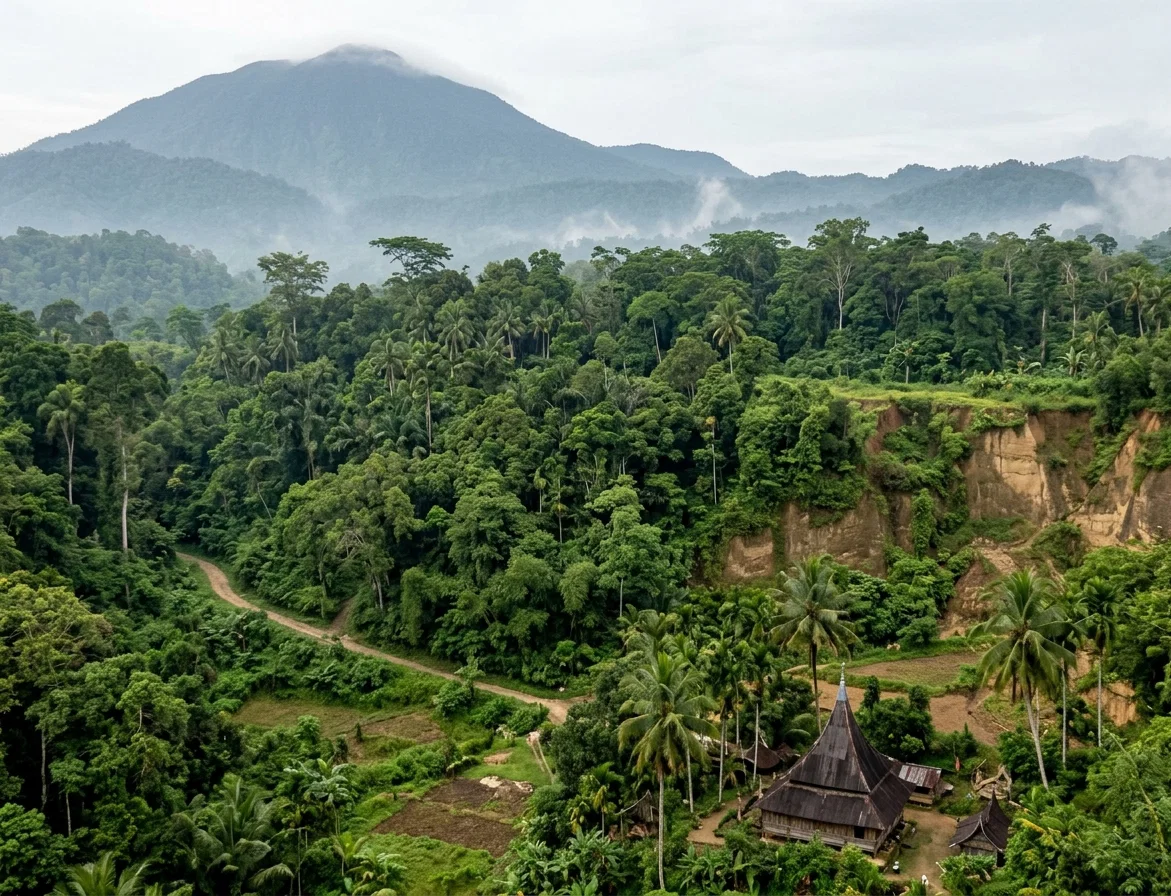
IN THE UPLANDS OF SUMATRA
But the Christian who sees the world just on the verge of the final catastrophe, and realizes the awful moral degradation of the heathen nations at their best, looks at things from a different standpoint. True, it is interesting to see representatives of so many different races, and their various costumes and customs; but when it is realized that of the vast numbers who crowd the streets of these large cities, scarcely one has any experimental knowledge of Christ’s salvation, nor the faintest idea that he is coming back to earth again, one is oppressed with feelings of sadness.
Soon after going ashore at Singapore, I called on the missionaries of the Methodist Mission (Americans), to whom I had a letter of introduction.
They treated me very kindly, and directed me to the rooms of the Singapore Temperance Club, where I obtained board and room. Probably this was the only place in the city where a person could board without being obliged to see liquor drinking almost every moment of his waking hours. These club rooms are kept up by a few men who work every day for a living, and who receive but little if any support or encouragement from the churches as such.
The day after landing was New Year’s day, and all the principal offices and shops were closed. In the afternoon I went out to see the immense crowds of people who were gathering to see the sports on the esplanade. I had before seen a few natives of these Eastern countries, but they were usually of the poorer classes as they appear in Fiji and occasionally in Australia; but they were very commonplace-looking creatures in comparison with these I saw in Singapore. Here were natives from the different parts of India,—Cingalese, Tamils, Bengalese,—dressed in their peculiar garb, though some were hardly dressed at all. Here would be seen a company of men wearing turbans, and dressed almost identically as was the custom when Christ was on earth. Some were dressed entirely in white, others in silk garments richly ornamented. The turban was generally yellow, but others were white, and some red. Next would be seen an Arab, then a Turk, each wearing the garb peculiar to his country. These nationalities usually wear the Turkish fez, which is really a badge of their Mohammedanism. Thousands of Malays were seen on every side, also the prosaic-looking Chinaman. Crowds of Indian children played in the green, most of them bright-eyed, happy-looking little creatures. Occasionally I saw little Indian girls begging, and such little mites they were. But instead of being dressed in rags as I had been accustomed to seeing beggars, they were dressed in purple or green silk, and wore considerable jewelry. Thousands of jinrikishas were dashing about in every direction; beautiful carriages, drawn by prancing horses, and carrying finely dressed pleasure seekers, drove up by the side of the esplanade; while the great, hump-backed Indian bullock plodded slowly along through the crowds, drawing his immense load of merchandise. For the first few hours the sight was fairly bewildering to one who was unaccustomed to such scenes; but I soon became used to them.
But in the midst of these novel and interesting sights I was oppressed with the thought of the dreadful moral condition of the people around me; for almost every one I saw was either a pagan or a Mohammedan. Riding down the street one day, I saw on one street corner a Mohammedan mosque, and on the next an Indian pagoda. Every morning I was awakened by the monotonous prayers chanted by Mohammedan priests in an adjoining mosque, not ten feet from where I lay. In addition to these forms of religion, and worse than all, if possible, is the fact of the spread of Romanism among these heathen, which gives another pagan religion more to be dreaded than the first mentioned, because masked under a Christian name.
Never before as now could I understand the terrible character of heathen idolatry. Before Christ’s first advent the Jews were constantly falling into this sin. At Sinai God’s voice had hardly ceased to sound before his people set up a calf of gold, and worshiped it. There seemed to be a witchery about it that they were not able to resist. When God brought his people to Canaan, he commanded them to destroy all the idols, and not even save the gold or silver on them, nor to bring them into their houses. Marriage with the heathen on the part of the Jews was strictly forbidden, lest their children should be enticed into idolatry. Deut. 7:3, 4, 25, 26. Only by resolutely banishing idols from their houses could they be kept from contamination. From the idolaters all true knowledge and understanding seemed to depart; in their minds all sense of right and wrong was confounded; and they descended to a condition scarcely higher than the gods they adored. Isa. 44:9, 18–20; Rom. 1:21–27; Ps. 115:8. This bewitching character of idol worship can be accounted for when it is considered that it brought the worshiper into communion with demons. 1 Cor. 10:18–21.
Here in the East Indies are millions of men and women who are bound to their idols as with chains of iron; to take away their idols is like taking away their lives. The sins that led ancient Israel13away from God are almost universally practiced among them—sins of unchastity. But, notwithstanding the frightful condition of the heathen of the Eastern nations (and it is not a particle different from some localities in the Western countries, nor any worse), some will yield themselves to the refining power of the Spirit of God; for the “great multitude” seen by John were from “all nations, and kindreds, and people, and tongues.” Rev. 7:9.
While at Singapore, I made a very interesting acquaintance. At my boarding place was a young man from Ceylon, who, like myself, had just arrived. He was half European and half Indian, and spoke good English as well as Cingalese and Tamil. Being an abstainer, he had come to the Temperance Club rooms to escape the sight of constant liquor selling and drinking. Seeing me, he at once recognized me as a minister, and offered assistance. In a short time we had become quite intimately acquainted. He was a Catholic, but seemed quite liberal-minded. Learning that I was a Protestant, he said, “There must be something you are protesting against.” His remark opened the way to hold a long talk with him on the subject of religious liberty, after which I gave him “Christian Patriotism.” This led to talks and studies on the signs of the times. Before he left for Borneo, I placed in his hands several publications on present truth, and, as he was a doctor, I ordered some health publications sent to him. He listened with the deepest interest to what I told him, and seemed to desire my society more than that of others. I am convinced that scattered through these heathen lands are many who are longing for something more than they get from the paganized Christianity about them. Our work should be to search them out.
After finishing my visit in Singapore, I left for Padang, Sumatra, via Java. On the steamer was a young man, a United States soldier, who had been discharged after serving through the entire Philippine war. From him I gained a great many points about the Philippine Islands that will be useful to me in the future. He was on his way to a little island north of New Britain, which he has leased for a term of years. He will be the only white man on the island, and he proposes to conduct his business according to principles of righteousness. I hope that he may be successful, as it will be a rare sight to see a place where natives are regarded as anything better than servants of the whites. I supplied him with a good stock of literature on the truth, which I hope may be as seed in good ground. I have seldom met a man who has such sensible ideas as this man on the way to treat the poor heathen natives. As he will have complete control of the island, he purposes to shut out liquor and Catholicism, but offered to let me go to the island and teach his natives. All these experiences give me new courage to push the knowledge of God’s truth into “the regions beyond.”
Our Matabele Mission
By G. W. Reaser
G. W. REASER
The writer recently had the privilege of visiting the first missionary station established by our people in Africa. In making the journey from Cape Town to Buluwayo—a distance of thirteen hundred and sixty miles—four distinct classes of country are traversed: first, the charming Cape district, bounded on the north by the Hex River Mountains, justly noted for the grandeur of their scenery; then the barren karoo, reminding one of the desert regions of Arizona, extending nearly to the Orange River, where it merges into a vast expanse of “veld,” or grass-covered prairie, reaching to Mafeking, at the northern extremity of Cape Colony; and lastly, “the bush,” or, as it would be called in America, the “scrub-timber” belt, stretching from the point last named to Buluwayo, and unbroken even then till the Central African forests are reached.
Evidences are abundant of the conflict between Briton and Boer, happily now in the past. The labyrinth of barbed wire, stretched to ensnare the bold Boer who might attempt to destroy or cross the railway at any point; the pitfalls, the alarm guns, the earthworks and trenches connecting the thousand blockhouses; the embankments and terraces thrown up at these tiny forts, ornamented with white stones and fragments of colored glass laid in almost infinite design, including figures of men and animals, and mottoes, some of which contained the words, “God save the king,” “Long live the king,” and, “Papers, please”—the latter intended as an invitation to the passengers to throw out reading matter in passing; the populous native and Boer concentration camps; the columns of British soldiers in camp and on the march; the massive, well-filled storehouses of supplies for the British army,—all of these add interest to the journey.
The monotony of the trip was relieved by breaking the journey midway, at the diamond-mining center of the world, the city of Kimberley. Here colossal works are in operation for the separation of the precious stones from the débris; and excavations, said to be the greatest ever made by man, forming cavities a quarter of a mile or more in diameter, and to the depth of fourteen hundred feet, may be seen, from which it is said that gems to the value of seven hundred million dollars have been secured.
While here, I witnessed the presentation of a richly jeweled sword to General French, as a token of gratitude from the citizens of Kimberley, for the relief he brought to that city, thereby breaking the famous Boer siege. By way of contrast, this scene brought to my mind the reward of the soldiers of the cross who will now go to the relief of those who sit in darkness and in the shadow of death, besieged by Satan, when, instead of an emblem of war, the faithful will receive crowns of rejoicing, jeweled with stars, indicating souls rescued from the enemy.
During my stay of two and one-half days in Kimberley, three meetings were held. The splendid bath rooms, conducted in an able manner by Brother and Sister Wilson, were visited, and also the resting places of Brother Mead and Sister Tripp. As we stand by the tombs of these laborers, our hearts cry out, “How long shall Death, the tyrant, reign?” The answer comes promptly from him who passed through the tomb and now holds aloft the keys of death and the grave, “It is only till I come.”14
Continuing the journey to Buluwayo, I was met at the station by Elder Sturdevant, who, with his family, and two of our native “boys” to drive the team of eight yoke of big-horned oxen, had come to take me to the mission. Arriving at the farm, thirty-five miles distant from Buluwayo, I received a cordial greeting from the workers, all of whom I met for the first time, and was made welcome to their homes.
The appearance of the mission farm was an agreeable surprise to me, as I had expected to see a barren, desolate region; but, contrariwise, although I arrived at the dry season of the year, I found the site of the homes on the farm very pleasing to the eye, as the view is extensive, and diversified with hills and valleys, kopjes, and an abundant growth of vegetation. In fact, as I wandered over the farm, it seemed to me that if this tract of twelve thousand acres were located in the suburbs of any of the great cities of the world, it would be considered almost a perfect natural park. Its great variety of flowers and grasses in their season, its many species of trees, including two varieties of mammoth cacti, and a like number of varieties of trees bearing edible oranges, inclosed in a shell, like a gourd, make it a place of interest to the botanist. Its picturesque, massive granite bowlders, many of them so delicately poised that apparently a slight touch would send them to the bottom of the hillocks which they crown, but held firmly in position by the law of gravitation; its numerous specimens of animal life; its many species of birds of beautiful plumage; and its agricultural possibilities,—all these combine to make it a place of interest to the student of nature.
But the mission farm is most attractive to persons who are interested in the science of salvation as applied to those who are in the depths of heathenism and superstition. All the other attractive features would fail to hold our workers there for a single year, as it is a place remote from civilization, and isolated from the great, busy world. Only the love of perishing souls causes our laborers to leave home and friends and native land, and devote their lives to the good work that is carried on at the mission farm.
The soil on portions of the farm will produce enyauti, a grain similar in every way to millet, but slightly larger, and much richer in flavor and nutrition, and preferred above all others by the natives for their staple dish—porridge; Kaffir corn and mealies (Indian corn), sweet potatoes, Irish potatoes, and Cape gooseberries (ground cherries) grow almost spontaneously. Nature has never caused anything like a famine at the mission since its occupancy by our people. The famine of which we have all heard was caused by the destruction of the crops and granaries of the natives by the British soldiers, as a war measure, at the time of the Matabele rebellion.
An industrial superintendent is greatly needed on the farm, to take charge of the agricultural department and the stock rearing, and to have the oversight of the native “boys” in the work which they perform to assist in supporting the school in which they are receiving an education to fit them as missionaries among their own people; thus relieving the evangelical laborers, and leaving them free to devote their undivided attention to the advancement of the spiritual interests of the mission.
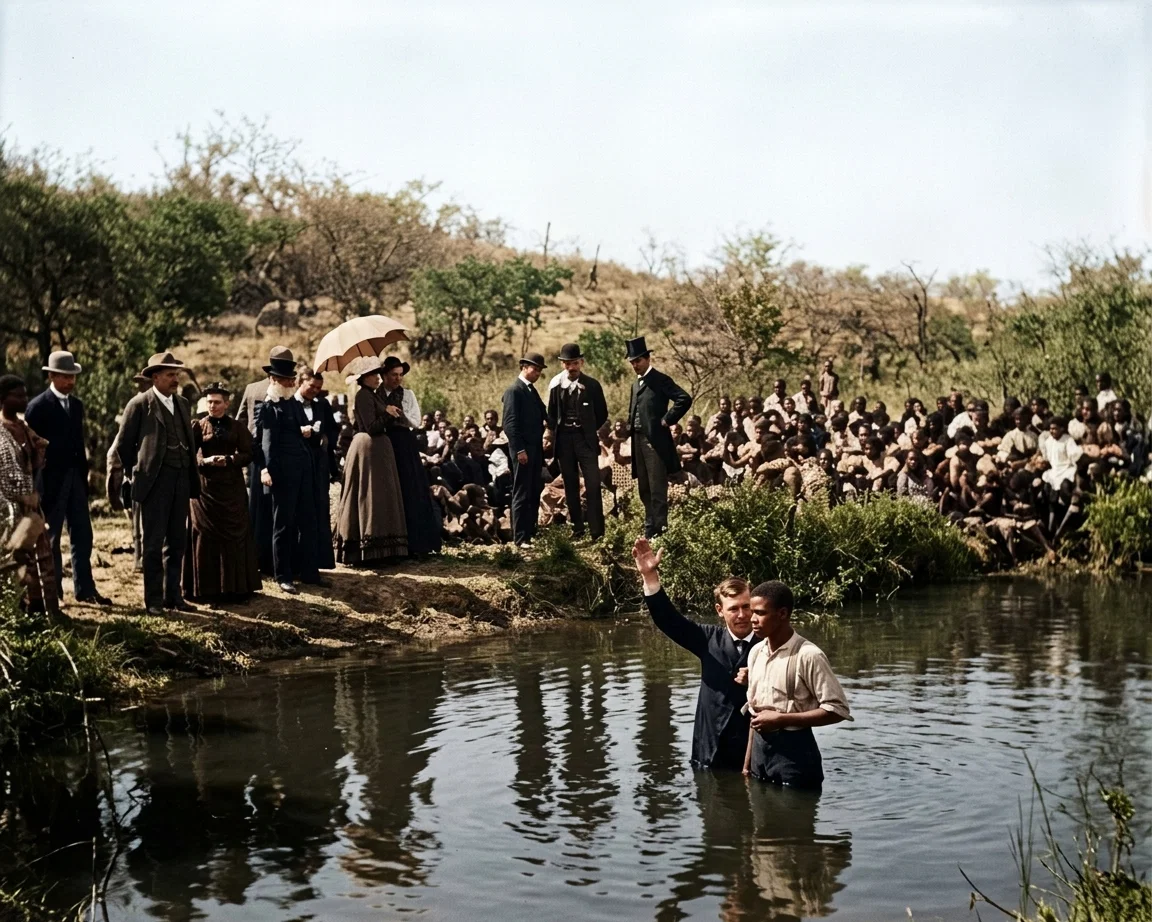
THE BAPTISM ON THE MISSION FARM
One thing which brings a shade of sadness to the visitor at the mission is the number of graves in the little cemetery near the church. It is considered by those who have been at the station longest that the death rate need not have been abnormal, in comparison with other lands, if certain safeguards had been known and properly regarded. Our brethren who have gone down in death have, as a rule, been sent to this field after they had passed the meridian of life, and it was more trying for the constitution of such than for younger persons to become acclimated to this high, subtropical climate; while some have overworked and otherwise unduly exposed themselves, thereby weakening their constitutions, so that instead of resisting the attacks of disease, they became its easy victims. All except native workers in the interior of Africa should have a change of climate for three or four months at least once in two years, and oftener if they feel that their condition requires such change. This can be secured at small expense in other portions of South Africa. We trust that the costly lessons learned will hereafter be applied, and thus hold the enemy at bay, and save lives, precious in themselves, and of great value to the cause of God.
Improvements are being made in the dwelling houses, which will make them more healthful. Packed earth floors are being supplanted by cement, which will keep out dampness in the wet season and prevent dust in the dry; and corrugated iron roofs are to take the place of the thatch now in use, as the latter holds moisture, and is, therefore, a germ incubator; nor is it rain-proof.
There is little hope of reaching the older natives with the gospel, but it is a matter of the greatest possible satisfaction to be an eyewitness of the transformation, both facial and spiritual, which the power of the gospel has wrought in their children. Some of the young men, who preach with as much freedom and power as our young white ministers, have entered the ministry. While at the mission station, it was my privilege to organize a church of twenty-nine members, twenty-two of whom were natives. Of this number, twenty-one were baptized at the time of my visit, one having previously followed the Lord in this blessed rite. There were about three hundred natives present who witnessed the baptismal scene, a number of these being indunas, who beheld their own children led into the water by Elder Sturdevant, to be planted together in the likeness of our Saviour’s death. Some came from the kraals to be baptized, well knowing that they must endure persecution on their return to their homes. Brother Sturdevant was chosen elder of this our first Matabele church, and Brother Anderson deacon.
We believe that the keynote of the true method for the evangelization of Africa has been struck at our Matabele Mission station. If it devolved alone upon the white people to carry the gospel to the millions of Africa, it would require all the workers and all the means in the denomination; but from our station a goodly corps of native missionaries will go out this year, to different parts of Rhodesia, to teach their own people the gospel, and to gather in other young men to attend the school. As these go out, they are freely supplied with homes and food at the kraals where they establish their schools, and thus with slight expense to the mission their support is assured. We should have at least one well-equipped training station, located in the most healthful and otherwise most favorable position among each of the nations of Africa, to be manned with white or educated colored laborers.
I had planned to visit Brother and Sister Armitage at Gwelo, but a severe outbreak of cattle sickness in the vicinity of their station made the risk too great in going there with the ox team, which was our only means of conveyance.
Never have I visited any branch of our work which gave me greater encouragement and more genuine satisfaction than that of our Matabele Mission station.
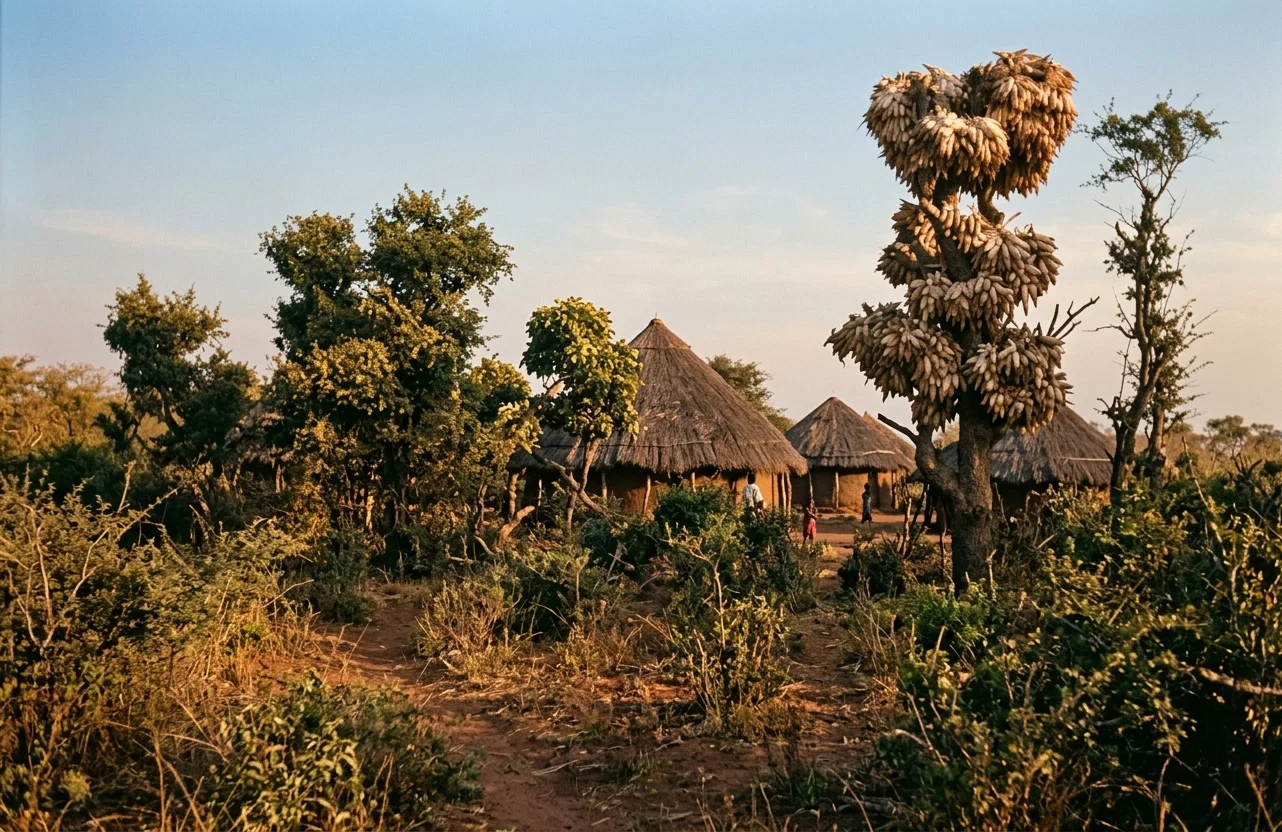
A native kraal, showing method of storing “mealies” (Indian corn). The smaller branches are cut from the trees, the mealies tied together in large clusters, and then suspended from the remaining branches.
Christ's Object Lessons Sold in Argentina
By John V. Maas
Argentina
DIAMANTE, ENTRE RIOS.— Our donation of five hundred volumes of “Christ’s Object Lessons” reached here nearly two months ago, and seventy-six copies were at once sent to me in Entre Rios. I began my work among our brethren in this place. They all felt too poor to buy, having had failure of crops so many years in succession that many scarcely knew what to offer their children when they asked for bread.
A Scripture text came to my help, and opened the way in which many are already rejoicing. It is 2 Kings 4:1-7. It was plain to me that the brethren here, as in other places, needed a part in this work for their own Christian development. Seeking the Lord for wisdom, this plan was suggested: that they make some sacrifice to buy and pay for one book. Nearly all had a great many chickens, six or seven of which would pay for one book. They could read this, and if careful, sell it to some friend, and with the money received they could buy another book, and thus continue to work. This plan was adopted, and the Lord signally blessed. Some sold chickens or geese, others sold feathers, and in two weeks we had sold more than sixty books.
Quite a number of these were sold to those not of our faith. Our people buy very readily when some plan is suggested to them which will help them to do it.
I next went to Santa Fé to visit our brethren there, and spent nearly four weeks with them. Some had not heard a sermon in German for three years, and felt quite forgotten and somewhat discouraged. Here also the Lord blessed in the study of his Word, and all bought the books, and will help sell them. We meet one great difficulty in selling the German book—there are so very few here who read German. We need this book in Spanish. I know of nothing so appropriate for these people as this book. They must hear the gospel invitation. We have simply begun the work, but already we are receiving good reports. The Lord is certainly leading in the march, and “as the will of man co-operates with the will of God, it becomes omnipotent.” This we are experiencing in our work. We are of good courage, and this week shall begin a campaign in some German colonies where none of our brethren live. We ask an interest in your prayers. JOHN V. MAAS.
S. E. WHITEIS
By S. E. Whiteis
India
CHANDERNAGOR.—There is no question as to how we shall get into the houses. When we go out, it is seldom that we are not called to enter places near by and tell about God. The women invite us in, and say, “We want to hear about God.” The men come to the house, and ask to be taught the Bible. A short time ago five boys from the college came together, and asked to be taught the Bible, so a class was formed of them. Others come alone, not wishing their friends to know. These are all Hindus.
We have been loaning the Good Health to a young man who is about to be graduated as a doctor. He became much interested in it, and as the result gave up the use of tea. He brought some of the articles before his class, and the Hindu professor said, “If that is what Seventh-day Adventists teach, they must be followers of Christ.”
We are also holding Bible readings with several European families, who seem much interested. Truly, the harvest is great, and the laborers are few.