Your ShelfYour Projects

Review and Herald, Vol. 82, No. 33.

THE MISSIONARY'S CALL

Review and Herald

Aug 17, 1905

Review and Herald Publishing Association · Washington, D. C. · Aug 17, 1905

THE MISSIONARY'S CALL

Words written about 1827 by Nathan Brown, an American Baptist Missionary to Burma, Assam, and Japan.

CHANT.

[Mendelssohn Collection, 1849.] — EDWARD HOWE, Jr.
1. My soul is not at rest. There comes a strange and secret whisper to my spirit, like a dream of night, that tells me I am on enchanted ground.
2. Why live I here? The vows of God are on me, and I may not stop to play with shadows, or pluck earthly flowers, till I my work have done, and rendered my account.
3. And I will go! I may no more refuse to give up friends and life's dear hopes, and every tie that binds my heart to Thee, my country!
4. Henceforth it matters not if storm or sunshine be my earthly lot, bitter or sweet my cup, I only pray, “God make me holy, and my spirit nerve for the stern hour of strife!”
5. And when Thou call'st me Home at last, and my frail body lies beneath the cocoa's shade, it will be sweet that I have toiled for other worlds than this.
6. And when the soul for whom the Evil One hath struggled as he hath for me, at last finds refuge on that blessed shore, O, how this heart will glow with gratitude and love.

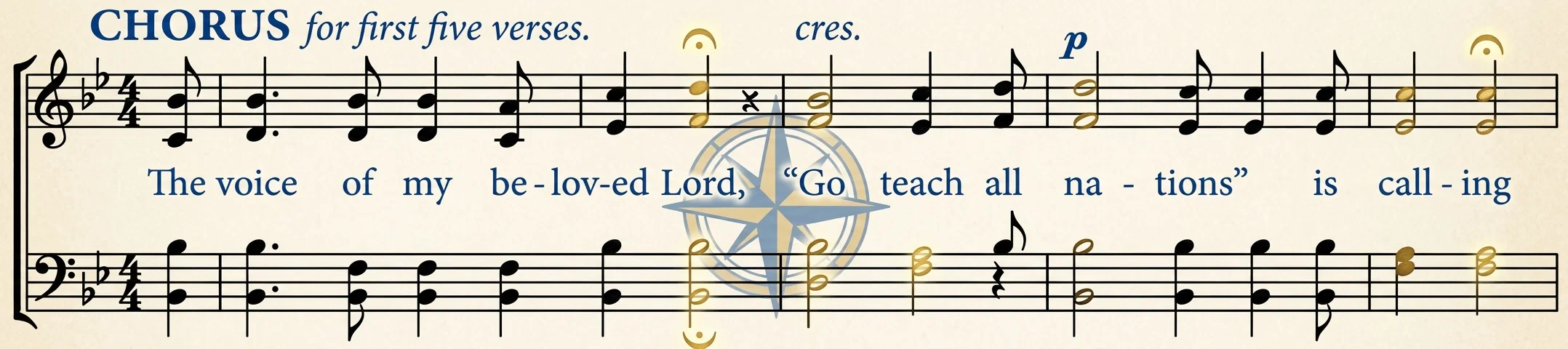
CHORUS for first five verses.

The voice of my beloved Lord, “Go teach all nations” is calling

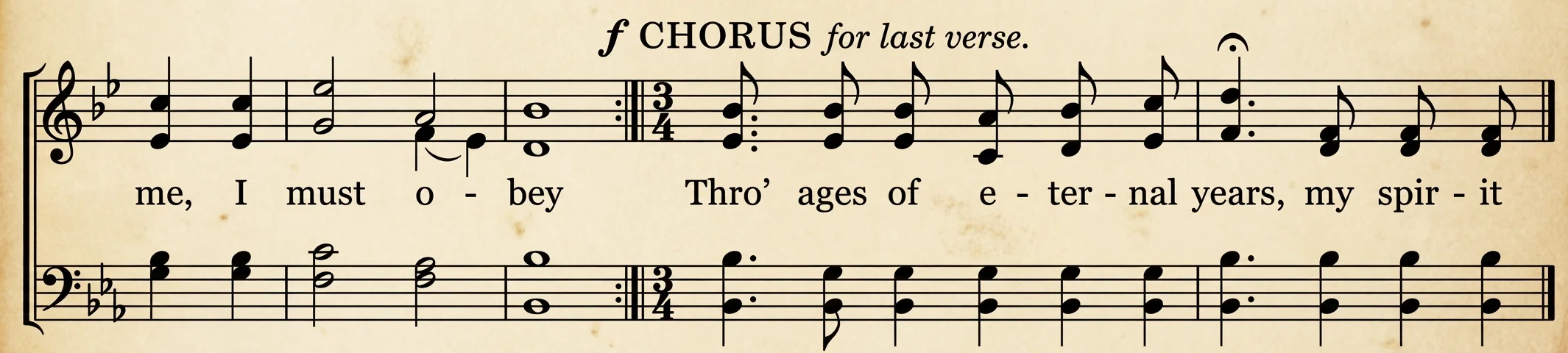
ƒ CHORUS for last verse.

me, I must obey. Thro' ages of eternal years, my spirit
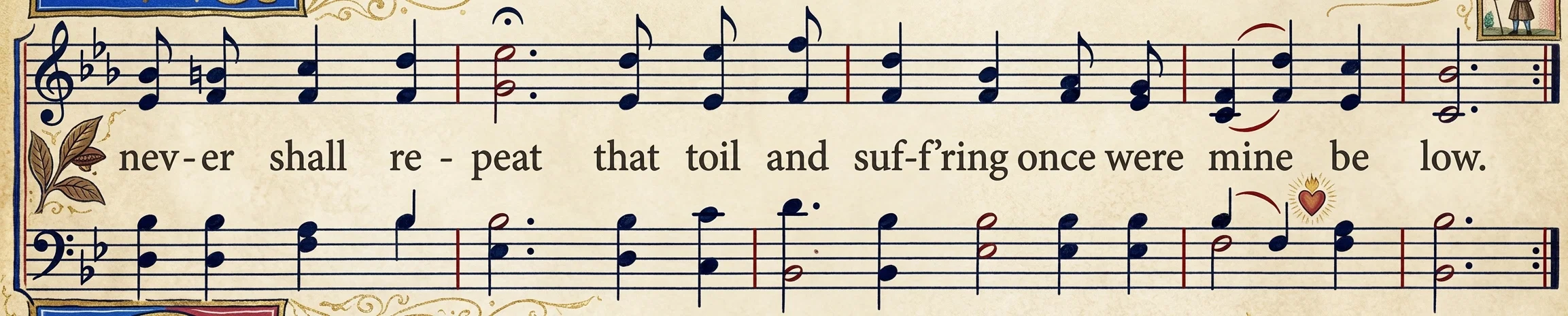
never shall repeat that toil and suffering once were mine below.
CHORUS for first five verses.

The Publishers’ Forum

Conducted by the Department of Circulation of the Review & Herald Publishing Association
ONE brother writes that he is going to act on the suggestion made in the “Forum” of August 3 in regard to preparing for work with “Desire of Ages.” A six-months’ study of the “Words and Works of Jesus,” by the Sunday-schools, in 1906, offers an excellent opportunity to introduce this most helpful book to Sunday-school workers and students. Who else will enlist?
  • *
As this number of the REVIEW begins the third year of its publication in Washington, D. C., the thousands of its devoted friends will be gratified, encouraged to continue their personal support, and to increase their energies in further extending its circulation, when they learn that during these two years the list reveals an increase of 5,000 subscriptions, and that the universal testimony of the oldest readers declares, “The REVIEW is growing better and better.”
  • *
A GENTLEMAN called at our office one day last summer and asked for a copy of the REVIEW AND HERALD. In the course of a short conversation, he said he was laid up with a broken limb for several weeks in a native hut some fifteen miles from Bulawayo, in South Africa, and the only reading-matter he had was a copy of the REVIEW he found there. He said he read it through and through, until he almost committed it to memory. Since that time he had made it a point to get a copy whenever he could, for he thought it such a good paper. Is there not some one of your acquaintances, Sabbath-keeper or not, who might be helped and encouraged by the weekly visits of this paper?
  • *
“In the morning sow thy seed, and in the evening withhold not thine hand: for thou knowest not whether shall prosper, either this or that, or whether they both shall be alike good.”
  • *
It’s a “far cry” to California to secure supplies, and this is especially true of the small leaflets which are in such demand during the tent season and the missionary campaign. So we have purchased from the Pacific Press a set of plates of the series of Signs of the Times Leaflets, and are printing an edition to supply our territory—the Atlantic and Lake Union Conferences. The series covers the most important phases of present truth, and the cost is so low that all the people can use large quantities. Prices: 100, of each (1,600 in all), $1.95; one pound, about 20 of each leaflet, 50 cents; 100 of any one kind, 15 cents; 1,000, $1.30. All prices are post-paid. Leaflets are put up in packages of 100 each; and we can not fill orders for broken packages, except in pound packages as provided above.
When you want the address of your paper changed, be sure to give both old and new address.
  • *
THIRTEEN camp-meetings are in progress this week, and we trust at every one of these definite work is being done, in harmony with the recommendation of the last General Conference, “to place the REVIEW AND HERALD in every Sabbath-keeping home.” This is the special work to be carried on in every conference “through the camp-meeting season and early fall.”
  • *
OUR friends will be pleased to know that extracts from Vol. VIII of “Testimonies for the Church” have been compiled in pamphlet form, and printed in the German, Danish, and Swedish languages. The German translation contains 144 pages; the Danish, 128 pages; and the Swedish, 136 pages. The low price of only 25 cents each brings this very important publication within the reach of all.
  • *
FOR the benefit of those who frequently desire a small book or a tract in the Japanese language we announce the literature we have in that language which can be secured from any of our publishing houses: “Glorious Appearing,” 20 cents; “The Marshaling of the Nations,” 10 cents; “New Testament Sabbath,” 2 cents; “Second Coming of Christ,” 3 cents; “The True God and His Sabbath,” 1½ cents; “The Way of Salvation,” 2 cents.
  • *
ONE of the conference presidents has just sent to the Review and Herald notice that it is his purpose to literally sow his conference with the forthcoming revised tract entitled “The Celestial Railroad,” by Nathanael Hawthorne, mention of which was made in a recent issue of the REVIEW. This will be a tract that will interest and instruct the general public. It is being printed, and advance orders may be sent in now. Thirty-two pages; price, 2 cents, post-paid.
  • *
WE have made a selection of tracts covering the principal points of present truth, and have placed them in a large envelope with an appropriate letter to the receiver from the publishers. This letter contains no names of individuals, does not reveal the source of the literature other than that of the publishers. It solicits the careful reading of the contents of the envelope. These packages may be sent to any friend who may be prejudiced against receiving literature directly from an acquaintance. They are good also to send out to individuals in whom any one may be interested. The packages will be sent, post-paid, to any address for 10 cents. Orders for these tracts sent out in this way should be forwarded directly to the Review and Herald Publishing Association, 222 North Capitol St., Washington, D. C.

Editorial

Discarding Christianity

It ought to be perfectly clear by this time to those who have followed the trend of the teaching of present-day teachers of up-to-date theology that they have discarded Christianity in favor of their own evolutionary doctrines. Indeed they are openly doing this, so that it is no longer necessary to show that the logic of their teaching will inevitably lead to this. A recent utterance of one of their representative men will illustrate the correctness of this statement. In a volume lately issued from the University of Chicago, Prof. Gerald B. Smith contributes an article on “Practical Theology,” in which, according to a published review of the book, he “proceeds to show that the majority of clergymen of the present day are, as a rule, out of harmony with modern progress, demands, and conditions, and that their greatest mistake, a mistake which they are slow and at all times reluctant to correct, lies in their endeavor to perpetuate a religion suited only to the simple peasants of a past age in the midst of conditions in which it no longer has a place.” According to the view of such men as Professor Smith, that religion which is the embodiment of love to God and to one’s neighbor, and which is expounded by its Author in the sermon on the mount, is not adapted to “modern progress, demands, and conditions,” and it is a mistake to attempt to perpetuate it in this age of the world. It is perfectly evident that the principles of true Christianity do not harmonize with the spirit of this time when iniquity abounds, and the love of many has waxed cold, but shall they therefore be discarded? This plain avowal of the attitude of the new theology toward primitive Christianity shows that the preachers of this modern religion will not be able to turn men “from darkness to light, and from the power of Satan unto God,” inasmuch as they set aside the one gospel which is “the power of God unto salvation” as not being adapted to this progressive age. Every such utterance as this by Professor Smith emphasizes the demand for the preaching of the original gospel truth as found in the third angel’s message—the one setting of the principles of Christianity which adapts them to modern conditions. Let this message be speedily proclaimed to all the world.

The Sabbath From Adam to Noah

IN renewing his subscription to the REVIEW one of our readers says:—
I have a neighbor who wishes me to tell him whether the Sabbath was kept from Adam to Noah. Will you please give an explanation through the REVIEW AND HERALD?
As an answer to this inquiry we will reprint a portion of the first article in Number 1 of Volume I of the REVIEW, then called Second Advent Review and Sabbath Herald, and dated “Paris, Maine, November, 1850.” The article is not signed, but the names of Joseph Bates, S. W. Rhodes, J. N. Andrews, and James White appear at the head of the column as the publishing committee. The title is “When Was the Sabbath Instituted?” and the whole article occupies half of the first page. We quote as follows:—
Some have contended that the Sabbath was not instituted until the law was given to Moses at Mount Sinai. But there are serious difficulties in the way of this belief. In the second chapter of Genesis, after having given an account of the creation, the sacred historian says: “On the seventh day God ended his work which he had made: and he rested on the seventh day from all his work which he had made. And God blessed the seventh day and sanctified it; because that in it he had rested from all his work which God created and made.” Now, if any part of this narrative is to be construed literally, the whole of it must be; and if we may not venture to deny or explain away the account which Moses has given of the creation, then we may not deny or explain away this unequivocal statement respecting the original institution of the Sabbath in paradise. The blessing and sanctifying of the seventh day is mentioned in connection with the first seventh day in the order of time, and it is so mentioned as most forcibly to impress the reader that the Sabbath was then instituted. God’s resting on the day is given as the reason for its sanctification; and it can not be supposed that this reason existed two thousand five hundred years before the institution. We conclude, therefore, that the Sabbath was enjoined immediately after the close of the work of creation.
This opinion is corroborated by some facts recorded in the Scriptures. There are frequent and early notices of reckoning by sevens. Noah observed a period of seven days in sending the raven and dove from the ark; the term week is used in the contract between Jacob and Laban; Joseph mourned seven days for his father; and Job and his friends observed the term of seven days.
Nor is it in the sacred volume or among the Jews alone that such facts are found. Nearly all the nations of antiquity were acquainted with the weekly division of time: The Assyrians, Egyptians, Indians, Arabians, and, in a word, all the nations of the East, have in all ages made use of a week of seven days. And we find that these nations not only divided time thus, but that they regarded as holy the very day which had been sanctified as a Sabbath, although they had forsaken the true worship of God. Homer, Hesiod, and Callimachus, say, “The seventh day is holy.” Theophilus of Antioch says, respecting the seventh day, “The day which all mankind celebrate.” Josephus asserts that “no city of Greeks or barbarians can be found, which does not acknowledge a seventh day’s rest from labor.” And Philo says that “the Sabbath was a festival not peculiar to any one people or country, but so common to all mankind that it might be called a public and general feast of the nativity of the world.” These authors, who lived in different ages and were of different nations, can not be supposed to have written thus in order to please the Jews, who were generally despised and persecuted; and this universal reverence for the seventh day can not be accounted for upon any other supposition than that the Sabbath was instituted at the close of creation, and handed down by tradition to all descendants of Adam.
It is plain that there is nothing new under the sun. The objection which is raised against the Sabbath in 1905 was brought forward and answered in 1850, and it seems fitting that those who defended the truth in those early days of the message should be permitted to bear their testimony to the objectorsof this day—more than half a century after they first presented their views to the world. They gave clear and convincing reasons for their position then, and the ground then taken has never been abandoned.
We hope this plain statement of the facts concerning the institution of the Sabbath will be helpful to the neighbor who asked concerning the matter, and that he will decide to join those who, as a testimony to their loyalty to the Creator of heaven and earth are resting on the Sabbath day according to the commandment.

Demolishing the Old Picture

UNDER the plea that certain phases of “nature study” should be given a place in Sunday-school teaching, Mr. W. S. Jackman, of the School of Education of Chicago University, contends that Sunday-school pupils should be taught the conception, which “science has created,” of “the origin, the development, and the destiny of nature, and of man’s place in the great plan.” This would involve the teaching of the Darwinian theory, which, he says, “certainly has more points in its favor regarding the history of life than any other,” and which “completely demolishes the old picture which was very firmly established in our minds in our early years through the teaching of the Sunday-school.” Such teaching will, he sees, “give the child an entirely different point of view from that received by those of us who learned its lessons a quarter of a century ago.”
Mr. Jackman then shows us the connecting link between the Darwinian, or evolutionary, theory of man and the “new religion,” the central idea of which is to substitute a human savior in the place of the divine Saviour by teaching men to look for divinity within themselves. “What, in the old conception, was the story of man and nature,” he says, “we now regard as the story of man in nature.” According to this conception, man finds himself in the grasp of certain natural laws from the influence and control of which there is no escape; so that “human actions and their consequences” have their origin in “natural laws that are as rigid and as immutable” as the law of gravitation. Salvation for mankind is to come through gaining and applying a knowledge of these laws. This leads up to Mr. Jackman’s statement of his conception of redemption, of which he says:—
I believe in the great doctrine of redemption. When imbued with the new religion, every man will become a savior of the weak and the needy. Man will not only become his brother’s keeper, he will become in truth his redeemer.
If men would read and believe the plain statements of the Bible, they would find that there is nothing new in the idea of saving men from the results of ignorance and violation of the laws of nature, and of being helpful to one another by this means. All this is provided in the gospel plan of life, and not only that, but the most effective agency for its accomplishment—charity, loving one’s neighbor as one’s self—comes from the gospel only. The tree of science yields little of the fruit of charity. The world is rich in scientific knowledge, but it is poor in love; and for that reason it is full of selfishness and full of suffering. But the gospel provides more than this. Many men need a redeemer, but all men need, and need most of all, a Redeemer. And for this reason they can not afford to dispense with the old religion, nor to accept any new religion which does not provide a Redeemer who saves people from their sins.
L. A. S.

“The Wild Solar Holiday”

‘The Use of Sunday,’ is a topic considered by Rev. Edward Everett Hale in a recent issue of the Christian Register. Mr. Hale considers Sunday as a holiday, and inquires whether “we” have “as yet hit on the best ways” in which the public “can use its summer Sunday holiday.” He rightly discerns that the first-day institution rests upon a wholly different basis from that of the Sabbath of the fourth commandment.
“The consecration of Sunday is,” says Mr. Hale, an “offering, or tribute, which this nation of ours makes one day in seven to religion.” The observance of the seventh day is an offering made to God,—a recognition of the day as belonging to God, of his right to call it “My holy day.” God does not call the first day his holy day, hence Sunday observance does not call the worshiper’s mind to the Word of God, give opportunity for the exercise of faith in that Word, or for a manifestation of loyalty to God by rendering to him what is his.
Mr. Hale recognizes Sabbath observance as a vital part of the worship of God, by saying: “No act or word by which a subject can defer to a king, or a child to his father, or the thing made to the maker, can be conceived which should be a more distinctive tribute than is this offering, or gift, of one day from every seven.” The true Sabbath, however, is not an offering, or gift, from man to the Creator, but from the Creator to man. “Moreover also I gave them my Sabbaths, to be a sign between me and them.” Eze. 20:12.
“By a sort of common consent,” says Mr. Hale, “the community at large leaves the use of this holiday—for holiday it is—to the direction of the people who are called the clergy of the country.” Not so of the seventh day, “the Sabbath of the Lord.” The proper use of that day is plainly specified in the law of God, and it is not left to any human authority to devise ways for its observance.
Mr. Hale relates that on a beautiful summer Sunday in a New England town, he attended the service at the leading church in the place, and made note of the fact that “thirty-five people wanted to spend an hour of Sunday in that way,” while “the rest of the population of the town, and a thousand or two ‘boarders’ who were in the town, had devised other methods;” which leads him to doubt “whether the class of the clergy to whom the American people has entrusted this affair is doing the best it can for the profitable use of the immense privilege which the American people has put into its hands.” Evidently sabbath observance is not prospering under their administration of the trust which they assume to hold.
The testimony of this eminent clergyman, and of many others who might be cited, shows that the Christian church has wandered away from the standard of true Sabbath observance, and is adrift upon an uncharted sea of speculation. The only remedy is to return to the day God specifies as his, and to the Word of God as the infallible authority and guide in its observance. L. A. S.

The Plan to Work To

THREE new countries are now to be entered. This cheering word comes, too, at a time when the Mission Board must hold back some workers on account of lack of funds for missions.
The new fields are to be entered without adding to the roll of workers. Older missions, themselves needy fields, are sharing help so that lands entirely neglected may have at least a witness for the message.
Algeria, in northern Africa, is to be opened by Brother and Sister Jesperson, transferred to that field by the Latin Union Mission in its recent conference in Switzerland.
Hayti, the French-speaking republic just off our own shores, is to be entered by Elder W. J. Tanner, transferred from Jamaica.
Bolivia, that great inland state of the South American republics, hitherto one of the most inaccessible of countries, is to be opened at once by colporteurs from Chile, who plan to make it a permanent occupation of the country.
There is a forward movement on in this work which even a shortage of mission funds can not stop. If in a time of shortage, when the Board must counsel delay and retrenchment in all the fields, three new lands are added to our missionary list, what might not be done if eighty thousand people bent every energy to the hastening on of the advent message? It might be said in a twelve-month that there was scarcely a land left without at least a witness. It is a most inspiring plan to work to, for when this message has been carried as a witness to all nations, the end will come. There is no other way of finishing this work, but this way will finish it. It is the Lord’s own plan.
W. A. S.

America’s Loyalty to the Roman Catholic Church

In the Washington Post of Aug. 1, 1905, there appeared an account of an audience which the pope had on July 31 with a company of American pilgrims. After giving his hand to each member to kiss, he made quite a long address, saying that he loved all Americans, even the non-Catholics, the latter for the liberty they allow the church. He concluded by saying:—
America has a good right to be called the eldest daughter of the church, for, although she entered last among the nations, she has given proof of her loyalty, devotion, and tolerance. The Catholics in America are not only protected, but respected.
When the pope spoke of the proof of America’s loyalty and devotion, he doubtless had in mind such things as the governmental appropriations which have been made toward Roman Catholic sectarian schools among the American Indians; the Supreme Court decision that this is a Christian nation based on various Catholic documents; the choice of a Roman Catholic on the board of arbitration in the settlement of the great coal strike in 1902; the appointment of Secretary Taft in adjusting the difficulties in the Philippines; and the deference shown to the prelates of the Catholic Church on occasions of great governmental functions, such as the inauguration of presidents, etc.
Further along this line, the Literary Digest, in quoting from Harper’s Weekly, says that “two members of the cabinet, a justice of the Supreme Court, and representative legislators and military and naval officials sat down at dinner with an Italian member of the College of Cardinals, at which he was the guest of honor, and a member of the cabinet the host; nor has any previous president ever welcomed a Roman Catholic Italian prelate as cordially as President Roosevelt recently welcomed Cardinal Satolli.”
The Boston Republican, a Roman Catholic paper, when speaking of the help the Roman Catholics rendered President Roosevelt at his last election, says:—
There was good reason why the Catholic Church authorities should have been friendly to Mr. Roosevelt. When the truth is told, he has easily been the one man in the president’s chair who has insisted upon righteous dealings with the various governmental problems in which the Catholic Church has been vitally interested.
The pope also is not unmindful of America’s loyalty and devotion to the Sunday institution, which she claims as the badge of her authority. America certainly is showing her devotion toward this institution, for, at the present time, forty-three of the forty-five States have Sunday laws, and at nearly every session of the United States Congress an effort is being made to get Congress to commit itself to Sunday legislation in order that a national Sunday law may be secured. Already one of the Supreme Court judges has plainly indicated that the Supreme Court would stand for Sunday legislation.
It is not surprising that the pope should express his love for Americans when receiving such considerate treatment from them. Pope Leo in an encyclical a few years ago expressed not only his love, but his “burning love” toward the Americans. It might be remarked in this connection that there were many people in the past ages who could testify, were they to arise from their silent graves, to Rome’s “burning love.” Many martyrs around whom the fagots were lighted, gave evidence of their loyalty and devotion to God until the flames of this “burning love” had taken away the last evidence of life.
It should never be forgotten that these faithful saints and martyrs of God in the past never showed their loyalty and devotion to Rome, nor will those who are loyal and faithful to God to-day do so. Instead of these expressions of love and other beautifully worded addresses of the pope causing Americans to think that, after all, the great Protestant movement inaugurated by Luther and others was a mistake, they should be aroused and alarmed at these endearing expressions coming as frequently as they do from the Vatican, and should seek, with greater earnestness, to warn the people, as God has commanded us, against the worship of the beast and his image. K. C. RUSSELL.

Envelopes for Tithes and Offerings

THE late session of our General Conference should mark a new era in the progress of our denominational work.
This conference was distinctly a missionary conference. From nearly every mission field a leading representative was present to speak upon the growth of the cause in his territory, and the needs of the field for more aggressive work.
These men spoke with power; they knew the needs of the various fields. They were well acquainted with the superstitions, the darkness, the ignorance, and the degradation of these benighted lands.
They knew full well what the gospel can do for these poor souls. They had seen the soul transformation that takes place when the darkness of heathenism has given place to the light of the third angel's message. No heart that listened to these soul-stirring reports was untouched with a desire to render the long-delayed help.
The delegates themselves responded to these appeals in every possible way. Day by day large delegations spent hours in earnest committee work, studying plans and methods for securing more means for the work in these benighted lands.
It seemed incredible to all, that conditions should continue as they have for the past few years, and so small an amount of funds be raised for the work in the regions beyond.
The General Conference while in session passed the following recommendations to secure more funds for the mission fields as well as to increase the tithes paid to the local conferences:—
That suitable envelopes of uniform size and quality, with texts and other reading similar to the attached copy, be provided by the General Conference, at small expense, for use in all the churches for the purpose of securing regularity and uniformity in taking up the weekly offerings and in the collection of the tithe weekly.

TITHES AND WEEKLY OFFERINGS

“YE SHALL CELEBRATE MY SABBATHS”
“O worship the Lord in the beauty of holiness.”
“Bring an offering, and come into his courts.”
For God hath said, “They shall not appear before the Lord empty. Every man shall give as he is able, according to the blessing of the Lord thy God.”
“Bring ye all the tithe into the storehouse . . . and prove me. . . . I will pour you out a blessing, saith the Lord.” “Will a man rob God?”
Tithe ........................................ $.....
Foreign Missions .......................... $.....
Literature in Home Fields ............... $.....
For Needy Poor ............................ $.....
Church Expense ........................... $.....
“God loveth a cheerful giver.” “Honor the Lord with thy substance.”
“There is that scattereth, and yet increaseth.”
“Well done. . . . Enter thou into the joy of thy Lord.”
Name ................................................
Address .............................................
These envelopes are now ready. The General Conference Treasury Department has had one million envelopes prepared for general distribution.
Many States have already placed their orders. Others should send in their orders at once. These envelopes are to be distributed each Sabbath for the peopleto take home, and during the week they are to place within the envelope their tithes, and offerings for all purposes, taking pains to write opposite each item the amount enclosed for each specific offering. If there is fifty cents of tithe, mark down opposite Tithe, fifty cents; if twenty-five cents for missions, write it down opposite Foreign Missions, and so on to the end. Be sure to sign your name, and bring your envelope to the Sabbath meeting.
We believe if each of us will adopt this plan, we shall find it will greatly increase the tithe and offerings for both home and foreign work.
Will not every church at once write to its State secretary for a good supply of these envelopes, and let us get this plan in operation at the earliest possible date?
Remember, each individual is to have an envelope every Sabbath, and bring it back with his tithe and offerings enclosed the following Sabbath. Thus each Sabbath there will be envelopes given out, and envelopes taken up. We would suggest that the envelopes be distributed and the collection gathered each Sabbath right after prayer, before the second song is sung. Of course all will take the offering when most appropriate, and need not follow this suggestion.
We trust this plan will greatly increase both the tithe and the offerings.
I. H. EVANS.

Divinity Concealed in Man

A RECENT issue of the New York Staats Zeitung contains an article on “Sects and Schisms in Russia,” contributed by Dr. A. Serbin. Among the various religious sects described is one of which it is stated:—
The members of another sect, the Christs, have discovered that every member is God, and they call themselves the Sons of God. Divinity is concealed in every man, so reads their fundamental tenet, and the chief ceremony is mutual adoration.
“Divinity concealed in every man,”—this is the same discovery that has of late been made by many in lands favored with a higher degree of culture and civilization. But in these simple-minded Russians the doctrine has had free course to blossom and bear its natural fruit, and the result is that among them “the chief ceremony is mutual adoration.” We must again record our opposition to this idea of looking within the human to find divinity.

L. A. S

In a defense of Sunday legislation the United Presbyterian says:— The purpose of law . . . is not to make men good, but to protect society in its rights, and to punish those who have no regard for the convictions of the majority. The purpose of a Sabbath law is not to make men religious, but to protect an institution which God has established, and which inheres in the very nature of man.
This is a sample of the loose reasoning which so naturally goes with an attempt to justify that which is unjustifiable.
The purpose of law is truly “to protect society in its rights,” but in the very next sentence the Presbyterian says that the intent of the Sabbath law is “to protect [not rights, but] an institution.” There is a vast difference between the two. That is just the trouble with the Sunday law. It is designed to protect an institution, and to protect it, if need be, at the expense of human rights. There is no right of man more necessary and more sacred than the right to labor, for it is upon labor that life itself depends. The Sunday law invades this right; and it forbids labor for the sole reason that labor is contrary to the religious aspect of the day.
The Sabbath is truly “an institution which God has established;” but that this institution is protected by protecting Sunday is pure assumption. God, the author of the Sabbath, has nowhere said so.
This institution which God has established, moreover, can not be protected by the laws of men, but rests upon the law of God himself. He has established it by his own law, and only as that law is kept is the Sabbath truly observed. But the law of God can not be kept by any but those who have experienced conversion; for it is written, “The carnal mind is enmity against God: for it is not subject to the law of God, neither indeed can be.” Rom. 8:7. No human law can enforce the law of God.
Neither is it evident that the Sabbath institution “inheres in the very nature of man.” If it did, it would naturally assert itself in the practises of men, just as pride, the necessity of eating and sleeping, and other things which inhere in human nature, assert themselves; and no law in its behalf would be necessary. The keeping of the Sabbath, and of all God’s commandments, inheres in the divine nature, but there is not one of God’s laws or institutions that inheres in the carnal nature. The Sabbath is of no use to any one whose heart is at enmity with God’s Sabbath law. This is self-evident; and therefore a human Sabbath law can be considered of use only upon the assumption that people can be made Christians by law. There is only one law that can change the sinner into a Christian, and that is “the law of the spirit of life in Christ Jesus.” Rom. 8:2.
The purpose of law, as before stated, is to protect people in the enjoyment of their rights; but Sunday laws assume to protect one right—the right of rest—by invading another—the right to labor. This can not be done. In no right are people more entitled to the protection of law than in the right to work,—to do that which is necessary to provide a living for themselves and those dependent on them. Sunday laws do, beyond question, invade this right. They assume, on the other hand, to protect rights, but this is only an assumption, the real truth being, as the Presbyterian stated, that their purpose is to “protect an institution.” An institution which can be protected only at the expense of human rights is certainly not one which God has instituted, and by the same token it is an institution which has no right to exist at all. If either God-given, inalienable rights or an institution must be sacrificed, let it be the institution.

L. A. S

Note and Comment

MANILA dispatches dated August 10 tell of a banquet given to Secretary Taft, by the archbishop of Manila, on the secretary's arrival there, at which the archbishop made a speech, extending to Secretary Taft the welcome of the Catholic bishops and clergy, and said he felt that the visit would become significant. Other features of the occasion were a speech by Secretary Taft, in which he said that the government of the United States had come into closer relationship with the Catholic Church, and a speech by Bourke Cockran, paying “a glowing tribute to Catholicism.”
Thus the governmental affairs of the United States and the religion and work of Rome continue to be commingled, and the line of separation between them to be obscured. This began at the beginning of the American occupancy of the islands, and the straws show that the direction of the current has not changed.
Continue reading: Protestantism and Scriptural Authority