THE REV. C. A. BRIGGS, once a well-known clergyman of the Presbyterian Church, but now near the end of a migration from that church to Rome, says that “the common doctrine of the present Protestant theologians would not be recognized by any of the Reformers.” The defection of Dr. Briggs and of others like him from Protestantism, is itself an evidence that the Protestantism of the churches of this day is not the Protestantism of Luther and of Wesley. Names and forms are left, but the vital spirit is gone, or is fast going. The Protestantism of the Reformers was anchored to the authority of the Word of God. Latter-day Protestantism has been led by the “higher criticism,” and other agencies of evil to question the infallible authority of that Word, and as a consequence Protestants are now seen turning for refuge to an “infallible” pope. Men like to feel solid ground beneath their feet, and when they lose faith in the infallibility of the Scripture, they naturally turn to the papal church as the only other authority that claims to be free from the possibility of error. But to those who receive God’s Word “not as the word of men, but as it is in truth, the word of God,” it remains “an anchor of the soul, both sure and steadfast.”
Thoughts of God
By J. B. S. Monsell
I THINK of thee, my God, by night,
And talk of thee by day;
Thy love my treasure and delight,
Thy truth my strength and stay.
The day is dark, the night is long,
Unblest with thoughts of thee,
And dull to me the sweetest song
Unless its theme thou be.
So all day long, and all the night,
Lord, let thy presence be
Mine air, my breath, my shade, my light,
Myself absorbed in thee.
— J. B. S. Monsell.
MRS. E. G. WHITE
By Ellen G. White
Lessons From the Life of Solomon — No. 1
MRS. E. G. WHITE
I HAVE been instructed by the Lord to call the attention of our people to the history of Solomon. From the record of his reign we may learn many lessons helpful in avoiding the paths that led to Israel’s downfall.
The early life of Solomon was bright with promise. He chose the wisdom of God, and the glory of his reign excited the wonder of the world. He might have gone on from strength to strength, from glory to glory, ever approaching nearer the similitude of the character of God.
The Kingdom of Israel in Solomon’s Time
In the reigns of David and Solomon, Israel reached the height of her greatness. Solomon was anointed and proclaimed king in the closing years of his father David, who abdicated in his favor. After the death of David, “Solomon was king over all Israel.” At this time “Judah and Israel were many, as the sand which is by the sea in multitude.”
Extent of the Kingdom
“Solomon reigned over all kingdoms from the river [Euphrates] unto the land of the Philistines, and unto the border of Egypt: they brought presents, and served Solomon all the days of his life. . . . He had dominion . . . over all the kings on this side the river [Euphrates]; and he had peace on all sides round about him.
“And Judah and Israel dwelt safely, every man under his vine and under his fig-tree, from Dan even to Beersheba, all the days of Solomon.”
“Hiram king of Tyre sent his servants unto Solomon; for he had heard that they had anointed him king in the room of his father: for Hiram was ever a lover of David.”
“Solomon the son of David was strengthened in his kingdom, and the Lord his God was with him, and magnified him exceedingly.”
The promise given to Abraham and repeated through Moses was fulfilled: “If ye shall diligently keep all these commandments which I command you, to do them, to love the Lord your God, to walk in all his ways, and to cleave unto him; then will the Lord drive out all these nations from before you, and ye shall possess greater nations and mightier than yourselves. Every place whereon the soles of your feet shall tread shall be yours: from the wilderness and Lebanon, from the river, the river Euphrates, even unto the uttermost sea shall your coast be. There shall no man be able to stand before you.”
Solomon’s Opportunity
The last great work of David, in his official position, was to call the attention of the people once more to their solemn relation to God as subjects of his theocracy. Summoning the princes of Israel, with the representative men from all parts of the kingdom, he delivered, in their presence, an inspired charge to his son, vesting him with kingly authority, and bidding him perform faithfully the duties devolving upon him. “Know thou the God of thy father,” the aged monarch pleaded, “and serve him with a perfect heart and with a willing mind; for the Lord searcheth all hearts, and understandeth all the imaginations of the thoughts: if thou seek him, he will be found of thee; but if thou forsake him, he will cast thee off forever. Take heed now; for the Lord hath chosen thee to build an house for the sanctuary: be strong, and do it.”
Through obedience, the Israelites could have stood at the head of the nations of the earth. God would have made them “high above all nations which he hath made, in praise, and in name, and in honor.” “All the peoples of the earth,” said Moses, “shall see that thou art called by the name of Jehovah; and they shall be afraid of thee.” “The nations which shall hear all these statutes” shall say, “Surely this great nation is a wise and understanding people.”
None understood these promises better than David. By his own experience he had learned how hard is the path of him who departs from God. He had felt the condemnation of the broken law, and had reaped the fruits of transgression; and his whole soul was moved with solicitude that the leaders of Israel should be true to God, and that Solomon should obey God’s law, shunning the sins that had weakened his father’s authority, embittered his life, and dishonored God. David knew that it would require humility of heart, a constant trust in God, and unceasing watchfulness, to withstand the temptations that would surely beset Solomon in his exalted station; for such prominent characters are a special mark for the shafts of Satan.
When he felt that death was approaching, the burden of David’s heart was still for Solomon and for the kingdom of Israel, whose prosperity must so largely depend upon the fidelity of her king. “And he charged Solomon his son, saying, I go the way of all the earth: be thou strong therefore, and show thyself a man; and keep the charge of the Lord thy God, to walk in his ways, to keep his statutes, and his commandments, and his judgments, and his testimonies. . . . that thou mayest prosper in all that thou doest, and whithersoever thou turnest thyself: that the Lord may continue his word which he spake concerning me, saying, If thy children take heed to their way, to walk before me in truth with all their heart and with all their soul, there shall not fail thee (said he) a man on the throne of Israel.”
O, what an opportunity was Solomon’s! He was to be not merely a warrior, a statesman, and a sovereign, but a strong, good man, an example of fidelity, a teacher of righteousness. With tender earnestness David entreated Solomon to be manly and noble, and to show mercy and loving-kindness to his subjects. The many trying and remarkable experiences through which David had passed during his lifetime, had taught him the value of the nobler virtues, and led him to exclaim: “He that ruleth over men must be just, ruling in the fear of God. And he shall be as the light of the morning, when the sun riseth, even a morning without clouds; as the tender grass springing out of the earth by clear shining after rain.”
Had Solomon followed the divinely inspired instruction of his aged father, his reign might have been indeed a reign of righteousness, so beautifully described in the seventy-second Psalm:—
A Reign of Righteousness
“Give the king thy judgments, O God,
And thy righteousness unto the king’s son.
He will judge thy people with righteousness,
And thy poor with justice.
The mountains shall bring peace to the people,
And the hills, in righteousness.
He will judge the poor of the people,
He will save the children of the needy,
And will break in pieces the oppressor.
They shall fear thee while the sun endureth,
And so long as the moon, throughout all generations.
He will come down like rain upon the mown grass,
As showers that water the earth.
In his days shall the righteous flourish,
And abundance of peace, till the moon be no more.
He shall have dominion also from sea to sea,
And from the River unto the ends of the earth.
They that dwell in the wilderness shall bow before him;
And his enemies shall lick the dust.
The kings of Tarshish and of the Isles shall render tribute:
The kings of Sheba and Seba shall offer gifts.
Yea, all kings shall fall down before him;
All nations shall serve him.8For he will deliver the needy when he crieth,
And the poor, that hath no helper.
He will have pity on the poor and needy,
And the souls of the needy he will save.
He will redeem their soul from oppression and violence;
And precious will their blood be in his sight;
And they shall live; and to him shall be given of the gold of Sheba:
And men shall pray for him continually;
They shall bless him all the day long.
There shall be abundance of grain in the earth upon the top of the mountains;
The fruit thereof shall shake like Lebanon:
And they of the city shall flourish like grass of the earth.
His name shall endure forever;
His name shall be continued as long as the sun;
And men shall be blessed in him;
All nations shall call him happy.
“Blessed be Jehovah God, the God of Israel,
Who only doeth wondrous things:
And blessed be his glorious name forever;
And let the whole earth be filled with his glory.
Amen, and Amen.”
Solomon’s entire history might have been in accordance with this inspired prophecy. Exalted to a position of sacred trust, he for a time heeded the wise counsels of David, and brought glory to the name of the God of Israel. But the later years of his reign were marred by pride, self-sufficiency, self-exaltation. Desire for political power and self-aggrandizement led him to form alliances with heathen nations. The silver of Tarshish and the gold of Ophir were procured at a terrible expense, even the sacrifice of integrity, the betrayal of sacred trust. Association with idolaters corrupted his faith. One false step led to another, until there was a breaking down of the barriers that God had erected for the safety of his people.
Gradually, yet surely, Solomon’s life was corrupted by conformity to worldly customs. Looking to the standards of right followed by heathen nations, he began to lose sight of the standard of God’s law. Uniting in marriage with worshipers of false gods, at last he gave himself up to idolatry. A character that had been pure and elevated, became marred and degraded. The mind that was once given to God, and inspired to write the precious words of wisdom found in the book of Proverbs,—that noble mind, through evil associations and constant indulgence, became weak in moral power. Solomon dishonored himself, dishonored Israel, and dishonored God.
Sad as is the story of Solomon’s apostasy, it portrays the result of separation from God. One false step prepares the way for a second and a third, and every additional step is taken more easily than the last. It is our privilege to take heed to the God-given warning of Solomon’s life. As followers of Christ, we are to honor our Master by studying and obeying his teachings. We are to manifest our love and fear of God by refusing to conform to the world’s standard of right. Let us beware of departing from the simplicity of our faith. The Christian’s standard of right must ever be the standard that is given in Holy Writ. Constantly we are to guard against every worldly influence that would weaken us in moral power.
Introduction
By M. E. KERN
M. E. KERN
The Bible is the Book of books. Written by no less than thirty-five authors, extending over a period of a millennium and a half, yet it is the same sweet message of salvation in every part. It is the message of God to humanity.
But the Bible has not always been received as the word of God. It has been the object of most powerful attacks; yet it has stood the storms of centuries, and, like the mighty rocks on the ocean's shore, is only polished by the waves that beat against it. In the last great conflict—the greatest spiritual battle of the ages—a conflict in which we all have a part—God's Word will be no less an object of attack. All the subtilty and power that the forces of darkness can command will be brought into operation to weaken the hold of God's Word upon the people. Through science, so called; through history and destructive criticism; through mystical philosophies; and in a multitude of ways, Satan will seek to overthrow the Word of God. Yet, while the forces of darkness have been gathering for the last conflict, God has prepared his witnesses. And it is our duty, who know God, to be ready always to give a reason for the hope that is within us. It is our duty to study to present the truth in such a way as to meet men under all conditions.
As an illustration of what I mean, I remember an instance where one of our ministers tried to talk with a man on present truth. The man stated at once that he did not believe the Bible; whereupon the minister said he had nothing more to say. In other words, the man must accept the Bible as the inspired word of God before the minister would proclaim to him the message. We shall pass a great many by in this world if we require that they first accept the Christian's Bible.
We judge men in two ways,—by what others say of them, and by what we ourselves find them to be. So with the Bible there are two lines of proof of its authenticity,—the outward proofs, such as miracles, prophecy, and history; and the internal proofs, or the demonstration of the soul. The first line of proof is good, but the second is better, and is all-sufficient. And it is this line of proof that is accessible to all, regardless of scholarship or learning. If this outward proof were absolutely necessary, the Bible would not be supreme, because dependent on authority outside of itself. It demands acceptance on its own merits, and contains within itself the assurance of its authenticity. External proofs, however, may serve as lights to direct to the Bible the feet of those who refuse at first to recognize the light of the Bible itself, but that is all.
It is to one of these side-lights that I wish to direct your attention. A recent writer says that “perhaps the most remarkable event in the history of modern Christianity is the unexpected confirmation of Bible truths from the hands of what seemed to be its arch-enemy, modern science.”
The past century has been distinctively one of scientific investigation. Since the days of the Reformation man's mind has been freeing itself, and refusing to accept dogmas either in science or religion9on authority merely. Everything has been tested by the fires of criticism, the Bible not excepted. Its claim to be such an old book challenged investigation, and, depending only on human resources of course, the Bible one hundred or even fifty years ago, was ruled out as a book of genuine history by these critics because there was no contemporaneous evidence, that is, there were no writings that were so old or told the same story. The Bible stood alone, and told of nations and peoples and civilizations far anterior to anything known to historians. With great display of scientific knowledge, the skeptic declared that genuine history could not reach back so far. Books were written to prove that the Bible was not in accord with history. Many illustrations of the arguments of these books might be given. Two will suffice.
A MAP OF BIBLE LANDS
Our critics said there was no evidence of the existence of a nation called the Hittites, of such power and greatness as brought to view in the Bible. We were told that there never was such a person as Belshazzar king of Babylon, that his name was found in no other history, but that this was simply a mythical character introduced into the Hebrew legend of the overthrow of Babylon. Such criticism could but be viewed with deep concern by those who knew from personal experience that the only hope of a lost world is in the reception of God's message to man, the Bible.
But now all is changed. As quoted in above, the Bible has met a remarkable confirmation at the hand of modern science. A new department of science, Oriental archeology, has come to the rescue, and we to-day stand face to face with the contemporaries of the Bible writers and men who lived before them. One writer forcefully remarks that not only have we been making history in these days, but we have been discovering history. Buried cities have been recovered, palaces and temples have been unearthed, bringing to light civilizations long forgotten except for the references to them in the Bible. Cities and countries spoken of in the Bible have been found. The records of the nations that had dealings with Israel, such as Assyria, Babylon, Medo-Persia, and Egypt, have been brought to light, and naturally all these discoveries have thrown much light on the Bible. They have given a historical background for the Old Testament, and brought out in clearer distinctness its story. The mouths of the critics of our sacred book have been stopped. No one now dares to make the charge of fable or fiction against the Bible history. On the foundation-stone of the Haskell Oriental Museum at the Chicago University are the words in Latin, Lux ex Oriente (Light out of the Orient). Truly light does shine out of the Orient. From every Eastern land God has caused light to shine forth upon his Word to illuminate the darkness of this skeptical age.
College View, Neb.
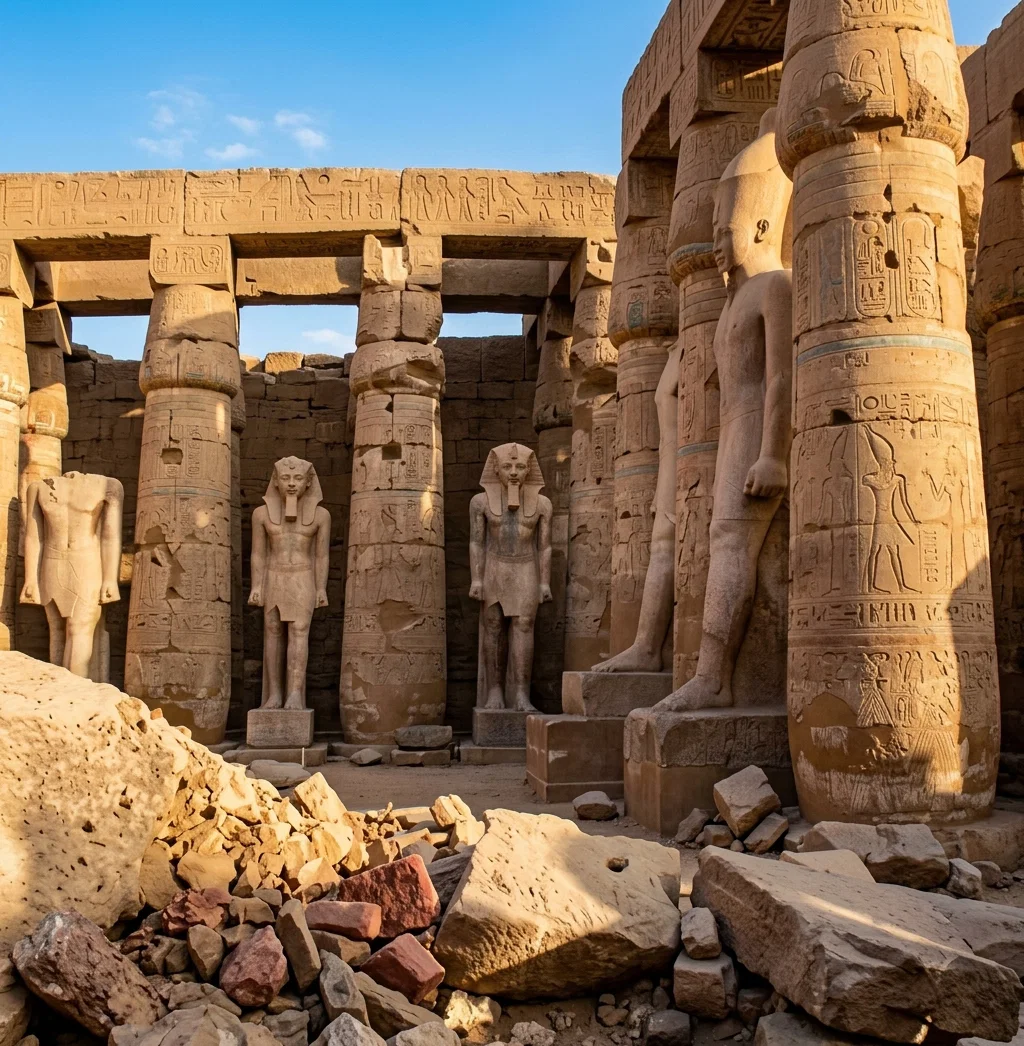
RUINS AT THEBES. THE NO-AMON OF NAH. 3:8
The Necessity of a Definite Judgment
By J. O. CORLISS
The Final Adjustment of Human Awards—No. 1
The Necessity of a Definite Judgment
J. O. CORLISS
WHILE the Bible is the highest standard of appeals in morals, and of appeals in morals, and the forecaster of man’s inevitable destiny, there is one thing it does not attempt, and that is to pronounce the final sentence, by which individual recompense is bestowed. The Bible points out that which is sure to follow certain conditions, but the results are applied only through the decisions of Him whose warning words, and leading power, are contained in the written Word.
No pre-judgment of men’s cases would accord with the complete integrity of God’s being. It is therefore absolutely necessary, even though the Bible reveals and discriminates between that which is condemnable and that which is not, for him to have an appointed time, when all cases may be impartially heard, and settled according to their actual merits. Several cogent reasons might be offered in behalf of such an arrangement, two of which will suffice in this connection.
To be worthy the name, the judgment must be carried on with discrimination; that is, the difference in men’s culpability must be discerned, and sentence rendered according thereto. This is in harmony with God’s instruction on the point. Through the apostle he says: “For we must all appear before the judgment seat of Christ; that every one may receive the things done in his body, according to that he hath done, whether it be good or bad.” 2 Cor. 5:10. Again we have the record that God “will render to every man according to his deeds.” Rom. 2:6. Another text there is, which seems stronger than these: “That servant, which knew his Lord’s will, and prepared not himself, neither did according to his will, shall be beaten with many stripes. But he that knew not, and did commit things worthy of stripes, shall be beaten with few stripes.” Luke 12:47, 48.
Some men’s deeds are more potent for good or evil than are others’. For instance, take a case like that of the noted Thomas Paine. The evil of his deeds was not finished with the close of his life. Though dead, through his books of infidel sentiment he still disseminates unbelief in the atonement of Christ, thereby turning men against God. Such a man could not possibly reap according to his sowing until the last man has lived who could become affected by the infidel sentiments he proclaimed. Let us also look at the reverse side of this proposition. No man like Wesley could be rewarded “according to his deeds,” until the effect of his godly life upon the human race can be fully estimated. Were men of these types to be judged at death, and enter immediately upon the award such judgment could give, how inadequate would its decisions prove.
These considerations go to show that the final judgment is a definite time set apart in the closing up of human affairs, wherein the cases of all who have ever lived shall be permanently adjusted for eternity. This thought was in the apostle’s mind when, at Athens, he viewed the senseless idolatry of its inhabitants. After tracing before them the effects of their heathenish veneration, he said: “The times of this ignorance God winked at; but now commandeth all men everywhere to repent: because he hath appointed a day, in the which he will judge the world in righteousness.” Acts 17:30, 31.
This brings us to the consideration of the second reason for a deferred judgment. The honor of Jehovah himself is involved in this tremendous issue. To see just how this is, it will be necessary briefly to review the nature and history of sin. When man, made in the image of God, was placed in Eden, he was forbidden to meddle with one certain tree in the midst of the garden, the taste or touch of which would entail death. Coming to the woman in the garden, God’s enemy saluted her with the invidious question, “Hath God said, Ye shall not eat of every tree of the garden?” Gen. 3:1.
Not knowing anything of evil, and so being unsuspecting of intended mischief, the woman remained to render the innocent answer: “We may eat of the fruit of the trees of the garden: but of the fruit of the tree which is in the midst of the garden, God hath said, Ye shall not eat of it, neither shall ye touch it, lest ye die.” Quick as thought, the reply came: “Ye shall not surely die: for God doth know that in the day ye eat thereof, then your eyes shall be opened,10and ye shall be as God, knowing good and evil.”
Fateful tarrying indeed! By it there were sown in the woman’s mind the seeds of suspicion that God was withholding from her something that she should have to make her equal with himself. She had not long to wait for the evidence to corroborate her suspicion. It was soon proved to her that God had actually deceived her, and so shown himself false to her best interests. Being therefore constrained to eat of the forbidden tree, she and her husband immediately saw the folly of the move they had made, but it was too late; the die was cast, and the sentence of death must follow their posterity to the latest generation.
The inquiry is now in order, Why did not God destroy them, then and there, and create another pair who would learn the lesson of righteousness from their predecessors, and so escape their fate? That could not possibly be done, for the reason that sin, having entered the world, would taint whoever might come in contact with it, and so any race placed on the earth would be fatally affected through it. But there is another reason why this was not done, and it has its foundation in the motive which prompted God to let Satan live after his rebellion in heaven.
The incitement of that first rebellion was the cherished thought by Lucifer that God was withholding from him a promotion due on account of his exceeding beauty of person and superior endowment of wisdom. Eze. 28:12-19. Wrought up to the highest pitch of indignation through nursing his ill-begotten idea, he said, “I will exalt my throne above the stars of God: . . . I will be like the Most High.” Isa. 14: 12-15.
Had God destroyed Lucifer then, before he had fully developed his propensity for vicious revenge, all the other intelligences of the universe might have found occasion to question the integrity of God in so doing. As it is, an appointed day of judgment in the end of this world and its reign of sin, will give ample data by which to condemn Satan and his followers, and will justify God for the part he may act in the transaction.
God is not the only one to be satisfied with the results of the judgment. He alone might have been satisfied had he ruthlessly crushed the first sin out of existence at its inception; but that might not have met the minds of other intelligences. Besides, to crush out the first appearance of sin without the whole universe having opportunity to see every reason for such a course, there would have been no assurance that sin would not again lift its hydra head for another crushing, until Jehovah would have been accounted tyrannical in his rule, while posing as a God of love.
It is therefore evident that God himself is on trial before the universe, and so is willing to wait until sin and its results shall appear so heinous, even to wicked men, that every knee will at last bow, and every tongue confess that “Jesus Christ is Lord, to the glory of God the Father.” Phil. 2:10, 11. In that time all, both good and bad, of every age and clime, will unite in declaring God to have been right, and Satan wrong, in the great warfare of sin from the beginning.
So, then, in having a final tribunal for both good and bad, God, as the embodiment of all that is good, will be no exception to the general rule. But to be “justified” in his sayings, and to “overcome” when he is judged, as the apostle says he will be (Rom. 3:4), his case must be decided after, or at the time of, his disposition of the world’s wickedness. It seems as if every candid mind ought to be able to see that the unity of minds in the eternal world depends on a final adjustment of every being’s doings. A following article will deal with the nature of such judgment.
Mountain View, Cal.
A Letter to the Lonely and Tried
By Mrs. E. M. Peebles.
DEAR CHRISTIAN FRIENDS: There are many precious words of encouragement and counsel, which, in these testing, trying times, we do well frequently to call to mind. The enemy has come down in great wrath, knowing that he has only a short time, but we must not fret and chafe under the peculiar trials which are sure to come to us, but rather we are to count it all joy when we fall into divers temptations, knowing that the trial of our faith is “more precious than of gold that perisheth, though it be tried with fire.”
We know that we shall never carry a trace of the world or of poor fallen human nature through those pearly gates into the city of God, and we do not want to either. So we must submit to the purifying process, and the furnace heat can no more harm us than it could the three Hebrews if the “form of the Fourth” is with us. The fire will only sever the cords that bind us, and will set us free to walk with God even in the furnace. Then welcome the fire! and welcome the burning! How we should rejoice that we are counted worthy of such divine ministrations, when he who applies the fire stays with us in its burning. “In all their affliction he was afflicted, and the angel of his presence saved them.”
How can we murmur when we are assured that these light afflictions which are but for a moment are working for us a “far more exceeding and eternal weight of glory”? The narrow way has ever been strewn thick with tears, with sharp thorns and bitter trials, and there has no temptation taken us but such as is common to man. Why should we murmur when so many others have suffered just the same or worse, and even our sinless Redeemer came and walked the same thorny path, with bleeding feet and pierced hands, in his dying agony praying for his murderers, “Father, forgive them; for they know not what they do.” He, the sinless One, bore our sins that we might take his righteousness, and did we more “consider him that endured such contradiction of sinners against himself,” we would forever still our murmurings. “Beloved, . . . it doth not yet appear what we shall be; but we know that, when he shall appear, we shall be like him; for we shall see him as he is. And every man that hath this hope in him purifieth himself, even as he is pure.” And yet we sometimes shrink from the purifying process. We want the prize without the trouble of winning it. “Ye have not yet resisted unto blood, striving against sin,” that is, some of us have not, but we can see those who have done so, rejoicing in hope of a resurrection among the just. Stephen died praying, “Lord, lay not this sin to their charge.” If we would keep our eyes continually fixed upon the prize we would in a measure forget the discomforts of the way.
God lets us pass through these trials for a purpose, and when they have done their work, we shall “come forth as gold.” He is only preparing us to wear the wedding garment at the marriage supper of the Lamb, when he shall gird himself and serve us. Patience, that crowning grace of the Christian, is to be perfectly developed in the remnant church. So if we have unusual trials, we can remember it is to prepare us for unusual honor, even to be one of the reception committee to greet the King of kings when he comes with all his glory and the glory of his Father and the holy angels. Then “let patience have her perfect work, that ye may be perfect and entire, wanting nothing.”
MRS. E. M. PEEBLES.
College View, Neb.
Wait for the Mud to Dry
FATHER GRAHAM was beloved by every one, and his influence in the little town was great, so good and so active was he.
A young man of the village had been badly insulted and came to Father Graham, full of angry indignation, declaring that he was going at once to demand an apology.
“My dear boy,” Father Graham said, “take a word of advice from an old man who loves peace. An insult is like mud; it will brush off much better when it is dry. Wait a little till he and you are both cool, and the thing is easily mended. If you go now, it will only be to quarrel.”
It is pleasant to be able to add that the young man took his advice, and before the next day was done, the insulting person came to beg forgiveness.—Exchange.
A Step Toward Heaven
By Anna J. Granniss.
You thought that bitter loss of yesterday,
That hope resigned, proved all your
toil in vain;
You did not know it was a step toward
heaven,
Though taken slowly, with a sense of
pain.
— Anna J. Granniss.
Mother
By Phila Butler Bowman
God made a home, where hearts might turn to rest
When all the other homes of earth had failed.
God made a star whose light burned steadily
When all the other lights grew dim and paled.
God made a voice that all the breadth of seas,
The change of seasons, or the flight of years
Could never silence, never rob of power
To reach, to bless, to guide, to silence fears.
God made a love that wrapped our infancy,
And blessed us, even when we knew it not—
A love that knew no barrier, no self—
A love that never faltered or forgot.
This was God’s gift, immortal, changeless, vast,
Whose name he wrote, because he knew no other
Name sweeter, on our waking consciousness,
In golden characters, That name was “Mother.”
—Phila Butler Bowman.
Fake Foods
By L. A. S.
L. A. S.
Some interesting figures on the subject of fake foods are published in recent bulletins issued by the New Hampshire State Board of Health. An analysis by the State chemist of samples of foods submitted to him for examination, yielded the following results:—
Among thirty-two samples of canned fruits, jellies, and jams examined, twenty-nine were found to be adulterated. Of twenty-four samples of lemon extract examined, twenty-one were adulterated; and of seven samples of lime juice, not one was found to be pure. Of thirteen samples of cream of tartar and baking-powder, four were adulterated. Of twenty-three samples of maple sirup and sugar, ten were adulterated. Of thirty-one samples of milk, fourteen were adulterated. Of forty-one samples of pressed meats and other meat products, twenty-three were adulterated. Of twenty-four samples of vanilla extract, twenty were adulterated. Of six samples of tomato catchup, five were adulterated. Of 363 samples of various products submitted, 164 were adulterated, the percentage of adulteration for the whole being 45.2.
The question of the nature of the adulterants used, is of course an important one. Adulteration with harmless materials is decidedly objectionable to the purchaser, but the matter becomes much worse if in addition to spending his money for that which he does not want, he is also made to administer poison to himself and his family. Adulterants which are designed as preservatives are among the most common of foreign ingredients in prepared foods, and it is well settled that most if not all of such ingredients are poisonous. Among the preservatives most frequently encountered by the State chemist of New Hampshire, were the salts of benzoic and salicylic acids. Certain coloring ingredients were found also which were not designed for admission into the human stomach. A number of samples of “raspberry preserves,” “currant” jelly, and “pineapple” jelly were found to consist wholly of apple, colored with coal-tar dyes and appropriately flavored.
It is possible of course, if not probable, that adulteration of food products is practised much more extensively in some States than it is in New Hampshire.
It is obvious from such facts that it is wise to dispense with prepared foods to the fullest extent, except such as are prepared under the housewife’s own supervision. Adherence to a simple, hygienic diet is not only best for the digestive organs, but will also exclude most of the “foods” extracted from tin cans, and substitute in their place foods upon which the work of preparation has been done by sun, air, and earth rather than by man.