Your ShelfYour Projects

Review and Herald, Vol. 89, No. 10.

A Morning Prayer

Review and Herald

Mar 7, 1912

Review and Herald Publishing Association · Takoma Park Station, Washington, D. C. · Mar 7, 1912

A Morning Prayer
Cause me to hear Thy loving-kindness in the morning, For in Thee do I trust. Cause me to know the way wherein I should walk, For I lift up my soul unto Thee. Teach me to do Thy will; for Thou art my God. Who can understand his errors? Cleanse Thou me from secret faults. Keep back Thy servant also from presumptuous sins. Let them not have dominion over me: Then shall I be upright, And I shall be innocent from the great transgression. Let the words of my mouth, And the meditations of my heart, Be acceptable in Thy sight, O Lord, my Strength and my Redeemer. Search me, O God, and know my heart, Try me and know my thoughts, And see if there be any wicked way in me, And lead me in the way everlasting.

Cover Design Printed in Three Colors

EARN YOUR OWN SUBSCRIPTION

By sending us two new subscriptions at $1 each, you may earn your own yearly subscription, including the three extra numbers offered above. These three extra numbers will also be sent to your two new subscribers. Send $2 for 50 copies; sell 20 to get your money back; then sell or give away the other 30 copies in the interests of true health reform.

PRICES

$1.00 a Year, 10 Cents a Copy; 5 to 40 copies, 5 Cents Each; 50 or More Copies, 4 Cents Each.

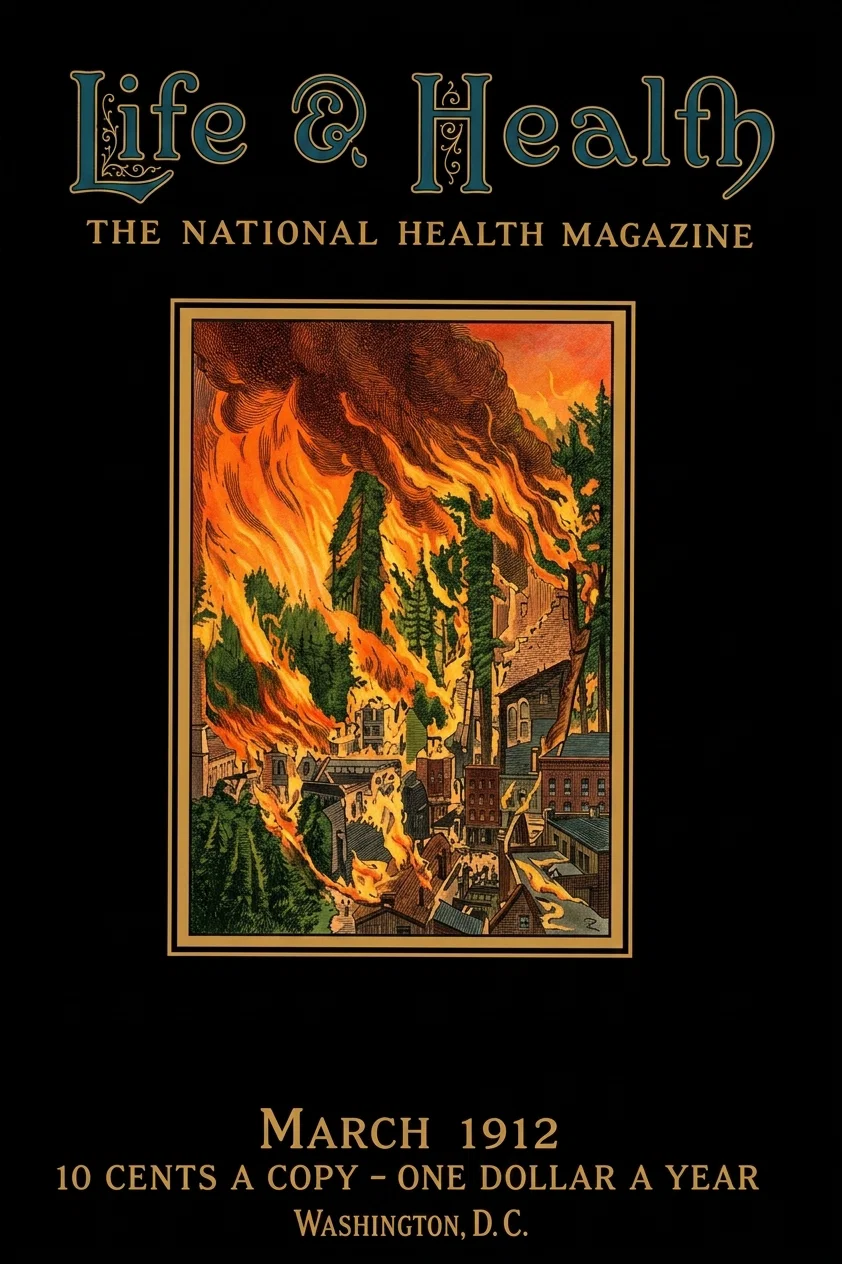
THE MARCH NUMBER OF

LIFE & HEALTH

NOW READY!

Over two thirds of February Edition sold by January 28
The striking cover picture in three colors (Forest and City Fires) is realistic, and rivets the attention.
Special Offer: Until March 15, 1912, all subscribers for one year who make definite request for the same, will receive, in addition to the 12 numbers for 1912, the beautiful October, November, and December, 1911, issues free of charge,—a 15 months' subscription for $1.00. Date of offer extended one month upon request.

“QUESTIONS AND ANSWERS”

In this new department the editor will reply to all reasonable questions by subscribers. Subscribe now. Send $3.00 for 5 years' subscription (or 5 yearly subscriptions); $2.00 for 3 years' subscription (or 3 yearly subscriptions); or $1.00 for 15 months, as offered above.

WILL YOU BE OUR AGENT?

Send 10 cents for sample copy and particulars. Pleasant and profitable work the year round.

PARTIAL CONTENTS

Frontispiece, “Old Faithful,” the world's greatest geyser.
Surprises of God's Out-of-Doors, by Geo. W. James (illustrated).
Fire and Fire Prevention, by F. W. Fitzpatrick (7 illustrations).
Milwaukee's Campaign for Health, by Carl D. Thompson, City Clerk.
The Organization of Junior Civic Leagues, by Mrs. Agnes McGiffert Bailey.
How to Cook Legumes, by George E. Cornforth.
Medical Missionary Work in Burma.
Editorial.—Shall Right and Truth Be Embodied in the Law?—The Tabooed Subject.
As We See It.—The Appalling Fire Hazard—Prevention Versus Cure—A Worthy Enterprise—“Uncle Sam Is Our Pardner.”
Abstracts.—Foreign Missions and the Liquor and Opium Traffic—We Want Aid and Not Interference by the Federal Government—Changing Habits.
Current Comment.—Diet and Health—How the Cigarette Does Its Work.
Questions and Answers, News Notes, and other Departments of interest.

Send All Orders Through Your Tract Society
If you don't know your Tract Society address, ask “Life and Health,” Washington, D. C.
Photo Cover Design in Three Colors

A Good Proposition for Agents!

PRICES: 25 cents a year. 10 cents a copy; 5 to 40 copies, 5 cents each; 50 or more copies, 4 cents each. Send 10 cents for sample copy. Better still, send $1.00 for 20, or $2.00 for 50. Discount to agents on yearly subscriptions.

OUR LIBERTIES ARE IN DANGER!

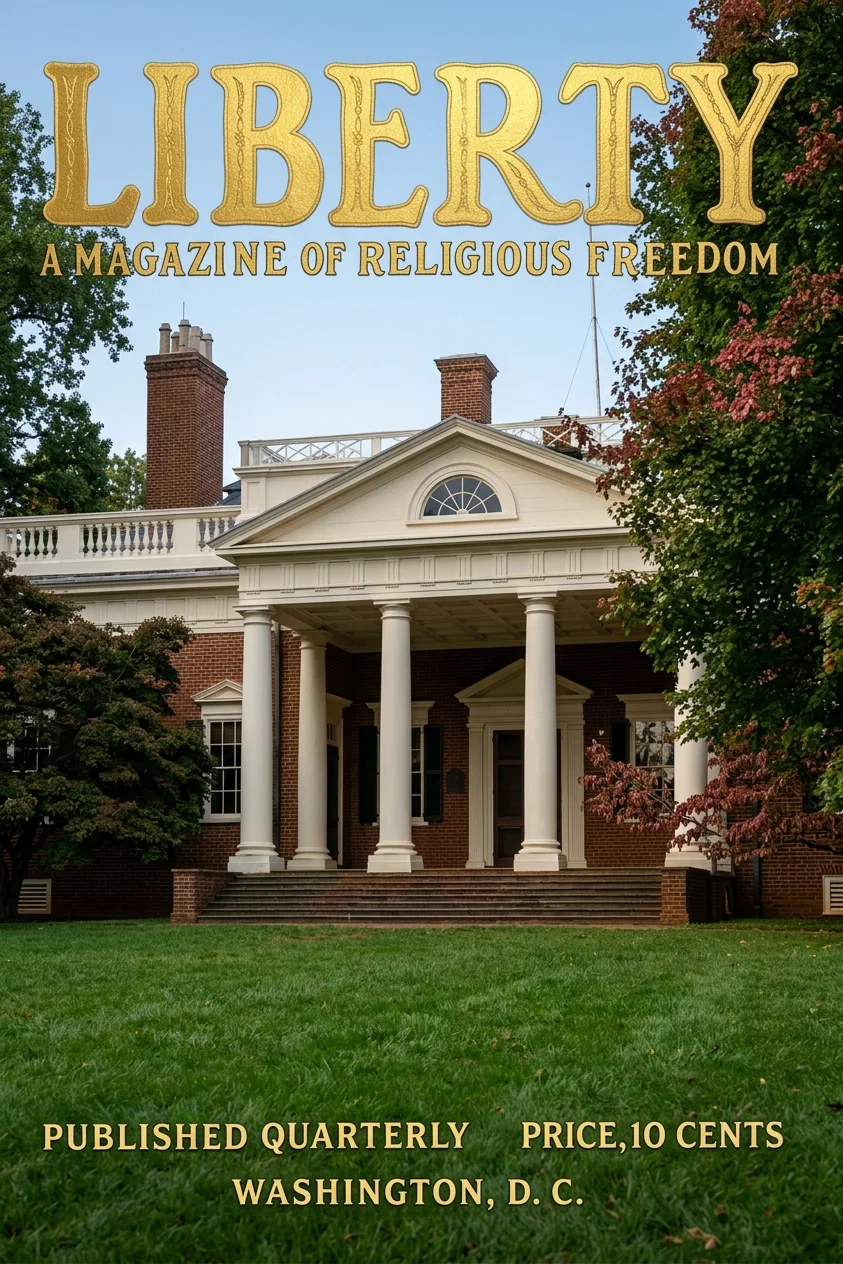
Young and Old Should Read and Circulate This Thomas Jefferson and “Freedom of the Press” Number, Just Out!
First Edition, 50,000 copies. Number of new yearly subscriptions added during the past three months, 6,764. List still climbing.

A FEW FEATURES

Three-color Photo Cover—Picture of Jefferson’s Home. Interior View of Jefferson’s Home. Rome’s Plan to Exclude Anti-Catholic Publications from the U. S. Mails. The President Again Attends St. Patrick’s Cathedral Thanksgiving Day. (Illustrations) Visit to an Inquisition Prison in Holland. (Illustrations) A Governor’s Plan to Increase Church Attendance by Law. Spain and Religious Liberty. America a Beacon-Light to the Nations. Should the State Teach Religion? Cardinal Gibbons on Church and State Union. Russian Passports and Religious Liberty. The Church in Politics. Religious Laws Now Before Congress. Religion and State in Turkey. Spain Tired of National Reformism. Roosevelt on Liberty. The Liquor Traffic and the Home. An Important Temperance Convention. Striking Cartoon: “Is It Constitutional?”
SPECIAL OFFER ON TEN, ONE YEAR: 10 or more copies, one year, to one address or to ten separate addresses, cash with order, only 15 cents each. Sender may include his own name as one of the ten. SEND THIS NUMBER TO EVERY EDITOR, ATTORNEY, AND PUBLIC-SCHOOL TEACHER IN YOUR COUNTY. WE CAN FURNISH THE NAMES AND ADDRESSES.

PLEASE ORDER THROUGH YOUR TRACT SOCIETY

If you do not know your Tract Society address, send to “Liberty,” Washington, D. C.

The Trial of Your Faith

MRS. E. G. WHITE
Not without a purpose does God send trial to his children. He never leads them otherwise than they would choose to be led if they could see the end from the beginning, and discern the glory of the purpose which they are fulfilling, as workers together with him. He subjects them to discipline to humble them, to lead them, through trial and affliction, to see their weakness and draw near to him. As they cry to him for help, he responds, saying, “Here am I.” He is not regardless of the entreaties of his children. He bears long with their impenitence, and when they turn to him, he receives them graciously.
Of the trial of faith Peter writes: “Beloved, think it not strange concerning the fiery trial which is to try you, as though some strange thing happened unto you: but rejoice, inasmuch as ye are partakers of Christ’s sufferings; that, when his glory shall be revealed, ye may be glad also with exceeding joy.” And James says, “Count it all joy when ye fall into divers temptations; knowing this, that the trying of your faith worketh patience. But let patience have her perfect work, that ye may be perfect and entire, wanting nothing.”
Christians are Christ’s jewels. They are to shine brightly for him, shedding forth the light of his loveliness. Their luster depends on the polishing they receive. They may choose to be polished or to remain unpolished. But every one who is pronounced worthy of a place in the Lord’s temple must submit to the polishing process. Without the polishing that the Lord gives, they can reflect no more light than a common pebble.
Christ says to man, You are mine. I have bought you. You are now only a rough stone; but if you will place yourself in my hands, I will polish you, and the luster with which you shall shine will bring honor to my name. No man shall pluck you out of my hand. I will make you my peculiar treasure. On my coronation day, you will be a jewel in my crown of rejoicing.
The Divine Worker spends little time on worthless material. Only the precious jewels does he polish after the similitude of a palace, cutting away all rough edges. This process is severe and trying; it hurts human pride. Christ cuts deep into the experience that man in his self-sufficiency has regarded as complete, and takes away self-uplifting from the character. He cuts away the surplus surface, and putting the stone to the polishing-wheel, presses it close, that all roughness may be worn away. Then, holding the jewel up to the light, the Master sees in it a reflection of himself, and he pronounces it worthy of a place in his casket.
Blessed be the experience, however severe, that gives new value to the stone, causing it to shine with living brightness.
Christianity promises no exemption from sorrow. “We must through much tribulation enter into the kingdom of God.” Faith is needed, strong, trusting faith, which believes that God will bring his children into no temptation greater than they are able to bear. What such faith has power to do is told by Paul in his letter to the Hebrews. Speaking of those who, in the face of persecution and death, had maintained an unshaken trust in God, he says:—
“Who through faith subdued kingdoms, wrought righteousness, obtained promises, stopped the mouths of lions, quenched the violence of fire, ’escaped the edge of the sword, out of weakness were made strong, waxed valiant in fight, turned to flight the armies of the aliens. Women received their dead raised to life again: and others were tortured, not accepting deliverance; that they might obtain a better resurrection: and others had trial of cruel mockings and scourgings, yea, moreover of bonds and imprisonment: they were stoned, they were sawn asunder, were tempted, were slain with the sword: they wandered about in sheepskins and goatskins; being destitute, afflicted, tormented.”
In this world these heroes of faith were counted unworthy of life; but in heaven they are enrolled as sons of God, worthy of the highest honor. “They shall walk with me in white,” Christ declares; “for they are worthy.” In the courts of heaven there awaits them an “eternal weight of glory.”
“Wherefore seeing we also are compassed about with so great a cloud of witnesses, let us lay aside every weight, and the sin which doth so easily beset us, and let us run with patience the race that is set before us, looking unto Jesus the author and finisher of our faith.” “Our light affliction, which is but for a moment, worketh for us a far more exceeding and eternal weight of glory; while we look not at the things which are seen, but at the things which are not seen; for the things which are seen are temporal; but the things which are not seen are eternal.”
When the redeemed stand in the presenceof God, they will see how short-sighted were their conclusions as to what Heaven records as success. They will see how petty were their supposed trials, and how unreasonable were their doubts. They will see how often they brought failure to their work by failing to show unquestioning faith in God. From the lips of the angelic choir and the redeemed host will peal forth the chorus: ‘Great and marvelous are thy works, Lord God Almighty; just and true are thy ways, thou King of saints. Who shall not fear thee, O Lord, and glorify thy name? for thou only art holy.’

What Is Man?

C. P. BOLLMAN
“When I consider thy heavens, the work of thy fingers, the moon and the stars, which thou hast ordained; what is man, that thou art mindful of him? and the son of man, that thou visitest him?” Ps. 8: 3, 4.
“Like as a father pitieth his children, so the Lord pitieth them that fear him. For he knoweth our frame; he remembereth that we are dust.” Ps. 103: 13, 14.
BORN in a universe of boundless space, Of countless mighty suns and myriad orbs, Of time not measured by mere days and years, Distance where only light can keep the pace And give us metes and bounds so we can speak Of circling, fast-revolving, radiant spheres,— O, what is man?
And yet, O God, thou dost look down And takest note of our frail, dying forms; Thou e’en rememb’rest that we are but dust; And when we meekly call, thou dost not frown, But suc’rest fondly those who come to thee, And savest all who in thee fully trust,— All this for man!

The Administration of the Ordinances

B. E. CONNERLY
THAT which will be of greatest spiritual value to the individual members in the celebration of the ordinances is careful preparation. We must study often and well the scriptures bearing on this subject; for we are warned against partaking of these emblems of our Lord’s broken body and shed blood in an unworthy manner. We are ever to remember that it is the Lord’s table, and that we do this in remembrance of him.
At these successive feasts we are to gain a deeper and ever deeper experience in the things that pertain to God and eternal life. At these consecrated seasons for thanksgiving there may be a query on the part of some as to who is worthy and who is not worthy to sit at the Lord’s table. Let all understand that no one, not even elders or deacons, has the power or should exercise the prerogative of discriminating between clean and unclean. Our Lord served a traitor, and in our churches all are served who desire to partake, unless in the case of open sin which should be publicly rebuked. “But let a man examine himself.” Thus the responsibility of the blessing or the curse rests on the individual communicants.
The house of worship and all auxiliaries should be made ready on time. All social differences should be amicably settled, all unpleasant domestic concerns properly adjusted; then, in joyful anticipation, we may await the hour when we shall participate in the ordinance that so vividly commemorates the great price paid for our ransom from the thralldom of sin.
The basic idea in the Lord’s Supper is that Christ at Calvary completed that oath-bound covenant with the Father by the sacrifice of himself to restore a lost world to its Edenic perfection. Sacrament means a sacred vow or oath, and it has been the custom since time immemorial to conclude engagements, treaties, or oaths with a feast. It was so in the case of Isaac and Abimelech, Laban and Jacob, and when Samuel anointed Saul king over Israel.
How fitting it is that at this season we renew our covenant with Christ! Faith is strengthened, hope is revived, and in imagination we are carried back to that “large upper room,” and surround the festive board, and hear the gracious words that fall from his lips. We get a new glimpse of our salvation. Amid this scene we bow and reverently renew our baptismal vow that Calvary’s unresisting Victim shall not have died in vain, that his blood shall be our sacrifice.
But what are these emblems, so simple in appearance yet with so mighty a significance? What is this wheaten loaf and this fragrant cup that point so forcibly to our Lord’s humility? And what is the meaning of such a sacrament that even the saints must wash one another’s feet ere they may sup at this lordly feast? Do not mistake here. A traitor has deceived the world. This bread and wine possess no merit, no efficacy in themselves. Nothing in all the realm of nature could so well represent our Saviour’s spotless life. They are his own chosen emblems of that mighty expiatory act, the scenes of Calvary, and are the most fitting symbols of that great triumph that he is to celebrate when he comes again as King of kings and Lord of lords.
It was the fourth and last Passover supper during our Lord’s ministry. The disciples had prepared for the occasion. The Lord desired to spend the few remaining hours in quiet together with his loved ones. Events of momentous importance were about to take place. Here the Son of God as man’s representative stands at the crucial point of transition between two great dispensations. The Saviour presents himself a final offering for sin, and forever causes to cease that crimson stream of sacrificial blood which had stained the altars of the patriarchs since the days when our first parents had, in sorrow at the barred entrance of their lost Eden home, offered their sacrifices which prefigured his death.
These holy convocations are for the benefit of all the congregation. One might be excused for absence from Sabbath-school or the weekly discourse, but what excuse could be presented for failure to participate with the brethren at the Lord’s table?
Another thought to bear in mind at these seasons is that Jesus said, “The hand of him that betrayeth me is with me on the table,” and the perfidious act of Judas is typical of that greater betrayal by an apostate church. We believe that church elders should occasionally rehearse to their congregations the manner in which the Papacy has prostituted the sacrament. It was in the second century that the church began to look upon the emblems of our Lord’s suffering as possessing intrinsic merit. Later, as the apostasy developed, the people began to look with a degree of reverence and awe upon the little loaf and the contents of the cup, and to believe that these agents possessed efficacy in themselves for the putting away of sin. It required only the superstition of the dark ages to complete that mysterious “transubstantiation” that taught the people to see in the simple elements of bread and wine the real body and blood of Christ. Contemporaneous with these acts, Rome changed the inexpensive communion table for a jeweler, the unleavened cake for the host, the simple earthen cup for a golden chalice, the plate for the revered monstrance, the simple garment for the silken robes of the tonsured priest—in fact, exchanged the simple yet solemn service of the Lord’s Supper for the idolatrous “sacrifice of the mass.”
Thus the betrayal is complete. “They crucify to themselves the Son of God afresh, and put him to an open shame.” The agonizing scenes of Golgotha are eclipsed by the idolatrous eucharistic procession. That vicarious Sufferer spilled his blood in vain if the elevated “host” is efficacious for the sins of both the living and the dead.
That the sacrifice of the mass is wholly expiatory has long been fundamental with the Romanists, and on this hypothesis all other dogmas rest. The idolatry of paganism never attained such alarming proportions. No pagan priest could have been persuaded to hold a little wafer aloft, and then declare it able to atone for sin; much less could he have been made to believe that by uttering a few Latin words over this same insignificant wafer, it could be changed into the body of Christ, and then to offer it as a sacrifice for the sins of the world in place of the true sacrifice.
When our people are fully informed of the “depths of Satan” in leading this apostasy of the last days, in perverting this ordinance into the most shocking idolatry the world has ever known, they will readily see how necessary it is that we as reformers raise it again to its proper place in the church.

God's Guiding Hand

MRS. C. O. HALL
The only condition in the matter of having God's guidance is that we let him guide. He can not lead us unless we follow. We must choose to let him guide, or he can not do it. The human has power to say “No” to the divine, for the Lord has made us free moral agents.
Why are we so afraid to trust ourselves in God's hands? Do we believe in God? Whatever God shall plan for us is positively and surely the best; and could our eyes at this moment be opened to see in the light of eternity, we would always choose for ourselves what God has chosen for us. Some day when the veil is rent that hides us from his presence, we shall be led to exclaim, My God hath done all things well! Until that day let us trust, even when we can not trace his hand.
Some one may ask, Do you mean to say God's hand was leading the disciples when they suffered martyrdom? that God was with the many who since that time have gone to the stake for Jesus' sake? and that his hand is with us when the billows of sorrow and trouble seem almost to overwhelm us? that he will be with us when we, too, may have to suffer martyrdom as we near the end of time?And to all these queries we answer “Yes,” for God's word can not be broken. His promises are sure: and I read, “In all thy ways acknowledge him, and he shall direct thy paths.”
Every true Christian has been taken through experiences that have well-nigh shaken the foundation of his being, but “looking unto Him” through it all, he has been led out into a large place with him. Looking back over his life, the faithful follower of Jesus will remember some sharp disciplines, which he now sees have better fitted him to minister to others. The place he now fills would have been less worthily filled had he been excused from the tears and testings that have been a part of his Christian experience.
We have tested fully that we can not walk alone. The path of life is beset with too many rough places. What insanity it is to lean upon our own weakness, when we can have the Lord's omnipotent strength at the command of our faith! If we would have God's guidance, we must be humble, be leadable, and then we can say with Whittier,—
“I know not what the future hath Of marvel or surprise, Assured alone that life and death His mercy underlies. “No offerings of my own I have, Nor works my faith to prove; I can but give the gift he gave, And plead his love for love. “And so beside the silent sea I wait the muffled oar, No harm from him can come to me On ocean or on shore. “I know not where his islands lift Their fronded palms in air, I only know I can not drift Beyond his love and care.”
Providence, R. I.

Definite

WILLIS G. TWITCHELL
THE remnant church has a definite work to do. “And the dragon was wroth with the woman, and went to make war with the remnant of her seed, which keep the commandments of God, and have the testimony of Jesus Christ.” Rev. 12: 17.
They are a definite people, and they have the specific work of restoring the definite Sabbath to its rightful place. “And they that shall be of thee shall build the old waste places: thou shalt raise up the foundations of many generations; and thou shalt be called, The repairer of the breach, The restorer of paths to dwell in. If thou turn away thy foot from the Sabbath, from doing thy pleasure on my holy day; and call the Sabbath a delight, the holy of the Lord, honorable; and shalt honor him, not doing thine own ways, nor finding thine own pleasure, nor speaking thine own words.” Isa. 58: 12, 13.
Let us see how definite the Sabbath commandment is, by noticing how many times God uses the definite article in it: “Remember the Sabbath day, to keep it holy. Six days shalt thou labor, and do all thy work: but the seventh day is the Sabbath of the Lord thy God: in it thou shalt not do any work, thou, nor thy son, nor thy daughter, thy man servant, nor thy maid servant, nor thy cattle, nor thy stranger that is within thy gates: for in six days the Lord made heaven and earth, the sea, and all that in them is, and rested the seventh day: wherefore the Lord blessed the Sabbath day, and hallowed it.” Ex. 20: 8-11. Nine times is used the definite article in this one commandment. How much more definite could he have made it? The indefinite articles an and a are not once used. The law is definite, the requirements are definite, the Sabbath is definite.
The more carefully and prayerfully we study the Word of God, the more we shall see the definite purpose of God in all his works. Let us seek that power from God that will make it possible for his definite purpose to be wrought out in our lives, that it may have the definite effect upon others.
Mohawk, N. Y.

God Still Answers Prayer

JOHN F. OLMSTED
ONE year ago to-night, or on Feb. 13, 1911, in the quietness of the home, away from the rush of daily activities and cares, a manifestation of the mighty power of God was seen when the subject of this sketch was marvelously healed and freed from the cruel bondage of epilepsy.
For about thirty years Charles A. Alexander, 101 North High St., Columbus, Ohio, suffered untold tortures and miseries from epilepsy, and like the afflicted of Bible times, he would fall in the street or in his room. Once a month, and sometimes at more frequent intervals, he would be compelled to pass through these trying ordeals, many times alone. He believed that sometime in the providence of the Lord he would be healed of the disease that was sapping his vitality and reason.
After a very severe attack, Brother Alexander came to my home greatly depressed, almost despairing of life itself. He requested prayer, however; and wonderful as it may seem, God heard prayer, and rebuked the one responsible for all those years of agony and woe.
We studied God's Word carefully, and this study was followed by earnest prayer on the part of Brother Alexander, Mrs. Olmsted, and the writer. We felt that God was very near, and at the close of the season of prayer we laid our hands on the sufferer's head, and in the name of Jesus of Nazareth commanded the wicked and unclean spirit to come out. In an instant Brother Alexander was violently thrown backward, and fell prostrate on the floor, screaming in such a shrill, piercing way that we felt the presence of another spirit than that which guides the faithful here. He then assumed the appearance of one who was dying. Taking him by the hand, we lifted him up, and he soon revived; but in it he was in a state of high nervous tension all night. He returned home the next morning, and we are glad to say that the past year our brother has not been afflicted nor overcome with epilepsy.
This experience has greatly increased our faith, and made us realize more and more the nearness of Christ in times of disease and distress, and his willingness to bind up our wounds and set the captives free. His name shall have the glory, for it is “not by might, nor by power, but by my Spirit, saith the Lord of hosts.”
Columbus, Ohio.

Ancient Manuscript Confirms Testimony of the Spirit of Prophecy

GEO. M. BROWN
THE incident of Christ’s dealing with the woman taken in adultery, as recorded in John 8: 3-11, is commented upon in “Spirit of Prophecy,” Vol. II (edition of 1877), pages 349-358. John does not tell us what Jesus wrote upon the sand, but it is here stated that he traced upon the ground “in legible characters, the sins of which the woman’s accusers were guilty, beginning with the eldest and ending with the youngest.”
How perfectly and naturally this accounts for the action of these hypocritical accusers of the woman as related in verse nine, where we are told that they “went out one by one, beginning at the eldest, even unto the last.”
In a recent lecture in Kansas City, Prof. Caspar Rene Gregory, professor of theology in the University of Leipzig, related how he had found among the many ancient manuscripts preserved in the monasteries on Mt. Athos, Turkey, one which recorded this incident of which John speaks. Said Professor Gregory: “Now this version had it that Jesus wrote upon the ground the sins of every man in the audience, and that they when they read it, convicted by their consciences, went out one by one.”
What this learned professor of theology has recently discovered, as a result of laborious research and the study of musty old manuscripts in an isolated monastery, was given to God’s people years ago through the spirit of prophecy, and has been published to the world for more than thirty-five years.
The books “Patriarchs and Prophets,” “Great Controversy,” “Desire of Ages,” and “Acts of the Apostles” contain thousands of interesting facts and comments which serve to throw light upon the records of the Bible, and make clearer and plainer God’s wonderful dealings with men.
Undoubtedly men and women paid for the privilege of listening to Professor Gregory and learning from him what he had found out in a long life devoted to study and research. Why did they do this?—Because they attached a valueto the knowledge he had acquired. If we properly appreciated the knowledge of divine things given this people through the spirit of prophecy, would we not all gladly spend the small amount necessary to purchase the books containing this light, and then prayerfully read them?
Were all to do this, it would help in bringing a genuine revival into our churches, and give an impetus to the work which would result in rapidly extending the knowledge of present truth to earth’s dark corners, and in making ready a people to hail the Saviour when he comes in the clouds to gather his own from the four corners of the earth.
Greensboro, N. C.

A Roman Catholic America

SANFORD B. HORTON
The Zion’s Herald (Methodist) of Boston thinks that “the time has come for the church as a whole to awaken to the situation” of a militant Catholicism. “Unless all signs fail,” says Zion’s Herald, “the last stand of the Roman Catholic Church for supremacy is to be made in the United States of America.” “All the power of the great organization built up under Hildebrand, and developed throughout the years by his successors, is to be concentrated upon this country.”
Seventh-day Adventists have been calling attention for many years to the encroachments which Rome has been making, and have referred to the spectacular functions of that church as being remarkable evidences of her determination to crowd herself upon the notice of the public. Zion’s Herald, interpreting these events, makes the following comments:—
“This is the explanation of recent events and of announcements that have found their way into public print. The elevation of American prelates is significant. So is the statement that the country is to be divided into eighteen ecclesiastical provinces, or subdivisions, for convenience of administration. These straws all indicate the direction of the blowing of the wind. Rome is determined to conquer in the United States.”
“As a matter of fact, she must. Her power in the Old World is all but gone. France has left her; Portugal has repudiated her; Spain has broken with her; Italy openly defies her. What is there left? Austria?—Yes, but hardly anything else. If Rome is to continue a power, then she must become supreme on this side of the Atlantic. And here in the United States of America is to be made the last stand.”
“Is this simply a fantastic statement?—Not at all. Within a few weeks there has appeared from the press of a leading American publishing house a book written by Abbe Felix Klein, of France. It is called ‘America of To-Morrow.’ In the course of the work the learned French author, already known to the American reading public by his volume ‘In the Land of the Strenuous Life,’ discusses the growth of Roman Catholicism on this side of the Atlantic, and dwells upon the work of the Catholic Extension Society. He concludes by saying:—
“‘With the increase of funds, the power for the good of the young society is rapidly augmenting, and it will not be long before the Church of Rome will have nothing to envy the Protestant churches, as far as their home missions are concerned; and if already, without this means of diffusion, it has developed two or three times as fast as the most prosperous of the Protestant sects, what will now be its progress! It may in a quarter of a century prevail over all the other confessions combined; it may make of the United States, according to the dream that is no longer merely visionary, the first Catholic nation of the world.’”
“There you have it, spoken right out in the open. Here on American soil it would the Roman Catholic Church establish itself in mighty power. It may be making virtue of necessity, as there is nowhere else for Romanism to go. But, be that as it may, the fact is the same.
“Even here do we find a challenge to Protestantism. It means that here on American soil is to be fought to a finish the battle of the Reformation.”
We disclaim all suggestions of bigotry, but, with Zion’s Herald, we feel free to ask Protestants of the United States if they still “believe that our fathers were right in breaking with Rome years ago; if they believe that the doctrines promulgated by Protestantism are the proper interpretation of the Word of God.”
The Roman Catholic Church has challenged the virility of Protestantism in Europe, has challenged the ability of the nations of Europe to keep it out of their civil affairs, and has lost, as the above extracts point out. The church has been trying, through home rule, to subordinate Ireland to her “tender” care, but thus far without success; and now Rome has set her face and heart to the subjugation of the United States of America, and thus challenges the virility of Protestantism in this land, as well as the stability of the government as founded by our forefathers. Not only so, but she has set herself the definite object of capturing the English-speaking world.
Referring to Rome’s plans, Zion’s Herald continues:—
“Do we want a Roman Catholic America? If not, we must be prepared to meet the challenge of the present. We must meet statesmanship with statesmanship.
“One of the most significant steps in connection with the new program that Romanism is enunciating in this country is that of dividing the United States into great subdivisions in order to get adequate leadership. Romanism has always made much of this. In every great center in the country she has her strong men, bishops and archbishops known to all, who are in a position to lead their forces to great victories. It is upon this leadership that the Pope counts to make the United States of America ‘the first Catholic nation of the world.’”
“And now the time has come for us to meet the issue squarely. We are face to face with a situation. Methodism, as perhaps no other church among the Protestant denominations, is fitted, by its aggressiveness, its inheritance, and its natural genius, to meet and resist Roman Catholicism. It must do its full share, and perhaps more, to save this country to Protestant Christianity.”
It should occur to our fellow Protestants in this country who are engaged in revival work, Christian Endeavor work, Men and Religion Forward Movement, and kindred movements, that due attention should be given the matter of the Roman Catholic challenge for supremacy. If Protestantism does not desire to see a return to the old order of things which produced the dark ages, it were well that we awaken to the importance of the situation now menacing this nation and the true principles of Christianity.

"It Shall Be Forever"

MRS. M. S. BOYD
The Holy Word very forcibly speaks of the enduring nature of God's works, in Eccl. 3:14, 15: "I know that, whatsoever God doeth, it shall be forever: nothing can be put to it, nor anything taken from it: and God doeth it, that men should fear before him. That which hath been is now; and that which is to be hath already been; and God requireth that which is past."
From a study of Gen. 2:2, 3, we find that when God had finished his creative works, he rested on the seventh day, blessed it, and sanctified it, thus making each succeeding seventh day a Sabbath. This is plainly one of the works of the Creator. Inspiration emphatically states that "whatsoever God doeth, it shall be forever: nothing can be put to it." Then the first day of the week can not be added unto the Sabbath institution, nor the seventh day "taken from it."
God proclaimed from Mt. Sinai, "The seventh day is the Sabbath of the Lord thy God." The same authority states, "That which hath been is now;" and again, "That which is to be hath already been." Isa. 66:22, 23, tells us that in the new-earth state all flesh shall come to worship the Lord from one Sabbath to another. Then the Sabbath that "is to be hath already been."
It is not left optional with us whether we keep this seventh-day Sabbath that was instituted at the close of creation week; for it is distinctly stated that "God requireth that which is past." A plain statement of these facts is made that "men should fear before him." What is this fear designed to lead men to do? "Fear God, and keep his commandments: for this is the whole duty of man." Eccl. 12:13, 14.
Cooranbong, New South Wales, Australia.

Leaning Toward Sin

LEANING toward a sin is as bad as taking it in your arms.—Ram's Horn.
Continue reading: Editorial