Your ShelfYour Projects

Review and Herald, Vol. 43, No. 8.

GRACE AND GLORY;

Review and Herald

Feb 3, 1874

Seventh-day Adventist Publishing Association · Battle Creek, Mich. · Feb 3, 1874

GRACE AND GLORY;

Or, the Two Thrones, Representing the Kingdom of Grace, and the Kingdom of Glory.
BY ELDER JAMES WHITE.
The existence of a throne supposes the existence of a kingdom. As by the thrones of Europe, the kingdoms of Europe are understood, so when the sacred Scriptures speak of heavenly thrones, heavenly kingdoms are meant. The throne of grace represents the kingdom of grace. The throne of glory represents the kingdom of glory.

The Throne of Grace.

Let us therefore come boldly unto the throne of grace, that we may obtain mercy, and find grace to help in time of need. Heb. 4:16.

The Throne of Glory.

When the Son of man shall come in his glory, and all the holy angels with him, then shall he sit upon the throne of his glory. Matt. 25:31.
The kingdom of grace is God’s plan to save men by grace. It was established as early as mercy and grace were offered to fallen man. Adam, Abel, Noah, Abraham, and Moses were as truly the subjects of the kingdom of grace as the apostles and martyrs of Jesus were, and as the followers of Christ now are.
The kingdom of glory is future. In connection with its establishment will be the second coming of Christ in power and great glory, to raise the righteous dead, and to change the living righteous. These, all immortal, will be the eternal subjects of the kingdom of glory. This kingdom will be God’s arrangement to glorify and reward the immortal righteous, who are saved from every nation, tongue, and people, during the ages of human probation.
The kingdom of grace and the kingdom of glory are closely related to each other. The former was established to prepare subjects for the latter. They span the time of all the ages from the fall, when the plan of redemption was instituted, embracing the eternal future. Two conditions of the people of God are expressed by the phrase, kingdom of Heaven, so frequently used in the New Testament. Sometimes it expresses their present condition, in this world, and sometimes their future condition, in the world to come.
The Scriptures distinctly speak of two thrones. One is the throne of the Father; the other is the throne of the Son. Christ first sits on the Father’s throne, in connection with the Father, until human probation shall close. He will then reign upon his own throne forever. In these emphatic words Christ addresses the church: “To him that overcometh will I grant to sit with me in my throne, even as I also overcame, and am set down with my Father in his throne.” Rev. 3:21.

THE THRONE OF THE FATHER

is the throne of the universe. David, speaking of this throne, says: “The Lord hath prepared his throne in the Heavens, and his kingdom ruleth over all.” Ps. 103:19. Daniel, speaking of the Ancient of days, the eternal Father, says that “his throne was like the fiery flame.” Chap. 7:9. And the Revelation, speaking of the birth of Christ, and his ascension to the Father, says: “And her child was caught up unto God, and to his throne.” Chap. 12:5.

ON THE FATHER’S THRONE

Christ will reign in the kingdom of grace, until human probation shall close. David, speaking of this gracious reign, says: “The Lord said unto my Lord, Sit thou at my right hand, until I make thine enemies thy footstool. The Lord shall send the rod of thy strength out of Zion. Rule thou in the midst of thine enemies. Thy people shall be willing in the day of thy power.” Ps. 110:1–3. And Peter, on the occasion of the pouring out of the Holy Spirit on the day of Pentecost, says that Christ “being by the right hand of God exalted, and having received of the Father the promise of the Holy Ghost, he hath shed forth this which ye now see and hear.” Acts 2:33.
The prophet Zachariah, speaking of Christ by the title of the Branch, and of his people under the figure of the temple of the Lord, says: “Behold the man whose name is The Branch; and he shall grow up out of his place; and he shall build the temple of the Lord. Even he shall build the temple of the Lord, and he shall bear the glory, and shall sit and rule upon his throne; and he shall be a priest upon his throne. And the counsel of peace shall be between them both.” Chap. 6:12, 13. In the kingdom of grace, the counsel of peace is between the Father and the Son. And Paul, speaking of the priesthood of Christ in the heavenly sanctuary, says that “we have such an High Priest, who is set on the right hand of the throne of the Majesty in the Heavens.” Heb. 8:1. He exhorts the church to look to “Jesus the author and finisher of our faith; who for the joy that was set before him endured the cross, despising the shame, and is set down at the right hand of the throne of God.” Chap. 12:2.

ON HIS OWN THRONE

Christ will reign in the kingdom of glory forever. God speaks of the eternal kingdom of his Son by his servant David in these words: “His seed shall endure forever, and his throne as the sun before me. It shall be established forever as the moon.” Ps. 89:36, 37. And the angel speaks to Mary of Christ in these words: “He shall be great, and shall be called the Son of the Highest. And the Lord God shall give unto him the throne of his father David; and he shall reign over the house of Jacob forever; and of his kingdom there shall be no end.” Luke 1:32, 33.
But at the close of human probation Christ delivers up the kingdom of grace, 1 Cor. 15:24–28, and receives from the Father the eternal kingdom of glory. Says Daniel: “I saw in the night visions, and behold, one like the Son of man came with the clouds of heaven, and came to the Ancient of days, and they brought him near before him. And there was given him dominion, and glory, and a kingdom, that all people, nations, and languages should serve him. His dominion is an everlasting dominion, which shall not pass away, and his kingdom that which shall not be destroyed.” Chap. 7:13, 14. And the prophet speaks of the immortal and eternal subjects of this kingdom in these words: “But the saints of the Most High shall take the kingdom, and possess the kingdom forever, even forever and ever.” Verse 18.
But it is not until all the wicked of the earth shall be destroyed from off it that the immortal kingdom of glory will fill the whole renewed earth, which will be the eternal inheritance of the saints. Then will be fulfilled the words of David: “For yet a little while and the wicked shall not be; yea, thou shalt diligently consider his place, and it shall not be. But the meek shall inherit the earth, and shall delight themselves in the abundance of peace.” Ps. 37:10, 11. And it is to this same glory and reward that Christ points in that ever blessed sermon on the mount, when he says: “Blessed are the meek; for they shall inherit the earth.” Matt. 5:5.
The prophet Daniel, while in holy vision, is assured by the angel that “the kingdom and dominion, and the greatness of the kingdom under the whole heaven shall be given to the people of the saints of the Most High, whose kingdom is an everlasting kingdom.” Chap. 7:27. And the great God, in response to the earnest prayer of Moses who was leading the children of Israel to the land of Canaan, the type of the kingdom of glory, says: “But as truly as I live, all the earth shall be filled with the glory of the Lord.” Num. 14:21. Isaiah takes up the promise of the future reward and glory in these words: “The earth shall be full of the knowledge of the Lord, as the waters cover the sea.” Chap. 11:9. And another prophet repeats the promise in still stronger language: “For the earth shall be filled with the knowledge of the glory of the Lord, as the waters cover the sea.” Hab. 2:14.
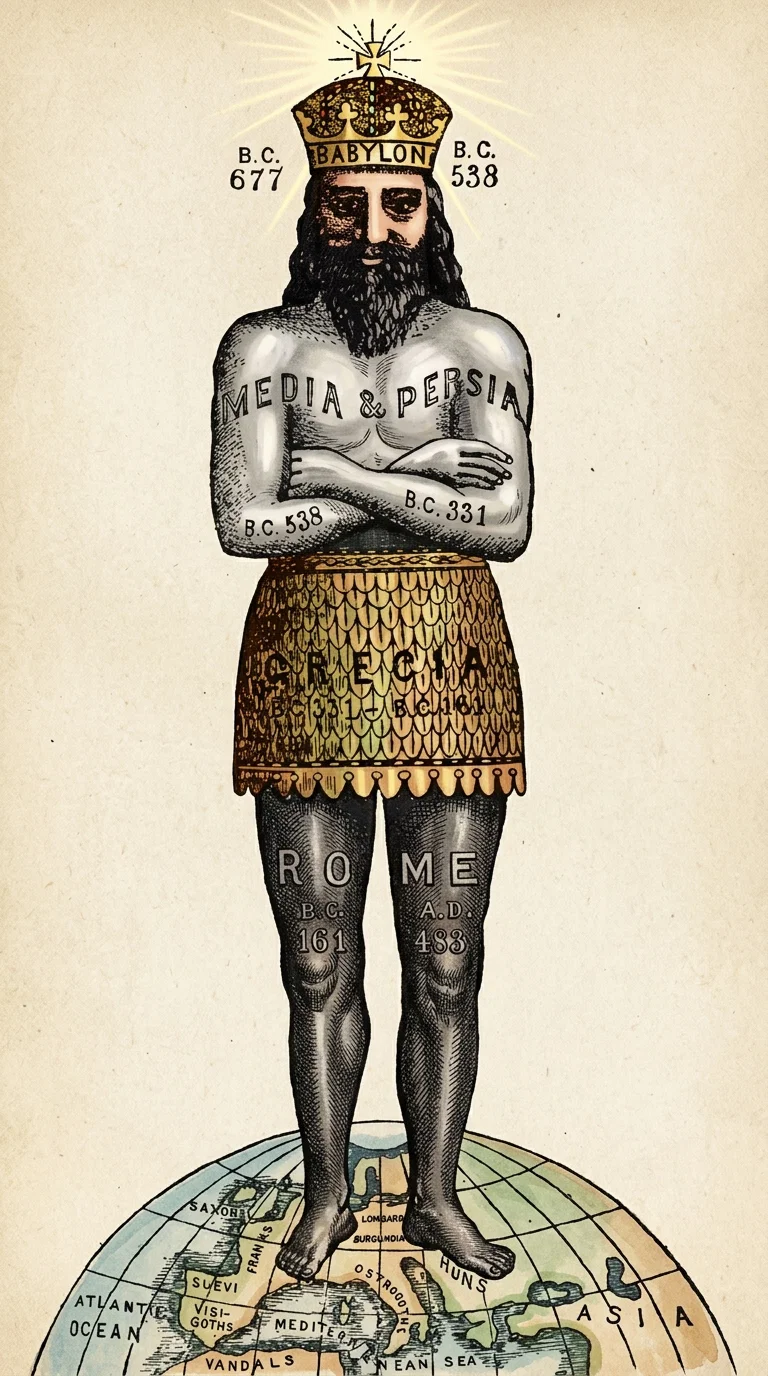
The second chapter of Daniel introduces five universal kingdoms which were to succeed each other. The first four kingdoms are earthly and perishable. The fifth is immortal, and will stand forever. The first four kingdoms are represented by the great metallic image, the several parts of which are composed of gold, silver, brass, and iron mixed with clay. When these shall be broken in pieces, and entirely removed, then will the immortal kingdom fill the whole earth. We call attention to Dan. 2:31–45.
Verses 31–36: “Thou, O king, sawest, and behold, a great image. This great image, whose brightness was excellent, stood before thee; and the form thereof was terrible. This image’s head was of fine gold, his breast and his arms of silver, his belly and his thighs of brass, his legs of iron, his feet part of iron and part of clay. Thou sawest till that a stone was cut out without hands, which smote the image upon his feet that were of iron and clay, and brake them to pieces. Then was the iron, the clay, the brass, the silver, and the gold, broken to pieces together, and became like the chaff of the summer-threshing-floors; and the wind carried them away, that no place was found for them; and the stone that smote the image became a great mountain, and filled the whole earth. This is the dream; and we will tell the interpretation thereof before the king.”
Please notice these points in the dream, however, before considering the interpretation. The stone smote the image upon his feet, when the iron, the clay, the brass, the silver, and the gold, were broken in pieces, and the wind carried them away, that no place was found for them. No language can express destruction more completely. Then, and not till then, does the stone that smote the image become a great mountain, and fill the whole earth.
Verses 37, 38: “Thou, O king, art a king of kings; for the God of Heaven hath given thee a kingdom, power, and strength, and glory. And wheresoever the children of men dwell, the beasts of the field and the fowls of the heaven hath he given into thine hand, and hath made thee ruler over them all. Thou art [or thy kingdom is] this head of gold.” Babylon was the first kingdom of universal empire. It was founded by Nimrod, the great-grandson of Noah. See Gen. 10:8–10. It lasted nearly seventeen hundred years, though under different names; sometimes called Babylon, sometimes Assyria, and sometimes Chaldea. It continued from the time of Nimrod to that of Belshazzar, who was its last king.
Verse 39 (first part): “And after thee shall arise another kingdom inferior to thee.” The Medo-Persian kingdom succeeded Babylon. See chap. 5:28: “Thy kingdom [Babylon] is divided, and given to the Medes and Persians.” The Medo-Persian was the second universal kingdom, represented by the breast and arms of silver.
Verse 39 (last part): “And another third kingdom of brass, which shall bear rule over all the earth.” In chap. 8:5–7, 21, we learn that Grecia conquered the Medo-Persian kingdom, and became a kingdom of universal empire. This took place under Alexander. Here, then, we have the third kingdom, which is represented by the brass of the image.
Verse 40: “And the fourth kingdom shall be strong as iron; forasmuch as iron breaketh in pieces and subdueth all things; and as iron that breaketh all these, shall it break in pieces and bruise.” The fourth kingdom is generally admitted to be Rome. It was a universal kingdom that was to break in pieces all that went before it. Rome alone answers the description. That did have universal empire. Luke 2:1: “And it came to pass in those days, that there went out a decree from Cæsar Augustus, that all the world should be taxed.” Cæsar Augustus was a Roman emperor. Here we have the fourth kingdom, represented by the legs of iron.
Verse 41 (first part): “And whereas thou sawest the feet and toes, part of potters’ clay, and part of iron, the kingdom shall be divided.” The Western Empire of Rome, between the years A. D. 356 and483, was divided into ten divisions, or kingdoms: 1. The Huns, in Hungary, A. D. 356; 2. The Ostrogoths, in Mysia, 377; 3. The Visigoths, in Pannonia, 378; 4. The Franks, in France, 407; 5. The Vandals, in Africa, 407; 6. The Sueves and Alans, in Gascoigne and Spain, 407; 7. The Burgundians, in Burgundy, 407; 8. The Heruli and Rugii, in Italy, 476; 9. The Saxons and Angles, in Britain, 476; 10. The Lombards, in Germany, 483. Thus the kingdom was divided, as designated by the ten toes.
Verses 41–43 (beginning with last part of verse 41): “But there shall be in it of the strength of the iron, forasmuch as thou sawest the iron mixed with miry clay. And as the toes of the feet were part of iron, and part of clay, so the kingdom shall be partly strong, and partly broken. And whereas thou sawest iron mixed with miry clay, they shall mingle themselves with the seed of men; but they shall not cleave one to another, even as iron is not mixed with clay.”
This language is descriptive of the state of the kingdoms into which the fourth kingdom should be broken. Some of them should be strong as iron, and some feeble as clay. Yet as iron cannot be permanently united to clay, so the stronger kingdoms shall not be able to annex the weaker to themselves in a permanent union. Nor shall the intermarriage of the reigning families succeed in causing these kingdoms to cleave together. Next come the words of the text, which distinctly point to the period of the setting up of God’s imperishable kingdom—
Verse 44: “And in the days of these kings shall the God of Heaven set up a kingdom, which shall never be destroyed; and the kingdom shall not be left to other people, but it shall break in pieces and consume all these kingdoms, and it shall stand forever.” The kings mentioned in the text are most certainly the ten kings, or ten kingdoms, of the divided fourth kingdom; for they are the subject of discourse. The phrase, “In the days of these kings,” does not refer to the days of the kingdom of Babylon, of Media and Persia, of Greece, nor to the days of Rome before it was divided into ten kingdoms. But it does refer to Rome after it had been divided into ten kingdoms, represented by the ten toes of the image. Therefore the kingdom of God was not set up at the time of the first advent of Christ. Neither could it be set up, according to the text, until the Roman kingdom should be divided into the ten kingdoms, which division took place between the years A. D. 356 and 483. The setting up of this kingdom is evidently a future event.
The stone did not smite the image on the head, Babylon; nor on the breast, Media and Persia; nor on the sides, Grecia; nor yet on the legs, Rome Pagan. But the stone did smite the image on his feet. It could not smite the feet before they existed, and they were not in being till several hundred years after the first advent of Jesus Christ. We still wait for the dashing of the image, or the destruction of all earthly governments, before the stone shall become a great mountain and fill the whole earth, or the immortal kingdom be fully established in the earth.
The stone has nothing in common with the image. Mark well the events here stated. The stone breaks the image, and it becomes like the chaff of the summer threshing-floors, and the wind carries it away so that no place is found for it. All earthly kingdoms are first broken, and cease to exist. Then, and not till then, does the stone fill the whole earth.
If it be said that the kingdom of grace was set up by our Lord Jesus Christ at his first advent, then we inquire, Had God no kingdom of grace before that time? If not, then Enoch, Noah, Lot, Abraham, Isaac, Jacob, Moses, and the prophets, have perished without hope; for certainly no man can be saved without grace.
It is true that the phrase, “It shall break in pieces and consume all these kingdoms,” gives the idea that the kingdom of God, for a time, is contemporary with perishable kingdoms. And in view of this fact, many adopt the popular view of the spiritual reign of Christ, the conversion of the world, commonly called the temporal millennium. Some others, who reject the spiritual reign, suppose they have a stronghold in this phrase for the mixed millennium, the literal reign of Christ on the earth with the immortal righteous of all ages, among the mortal nations. But we reject both these views as being opposed to the plainest declarations of the sacred Scriptures, and invite attention to one which we regard as scriptural and harmonious.
The establishment of the eternal kingdom is by a succession of events, the first of which occurs prior to the destruction of earthly governments.
1. The Son of God, at the close of his ministration for sinners, and before his second appearing, will receive the kingdom from the Father. In the seventh chapter of this prophetic book we read these words: “I saw in the night visions, and behold, one like the Son of man came with the clouds of heaven, and came to the Ancient of days, and they brought him near before him. And there was given him dominion, and glory, and a kingdom, that all people, nations, and languages, should serve him. His dominion is an everlasting dominion, which shall not pass away, and his kingdom, that which shall not be destroyed.” Dan. 7:13, 14. This language describes a grand transaction in Heaven between the Father and the Son. The Son, at his second advent to this world, does not approach the Father. So far from this, the apostle represents the Father as remaining in Heaven, and sending his Son. “And he [the Father] shall send Jesus Christ, which before was preached unto you.” Acts 3:20.
The words of the psalmist are to the point: “Ask of me [says the Father to the Son], and I shall give thee the heathen for thine inheritance, and the uttermost parts of the earth for thy possession. Thou shalt break them with a rod of iron, thou shalt dash them in pieces like a potter’s vessel.” Ps. 2:8, 9. Before the Son makes his second advent to this world, he receives from the Father “dominion, and glory, and a kingdom.” The heathen are his, and the uttermost parts of the earth are his possession. Thus the God of Heaven sets up the kingdom by investing his Son with royal authority before sending him to manifest it in the earth among his enemies.
2. After the coronation of the King of kings, the opening heavens will reveal him coming in grandeur and in glory, leading on the armies of Heaven to the last great conflict with the beast, the false prophet, and the kings of the earth. See Rev. 19. “His eyes were as a flame of fire, and on his head were many crowns.” “And he hath on his vesture and on his thigh a name written, King of kings, and Lord of lords.” His mission then will be to “judge and make war.” On one side will be the beast, and the kings of the earth and their armies; and on the other side will be the King of kings, followed by all the holy angels. The armies of Heaven achieve a glorious victory. “And the beast was taken, and with him the false prophet that wrought miracles before him, with which he deceived them that had received the mark of the beast, and them that worshiped his image. These both were cast alive into a lake of fire burning with brimstone. And the remnant were slain with the sword of him that sat upon the horse, which sword proceeded out of his mouth.”
In Rev. 19, we see the complete destruction of all wicked men, or the dashing of the nations in pieces as a potter’s vessel, or the image broken by the stone, and utterly destroyed and removed like the chaff before the wind. The destruction of the enemies of the Lord, represented by the several names of “man of sin,” “mystery of iniquity,” and “that wicked,” is thus described by the apostle—“whom the Lord shall consume with the spirit of his mouth, and shall destroy with the brightness of his coming.” 2 Thess. 2:8.
3. At the second advent of Christ, the righteous dead will be raised, the living righteous will be changed, and thus the subjects of the eternal kingdom will be made immortal. 1 Thess. 4:14–18; 1 Cor. 15:51–55. This is the first resurrection at the commencement of the millennium.
4. The immortal subjects of the kingdom will ascend with their Lord to the eternal city, and reign with him in the judgment of the wicked a thousand years, during which time the earth will be desolate. We have seen from New-Testament testimony that all wicked men will be destroyed at the second advent. See 2 Thess. 1:7–9; 2:7, 8; Matt. 13:26–30, 37–43; 3:12; Luke 17:26–30. The prophets of the Old Testament clearly describe the desolation of the earth during the millennium. See Isa. 6:8–11; 13:9; 24:1–3; 34:1–15; 28:21, 22; Jer. 4:20, 27; 25:32–38; Zeph. 1:2, 3; 3:6–8.
5. At the close of the millennium, the wicked will be raised from the dead. “But the rest of the dead lived not again until the thousand years were finished.” Rev. 20:5. They will then be destroyed. “And fire came down from God out of Heaven, and devoured them.” Rev. 20:9. Satan, and all the fallen angels, and all wicked men, will then be consumed by the fire of Jehovah’s wrath. Rev. 20:10; Matt. 25:41; 2 Pet. 2:4; Jude 6. In the general conflagration of that time, the old earth and atmospheric heaven will pass away from the face of Him that sitteth on the great white throne. Rev. 20:11. “The heavens shall pass away with a great noise, and the elements shall melt with fervent heat, the earth also; and the works that are therein shall be burned up.” 2 Pet. 3:10.
6. From the old earth, melted and cleansed from sin and sinners, will come forth, molded by the hand of the great Restorer, the new earth, free from all the marks of the curse. “And I saw a new heaven and a new earth; for the first heaven and the first earth were passed away.” Rev. 21:1.
It is at the close of the one thousand years of Revelation 20, after the final destruction of all of God’s enemies, that the saints take the kingdom, to possess it forever, even forever and ever. Then will the kingdom in all its parts—the King, the subjects, the territory, the holy city being the metropolis—be complete. Then the stone will have become a great mountain, so as to fill the whole earth.
We have seen that the establishment of the immortal kingdom will be by a succession of events. The kingdom in its first stage, when set up in Heaven, by the God of Heaven, is represented by a stone cut out of the mountain. When complete and fully established in the earth, it is represented by a mountain filling the whole earth. The kingdom, in its stone condition, is contemporary for a while with the perishable kingdoms of this world. Hence it is said that “it shall break in pieces and consume all these kingdoms.” Dan. 2:44. This accomplished, and the earth restored to its Eden glory, the kingdom and dominion, and the greatness of the kingdom under the whole heaven, will be the eternal inheritance of the redeemed.
Contrast with this harmonious series of events in the establishment of the kingdom, that view which has the kingdom established on the earth when Christ comes, and the one-thousand-years’ reign of Christ with his people on the new earth. That view necessarily has Satan let loose on the new earth, after the saints, with Christ in their midst, have enjoyed its glories for a thousand years! Then Satan’s vast army, “the number of whom is as the sand of the sea,” is raised from the dead out of the new earth; and, with Satan at their head, come tramping up over the fields of living green on the breadth of the new earth! to surround the city of the saints. And to crown the absurdity of this position, fire comes down from Heaven and consumes the vast multitude of the wicked of all ages upon the new earth! In our opinion, the inconsistencies of this view have led many to adopt the mixed millennium, and follow on in the almost endless fancies of what is called the Age-to-Come.
If it be objected that our view of the subject has the city of the redeemed resting upon the old earth before it shall be regenerated by fire, we reply: This may be in the plan of God, that all sinners may see what they have lost, that the redeemed may witness the terrors of that death from which they are saved, and that the assembled intelligences of the universe that have not sinned, may also be impressed with the holiness and dignity of the divine law, the penalty of which is death.
Tremendous execution! Satan, and all the angels that revolted with him, and all men who have died in their sins, from the murderer, Cain, down to the last sinner that shall refuse salvation, perish in the lake of fire poured upon them as they gather around the city of the redeemed to take it. How fitting a place will the old world be—the marks of the curse now doubly visible—for this terrible execution.
“And his feet shall stand in that day upon the Mount of Olives, which is before Jerusalem on the east, and the Mount of Olives shall cleave in the midst thereof toward the east and toward the west, and there shall be a very great valley.” Zech. 14:4. At the close of the millennium, the Lord will stand upon the mount of his ascension; and, after his voice shall call forth the wicked dead, the mount will cleave asunder, leaving a plain sufficiently extensive to receive the New Jerusalem.
Around this city, Satan and his vast forces will gather to take it. And at the very moment of attack, fire from Heaven will come down upon them to that extent that the vast scene, necessarily covering a large portion of the old earth’s surface, is represented as a lake of fire and brimstone. Then “the elements shall melt with fervent heat, the earth also.” But whether that portion of the earth where the city shall rest, having been prepared by a miracle of divine power for the reception of the beloved city, will remain unaffected by the fires of that day; or whether the melting earth and heaven, fleeing from the face of Him that shall be seated on the great white throne, Rev. 20:11, shall be removed from the city during their regeneration by fire, may not be important to the present discussion of the subject. Either of these can be done by the power of Him who will do greater things in the grand work of the restitution.
(To be Continued.)

PATIENCE

Why are we so impatient of delay, Longing forever for the time to be? For thus we live to-morrow in to-day, Yea, sad to-morrows we may never see.
We are too hasty; are not reconciled To let kind nature do her work alone; We plant our seed, and, like a foolish child, We dig it up to see if it has grown.
The good that is to be we covet now, We cannot wait for the appointed hour; Before the fruit is ripe, we shake the bough, And seize the bud that folds away the flower.
When midnight darkness reigns we do not see That the sad night is mother of the morn; We cannot think our own sharp agony, May be the birth-pang of a joy unborn.
Into the dust we see our idols cast, And cry, that death has triumphed, life is void! We do not trust the promise that the last Of all our enemies shall be destroyed!
With rest almost in sight, the spirit faints, And heart and flesh grow weary at the last; Our feet would walk the city of the saints, Even before the silent gate is passed.
Teach us to wait until thou shalt appear— To know that all thy ways and times are just; Thou seest that we do believe and fear, Lord, make us also to believe and trust!
—Phebe Cary.

Pre-Millennial Advent: Canons of Interpretation

PRE-MILLENNIAL ADVENT.—No. 4.

I have in a previous number stated the necessary canons of interpretation by which to avoid the doctrine of the pre-millennial second advent.
1. All passages in which either the advent, resurrection, Judgment, or conflagration, stand connected with millennial descriptions, must be spiritualized, BECAUSE THEY UNIFORMLY PLACE THE MILLENNIUM LAST.
2. All passages in which either of these events stand alone, disconnected from any millennial descriptions, ARE TO BE TAKEN LITERALLY, BECAUSE IN THEM THE MILLENNIUM CAN BE ASSUMED TO BE FIRST.
I am now showing that these canons are practically indispensable to those who deny the pre-millennial advent.
A striking illustration of the application of these canons, may be found by comparing the different treatment given to equally plain language.
There is a Coming and a Judgment described in Psalm 50. There is also a Coming and a Judgment described in Psalms 96, 97, 98. Let now the eye glance at the parallel columns which follow, and see which uses the most literal style of description.
Psalm 50. Psalms 96, 97, 98.
“Out of Zion, the perfection of beauty, God hath shined.” “His lightnings enlightened the world; the earth saw, and trembled.”
“Our God SHALL COME, and shall not keep silence.” “Rejoice before the Lord; FOR HE COMETH, FOR HE COMETH TO JUDGE THE EARTH.”
“A fire shall devour before him, and it shall be very tempestuous round about him.” “A fire goeth before him, and burneth up his enemies round about.”
“He shall call to the heavens from above, and to the earth, that he may judge his people. Gather my saints together unto me; those that have made a covenant with me by sacrifice. And the heavens shall declare his righteousness: for God is judge himself.” “Clouds and darkness are round about him; righteousness and judgment are the habitation of his throne.” “The heavens declare his righteousness, and all the people see his glory.” “Confounded be all they that serve graven images; that boast themselves of idols, worship him, all ye gods.”
Would not any mind which should examine these parallel columns without any theory to maintain, say that the “Coming” and “Judgment” described in the right hand column, is as likely to be literal as that in the left?
And yet, the 50th Psalm I have had presented to me by a clergyman opposing the pre-millennial advent, as an unquestionable prophecy of the Lord’s final coming to judgment, while the 96th, 97th, and 98th, were denied any such meaning.
I had urged upon him the fact that, if consistent, he must eradicate every “promise of his coming” from the Old Testament, and challenged him to produce one. He alleged this 50th.
Now I ask any candid reader to ponder on this a little. Is not the language in the two columns very much alike? Why is the coming and judgment literal in the one, figurative in the other? For no other reason that I can discern than that presented in the CANONS at the head of this article, viz.: The 50th Psalm contains no very distinct allusion to millennial times, but the 96th, 97th, 98th, DO. These latter Psalms, from their whole structure, and from the use made of them by St. Paul, Heb. 1:6, are incontestably pre-millennial, and hence it will not do to understand the Coming and Judgment literally. But the 50th Psalm, containing nothing toidentify the time, it will do to understand the Coming and Judgment literally.
And here I remark another thing to be much pondered. The passages like Psalm 50, which it will do to take literally are few, very few. Indeed I am at a loss to find so good an instance. But the passages like Psalms 96, 97, 98, which it will not do to take literally, are so abundant that I am oppressed with them. The Scripture is verily crowded with the strongest descriptions of “his coming” to Judgment that St. Peter could desire, all of which, owing to some unfortunate millennial item interwoven into the description, we must sprinkle with allegoric narcotine, while a few struggling, sorrowful, forsaken passages, free from any millennial taint, we must baptize with literal fire. Here are some specimens of what it will not do to take literally, as any one may see by examining the context, and noticing the unfortunate millennial connection. Isa. 30; 31; 33, &c.:
“Jehovah shall cause his glorious voice to be heard, and shall show the lighting down of his arm, with the indignation of his anger, and with the flame of a devouring fire, and with scattering, and tempest, and hail-stones.” Like as a “young lion roaring on his prey, . . . so shall Jehovah of hosts COME DOWN to fight for Jerusalem and for the hill thereof—as BIRDS FLYING, so will Jehovah of hosts defend Jerusalem; defending also he will deliver it; and PASSING OVER he will preserve it.” “THINE EYES SHALL SEE THE KING IN HIS BEAUTY.” Even so, come, Lord Jesus. Come quickly. —Charles Beecher, in Letter to Henry Ward Beecher.

The Happy Secret.

[A subscriber writes: I send the following conversation, taken from the Advocate of Christian Holiness, hoping it may be of benefit to the readers of the REVIEW.]
Good morning, good morning, neighbor. How bright and happy you always look! It is a mystery to me how you can be so happy—you who appear to have so little.
So little? ah! you don't know that I have everything.
What! hid away in a private place, or deposited at the bank?
No; I am not such a fool as that.
What then? are you heir to some millionaire that is very low, and not expected to live?
No, indeed; guess again.
Have you hit upon some invention, struck some lucky idea, that you are confident of turning into a fortune?
Not a bit of it.
Well, I am puzzled. I am sure I can't imagine where the wealth can be that makes you so joyful. Did you not say you had great possessions—in fact, everything you wanted? Do tell me about it.
Why, it comes about in this way. Sometime ago, I gave up all right and title to myself. I executed a quit-claim deed, and made over everything to God. Of course, since then, strictly speaking, I have not owned anything—not a cent of money, not an inch of land, not a particle of praise or blame, not a pound of strength of any kind. Of myself, I know nothing, and can do nothing. But, when I gave up myself to God, God gave me himself in exchange; and so, possessing him, I really possess everything. Don't you call that a good bargain?
Most certainly, if it is as you say. But I confess I don't quite understand it.
Well, it is difficult to explain; but, when you get the experience, you will know all about it. You see, he who gets possession of the capital in a campaign gets possession of the country; and to have the monarch is to have all the treasures of the monarch. So to have God is to have all that God makes and governs; and that is everything. You look a little skeptical; but see here. You call me, I suppose, a poor man; but, in reality, I am very rich. I have all the benefits of riches, all they can possibly supply, and far more than they usually do supply, and that, too, without any of their troubles and burdens. I have not to vex my brain all day with stocks and notes and shares. I am not worried lest this calamity or that should happen, and leave me penniless. But I have plenty of food and clothing, and ample security for the future. I have all that is necessary for bodily comfort, and I have a contented mind. What more can there be? What would it amount to if I had more delicate dishes on the table? It would only be the means of increasing disease. What would it help if I had fine clothing and rich attire? It would only make it more difficult for me to be humble. What would it avail if I had a large bank account? I should be so much less likely to trust in God, and so much more exposed to the power of wicked men and evil times. I have all the world's wealth that I need for present use, and the rest is held in reserve as an unfailing fund to supply my future wants. I am an integral part of the Firm that owns the universe, and not a need can be unmet, not a desire unfulfilled.
But would it not be well if you had a little more ready cash? Think how much good you could do in a great many directions.
No; I believe I have all that is best. I feel sure that when the Lord has a call for me to do good in that way, he will put the means into my hands. When he sees that I am the right one to be his disbursing agent in those particulars, I shall have the funds at my disposal. It is a very difficult thing to administer a large property with perfect righteousness—a very difficult thing to give away large sums so as to do more good than harm; and probably I am not fitted for that work. Meanwhile, I am satisfied with this thought: I am doing all that God wishes me to do, and that is all I wish to do. I am not so much concerned to do a great amount of good as I am to do the Lord's will. That I can do in a small station as effectually as in a large. The will of God, done simply and lovingly from moment to moment, as he makes it known, this is the whole secret of that happiness of mine on which you remark.
Well, I cannot stop longer this morning to hear about it; but I shall certainly come again some day, that you may explain to me more particularly how I, too, can get hold of this blessed secret. In the meantime, do not forget to pray for me.
Continue reading: A Place of Refuge