Your ShelfYour Projects

Signs of the Times, Vol. 24, No. 24.

JESUS AND THE WOMAN OF SAMARIA

Signs of the Times

Jun 16, 1898

Pacific Press Publishing Company · Oakland, California · Jun 16, 1898

JESUS AND THE WOMAN OF SAMARIA.
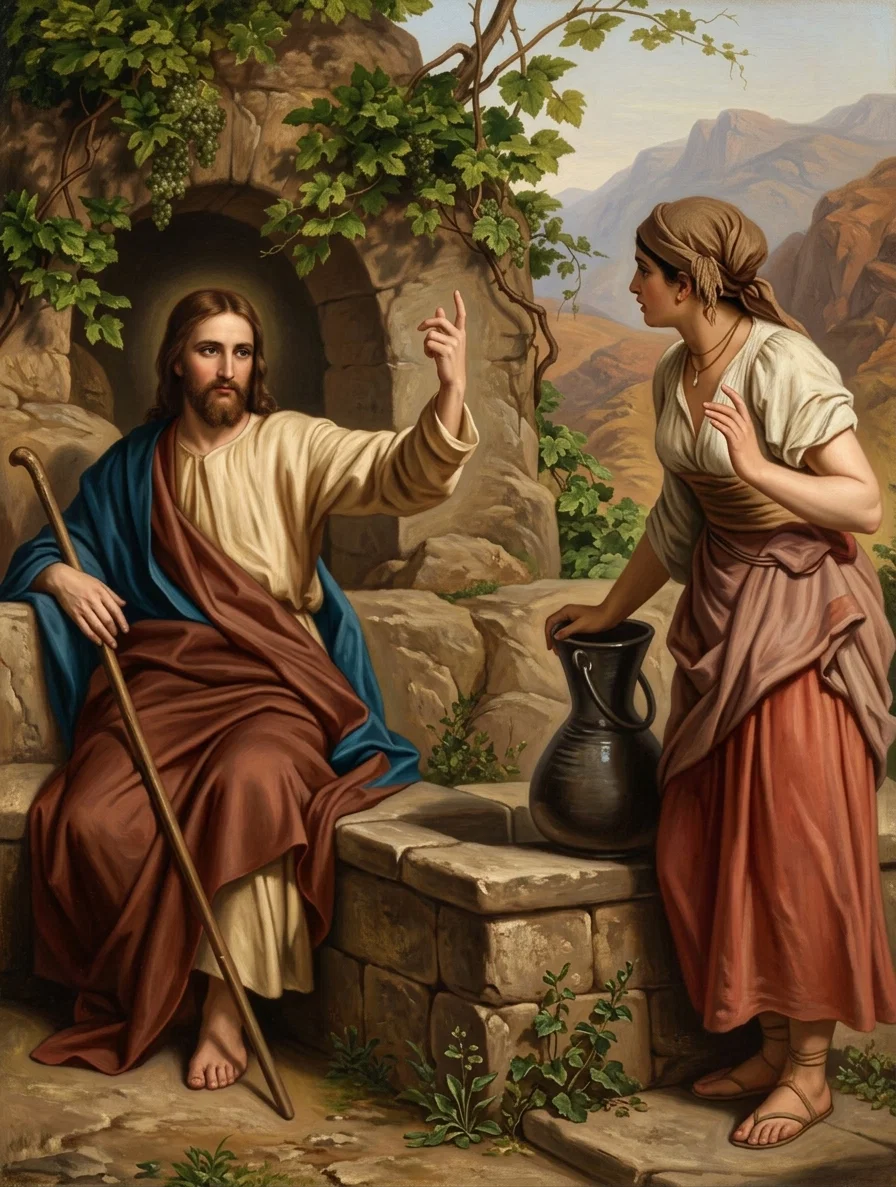
JESUS AT JACOB'S WELL. “Whosoever drinketh of the water that I shall give him shall never thirst; but the water that I shall give him shall be in him a well of water springing up into everlasting life.” John 4:14.
Among the beautiful incidents of Jesus’ life on earth is that of His meeting with the woman of Samaria. The record is found in John 4:3–42. The incident is the special one of a journey which our Lord took with His disciples from Judea to Galilee.
As they came to Sychar, Jesus, wearied with the journey, seated Himself on the curbing of Jacob’s well. His disciples left Him there, and went into the city to buy food. While they were away, there came to the well a Samaritan woman to draw water. We quote only so much of the record as is germane to the lessons we wish to draw from it.
Jesus first spoke to the woman: “Give Me to drink.”
“Then saith the woman of Samaria unto Him, How is it that Thou, being a Jew, askest drink of me, which am a woman of Samaria? for the Jews have no dealings with the Samaritans.”
“Jesus answered and said unto her, If thou knewest the gift of God, and who it is that saith to thee, Give Me to drink; thou wouldest have asked of Him, and He would have given thee living water.”
“The woman saith unto Him, Sir, Thou hast nothing to draw with, and the well is deep; from whence then hast Thou that living water? Art Thou greater than our father Jacob, which gave us the well, and drank thereof himself, and his children, and his cattle?”
“Jesus answered and said unto her, Whosoever drinketh of this water shall thirst again; but whosoever drinketh of the water that I shall give him shall never thirst; but the water that I shall give him shall be in him a well of water springing up into everlasting life.”
“The woman saith unto Him, Sir, give me this water, that I thirst not, neither come hither to draw.”
“Jesus saith unto her, Go, call thy husband, and come hither.”
“The woman answered and said, I have no husband. Jesus said unto her, Thou hast well said, I have no husband; for thou hast had five husbands; and he whom thou now hast is not thy husband; in that saidst thou truly.”
“The woman saith unto him, Sir, I perceive that Thou art a prophet. Our fathers worshiped in this mountain; and ye say, that in Jerusalem is the place where men ought to worship.”
“Jesus saith unto her, Woman, believe Me, the hour cometh, when ye shall neither in this mountain, nor yet at Jerusalem, worship the Father. Ye worship ye know not what; we know what we worship; for salvation is of the Jews. But the hour cometh, and now is, when the true worshipers shall worship the Father in spirit and in truth; for the Father seeketh such to worship Him. God is a Spirit; and they that worship Him must worship Him in spirit and in truth.”
“The woman saith unto Him, I know that Messias cometh, which is called Christ; when He is come, He will tell us all things.”
“Jesus saith unto her, I that speak unto thee am He.”
“No Respecter of Persons.”—Over and over again the Bible tells us that God is “no respecter of persons.” Jesus came to represent God to the world. In this same chapter He tells us, “My meat is to do the will of Him that sent Me, and to finish His work.” And again: “I came . . . not to do Mine own will, but the will of Him that sent Me.” “He that hath seen Me hath seen the Father. . . . The words that I speak unto you I speak not of Myself; but the Father that dwelleth in Me, He doeth the works.” God loved the world. Jesus represented that love. God loved all the people of the world, by loving each one in the world. Therefore Jesus could not live.within the narrow prejudices of His own countrymen, the Jews. They hated the Samaritans, who, no doubt, in their mixed worship, were in many things despicable, low, and unworthy. They called the Samaritans “dogs,” and believed that they were no better than demoniacs.
But Jesus knew they were sinners. He needed not that any should testify to Him of man; for He knew what was in man. He came to seek and to save the lost. It mattered not to Him what nationality they were, He gave Himself for them, and longed to save them. Each and all were the purchase of His blood. He did not argue about nationality or race with the woman or the disciples. His business was to save. And so in a wonderfully wise manner He opened the heart of the woman by appealing to her kindness, and showing that He was interested in her welfare and salvation.
What would He do, dear reader, were He here to-day? Would He reject the African, because the poor man had been a slave? Would He despise the Chinese? Would He call for vengeance on the Spaniards?—No; His great heart of love and pity would go out to all men, and His arms were open wide to receive them. “Come unto Me, all ye [Jews, Samaritans, Romans, Pharisees, publicans, Spaniards, Chinese, English, American, white or black] that labor and are heavy-laden, and I will give you rest.” O, for a heart like Christ’s, to love all men and women, irrespective of race or nation!
Not a Seeker after Prosperity.—Jesus did not seek the great crowds; the multitudes sought Him; for “there went virtue out of Him and healed them all.” He came to save. He “preached the righteousness of God in the great congregation;” He taught the lone, immoral woman by Jacob’s well; and He became so interested in the latter work that He forgot His weariness and hunger. What a lesson is here for the servant of Christ! How few there are who would have paused to tell the sweet story of salvation; but Jesus found a soul in need, and His work then was to supply that need. Every needy soul sent us whom we can help by word or otherwise is an opportunity given us of God to co-operate with Him.
The Wonderful Teacher.—Here is an example of Christ’s teaching. He ever lifted the mind from some earthly thing with which His hearers were familiar, to the great heights of God. It is the sower and his seed, the fisherman with his net, the merchant seeking goodly pearls; the woman and her leaven, the vine and its branches. In our lesson it is water from the well. The woman knew of this water, knew of the constancy of the flow of the water. From that earthly water Jesus lifted her mind to the great Fountain of life, which satisfies soul-thirst. How many times Satan endeavored to get the woman to lose the lesson by stirring her up to argue these questions with a Jew! Jesus does not argue. By one question He shows that her manner of life is known, and then reveals to her the great divine remedy, the water of life.
He is the Fountain to-day, as truly as then. Whosoever drinks of the water which He gives, never thirsts for the earthly, human pools of sin and selfishness. He quaffs of the life of God. Christ will give it as freely to us; for “He is no respecter of persons.”
The Clear Revelation.—With the honest doubt of the woman, Jesus has all patience. He knows how slowly light sifts through the sluggish brains, darkened and hardened by sin. Closer and closer He presses home the truth upon the heart, till at last she mentions the expected Messiah. Then our blessed Lord, knowing her sincerity, declares, “I that speak unto thee am He,” I am the Christ. Not so did He reveal His mission and work to the Pharisee, or the doctor, or the scribe. They would not trust Him or would betray His confidence. But to the simple heart, how clear the revelation came! Humbled by a sense of her own sins, she readily accepted the Saviour, and brought the people to hear Him. So, sinner, will the blessed Christ of God reveal Himself as a Saviour to you. “The meek will He teach His way.” “The secret of the Lord is with them that fear Him; and He will show them His covenant.” Open your hearts; come unto Him as unto a little child. He will place to the parched lips of your souls the water of life. He will teach to you the simple, saving truth.
There are other lessons,—the true manner of worship, the place of worship, the missionary work of the woman,—you will find them in almost every verse. But these which have been suggested are lessons most precious to both saint and sinner. X.

THE TRUTH AS IT IS IN JESUS.

TRUTH in Christ and through Christ is measureless. The student of Scripture looks, as it were, into a fountain which deepens and broadens as he gazes into its depths. As he searches the Word of God, the grand theme of redemption opens to his research. What subject is so vast and mysterious as the manifestation of God’s compassion for man? Herein is love, not that we loved God; for why should we not love Him? but that God loved us, sinful human beings.
Before Christ’s advent, darkness covered the earth, and gross darkness the people. He who is the Light of the world saw that Satan was throwing his shadow athwart the pathway of men, that he might prevent them from gaining a knowledge of God and of the future world. Men were sitting in the shadow of death. The only hope for the world was for this gloom to be lifted, and God revealed to the world. A teacher from heaven must come to this earth. The Sun of Righteousness must banish the darkness. Man’s necessities could be met in no other way.
The prophetic roll testifies of the Messenger that was to visit the earth: “Behold My Servant, whom I uphold; Mine Elect, in whom My soul delighteth; I have put My Spirit upon Him; He shall bring forth judgment to the Gentiles. He shall not cry, nor lift up, nor cause His voice to be heard in the street. A bruised reed shall He not break, and the smoking flax shall He not quench; He shall bring forth judgment unto truth. He shall not fail nor be discouraged, till He have set judgment in the earth; and the isles shall wait for His law.” “He shall not judge after the sight of His eyes, neither reprove after the hearing of His ears; but with righteousness shall He judge the poor, and reprove with equity for the meek of the earth; and He shall smite the earth with the rod of His mouth, and with the breath of His lips shall He slay the wicked. And righteousness shall be the girdle of His loins, and faithfulness the girdle of His reins.”
“When the fulness of the time was come, God sent forth His Son.” God could reveal Himself in no other way. The Eternal Word was made flesh, and dwelt among us. “Behold, what manner of love the Father hath bestowed upon us, that we should be called the sons of God.”
With mercy that is without a parallel, God strove to melt the hardened, sin-bound heart of man. His only-begotten Son, the Majesty of heaven, came to live among men. His life was far from being one of ease or pleasure. Painful toil was a part of each day’s experience. Weary, hungry, sorrowful, opposed and misrepresented by His brethren, His soul acquainted with grief, He did indeed bear the yoke in His youth. No other human being was ever so weighted with responsibility. He had a mission to perform, and constantly the words were on His lips, “I will not fail nor be discouraged.”
“Come unto Me,” Christ cried, “all ye that labor and are heavy-laden, and I will give you rest. Take My yoke upon you, and learn of Me; for I am meek and lowly in heart; and ye shall find rest unto your souls. For My yoke is easy, and My burden is light.” This is Christ’s recognition of duty. What is a yoke?—That which restrains. What is a burden?—Something to be carried. Obedience and service are combined in Christ’s words.
Many take views of life entirely opposite to Christ’s teaching. They look upon a life of freedom and idleness as the happiest. But Christ acknowledges no such principle. He put His neck under the yoke of obedience; and He says to us, Take My yoke upon you, and learn of Me how to obey and how to serve. In this you will find rest.
What is God’s law?—It is the expression of His character. What is service?—The work that human beings are to do for Christ. By wearing the yoke of obedience, we may be laborers together with Him. Through perfect obedience Enoch walked with God. The life in which the mind, soul, heart, and strength are given to God forms a part of the divine plan.
It was the spirit of uncomplaining submission in which our Saviour did His duty that made His yoke easy and His burden light. He conformed to the law of obedience and service, and the same principle that made Him so useful everywhere, He requires His followers to obey. In this way every man must be educated before he can love God supremely and his neighbor as himself.
During His life on earth Christ went about doing good. His sensibilities were most acute; for in Him was all that is elevated in mind, exalted in sentiment, and fine and delicate in feeling. In His nature was seen the perfection of humanity. His sensibilities were all in continual activity. Wherever He looked, He saw work to be done. At times He suffered beyond what any language can express as He realized that unaided humanity would be extinguished. Supernaturally sustained, He endured the seeing of men for whom He gave His life, perishing within reach of abundant help. With tender longing He looked pityingly upon them, and said with quivering lips, “Ye will not come to Me, that ye might have life.”
Man’s insensibility to wrong was sufficient to blunt Christ’s affections. Those who were the objects of His tenderest regard required Hiscompassion by fixed hostility and defiance. A constant demand was made on His forbearance, a demand sufficient to drain any heart but the one replenished at the Fountain Head of compassion itself. Were it not for the hidden Source from whence Christ drew His strength, He could not have lived. But thus supplied, He failed not, neither was He discouraged. His affections languished not. Throughout His life He constantly ministered to others. After His resurrection His first work was to convince His disciples of His undiminished love and tender regard for them. To give them proof that He was their living Saviour, that He had broken the fetters of the tomb and could no longer be held by death, that He had the same heart of love as when He was with them as their teacher, He appeared to them again and again, drawing the cords of love still closer around them.
All that Christ suffered, He suffered for us, that His grace might lighten the load we have to carry. He looked steadfastly to His Father for strength to live a perfect life and develop a complete, symmetrical character, that He might say to every struggling soul: Fear not; for I have overcome the world. I will give you the aid of My Spirit.
Not in this life shall we comprehend the depths of God’s love in giving Jesus to be the propitiation for our sin. The work of our Redeemer on this earth is, and ever will be, a subject that will put to the stretch our highest imagination. Man may strain every mental muscle and sinew in the endeavor to solve this mystery, but his mind will become faint and weary. The most diligent searcher will see before him a boundless, shoreless sea.
The truth as it is in Jesus can be experienced, but never explained. Its height, and breadth, and depth pass our knowledge. We must look to the source, in the great heart of the infinite God, our Creator. We may strain our imagination to its utmost, and then we shall only see dimly the outline of a love that is unexplainable, that is as high as heaven, but that stooped to earth to stamp the image of God on all mankind.
Yet it is possible for us to see all that we can bear of the divine compassion. This is unfolded to the humble, contrite soul. To be permitted to have a view of God is the highest privilege accorded to man. This privilege should be prized above all earthly distinction or honor. We shall understand God’s compassion just in proportion as we appreciate His sacrifice for us. “Thus saith the high and lofty One that inhabiteth eternity, whose name is Holy: I dwell in the high and holy place, with him also that is of a contrite and humble spirit, to revive the spirit of the humble, and to revive the heart of the contrite ones.” MRS. E. G. WHITE.

“SURELY HE HATH BORNE OUR GRIEFS.”

Christ’s heart was wrung for me, if mine is sore; And if my feet are weary, His have bled; He had no place wherein to lay His head; If I am burdened, He was burdened more; The cup I drink, He drank of long before; He felt the unuttered anguish which I dread; He hungered who the hungry thousands fed, And thirsted who the world’s refreshment bore. If grief be such a looking-glass as shows Christ’s face and man’s in some sort made alike, Then grief is pleasure with a subtle taste; Wherefore should any fret or faint or haste? Grief is not grievous to a soul that knows Christ comes—and listens for that hour to strike.
—Christina Rossetti.

The Gospel

THE THREE BABYLONS. NO. 8.

The Gospel.

IN this time of moral darkness, when the world was sunken in heathenism, the Light of the world appeared. He came to reveal the character of God in humanity, to show how it is lived.
He taught by example and precept that a Christian life is a life that in spirit and overt act conforms to the law of God. His words are: “I delight to do Thy will, O my God; yea, Thy law is within my heart.” “I have kept My Father’s commandments.” “If ye will enter into life, keep the commandments.”
As He was to show us how to live the divine life, He must be as we are while living it, He must take human flesh. In this condition He is to meet the tempter as man, and in man’s condition conquer. Hence, He must receive strength to meet temptations only as we may. And as He took man’s part against Satan, He made Himself the special object of Satan’s attacks. We watch with interest to see how He, with human weakness upon Him, is able to meet the tempter and foil him at every step. Example is often better than precept, and in this case it certainly is not inferior.
After His baptism, at which time He was anointed by the Holy Spirit as Messiah, He was led by the Spirit into the wilderness. Here He fasted forty days, His humanity being brought to that place where all can see it disclosed its weakness perfectly. None can say that that weak, emaciated flesh has strength to stand against Satan, yet so the Saviour met him.
Three masterly temptations are brought to Him, and He, as humanity weakened, completely overcame the adversary. How?—At every onslaught the tempter was met—not with the strength of the weak One he was tempting, but with the power of God’s Word—“It is written.”
If Christ could thus overcome Satan, when in that weakened condition, need we ask how we may overcome him? “The weapons of our warfare are not carnal [fleshly], but mighty through God to the pulling down of strongholds; casting down imaginations, and every high thing that exalteth itself against the knowledge of God, and bringing into captivity every thought to the obedience of Christ.” Take “the sword of the Spirit, which is the Word of God.” Christ trusted the Word, and thus overcame. That is what He told Adam to do in the beginning, and it is what He has told each soul since.
When Jesus left the earth, He gave instruction to His disciples as to what they were to preach: “Go ye into all the world, and preach the Gospel.” “Go ye therefore, and teach all nations; . . . teaching them to observe all things whatsoever I have commanded you.” From this we see that His words and the Gospel are all the same. But as He is “Jesus Christ the same yesterday, to-day, and forever,” His words were always the Gospel. But He says: “The words that I speak unto you I speak not of Myself,” “but the Father which sent Me, He gave Me a commandment, what I should say, and what I should speak. And I know that His commandment is life everlasting.” Then all the Word of God is the Gospel; and one whom the Saviour told to preach the Gospel says: “The Word of the Lord endureth forever. And this is the Word which by the Gospel is preached unto you.” He, therefore, who trusts the power of God as manifested through His Word for salvation, trusts in the Gospel, “the power of God unto salvation;” but he who will not do this, must trust self instead of the power of God.
The Gospel is, therefore, a Gospel of faith, entirely faith, in just what God says.
The Word of the Lord is pure. His commands are holy, just, good, and spiritual; and if we but accept it “as it is in truth, the Word of God,” it will “effectually work” holiness, justice, goodness, and spirituality in us.
Now since it is God who is to work in us when we trust His Word, it follows that as long as any one trusts God’s Word, and God works in him, he can not apostatize from God. If an apostasy takes place in the life of a Christian, it must be because he fails to trust God’s Word; and if an apostasy takes place in the church, it must take place in the individual Christians composing the church. Therefore, all apostasy is but men leaving God’s Word.
Paul, realizing this, charged Timothy, and all other ministers, to “preach the Word,” because apostasy was going to come, and this would restrain it for a time. He also told the Ephesian elders of the apostasy to come, and told them how it might be avoided: “I commend you to God, and to the Word of His grace, which is able to build you up.” The same Word will save from apostasy and out of apostasy now. C. L. EMERSON.

CHRIST THE CREATOR OF THE SABBATH.

THERE was a time when the worlds that inhabit space had no existence; then it was that, by the will and purpose of the omnipotent One, Christ became, in the hands of the Father, the one sole Agent in the carrying out of the purpose of the Infinite, the creation of the universe peopled with intelligences like unto His image. The Father was the great Master Builder, and in harmony with His purpose and design, the Son wrought as the chief Architect.
The great apostle to the Gentiles says he was ordained “to make all men see what is the fellowship of the mystery, which from the beginning of the world hath been hid in God, who created all things by Jesus Christ.” Eph. 3:9. Again he says in his letter to the Corinthians, “To us there is but one God, the Father, of whom are all things, and we in Him; and one Lord Jesus Christ, by whom are all things, and we by Him.” 1 Cor. 8:6. In Paul’s letter to the church in Colosse, after stating that Christ is the image of the invisible God and the first-born of every creature, he says, “For by Him were all things created, that are in heaven, and that are in earth, visible and invisible, whether they be thrones, or dominions, or principalities, or powers; all things were created by Him, and for Him; and He is before all things, and by Him all things consist.” Col. 1:16, 17. One more positive declaration will suffice to prove the companionship of Christ with the Father in the creation of the universe. Says John in the first chapter and second and third verses of his Gospel, in speaking of Christ, or the Word: “The same was in the beginning with God. All things were made by Him; and without Him was not anything made that was made.” That there were two divine Beings interested in the work of the creation is further shown in the first chapter of Genesis and twenty-sixth verse, where God says, “Let Us make man in Our image, after Our likeness.” The plural form of expression denotes the co-operation of at least two Divine Intelligences.
Hence we must conclude that, as all things were made by Christ, as by Him all things in heaven and earth, visible and invisible, were created, as by Him all things consist, and as without Him nothing was made that was made, Christ must have been the creative agency in the formation of this earth. He was present when the long reign of darkness was first broken by the light, as recorded in the first day’s record of time. It was His power that separated the light from the darkness, that created the bodies in the firmament of heaven to give light by day and light by night, that caused the earth to bring forth, and the waters to multiply living things. And He it was who formed man, the masterpiece of His work, in His own image, as the ruler of the world He had made.
And as He was associated in the work performed upon the first six days of time, so He was just as fully identified with the events connected with the seventh day, forming it into a grand memorial of rest in commemoration of the work He had accomplished. Thus it was, as recorded in Mark 2:28, that Christ could claim the lordship of the Sabbath. It was His because He had made it. Therefore, in honoring the Sabbath which Christ has made, menhonor Christ. In disloyalty to the day which He claims as His own, disloyalty is shown to the Creator and the Redeemer.
If Christ was the Author of Sabbath observance, and the Creator of the rest day enjoined upon the human family in the beginning of the world, why should He seek during His earthly ministry to antagonize His own work? It can not be considered probable or even possible for a single moment that He did so. Let all remember that Jesus Christ, the Saviour of men, was likewise the Creator of the world, and in honoring the day that Christ created and made, no higher respect can be shown to both the Father and the Son. F. M. W.

“THOU HAST HEARD, O MY SOUL!”

The prophets were often permitted to view scenes of desolating destruction that were to spread over Jerusalem and Palestine. And quite as often were their minds led on by vision to behold the still greater desolations that would completely break the world down in the last days. A very clear illustration of this is found in Jeremiah, chapter four. In the first part of the chapter the prophet is addressing Israel and Jerusalem. And in the last part of the chapter he is dwelling upon the terrible last-day scenes. And the destruction of ancient Jerusalem is only a faint shadow of the rapidly-approaching time when the mountains tremble, the hills move lightly, and the “fruitful place” becomes “a wilderness, and all the cities thereof were broken down at the presence of the Lord, and by his fierce anger.” See Jer. 4:24–26.
One thing in particular that engages the prophet’s attention in a most wonderful manner is the “alarm of war” that is heard in the land amid these last-day scenes. His languagein both feeling and power is among the most thrilling utterances of all the inspired volume. He says:—
“My bowels, my bowels! I am pained at my very heart; my heart maketh a noise in me; I can not hold my peace, because thou hast heard, O my soul, the sound of the trumpet, the alarm of war. Destruction upon destruction is cried; for the whole land is spoiled; suddenly are my tents spoiled, and my curtains in a moment.” Jer. 4:19, 20.
The “sound of the trumpet and the alarm of war” are heard by the prophet. But it is no ordinary scene that is passing before his prophetic vision. What he beholds is so soul-stirring, so awful, and so filled up with “destruction upon destruction,” that he cries out, “I am pained at my very heart; my heart maketh a noise in me; I can not hold my peace, because thou hast heard, O my soul, the sound of the trumpet, the alarm of war.”
The trumpet is sounding among the nations, and the war cry is heard everywhere. Nations that have claimed to be standing for peace are being plunged into the awful maelstrom of strife. Superhuman agencies seem to have taken possession of men, and they have gone fairly wild in their unprecedented endeavors to prepare for human slaughter. From the small boy to the gray-haired man you will hear the situation discussed. Every one grows pale before the thought of this incoming tidal wave of war. Here and there all over the land you may hear a few warning voices against it. All are united in saying that even the contemplation of a modern battle is terrifying beyond description. Peace societies are formed, and kind-hearted and noble-souled men and women seek to raise a standard that will turn aside the threatened flow of blood; but all to no purpose. Everything is borne down before the swelling tide. War! war! is the cry. Even the minister, who claims to be a representative of the Prince of Peace, joins in swelling the battle din and call to arms.
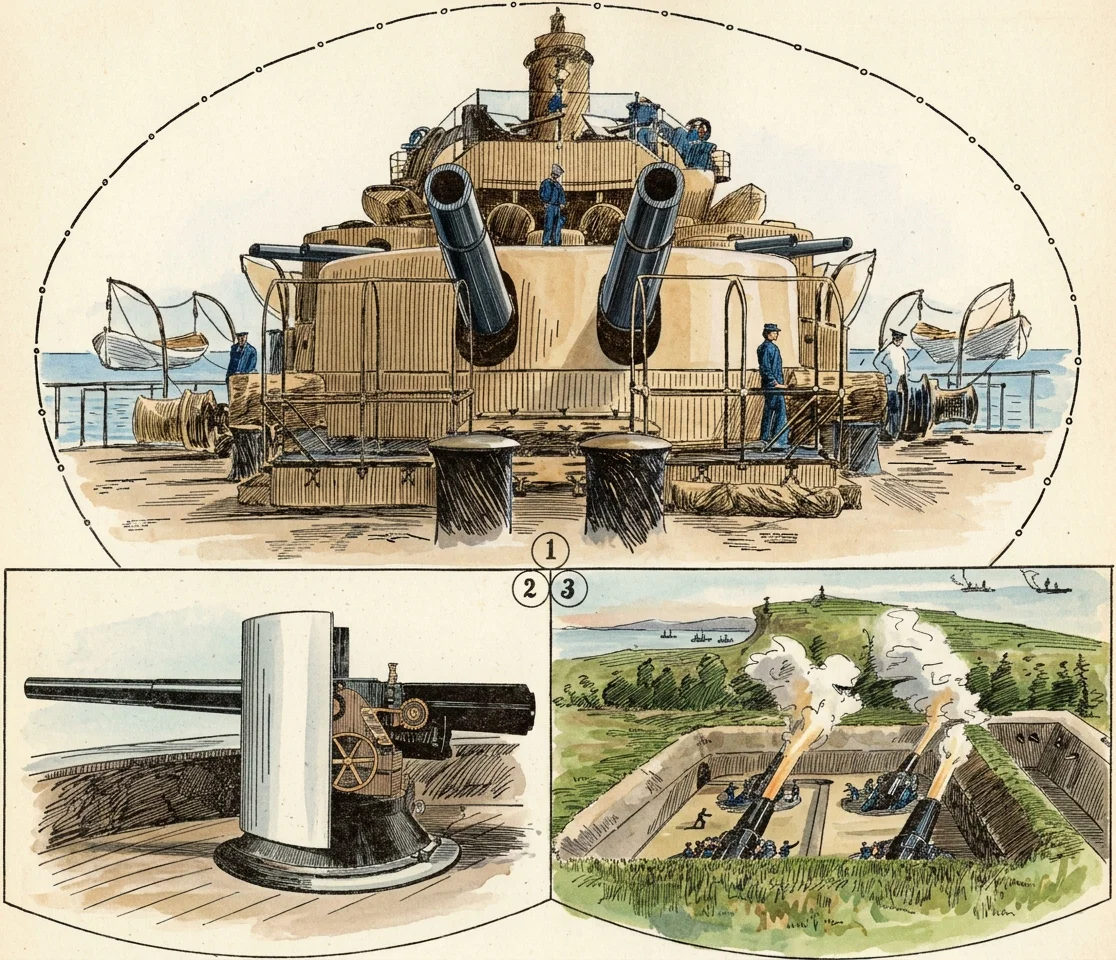
No. 1. The after part of the battle-ship Oregon, showing her aft revolving turret with two of her 13-inch guns protruding from the same. On either side may be seen one of her broad-side revolving turrets with two of her eight 8-inch guns projecting from each. Some of her small rapid-fire guns may be seen near the top of the cut. The 13-inch guns use a charge of 550 lbs. of powder and throw a shell weighing 1,100 pounds, with a velocity of 2,100 feet, or nearly half a mile, per second. The 8-inch guns use 115 pounds of powder and throw a 250-pound shell with a velocity of 2,080 feet per second. The forward part of the Oregon has the same heavy guns, while her secondary rapid-fire battery, of twenty 6-pounders, six 1-pounders, and four Gatling guns, can shoot out a regular hailstorm of steel. No. 2. A 4-inch rapid-fire gun, with revolving shield, such as is used on the men-of-war. It uses a charge of from 12 to 14 pounds of powder, and throws a 33-pound shell with a velocity of 2,000 feet per second. At the muzzle its projectile would pierce 10 inches of wrought iron. It is fired with such rapidity that in the ordinary range, 5 balls may be kept in the air flying toward the mark. Thirty-six years ago the iron-clad Monitor pounded the sides of the Merrimac for over half a day with her two 11-inch smooth-bore guns. And, altho the Merrimac had only 4-inch iron armor, yet no shot perforated her during the whole fight. This 4-inch gun would have made a veritable pepper box out of her in short order. No. 3. A section of a battery at the entrance to New York harbor. Ships may pass and repass this battery without being seen by the men within; neither would those on board the ship get any idea of a battery being there from any outward appearance. The mortars are down behind great earthworks, and within these earthworks are massive walls with an intervening space so as to protect them from a charge from the enemy's infantry if they should succeed in landing. As shown in the engraving, some machine guns are so arranged in the diagonally opposite corners of this outer space that they could mow men down as fast as they could rush in. The harbor is all carefully mapped off in squares, and an officer on a prominence a mile or so away from the battery, by means of his range-finder and chart can tell what square the enemy's ship is occupying. He telegraphs this to the officer in charge of the mortar battery, and he immediately gives his pieces the proper elevation and fires them, either one, two, three, or on up to sixteen at a time, just as he likes. They have the matter so accurately figured out, and the men have become so skilled in their work, that a shot from one of these mortars can be dropped down on the space of a vessel's deck anywhere within a radius of five miles, the plan of a mortar being, of course, to throw a shell high into the air and let it fall on its target, bursting as it strikes. The shells thrown by the mortars shown in our cut weigh 1,000 pounds and are charged with 100 pounds of a high explosive. They would make short work of any hostile war ship that came within their range.
Why is all this? What does it all mean? We have been told of a millennium of peace. But instead of peace the whole world is gathering for such a war that all the battles of all the legions in all the past would seem but little more than child’s play beside it.
The frowning after-part of the battle-ship Oregon, shown in our accompanying cut, most would have been sufficient, previous to fifty or sixty years ago, to have completely unnerved the navies and armies of the world. A few batteries of the little four-inch guns shown on this page, if accompanied by their skilled manipulators, would have enabled the Corsican of a hundred years ago to have marched in triumph from country to country, laying all the world under tribute at his feet. While a battery or two of the modern mortars, favorably placed at the entrance to a harbor, could have made the authoritative demand that all who enter this port must first secure our permission or else lie beneath the wave.
And only to think that a short twenty-five years in the closing part of the nineteenth century is able to produce these marvelous machines of war! It seems incredible! But here it lies before us, and we are compelled to believe it. The dizzy spheres into which the imaginary stories of our nursery days carried us are outdone by the wonderful realities of to-day. And so can there be any doubt that Jeremiah had a wonderful and most intensely realistic view of these times? Nothing short of the modern engines of war could have called forth such vivid language. Such a flame of intense expressions would not burst forth from a vision of a few thousand men stabbing each other with swords and spears. But modern rapid-fire and machine guns, the great high-power cannon and bursting torpedo, are belching forth their “destruction upon destruction” when the ancient seer is caused to say, “I am pained at my very heart; my heart maketh a noise in me; I can not hold my peace, because thou hast heard, O my soul, the sound of the trumpet, the alarm of war.”
The last days are here; and not simply by the “alarm of war” that is heard all over the world, but by multiplied signs on every hand, the Lord is seeking to press this great truth home on every heart. If we discern and receive the truth for our time, divine power will shield us from every evil that confronts this age. Satan is seeking by every means to destroy men, but the Father above is speaking to your heart and conscience, and by the most touching appeals is bidding you enter that haven where we may rest in eternal safety. You hear the voice of God speaking through His Word, and your soul is stirred to respond to a Father’s invitation and love. You must soon decide. What will you do? T.

THE FLAG ON THE CHURCH.

CAN a church that musters under a worldly banner be a church of Christ? Of His disciples He says, “They are not of the world, even as I am not of the world.” In the same connection He says, “The world hath hated them, because they are not of the world, even as I am not of the world.”
When a man marches under a banner, he signifies that he is of whatever that banner represents; just so is any company or organization. All the governments of earth are “of the world.” Civil government was ordained for the world, and will come to an end when Christ comes to set up His kingdom, which will “fill the whole earth.” Of all the governments of the world, there will be no place found for them.
How, then, can a church place itself under the flag of any government of the world and claim the protection of Him who has given fair warning that He is coming to destroy that government? The Lord gave warning that He was going to destroy Sodom, and those who preferred to give their service to Sodom were destroyed with Sodom. So with Jerusalem; warning was given that it would be destroyed, and all who cast their lot with Jerusalem were destroyed with it. It will be just so with those who indicate by their worldly banners that they are of the world. When the world and its governments are finally overthrown, those who gather under their banners will fall in the general collapse.
It matters not under which of the national banners one may choose to march, if that be his choice of citizenship, he unites his fate with that of the government so chosen. If he join himself to a worldly government, the fate of that government must be his fate. If he join himself to the government of God, he will share the glory and the life of that government. God has not selected the stars and stripes, nor the red and yellow bars, nor the cross of St. George, nor the dragon on a blue field, as his particular ensign. Not any nor all of them are any part of the kingdom of heaven. These and all others are the tokens of a selfish human rivalry everywhere prevalent in the world. They indicate government by force. They represent a force that is ready to kill and destroy in retaliation for wrongs or injuries, real or imaginary. In their very nature they can not be Christian; for Christ has told His disciples emphatically not to resist evil. Then can a Christian or a Christian church consistently raise a banner that says to the world, We stand for retaliation, for strife, for revenge, for bloodshed, for conquest? No, most emphatically, no.
Christ was offered all the kingdoms of the world and the glory of them, but He refused them. They were nothing to Him; for it was His purpose to destroy them all in His own good time. A great multitude of people once thought to make Him a king, but He declined; for His kingdom is not of this world, nor is His banner the banner of any worldly power. “His banner over me is love,” and His law is, “Thou shalt love thy neighbor as thyself.” His doctrine is, “Love your enemies, bless them that curse you, do good to them that hate you, and pray for them which despitefully use you, and persecute you.”
No one can follow out these Heaven-born principles while marching under the banner of blood and carnage, or while urging men on to the field of slaughter. No; the carnal battlefield is a thing of the world, and Christians can have no part in it. The apostle Paul made the true Christian decision when he said, “I determined not to know anything save Jesus Christ and Him crucified.” W. N. G.
Continue reading: A GREAT MISSIONARY