Your ShelfYour Projects

Review and Herald, Vol. 90, No. 13.

My Prayer
Earlier text: My Prayer

The Chief Responsibility

Is the church to lose its children? This is the question raised in the leading editorial of the Continent (Presbyterian) of March 13, 1913. It is a question which concerns not alone the Presbyterian Church, but every church. It is one of the vital questions of the Seventh-day Adventist Church at the present time. The Continent quotes Sir Robinson Nicol, as stating in the British Weekly that the large decrease in attendance at Christian worship in some of the churches of England as compared with ten and twenty years ago is directly due to the absence of young people and children. Reference is made to five of the strongest Presbyterian synods in the United States, embracing six hundred Sunday-schools with some forty thousand young people under instruction, and in the whole year not one of them was led to confess Christ.
How many children and young people among Seventh-day Adventists have been led to confess Christ during the past twelve months? Our church record would make a different showing than the above figures we are sure. We are glad indeed that the report has come from many of our camp-meetings, schools, and sanitariums of scores of earnest young men and women who have been led to consecrate themselves to God. But while we rejoice in this, what shall we say of the scores of young men and women, and boys and girls, among Seventh-day Adventists who have not been led to take this step? In every Sabbath-keeping community we find the unconverted. We can not visit a church of any size but that we find in the congregation bright, intelligent young people who have never yielded themselves to God.
Upon whom does the responsibility for these unconverted ones rest? Upon the church, we are willing to admit; but this, after all, does not locate specifically the responsibility. In too many instances we believe the church has been recreant to its trust. The ministry itself, and the writer includes himself with his brethren, have not labored so faithfully as they should for these classes.
The church of God has a great responsibility in these matters. This should be sensed by every officer and by every member. By attractive, spiritual services in the house of God; by kindly personal interest on the part of its members, the church should seek to attract rather than repel the children and youth.
But when we say that the church is responsible for the salvation of the youth, we speak of a general responsibility. Back of the church the chief and specific responsibility rests upon the home. Above the responsibility of the minister of the gospel; above the responsibility of the church elder; above the responsibility of the officers of the Sabbath-school and young people’s society; yea, above the combined responsibility of every member of the church, stands the responsibility of the home for the conversion of the youth. This is where God has placed it, and, dear parents, we can not shift this responsibility; we can not throw it off upon others.
We can not secure entrance for our boys and girls into our institutions, and then say to the managers of these institutions, “We hold you responsible.” For your child God has placed the chief responsibility upon you, and O, what a blessed labor of love you may make it! In your own home you can watch and labor for souls as those who must indeed give an account. To your children who have not reached the age of accountability you stand in the place of God. The Heavenly Father designs that you shall represent to them the principles of heaven,—the love and mercy of his character,—and he has not left you to do this alone. He desires to become your mighty helper; he desires to enter into your heart and life and fill you so full of his Spirit that your life shall indeed reflect the principles of heaven.
In labor for no other class may you so confidently take hold of the hand of God. If your souls are drawn out in burden of prayer for those you love, the Spirit of God will seek in sympathizing co-operation to change the hearts of those for whom you pray. And what a joy will it be, when the Master comes, to be able to say, “Lo, here am I and the children that thou hast given me.”
God has promised to turn the hearts of the children to the parents and the hearts of the parents to the children. It is our blessed privilege to pray and work and believe for the fulfilment of this promise. Doing this, we shall not be disappointed.
F. M. W.

Examples to the Flock

The minister of Christ should exemplify in his own life that which he preaches to others. If his life denies the profession he makes, his preaching, however good, will accomplish but little. The minister proclaims Christ as the Saviour of mankind. Does he know this as a precious truth which he himself has realized in his own experience, or has he learned merely the theory from the Scriptures? Does he know that his own sins are forgiven, and that he is accepted in the Beloved? Is he experiencing from day to day the keeping power of God? Only by knowing God for himself can he minister light and blessing to those in the bondage of sin. And he will be able to bear witness only to that which he has seen with his own eyes, felt in his own heart, and experienced in his own life.
It is a great thing for the minister of Christ to maintain a clear connection between his own soul and God. It is a great thing also for the gospel minister to live in this world as an ambassador of heaven; to associate with worldly men and women, and yet not partake of their spirit; to labor for men, free from personal prejudice and bias; to hold himself above the spirit of self-seeking, of envy, jealousy, and evil surmising. He is human, the same as those for whom he labors; and it is only as he is kept by the power of God that the worldly influences with which he is surrounded do not enter into his heart and control his life.
When the gospel laborer fails; when, in an unguarded moment, the enemy has come in and carried off the victory, then it is for him to turn again to God in precisely the same manner as must come every penitent to the mercy-seat. Have difficulties arisen between him and his brethren? has he been a party to strife and become embittered against those who he feels have wronged him? Then, to be consistent, he must be governed by the same principles which he advocates to his flock. For him or for his class there is no royal road of repentance. He can put away his sin only through confession and humiliation of soul. He can make wrongs right with his brethren and with God only by confession of those wrongs, the same as he enjoins upon the lay members of the church. And the occupying of official positions in no way affects the principle. The president of a conference, the principal of a school, the manager of a sanitarium, must put away sin in precisely the same way as those under their direction. Indeed, in matters of this kind the gospel worker should be an example to the flock.
There is quite as much need of the recognition of these principles on the part of the gospel worker as on the part of other members of the church; and if they were observed and followed, it would save many differences and much misunderstanding among brethren. It would relieve many heartaches and heal many wounds.
David was a man after God’s own heart. He committed a great sin against both his Maker and his fellow men. But when this sin was pointed out, when an awakened conscience recognized the enormity of his guilt, he demonstrated that he was indeed a man after God’s own heart, by humbling his soul before God, renouncing his sin, and turning again to the principles of righteousness.
The ministers of Christ to-day, like the priests of old, are “compassed with infirmity.” But though beset with human infirmity, though falling short of the perfect righteousness there is in Christ Jesus, it is their privilege to prove to all the sincerity of their profession by a recognition of the gospel principles of which heaven has made them the teachers. In this course they will prove to all men their sincerity and their consistency.
“The elders which are among you I exhort, who am also an elder, and a witness of the sufferings of Christ, and also a partaker of the glory that shall be revealed: Feed the flock of God which is among you, taking the oversight thereof, not by constraint, but willingly; not for filthy lucre, but of a ready mind; neither as being lords over God’s heritage, but being ensamples to the flock. And when the chief Shepherd shall appear, ye shall receive a crown of glory that fadeth not away.”

President Wilson and His Cabinet

WE are indebted to the United Presbyterian of March 13, 1913, for the following statement with reference to Mr. Wilson’s Cabinet:—
President Wilson’s Cabinet has a reassuring personal aspect. The members of it are men who have won success or distinction in business, professional, or public stations. They are in the prime of life, the average age being about fifty years. Five of them (one half) were born in the South. The list of members is headed by Wm. Jennings Bryan, who has the portfolio of Secretary of State. The Secretary of the Treasury is Wm. G. McAdoo, a lawyer, but better known in connection with his very successful construction of the tunnel system under the Hudson River. He was born in Tennessee, but resides in New York City. The Secretary of War is L. M. Garrison, from New Jersey. He is the son of an Episcopalian clergyman and a jurist of acknowledged ability. The Postmaster-General is Albert S. Burleson, of Texas. He is a lawyer, and has been a member of Congress for seven consecutive sessions. The Secretary of the Interior is Franklin K. Lane, of California, a lawyer, but for seven years a member of the Interstate Commerce Commission. The Attorney-General is James C. McReynolds, born in Tennessee, but resident in New York City. For some time he has been special government counsel in proceedings against trusts. The Secretary of Navy is Josephus Daniels, of North Carolina, admitted to the bar, but his energies have been devoted to journalism in his native State. The Secretary of Agriculture is David Houston, born in South Carolina, but resident in Missouri. He has been in educational work all his life, being chancellor of the Washington University, St. Louis, at the time of his appointment to the Cabinet. The Secretary of Commerce is Wm. C. Redfield, of New York. He is a well-known manufacturer, and has served one term in Congress. The new chair in the Cabinet, Secretary of Labor, is filled by William B. Wilson, born in Scotland, but since 1870 resident in Pennsylvania. He was a coal-miner, coming into prominence as a union leader. He was twice member of Congress. Seven of the ten secretaries are college men—the editor, the manufacturer, and the labor leader not having had that sort of training.

Dr. Pierson on Baptism

DR. ARTHUR T. PIERSON, for many years the efficient and inspiring editor of the Missionary Review of the World, which before he died changed his views regarding the question of infant baptism and immersion. Quoting from “The Life of Arthur T. Pierson,” published by the Fleming H. Revell Company, the Examiner of March 6, represents Dr. Pierson as saying:—
Another impression left by the reading of the Acts of the Apostles was that infant baptism has, in that book, a very slender basis of authority. The common, unbiased student would not infer that such was the primitive custom. In every case but one, where the baptism of households is referred to, their “believing” is also recorded. I was compelled to admit the absence of any direct injunction, and that so far as the explicit teaching of the Word goes, the practise found but little support or sanction. I observed with increased misgiving that in actual practise infant baptism is sometimes a snare. In the Presbyterian Standard, though it is more carefully worded than some others, I find no word concerning baptizing children of the regenerating influence of the Spirit. They are treated as within the pale of the church, under its inspection and government, to be taught all Christian duties, and “when they come to the years of discretion, if they be free from scandal, appear sober and steady, and to have sufficient knowledge to discern the Lord’s body, they ought to be informed it is their duty and their privilege to come to the Lord’s Supper.” Is it not the fact that, judged by such criteria, many an utterly unregenerated person actually finds entrance to our communion? If in our day of superficial and unsanctified morality any truth needs emphasis, it is that “excepta man be born again — born from above — he can not enter nor even see the kingdom of God.” A baptized infant needs, as much as any other, the new birth. I was sought by scores of inquirers who had been depending upon baptism in infancy to such a degree that they had no clear sense of their need of the new birth. Every motive of worldly policy counsels me to silence, but loyalty to God, to the truth, and to my brethren demands utterance, whatever consequences may come to me personally.

Enforced Bible Reading in the Public Schools

RECENTLY there was introduced into the house of the Pennsylvania Legislature a bill requiring teachers in public schools to read without comment every morning at least ten verses from the Bible, the penalty in case of refusal being dismissal. When this question came to an issue, there were 149 votes in its favor, with 29 against it. Two years ago the same bill was rejected by the senate, and it remains to be seen whether or not the senate of the present session will indorse the action of the house. Among the reasons urged against a bill of this character, the Lutheran of March 6 gives the following:—
There is never anything gained by legislating religion into favor. The state should give the church the benefit of its support; but it has no right to force the Bible upon any one who does not want it. There are Jewish and Roman Catholic teachers and pupils in the public schools. The former do not accept the New Testament, and the latter have a version of the Bible different from the one in general use. To compel teachers to read the Bible when they either do not believe it or are opposed to a certain version is not in accord with the law of liberty which Christ preached. Christ never compelled any one to listen to him.
It is not the function of the state to prescribe in religious matters. It may frame laws that accord with Christian principles, and should always do so in this country where those who are in sympathy with Christianity are greatly in the majority. But it may not teach Christianity. That is the function of the church. As the church (blessed be God) is separate from the state in this country, it devolves upon the former to teach religion, and upon the latter to see to it that the church may do so unmolested.
The truth of the matter is, parents are thrusting upon the church and the state burdens that are placed primarily upon them. Religion and morals should be taught in the home. There is where the best foundation for citizenship is laid. Parents should cooperate with the church.

Paganizing Easter

ADMITTING that it has never felt very keenly over the origin of the Easter festival even though it came from heathenism, the Standard of March 15, 1913, confesses that it views with deep concern the influences which are now at work to paganize this church festival:—
The extent to which this modern paganizing of Easter has gone is indicated, for example, by the fact that most of the magazine articles for several years fail to refer to what is the heart of Easter. One will find discussions about the date of Easter, menus for Easter breakfasts and luncheons, chatty talks about Easter eggs, advice about Easter gifts and entertainments, but not much about the great hope of personal immortality.
When an institution like Easter is founded upon pagan custom rather than upon Scriptural injunction, why should we consider it strange to see it reverting to its old-time use? The very fact that paganizing influences are molding the observance of this institution shows that the church at large recognizes its true origin after all. It would be far better for the church of God to drop out of its reckoning and observance these institutions that have descended from the pagan fathers of the past, giving more regard to those institutions and ordinances and observances which have their foundation in the Scriptures of Truth.
For the Christian church to do this, however, would greatly revolutionize her faith and practise. For instance, she would have to drop out sprinkling for baptism and employ immersion instead; she would need to regard the first day of the week as an ordinary day of labor and observe the seventh day of the week as the Sabbath of Jehovah. It is too much to hope that this will ever be done, but there will be found devoted lovers of the truth, who, through discarding tradition, will take their stand upon the Word, and the Word only, as the foundation of their faith and practise.

The Jesuit Oath

REFERRING to the oath purporting to be that taken by the Jesuits, which has been printed in some of the newspapers recently, the Christian Observer quotes this from Dr. Juan Orts Gonzalez:—
I am absolutely certain that the oath printed on the little folder you sent me was never used at any time by the Jesuits. The Jesuits, however, have taught, and still teach, that the Inquisition is right; that heretics deserve to be burned if they do not accept the Roman Catholic faith. They are deterred from resorting to the Inquisition because the civil law of the land prevents them, but should they ever get control, they couldby right, as they see it, apply at once the methods of the Inquisition; in other words, if the church likes to burn heretics, she has a perfect right to do so. They are compelled to this line of action without any special oath to that effect, because the Roman system teaches that the Inquisition is right, and they are its stanchest exponents.
Regarding this testimony the Observer adds:—
From this it is evident that should the Roman Church come to a dominating influence in any land, there is nothing in the moral and religious beliefs of the church to prevent it from punishing heresy with the fagot or the hangman's noose. The Inquisition has repeatedly done this in past ages with the approval of the hierarchy. And it is the boast of the church that it never changes.

Is the Saloon Doomed?

WE truly hope that this will be the result of the growing agitation regarding the future of this institution. The Charlotte (North Carolina) Observer has this to say on the subject:—
It is significant of the changing condition of the country that one of the New York newspapers—Collier's—has begun to discuss the question as to what occupation shall be provided for the saloon-keeper when the present-day saloon goes, as go it must. Even in the large cities of the country the handwriting is seen on the wall. The open saloon is disappearing from the land, and the time is not far away when it will be unknown in the United States. The dispensation of whisky through the open saloon is a species of traffic that is destined for final disappearance. Whisky will for a time after the disappearance of the saloon be obtainable in some way, but it is not reasonable to suppose that it will survive any great length of time, for the traffic in it will be made unprofitable, and it is peddled now mainly for the money that is in the business. The process of the elimination of the saloon will be slow, that of ridding the country of liquor will be still slower, but no two ends are more certain of final accomplishment. It is certain we shall never again see the open saloon in North Carolina. It is equally certain that in time this institution will be searched for in vain in any State in the Union.

No Command for Sunday Observance

QUOTING the Times-Journal that “the Christian citizenship of our nation should stand four-square against Sabbath desecration and should drive from our land the loose idea of Sunday observance,” the Bowling Green (Kentucky) Messenger of Feb. 9, 1913, truly says:—
The decalogue decrees that the seventh day of the week shall be observed as a day of rest. “Six days shall work be done, but on the seventh day there shall be to you an holy day, a Sabbath of rest to the Lord.” . . . The provision of Sabbath observance is likewise incorporated in the decalogue, or ten commandments. But this referred to Saturday, or the seventh day of the week, and such a day of rest was observed with more or less rigidness by the children of Israel, and is to this day. At what time Sunday, or the Lord’s day, came to be observed as a day of rest is clouded in some obscurity. Certain it is there is no direct command for its observance in the Scriptures.

Increasing Their Armies

Of the efforts being made to increase the peace footing of the armies of France and Germany, the Advance of March 13, 1913, says:—
The French cabinet accepted the decision of the supreme council of war in favor of a three years' term of service in all branches of the army instead of two years, as hitherto. The measure will add at least 210,000 men to the peace footing of the army, which at present stands at 580,000, excluding officers. The vast military preparations being made by Germany are given as the compelling reason for this step of the French government. The new German military bill will add 84,000 recruits to the annual contingent called up for service in the army. The total strength of the peace footing of the army will thus be increased by 168,000 men, bringing it up to 806,000, excluding officers.

Europe Fearing War

PRESS reports indicate that there is a general expectation throughout Europe and Great Britain that a clash between the armies of the greater powers is imminent. This fear was accentuated recently when it was declared that Germany, in order to make such an increase in her army as she considered necessary to the carrying out of her aims, had provided for the placing of a direct tax on private fortunes. Fortunes up to $50,000 would bear a tax of $1.25 on every $500, and this rate of taxation would be increased for fortunes of a greater amount, until fortunes of $25,000,000 or over would be taxed $20 on each $500. It is reported that France at once began to arrange for similar taxation, in order that she should not be left behind in this race for a large army and the latest equipment. A London correspondent says, “France’s spirited response to the proposed military aggrandizement of Germany has done more toward insuring peace to-day and war to-morrow than any diplomatic move in the recollection of any person now living. On the other hand, Germany’s lame explanation as to the causes of the enormous outlay and the increase of her peace army has deceived nobody.” A British diplomat says: “It is admitted by all who are acquainted with the currents of diplomacy in Europe that the coming of Poincare has put more electricity into the French-German situation than there has been in many years. The appointment of Delcasse, who has a decided partisan policy, as ambassador to St. Petersburg, constituted nothing less than a direct challenge to Germany, the answer to which has not yet been given, and which, when it comes, may stagger the world with its suddenness.” This diplomat declares that the appointment of M. Delcasse to the Russian post is a matter of undisguised amazement to all the chancelleries of the world. It is also reported that France will spend $200,000,000 in strengthening her land forces. A well-known American, Mr. Perry S. Heath, who has just returned from Europe, states that “one hears little but war and preparations for war in Europe just now.” Germany, he reports, is preparing for a standing army of 900,000 and France for a standing army of 750,000, while the British are demanding a large aerial fleet and the strengthening of the land forces. In the Balkans the situation is little changed since the capture of Janina by the Greeks. The Turkish and Bulgarian forces have been engaged twice during the week, with honors about even. It is reported that the commander of Adrianople has offered to surrender if his troops are allowed to march out with the honors of war and to retain their arms. This the Bulgarians refuse. It is also reported that the powers are insisting upon a material reduction of the demands of the allies. The situation has never been more uncertain and dangerous than at the present time. Every European nation seems to be expecting war, and is preparing for it with all possible haste.

Threatening Men in Office

Much is being said to-day about the spirit of terrorism which is being inspired by threats against the life of prominent citizens. Within fifty years three Presidents of the United States have been murdered, one ex-president wounded, and it now is necessary to subject the one occupying this position to constant surveillance by secret service men. Three turbulent mountaineers of New Jersey have been arrested for threatening the life of President Wilson. Recently Mayor Gaynor, of New York, narrowly escaped assassination; and District Attorney Whitman, of that city, has had his life repeatedly threatened. Rosenthal, a noted gambler in New York, was murdered to prevent his disclosures of crime and graft. Zelig was slain to prevent revelations that he purposed to make, which would have involved the police, and thus the list might be indefinitely continued.
This state of affairs is a terrible commentary upon the condition of society at the present time. While this spirit of terrorism should be held in check by legal enactments, and those who participate in it should be punished as criminals, yet it must be confessed that back of all this there is a great lowering of the moral standard in the hearts of men which makes such crimes possible, and with this the state can never hope to cope. We are coming into evil days in the history of this world, into the times when he that would depart from evil also makes himself a prey. How great is the privilege of the child of God to trust himself to the keeping of infinite power!

In Mexico

THERE seems little change in the general situation in the Mexican Republic. While Mexico City and the central portion of the republic seem to be enjoying comparative quiet, in the north and in the south the conditions are very similar to what they were during the last few months of President Madero’s administration. The government continues to send out detachments to deal with the rebels in the various states where there is resistance to the Huerta government; but these detachments are usually outnumbered by the rebels in whatever vicinity they operate. There have been a number of sanguinary engagements during the week, some of these close to the American boundary, and resulting in the injury of persons on the American side of the line. American troops are still patrolling the border, but no further encounters have taken place between American and Mexican soldiers.

A Setback in Sunday Laws

There have been a number of different organizations working earnestly for the enactment of a general Sunday law for the District of Columbia, and several times it has appeared to both the friends and opponents of such measures that the efforts of such organizations would be successful. A few years ago a Sunday law which was taken over from the general statutes of Maryland when the District of Columbia was carved out of that State was declared obsolete by the courts and was set aside. However, there was still on the statute-books of the District a law against the operation of barber shops on Sunday. Recently a prominent barber of the District, determining to furnish a test case, kept his shop open on Sunday, was indicted, and brought to trial. Judge Pugh, who tried the case, decided that the regulation prohibiting the operation of barber shops on Sunday was void. This law, which was passed in 1869, together with all the laws adopted under what is known as the old corporation, the judge holds were vacated with the establishment of the new form of government. To receive such a setback after such strenuous endeavors for Sunday legislation for the District must seem discouraging to the advocates of such legislation. It is quite probable that this decision will make the opponents of religious liberty more determined than ever to insure the enactment of a Sunday law for the District. C. M. S.

L. R. CONRADI

From Aden to Gendia, British East Africa

L. R. CONRADI
AFTER we had spent five days at Aden, the German East African steamship “Tabora” reached that port Nov. 23, 1912, and we at once took our cabin. This is the latest and the largest of the German East African steamers, being a boat of eight thousand four hundred tons, and in its equipment, especially in the second class, it is fully up to Atlantic steamers.
We were happily surprised to see the change for the better, when the service is compared to what we found on this line eight years ago. The boat was well filled with cargo and passengers. There were about seventy second-class passengers, nearly half of whom were missionaries—German, English, Irish, Dutch, Portuguese, and American. About a dozen of these were Roman Catholics. It was not altogether a happen so that we met two missionaries of the Leipzig Mission, who are our neighbors in the Pare District, and with whom we had corresponded concerning their cooperation with us in the translation of the New Testament.
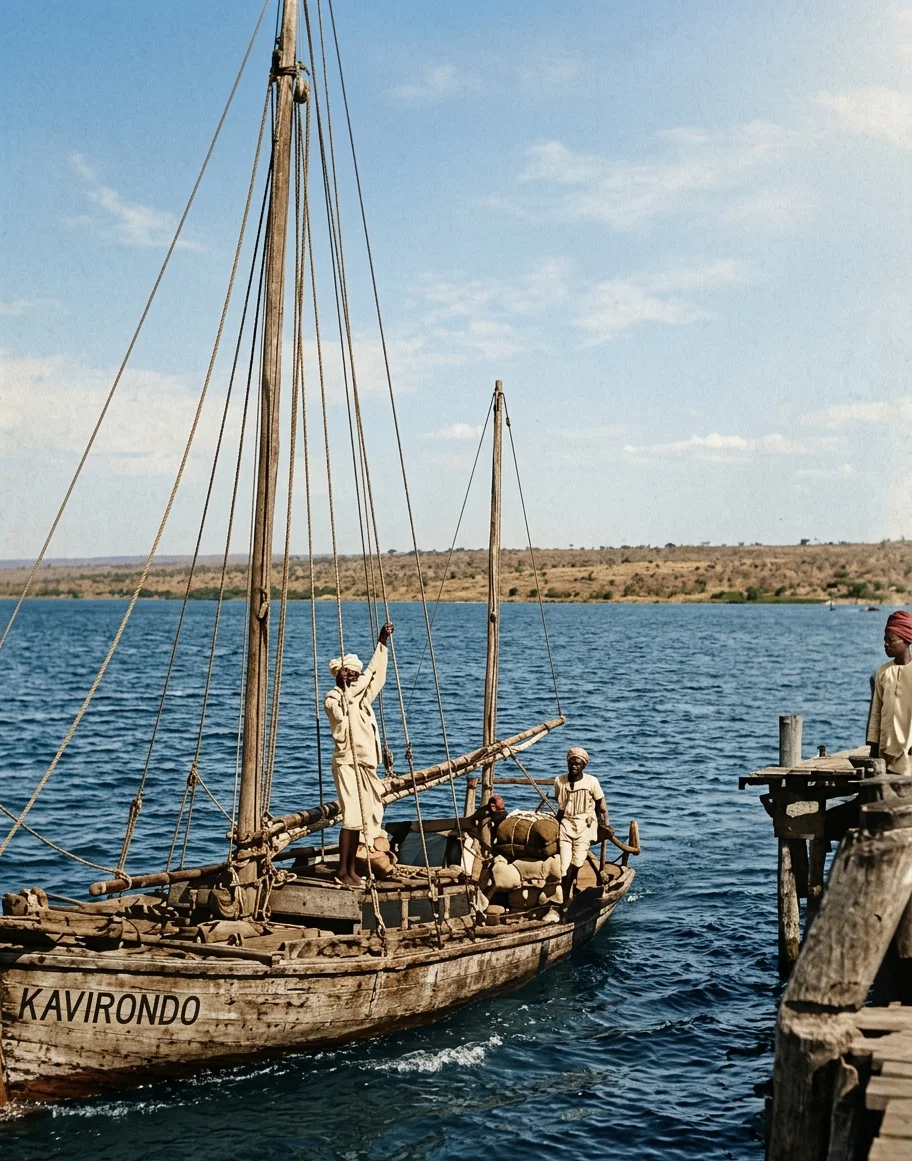
THE NEW BRITISH MISSION SAILBOAT
“KAVIRONDO”
THE NEW BRITISH MISSION SAILBOAT “KAVIRONDO”
Early on the morning of November 28 we reached Mombasa, where Brother E. Kotz and his native teacher came out to meet us on the steamer. We were soon settled in the African hotel, where they had secured quarters for our accommodation. That evening we called on Major Millet, of the East African Industries. I had quite an interesting talk with him and with one of his employees whom I met four years ago, discussing various points of present truth with them. At the major’s invitation we visited their large workshops next morning, where we found an excellent outfit of modern machinery for working up timber, doing blacksmithing, and producing cement, and we were also informed that the company has a good brick-kiln. They still employ a number of Indian workmen, some of whom earn ten dollars a week, but we were told that the natives are rapidly getting hold of the various handicrafts, so that before very long Indian labor can be dispensed with.
At noon the Uganda Railway train left for the lake. A second-class return ticket from Mombasa to Kisumu costs about twenty-seven dollars, and the apartment we had was arranged as a tourist’s sleeper, so we could sleep at night. In about fifty hours we reached Kisumu, where we were met by Brethren A. A. Carscallen, B. Ohme, J. D. Baker, H. J. Sparks, and a number of our mission boys. That evening we were invited to tea by the district commissioner.
Kisumu, formerly known as Port Florence, is quite a growing town. The Uganda Railway has four good steamers on the Victoria Nyanza. One of these plies regularly between Uganda and Kisumu, while the others make monthly trips around the lake in the northern and southern directions. Some of our fellow missionaries remained down in Mombasa, because they could not get a boat leaving for the lake for some days. We were more fortunate in this respect. Brother Ohme had come to Kisumu on the German boat “Harold,” from German East Africa. This dhow carries nearly seven tons. Our British mission had during the last year also built a new dhow, the “Kavirondo.” At Mombasa a man who was an entire stranger to us had told us that the “Kavirondo” is about the best sailor on the lake. It cost seven hundred dollars. During the night we sailed across the bay to Gendia, a distance of about twenty miles. Early in the morning, as we came up to the pier, we were greeted by a number of our native Christians, who sang songs of welcome in their own language. All our British East African missionaries were in, so that, with Brethren Ohme and Kotz, there were fourteen foreign workers in all—eleven brethren and three sisters.
One of the first things we did was to draw up a program for our stay here, and for our trip to German East Africa. We were pleased with the signs of progress about the mission and the hearty welcome accorded us by the brethren. God is surely working in this mission, as will be seen from our next report.

In Troubled Greece

R. S. GREAVES
Before the war broke out there were many rumors, but the whole Levant is a land of rumors, and if one paid too much attention to them he would never venture at anything. Therefore, having business at Saloniki, I started out. On arriving at Athens, it was easy to see that something unusual was taking place, and within a few hours it seemed that the whole nation had suddenly become electrified.
During my short stay it became apparent I had better not try to go to Saloniki, and the question was whether I could even return home, for the government seized steamers, railway-trains, automobiles, and horses. The reserves were being called to the colors, and everything available was bringing them. The small coast steamers were coming in from every direction, crowded with men who, as soon as they got within jumping distance, came ashore with a shout of “Hurrah! Hurrah for the war!” They struck one straight line for the barracks to get their names enrolled, and don soldiers’ clothes. Officers on horseback were galloping through the streets, and military carts filled with war materials rolled along, The whole place was stirring, and preparing for a desperate struggle.
One evening I found a small steamer that was supposed to be just starting for my home town. It was crowded with men, and loaded down to the water’s edge with merchandise, and I considered myself fortunate to get a place even on the open deck; and it was no time to complain although we were delayed nearly twelve hours before sailing, not starting until after daylight the next morning. After a while I found an unoccupied chair, and made myself quitecomfortable, considering the heat. I was very glad indeed when about the following midnight I reached home.
WIRE HILL MISSION STATION, BRITISH EAST AFRICA
During my short absence, what a change had taken place! The grocer and his assistant just across the street were no longer in their accustomed places. They were called to be soldiers. The same was true of many other tradesmen all around us. The familiar faces had given place to the faces of strangers. This is a time when old men and boys are in great demand. Where conscription exists it is not the regular soldiers only who go to war, and here at this time it is the arming of the nation.
In the excitement of the moment there is no doubt the enthusiasm has been great. The first change from this I noticed when a number of troops were embarking on steamers to go to the front. There was no noisy demonstration, for it was realized that many would never return, and women with handkerchiefs to their red, swollen eyes could be seen everywhere. As the troops passed the spot where I was standing, I noticed the crowd silently doffed their caps as a parting sign of respect to their kinsmen who were going to fight. Many a hasty hand-shake was given as friend passed friend.
What is it all for? We might almost liken it to some one wanting a garden-patch that another has, and that can be purchased only with blood; and so the price is paid. If some of those heartbroken wives and mothers had that garden-patch, how willingly they would give it in order that their loved ones might have the privilege of staying at home. People are already tired of the war, and its dreadful toll is being seen by the increasing number of women dressed in black that one meets on the streets every day. We hope it may soon end.
Continue reading: ALBERT F. PRIEGER