Your ShelfYour Projects

Review and Herald, Vol. 86, No. 30.

THE WORK

Review and Herald

Jul 29, 1909

Review and Herald Publishing Association · Takoma Park Station, Washington, D. C. · Jul 29, 1909

THE WORK

— AND —

THE WORKERS

LIFE AND HEALTH SERIES is the name of a series of the large-page-style tracts, dealing principally with the temperance question. Each of these tracts is written by a physician who has made a study of the subject treated. The tracts, therefore, are high-class matter, and deserve a large circulation. The series, so far, contains five tracts on the following topics: No. 1, “Tobacco Using,” 1½ cents; No. 2, “The Tobacco Habit,” 5 cents; No. 3, “Diet and Endurance,” 5 cents; No. 4, “Chronic Constipation,” 1½ cents; No. 5, “Medical Use of Alcohol,” ¼ cent.
“THE last number is all right; isn’t it a beauty?” writes an aged Life and Health agent from Iowa. “My courage is good, and I am really satisfied with my work. I made seven exhibitions, and sold six copies, also three ‘Christ’s Object Lessons,’ to help the educational work in the South. A sale of $3.60 worth of literature in a little more than one hour is not so bad for an old lady seventy-one years old. It is God that does it, and he shall have the glory.”
No. 104 of the Bible Students’ Library tract series, has been republished in response to repeated requests. The tract contains 16 pages. Price, 1 cent.
A COMMON-SENSE health cook-book is as essential in the work of the housekeeper as any other household commodity. “A Friend in the Kitchen” will prove to be a friend indeed to every woman who has to do cooking. The recipes are simple, practical, and varied. It is vegetarian throughout, and is designed to educate the people away from a flesh diet. In addition to its twenty general departments, containing 400 choice and thoroughly tested recipes, it contains much matter not found in the ordinary cook-books, such as “substitutes” for hurtful meats, “How to Can Fruit,” “How to Make Unfermented Bread and Wine,” “How to Become a Vegetarian,” “Rules for Dyspeptics,” “Rules for Health.” All the instruction on “How to Can Fruit” is worth many times the price of the book. Just at this season of the year, it will be of special value in general fruit preserving. Waterproof paper, 25 cents; cloth, 50 cents.
“Was out yesterday, the only day this since arriving here,” writes a young man, giving from Ohio, “and sold 66 copies of Life and Health in five hours. I would go oftener, but we are doing heavy farm work, and I can not get away. Will go again next week.”
CONFERENCE presidents and tract society secretaries would do well to send for our neat little order blank—just prepared—for securing Liberty subscriptions and selling single copies to large audiences. Just the thing for use on religious liberty day at the camp-meeting. The kind used by some of our leading religious liberty workers. They are free to our agents.
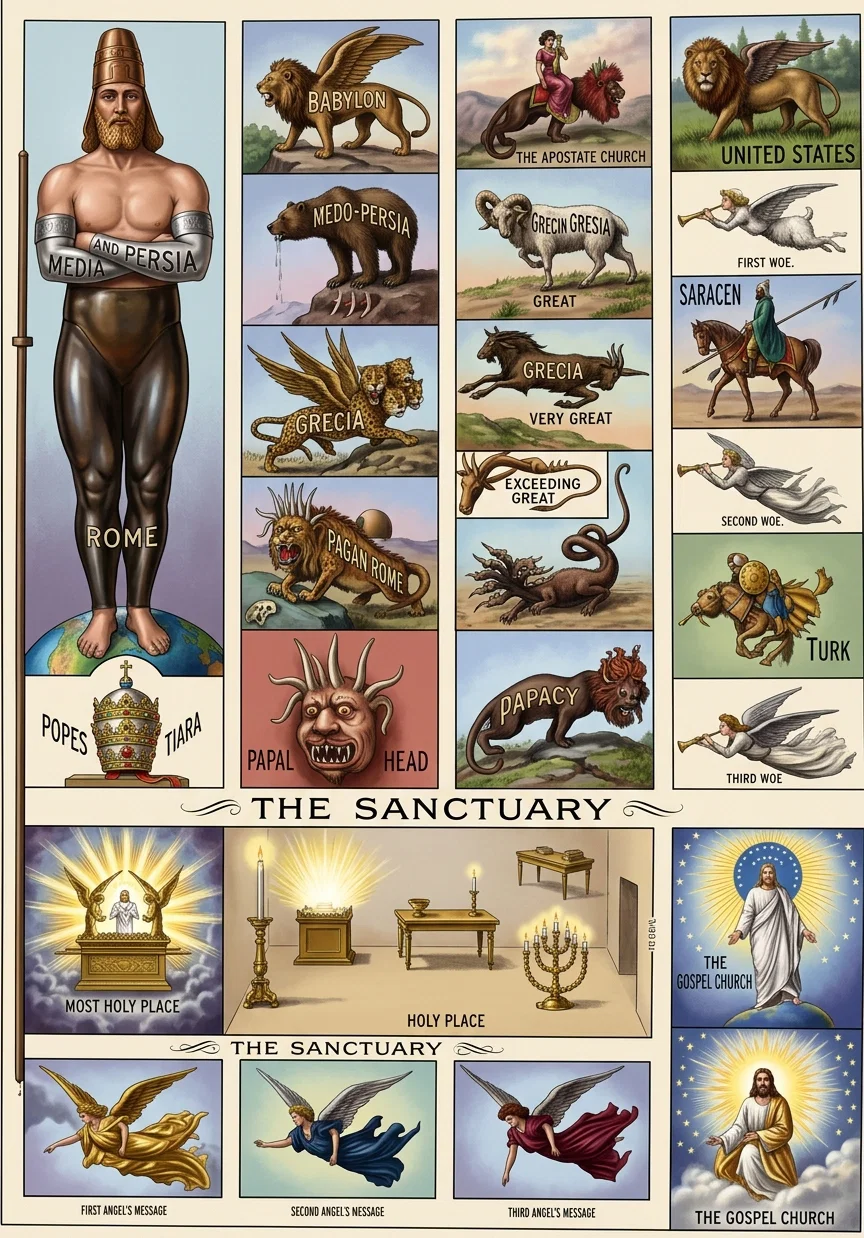
THE SANCTUARY
THE SANCTUARY
The above illustration is a reduced facsimile of the Review and Herald new prophetic chart, 46 x 72 inches in size: printed in five colors, on a fine quality of muslin, that will stand folding as many times as may be desired without hurting the appearance of the chart. It can be folded to show each set of symbols separately, or so as to compare similar chapters—as Daniel 2, 7, and 8. All the symbols are large enough to be seen from any part of an ordinary lecture hall or tent. Price of the large chart, post-paid, $2.75.
WE have printed a supply of miniature prophetic charts, the exact size of this illustration, for convenience in giving individual Bible readings or personal study. These miniature charts may be pasted in one’s Bible for convenience. They are printed on tough, glazed paper, in one color. They make a very neat, plain, attractive chart for individual use. Price of these miniature charts, 5 cents each, post-paid.
PROF. B. L. HOWE, principal of the Central California Intermediate School, Armona, Cal., has just sent us a list of twelve yearly subscriptions for the Protestant Magazine. He says: “I think the publication of the Protestant Magazine is a heaven-born idea, and I am sure that it will have Heaven’s blessing in its mission. I expect to send you more orders soon. Our colleges and other schools have shown a good interest in the circulation of this timely quarterly.
“DRESSING FOR HEALTH,” by Dr. Maria Edwards, is a nicely illustrated pamphlet. It is the outgrowth of a series of practical talks on treatment of common diseases, given by the author at various public gatherings. It will be found to be very practical, and costs only 5 cents. Order all supplies through the State conference tract society.
BROTHER J. F. BAHLER, one of our blind agents, is planning to sell an edition of 30,000 copies of Life and Health in the near future. He sells magazines purely on their merits.
“I WONDER how many of our people know what ‘Early Writings’ contains that is really essential in establishing the principles of the message and laying the foundation of faith in it? I think it is the best book we have to establish faith and to impart a clear understanding of the beginning of the proclamation of the third angel’s message. It ought to be constantly studied by all of our members. It ought to be perfectly familiar to our workers. It ought to be kept constantly before our young people.” The preceding statement was recently made by one of our leading ministers and General Conference officers, as he was inquiring about the circulation of this book. The pocket edition of this book is very convenient for the workers to carry. Price, $1.25, leather binding. The paper edition keeps it within the reach of all. Price, 35 cents. The regular cloth edition is only 75 cents.

Editorial

Trumpet-Calls

TRUMPET-CALLS to service were heard day by day in all the addresses and reports at the General Conference. We take for this page a few words that appeal to personal action, from the addresses by Sister White.
To Every Man His Work: “There is something for each of us to do. It is no use to talk of being Christians if we leave unhelped those who are perishing all around us. . . . Christ is waiting, waiting for places to be entered. Who are preparing for this work?”
One Light Kindles Many: “Your light may be small, but remember that it is what God has given you, and that he holds you responsible to let it shine forth. Some one may light his taper from yours, and his light may be the means of leading others out from the darkness.”
Use the One Talent: “It is not always the brightest talent that accomplishes the most for the cause of God. God can speak through a humble mind if that mind is consecrated to him and to his service. When we catch the spirit of the message which is to lead souls to choose between life and death, we shall see a work done that we do not now dream of.”
Finding the Work: “Go daily to the Lord for instruction and guidance; depend upon God for light and knowledge. Pray for this instruction and this light until you get it. It will not avail for you to ask, and then forget the thing for which you have prayed. Keep your mind upon your prayer. You can do this while working with your hands. You can say, Lord, I believe; with all my heart I believe. Let the Holy Spirit’s power come upon me.”
Home Training for Service: “Fathers and mothers, you have a solemn work to do. The eternal salvation of your children depends upon your course of action. How will you successfully educate your children? Not by scolding; for it will do no good. Talk to your children as if you had confidence in their intelligence. Deal with them kindly, tenderly, lovingly. Tell them that God would have them educated and trained to be laborers together with him.”
Response by Sacrifice: “It does not mean the making of a little sacrifice. It costs much to be men and women of God. Men and women are going forth more and more to carry the gospel message. We thank God for this, but we need a greater awakening. We slide back into self-indulgence; we do not exercise to the utmost power the virtues that Christ has promised if we ask for them in faith. That which we receive from Christ we must give to others. None who receive the grace of Christ can keep it to themselves.”
Blessed, to Be a Blessing: “‘For the Lord shall comfort Zion: he will comfort all her waste places; and he will make her wilderness like Eden, and her desert like the garden of the Lord.’ When the Lord comforts you, you will speak that comfort to others; you will choose to speak words of comfort rather than blame. When the Lord makes your wilderness like Eden, you will want to go forth to the people. You will want the light that is so precious and glorious to you to shine upon their pathway. ‘Joy and gladness shall be found therein; thanksgiving, and the voice of melody.’”
Hundreds More to the Field: “There are hundreds of our people who ought to be out in the field, who are doing little or nothing for the advancement of the message. . . . We need the wisdom that God alone can give if we carry the message to these cities with success. Let our churches everywhere come into line. Let none who have pledged themselves by baptism to live for the service and glory of God take back their pledge. There is a world to be saved. Let this thought urge us on to greater sacrifices and earnest labor for those who are out of the way.”
Get Ready: Closing words of the final Sabbath morning sermon. “Who among us is humbling the heart before God? Who are washing their robes and making them white in the blood of the Lamb? Let us awake from sleep, and pray as we have never prayed before, that the burden of souls may rest upon us. The burden of my message to you is, Get ready, get ready to meet the Lord! Trim your lamps, and let the light of truth shine forth into the byways and hedges. There is a world to be warned of the near approach of the end of all things.”

Deliverance by a Voice in the Night

DR. JOSEPH STENNETT, one of that old-time Sabbath-keeping family of London, was for a period pastor of a Baptist congregation in Abergavenny, Wales. While ministering there, he became acquainted with a striking instance of special interposition of Providence in supplying the needs of a godly man and his family. The story was repeated in the Baptist Register for 1801-02, the writer having heard it from Joseph Stennett’s son, Dr. Samuel Stennett, author of the hymn, “Another Six Days’ Work Is Done.”
Samuel Stennett said that one member of the Abergavenny congregation in whom his father took special interest was a pious collier named Caleb, an unlettered but remarkably intelligent man. Caleb was a regular attendant at church, walking seven or eight miles to the service from his home in the hills. One winter when severe storms had blocked the way, Dr. Stennett felt very anxious lest the collier’s family had suffered need. When next Caleb appeared, however, he reported that the Lord had provided for them, and that they had fared better than ever. The account states:—
Caleb told him that one night soon after the commencement of the frost, they had eaten up their stock, and not a morsel was left for the morning, with no human probability of getting any; but he found his mind calm and composed, relying on a provident God. He went to prayer with his family, and thento rest, and slept soundly until morning.
Before he was up, he heard a knock at his door. He went to see who was there, and saw a man standing with a horse loaded, who asked if his name was Caleb. Answering in the affirmative, the man asked him to help take down the load. Caleb asked him what it was. He said, “Provisions.” On his inquiring who sent it, the man said he believed that God sent it; and he could obtain no other answer.
Some time later Dr. Stennett was visiting the home of a physician of Hereford, Dr. Talbot, whose wife was a member of the Baptist congregation. Dr. Talbot himself was a very generous man, but a skeptic. For his particular benefit Dr. Stennett led the conversation around to the topic of God’s providences, and speaking of prayer, he mentioned the recent experience of Caleb. Dr. Talbot smiled knowingly, and when Mr. Stennett had finished, told him he also had a story to relate. Some time before, in driving among the hills, he had come across a meeting that was being held in a barn. He remained for thirty minutes or more, watching the speaker and the rustic congregation. He particularly noticed one man, who had a well-thumbed Bible, and who followed the discourse with the deepest interest.
As the congregation broke up, Dr. Talbot rode for a little time alongside this man whom he had particularly noticed. He learned that his name was Caleb. He was impressed by the man’s intelligence as he talked with him. However, he thought no more of Caleb or of the meeting until the time of the great frost. The account continues:—
One night in bed, he could not tell for sure whether he was awake or asleep, but thought he heard a voice say, “Send provision to Caleb.” He was a little startled at first, but concluding it to be a dream, he endeavored to compose himself to sleep. It was not long before he imagined he heard the same words repeated, but louder and stronger. Then he awoke his wife, who was in sound sleep, and told her what he had heard. But she persuaded him that it could be no other than a dream, and she soon fell asleep again. Yet the doctor’s mind was so impressed that he could not sleep, but tumbled and tossed about. At last he heard the voice so powerfully saying, “Get up, and send provision to Caleb,” that he could resist no longer.
He got up, and called his man, and bade him bring the horse. He went to his larder and stuffed a pair of panniers as full as he possibly could of whatever he could find, and after having assisted the man to load the horse, he bade him take that provision to Caleb. “Caleb?” said the man, “what Caleb, sir?” “I know very little about him,” said the doctor, “but his name is Caleb. He is a collier, and lives among the hills. Let the horse go, and you will be sure to find him.”
Thus Dr. Stennett learned from his skeptical friend how a kindly Providence had sent food to the praying collier family in the hills.
W. A. S.

An Interesting Discussion

Varying Views of Roman Catholics on the Relation Between the Church and the State

THE now famous letter of Theodore Roosevelt to Mr. J. C. Martin concerning the election of a Roman Catholic to the presidency opened the way for a vigorous and continued discussion of the Roman Catholic doctrine concerning the proper relation between the church and the state. First came the letter from the members of the Lutheran Church, in which an appeal was made to the authoritative utterances by representatives of the Roman Catholic Church and to the facts of history to sustain the contention that the election of a Roman Catholic to the presidency would be a menace to the liberties of the country, provided he was loyal to the teachings of his church. Notable among the articles which this letter called out was one by Cardinal Gibbons on “The Church and the Republic,” which was published in the March number of the North American Review. We have already referred at some length to this article, and will therefore only quote from it briefly here to indicate the Roman Catholic position as interpreted by the leading American representative of that church:—
The distinction between the civil and the ecclesiastical powers is very firmly established in Catholic teaching. . . .
The church, then, holds that the civil government has divine authority, just as has the ecclesiastical; that the limits of each are fixed by the nature of its purpose; that within these limits each power is supreme; consequently, that the church can not intermeddle in matters purely civil, nor the state in affairs purely ecclesiastical; and that members of the church are bound to obey the state, within its own domain, in all things that do not contravene the moral law. . . .
We may put aside, then, as an absurdity, the injurious supposition that the pope would ever interfere in purely civil affairs. But is there not a twilight zone over which both church and state put forth claims? True; and I grant that here a collision of authorities comes more within the horizon of possibility. But the American concept of government and of liberty puts this hypothesis outside the range of practical affairs.
In the May number of the North American Review there appeared a reply to Cardinal Gibbons, written by Rev. William Schoenfeld, of New York, who prepared the letter in behalf of the Lutherans. The real point at issue is clearly stated in this article in these words:—
This is the difference between the cardinal and his church, on the one hand, and ourselves, on the other: he and his church accept separation of church and state merely as a temporary policy, a matter of expediency; we proclaim it to be the only true and right principle, a fundamental principle also of the American Constitution which must be accepted as immutable by all loyal and true American citizens.
The Jesuitical nature of Cardinal Gibbons’s article is clearly pointed out in this statement:—
He [Cardinal Gibbons] tells us, indeed, that the distinction between the civil and ecclesiastical powers is very firmly established in Catholic teaching; but never once does he say aught to the same effect with regard to separation.
In the light of Cardinal Gibbons’s article, it appears to be quite possible to dwell enthusiastically upon the distinction between the church and the state, as recognized by the Roman Catholic Church, while at the same time to hold firmly to the doctrine of such a union of church and state as is illustrated by the union of the soul and the body.
The latest contribution to this illuminating discussion is made by “A Catholic Layman” in the July number of the North American Review. The writer of this article, whose name was doubtless withheld for good reasons, deals with the subject in a spirit of frankness which is manifestly lacking in Cardinal Gibbons’s writing. To give a clear idea of his views, we quote some paragraphs:—
Now what are the grounds upon which they who impugn our loyalty rest their charge that, until the Roman Church frankly changes her doctrine, the admission of Catholics to high offices in the state is a menace to American liberties? The grounds are that the union of church and state is a Catholic principle; that history shows that Rome has approved of religious persecution; and that the doctrine of “papal infallibility would seem to preclude the idea of retraction of dogma or decree;” that Catholics are bound to obey the pope in all things; and, as a make-weight, we are told that the pope maintains his claims to the temporal power against the kingdom of Italy, and desires to be recognized as a great power among the nations. . . .
That the pope does teach the ideal of human society to be the union of church and state no Catholic may deny. It was the only conceivable idea in the Middle Ages; it has been proclaimed by Pius IX, reiterated by Leo XIII, and rejuvenated by Pius X in his recent address to the French episcopate. This, certainly, is not a doctrine that falls sweetly upon the ears of American Catholics. How they regard it may be gathered from the silence in which it is passed over by all ranks of our clergy, a silence which is due not to astute calculation, but to strong attachment to American conditions and principles. True also it is that Rome clings to the vanished temporal power; but what that fact has to do with the loyalty of American Catholics is by no means obvious, and the Protestant synods have not elucidated the connection. Rome does crave to obtain political recognition from the great nations; she would be ready to pay a high price for it; I shall go further and say that I believe Rome has been often ready to pay much too high a price for it. Roman bureaucrats, administrators, and diplomats have morethan once induced the Holy See to buy the support or favor of secular statesmen at a rate incompatible with the best interests of the church and the eternal principles of justice.
With a clearness of perception which is most gratifying, and with a frankness which is most surprising, this Catholic layman deals with the practical side of this whole question in a manner quite in contrast with Cardinal Gibbons’s brief and uncertain treatment of the subject:—
We are familiar in this country with the cleverly drawn congressional bill or franchise grant which contains one little clause, more pregnant than all the rest, running counter to the tenor of the other parts which have been introduced merely to allay suspicion or disarm opposition. In like fashion, one provision of the amended papal doctrine is of a character to justify non-Catholics in asking whether, notwithstanding the admission that the state is supreme and independent, the pope does not still reserve to himself the right to interfere actively in the relations of Catholics, with the national government. And if this question must be answered in the affirmative, it is incumbent on us to convince our fellow citizens that there exists a force which may be counted on to successfully oppose any pernicious action of this sort. His Eminence [Cardinal Gibbons] has strongly insisted that we may subscribe to the fundamental article of English Protestantism that “the pope of Rome hath no jurisdiction in this realm,” but he is careful to add the very significant qualification, “If it be understood of the realm of purely temporal affairs.” But between the purely spiritual and the purely temporal realm there is “the twilight zone,” where both church and state put forth claims; and the cardinal frankly acknowledges that a conflict here is within the range of possibility. Then he hastily drops the subject, with the observation that the American concept of government puts this hypothesis outside the range of possibility. I share his conviction that the American government will never take any measures that would infringe our religious liberty. The possibility of danger lies elsewhere. The pope holds that, in those affairs which are the common concern of both powers, the state is bound to yield to the church, and that in case of dispute, he, the Vicar of Christ, is the court of final resort to determine the right. Now, to this claim join another co-ordinate doctrine, i. e., that, as the supreme teacher of morals, he possesses the right to decide what line of conduct duty imposes upon Catholics in any given circumstances. A moment’s reflection will show that these two principles in combination may be stretched so as to cover almost the entire civic life of a Catholic. The “twilight zone” embraces, among other things, ecclesiastical property, endowments for charity, wills containing bequests for religious purposes, marriage, the legitimacy of children, provision for the religious needs of the army and navy, and, students of history need not be reminded, the question of the exemption of the clergy from the civil jurisdiction. There are few political questions outside purely economical affairs that do not involve a moral issue. Any war, in the eyes of the pope, touches upon spiritual things if the success of either belligerent, in his judgment, will, anywhere on the globe, entail injury or gain to the world-wide church. In fact, when the enormous sweep of these two claims is fully surveyed, the concession that all purely temporal affairs are outside papal jurisdiction seems to be merely nominal, as far as the Catholic conscience is concerned. If, at any political crisis in any country, Rome should believe it to be her interest to exercise spiritual pressure on the Catholic body, expert canonists and theologians would promptly bring forth an imposing array of arguments and precedents to prove that the occasion required the Holy Father, in the exercise of his office as Supreme Pastor, to explain to his faithful children their duty.
It would be difficult for any Protestant writer to state the case more fairly. As a theoretical principle of expediency, Rome advocates a distinction (not a separation) between the church and the state. As a practical principle of policy, Rome adopts the idea that the church should dominate in all matters which in any way affect the interests of the church, and under cover of the idea of a “twilight zone,” the church reserves the right to extend her sway over the whole field of civil conduct. That Rome does thus assume to control in the affairs of state in the interest of the church is clear from the testimony of both medieval and current history. In support of this assertion we call attention to the letter of Martin V (A. D. 1416–1431), from whose instructions to the king of Poland we quote:—
Know that the interest of the Holy See, and those of your crown, make it a duty to exterminate the Hussites. Remember that these impious persons dare proclaim principles of equality; they maintain that all Christians are brethren, and that God has not given to privileged men the right of ruling the nations; they hold that Christ came on earth to abolish slavery; they call the people to liberty, that is, to the annihilation of kings and priests! Whilst there is still time, then, turn your forces against Bohemia; burn, massacre, make deserts everywhere, for nothing could be more agreeable to God, or more useful to the cause of kings, than the extermination of the Hussites.—De Cormenin’s “History of the Popes,” Philadelphia, 1847. Vol. 2, pages 116, 117.
To this may be added a portion of an editorial article in the Western Watchman (Roman Catholic) of July 8, 1909, which reads thus:—
The Liberals in the German Reichstag have surrendered. The combination of all the irreconcilables has been broken. The kaiser is forced to call to his aid the indomitable Center, which for years has calmly looked on and witnessed confusion growing daily worse confounded. The Socialists now form the cloud the size of a man’s hand on the Hohenzollern horizon, and all the other parties are seeking for cover, save the Conservatives and the Center. These two have formed a coalition, and have been called to man the ship of state. Henceforward only such laws will be passed by the Reichstag as will suit the Catholic party, and the greatest Protestant state in Europe must, willy-nilly, take its orders from Rome.
The lack of harmony between these Roman Catholic writers is susceptible of a clear explanation. Cardinal Gibbons represents the hierarchy, the official side of the church, and gives expression to those views which must be maintained by every faithful ally of the pope. The Catholic layman views things from another standpoint, and does not attempt to conceal the actual facts,—facts which are patent to every candid student of history. He declares, however, that “the stick upon which the scarecrow of Vaticanism is constructed is the false idea that Catholics are bound slavishly to obey the pope in everything that he pleases to command,” and he depends upon what he designates as the “lay spirit” as the antidote for papal aggression. In other words, he assumes that the American Catholic would be loyal to the Constitution rather than to papal encyclicals and bulls. This, however, is somewhat uncertain ground.
The latest turn of affairs in the German Reichstag furnishes abundant evidence that the Roman Catholics are seeking political control in every country, and that when such control has been obtained in any country, that country “must, willy-nilly, take its orders from Rome.” This latest example in current history justifies all that has been claimed concerning the election of a Roman Catholic to the presidency.
W. W. P.

“Helping Together”

PAUL wrote: “Ye also helping together by prayer for us.” Still that weapon, “all prayer,” wins victories in the field of conflict. Let us wield it one for another, at home and abroad.
From South America, Miss Voris writes: “We think so often of the prayers that are going up to our Heavenly Father from the home land for us, and it gives us courage.”
From California, Sister J. N. Anderson, of China, now recovering from very serious illness, writes: “I am very grateful to the Heavenly Father that he has put it into the hearts of his dear people to aid me by their prayers. Letters have come from China and various parts of America, saying, ‘We are praying for you.’ It has been a very great source of strength, especially in those weeks when I could not collect my mind to pray for myself.”
We do need to pray more regarding individual and definite interests. The churches in prayer can help every tent company, or make the way of the gospel laborers in every field more successful.
W. A. S.
Continue reading: Forces in Training