IN the last issue of the REVIEW we studied the rise and history of the Young Turk movement, and sketched the main features of the remarkable revolution which that movement has effected. In this article I shall endeavor to make plain the fundamental causes which have inspired all this recent activity in Young Turk ranks, and which have prompted the thought of revolution at this particular time.
The battle of Marathon was fought in the year 490 B. C. On one side were eleven thousand Europeans—Greeks. On the other side were one hundred ten thousand Asiatics—Persians. The event of the day was an overwhelming victory for the European, or western, nation. The Persian army was utterly routed, and forced to retreat to Asia.
This battle was one of the decisive battles in the world's history. The result of it was supposed to have settled for all time the white man's superiority over the yellow, the brown, and the black man. From that day forward it was presumed to be an incontrovertible fact that no Asiatic race could stand before Europeans.
The world-shaking victories of Japan over Russia have sent this theory tumbling down the abyss. The verdict of Marathon has been annulled. A small nation of Asiatics humiliated the arms of a great European power into the very dust. Forever in the Oriental mind is the idea shattered that he must be ground down beneath the mailed heel of Europe. Orientals have determined that the exploitations of their territories by Western powers must cease. The marvelous successes of the Japanese have awakened the “Asiatic spirit.” If, they say, the doctrine is to prevail of “Europe for the Europeans,” and “America for the Americans,” then it shall be the “Orient for the Orientals.” It is this which has stimulated China, with her history of forty centuries, to renew her youth. It is this which has brought about the “awakening of China.” It is this which has produced the “unrest in India,” and a feverish determination upon the part of the Hindu people to bring to an end forever the rule of Great Britain in their land. In the near future the “kings of the East” intend to force a settlement on this question. See the two remarkable works treating upon this subject—“The Reshaping of the Far East,” and “The Truce in the East and Its Aftermath,” by Henry Putnam Weale, the Macmillan Company, New York.
Now there is no question but that the extraordinary successes of Japan, and “China's energetic pulling of herself together” have had a remarkable and electric effect upon the Mohammedans of the Ottoman empire. “The heathen Buddhists, formerly despised as blackest infidels, now appear as shining lights and examples in their eyes.”
To the deeds of the people of the far East—the Japanese—must be attributed the vision of liberty, and freedom from interference by the great powers, toward which the people of the near East—the Ottoman Turks—are striving.
All Islam is awakening, and is determined to come into her own, politically and nationally as well as religiously. I have already mentioned the manifestations of this spirit in the popular “unrest in India,” which ever since the Russo-Japanese War has given the British government so much concern. Then there are the nine million Mohammedans of the Nile lands. These “are unbounded in their enthusiasm at the revival of the constitution in Turkey.” True, the Turks have never enjoyed much popularity with the Egyptians. At the present moment, however, they all join together in longing for the restored sovereignty of the constitutional calif.
Among the Russian Mohammedans, i. e., the Tartars, the same spirit is moving. Their national consciousness has been roused by the Russian Talmi constitution. It is difficult to describe their delight at the revival which has taken place among their fellow tribesmen and coreligionists in Turkey. So manifest is this exultation, that the Mohammedan faction of the Russian Douma has sent a congratulatory address to the Turkish Parliament, the appended text of which is instructive:—
“The Moslem faction of the Russian Douma desires to offer this day, the day of the opening of parliament, hearty good wishes to their Osmanli fellow tribesmen and coreligionists. We congratulate the deputies, and through them the whole Ottoman nation, on this happy day. We heartily hope that Turkey, awakened to a new existence, may grow and flourish under the protection of freedom. We feel and realize how great must be her joy on this day, and it finds an echo in our hearts.”—Tewfiklet, President of the Mohammedan Faction.
From India and from Java and from Sumatra like messages of congratulation have been received. All of these breathe words of joy and enthusiasm over the successes of their brethren in the Turkish empire.
In other words, this Pan-islamic sentiment, this determination of the followers of the Arabian “prophet” to come together and make themselves a dominant factor in the world's affairs, is traveling everywhere with an almost incredible celerity and tremendous power. It must be taken into account, for in the near future it will have to be reckoned with. It is a part of the very quintessence of “the Eastern question.” It is one of the signs that “the Eastern question” is getting acute, and that it will soon be up for settlement.
What now is that which has come to be known to the cabinets and chancelleries of Europe as the Idée Ottomane, i. e., the Ottoman idea? What are the visions, the ideals, of the Young Turks? What do they aim at, as far as the larger matters of government, and the relation of Turkey to the great powers, are concerned?
First and foremost it must be understood that the members of the Young Turk party are most intensely patriotic. Above all else, they are Nationalists. One of the great cries with which they have rallied the people to their support has been, “Reform from within; hands off from without.” Stated in another way, they are endeavoring to marshal the entire Turkish population beneath their banner, over the issue that the Turkish empire shall be “one and indivisible.” Everywhere they have raised the campaign cry, “One flag; one people.” “The foreign situation, and the temper of a large number of the Turks themselves, alike make it certain that the Ottoman constitution can not be again destroyed without destroying the Ottoman empire as it exists.”—Editorial in the Fortnightly Review; London, January, 1909.12
Can the ideal of the Young Turks of a great and powerful united Turkey be realized and made even semipermanent? The internal difficulties which beset a favorable solution of this problem, and which confront the Young Turk statesmen, are enormous. “If the Christian states of Europe can only with the greatest difficulty keep together and govern an ethnically disjointed political body, how can this be accomplished in a state where, besides the ethnical differences, the poison of religious antagonism frustrates all attempts at agreement?” The warring and the jarring, the mutual antipathies of the races in the Turkish empire, are not at bottom chargeable to the form and maladministration of its late government. On the other hand, they are directly traceable to certain permanent and fundamental factors.
Briefly stated, these factors are as follows: There was a day when the world was the domain of the Arab, and when the Turks held dominion over Europe. Not without cause have the great Mohammedan empires of the past declined and decayed. For while the Mohammedans have known how to conquer, they have never known how to govern. They have proved themselves strangers to the art of preserving, organizing, civilizing, and nationalizing the peoples over whom they were victorious in arms. “In Asia, Africa, and Europe the ruling Mohammedans have remained strangers among strangers in a conquered land.” The cause of this peculiar state of affairs lies in the teachings of the Koran. A great authority has summed up the case as follows:—
“The Koran is at the same time a gospel of conquest and of peace; it commands war, yet it enjoins civic and religious toleration. The followers of the prophet are to propagate his gospel with the sword, and to slay those who resist them, but to spare the vanquished and to respect their religion. Following the prophet's precepts, the Mohammedans neither proselytize by means of the church, nor nationalize by means of the school, as do the Christian nations. Hence the nations which were conquered by Mohammedans could preserve their language, religion, and national individuality; and the consequence of this short-sighted policy of toleration and noninterference on the part of the conquerors has been fatal to Mohammedan rule. Owing to this fundamental mistake, Mohammedanism has created everywhere, not nationally organized and homogeneous states, but merely strong military settlements among alien nations, which were allowed to remain alien nations. Although these nations have revolted against Mohammedan rule whenever opportunity offered, the followers of the prophet have not altered their policy in the course of thirteen centuries, for to them the Koran is law. The foregoing makes it clear that the difficulties of the Turkish empire, as those of the ancient Arab empires, have sprung from the fundamental principles, of Mohammedan statecraft and policy which were laid down by the prophet, and the consequences of that policy may clearly be seen in the Turkish empire. European Turkey has about six million inhabitants, of whom only about one third are Turks, and in Constantinople itself the Turks are in a minority. Turkey in Asia and Africa has about nineteen million inhabitants. Of these three millions or four millions are Christians and Jews; and several millions of the Mohammedan inhabitants, such as Arabs and Kurds, are constantly in a state of revolt or of war with their Turkish masters. Turkey is a state, but not a nation. The Bulgarians, Greeks, Serbs, Albanians, Arabs, etc., in the Ottoman empire have no affection for the Turks. They are Turkish citizens only by compulsion, and although they have been inhabitants of Turkey during many centuries, they do not consider themselves citizens of Turkey, but members of a conquered race, and they sigh for their liberty.”—The Fortnightly Review, London, October, 1908; Art., “The Future of Turkey,” by J. Ellis Barker.
In view of all this, the question now arises, Can the Young Turk party maintain, in the midst of such a situation as this, a constitution and a liberal form of government? Can the Turkish statesmen give to these various races and creeds the liberty for which they clamor, and for which the Young Turk party stands? Can the Young Turks do this, and at the same time preserve the Turkish empire?
The task is sufficient to strain the resources of the loftiest public spirit and the most accomplished statesmanship. Few men believe that in the ultimate the Turkish government will be able to weather out the problem. And if by any possible chance Turkey should be able to do so, another, and an even more serious problem will confront her. And if she fails, her failure means the end of her rule in Europe.
Madison, Tenn.
Financial Obligations Resting Upon Believers in the Closing Message
By George I. Butler
GEORGE I. BUTLER
Last week we considered the progress and growth of the last message to the world, as represented at the last General Conference. All hearts were inspired by the progress it has made. The truth is planted firmly in all the leading nations on our earth, and is making progress in all. Rising to the duties of the hour, the General Conference resolved to make greater efforts in the immediate future to carry on the work to a glorious victory. Many missionaries are to be sent out to the various fields. The weak stations are to be re-enforced. Where martyrs have fallen in death, others are to step in. In no other way can we be true to our solemn responsibilities. With bold, faithful Caleb of old, we can say we are “well able” to go up and possess the goodly land. With our ranks already a hundred thousand strong, what can not be done if the Lord is with us? And he surely will be with us if we all move forward strong in faith and true to his work.
Such advance must necessarily demand strong financial support. Has God given us such a work to do, and not given us means sufficient to support it properly? That would be a great reflection upon the wisdom of God’s generalship. Is the God of heaven like the man who began to build and was not able to finish? or like the king who started out to meet an enemy, but, unable to cope with him, met with an ignominious failure, and had to beg for peace?—Ah, no! Our Captain never lost a battle. Noah preached a coming deluge; and it came as God said it would. God proposed to take the Israelitish slaves out of Egypt, and give them a land flowing with milk and honey, and though many were stiffnecked and rebellious, and showed themselves unfit to enter that goodly land, yet others were true, and the expedition was not a failure. For some fifteen centuries Israel possessed that land. Christ took a little handful of weak disciples, educated them for a season, and by means of their labors filled our world with glorious lights. He never makes failures in his efforts.
To be sure, God’s people were tested. Noah no doubt spent all his property in building the ark by which he and his family were saved. When the ark was built, and its valuable contents were all enclosed within its strong walls, all the property in the world was of no value whatever compared with it. Earth’s wealth, with its owners and worshipers, was buried out of sight in an ocean of water. The little that Noah and his family had was all there was left of earth’s treasures.
A nation of slaves in Egypt could not have been very wealthy; but all of Pharaoh’s host, with their ornaments, beasts, and trappings, when rolled under the waters of the Red Sea, were poorer by far than these slaves.
How poor were Christ’s disciples in the things of this world when they began the proclamation of their message to the world! In their poverty, they had all things in common, and the apostles afterward had to take up collections for them to keep them from suffering. But the message went on in triumph till the then-known world all heard the gospel. Col. 1:23.
The advent believers who first accepted the third angel’s message were, as a rule, poor in this world. Much of their means was used in giving the first angel’s message. But now our people are not poor. We have means enough with which to support this grand work of missions triumphantly. The only question is, Have we the genuine faith to use our means faithfully in carrying on this work to a grand success? Here is where our faith is to be tested.
The call for means to support our work in all parts of the world is surely13going to test us as a people. We greatly fear many will fail to stand that test. The love of the world fills the hearts of many who profess to love this truth. The calls have been coming, are continuing to come, and will constantly and greatly increase. There can be no doubt of that. The transferring process must and will go on. By that process our faith will be mightily tested. ‘Fear not, little flock; for it is your Father’s good pleasure to give you the kingdom. Sell that ye have, and give alms; provide yourselves bags [“purses,” American Revised Version] which wax not old, a treasure in the heavens that faileth not, where no thief approacheth, neither moth corrupteth. For where your treasure is, there will your heart be also. Let your loins be girded about, and your lights burning; and ye yourselves like unto men that wait for their lord, when he will return from the wedding; that when he cometh and knocketh, they may open unto him immediately. Blessed are those servants, whom the lord when he cometh shall find watching: verily I say unto you, that he shall gird himself, and make them to sit down to meat, and will come forth and serve them.’ Luke 12: 32-37.
This ‘little flock’ must be the advent believers who are looking for the Lord when he comes. They transfer their treasure to the bank of heaven by using their means to carry on the work of warning the world of Christ’s soon coming, preaching faithfully the closing message to all the world, for the proclamation of it will enlighten the whole world. Every dollar put into this work with right motives will be transferred over yonder. If it is left to be burned up in this world at Christ’s coming, its owner will be burned up with it. ‘Where your treasure is, there will your heart be also.’
These words of Christ are strictly true: just as true is it that where our hearts are, there shall we go ourselves. The heart being the seat of our affections, our actions show what we love the most. The one who truly, firmly, continually believes we are in the last days, that Christ is coming very soon, will use of his means to support and sustain that work. Just as true is it that those whose faith is weak, and whose love of this world is strong, will fail to properly sustain the great work of carrying the truth to the world. They love this world and its riches better than the cause of God.
Christ illustrated this principle in his counsel to the young man of great wealth, who, having heard the precious words of the Saviour, desired to share in the great salvation. He eagerly inquired what he should do to obtain eternal life. Christ referred him to the commandments of God, the great standard of right. He claimed to have kept them from his youth up. Christ beheld the young man, saw noble qualities in him, loved him, and greatly desired to have him as a true disciple. Christ saw the young man’s one great need, and told him to go and sell his property and do good with it, and come and follow him in the self-denying life of a true follower, and he should have part in the great reward hereafter. The young man turned away very sad. He had great possessions.
What a lesson our Saviour makes of this one illustration! ‘How hardly shall they that have riches enter into the kingdom of heaven!’ He even declares that it is easier for a camel to go through a needle’s eye than for a rich man to enter into the kingdom of God. It is no wonder that the disciples were astonished at this statement. Multitudes in this message will be greatly astonished to see this principle verified before their eyes. This young man disappeared from view, going away with a sad heart. He loved his riches so much that he gave up Christ and the great reward that he might retain them.
The servant of God has told us that this young man, had he obeyed Christ, might have been one of his apostles and stood high in Christ’s favor. Ah, what a terrible mistake he made! Thousands, yea, millions of talented, naturally good and most valuable men have made, and are making, mistakes of the same nature. Many of them may read this article. They will be tested in this last solemn message. If they are unwilling to transfer their property by supporting the cause of God with it and assisting in the great work of proclaiming this message, clinging to their possessions as did the young man to whom the Saviour gave this heart-searching advice, they will be among those to whom James speaks: ‘Your gold and silver is cankered; and the rust of them . . . shall eat your flesh as it were fire.’ James 5: 1-5. The love of riches, when it supplants the love of God’s truth in the heart, is indeed the root of all kinds of evil. Men can not realize this now, but, alas! they will realize it in that awful day when they find themselves lost forever because they loved this world more than they loved Christ and heaven.
Bowling Green, Fla.
Who Should Attend Camp-Meeting?
By A. SMITH
A. SMITH
The duty of appearing in general convocations each year was enjoined upon ancient Israel by the authority of God himself. The necessity for such convocations in Israel has not ceased. Of course the printed page now, in a large measure, takes the place of oral teaching; but there is a communion of saints necessary to a well-developed Christian character that is not sufficiently promoted by literature. A forty-years' successful test of the camp-meeting among Seventh-day Adventists is sufficient proof of its value as a means of grace.
But God has not given us this institution to be regarded by his people with indifference; he must rather be pleased to see them manifest a zeal to attend that will by faith surmount many difficulties.
The warm-hearted, zealous child of God should be there. Brother, sister, your help will be much needed on the camp-ground.
Parents, you have long pleaded that your children might be brought into the truth; go, and take them with you, thus making use of an important instrumentality ordained by God to save them. Let us invite neighbors, friends, backsliders, and others to go with us. When on the grounds, let two Bible aphorisms control our deportment,—“Use hospitality,” and “Be courteous.”
Does my business, my horses, my cattle, my crops, lack of money, state of health, etc., stand in the way? We must not allow Satan to hold the reins over us. After having used reasonable care to guard our property interests while we are away, let us draw from the storehouse of God's promises perfect protection of our interests. See Ps. 34:7; Job 1:10. Read, carefully, as a public lesson in the church, or family, “Testimonies for the Church,” Vol. VI, pages 31-34. Let us talk faith, courage, and self-sacrifice for the truth. Only a few more camp-meetings can be held before our work is done. Let us not miss such blessed opportunities.
Grandville, Mich.
Submit to God
By Albert Weeks
ALBERT WEEKS
If we would succeed in the Christian life, we must submit to God in everything. Our wisdom unaided is foolishness; our strength alone is weakness. God gives grace to help, and through that comes wisdom to know, and power to do, the will of God. That grace, however, can not be given to those who are not humble: “But he giveth more grace. Wherefore he saith, God resisteth the proud, but giveth grace unto the humble. Submit yourselves therefore to God. Resist the devil, and he will flee from you.” James 4:6, 7.
True humility before God places us where the power of God may be exercised in our behalf. As Satan can not stand before the power of the Almighty, he is defeated, and the child of God has gained a victory. Thank God for the means of success in the warfare with the enemy of all righteousness.
Smith’s Corners, Mich.
God’s Touch
By Marion Cook Knight
SOMETIMES God sees what harsh,
discordant things
Our hearts are grown,
And sets about to tune the jarring
strings
With touch his own;
Full well we know, though quivering
with the strain,
Whose hand it is,
For presently there steals, through all
our pain,
His melodies.
— Marion Cook Knight.
Individuality and Selfishness
“To be yourself you need not be selfish.”
China
By J. J. WESTRUP
J. J. WESTRUP
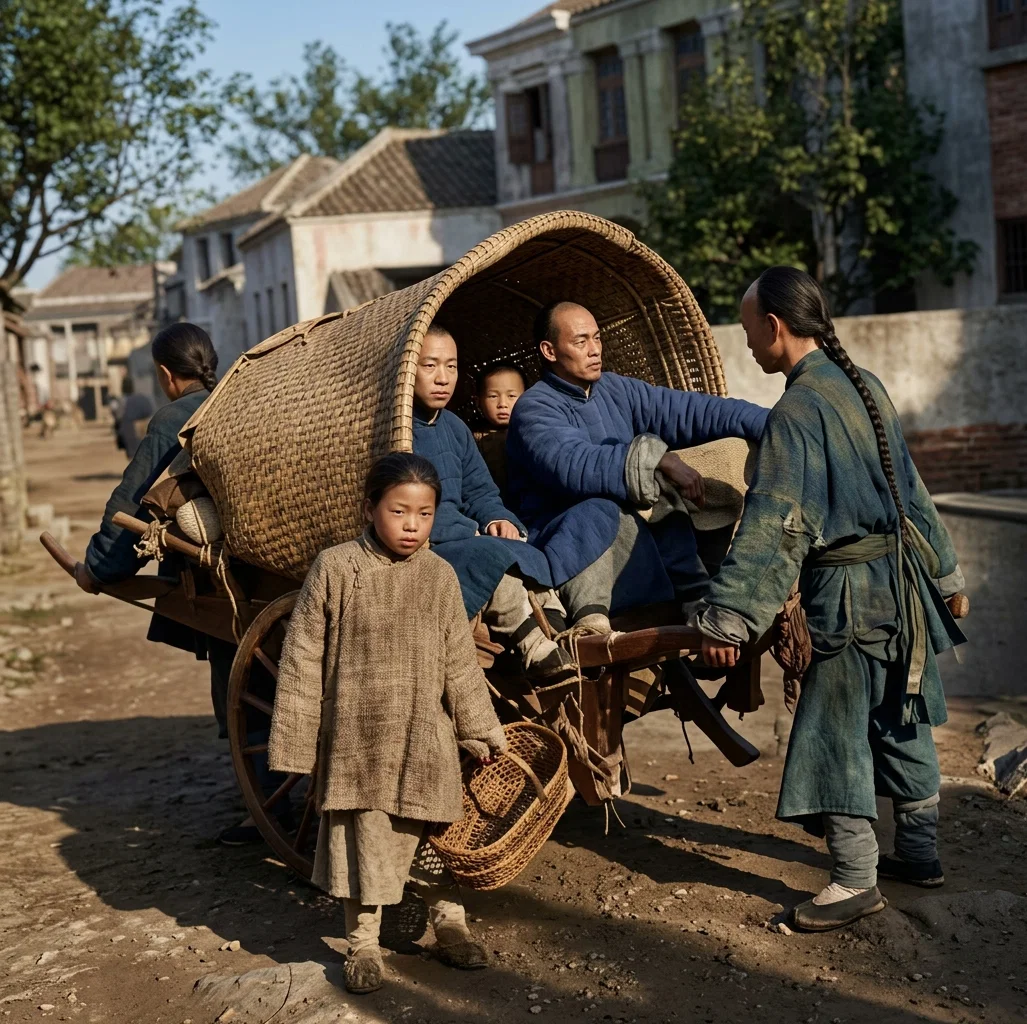
TRAVELING IN A CHINESE WHEELBARROW
Last Sabbath afternoon a young brother came into my room, and as we were talking about many things, he related an experience, and the tears filled my eyes as I saw his simple, childlike faith. He said: “When we were going to have the workers’ meeting in Cheo Chia K’o, I had no money to take with me, with which to buy food while on the road, and while there. But I prayed to God to provide, and I went, and he so provided that I had all I needed. At the end of the meeting, they took up a collection to build a church in San Go Ch’iao. I wanted to give, and told my cousin so; but I had no money. He said that if they got it within three months, it would be all right, and that I could promise the money, and then work, and give it as soon as I had earned it. Hence I promised to give them one string [one dollar Mexican].”
I said, “The Lord does not expect you to give what you have not.” “True, but I can earn it. The Lord is soon coming; and he says, ‘Lay up for yourselves treasures in heaven, where neither moth nor rust doth corrupt, and where thieves do not break through nor steal.’ But I want to have some treasure there when he comes.” The tears filled my eyes. The poor brother has to walk in the dust, under the burning sun, for at least fifteen days, selling Bible portions and papers and tracts, before he is able to earn that amount over and above what it takes to keep him and his family with the barest necessities of life. The widow gave all that she had; but this poor brother gave what he had not earned as yet. This brother, poor in this world’s goods, will be richer in the kingdom of heaven than those who have given only out of their abundance. O that those who have this world’s goods may learn a lesson of childlike faith in the word of God!
A native doctor accepted Christ as his Saviour about two years ago. We have watched him, and prayed for him daily, as we knew it meant a great sacrifice for him. He lives at the Shang-tsai out-station. When I visited them the other day, he said: “When I used to sell my medicine at an enormous price, and played cards, drank, and smoked opium, and could make from one hundred fifty dollars to three hundred fifty dollars a year, then they said I was a good man, a fine fellow, and I had many friends. But now when I have quit these habits, and by making my living in an honest way earn only from thirty-five to forty dollars gold a year, they call me a bad man, and all my worldly friends have forsaken me. I had to discharge my cook, and my wife does the cooking now; but I am not afraid to work, I am not lazy.” And surely he is not.
Only coolies are supposed to roll wheelbarrows and do hard work, and if any one else does it, he is regarded as a coolie. But this man, although educated and a doctor, wheels his books himself on a barrow to places where he wants to go to sell them—he is one of our book sellers. Some time ago he had sold out. Then he took his barrow, and came all the way to this station, got his box of books, and wheeled them back to Shang-tsai, a distance of seventy-three miles in all. And such trips he makes often. On evenings and rainy days he makes shoes to sell, to earn a living.
My wife and I have more confidence in the Chinese the longer we work among them. Some may come from a wrong motive, but others are as true as steel. This doctor can sell more than twice as many books as any other man. He reads his paper, tract, or book through, and can tell the contents to the people in an intelligent way. He can talk and preach. I never heard any one like him. He is very bright, and learns the truth quickly. I am confident that he, kept by the grace of God, will be a great help in giving this glorious closing message in China.
When the Chinese believer, with his practical mind and simple faith, sees the Sabbath truth in the law of God, he at once asks his Sunday-keeping pastor for a definite proof from the Bible as to when and how this law was changed, or when it and the teachings of the prophetic books were abolished. As the pastor knows that it is impossible to give any such proof, he constantly encourages his poor church-members to read and to preach only the New Testament. What a pitiable condition when an overseer of a flock is afraid to preach the whole Bible! And then when we come and teach the native believers the whole truth, that they may gain a deeper experience and a firmer hold on God by faith, the pastors threaten to throw them into prison, or at least attempt to frighten them by this threat. In Ye Hsien one threatens to imprison a man who has just accepted the whole truth, or any one else who preaches the Sabbath. May they beware lest they belong to the class mentioned in Matt. 7: 21-23.
China, with one fourth of the population of the earth, has been most neglected in the past, and therefore needs most help just now. We need literature. O, help us with means to get literature as soon as possible! Here a few are willing, yea, eager, to listen to and drink in these soul-saving truths of an eternal gospel. I praise the Lord that I am here. I want to live and die here, or else be here on duty when the King comes with his reward. And this is the heart’s desire of every one of us who are in China, and that will be the15wish of every one who is yet to come to this land. O that we could fathom the length and breadth and height and depth of that glorious, eternal reward that will be given to those who are faithful unto the end! And how earnest, how zealous, we should be! how we should sacrifice, and lay up treasures in heaven, and thus hasten the coming of our King!
ABOVE THE CLOUDS IN JAVA
Last night as I was meditating before I went to sleep, my heart went out after God as never before; and how intensely I longed for the day when we can be entrusted with the fulness of his Holy Spirit, who would make our Father and Saviour more real to us, the truth brighter, heaven nearer, and our eternal reward ten times more precious to our minds than it is now. With what power we should proclaim this glorious message then! Of course I am thankful for the measure of the Spirit which I have. I am not worthy of more. I rejoice that the day is soon coming when we shall be worthy, through Jesus, to receive the fulness of the Spirit.
Honan.
First Impressions of Java
By J. E. FULTON
J. E. FULTON
The beauties of this wonderful country, with its strange and new scenes, are far beyond my powers to describe. Everywhere we see strange sights, and hear unusual sounds, and the few weeks we have been here have been to me like a huge dream, from which there seems to be no waking. From the moment of our landing, we have been in a vast wonderland, and that a real one, with no painted illusions.
Some one has styled this island the “Garden of the East,” and I think, after what little I have seen, that the name is certainly very appropriate. Wherever we travel, there are vast fields of rice, sugar-cane, corn, beans, and tobacco; in other parts we see plantations of coffee, vanilla, and rubber, also forests of teak, a valuable wood planted by the government, and here and there about the villages, choice tropical fruit trees, such as bananas, mangoes of many varieties, jack-fruit, breadfruit, and many the names of which I do not know. There are many towns, for the country is full of people. The Lord has profusely adorned and greatly enriched this country. I thought the islands of the South Seas beautiful, and so they are, but they are nothing in comparison to this. Some of the Old Testament descriptions of the land of Canaan would not be far from a good description of Java. See Deut. 11:11, 12.
We have made a visit to Pangoengsen, where Miss Jansz lives. We rode all day on the train, or rather a steam tram, then stopped at night at the home of a Dutch public-school teacher. He is a very fine man, and we were glad to meet with one who did not smoke, and who seemed to be a genuine Christian. Mrs. Fulton and Miss Tunheim accompanied me. The next day we arrived at Miss Jansz’s place. This was reached by a ride in the tram, a ride in a dog-cart, and then a horseback ride. It was all very interesting, and we enjoyed it. The journey was made through a country of beautiful valleys and terraced mountainsides, where the fields of rice, green and golden, waved gloriously.
We were met at the station by Miss Jansz, who gave us a most hearty welcome. We were with her for a few days, and spent a Sabbath at her place. This gave us an opportunity of seeing her people, and speaking to them on the Sabbath. I was much interested in her work. She has been used to do a work here which I believe the Lord has blessed.
One thing I saw,—and this is a fundamental principle in missionary work,—the native people recognize that their missionary loves them. This is manifested constantly in many ways. They are like a well-looked-after flock of sheep. Their physical and spiritual wants are looked after. Here is where many who labor for natives fail. They hold them off at arm’s length, failing to break down the barriers that have been set up by the Europeans, who universally despise the natives; failing to demonstrate that they are representatives of him who is no “respecter of persons,” and that he loves all mankind, of whatever color.
The Boy Emperor’s Playmate
“A PRETTY story comes from China, of the boy emperor’s recent coronation. All the high dignitaries and officials were assembled in the palace at Peking, which was brilliant with decorations. The child emperor looked around anxiously; then he turned to his father, the regent, and asked, ‘Where is Mow?’ Nobody knew whom he wanted, until his mother explained that Mow was his five-year-old playmate, the son of a humble Chinese family. Mow was quickly sent for, but couldn’t be admitted until he was first ennobled. He was dubbed an officer of the palace guard, received a cap with a button on it, and then was permitted to see his royal playmate ascend the dragon-throne, to the great delight of the little emperor.” A very fitting illustration of how the royal Son of God will not ascend his throne without sharing the glory with those here on earth whom he has been pleased to call “my friends”—yes, and of very humble parentage at that.—Selected.
Japan’s Industrial Development
SOME of the seed which has grown into the harvest of industrial activities in Japan was sown in her soil at the time Commodore Perry made his second visit to the interesting islands, in 1854. While negotiations were pending at the time of signing the first treaty opening up her ports to trade, Perry sent ashore a miniature telegraphic apparatus, and a miniature train of cars he had brought with him from America. In his report of the reception of the telegraph, he says: “The telegraphic apparatus was soon in working order, the wires extending nearly a mile. When communication was opened up between the operators at either extremity, the Japanese were greatly amazed that in an instant of time messages were conveyed in the English, Dutch, and Japanese languages. Day after day, the dignitaries and many of the people would gather, and eagerly beseeching the operators to work the telegraph, would watch with unabated interest the sending and receiving of messages.” Thus at the very start, Japan was given an object-lesson as to how she might improve her natural resources, and further develop along industrial lines. She has improved her opportunities.—Selected.
A Pilgrim Life
A PILGRIM life is to me the sweetest this side of eternity: I am more content with it, and I shall have time enough to rest in heaven.—Whitefield.