Your ShelfYour Projects

Review and Herald, Vol. 84, No. 8.

Our Trust
Earlier text: The Day of Our Visitation

Kathleen’s Sacrifice

A TRUE STORY

“The strike’s on, an’ we go out to-morrow,” said Dennis Coogan, as he entered the little kitchen where his wife was engaged in preparing the evening meal.
“Will it be a long strike, Dennis?” asked Mary Coogan, in a tone of anxiety.
“Sure it’ll be too long for us if it lasts but a week,” replied Dennis, gloomily.
Mary Coogan glanced toward a group of children who were listening to a wonderful fairy tale which their eldest sister was relating to them.
“I’d not be minding it at all if it wasn’t for the ones beyant,” she said in a whisper—“and,” she added in a choking voice, “Kathleen’s that frail she’ll be sure to suffer for the want of things I’ll not be able to get.”
Mary Coogan covered her head with her apron, and rocking her body to and fro, sobbed aloud.
The children, drawn to the spot by the sound, clustered around their mother, and soon filled the air with cries of infantile sympathy.
“Hush, childers!” said a low, sweet voice, “Ye’ll be after makin’ all of us that sad we’ll be heart-broken. I’d not be takin’ on so, mother,” she continued in a soothing tone: “sure an’ father’ll find a way out o’ the throuble.”
“Ah, child, ye don’t know, ye don’t know. I’ve been through it, an’ I know the sufferin’,” sobbed the mother.
“I’ll not be shtayin’ where there’s confusion,” said Dennis, gruffly. Putting on his coat, he left the cabin, and turned his footsteps toward a saloon where he knew that he would find many of the strikers. By the time Dennis reached his destination, he had evidently become reconciled to “confusion,” for the loud sounds that greeted him as he entered the room changed the sullen expression upon his countenance into one of eager interest, and erelong his wife, his helpless little ones, and the cloud that hung over them, were for the time forgotten.
Two, three, four weeks passed away.
“Sure father’s not himself since the strike,” murmured Kathleen, sadly. “He’s that rough to mother an’ the childer, an’ ’twas but to-day he raised his hand to strike me.”
The child’s blue eyes filled with tears, and her lips quivered at remembrance of the unkind action.
“What’s that yer sayin’, Kathleen, darlint?” asked her mother, kindly.
“I’d not be worryin’ ye, mother, wid tales, but—but it’s about father, I’ve been thinkin’ he’s not like himself, an’—”
“No more he is,” interrupted the mother, “an’ ye always came nearest his heart on account o’ the fall that lamed yer back. ’Tis the strike that’s doin’ it,” she said, bitterly. “When the men are workin’, they’ve no time to washte at Mike Flannagan’s saloon. He’s there to-night, an’ he’s taken the bit o’ money I’d laid by to get a bite an’ sup for all of ye,” she concluded, wringing her hands.
As time passed on, the anxious expression upon Mary Coogan’s face deepened. Dennis became more sullen and uncommunicative, and the time that should have been spent in devising a way out of the network of difficulties that surrounded him, was passed at Mike Flannagan’s saloon, in the society of men who were seldom in a condition to reason.
It is late in the afternoon. Gradually the evening shadows creep around the little cabin. No “beacon” shines from the small window to welcome the father upon his return. Cold, weary, and hungry herself, Mary Coogan doled out to each child a scant portion of thin porridge; then when the little ones were sleeping soundly, she lay down beside them, and erelong was enjoying the blessed oblivion which slumber brings to those who suffer.
Meanwhile, Kathleen—with her four-year-old sister Norah clasped in her arms—devised a plan that would enable her to help those she loved.
Slipping quietly out of bed, so that she would not disturb her sister, Kathleen crept slowly down the rickety stairs that led to the kitchen.
“Sure an’ it breaks me heart to see mother an’ the childer sufferin’,” murmured the girl, as she lifted a large tin bucket and turned toward the outer door. “Mother’s that tired she’ll not hear the bit o’ noise I’ll make unfastenin’ the door,” she whispered.
Closing the door behind her, the child grasped the bucket which she held in her hand firmly, and did not pause until she reached the railroad.
“It’s in luck I am to-night,” she said softly. “The moon’s shinin’ like day, an’ the coals is that thick I’ve me bucket nearly full a’ready. The bucket’s heavy now,” she murmured, as she walked slowly homeward; “but,” she added with a smile, “it’ll be light enough when all the coal’s in the shed.”
Three times Kathleen returned to the railroad, refilled her bucket, and with tired limbs and aching back, returned to the shed, where she deposited her burden.
“I’d—I’d—like to go back for more,” she panted, “but—but it’s so tired I am.”
“It’s thoughtful o’ yer father, Kathleen, to be bringin’ in coal unbeknownest to us,” said Mrs. Coogan the next day.
“I’ll be after lettin’ mother think it’s father’s doin’s; it’ll be sort o’ comfortin’ to her,” thought Kathleen.
“It’s not a bad man he is at all, but aisy led asthray,” said Mrs. Coogan, with a sigh.
“I’ll be goin’ out for the day, mother, if ye don’t mind,” said Kathleen, hesitatingly.
“Go, child,” said the mother, “it’ll brighten ye up a bit to go among the neighbors. Sorra a bit o’ comfort ye get at home these days,” she concluded, sadly.
“There’s piles o’ coals layin’ on the thracks, an’ I’ve the day before me,” said Kathleen, swinging the bucket which she held in her hand to and fro. She paused in front of a small, neat cabin, hesitated for a moment, then rapped gently upon the door. The summons was answered by a stout woman, who said, kindly:—
“An’ what might ye be wantin’, dear?”
“I—I—thought bein’ as the men have struck, ye’d mebbe be wantin’ coal, Mrs. Rafferty,” said Kathleen, timidly.
“Indade I’ve been sufferin’ for the want of it these three days,” replied Mrs. Rafferty. “I’d not be in this fix,” she continued, “if ’twasn’t that the lads is in their beds wid the faver, an’ the ould man’s laid up wid rheumatic in his jints.”
“What would ye be willin’ to pay for a bucket o’ coal?” asked Kathleen.
Mrs. Rafferty considered a moment, then said: “They’re askin’ tin cints at the shtores, but if it’s brought to medoor, sure I’d be willin’ to pay two cints extra.”
“I’ll bring it to the door,” said Kathleen, eagerly.
“You, child!” exclaimed Mrs. Rafferty. “Why, it ’ud——”
Kathleen was off before the sentence was finished. At the expiration of half an hour she returned, and going quietly into Mrs. Rafferty’s shed, poured out the contents of the bucket. “Five buckets o’ coal, an’ I’ll get sixty cents,” said Kathleen, as she emptied the last bucketful.
“Indade an’ ye have earned the money, an’ I’m rale glad to git the coal,” said Mrs. Rafferty, as she slipped sixty cents into Kathleen’s hand. “There’s lots o’ people ’ud be glad to buy all the coal ye can pick,” she called out, as Kathleen walked down the street.
“Sure I’m that tired I’m ready to fall,” said Kathleen, wearily. Her face brightened as a small grocery appeared in view. “Mother’ll be glad to have the cup o’ tay she’s been wantin’ this many a day.”
Entering the store, Kathleen purchased oatmeal, flour, tea, sugar, a loaf of bread, and a tiny bit of butter. As she lifted the bucket in which she had placed her purchases, a sharp pain darted through her back, and she caught her breath to stifle the cry that almost escaped her. A woman who was going in the same direction gave her a “lift” all the way to the door of the cabin. As Kathleen entered the kitchen, where her mother and the children were huddled close to the fire, she heard Norah exclaim: “A bit o’ bread, mammy; it’s hungry I am.”
“Hush, darlint,” said the mother, soothingly, “Daddy’ll be comin’, an’ he’ll surely bring ye a bite.”
“See what I’ve brought ye, Norah, dear,” said Kathleen, advancing.
“O Kathleen! sure an’ ye’ve done nothin’ that’ll be agin ye?” said the mother, in a trembling voice.
Kathleen’s face flushed. “It’s a little secret I have of me own, mother,” she answered; “by and by I’ll tell ye all about it.”
Kathleen’s eyes filled with tears when she saw how eagerly her brothers and sisters ate the food which she had brought to them. She ate sparingly herself. “I’ll not be afther eatin’ me fill, for I can do widout a sight better’n they can,” she said to herself.
“I hope yer father’ll not be forgettin’ that the last bit o’ coal’s on the grate,” said Mrs. Coogan, anxiously.
A startled expression crept into Kathleen’s blue eyes.
“I’ll have to go,” she murmured; “but for me they’d freeze.”
“You’re tired, Kathleen, an’ ’ud better be after goin’ to bed,” said Mrs. Coogan, kindly.
Kathleen crept into her little cot without undressing. Pressing her face close to Norah’s curly head, she murmured: “I’ll not be goin’ to sleep yet, for I’m that tired I’d not waken in time to get the coal.” She heard her father stumble into the house,—heard his sullen reply to a remark made by her mother,—then all was still. The moon was shining bright through the little window at the foot of the cot, and as Kathleen turned to leave the room, she paused for a moment to kiss her sleeping sister. The child stirred.
“Norah cold. Norah want a bite,” murmured the little one.
“It’s Kathleen that’ll not let ye go hungry,” murmured the cripple, as she walked softly down the stairs.
Day after day, night after night, Kathleen worked bravely for those she loved. It was Saturday. The last bucketful of coal had been delivered, and Kathleen hurried to the grocery to buy provisions for the next day.
“Jimmy an’ Ted’ll be six years old to-morrow,” she murmured, pausing in front of a toy-shop. “Ted’ll like that tin soldier in there, an’ Jimmy’ll go wild over the horn.”
“My head feels giddy like,” muttered Kathleen, as she hurried toward home. “I heard that the men were goin’ to work, an’ mebbe I’ll not be goin’ out for coal afther to-night.”
“I’ll put the little presents where they’ll see ’em,” said Kathleen, as she walked softly across the kitchen floor. She laid the tin soldier on Ted’s chair, and hung the tin horn on the door-knob. “Shure an’ I’m tired all over, but mebbe it’s for the last time,” murmured Kathleen, as she lifted the bucket and started toward the railroad. Her bucket was half filled. “I’ll rest for a while on the track,” she said, wearily, as she drew the thin shawl closely around her misshapen shoulders.
The child does not hear a loud, shrill whistle, nor see the brilliant headlight as the huge locomotive rounds a curve in the road. She does not hear the wild cry of the engineer, nor see the pale faces of the conductor and brakeman as the train rushes by the spot where she had paused to “rest.”
Tender hands lift the crippled form, and bear it gently to the rude cabin.
“An’ wasn’t it ye, Dennis, that fetched the coal ivery night these past six weeks?” asked the grief-stricken mother, reproachfully. “Ah, Kathleen, me darlint, sorra’s the day whin yer father left ye to do this!” she wailed.
“Yis, an’ ivery day o’ her life these four weeks she’s picked an’ sold coal to the neighbors,” sobbed Mrs. Rafferty.
“An’ see, her lasht thought was for the childer,” murmured Mrs. Coogan, in a heart-broken whisper, as she pointed to the little toys. “O Kathleen, me darlint, come back to me!” sobbed the mother.
Dennis Coogan knelt by the side of his child; he clasped the hard, discolored little hand in his own rough palm, and with the anguish that only a repentant parent can experience, gazed long and wistfully into the face that had always brightened at the sound of father’s footsteps. A determined expression settled upon Dennis Coogan’s countenance, and his lips moved.
“I’ve lost ye, Kathleen,” he murmured, brokenly, “but not anither drap o’ liquor will I ever touch or drink, an’ I’ll work day an’ night to kape the mother an’ the wee ones from starvin’.”
Dennis kept his pledge, and years afterward, when he had built a cottage of his own, and laid by a snug sum for a “rainy day,” he called his tall sons and comely daughters around him, and told them the story of Kathleen and her sacrifice.—M. A. Thurston, in Nat. Temp. Advocate.

The Desert Shall Blossom

MRS. EDITH B. GOODRICH
A SCENE of rarest beauty unfolds before my eyes,— The earth made new, fair Eden, our home in paradise; And as its splendor flashes, the radiance of its gleams In glory far excelleth the height of mor- tal dreams.

Chorus

“The solitary places shall be glad; My people, ye shall then no more be sad! The tree of life there grows, The crystal river flows, And the desert bare shall blossom as the rose.”
I see those desert places,—they blossom as the rose,— While over all the landscape a sheen of glory glows. The Saviour leads his people: the dumb there finds his voice; The ears, long deaf, are opened; the once blind doth rejoice.
O vision of the future, when Christ the King of kings Shall dwell among his people with heal- ing in his wings! We soon shall see thy splendor, soon taste the joy that flows, And walk those desert places that blos- som as the rose!
Cottage Grove, Ore.

Wrong Side Out

Jack was cross; nothing pleased him. His mother gave him the choicest morsels for his breakfast, and the nicest toys; but he did nothing but fret and complain. At last his mother said, “Jack, I want you now to go right up to your room, and put on all your clothes wrong side out.”
Jack started in astonishment.
“I mean it, Jack,” she repeated.
Jack had to mind. He had to turn his stockings wrong side out, and put on his coat and his trousers and his collar wrong side out.
When his mother came up to him, there he stood—a forlorn and funny-looking boy, all linings and seams and ravelings—before the glass, wondering what his mother meant; but he was not quite clear in his conscience. Then his mother, turning him around, said, “This is what you have been doing all day, making the worst of everything. You have been turning everything wrong side out. Do you really like your things this way so much, Jack?”
“No, mama,” answered Jack, very shamefacedly. “Can’t I turn them right?”
“Yes; you may if you try to speak what is pleasant and do what is pleasant. You must do with your temper and manners as you prefer to do with clothes, wear them right side out.”—The Home Herald.

The Greatest Blunders of Life

It is said that in the Crerar Library is a record made by a large number of men of the greatest blunders in their lives. Some of them are as follows: “The greatest blunder of my life was gambling.” “When I left my church and mother.” “My greatest blunder was when I first learned to smoke.” “When I left school before I was past the fourth grade.” “Did not stick to my trade.” “Fooling away my time when I was at school.” “Not keeping my position, but grew slack in my work.” “Reading worthless books.” “Thinking that my boss could not do without me.” “Refused a steady position with a good firm.” “Would not harken to the advice of older people.” “Not saving money when I was young.” “Beating some one out of money.” “Did not stick to anything.” “Careless about religious duties.” “Did not take care of my money.” “The greatest blunder of my life was not accepting Christ, and thereby avoiding many sorrows caused by serving Satan.”—Selected.

A Canon of the Catholic Church Baptized at Rome

CHAS. T. EVERSON
ONE evening while holding one of our regular services at our hall, a gentleman chanced in, impressed, as he afterward said, by the inscription over the door, which reads, “The response of history to the voice of prophecy.” Being a professor and a great student of history, these words impressed him so that he entered the hall, and stood at the door, listening. But becoming interested in the sermon, he took a seat, and remained till the end of the meeting. At its close he came forward, and said that he had become interested in what he had heard, and especially in our method of presenting the truth. We gave him a cordial invitation to come and study the truth with us, and he gladly accepted. It is now nearly a year since that first meeting, and during this interval we have studied the message together, both at our home and in the hall.
This professor was brought up in the Catholic Church, and early in life began to study for the priesthood. After taking the regular ecclesiastical orders, he became professor of sacred literature and theology in the Catholic seminary, and a little later was invested with a canonicate, conferred upon him by Pope Leo XIII, under the sanction of the Italian government.
While teaching Catholic doctrine to the seminarists, he was compelled to study Protestantism, in order to show up the weakness of its claims. But the comparative study of the two religions resulted in favor of Protestantism. He began to teach some of these new-found truths to his classes. But he was soon called up before the bishop, who said that there was a flavor of Lutheranism about his teachings that was incompatible with the best interests of the church. He was told that these teachings would not be tolerated in the seminary. Seeing that he would have to deny his principles if he remained in his position, he decided to give up his place in the church. The bishop of his diocese told him that it was sheer madness for a young man who was already canon and professor of the seminary to leave his position, with such a splendid future before him. But these specious arguments were not sufficient to deter him from his purpose, and he resigned, and entered the university at Florence. While there studying, he occupied the place of professor of philosophy in one of the best schools of the city. From Florence he came to Rome, and took his doctor's degree in the Royal University. This degree was necessary to have a standing before the government, as ecclesiastical titles are not recognized by it.
During this time he had continued to investigate the doctrines of Protestantism as taught by the various evangelical churches of Italy, but he was not persuaded or fully satisfied with any of them. But when he began to look into the eternal claims of the present truth, he found a system of teaching thoroughly Biblical, and was often led to exclaim in the study of the message, “Here we can not be mistaken, as we read it right out of the Bible.”
Our method of letting the Bible prove itself is highly appreciated by these men, and it makes a wonderful impression upon them. But while arguments were good, yet that which really did the work of gaining this brother for the truth was the mighty, transforming power of the Spirit of God working directly upon his heart; for, as he expressed it at the meeting when he was received into the church, “I have been convinced for nearly a year of the truths of Protestantism, but the heart remained untouched. But now the Lord has spoken directly to my heart, and for that reason I have decided to unite myself with this people among whom the Lord has revealed himself to me.” He told me that a gradual transformation had begun to take place in him after his coming among us, but it had come to a climax a short time ago, when God spoke definitely to him, and the Spirit of God moved mightily upon his heart. He had then come to me, and said that the Lord had revealed himself so clearly that he could not ask for more evidence, but wished to take the necessary steps for uniting with this people. He said that while he had attended other Protestant meetings, he had never seen nor felt the power of God's presence in them as he had experienced it in our church.
He has never been a member of any other church, but comes directly to us from Catholicism, and thus far in our experience those who come directly from the Catholic Church make the best Adventists.
The baptism of the professor took place at the Baptist church, and it was a meeting long to be remembered for the presence of God's Spirit. A young lady who is becoming interested in the truth, was present at that service, and was much moved. We pray that it may be the means of helping her to unite with the Lord's people at Rome.
We recognize God's hand in this victory which has been won for the truth. If the heart of this brother had not been touched by the power of God, all the arguments in the world would have proved useless. God alone can touch the heart, and therefore a heart touched by his Spirit is the best evidence that a true work of grace has been wrought.
During one of this brother's discouraging moments while still studying the message, an emissary of the Church of Rome wrote to him, offering to reinstate him in his former position, and give him new honors, if he would return to the church. It seems that these valuable men are watched by the church, and when it finds that they are discouraged, it quickly tries to win them back with splendid offers. He, however, won a victory over the temptation, through the help of God.
All honor and glory belong to the Lord; for he alone can convert the heart and purify the life. We are thankful for the privilege of being instruments in his hands, and we wish to bow humbly at his feet, that he may continue to manifest his saving grace with ever-increasing power in “the land of the papacy.”
Rome, Italy.

In the Australian Field

G. A. IRWIN
THURSDAY evening, November 29, I returned to the sanitarium at Wahroonga, where I met Elder Olsen and Dr. Kress, who had just reached home from New Zealand. On Friday morning, after putting my trunk on board the “Medic,” I accompanied Elder Olsen to Strathfield, to which place they have removed the general office of the union conference from the city of Sydney. The New South Wales Conference and the union conference have united in renting a large two-story dwelling-house, with a roomy yard in front and back; they are using this building conjointly for offices. It furnishes ample room for both parties, and the rooms are light, airy, and quiet, and much more comfortable for the office workers than the close, hot rooms in the city. Strathfield is the largest and most important suburb of Sydney. All trains going in and out of Sydney stop there.
Returning from Strathfield, I spent the evening at the sanitarium, and took charge of the devotional meeting of the helpers, which is held regularly every Friday evening. The Spirit of the Lord was present in a marked degree, and many good testimonies were borne. By previous appointment there was an all-day union meeting held in the Stanmore church on Sabbath, of the churches and companies in and about Sydney.
I spoke at eleven o’clock, giving a brief review of our work from the time of its rise up to the present, showing, among other things, how utterly futile had been the efforts of ambitious, designing men within our ranks to deflect this message from its purpose, and that even now when the strongest and most subtle effort in that direction is being made that has ever been made inside the denomination, the message in its purity, as it was given to the pioneers in 1844, is going with greater power to-day than at any former period in its history. The church was again well filled at three o’clock, when, by request, I gave a history of the present movement and apostasy in Battle Creek, showing that itwas not, as some supposed, merely a strife between men as to leadership or “who should be the greatest” in the kingdom, but that it was a direct and premeditated effort against our system and form of organization, and against the work and influence of the spirit of prophecy. All who would be saved by this message must “abide in the ship,” for it is certain to reach the harbor even though storms, rocks, and icebergs are encountered on its way.
At the conclusion of the service, many private testimonies of loyalty to this message in its entirety were borne in my presence. I spent the night with Brother and Sister Hindson and Sister Graham at their home in Summer Hill.
On Sunday morning, December 2, in company with Sister Graham, I returned to the sanitarium, and met with several members of the union conference committee who had convened at the call of Brother Olsen. There were present Brethren Olsen, Gates, Kress, Fulton, C. W. Irwin, Johansen, Hennig, and Sister Graham. Time was given me to explain the object of my visit to Australia, and my mission to Africa, and also to speak of the plan for raising the $150,000 fund in the States, and the objects to which it is to be devoted. I spoke also of the plan to hold the next General Conference Committee Council in Europe. When I had finished, Brother Olsen brought up a number of questions pertaining to the work in the Australasian Union Conference, in the discussion of which I was requested to feel free to take part.
From a copy of the minutes of the meeting, I take the following as being of general interest:—
“Resolved, That G. A. Irwin be requested to represent this field at the next General Conference Council.”
“Resolved, That plans be laid for a printing-office in Singapore, to meet the needs of our own field only.”
“Resolved, That O. A. Olsen and J. E. Fulton attend the general meeting in Fiji, returning by way of Samoa and Tonga.”
“Resolved, That Elder Gates make a trip to the Philippine Islands, spending what time he deems necessary, and then proceed to Singapore and organize the Malaysia Union Mission, with G. F. Jones as superintendent.”
It is a fact worthy of special note in this connection, that of the fourteen recommendations passed at their recent union conference, sending persons to the East Indies and other island mission fields, not one refused to go. Most of them have already gone, and the others are in training while waiting for the sailing of the vessel. At noon on Sabbath, Brother and Sister Mitchel and their little daughter, from Adelaide, South Australia, took passage for Norfolk Island. Brother Mitchel goes to do general missionary and evangelical work on the island, and to take the position of elder of the church, which was made vacant by the death of Brother Belden.
Brother G. B. Starr continues to hold the position of chaplain in the sanitarium, although most of his time is taken up with mission work at Bondi, where the New South Wales camp-meeting was held. This mission is conducted conjointly by the sanitarium and New South Wales Conference. Four of the trained nurses are assisting Brother and Sister Starr in their mission work. The vegetarian café, in Sydney, under the management of Brother Fisher, is doing a good work. It is not only doing well financially, but it is exerting a good influence in the city. The sanitarium food factory and café work in harmony, and thus each is a help to the other. The sanitarium doctors have a consulting office in connection with the café, where, on stated days in each week, some one of the doctors is present to meet persons needing medical attention, and to advise in regard to their treatment.
AUSTRALASIAN UNION CONFERENCE OFFICES
Mrs. Boyd having resigned her position as matron and preceptress at the school, in order to devote her entire time to the care and companionship of her aged mother, Mrs. Sisley, Miss Andre has been selected to take charge of the ladies’ dormitory. Miss Andre has for some time stood at the head and done much of the teaching in the department to educate and train church-school teachers. Her new position will not take her from her former one, but more help will be given this department, leaving her free to superintend, rather than do so much teaching. Miss Ella Boyd, one of the first graduates from this department, who has been teaching in the island of Tonga for the past three years, will return to the Avondale School, and take the place of Mrs. Mariot, whose husband is under appointment to Fiji. In this field, as well as others, changes are frequent, but the work moves forward.
At noon December 4 we had a very tender parting meeting with the helpers, and at four o’clock bade them all a final adieu, and left for Sydney, to take the train for Melbourne, being accompanied by Elders Olsen and Hennig and Brother Fisher.
As I took a last look at the dear old place, where my wife and I had spent so many happy hours, and the company standing on the veranda, waving their last farewell, I felt more thankful than ever that we were so near the time when such scenes will be forever in the past.

A Notable Celebration

E. H. GATES
TO-DAY is a “high day” here in Manila. Thousands upon thousands of Filipinos in their ‘best attire throng the streets and the beautiful Luneta (public park), to do honor to the memory of Dr. Jose Rizal, who ten years ago to-day was publicly shot on the Luneta at the instigation of the Spanish friars. Dr. Rizal was a Filipino youth of considerable intelligence, who distinguished himself in the Jesuit college in this city. Later he went to Europe and took degrees in medicine and philosophy at the Madrid University, and also studied at Paris and in Germany.
Understanding that Spanish friars in these islands were the chief cause of the ignorance and bondage to Rome of his countrymen, he set himself to the task of securing their expulsion from the country. While still in Europe he wrote two books in which he set forth the sufferings of the Filipinos and the vices and cruelties of the friars.
On his return home he led in a protest against the validity of the title to a large estate claimed by the Dominican friars. This could not be forgiven by the friars, so on a trumped-up charge of sedition and rebellion he was sentenced to be shot; and ten years ago to-day, surrounded by thousands of troops, he was blindfolded and shot in the back, while hundreds of friars smoked their cigars and witnessed with delight the deed of blood. Probably not one of the friars was present to-day to see the general rejoicing. Probably no Filipino has ever received greater honors than Dr. Rizal. Governor-General Smith, also prominent Filipinos, made speeches in honor of the occasion. A fine monument will soon be erected on the spot where Rizal's life-blood was poured out.
The execution of Rizal is another demonstration of the fact that the surest way to bring prosperity to a just cause is to oppose it by force. The shot that ended the life of this man was the signal for the downfall of friar dominion in the Philippines. Within sixteen months from that day, Admiral Dewey's guns battered to ruins the Spanish fleet within sight of the spot, and to-day the circulation of the Bible and the preaching of the gospel are as free here as in America, a thing unknown in the previous history of these islands. After four centuries of darkness and oppression, God set this people free that they might hear the gospel of the kingdom, which must bear its witness in every nation on the earth.
Undoubtedly Rome will again gain control of these islands; but a little respite has been given that the “everlasting gospel” may be heard before the darkness closes down forever. God grant that we may do our part faithfully while the opportunity lasts.
Manila, P. I., Dec. 30, 1906.

An Experience in China

EVA ALLUM
Only a short time has passed since our arrival in Shang-tsai Hsien, and during this time we have had many new experiences. We have felt the rich blessings of God with us, and have realized that the prayers of our friends have followed us. We can do but little direct work for the people as yet, as we must spend most of our time on the language before we can do anything. Although we have been here but a short time, the fact is very apparent to us that numbers of young people should be here studying this language preparatory to doing actual work for the people. The missionaries here on the field tell us that it takes at least two years' hard study to get the language so as to be able to use it to advantage. This seems so long to us when we see the conditions that exist here.
Recently Dr. Miller left us to attend a council meeting at Lo Shan, and on account of the heavy rains, we do not expect him back for another week. My husband and I are the only two here now who understand English, and as our vocabulary in Chinese is very limited, we have to use the few words we know in a variety of ways, and accompany them with signs to make ourselves understood.
On Sabbath our Bible woman's little son died. For several days before his death we knew he could not live long, but we did all we could for him. On Sabbath afternoon he fell asleep, and I attended to laying him out while my husband made arrangements about the coffin.
Mrs. Chen was worn out with watching the child, and she was almost heartbroken. She had buried four children before, and now to lose her only son seemed almost too much for her, as the heart of every Chinese mother yearns for a son, and she truly loved her child. The trial is still harder to bear as her husband is away with Dr. Miller, and although they are only four days' journey away from us, it was impossible for us to get a message to him and have him return in less than eight days, and so we had to bury the little one before his return.
When my husband went to make arrangements about the coffin, he found that one could not be procured, and so carpenters were hired to come here and make one. The evangelist told us that the Chinese here do not bury their children, but throw them over the city wall. There the dogs and birds eat them. When a Chinese woman wishes to ask another how many children have died in her family, she asks her how many children she has “thrown out.” Such is the disregard of the Chinese for their infants.
The carpenters finished the coffin about midnight, and our evangelist called us to put the child into its narrow bed. Our hearts were full as we performed the sad duty, and sadder still was the thought of the many little ones in this heathen land who are daily “thrown out.” After death children are sometimes crushed and mutilated dreadfully that the evil spirit will not again visit the family.
We had to have the burial at night because of the crowds who would have gathered around us in the daytime, and so at nine o'clock we took the little coffin outside the city wall to a grave in the same enclosure where Sister Miller is sleeping. There as we knelt in prayer, we realized more than ever before how bright is our hope, and how dense is the darkness around us. We were able to point this mother to a glorious resurrection. But there are thousands and millions around us who know nothing of the glorious hope of the Christian.
Mr. and Mrs. Chen are earnest, humble Christians, and their home is a constant object-lesson to their neighbors. The contrast between it and the surrounding homes is most striking. Our hearts rejoice every time we look at this dear brother and sister, and realize what the gospel can do for the Chinese.
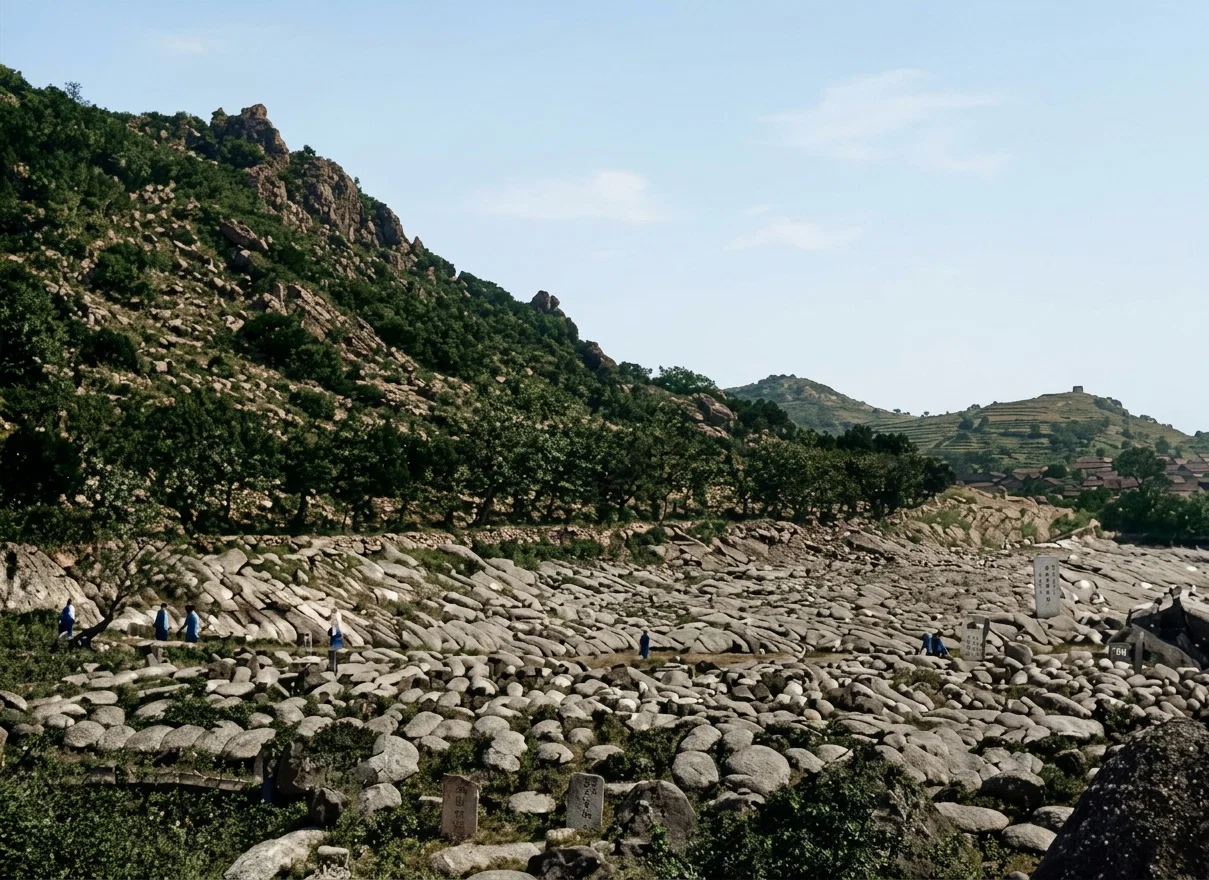
A GRAVEYARD IN CHINA
On the other hand, our hearts are constantly made sad by sights of misery and degradation. Among the women we see the greatest misery. They are of no account in China, except as slaves, and the bondage is often a long and bitter one. If she ventures on the street, no matter how respectable she may be, she is made the object of ridicule, descending sometimes even to obscenity. She has to run the gauntlet of jeers from a crowd of rough men, and as her small bandaged feet handicap her pace, her rude reception is slow torture.
Our hearts burn within us when we think of how little those in the home lands realize the vast need of these millions of precious souls. In the final reckoning we shall each be responsible for what we might have done with our entrusted talents. Our daily prayer is that the Lord will arouse men and women to action who should be in the foreign lands, and fire them with a zeal and devotion that will lead them to consecrate their lives as never before to the uplifting of their fellow beings. Let us follow the example of the One who said, “For their sakes I sanctify myself, that they also might be sanctified through the truth.”
Continue reading: R. A. CALDWELL