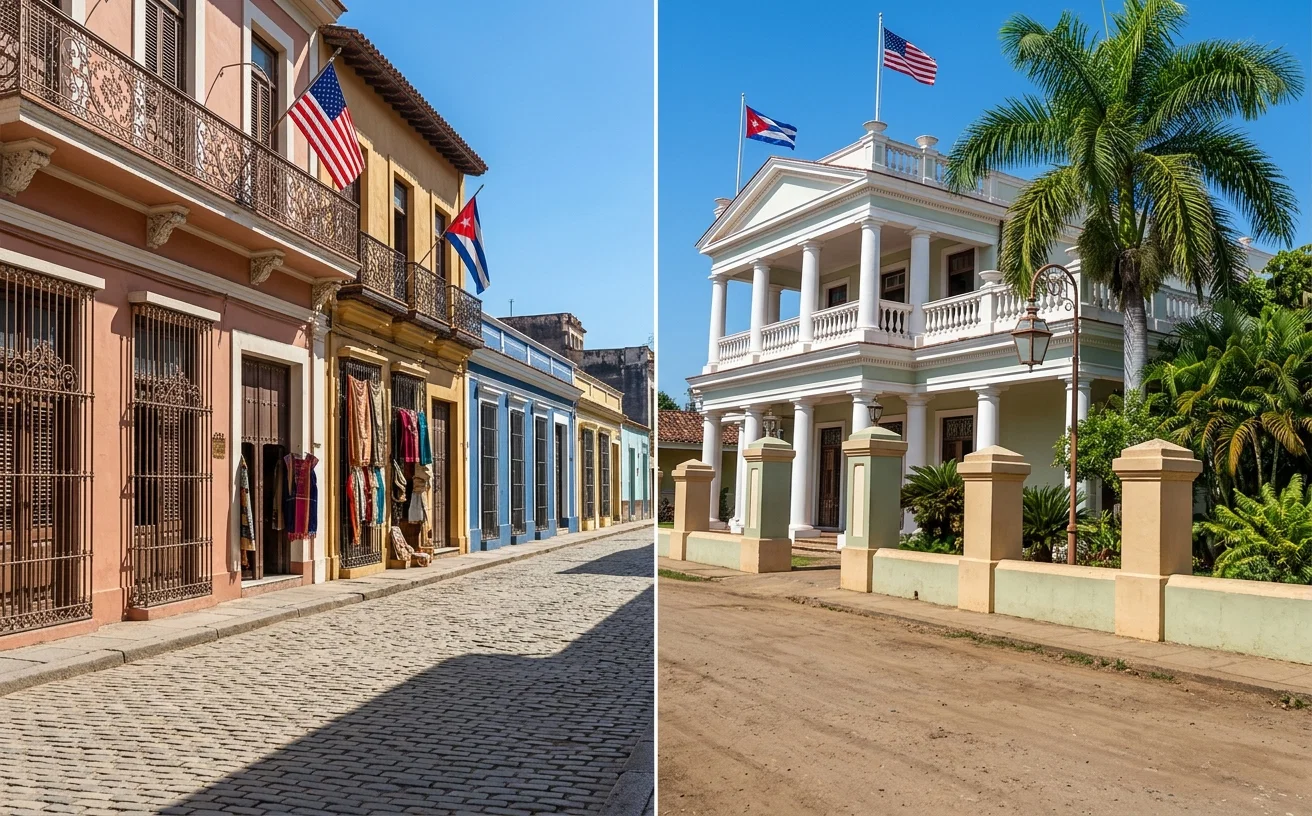
Lying one hundred miles south of Key West, between the Caribbean Sea and the Gulf of Mexico, the largest and most westerly island of the West India Group is found.
Cuba, with her coast line of nearly 2,200 English miles, her 47,278 square miles, including her dependencies, her population of nearly two million souls, who know nothing of the third angel’s message, presents a most interesting field for the consecrated worker.
With her two hundred or more ports, including Havana, which has one of the best harbors in the West Indies, there are twenty-three principal ones.
SCENES IN CUBA
Intersected by a broken mountain range, which extends through the island from east to west, some of the mountains rising to a height of eight thousand feet, with two hundred and sixty rivers, independent of streams, the falls which are found in the Ayor Negro River, which are nearly two hundred feet high, and the natural bridge which spans this river, many mineral springs, the luxuriant palms and tropical fruits and flowers,—all these make it a paradise to the tourist.
No wonder a Spanish writer in speaking of this beautiful spot at the time of its discovery by Columbus in October, 1492, gives the following statements: “At the sight of that coast so clean, without shoals or reefs, in which its gentle waters flow tranquilly, at seeing those mountains covered with verdure, that sky so blue, Columbus exclaimed, full of enthusiasm, ‘This is the most beautiful land that eyes have seen.’”
When the island was first discovered, it was inhabited by Indians of the same tribe that inhabited all the islands of the Caribbean Sea. These Indians lived in tribes under chiefs, who were called caciques. These looked upon the Spaniards with confidence, and at first regarded them as gods.
After discovering the island of Pines, Columbus returned to Cuba in July, 1494. He landed on the shore of the River Jatibonico (Ha-te-bo-ne-co), where he celebrated the first services held on the island. The Indians regarded with respect these wonderful ceremonies of the Catholic Spaniards. At last one of their old men drew near tremblingly, and said, “It seems to me that you are doing a good work, because you are worshiping your Divinity. Although it is said you have come from strange lands with great arms to conquer many peoples and countries, nevertheless you are not vain. Know thou there is in the other life two places where the souls will go,—the one full of joy and luck, is destined for the good; the other, fear and horror, where groan the evil. If you are mortal, and fear the eternal punishment, you will not do evil to those who do you no evil; and according to what you do, you will be recompensed.” Thus the savage recognized the infallibility of a Supreme Being.
Most of these savages have gone the same way as those of the other islands which were under Spanish rule. It is claimed that a few families are still in existence near Santiago.
Most of the inhabitants of this island are Spaniards and Africans. After the year 1511, colonists came from all provinces, even the Canary Islands, and settled in this island. Until 1511 only the Castilians were permitted to live there, but now the Biscayans, Catalans, Asturians, Castilians, Andalusians, and negroes share its wealth.
In 1886 slavery was abolished. Until 1898 the island was under Spanish rule. Havana, the capital, has over four hundred thousand inhabitants. Santiago, in the southeastern part, which was the original capital, has a population of over three hundred thousand. Spaniards have told me that this city is far more healthful than Havana.
The chief industry is sugar and tobacco raising. Its tobacco is recognized as the best in the world, if such a thing can be said of the weed. This fact has caused some feeling with the Porto Ricans, as they think that their country produces a good plant.
All of the tropical fruits are raised on the island; and it is claimed that when the island was discovered, six varieties of sweet potatoes were cultivated.
Like all Spanish countries Catholicism is the principal religion. The people, bound down by superstition, trust to their saints and penances to gain them an entrance to the kingdom of heaven.
Alberto Jose Diaz, a former officer among the Cuban revolutionists, was the first man to carry Protestantism into this Catholic land. One day during the last rebellion, he, with a companion, was sent ahead to select a camping-ground. Spanish sentinels saw them and followed them; night drew on, and they hid in a thicket, lashing their horses, to make the Spanish soldiers think they had escaped; but not being able to deceive them, they were forced to take a log and drift out to sea, expecting to land some place else on the shore. Sunrise found them far from land. For days they drifted without food or water, and finally Diaz’s companion lost consciousness, fell off, and was drowned. At last Diaz was picked up, unconscious, by a passing vessel bound for New York, and was put ashore penniless.
He spent his time reading newspapers to the men in a cigar factory. After a time he was taken sick with pneumonia, and was confined to his boarding house. Miss Alice Tucker, a home missionary, became interested in him, and living in the same house, went to his bedside and prayed with him and left him a New Testament. Diaz studied it, and was led to give his heart to God. His heart yearned for his people; and the rebellion being over, he was sent as a colporteur by the Gethsemane Baptist church of Brooklyn. He was the one who led the company of over twenty Baptist missionaries in their work.
After he returned to Cuba, he was closely watched by the police, as he had been a rebel. One day he left Havana on the railroad with two boxes of Bibles. He was arrested, as they thought the boxes contained dynamite. His Bibles were taken from him, and placed in another cell. He applied to the United States consul, as he was a naturalized citizen. On Sunday morning he asked permission to preach to the prisoners, but was refused. Nevertheless he prayed, sang, selected his text, and preached so that all could hear him. In a short time he was released. There was a great demand for his Bibles, and he sold them all. Afterward the mayor who caused his arrest was converted with seventy others in the same town.
With two other missionaries, he was arrested in the town where he was born, in 1890, where they went to hold meetings, the charge being that they broke the law by not notifying the Spanish authorities of the meeting.
Soon he organized a church, and baptized three hundred persons. One of the first persons to enter his church was his mother, who had been a pious Catholic. Diaz had the pleasure of baptizing her, and it so affected him that all he could say was, “Lord Jesus, this is my mother.” At the end of two years’ work eight thousand persons had offered themselves for baptism, and he had received eleven hundred.
Later reports of his work testified of “twenty-five ministers, thirty churches and stations, day schools in which seven hundred pupils were being instructed, twenty-five thousand Sunday-school pupils, and industrial schools.”16
So it is that the blessed gospel of peace has begun its work in this darkened part of the globe, but when “this gospel of the kingdom shall be preached to all the world as a witness unto all nations; . . . then shall the end come.”
In the entrance of Protestantism, Cuba holds open to us her door, and invites, yea, pleads, that this last message of the soon coming of our Lord be preached to her millions. Can we close our eyes to her needs any longer?
Simla, the Summer Capital of India
By Mrs. J. L. Shaw
MRS. J. L. SHAW
Away in the central chains of the western Himalaya Mountains, fifty-eight miles from the main railway, is Simla, the summer capital of India—the summer home of the viceroy and leading government officials. This was first established as a health resort in the early part of 1800, and has for years been the summer residence of the viceroy and officials of the government of India, and their retinue of government servants.
Simla has an elevation of seven thousand feet. Up to the present time all the travel of the fifty-eight miles is made by tongas, over a broad, well-kept cart road. When it is known that this distance, and the ascent of seven thousand feet, is made in eight hours, it can easily be seen that everything must be done most orderly to accomplish the trip. Each tonga is equipped with two strong horses, which are changed every two or three miles. The drivers are stalwart natives of dignified bearing, with steady nerves, and, as far as we could see, kindly manners. To avoid accident, each driver is provided with a horn, which is blown occasionally to warn the return tongas, bullock trains, or camel caravans, of their coming. Everything, from the driver to the harness and bullock wagons, is of a substantial nature. It is evident that lightness of weight has never entered into the thought, but, rather, substantiality. No doubt this has saved lives; for accidents are seldom known, though at times during the rains the old cart road is regarded a little dangerous. At the present time a railway is under construction, and will soon be in operation. This will make Simla more accessible to tourists.
As one begins the ascent, he leaves behind the hot and sultry plains, dotted with rice fields and native villages, and finds instead towering hills and green slopes, which are a pleasant change from the heat and congested condition of the cities. When work is impeded by sickness, it is, indeed, a boon to lift up our eyes to the hills, from whence cometh our help. These old Himalaya Mountains bring relief to many worn missionaries in India, and are natural provisions for giving renewed health and vigor.
About thirty miles distant, as one winds in and out among the hills, Simla can be seen quite distinctly, and the buildings that can first be recognized are the town hall and Viceregal Lodge. Simla covers an extended area, and jinrikishas are used by nearly every one. These are drawn by four or five native men—two in the front, and two or three at the back. The men make a very pleasing appearance in their highly colored costumes, as they run up and down the hills with the jinrikisha. The privilege of riding in a carriage in Simla is granted only to the viceroy—the commander in chief and lieutenant governor of the Punjab.
One of the most interesting points is the peak of Jako, eight thousand feet in height, in the east of Simla. This hill is thickly wooded, and its slopes on all sides are covered with beautiful homes. On its top a Hindu priest lives, and has a heathen temple. He spends his life in worshiping idols and feeding the monkeys grain. When we visited Jako at first, we did not see any monkeys. The old priest, now almost blind, brought out grain, and began to call the monkeys. They seemed to know the voice; for there were answers from all over the mountainsides, and soon from all directions they came, large, small, and medium-sized. Some, too weak to walk, fastened themselves to their mothers, and swelled the number. They ate their food greedily, and when we ventured to offer a little food to the rajah, or king of the company, he gave a snarl, and made a most hideous grimace. These monkeys are free to wander all over the city, as people are not allowed to molest them, there being some who regard them as sacred, and worship them. It is not an unusual thing for twenty or thirty to pass along together in the main thoroughfare, or to walk into a house and take what best suits their fancy.
The chief building of interest to the visitor is the Viceregal Lodge, the residence in the summer months of Lord Curzon, the viceroy of India. The grounds have the appearance of an American park, covered with green grass and an occasional cluster of pampas grass.
The climate resembles very much that of California, but the winters are colder. During the warm weather there is an evenness of temperature that makes it a very healthful place. Here are gathered representatives of the best families of England and India. The system and thoroughness that characterize the government work in all its branches are reflected in the homes of the people, and there is much really to learn and admire in these English and Indian people.
It was our privilege to spend eight weeks in this beautiful retreat, with two of our workers, Sisters Wilcox and Knight. To reach the class of people represented in this place is no small undertaking, but the Lord has greatly blessed the efforts made. Miss Wilcox came to India as a self-supporting missionary. By means of the health work, she has gained access to some of the most influential homes in India, and has had experiences that have shown the leadings of the Lord in a marked manner. Miss Knight has spent two summers here, and formed a large circle of friends, and has had a very pleasant connection with the Young Women's Christian Association. Some have taken their stand for the truth, and others are interested.
Calcutta, India.
Africa
ONE hundred years ago Central Africa and the Congo region were shrouded in dense darkness. Superstition, cruelty, and debauchery ran riot. It is only with the last quarter of a century, since the valiant explorations of Livingstone and Stanley, that we have seen the rays from the Sun of righteousness illuminating the awful gloom. The religion of the people is fetishism, a form of demon worship, the utter hopelessness of which renders its devotees much more ready to receive the gospel than are those of other heathen countries, where their religions promise future rewards.
The vigorous churches there, with thousands of stalwart, independent Christians, who a few years ago were naked savages, “having no hope, and without God in the world,” should stimulate the churches in the home land to more earnest efforts to sow the good seed in the vast fields of rich, virgin soil in the regions beyond.
The Roman Catholics are opposing the work of Protestant missions, even to the extent of committing acts of violence upon the persons of Protestant converts. They are pre-empting large districts, to the exclusion of missions, and at present are especially aggressive.
The history of missions is replete with difficulties and oppositions; but these are the badge of the genuineness of the work, and have tended to strengthen and purify it. There is no alternative; we must press forward; duty demands it; the love of Christ, the needs of Africa’s millions of people, and the opportunity all demand it.— Selected.
What Wait We For?
“WITH the open door to every land, with the beckoning hand of waiting nations, with many ready to go, and with our abounding wealth given us by a mighty God—what wait we for?”
Untranslated Languages Awaiting Scripture
THERE are hundreds of languages into which not one word of the Scriptures has yet been translated. In the islands of Polynesia it has been estimated that there are over one hundred languages sufficiently distinct and worthy to warrant the preparation of independent versions. Africa, from the West Coast, going eastward through the great district in the interior, which the native church of Uganda has claimed as the outlet of its own missionary zeal, has a number of languages. South America and Central America have native tribes which are yet entirely without the Word of God. The languages of the Indian empire alone number one hundred and fifty—not mere dialects, but as different from one another at least as French is from Spanish. And over seventy million people, speaking nearly one hundred of these languages, are still without any portion of the Scriptures in their own tongue.—Selected.
South Africa
By I. J. Hankins
AFTER a comparatively smooth voyage of twenty-four days, we landed in Cape Town, November 24. About ten days of were spent in London on our way to Africa, during which time we visited the sanitarium and the school. Those who contributed so cheerfully to the former will be glad to know that it has paid its way from the beginning, and that its patronage is increasing. Fifty young people are enjoying the benefits of the school, many of whom are wholly paying their way by selling our literature in the great city. We could but admire the faith and courage of these devoted students. The school equipment and facilities are very limited, but the Lord is blessing the work, and will, I feel sure, send forth from the world's metropolis up many earnest laborers to assist in gathering from among the nations the remnant of Israel. The power of present truth is yet to be felt in the world; but this will not be until its power is more sensibly experienced in the lives of those who profess it. When self is dead, the truth will live.
After three years' absence, many changes appear in this field. Satan would like to wreck this message, but the Captain of the Lord's host is leading the work, and it is destined, not to defeat, but to triumph gloriously.
Several of the brethren and sisters met us at the wharf, and gave us a hearty welcome. We hope so to labor together and so to co-operate with the Lord that his work may be speedily accomplished in this part of his vineyard.
I. J. HANKINS.
India
By Mrs. W. O. James
ASANSOL.—After a pleasant voyage we reached Bombay, India, March 30, 1903, remaining there until July. We have been working with our excellent paper, the Oriental Watchman, which is carrying the third angel's message in this sin-darkened land.
From there we went to Poona, where we also began canvassing with the British Good Health, which is published in London especially for the Indian field. With this we are able to reach the Parsee class, who are a very intelligent people. They do not believe on the Lord Jesus, but are of those “who changed the truth of God into a lie, and worshiped and served the creature more than the Creator.” They are vegetarians as a rule, and Good Health takes well among them. We have been able, however, to get the Oriental Watchman into several Parsee homes.
We had some precious experiences while in Poona, and the privilege of seeing one woman who had served Satan for about sixty years give her heart to the Lord. What a grand privilege to carry this life-saving message to a dying world! One day while walking on the street in Poona a man whom Mr. James had canvassed stopped him, and asked that he would pray for him. He had once been a Christian, but had gone back into the world.
Since leaving Poona we have been traveling through the northern and central provinces. We can see that the Spirit of God is working mightily upon the honest-hearted people. The Oriental Watchman has been circulated for about six years now, and the truth which it contains has stirred the people. Often pressing invitations are extended to us to spend the evening with families, and more fully explain to them this message. It is easy to work for the people of India, as this truth is new to them. Then, again, I believe the Lord is doing a special work at this time; for he says that the work will be cut short in righteousness.
We have no time to lose; for we can see that the Lord is calling out a people from the world who will make up the number of those “that keep the commandments of God, and the faith of Jesus.”
Our conference was held in Calcutta, November 6-16. There we met all the liberal workers of India, after being separated from our people for over seven months. How it cheered our hearts to hear the glowing reports from different parts of the field! Together we enjoyed the spiritual feast which our hungry hearts had been longing for. The Lord came very near and blessed in our meetings.
When the conference closed, all the workers seemed anxious to return to their work again. I was very much impressed with the spirit of brotherly love that existed among them.
What a privilege to meet with so many of God's people, whose hearts are aglow with his love, and whose highest ambition is to win souls for Jesus.
MRS. W. O. JAMES.
Argentina
By N. Z. Town
CRESPO.— We have watched with interest the removal of headquarters from Battle Creek to Washington, and it has rejoiced our hearts to see the manifest leading of the Lord. The willingness to follow the heavenly counsels is sure to give fresh courage to our brethren everywhere.
We have no discouraging report to send from this part of the field. Brother McCarthy writes me that fifty-five are firm in the truth, as the result of the effort in Missiones. The Lord is working in a wonderful manner there.
We pitched our tent in the village of Crespo, Entre Rios, early in September, to hold a local meeting for the brethren of the province. Each evening we had a meeting in the Spanish language, for the benefit of the people in the village and vicinity. These meetings were conducted by Dr. Habenicht and myself. The day meetings were conducted mostly by Brethren Westphal and Maas, in the German language, as our brethren in this vicinity are German. There was a good attendance of our own people, and at the close of the meeting four were baptized.
As there was considerable interest manifested on the part of the Spanish-speaking people, Mrs. Town and I remained to follow up the interest. It is slow work among these Catholic natives, who have never seen a Bible, but we are seeing some results. Five have begun the observance of the Sabbath, and have expressed a desire for baptism.
From here Brethren Westphal and Maas went to a German colony on the east side of the province, with the tent. They pitched the tent in the village, near the place where we held our general meeting in March, and where Brother Maas has since been working. In a letter just received from Brother Westphal, he reports five baptized recently, and others keeping the Sabbath, who will be baptized soon.
One of our native workers, Brother Diriwachter, is working in the province of Santa Fe. He reports that a German Catholic family with four sons has begun to keep the Sabbath.
A few months ago a young German teacher came to our school to study. He had to room with other young men. When they had their worship together before retiring, he made sport of it for a time. But after a while he grew more serious, and it became clear that he was having a struggle with the truth. At last he gave in, and sent me the following note:—
“I have decided to be baptized, to liberate myself from this load that I18am always carrying, and to find eternal peace. Although I do not expect that my life from now on will be free from tornadoes, I believe the Lord will help me in the struggles I may have to go through, if I give myself entirely to him. May the Lord help me in a fulfilment of that which I to-day promise. Do not forget me in your prayers; and let me know where the baptism will take place.”
The young man has taught school for some time among the German colonists here, who are opposed to us, and it has cost him quite a struggle to take this stand; but he could not withstand the power of the truth. So, even in this dark land, the good work is going forward slowly, for which we give thanks to our Heavenly Father.
N. Z. TOWN.
Japan
By S. A. Lockwood
KOBE.—The past month has been the most prosperous in our history here. Six new patients have applied for treatment, and six or eight have continued from the previous month. The last two weeks particularly have been busy ones. Of late, when patients come in, they tell us they have been hearing a great deal about this place, and have come to see what we can do for them. During November our receipts were about two hundred dollars. The patients have begun to show some interest in our belief.
At the beginning of November we divided our forces, Drs. Kumashiro and Kawasaki taking charge of a little sanitarium in the locality where there are more Japanese than there are in our neighborhood. Brother Kuniya has been holding meetings in Kobe, with an encouraging attendance. S. A. Lockwood.
T. GODFREY
By T. Godfrey
Kansas
NORTHWESTERN Kansas is my present field of labor. This district is not so densely populated as the country farther east; but it contains many souls that have never heard this great truth. O, how we need more consecrated workers! We need canvassers, missionaries, and medical missionaries in this field. Here is a good place to get experience; one comes in contact with men and women from every part of the world. There is opportunity here for young men and women to show their willingness to work for God. The work is moving on. Our Captain is commanding, and the victory is sure. We are now in the midst of the week of prayer, and we believe many souls will be blessed. As soon as the week of prayer is over, we expect to begin a series of meetings.
Any one desiring to enter this field to canvass, sell Signs and tracts, and distribute reading, is invited to address me at 821 West 5th St., Topeka, Kan.
T. GODFREY
ALEXANDER RITCHIE
By Alexander Ritchie
Scotland
The Lord is still blessing our efforts in this field. Wednesday, October 28, we had our first baptism, when thirteen precious souls were buried with their Lord in the watery grave. About the same number are now waiting the next opportunity for baptism. We expect before long to organize a church here, and at this writing there are between thirty and forty who are ready to become charter members of the new church. The interest in our meetings, especially those held on Sunday, is excellent. The Lord is working. Of this we frequently see evidences.
One of our dear brethren, formerly a Salvation Army captain, but now a successful canvasser, gave his heart to the Lord when he was a boy. At that time his father was a devoted Christian worker, and for years enjoyed a rich experience; but when in temptation, he fell into great wickedness, and for years led a life of sin. The son came to our tent-meetings, accepted the truth joyfully, and soon began to feel a burden of soul for the restoration of his father. The father began to attend our meetings, became interested in the prophecies, and last Sunday the Lord led me to plan a discourse especially suited to this man's needs. The Lord blessed the word with power, and that night the Spirit brought salvation to that home, and at midnight there were songs of praise over the return of the lost sheep. Before his conversion, this man said that he must be a Seventh-day Adventist if he ever came back to the Lord. Both father and son are, by training, expert commercial canvassers, and we now expect their talents to render good service for the Lord.
Another brother, a master baker by trade, holding a leading office in the Congregational church, came to the tent-meetings, heard the message, and was convinced of its truth. Saturday was his busiest day; but after visiting, talking, and praying with him, he decided to obey the Lord. Then the Lord began to work for him by what seemed to him strange providences, although they were not new to us. The very week he made up his mind to close his store on the Sabbath, although he could not do so without giving notice, people came and paid their bills on Friday, who had never done so before until Saturday night or later, and on the Sabbath of that same week there was so little business in the shop that the brother changed his clothes and came to the Sabbath service, leaving his wife and a hired girl to tend the shop. When he returned from meeting, his wife told him that they had done no business since he left, nor did they do any until the Sabbath sun had set; and then there came such a constant stream of customers that the brother, his wife, and the hired girl were kept busy until the closing hour, and thus a whole day's business was done in the few hours between sunset and midnight. In this remarkable way by his providence, the Lord spoke to this dear man, and showed his ability to care for him. His shop has been closed ever since on the Sabbath, and he is firm in the truth.
Another brother was an inveterate user of tobacco, although a professed Christian. He heard the message, and became convinced that his Sunday-keeping and his tobacco using were alike wrong. He first desired to be free from the tobacco, but promised the Lord that if he would deliver him from the tobacco, he would also keep the Sabbath. The Lord heard him, and he has had no desire for tobacco since. Then he determined to keep the Sabbath, as he had promised, but the enemy strove hard to turn him from his purpose by picturing before him the dire results to his wife and large family of small children. We encouraged him to obey, and to leave the future with the Lord. He began to keep the Sabbath, and in consequence lost his work and good wages as a carpenter. Then the Lord worked for him. The Scotch people all buy their bread for the week at one time, and for years past on each Monday morning his wife has needed to replenish the bread box, but on this particular Monday morning the usually empty bread box was found to be full of bread.
The scoffer would make light of this, but we who know the God of Israel know that he who replenished the barrel of meal and cruse of oil for the widow of Zarephath is the same yesterday, to-day, and forever. This brother entered the canvassing work, the Lord blessed him greatly, and after this we presented the tithing question. He heard, but did not obey. The Lord began to slacken his hand, and for two or three weeks success departed from him. I told him plainly he was robbing God, and that it would pay him well to take the Lord into partnership. For some time he held out, but we pleaded with him not to reject the light, and assured him that the Lord would prosper him. A letter received from him a day or two ago would do anybody good to read. I will give a few extracts from it:— “I had very good success in my delivery yesterday. I lost only three books, and that was made up to me by the gentleman in my last lodging, who, seeing me unwrap a copy of ‘Great Controversy,’ bought it. At night when I was looking over my day’s work, I set the tenth part aside to give to the Lord, and the Lord does hear and bless. The Lord drew me out to canvass to-day, and he put in the orders in a manner one could scarcely look for. He is a grand partner. To-day we [meaning the Lord and himself] sold four copies of ‘Eden to Eden,’ four of ‘Christ Our Saviour,’ and one of ‘Making Home Happy.’” Further on in his letter, he writes: “Dear brother, Mr. Brown was telling me last night that Mrs. Brown was saying that she did not understand how some things are as they are. She has, as a rule, to send for goods on Thursday, and yet this week she needed nothing, although she has not bought more than usual. Mr. Brown quoted that passage that tells us something about being careful to entertain strangers, for some had thereby entertained angels unawares. So the Lord is speaking in more ways than one to them. Praise the Lord.” The Mr. and Mrs. Brown were boarding him without charge.
Dear brethren and sisters in America, others may explain these things as they choose, but we see in them the manifest working of our wonder-working God accompanying the preaching of his last great message by something approaching those signs and wonders which the Saviour promised to the apostolic preachers of the early gospel. Pray for us and the work in Scotland.
ALEXANDER RITCHIE
Dedications in Wisconsin
By William Covert
WE held a series of meetings and dedicated a church building at Clear Lake, Wis., November 27-30. Elder J. B. Locken and Brother C. D. AcMoody were present to assist in the services. Sister Lottie Farrell was also there in the interest of the church-school work. At all the services the house was quite well filled with attentive listeners. A commodious little meeting house worth about five hundred dollars was formally dedicated to the service of the Lord on Sunday, November 29. This building was entirely free from debt. Arrangements were made to increase the order for the special number of The Signs of the Times three hundred copies.
I also visited a newly organized church at Barron the evening of the thirtieth, and talked to them in regard to missionary work. They ordered five hundred copies of the Capital and Labor number of The Signs of the Times.
I next went to Eau Claire, December 1, and continued meetings over the following Sunday, December 6. On the last day of the series of meetings we dedicated a new house of worship in that place. Elders T. B. Snow and J. B. Scott, and also Brother L. L. French, were present to assist in the services. The interest in our meetings increased as long as we remained there. Five hundred copies of the Capital and Labor number of The Signs of the Times were added to the order which they had already made. This paper was meeting a ready sale in that city. An immense number of copies could be sold if the proper effort could be made.
The prospect in Eau Claire seems quite favorable for an increase of membership in the church. It would have been quite agreeable to our feelings if we could have remained longer to conduct meetings in the new church building, but the large amount of conference business at this season of the year made it necessary to return to the office. Elder Scott is spending most of his time this winter in the new sanitarium at Madison, doing pastoral work with the patients, and also conducting meetings in the People’s church in the city. He reports that some have lately accepted the truth in the sanitarium, some in connection with his labors in the church, and one family who were attending his services at the People’s church. Had it not been for his interest in Madison, he could have remained in Eau Claire, but as it is, Elder Snow and his wife will follow up the work there. WM. COVERT.
Brazil
By F. W. Spies
At the Curityba general meeting, arrangements were made for Brother Emil Holzle and the writer to labor together among the Brazilians in the Panama Province. Accordingly, upon my return from the Rio de Janeiro general meeting, I started for Curityba, where Brother Holzle lived, to meet him and then go with him into the field. On my way to Curityba I spent one Sabbath at Joinville, then passed through the Hausa Colony, visiting the brethren who live there, and celebrating the Lord's supper with them. At San Bento, where I was obliged to go in order to get a mule that I had lost on my trip to the Curityba general meeting, I also celebrated the Lord's supper with the brethren. After passing through Rio Negro, and visiting the believers there, I arrived at Curityba the first of October.
As soon as possible Brother Holzle and I left Curityba, and after a short day's journey we came to a small Roman Catholic town called Bocayuwa. Here we met two families who had for some time been reading our Portuguese paper, the Arauto da Verdade, and were much interested. One of the men, the mayor of the place, offered us the town hall in which to hold meetings at any time when we were able to do so; but owing to more advanced interests in a number of other places, it did not seem best to leave those in order to create a new interest, and so we went on, promising to return and hold meetings as soon as we were able to do so. Leaving Bocayuwa, we intended to go to Ouro Fino (Fine Gold); but just as it was getting dark, we lost our way, and after traveling nearly two hours without meeting any one, we heard the barking of dogs far down in a valley, and soon found the house. As these people had no pasture for our animals, we had to go a little farther, to a place called Campinhos. Here we were very hospitably entertained by an aged Brazilian planter. Our missing the road seemed providential, for this man and his family were hungering for the truth.
Leaving Campinhos the next morning, we were soon overtaken by a heavy rain, which continued the rest of the day. About dark that evening we arrived at Serro Azul. The following day it rained even harder, so we spent the time in visiting some Englishmen who lived about ten miles from Serro Azul. We next went to Ribeira. In the vicinity of this villa a number of people have for some time been interested in the truth, and are keeping the Sabbath. We spent two weeks with them, also visiting others in the neighborhood, some of whom are much opposed to the truth, all being Catholics. Sabbath, October 31, we buried fourteen dear souls with their Lord in baptism, while four others are expecting to be baptized in a few days after they are legally married.
The loose way in which the marriage relation is treated in this country, owing to the influence of the Roman Catholic Church, causes much difficulty in our work. Since the republic was proclaimed, legal marriage exists, but the priests as a rule do all in their power to have the people disregard the laws, and become married by the Catholic Church, as they do not like to lose their prestige. Many simply live in concubinage. Of those who were keeping the Sabbath at this place, two couples, who had been married only by the Catholic Church, now sought to comply with the requirement of the law, becoming married by the civil authorities.
But too often, when these people seek to place themselves in right relation to God's law and man's, the guardians of the law, who themselves are frequently leagued with the political priests, do all they can to hinder the people from carrying out the requirements of the law, by asking exorbitant prices for the performance of the ceremony, or else by making other unjust demands. But the truth is triumphing, and gradually is its light dawning in Brazil, for which we praise the Lord! F. W. SPIES.