Your ShelfYour Projects

Signs of the Times, Vol. 27, No. 35.

PURPOSE OF HISTORY

Signs of the Times

Aug 28, 1901

Pacific Press Publishing Company · Oakland, California · Aug 28, 1901

PURPOSE OF HISTORY.

Some Preliminary Considerations.
AUTHENTIC history is not to the Christian student a mere enumeration of dead facts. It is not a mere record of the struggles and changes, the defeats and triumphs, the gains and losses of men and nations. If we see only one or all of these in the history of men and nations, our view is indeed limited and imperfect.
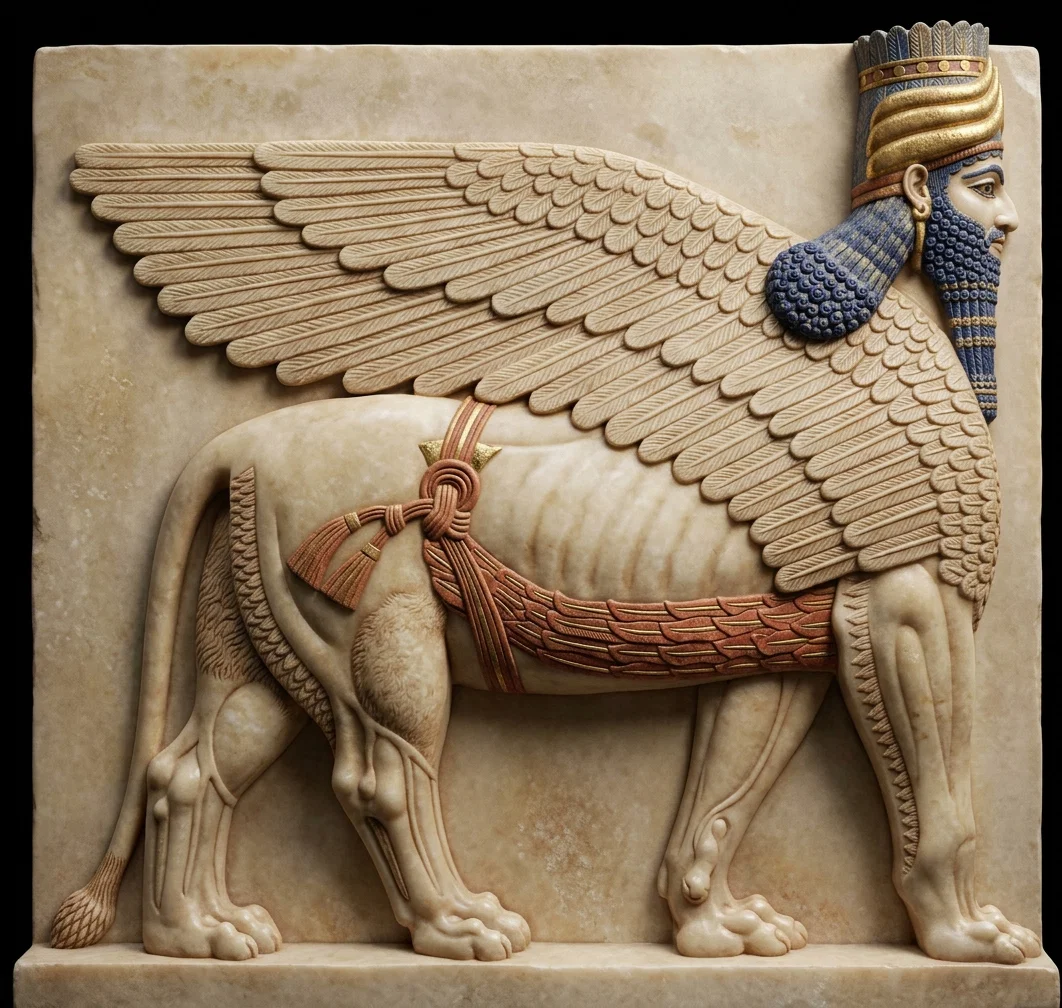
The Winged Man-headed Lion, of Semitic Idolatrous Origin.
In a strange land, fraught with dangers and difficulties seen and unseen, filled with numerous foes, who lurk in ambush and lay hidden snares for our feet, it is wise now and then to ascend some high hill, to climb to the top of some lofty and commanding eminence, whence we may review the ground already traversed, and behold as best we can the perils and pitfalls, the dangers and difficulties, which await us in the future. If to be forewarned is not wholly to be forearmed, it is a necessary step to that end; for he will make no preparation to meet perils or difficulties who believes that there is no danger.
History is one of the lofty eminences from which we may view the past, but not in its own light. For he who studies history from any other view-point than that of the divine, misses the great lesson which history teaches.
God’s invitation to Moses is applicable here: “Come up to Me into the mount, ‘and be there;” or to Ezekiel: “In the ‘visions of God brought He me, . . . ‘and set me down upon a very high mountain, . . . and the Man said unto ‘me, Son of man, behold with thine eyes, ‘and hear with thine ears, and set thine ‘heart upon all that I shall show thee; for ‘to the intent that I might show them ‘unto thee art thou brought hither: declare all that thou seest;” or to Isaiah: “O thou that tellest good tidings to Zion, ‘get thee up into the high mountain.”
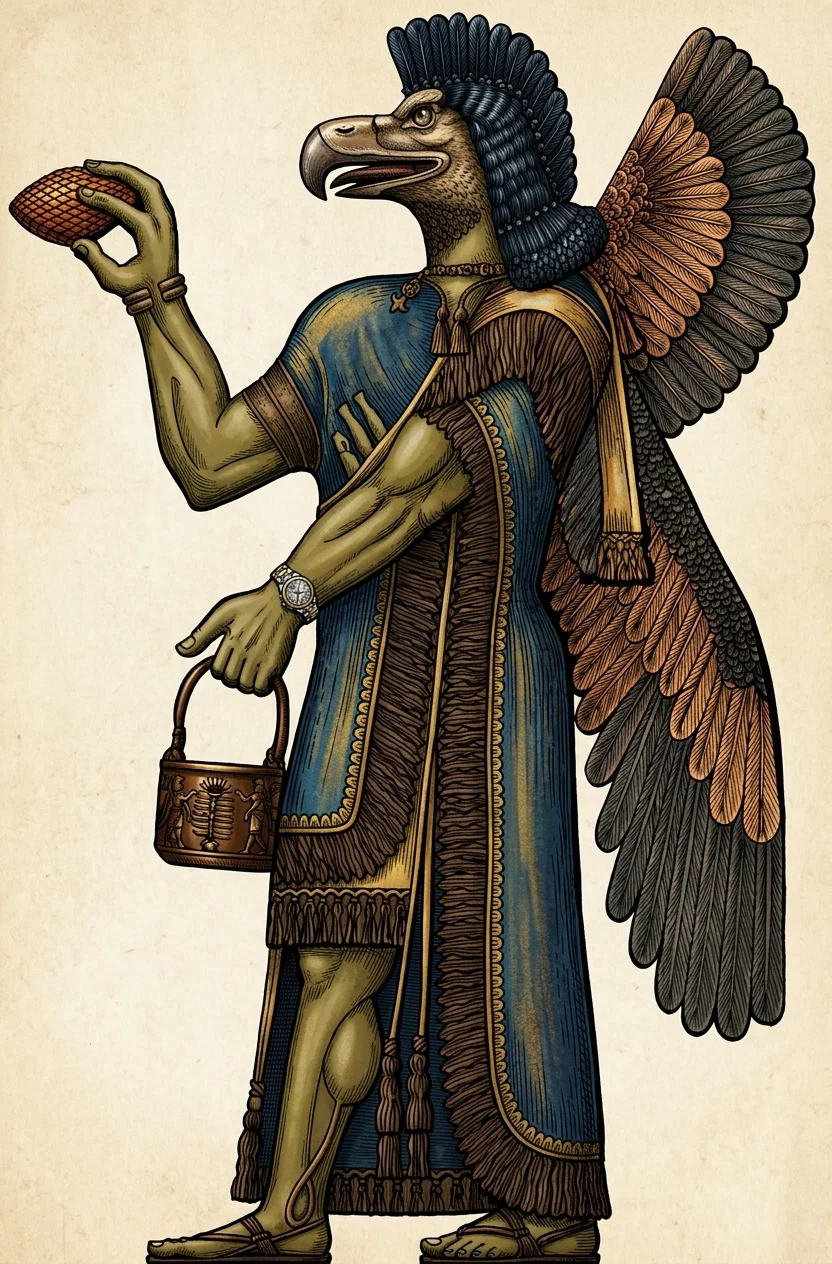
Eagle-headed, Winged, Human-bodied Genius, or Deity.
He who would rightly judge the past, understand the present, or discern the future, needs, like the prophet of old, to get up into the high mountain, to the “top of the rocks” “of Pisgah” and “of Peor,” if he would see the Israel of God, God’s purpose in calling them out, their victories over opposing powers, and their latter glory under King Immanuel. He must see in the vision, or seeing, of God. To God’s outlook of vision, to His seeings, these studies invite the reader. The watch-tower—the mountain—is the sublime heights of the prophecy of God—history in advance—written by the pen of Inspiration as kenned by prophet and seer.
God is in history, whether His name be named or not. Tracing it through the ages with that thought dominant, chaos becomes cosmos, confusion becomes order. The indefinable to human wisdom may be seen to have been ordered of God; while despite all the machinations of men, and the efforts of hostile powers, the divine Master works to the one great end, the establishment of the kingdom of righteousness, and the gathering out from the wickedness of a corrupted world all those who in Him are worthy to inhabit that kingdom forever. “The Most High ruleth in the kingdom of men.”
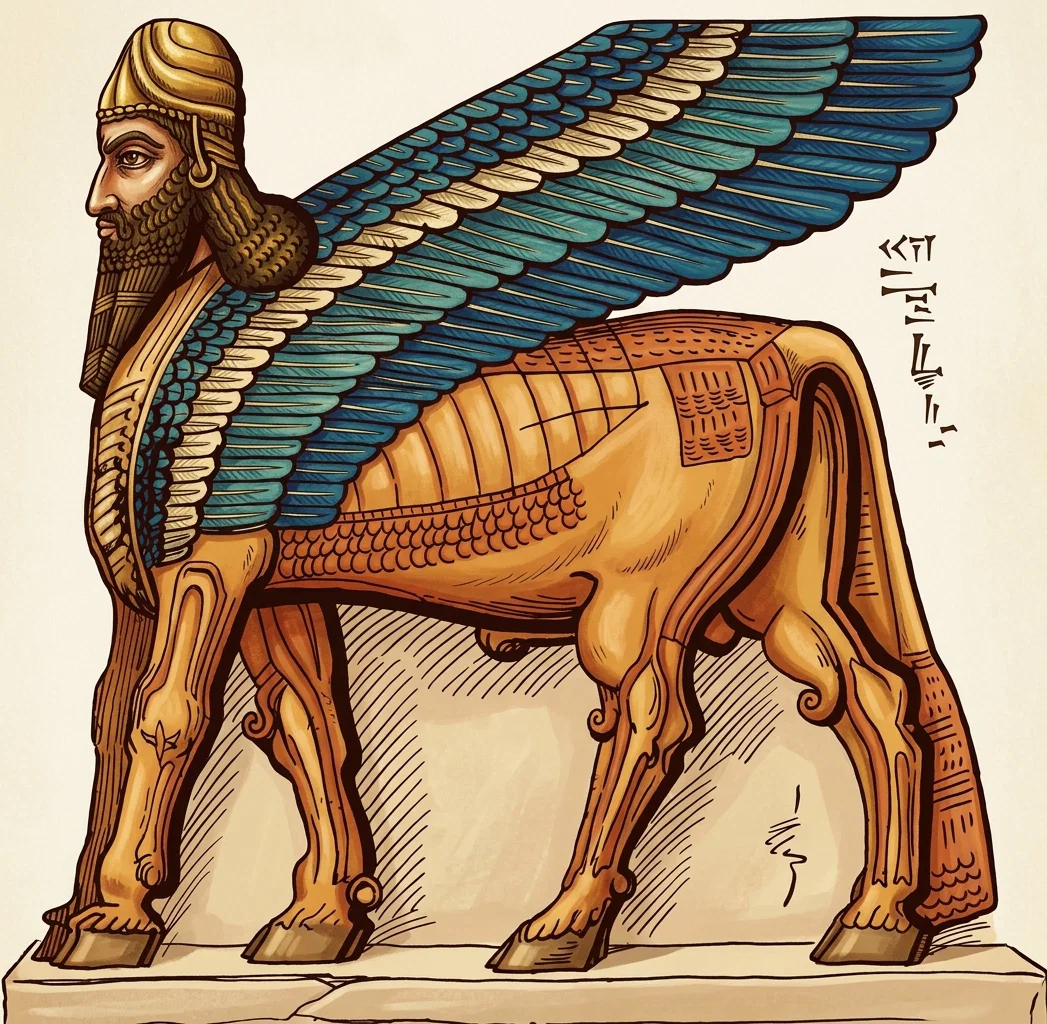
The Winged Man-headed Ox from Nimrud.
In thus reading history, the clear-sighted student may see, often repeated, God gathering from seeming defeat, utter ruin, and nothingness, the most glorious victories, the grandest structures, and the mightiest impulses, forces, and movements earth has ever known.
The great theme of these studies is God revealed in history and prophecy. In the prophecy He reveals in word and symbol Himself and the future, which He works out despite of sin. In history is the same word and symbol developed in deed and monument, in man and nation, in movements and changes, and in some form or way ever revealing the working of God.
Prophecy and history are two agreeing witnesses which God gives to the truthfulness of His Word—two witnesses between which there can have been or can be no collusion. The former is written beforehand with the pen of Inspiration: “Declaring the end from the beginning, and ‘from ancient times the things that are not ‘yet done, saying, My counsel shall stand, ‘and I will do all My pleasure,’” Isa. 46:10. The latter—history—worked out despite the sin, the corruptions, the efforts of Satan, through the overruling of God, writes again in after years, centuries, ages, the things which prophecy recorded.
Concerning God’s purposes among the children of men, His Word declares: “Surely the Lord God will do nothing, but He revealeth His ‘secret unto His servants the prophets.” Amos 3:7. Concerning what He thus reveals through His prophets, His apostle Peter declares: “We have also a more sure word of prophecy; whereunto ye do wellthat ye take heed, as unto a light that shineth in a dark place, until the day dawn, and the day-star arise in your hearts. . . . For the prophecy came not in old time by the will of man; but holy men of God spake as they were moved by the Holy Ghost.” 2 Peter 1:19-21.
We are now in the long, dark night of sin. Many lights are gleaming, but few indeed mark the pathway of life. Many are but the combustion of the noxious gases rising from the miasma of pestilential morasses, which lead the hapless wanderer into sloughs of despond, where they leave him in total darkness to perish. Myriads are now wandering in the mazes of doubt, skepticism, error, and political uncertainties. Blessed be God that He has given us the sure light, that shines in the darkness, and illuminates the path of life even to the end.
With these divine assurances, dear reader, may we not in humility, ever by faith asking God to grant us the guidance of that Spirit who inspired the prophecy, undertake its study with the assurance that we shall there find God revealed—a Teacher, a Guide, a Helper, a Saviour, and an everlasting King? M. C. WILCOX.

WORDS OF CHEER.

And he showed me Joshua the high priest standing before the angel of the Lord, and Satan standing at his right hand to resist him. And the Lord said unto Satan, The Lord rebuke thee, O Satan; even the Lord that hath chosen Jerusalem rebuke thee: is not this a brand plucked out of the fire? Now Joshua was clothed with filthy garments, and stood before the angel.”
Joshua represents the people of God. When Satan accused him, the Lord rebuked him, and spoke to those who stood before him, saying, “Take away the filthy garments from him. And unto him he said, ‘Behold, I have caused thine iniquity to pass from thee, and I will clothe ‘thee with change of raiment. And I said, Let them set a fair miter ‘upon his head. So they set a fair miter upon his head, and clothed ‘him with garments. And the angel of the Lord stood by.’”
Satan endeavors to bring reproach upon those who are trying to serve and honor God. He presents them in a questionable light, as those who are clothed with filthy garments. But God says, “‘Take away the filthy garments. You have no right to put them upon my ‘people. Take them away. My people may have imperfections of ‘character; they may fail in their endeavors; but if they repent, I will ‘forgive them.’”
The word of assurance is given to all who have faith in God. Receive this wonderful promise. It is not a human being who is speaking: “Thus saith the Lord of hosts, If thou wilt walk in My ‘ways, and if thou wilt keep My charge, then thou shalt also judge ‘My house, and shalt also keep My courts, and I will give thee places ‘to walk among these that stand by.”
Among those who stand by,—the hosts of the enemy, who are trying to bring God’s people into disrepute, and the hosts of heaven, ten thousand times ten thousand angels, who watch over and guard the tempted people of God, uplifting and strengthening them. These are they who stand by. And God says to His believing ones, You shall walk among them. You shall not be overcome by the powers of darkness. You shall stand before Me in the sight of the holy angels, who are sent forth to minister to those who shall be heirs of salvation.
God loves His believing people, and He has placed their feet in a safe and sure path. He has caused them to sit in heavenly places in Christ Jesus. This He has done, not because of their goodness and worthiness, but because of the free promptings of His grace, because He is rich in mercy, because of the great love wherewith He loves them. He has delivered them from the power of darkness, and has translated them into the kingdom of His dear Son. He is very desirous that they shall perfect characters which will enable them to stand before Him, purified and made white.
But let them not suppose that the pathway to heaven will be always smooth, that no temptations will come. Peculiar difficulties will arise, which will test their faith, tax their patience, and try their steadfastness. Face the difficulties bravely. Be men and women of unswerving principle. Remember that Christ has said, “Be of good ‘cheer; I have overcome the world.” The battle is before you, but you are not called upon to fight alone. Christ and the angels are with you. Perseverance in service, willing obedience to God’s way, will win for you a crown of life. Then cast off the works of darkness, and put on the armor of God.
“Be strong in the Lord, and in the power of His might. Put on the whole armor of God, that ye may be able to stand against the wiles of the devil. For we wrestle not against flesh and blood, but against principalities, against powers, against the rulers of the darkness of this world, against spiritual wickedness in high places. Wherefore take unto you the whole armor of God, that ye may be able to withstand in the evil day, and having done all, to stand. Stand therefore, having your loins girt about with truth, and having on the breastplate of righteousness; and your feet shod with the preparation of the Gospel of peace; above all, taking the shield of faith, wherewith ye shall be able to quench all the fiery darts of the wicked. And take the helmet of salvation, and the sword of the Spirit, which is the Word of God.”
Unbelief is repulsive, dark, forbidding. It can only deny and destroy. Faith lifts the head in conscious dignity and firm trust in God. True workers walk and work by faith. Sometimes they grow weary with watching the slow advancement of the work, when the battle wages strong between the powers of good and evil. But if they refuse to fail or be discouraged, they will see the clouds breaking away and the promise of deliverance fulfilling. Through the mist which Satan has thrown across their pathway, they will see the shining of the bright beams of the Sun of Righteousness. The glory of the Lord is to fill the whole earth.
Have faith in God. When you make mistakes, turn your defeats into victories. Your love and fidelity will be tested by difficulty, disappointment, and trial. These your faith must overcome. The burden you bear for Christ’s sake, the service you render in the complete surrender of your will to God,—this is the measure of your love for Him. There is fulness for you in Christ. Come to the water of life and drink. Do not stay away and complain of thirst. The water of life is free to all. Spend much time on your knees in prayer. Believe that God hears your prayers, and you will see of His salvation.
“If God be for us, who can be against us? He that spared not His own Son, but delivered Him up for us all, how shall He not with Him also freely give us all things? Who shall separate us from the love of Christ? Shall tribulation, or distress, or persecution, or famine, or nakedness, or peril, or sword? . . . Nay, in all these things we are more than conquerors through Him that loved us. For I am persuaded, that neither death, nor life, nor angels, nor principalities, nor powers, nor things present, nor things to come, nor height, nor depth, nor any other creature, shall be able to separate us from the love of God, which is in Christ Jesus our Lord.”
MRS. E. G. WHITE.

PARAGRAPHS ON PRAYER.

“It will hurt you more to live a day without prayer than to live it without bread.”
“MANY long prayers are bloodless cold. If solemn, yet nothing else than chaff. If earnest, yet as selfish as Satan desires.”
“HE who prays six times fervently and stops there, when he ought to have prayed seven times, deprives himself of the answer to his prayer. 2 Kings 13:18, 19.”
O, FOR closest communion with God, till soul and body, head, face, and heart shine with divine brilliancy! but, O, for a holy ignorance of our shining!—Rutherford.
CHRISTIANS who are much in secret prayer and contemplation, are men of greatest life and joy; because they have all more immediately from God Himself.—Baxter.
“If we come forth from the closet of communion, the atmosphere of evil-speaking will be to us as the tainted air of some great city to one that has been breathing the pure air of a mountain-top, or the fresh breezes of the seashore.”
“SPIRITUAL health and comfort require good praying. So does spiritual usefulness. Did you do a good job of praying this morning? We should be apt at speaking to God about things. We should be neither dull nor lazy about it. Life is too momentous not to understand God and His will concerning us.”
THE preaching that takes the deepest hold on human hearts and gives adequate and permanent results in every way, is that which strikes straight, swift, and sure blows at sin. The sin-searching truth and power in the pulpit brings something to pass.—Christian Worker.
THE pastor who turns his church service into an entertainment is running a stern chase with other entertainers, who can always furnish a better show for less money. Our coign of vantage is the presentation of the Gospel. We have that field to ourselves, and it is quite large enough for the best of us. The old truths of the Gospel are always new and attractive if set forth in the power of the Spirit. And we preach successfully only when we preach under the power of God.—Burrell.

STANDARD OF THE JUDGMENT.

IT is a self-evident proposition that, if a righteous judgment shall at last be rendered in the cases of all men, some equitable and righteous standard must be employed by which to decide the merits or demerits of every one. This must be accomplished by measuring the deeds done by each during his entire life. Eccl. 12:14; 2 Cor. 5:10.
After the view given John in Revelation the tenth chapter, of the great disappointment in the matter of proclaiming the time for the end of the world, which we have seen was fulfilled in the autumn of 1844, he says there was then given him a rod, with which to measure not only the temple of God, and its altar of worship, but also the worshipers therein. Rev. 11:1. Inasmuch as the prophet, in the tenth chapter, represented the people of the great advent movement in their disappointment, so in the eleventh chapter he must continue to be the symbol of the movements to follow that work of 1844. Therefore when he says that a measuring rod was put in his hand with which to measure the temple and its worshipers, it signifies that, following the 1844 movement, some rule of measurement was to be given to a faithful people by which might be measured, not only the requirements of the temple of God, but also the standing of those who worship in that temple. This would certainly require them to proclaim specially, as those called to fulfil the prophecy, the measurement recorded by the application of the measuring rod put in their hands.
The moral measurement of men, contemplated in the prophecy, can apply only to deeds, which assist in forming character. In deciding the nature of these a perfect rule,—one which indicates God's being and doing,—must be placed beside the one to be measured, so that a correct deficit, if existing, may be readily estimated. By one of His representatives God says: “I will make judgment the line, and righteousness the plummet.” Isa. 28:17, R.V. Thus righteousness itself,—the very character of God,—is made the plummet by which the degree of man's unrighteousness is determined. As this line is placed alongside of men's being and doing, the least defect, anywhere along the way, will be plainly shown.
The reason why such a rigid rule is applied by which to test men, is that this is the final ordeal by which it is to be determined whether or not the one tested shall be permitted to enter life in the presence of God and the holy angels. Inasmuch as these heavenly beings are absolutely righteous, and can not countenance unrighteousness in any degree, the test of man's privilege to dwell with them, must be the righteousness which they have among themselves. Thus to be a candidate for eternal life, one must know God and Jesus Christ, whom He has sent. John 17:3. It is not enough to know of God, but one must know Him, that is know His being, as He dwells in righteousness.
The primary thought of righteousness is being rather than doing. Righteousness therefore does not come by doing, but by letting the Lord so dwell in us as to change our being into His being. When this has really been done, then we do His way, because His being is working in us both to will and do of His good pleasure. Phil. 2:13. But there must be a standard among men, because of sinfulness abounding, by which all may know what is the righteousness of God's being. This is plainly set forth in the Scriptures of truth. One inspired writer tells it thus: “My tongue shall speak of thy Word; ‘for all Thy commandments are righteousness.” Ps. 119:172. God being all righteousness, nothing of an opposite nature could proceed from Him; so then all His commandments are like Him,—righteousness,—because they proceed from Him, and must therefore be the expression of a true and holy mind. This, then, must be the true standard by which to decide the state of man's mind, as to whether it is fit to associate with the mind of those who now dwell in heaven. Rom. 8:6, 7.
All this being true, it is not strange that the law of God is made the measuring rod by which to determine the acts of men,—the indicators of their state of mind. James 2:12; Rom. 3:19; Rev. 14:9-12. God's righteousness and His truth are eternally steadfast. Indeed, they are the same; for truth is but the expression of right being. Criticize it as one may, truth never disintegrates or decays. Its very nature makes it imperishable. That is the reason why Jehovah is a God of truth. Deut. 32:4. His law, emanating from Him, must therefore be also everlasting righteousness and truth. So the final decisions concerning men's standing in the sight of heaven, must be according to righteousness and truth (Ps. 96:13), when determined by the standard of the law of heaven.
It is possible that with present lax notions about the requirements of God, some may be led to say that no man can possibly meet such a standard. Yet we are given the privilege of being filled with the fulness of God, whatever that is. Eph. 3:19. More than this, the gifts of heaven to men, to become prophets, evangelists, pastors, and teachers, have been bestowed, to remain until the Lord's people so far partake of the knowledge of God as to be perfect, even to the “measure of ‘the stature of the fulness of Christ.” Eph. 4:11-13. When the number of this class has been made complete according to the design of God, then Jesus will come to gather His saints, who will be permitted to stand with Him on Mount Zion, having His Father's name written in their foreheads, because they were found without fault before the throne of God. J. O. CORLISS.

THE SACREDNESS OF OPPORTUNITY.—NO. 3.

(Concluded.)
REMEMBER that heaven does not send us here to recognize great opportunities for other people. When Jesus saw the blind man, it meant that there was a work He must do for the blind man. When you see a human soul in need, it means there is a work for you to do for him. When God sends us a discouraged soul, it does not mean that we are to take him to some other person, and say, “Will you please attend to this man?” It means that we should take him straight to Jesus.
At the miracle of feeding the five thousand, Philip thought he must have two hundred penny-worth of bread before he could undertake to feed the hungry multitude; but Andrew, who had been doing personal work in the crowd and knew there was a boy with a lunch-basket there, was willing to begin with what the lad had. When Christ is with us, we can begin with just what we have and are. Philip was a mathematician and must figure it all out before he would do anything. Let us begin with what we are and have. There is no use in waiting till you get through school to be a missionary. Four years in college, or a trip across the ocean will not make missionaries. It is the missionary spirit that makes missionaries. And you don't get itfrom boards, committees, or by resolutions, but you get it by doing missionary work.
On one occasion some Greeks came to Philip, and said, “We ‘would see Jesus.” So Philip took them to Andrew. Let us not simply carry persons off to anybody else when they come to us discouraged. Go right to Jesus with them, as Andrew did. He could not help the Greeks any more than Philip could, but he knew enough to take them to Jesus. His eyes were wide open to recognize opportunities.
We get by giving; we live by dying; we grow by decreasing. The only way to get good out of an opportunity is to give yourself away with it. As far as you give yourself away, it will come back to you in Christ an hundred-fold more than it was when it left you. Let us ever remember to recognize the sacredness of physical, mental, and moral opportunities. They are all of the same degree of sacredness. May God grant that we may continue to look upon a spiritual opportunity as a very sacred thing, and that we may also see a physical opportunity as none the less solemn and important matter. It is as solemn a thing to give a man a bath to help him get into harmony with God physically, as it is to pray with a man, to help him get back into harmony with God spiritually. W. S. SADLER.

TO PREACHERS AND TEACHERS.

[By Prof. Alphonso Alva Hopkins in New Voice.]
“A COMPROMISE of Right is a triumph of the Wrong?” Let it loudly ring from sermon, let it proudly sing in song, All across our Christian land! Tell it bravely, all ye preachers, Spell it gravely, all ye teachers, Till the statesmen and the people understand!
Among us Error stalks, with a brazen, bloated face, And it walks o’er Truth and Manhood, while it mocks at their disgrace; And it sneers at all their shame! Teach it gravely, O ye teachers, Preach it bravely, O ye preachers, That the compromise of Christians is to blame!
The hand of Duty shrinks from the task that God has set; And a sleepy Conscience winks and blinks at Evil that is met In the Church and in the State; Then proclaim it, godly preachers, Name and shame it, moral teachers, Ere your courage and your conscience rouse too late!
Men hunger where the fields have been lavish of their yields— Where the greed of men o’er need of men a tyrant scepter wields While the children cry for bread; Spell it slowly, moral teachers, Tell it holy, saintly preachers, Till the hungry and the innocent are fed!
The images of God in the slime of sin are trod, By the feet of human vultures that with selfishness are shod; And the law defends the deed! Make it plain, O public teachers, That in vain are pious preachers If the practise do not parallel the creed!
Where Christian men uphold wrong or sin for guilty gold, They shall see the wrath of God at last His flaming path unfold, While they cower at His feet! Take His Word, O puny preachers! Make it heard, as living teachers Of a Gospel that is Godlike and complete!
Indulgence can not buy, under License low or high, Any right for man to blight for man his Manhood till he die, While the devil holds the purse! Loudly teach it, righteous teachers, Proudly preach it, ye His preachers, Or the God of wrath shall smite you with His curse!

CHRISTIAN SCIENCE AND SIN.

IN Mrs. Eddy’s “annual letter,” which was printed in the Boston Herald of June 24, she has the following to say concerning evil and sin:—
Incorporeal evil embodies itself in the so-called corporeal, and is manifested in the flesh. Evil is neither quality nor quantity; it is not intelligence, a person, or a principle, a man or a woman, a place or a thing, and God never made it. The outcome of evil, called sin, is another nonentity that belittles itself until it annihilates its own embodiment; this is the only annihilation. The so-called visible sin should be invisible; it ought not to be seen, felt, or acted; and because it ought not, we must know that sin is a lie, an illusion, nothing, and only an assumption that nothing is something. We must not assume the position that sin is sin, and can take possession of us and destroy us, but that we take possession of sin with such a sense of its nullity as destroys it; it can have neither entity, verity, nor power thus regarded, and we verify Jesus’ words, that evil, devil, sin, is a lie, therefore is nothing, and the father of nothingness. In Christian Science love lays the ax at the root of sin, and destroys it on the very basis of nothingness. When man makes something of sin, it is either because he fears it or loves it. Now, destroy the conception of sin as something, a reality, and you destroy the fear and the love of sin; and there is nothing left of it, and sin disappears. A man’s fear conquers him in whatever direction it runs.
It is self-evident that evil is not truth; then it follows that it is untrue; and if untrue, unreal; and if unreal, to conceive of evil or sin as real is sin in itself. To be delivered from believing in what is unreal, from fearing it, following it, or loving it, one must watch and pray that he enter not into this temptation—even as one guards his door against the approach of thieves. Sin is thought before it is acted; you must control it in the first instance, or it may control you in the second. To overcome sin, it must become unreal to us; and it is good to know that sin has no divine authority; therefore man is its master. I rejoice in the scientific apprehension of this grand verity.
Upon this the Outlook of July 6 has the following excellent comments:—
This doctrine that sin is naught, that it does not exist, that it is nothing, that to believe that it exists is itself sin, that at best it is but a negation—the absence of virtue, as darkness is the absence of light—constitutes at once the power and the vice of Christian Science. Who would not be glad to believe that there is no sin in the world? Who would not rejoice to believe that in his own life sin can be vanquished by simply believing that it does not exist? Who would not rejoice to be thus freed from all fear of sin and its consequences, and all conflict with sin and temptation, if only the deliverance could be real and permanent? This doctrine is not consistently stated nor logically followed out; but this logical inconsistency adds to its popular power; for when one revolts from the necessary conclusions, he is calmly assured that they are not conclusions.
This was not the view of Christ, who bade His followers fear Him who hath power to cast both soul and body into the fire of Gehenna; this was not the experience of Paul, who wrote, almost as tho he had a prevision of Christian Science, “So fight I, not as one that beateth the air;” this was not the understanding of John, who wrote, “I write unto you, young men, because ye have overcome the wicked one.” Christ and the apostles suffered no illusion on this subject. They did not regard sin as nothing, nor did they teach their followers so to regard it. To them it was a very real and a very terrible entity.
For ourselves, we wish to repudiate with all the vigor of which we are capable this pleasing but treacherous optimism. It is a very Delilah, who summons man to go to sleep in her lap with assurances that there is no enemy near, only that she may deliver him over to his enemy. Sin the Westminster Catechism defines as any violation of, or want of conformity to, the law of God; sin John defines yet more tersely as “lawlessness;” sin Paul describes as the supremacy in man of the lusts of the flesh over the higher will of the Spirit. Sin as thus defined and described is real, actual, aggressive, the terrible tragedy of human life. It is no mere nightmare, which will disappear when we awaken; it is no mere absence of goodness, which glides away noiselessly and without a struggle before our higher aspirations, as the darkness disappears before the sunlight.
Sin is lawlessness; sin is the spirit of a self-will setting divine law at defiance, or the spirit of self-indulgence acting in serene indifference to law, as though there were no higher will than one’s own. Sin is to be feared; sin is to be fought; in one’s self and in society. The serenity which smiles and folds its hands and says sin is nothing will never conquer sin. This spirit will not close saloons, nor lessen gambling-halls, nor rescue fallen women, nor emancipate the slave, nor overthrow despotic government, nor purify governments that are corrupt, nor in the individual vanquish his appetite, his lust, his pride, his self-conceit, his self-will. Sin is real, actual, terrible, a spiritual reality. It is an incident of a world of men whose wills are free to follow or to reject God and goodness, and who often choose to reject both. It can not be argued out of existence by any such syllogism as, God is infinite and God is good, therefore there can be no evil. There is evil; and no philosophy can be intellectually or morally sound which denies its terrible reality.
In this illusion lies the power of Christian Science; its doctrine of metaphysical healing is subordinate and secondary. There are a great many sweet and pious souls who wish to believe only good about mankind, and only pleasant things about life. They never read the novels, the past history, or the current records which depict in strong colors the evil passions of mankind and their consequences; they even think, or try to think, that whatever portrays immorality is immoral. Their motto is, Where ignorance is bliss, ’tis folly to be wise, and to them ignorance of the darker and more terrible aspects of life is always bliss. A philosophy which declares that there is no sin, it is only nothing, and no misery except in imagination, and none, therefore, which imagination can not cure, that all evil is a “mortal thought,” and to meditate on God as love, and love as infinite is a panacea, brings to such optimists a welcome relief from the pains and burdens of life. It is like an anodyne to one in pain; it brings no cure, but it brings a delicious forgetfulness.
There are other souls whose bane is spiritual laziness. They would be glad to “sit and sing themselves away to everlasting bliss,” but they have no inclination to fight their way thither; they enjoy fondling their own aspirations, as the father likes to play a little while with his baby before the serious business of the day begins; but they have neither the courage to fight evil in others nor the resolution to fight evil in themselves. The doctrine that there is no evil to be fought, that there is no higher virtue demanded of us than fondling our own aspirations, that to dream of goodness is to be good, that to meditate on God as love is to conquer sin, comes to such dreamers as a welcome relief from the summons of reformers without, and of conscience within, to a strenuous life. The attractiveness of Christian Science is not in its prescription for physical disease; it is in the opiate which it furnishes to the troubled sympathies and the troubled consciences of the sensitive and the sentimental.
But one does not need to read novels or daily papers to know that there is sin. God has revealed it in His Word, and that Word will reveal it in every heart, if the heart will give it entrance.
Continue reading: Translation and Death