NOT all visitors to the Buffalo Exposition will appreciate the fact that its wonder of wonders is not within but without its gates—in the streets of Buffalo itself.
Every time they board a trolley car in the Exposition city, they go riding with Niagara. The traction company has hitched its cars to the great cataract, fifteen miles away, and every nickel it collects is based on power extracted from those mighty waters.
Likewise at night, when the Exposition and the city are made radiant with thousands of lamps, reflected in all the colors of the rainbow, Niagara is the lamplighter. The electric company turns on all its currents from the big power-house back of the vast torrent.
Niagara is literally the power that runs Buffalo by day and rules it by night. And the wonder of wonders for Exposition visitors to think about is that there is energy still left untapped in those mighty falls equal to the latent power in 200,000 tons of coal per day. And the plans are already drawn by engineers for harnessing it. Niagara is a power-house of continental capacity.
NOT WORK, BUT WORRY.
It is not the work, but the worry,
That wrinkles the smooth, fair face,
That blends gray hairs with the dusky,
And robs the form of its grace;
That dims the luster and sparkle
Of eyes that were once so bright,
But now are heavy and troubled,
With a weary, despondent light.
It is not the work, but the worry,
That drives all sleep away,
As we toss and turn and wonder
About the cares of the day.
Do we think of the hands’ hard labor,
Or the steps of the tired feet?—
Ah, no, but we plan and ponder
How to make both ends meet.
It is not the work, but the worry,
That makes us sober and sad,
That makes us narrow and sordid,
When we should be cheery and glad.
There’s a shadow before the sunlight,
And ever a cloud in the blue,
The scent of the roses is tainted,
The notes of the song are untrue.
It is not the work, but the worry,
That makes the world grow old,
That numbers the years of its children
Ere half their story is told;
That weakens their faith in heaven,
And the wisdom of God’s great plan.
Ah! ’t is not the work, but the worry,
That breaks the heart of man.
—Somerville Journal.
AN AFRICAN BABY'S BATH.
His mother sets him down in the water (sometimes at the sea-beach, but oftener in the colder river water) and splashes the water up over him. The baby cries, but that makes no difference to the mother, she just goes on throwing the water on him. It would not trouble him so much, except that the river water is so cold for the little fellow. The water comes from the creeks in the shade of the big trees and the bush, so it is much colder than the sea-water. To put a finishing touch to the bath, the mother lays the baby on her hands and plunges him head first down through the water. The baby comes out of his bath clean, but he is so cold he is nearly blue. When you were a little baby, did you have a bath that way?
When we were coming from Lolodorf, some Uganda people were going with our company to the beach. One man carried his baby, about a year old, in a deer-skin sling, supported on his right shoulder. The mother carried a load heavier than the baby, or she would have carried him. It rained for three hours and more, most of the time a heavy rain. The baby had no protection from the rain. He was as wet as cold water could make him for more than three hours. The rest could walk and keep warm, but he could not. He did not die, tho it seemed a wonder he did not.—Exchange.
HOW HE SAVED HIS MONEY.
I remember once hearing of a boy. He was very, very poor. He lived in a foreign country, and his mother said to him one day that he must go into the great city and start in business, and she took his coat and cut it open and sewed between the lining and the coat forty golden dinars, which she had saved up for many, many years, to start him in life. She told him to take care of robbers as he went across the desert, and as he was going out of the door she said to him, “My boy, I have only two words for you, ‘Fear God, and never tell a lie.’”
The boy started off, and toward evening he saw glittering in the distance the minarets of the great city, but between the city and himself he saw a cloud of dust; it came nearer; presently he saw that it was a band of robbers. One of the robbers left the rest and rode toward him, and said, “Boy, what have you got?”
The boy looked him in the face and said, “I have got forty golden dinars sewed up in my coat.”
And the robber laughed, and wheeled around his horse and went away back. He would not believe the boy.
Presently another robber came, and he said, “Boy, what have you got?”
“Forty golden dinars sewed up in my coat.”
The robber said, “The boy is a fool,” and wheeled his horse and rode away back.
By and by the robber captain came, and he said, “Boy, what have you got?”
“I have got forty dinars sewed up in my coat.”
And the robber dismounted and put his hand in the boy’s breast, felt something round, counted one, two, three, four, five, until he counted out the forty golden coins.
He looked the boy in the face, and said, “Why did you tell me that?”
The boy said, “Because of God and my mother.”
The robber leaned upon his spear and thought, and he said, “Wait a moment.” He mounted his horse, rode back to the rest of the robbers, and came back in about five minutes with his dress changed. This time he looked not like a robber, but like a merchant. He took the boy upon his horse, and said, “My boy, I have long wanted to do something for my God and for my mother, and I have this moment renounced my robber’s life. I am also a merchant. I have a large business house in the city. I want you to come and live with me, to teach me about your God; and you will be rich, and your mother some day will come and live with us.”
And it all happened. By seeking first the kingdom of God, all these things were added unto him.—British Weekly.
F. T. ELKIN
By F. T. Elkin
THERE is something woefully wrong with the structure of our civilization that demands sobriety and sedateness of its young womanhood, while it overlooks or condones the flagrant license and misdemeanors of its young manhood. How a girl would be shunned and despised if she sowed “wild oats” half as lavishly as brother John. Yet John is a “good fellow—a trifle sporty, perhaps!” and has entrance to a hundred Christian homes.
F. T. ELKIN
Winning Boys by Winning Leaders
“In order to win the boys, we must try to put ourselves in a boy’s place and find out what would please a boy. We need not cater to what is rude and careless in boy nature, but appeal to everything that is manly and to all his innocent boy tastes. Try Drummond’s method of winning the leaders of cliques, and let them know you need them. If you succeed in winning the leader,—you will soon have all the rest.”
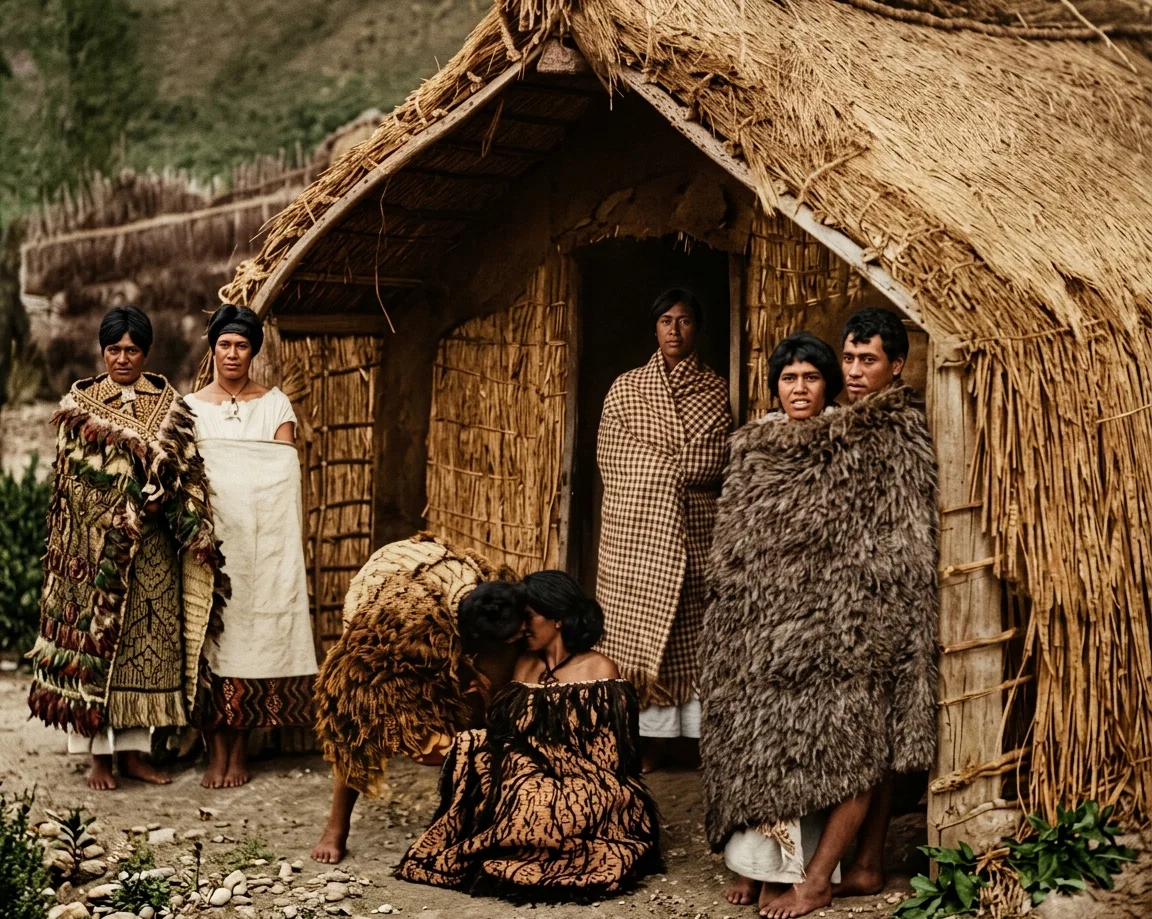
A LETTER FROM MAORILAND.
By J. E. Caldwell, M.D.
[J. E. Caldwell, M.D., in Australasian Union Conference Record.]
A Maori Dwelling.
A Maori Chief.
At the last Union Conference held nearly two years ago, steps were taken to materialize the long-cherished purpose of Seventh-day Adventists everywhere, and of the New Zealand Conference in particular, to establish a mission among the Maoris of New Zealand. To that end a request was made to the Foreign Mission Board that I should be released from my work in the Raratonga Mission and connect with the New Zealand Conference and take up this work. As we were worn down by a somewhat protracted residence in the tropics and needed a change, the Foreign Mission Board acceded to the request, and voted myself and family a furlough of indefinite duration, with the understanding that it be spent among the Maoris of New Zealand.
Owing to unavoidable delays, and the difficulty of finding a suitable person to carry on the work in Raratonga, we were not released from our work there until about the first of February of the present year. At that time we came to New Zealand and settled temporarily in Auckland.
On the arrival of Brother E. H. Gates, Superintendent of Polynesian Missions, we prepared to visit the Maoris, that we might know for ourselves their real condition and needs before making a permanent settlement.
After making arrangements for the revision of a tract on the second coming of Christ already in Maori, and the immediate translation of more literature, Brother Gates and I left Auckland by one of the coasting steamers, and, after a rough passage and some delays, reached Opouriao, the home of Brother and Sister Marple, situated on the border of the Uriwera country.
Already we have made several short excursions across the “confiscation boundary,” a line fixed by government when a portion of land was exacted as a penalty from the untamed Uriweras for lawlessness and murder.
In addition to the information we have gathered ourselves, we have been enriched by meeting, providentially as it appears, a young Scotchman, a colporter of the Bible Society, who has just returned from a trip on horseback through the very country we came here to examine. For about eighteen months he has been traveling most of the time among these natives. During the past three weeks he has been in the bush, carrying his books on a pack-horse in the wildest part of New Zealand. He is not only very friendly, giving us all the information possible, but kindly allowed us to read his diary in which his experiences are detailed.
He tells us he saw more than one hundred natives making a new government road through their country, working on the “co-operative plan,” who themselves met the government surveyors only a few months ago, ready with arms, if necessary, to forbid the white man’s passage through the land. So great and so rapid is the change that is being witnessed among them. Yet for all this tribe numbering 900 souls, many of whom are primitive Maoris, not one resident missionary is to be found. By a strange mixture of Judaism, Christianity, and heathen practises, they worship, or, rather, go through a form of worship. They meet for prayers twice every day and four times on Sabbath; for, strange to say, they regard the seventh day as sacred time.
Brother Gates and I walked out to visit a few of them in their nearest village last Sabbath. When they knew we also keep the Sabbath of the Bible, which they accept, a bond of sympathy was formed at once. Has not Providence laid the burden on us as a denomination to lead this people into the light of truth?
They claim four or five thousand adherents among the various tribes, and are called Ringatus, from ringa-ringa (hand) and tu (to stand). In worship they always lift the hand in prayer, as mentioned in Ps. 63:4.
THE WORK OF MISSIONARIES.
In telling “What are Christian missionaries trying to do?” Robert E. Speer, in the Christian Work, well sets before us the true object and spirit of missionary effort in the following (italics ours):—
We do not send Christian missionaries to clothe the heathen or to alter their style of dress. In China the women dress more modestly and sensibly than ours do, tho not so cleanly. Elsewhere the women do not dress so properly, and there are many improvements resulting from missionary influences, but the missionaries do not go out as dress reformers.
We do not send missionaries to improve the industrial conditions of Asia and Africa. They have introduced American fruits in northern China, and American vegetables in many lands. They have taught new industries to thousands of boys and girls in India and Africa, and have improved the native industries everywhere. But our missionaries would not have gone simply to accomplish these ends.
Nor do the missionaries go out to reform politics. . . . The missionaries are not political propagandists. They do not go out for the purpose of turning monarchies into republics, far less to turn independent States into dependencies upon European or American governments.
And, again, we do not send missionaries to reform morals or check social abuses. There is abundant room for such work. . . . Christian lands are infinitely cleaner, morally, than other lands. Where every man may have a private brothel under the forms of law, as in Mohammedan lands, and call it his family; or where divorce is so easy that it becomes the end of one out of every three marriages, as in Japan; or where polygamy and divorce are both unnecessary because of a general moral rottenness, as in India, there is no localization of vice, or such sharp line between it and virtue, as makes the immorality of Christian lands stand out so startlingly. In quantity and heinousness the moral evils of heathenism are worse than the moral evils of Christendom. But beyond this, the worst vice of Asia exists under the shadow and sanction of religion. In America it is in the face and against the protest of religion. The foulest cities of Asia are the holiest—Mecca, Meshed,13and Benares. And some of its sacred books are most intolerable. It is true of one of the sacred accounts of the greatest Hindu god that it is so indecent that the British Government has forbidden its translation. But morality is merely the product of the inner life, and missionaries do not go to heathen lands to try to amend behavior, any more than a husbandman regards it as sane horticulture to go out and tie fruit on the limbs of his trees. His aim is to make the trees produce the fruit.
Now, it does not affect the truth of what has been said to allege that the missionaries do interest themselves in the physical and moral condition of the people, and that they do introduce changes of dress, and industry, and medical treatment, and that their work does spread enlightenment, and make the people discontented with ignorance, injustice, tyranny, and wrong. All these things result from the missionary work, because the missionary goes out to sow the seed of the plant of which these are the leaf, and flower, and fruit.
The primary business of the missionary is a religious business. Missionaries are the product of the conviction that Christianity is a divine life in man, and that every Christian is different from other men, not in this or that external, but in the fact that he is alive and other men are dead. The church may have become so much like the world as to have lost sight of this truth; but the New Testament is falsehood and delusion, if there is not in the Christian the power of a supernatural life which is absent from the non-Christian. It is to give men that life that the church sends out missionaries, and all kinds of accessory and blessed consequences flow from missionary work, because the life of Christ planted in men can not be restrained from producing such results.
This is what Christian missionaries are trying to do. Men may say they are trying to proselytize, if they wish to say so. But proselytizing with Christians is not the attempt to lead men to change their opinions or their mode of worship. It is an attempt at resurrection. The missionary is taking life to dead men, and life, not in the sense of quickened intellectual movement or refined moral taste; but in a supernatural sense, Christianity is a personal divine life dwelling in the lives of men. In this matter Christianity refuses to be classed with other religions. . . . Yet this is a trifling part of its claims. It asserts that they are only systems. It is a life. They are dead. It is quick with divine presence. God is in it in a sense above and beyond the sense in which He is everywhere, and ruling all things.
Of course, this is fanaticism in the eye of the modern world. But it is not the fanaticism of missions only. It is the essential character and claim of Christianity. To the extent that Christianity at home abates or betrays this claim, it is untrue to itself, and it surrenders its power.
Missionaries and their supporters may lose sight of their true aim and duty. Political or philanthropic or social motives may be dominant with them. It is not wrong to be touched with sympathy for the famine orphans of India, or the child wives of Moslem harems, or the sick and uncared-for sufferers of many lands. But such sympathy is wise and discriminating when it does not content itself with relieving the symptoms merely, but strikes at the disease. To give all the sick people in China to-day the benefit of Western medical science would be a purely temporary measure. The missionary theory is to plant in the Chinese people those principles of life which will bear their fruitage in such sympathies and ministries in China, and make them indigenous thereto, as now bless every Christian land.
There may easily be waste or comparatively unprofitable expenditure of life and toil in missionary effort through our failure to discern true principles. Philanthropic and educational work are worth while, as they help to plant deep in the life of individuals and nations the supernatural life of Christianity. If they merely ripple the surface of social life, or end in comfort or clothes or cleanliness, they serve a not useless purpose, but they are not in line with the real work of missions, which is the lodgment in human life of the supernatural life of Christ.
Whenever men believe in Christianity as a unique supernatural life, they will go out into the world with it. When they don’t, they won’t. My reporter friend [whose question Mr. Speer is answering] was a heathen, alike in his knowledge and in his experience of Christianity. He did not know what it was. Neither books nor men nor his own heart had told him. To such a man Christian missions will naturally appear unintelligible. And there are many such in the church. The fact that they do not thrill with the missionary spirit shows that they do not understand what Christianity is.
What Christian missions are trying to do is the direct and necessary consequence of this view of Christianity. Of course, if Christianity is not this, but merely a moral system, finer than the moral systems of other religions, and richer by the superior wonder and admiration which Jesus has awakened, but, after all, the same in kind as they, indifference to its extension is intelligible—and also indifference to its acceptance. A religion that is not so good that all the world ought to have it, is not so good that any one man must have it. But if Christianity is what the New Testament represents, and the experience of millions of Christians proves, it is the business of all who have received it to support the missionaries who are trying, not to bear this or that fruit of Christianity to heathen lands, but to plant there its roots, that they may produce among each people the living works of God.
THE SOWER.
By Mrs. Muloch-Craik
In the dim dawning sow thy seed,
And in the evening stay not thine hand:
What it will bring forth—wheat or weed—
Who can know, or who understand?
Few will heed,
Yet sow thy seed.
See, the red sunrise before thee glows,
Tho close behind thee night lingers still;
Flapping their fatal wings come the black foes
Following, following, over the hill.
No repose;
Sow thou thy seed.
We, too, went sowing in glad sunrise;
Now it is twilight, sad shadows fall.
Where is the harvest? Why lift we our eyes?
What could we see here? But God seeth all.
Fast life flies;
Sow the good seed.
Tho we may cast it with trembling hand,
Spirit half broken, heart-sick, and faint,
His winds will scatter it over the land,
His rain will nourish and cleanse it from taint.
Sinner or saint,
Sow the good seed.
—Mrs. Muloch-Craik, in the Sunday Magazine.
A Blessed Beacon Light
By J. A. D.
to thousands of poor souls seeking a haven of refuge from the fiercer storms of life. It is the only institution of its kind south of Portland and west of the Rockies, and its life-saving efforts deserve practical recognition at the hands of our charitable people.
Without State or other tangible public support, it relies for existence to a large extent on large-hearted people through donations and contributions, and it is to be hoped these will be generously forthcoming to sustain the work of the mission. Donations of money, fruit, and food will be gratefully received, and if the friends of suffering humanity would contribute a monthly sum, small or large, say of twenty-five or fifty cents, or a dollar, a noble work could be sustained in the heart of a big city, where drowning cries for help are continually going out from those unable to swim to the shore of safety.
J. A. D.
SAN FRANCISCO HELPING HAND AND MEDICAL MISSION.
This mission at 641 Commercial Street is unique in its facilities for coping with the many wants and infirmities of the poor and penniless. Situated on the confines of Chinatown and the notorious “Barbary Coast,” in the storm center of vice and crime, the mission has done a wonderful work of charity since its opening in February, 1898, over three years ago.
Facts and Figures.
Within this period more than a million and a half dishes of substantial hygienic food have been served, in addition to nearly half a million free dishes given the indigent poor.
More than 160,000 clean, comfortable beds and an equal number of free baths have been furnished, and 60,000 free beds and free baths given to the homeless and shelterless.
Nearly 7,000 free medical treatments have been given and 250 surgical operations performed.
Large quantities of clothing donated to the mission have been distributed among the needy, by means of which not only were the naked clothed, but many worthy persons down in misfortune were enabled to fill situations suited to their vocations and abilities.
Permanent Positions
have been secured for more than 1,500 men, and more than 30,000 furnished temporary employment, thus tiding them over the acute hardships incidental to the friendless poor of a large city. Many poor families have been helped, and many broken homes and broken hearts re-united through the Gospel preached in the mission chapel.
Jails and prisons have been visited; ex-convicts have been furnished encouragement and employment, and a quarter of a million pages of wholesome literature distributed. In October, 1899,
The Helping Hand Magazine
was established. Its free distribution among the poor and the prisoners has had its appreciable effect on a class most in need of a helping hand, and there are daily calls for “more copies.”
Such a large scale of charitable work of a non-sectarian character has not been successfully carried out without much sacrifice on the part of the good friends of the mission and of the resident mission help, who with merely nominal salaries to a few, and no salary at all to many, have given their time and abilities to the cause of God.
Help Needed
Even with these sacrifices the mission has not been able under the most economical management to keep out of debt, owing to the numerous cases of appealing distress at its doors, and many deserving appeals have to be refused for lack of means. At present the mission is trying to meet an indebtedness of $400 incurred in its vast charitable labors of three years and three months.
If the mission were run on strictly commercial principles, it could be readily made self-sustaining; but this was not the object of its founders, nor is it likely to be. The poor we have always with us, and the poor are always in want. The Helping Hand Mission has been—
OUR WORK AND WORKERS.
THE addition of five members to the church in Camden, N. J., is reported by Brother Jay W. Rambo.
SABBATH, August 3, six candidates were baptized after the regular services in South Side church, Chicago.
A CHURCH of fourteen members was organized at Lewiston, Ill., recently, by Brother J. P. Henderson.
A NEW house of worship is being erected by the church in Du Quoin, Ill. A church-school is also contemplated the coming winter.
THE church-school children of San Francisco sell 500 copies of the SIGNS each week. One little boy sells twenty copies every day after school.
THE Chesapeake Reporter notes that six of the readers of the SIGNS supplied by Brother Shaffer, of Washington, D. C., have recently begun the observance of the Sabbath of the Lord.
FOUR persons have been convinced of the claims of the Sabbath commanded by Jehovah, and have begun its observance, in Newark, N. J. This is the result of Bible work by Sister Neale.
A CHURCH was organized on the Oneida reservation, Wis., on the 11th inst., by Brethren William Covert and H. W. Reed. This is the first Indian church organized by Seventh-day Adventists.
THE Atlantic News of the 1st inst. states that on the previous Sunday night 3,000 persons attended the services in the tent at Trenton, N. J., where meetings are being conducted by Brother E. E. Franke.
AT the recent quarterly-meeting of the church at Roby, Fisher County, Texas, thirteen new members were added to the church. Brethren French and Field were present to officiate in the administration of the ordinances.
AT the recent session of the Tennessee River Conference, it was decided to establish an intermediate school at Hazel, Ky. Prof. C. L. Stone and wife are to have charge, and the school will open about November 1. It is expected that there will be at least forty pupils at the opening.
FIFTY thousand tracts were distributed among the delegates and visitors to the recent Epworth League Convention, held in San Francisco. The tracts were in packages enclosed in envelopes, on which was printed a neat cut showing a view of the Cliff House, Seal Rocks, the ocean, and the beach.
THE Pacific Union Recorder has made its appearance as the organ of the Pacific Union Conference. The initial number, August 1, presents a neat appearance, and is full of conference news, and good thoughts and suggestions. It contains sixteen pages, and is issued bi-weekly at 50 cents a year. Address Box 548, Oakland, Cal.
JULY 13, 14 important services were held in Pittwood, Ill., when the tabernacle that had been purchased by the church was dedicated, and seven persons were baptized. Brethren were present from several other churches, as also many of the citizens of the place.
BROTHER A. S. HICKOX has returned from the Australasian field to California, arriving in San Francisco on the 9th inst. He was accompanied by his wife and Sister Manners, the latter of whom was destined for Battle Creek, Mich. Brethren G. A. Snyder, H. W. Woodruff, and C. W. Irwin, with their wives, who sailed from San Francisco in June, had just arrived safely in Sydney as Brother Hickox left on the home voyage.
LESSON X.—SEPTEMBER 7.—RULE OF THE JUDGMENT.
[Note to the Student.—These lessons are not designed to be exhaustive, but suggestive. In references to the “Desire of Ages,” in the lessons, the subscription edition is referred to. Those who have only the trade edition will find the matter in chapters 1, 4, 11, 27, 71, 77, 78; also read “Patriarchs and Prophets,” chapters 5 and 30. “Christ Our Advocate,” Bible Students’ Library No. 129 (price, 10 cents), and “Looking unto Jesus” (price, $1.00) will be found a great help. The SIGNS OF THE TIMES will have an article on the subject of each lesson this quarter by J. O. Corliss. Read these articles in connection with the study of the lesson. We have not space to print all the scriptures. Let the student study them carefully from the Bible. Those printed are from the Revised Version.]
SUGGESTIVE QUESTIONS.
1. What command is given to God’s people with reference to the temple of God and its worshipers?
“And there was given me a reed like unto a rod; and one said, Rise, and measure the temple of God, and the altar, and them that worship therein. And the court which is without the temple leave without, and measure it not; for it hath been given unto the nations; and the holy city shall they tread under foot forty and two months.” Rev. 11:1, 2.
“Then said I, Whither goest thou? And he said unto me, To measure Jerusalem, to see what is the breadth thereof, and what is the length thereof.” Zech. 2:2. See “Thoughts on Daniel and the Revelation,” under Rev. 11:1, 2.
2. Besides God’s people, who has a measuring line? Where does He place it? What does He say He will not do?
“Thus he showed me; and, behold, the Lord stood beside a wall made by a plumbline, with a plumbline in His hand. And the Lord said unto me, Amos, what seest thou? And I said, A plumbline. Then said the Lord, Behold, I will set a plumbline in the midst of my people Israel; I will not again pass by them any more.” Amos 7:7, 8.
3. What time is reached when the Lord says, “I will not pass by them any more”?
“And He said, Amos, what seest thou? And I said, A basket of summer fruit. Then said the Lord unto me, The end is come upon My people Israel; I will not again pass by them any more. And the songs of the temple shall be howlings in that day, saith the Lord God: the dead bodies shall be many; in every place shall they cast them forth with silence.” Amos 8:2, 3.
4. What is this plummet by which God’s people are measured?
“And I will make judgment the line, and righteousness the plummet; and the hail shall sweep away the refuge of lies, and the waters shall overflow the hiding place.” Isa. 28:17. (One translation reads, “I made judgment for a line, and righteousness for a plummet.”)
5. What is righteousness?
“Let my tongue sing of Thy Word; for all Thy commandments are righteousness.” Ps. 119:172.
6. By what standard is the world to be measured, or judged?
“So speak ye, and so do, as men that are to be judged by a law of liberty.” James 2:12.
“This is the end of the matter; all hath been heard: fear God, and keep His commandments; for this is the whole duty of man. For God shall bring every work into judgment, with every hidden thing, whether it be good or whether it be evil.” Eccl. 12:13, 14.
7. What did the Saviour say would judge unbelievers?
“He that rejecteth Me, and receiveth not My sayings, hath One that judgeth him; the Word that I spake, the same shall judge him in the last day.” John 12:48.
8. What rule does the psalmist say the Lord will use in judgment?
“He cometh; . . . He cometh to judge the earth: He shall judge the world with righteousness, and the peoples with His truth.” Ps. 96:13.
9. What is truth?
“Thy righteousness is an everlasting righteousness, and Thy law is truth.” Ps. 119:142.
“Jesus saith unto him, I am the Way, and the Truth, and the Life; no one cometh unto the Father, but by Me.” John 14:6.
10. Is it possible to attain to this standard?
“Till we all attain unto the unity of the faith, and of the knowledge of the Son of God, unto a full-grown man, unto the measure of the stature of the fulness of Christ.” Eph. 4:13.
“Husbands, love your wives, even as Christ also loved the church, and gave Himself up for it; that He might sanctify it, having cleansed it by the washing of water with the Word, that He might present the church to Himself a glorious church, not having spot or wrinkle or any such thing; but that it should be holy and without blemish.” Eph. 5:25-27. (Jude 24.)
11. What will be the character of those who are redeemed from the earth when Christ comes?
“And they sing as it were a new song before the throne, and before the four living creatures and the elders; and no man could learn the song save the hundred and forty and four thousand, even they that had been purchased out of the earth. These are they which were not defiled with women; for they are virgins. These are they which follow the Lamb whithersoever He goeth. These were purchased from among men, to be the first-fruits unto God and unto the Lamb. And in their mouth was found no lie; they are without blemish.” Rev. 14:3-5.