Your ShelfYour Projects

Signs of the Times, Vol. 30, No. 42.

PALM-TREE CHRISTIANS

Signs of the Times

Oct 26, 1904

Pacific Press Publishing Company · Mountain View, California · Oct 26, 1904

PALM-TREE CHRISTIANS.
"The righteous shall flourish like the palm tree." "He shall be like a tree planted by the rivers of water, that bringeth forth his fruit in his season; his leaf also shall not wither; and whatsoever he doeth shall prosper."
These texts describe the happy state of him whose soul is rooted and grounded in Christ. But there is always danger of being satisfied with a superficial work; there is always danger that souls will not anchor themselves in God, but be content to drift hither and thither, the sport of Satan's temptations. "Enter ye in at the strait gate;" says Christ, "for wide is the gate, and broad is the way, that leadeth to destruction, and many there be which go in thereat; because strait is the gate, and narrow is the way, which leadeth unto life, and few there be that find it." The work of the Spirit of God in the heart will develop true penitence, which will not end with confession, but will work a decided reformation in the daily life. There will be manifested an earnestness, a perseverance, and a determination that can be properly represented by agonizing. Many professed Christians greatly need just this experience.
Are you beginning to see the defects in your character? Do not feel helpless and discouraged. Look to Jesus, who knows your every weakness and pities your every infirmity. He came "not to call the righteous, but sinners to repentance."
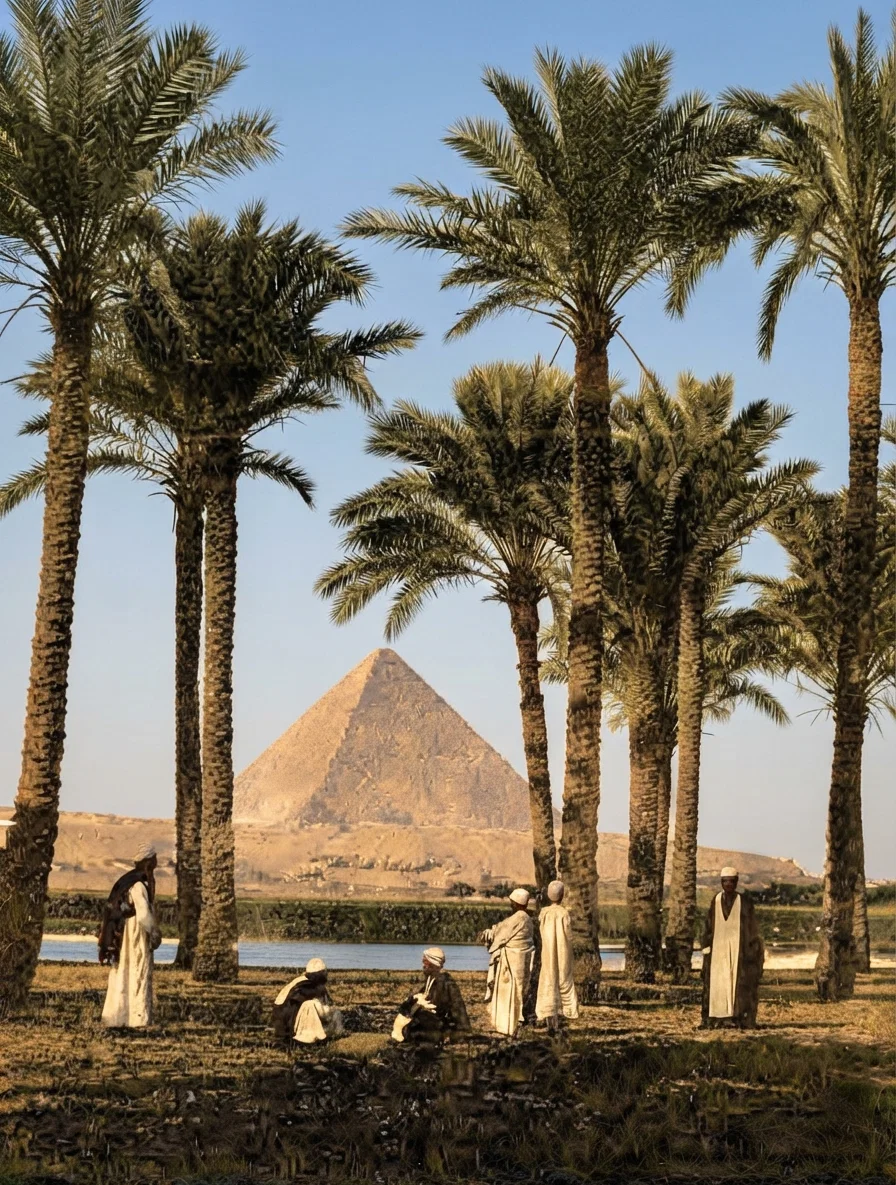
Palm Trees of the Nile.
It is no disgrace to confess our sins and forsake them. The disgrace rests upon those who know their sins, but continue in them, and grieve the dear Saviour by their crooked paths. A knowledge of our wrongs should be more highly prized than a happy flight of feeling; for it is evidence that the Spirit of God is striving with us and that angels are round about us. Let the heart-searching work go forward; let it be deep and earnest, until every barrier is removed, and your heart is opened to welcome the messenger of pardon and peace, that has long been waiting to bring light and joy and gladness. In true contrition for sin, come to the foot of the cross, and there leave your burdens; come exercising repentance toward God because you have broken His law, and faith in our Lord Jesus Christ to pardon your transgressions and reconcile you to the Father. Believe what God says; take His promises to your heart.
It is the Christian's privilege to grow in grace and in the knowledge of the truth.
"The righteous shall flourish like the palm tree." See the weary traveler toiling over the hot sands of the desert, with no shelter to protect him from the rays of a tropical sun. His water supply fails, and he has nothing to slake his burning thirst. His tongue becomes swollen; he staggers like a drunken man. Visions of home and friends pass before his mind, as he believes himself ready to perish in the terrible desert. Suddenly those in advance send forth a shout of joy. In the distance, looming up out of the dreary, sandy waste, is a palm tree, green and flourishing. Hope quickens his pulses. That which gives vigor and freshness to the palm tree will cool the fevered pulses, and give life to those who are perishing with thirst.
As the palm tree, drawing nourishment from fountains of living water, is green and flourishing in the midst of the desert, so the Christian may draw rich supplies of grace from the fountain of God's love, and may guide weary souls, that are full of unrest and ready to perish in the desert of sin, to those waters of which they may drink, and live. The Christian is ever pointing his fellow-men to Jesus, who invites, "If any man thirst, let him come unto Me and drink." This fountain never fails us; we may draw, and draw again.
We may individually have an experience of the greatest value. The fact that iniquity abounds, that we are surrounded by infidels and skeptics, or by professed Christians who have a name to live, and are dead, is no reason why one of us should be swept away by the current toward perdition. Because there is an almost universal forsaking of God, there is the greater need that we stand firm and loyal. Says Christ, "Ye are the light of the world." We must gather the divine rays from the Sun of Righteousness, and reflect them to the world. In the midst of a crooked and perverse generation, we must show forth the praises of Him who has called us out of darkness into His marvelous light.
Nothing but a deep personal experience will enable us to stand the test of the trials and temptations we shall meet in the Christian warfare. Too often we feel well when everything goes smoothly; but when doubts assail the soul, and Satan whispers his suggestions, our defense is gone, and we yield quickly to the arts of the tempter, with scarcely an effort to resist and repulse him. It is not enough to have good impulses. The soul must be barricaded by prayer and study of the Scriptures. Armed with these weapons, Jesus encountered our wily foe on the field of battle, and overcame him. We may all conquer in His strength; but it will not answer for us to suppose that we can dispense with His help. He says, "Without Me ye can do nothing." But no truly humble soul who walks in the light as Christ is in the light, will be ensnared by Satan's deceptive devices.
All self-confidence, all boasting, all pride of talent, must be yielded, and the soul must fall broken on the Rock Christ Jesus. Those who have a proud spirit, and feel that they are capable of doing a great work, will be left to their own weak strength, to fall into grievous sins. They do not realize what a pure, virtuous, and holy character they must possess if they would stand without fault before the throne of God. Self must be crucified. There must be a thorough transformation of character. The clear, sharp testimony of living truth will separate the wheat from the chaff, the half-hearted from the humble and devoted.
There never was a time of greater danger to the church than the present, and many will not be true to their own souls. They will not be sanctified through the truth. They have lamps, but no oil in their vessels to replenish them, and their light goes out in darkness. Eli and his sons trusted to the ark, the symbol of the divine Presence, while they were transgressing the holy law enshrined in the ark, and their sins were separating them from God. As a consequence of their presumption, both sons of Eli were slain, and God permitted the ark to pass into the hands of the enemies of His people. Some in our day are making a similar mistake in trusting to their profession while they are transgressing the holy requirements of God's law. Such are asleep to their true condition.
The apostle Paul exhorts careless and unconcerned professors: "Awake thou that sleepest, and arise from the dead, and Christ shall give thee light." Christ, the True Witness, would break the slumbers of His ease-loving people. His voice is heard addressing them: "I would thou wert cold or hot. So then because thou art lukewarm, and neither cold nor hot, I will spue thee out of My mouth." I will not take your names into My lips, for you are unworthy. I am ashamed to call you brethren. "Be zealous therefore, and repent." "I counsel thee to buy of Me gold tried in the fire, that thou mayest be rich; and white raiment, that thou mayest be clothed, and that the shame of thy nakedness do not appear; and anoint thine eyes with eyesalve, that thou mayest see."
Our only safety is in Christ. "Other foundation can no man lay than that is laid, which is Jesus Christ." Those who enter heaven will not scale its walls by their own righteousness, nor will the gates be opened to them for costly offerings of gold and silver; but they will gain an entrance to the many mansions of the Father's house through the merits of the cross of Christ. Jesus is the ladder by which every soul must mount who would climb from earth to heaven. But there is round after round of painful ascent; for our characters must be brought into harmony with the law of God, and every advance step in this direction requires self-denial.
The prize before us will amply repay every effort that we make to gain it. "Eye hath not seen, nor ear heard, neither have entered into the heart of man, the things which God hath prepared for them that love Him." "As the days of a tree," says the Lord through His prophet, shall he "the days of My people, and mine elect shall long enjoy the work of their hands." As by an eye of faith we view the glories of that better land, the saints' everlasting inheritance, we rejoice, clinging to the merits of our crucified Redeemer. Love kindles in our hearts toward Him "who spared not His own Son, but delivered Him up for us all," and faith grasps the promise, "How shall He not with Him also freely give us all things?" Thus Jesus becomes the medium of communication between heaven and our souls, and holy angels are sent to minister unto us. And while these divine messengers are striving to lead sinners to plant their feet on the ladder that extends from earth to heaven, let us be co-laborers with them, and urge all who will to climb the shining way.

ETERNAL TRUTH.

TRUTH will never die; the stars may grow dim, the sun may pale his glory; but the truth will ever be young. Integrity, uprightness, honesty, love, goodness—these are all imperishable. No grave can ever entomb these immortal principles. They have been in prison, but they have been freer than before; those who have enshrined them in their hearts have been burned at the stake; but out of their ashes other witnesses have arisen. No sin can drown, no storm can wreck, no abyss can swallow up, the ever-living truth of God. You can not kill goodness, and truth, and integrity, and faith, and holiness; the way that is consistent with these must be a way everlasting.—Rev. C. H. Spurgeon.

THE GOSPEL OF JESUS CHRIST.

BY T. L. WATERS.
"For I am not ashamed of the Gospel; for it is the power of God unto salvation to every one that believeth; to the Jew first, and also to the Greek." Rom. 1:16, R. V.
THE Gospel reveals to us the favor of God to sinful man through a Mediator. See Heb. 4:14-16. It comprises the birth, life and teachings, death, burial, resurrection, and ascension of Jesus Christ, His Mediatorship, and His second advent in glory. These comprise the things to be believed, and all connected truths are but concomitants growing out of belief in these. See 2 Tim. 1:8-10 and 2:8; 1 Cor. 15:1-4; 1 Thess. 4:13-18; 2 Thess. 1:7-10; 1 Peter 1:3-5, 11, 12; Rev. 14:6, 7. One of the most important truths of theWord is thus declared by the apostle Paul; "Be not ashamed therefore of the testimony of our Lord, nor of me His prisoner; but suffer hardship with the Gospel according to the power of God; who saved us, and called us with a holy calling, not according to our works, but according to His own purpose and grace, which was given us in Christ Jesus before times eternal, but hath now been manifested by the appearing of our Saviour Christ Jesus, who abolished death, and brought life and incorruption to light through the Gospel." 2 Tim. 1:8-10.
The abolition of death and the destruction of him who brought it into this world, that is, the devil, forms no inconsiderable portion of the Gospel; indeed the good news would be incomplete without it. Says the prophet Isaiah, "And He [the Lord] will destroy in this mountain the face of the covering cast over all people, and the veil that is spread over all nations. He will swallow up death in victory; and the Lord God will wipe away tears from off all faces; and the rebuke of His people shall He take away from off the earth; for the Lord hath spoken it." Isa. 25:7, 8.
The apostle Paul, in commenting upon this, writes: "So when this corruptible shall have put on incorruption, and this mortal shall have put on immortality, then shall be brought to pass the saying that is written, Death is swallowed up in victory." And, quoting Hosea, he exclaims: "O death, where is thy sting? O grave [hades], where is thy victory? The sting of death is sin; and the strength of sin is the law. But thanks be to God, which giveth us the victory through our Lord Jesus Christ." 1 Cor. 15:54-57. Again, in his Epistle to the Hebrews, he says: "Forasmuch then as the children are partakers of flesh and blood, He also Himself likewise took part of the same; that through death He might destroy him that had the power of death, that is, the devil; and deliver them who through fear of death were all their lifetime subject to bondage." Heb. 2:14, 15. And the beloved John writes: "For this purpose the Son of God was manifested, that He might destroy the works of the devil." 1 John 3:8. Putting these Scriptures together it is evident that Satan, sin, and death are to be blotted out of God's universe forever; and this constitutes the final triumph heralded by the Gospel of Jesus Christ.
Riverside, Mich.

A SPARK OF HOLY FIRE.

BY H. A. ST. JOHN.
To every converted person the Lord imparts at least a spark of holy fire. Reader, have you received that spark? If so, is it still only a spark? How easily, oftentimes, is a spark of fire extinguished. Your only safety, if this holy fire in you is only a spark, consists in drawing near to God in earnest prayer, asking Him to kindle it with a sacred flame.
In this time every one of God's sacramental host, whether young or old, small or great, should arise and shine, like John the Baptist, as burning and shining lights. In no other way can the whole earth be lighted with the glory of the Gospel of the kingdom. The Gospel of the kingdom must be vividly illustrated by the shining of the subjects of the kingdom. And there can be no question but the gifts and graces of the Spirit of God illuminating the hearts and lives of the remnant church of Christ, will shine forth with such astonishing luster as to attract the attention of the whole world; and for a brief time their power and message will be either the astonishment or admiration of all people, kings, Gentiles; thousands will come with eager haste to the brightness of their rising. The Lord is well pleased to make each one of His children a flame of fire.
Lamps gone out, lamps dimly burning and going out, should be trimmed at once. Reader, you must do the trimming, you must put your lamp in order; the Lord will furnish the oil and set the lamp to burning brightly, when you have done your part, and ask Him for fellowship with Him in whom there is no darkness at all. The Lord wants to fill our mortal bodies with light. He would make us all light in the Lord, children of the light and of the day. Then with His radiance splendid shall our light be blended, when He comes in unsurpassing brightness to redeem His own, and take them to the inheritance of light prepared in glory above, for the purchase of His love. Let the constant prayer of every soul be:—
"Refining fire go through my heart, Illuminate my soul, Scatter new life through every part, And sanctify the whole."

A FEW FACTS FROM GOD'S WORD.

BY WALTER E. GILLIS.
"THE way of man is not in himself; it is not in man that walketh to direct his steps." Jer. 10: 23.
"For all have sinned, and come short of the glory [character] of God." Rom. 3: 23.
"Sin is the transgression of the law." 1 John 3:4.
"If any man sin, we have an advocate with the Father, Jesus Christ the righteous." 1 John 2:1.
"Neither is there salvation in any other; for there is none other name under heaven given among men, whereby we must be saved." Acts 4: 12.
"If we confess our sins, He is faithful and just to forgive us our sins, and to cleanse us from all unrighteousness." 1 John 1: 9.
"As many as received Him, to them gave He power to become the sons of God, even to them that believe on His name." John 1: 12.
"Beloved, now are we the sons of God, and it doth not yet appear what we shall be; but we know that, when He shall appear, we shall be like Him; for we shall see Him as He is." 1 John 3: 2.
"I will come again, and receive you unto Myself; that where I am, there ye may be also." John 14: 3.
"This same Jesus, which is taken up from you into heaven, shall so come in like manner as ye have seen Him go into heaven." Acts 1: 11.
"When ye shall see all these things, know that it is near, even at the doors." Matt. 24: 33.
Are you ready?

THAT "SIGN SABBATH."

BY CLARENCE K. REDFIELD.
AT the present time Dr. S. W. Gamble is placing a great deal of stress in his anti-Sabbath lectures, on what he calls the "Sign Sabbath of the Jews." As some who hear him are led into believing that the Sabbath kept by the children of Israel was not the Sabbath instituted by Jehovah at creation, it may be well to spend a little time in studying this proposition of the doctor's by the light of God's Word.
The doctor begins his argument by quoting Neh. 9: 13, 14. "Thou camest down also upon Mount Sinai, and spakest with them from heaven, and gavest them right judgments and true laws, good statutes and commandments; and madest known unto them Thy holy Sabbath, and commandest them commandments, and statutes, and a law, by the hand of Moses Thy servant." "This Sabbath," the doctor tells us, "was the creation Sabbath." Certainly it was, for the only Sabbath ever claimed by Jehovah as His holy Sabbath was the one whose institution by Him is recorded in Genesis.
The doctor lays especial stress on the words "madest known." He tells us that these words prove conclusively that the true Sabbath had become lost, and that at this time the Israelites were keeping a spurious Sabbath that they had invented for themselves on leaving Egypt. If so, this Sabbath received the approval and seal of God in the withholding of the manna on that day. Read Ex. 16: 22-30. This Sabbath, which the doctor calls "spurious," he tells us was Saturday. If so, Jehovah must have once approved of a Saturday Sabbath apart from the one which the doctor calls the "sign Sabbath." That the Lord would set the seal of His approval on a sabbath that was not His Sabbath is hardly within the realm of probability.
But the doctor tells us that on Mount Sinai was the true creation Sabbath made known to the children of Israel. This, he says, is the Sabbath of Ex. 20: 8-11, and "fell upon Sunday." With the day of the week this present article has nothing to do. Soon after the Sabbath was made known, Moses ascended the mount again, and received the law written upon the tables of stone. This law the doctor is pleased to call the Jewish Decalogue, and is, he says, entirely different from the law given in Exodus 20. This Decalogue, the doctor says, we will find in Deuteronomy 5. The only difference he finds between these two decalogues is in the fourth precept. He argues that this must refer to a different day than the Sabbath of Ex. 20: 8-11, and grows quite facetious over the idea that unless this decalogue differs from the other, Moses wasted forty days of valuable time in going up on the mount to receive it. If he had but read the fourth and fifth verses of the fifth chapter of Deuteronomy, he would have found that the Decalogue repeated here was the one spoken in the midst of the fire of Sinai,—"Jehovah spake with you face to face in the mount out of the midst of the fire, . . . saying, I am Jehovah thy God," etc.
So, if a different Sabbath was commanded than the one spoken on Mount Sinai, it is not recorded in Deuteronomy 5. Where, then, is it?
Dr. Gamble tells us that this "sign Sabbath" is the one spoken of in Exodus 31, and that this is not the creation Sabbath. In proof of this he quotes, beginning with the thirteenth verse: "Speak thou also unto the children of Israel, saying, Verily ye shall keep My Sabbaths; . . . It is a sign between Me and the children of Israel forever;" and there he stops. Why not finish the seventeenth verse? "For in six days Jehovah made heaven and earth, and on the seventh day He rested, and was refreshed."
Therefore this Sabbath was the creation Sabbath. The Sabbath of Exodus 20 was the creation Sabbath. The Sabbath of Deuteronomy 5 was the same as the one of Exodus 20, and, therefore, the creation Sabbath. Where, then, have we an account of the institution of, or the commandment to observe, another weekly Sabbath than the creation Sabbath?—Nowhere in God's Word.
Another weak point in Dr. Gamble's argument: He says the creation Sabbath was given to the Israelites to remove from them the error of keeping Saturday. Now, I have shown that God honored the seventh day of the week in the matter of the giving of manna. Now, if this Sabbath was good enough for that, and a new Sabbath was to be given from Mount Sinai forty days later, what need for the Sabbath of Exodus 20 to be made known at all. One could grow as facetious over this matter as the doctor himself does in regard to the same matter being repeated to Moses. But it is not a humorous matter. It is serious. Will we keep God's commandments, or will we wrest the Scriptures from their meaning, yea, even falsify them, in order to follow the traditions of men and honor Satan's spurious sabbath?
Genesee, Idaho.

ASPIRATIONS.

BY L. D. SANTEE.
LORD, let Thy Spirit its fulness impart, Make me and keep me like Thee; Come, blessed Jesus, and reign in my heart Till Thy dear face I shall see.
So may my feet, as the years roll away, Walk where my Saviour's have trod, Bearing life's burdens through each coming day, Strong in the strength of my God.
Tho all the wiles of the earth may allure, Saviour, I'm trusting in Thee; Earnest, devoted, and loving and pure, So may my life ever be.
Till that glad morn when the clouds flee away Keep me, Thou Saviour divine, Give me Thy strength for my duties each day, So shall Thy Spirit be mine.

Blaming Circumstances, Not Ourselves

"We hear ten persons complaining about their circumstances to one person who blames himself for his mistakes in life—which shows the rarity of common sense."

CHRIST AND THE CHRISTIAN SABBATH.

Showing the Attitude of Christ toward the Law of God and the Sabbath which that Law Enjoins.

FOR Moses truly said unto the fathers, A Prophet shall the Lord your God raise up unto you of your brethren, like unto Me, Him shall ye hear in all things whatsoever He shall say unto you. And it shall come to pass, that every soul, which will not hear that Prophet, shall be destroyed from among the people." Acts 3:22, 23.
First, let us listen while He proclaims His relation to the law. "I delight to do Thy will, O My God, yea, Thy law is within My heart." Ps. 40:8. This the apostle Paul quotes in Heb. 10:7-10, and applies to Christ when He came into the world, offered Himself as a sacrifice for sin, and established, or confirmed, the second or new covenant by His own blood. Verses 9, 10. He delighted to do the will of God, because the law was in His heart. This could be none other than the law of Ten Commandments, for that was the only law given to man which made known the will of God. But this law commands the seventh-day Sabbath.
Again it is declared of him (Isa. 42:21): "The Lord is well pleased for His righteousness' sake, He will magnify the law, and make it honorable." And this Christ did. When beginning His life as a public minister, in almost the first discourse, as recorded in the fifth chapter of Matthew, He defines very clearly His attitude toward the law. Verse 17 reads as follows: "Think not that I am come to destroy the law, or the prophets; I am not come to destroy, but to fulfil." He did not come to destroy it, but to demonstrate before the universe that the law could be lived out in sinful flesh, when that flesh is fully surrendered to God. No, He did not destroy it, but fulfilled every precept, and declared concerning it: "Till heaven and earth pass, one jot or one tittle [the smallest particle of a letter] shall in nowise pass from the law, till all be fulfilled." Matt. 5:18. That law is the will of God to man, and the keeping of that law is man's "whole duty." Eccl. 12:13, 14. He further declares concerning it: "Whosoever therefore shall break one of these least commandments, and shall teach men so, he shall be called the least in the kingdom of heaven [another version says, "farthest from the kingdom of heaven"]; but whosoever shall do and teach them, the same shall be called great in the kingdom of heaven." Matt. 5:19.
Our introductory text says if we do not hear Him, "we shall be destroyed from among the people." He says if we do not obey the law and teach it, we shall be called "the farthest from the kingdom of heaven." But if we do and teach it, we will be called great in the kingdom of heaven. But this law says the seventh day is the Sabbath. Will we hear Him and be saved? To hear is to obey.
In verses 21-32, Christ magnifies the law, and thus fulfils Isa. 42:21. It is not only the overt act which is a violation of God's command, but whosoever is angry with his brother is a murderer, and "whosoever looketh on a woman to lust after her hath committed adultery with her already in his heart." And so we may reason in regard to every command of the Decalogue. The man who meditates on his business or pleasure on the Sabbath violates that command. Isa. 58:13.
Christ kept the seventh-day Sabbath, and not only kept it, but taught the people how to keep it. It was a memorial of creation, designed to keep before the people the Creator, the true God, and, being a memorial of creative power, it was to be a sign to His people that He could make of them "new creatures." "I gave them My Sabbaths, to be a sign between Me and them, that they might know that I am the Lord that sanctify them." Eze. 20:12. The Jews had almost hidden this memorial from the people by their traditions. But Christ tore away this rubbish and caused the Sabbath to stand out in bold relief. When accused of Sabbath-breaking, He replied that He was guiltless. Thus He did not break the Sabbath. Matt. 12:7. Luke 4:16 reads thus: "And as His custom was, He went into the synagog on the Sabbath day, and stood up for to read." It was His custom, not a happen-so nor an unusual thing.
In Matt. 12:12 we read, "It is lawful to do well on the Sabbath days." So we find Christ doing deeds of kindness, and many of His miracles were wrought on that day.
It is very important that we follow Him strictly, "walk even as He walked." For "he that saith he abideth in Him ought himself also so to walk; even as He walked." But He kept the seventh-day Sabbath.

The First Day Not Included in His Will.

The New Testament does not mention the first day of the week until after the death of Christ, and then not in any way that would indicate He ever intended it as a Sabbath. Therefore it could not be included in His will. While He lived it was His privilege to add to or take away from it. Heb. 9:16, 17. But after His death it could have nothing added to it, nor anything taken away. Paul, in speaking of this in Gal 3:15, says: "Brethren, I speak after the manner of men: Though it be but a man's covenant [margin, testament], yet if it be confirmed, no man disannulleth, or addeth thereto." Much less could the will, or testament, of our Saviour be altered after it was confirmed by His death upon the cross.
In Christ's will, or testament, the law is written in the heart, and becomes an abiding principle in the life. Jer. 31:33; Heb. 8:10. This was spoken to the Jews, and must refer to the law of Ten Commandments, as there was, and is, no other law known to man which was a rule of life. It was written in the heart by the Spirit of God, and was the same law that was written on the tables of stone. 2 Cor. 3:3.
Everything pertaining to His will was given before His death. Even the Lord's Supper, which was to commemorate His death, was given before He died, in order that it might be confirmed with the other articles of His will. But the first day (which Matthew does not mention until we come to the last chapter) Christ is in the tomb. The covenant is ratified. So it is with Mark. Read to chapter 16, which records the death of Christ, and you find no mention of the first day. Luke, like the others, does not mention the first day. The twenty-third chapter closes with the Testator in the sepulcher, and the holy women keeping the Sabbath, which is the seventh day, according to the commandment. Read carefully John's gospel to ch. 19:30, where Jesus said, "It is finished." He dies without adding the first day to His will. Why, O why, was it not put in along with the Lord's Supper?—Evidently because it did not belong there, and He did not want it there.
He had placed one Sabbath in the week (Mark 2:27); it was perfect (Ps. 19:7); and it was to last forever (Ps. 111:9). The Testator was pleased with it, and refreshed by it (Ex. 31:17); and when the law is written on the heart, stating that "the seventh day is the Sabbath of the Lord thy God; in it thou shalt not do any work" (Ex. 20:10); any other Sabbath would only be a rival, and opposed to the writings of the Holy Spirit.
After the resurrection, Christ met with His disciples but one time on the first day, and that was when they were assembled for fear of the Jews. John 20:19. But this was not a meeting in honor of the resurrection; for Mark, referring to the same event in ch. 16:12-14 says they did not then believe He was risen. See Luke 24:33-38 and John 20:26. "After eight days" He went with them again; but this could not be the first day of the week. It must reach over to Tuesday at least.
So we find the seventh-day Sabbath and nothing but the seventh-day Sabbath in either Christ's teachings or His life.

His Followers.

The followers of Christ observed the Sabbath of the fourth commandment, as proclaimed from Sinai. Luke 23:54-56; Mark 15:46 to 16:2; Matt. 28:1. After Christ's time, the apostles kept the same day. Acts 13:14, 15, 42-44. The Gentile believers also kept it (Acts 15:19-21), and they studied the law of Moses every Sabbath.
Paul always utilized that day to teach the people. It was "his manner." Acts 17:2. In one village, as recorded in Acts 18:1-11, he spoke seventy-eight times.
Christ, the prophets, and the apostles all observed the seventh day. We are to build on them. Eph. 2:19, 20. Christ is the chief corner-stone. Verse 20. He had the law in His heart (Ps. 40:8), and delighted to do God's will. If we build on Him, we will have the law in our hearts (Jer. 31:31-33; Heb. 8:10), and we also will delight to do His will. If we do not build on Him, our worship is vain (Matt. 15:9), and all of our teaching will eventually be rooted up. Matt. 15:13. "And it shall come to pass, that every soul, which will not hear that Prophet, shall be destroyed from among the people." Acts 3:23. "IF YE LOVE ME, KEEP MY COMMANDMENTS." John 14:15.

THE DEFINITIVE SABBATH DAY.

As regards the necessity of a definite weekly Sabbath day, it is said by those who adhere to the observance of Sunday:—
"Some one day in the week must be chosen, and all men must abide by that day. . . . Business would be in a state of utter confusion, and many would suffer if the adherents of different religions were to select different days of rest."
Was it not necessary, then, that the Sabbath appointed by the Lord for all the world should be a definite day of the week? And did He not set apart a definite day? Has He not as much wisdom as man has to discern what is necessary to the prosperity and convenience of His own creatures? Men pretend to think that the Creator's Sabbath is an indefinite day,—merely any one day in seven,—but out of their own mouth they are convicted of dishonesty. They never contend for an indefinite Sabbath day save when in search of something to justify them in disregarding the definite seventh day. Every "Sabbath law" that men have devised specifies a definite day to be observed, and the indefinite seventh-day theory is never allowed a grain's weight in the courts of law. No intelligent man really believes in it or ever offers it for any purpose but to serve the ends of sophistry.—L. A. Smith.

LESSONS FROM THE NATURAL WORLD.

BY ARTHUR FOX.
THERE are many lessons to be learned from the various objects of the natural world. If observant we can see that they are obedient to the will of their Creator; that they never deny God, or ever refuse obedience to any intimation of His will. Fallen beings alone refuse to yield full obedience to their Maker. "There is nothing that lives to itself except the selfish heart of man." Their works and words are at variance with God, and are "not subject to the law of God, neither indeed can be."
"Those professed Christians who are constantly whining and complaining, and who seem to think happiness and a cheerful countenance a sin, have not the genuine article of religion. Those who look upon nature's beautiful scenery as they would a dead picture, who choose to look upon dead leaves rather than to gather the beautiful living flowers, who take a mournful pleasure in all that is melancholy in the language spoken to them by the natural world, who see no beauty in the valleys clothed with living green, and the grand mountain heights clothed with verdure, who close their senses to the joyful voice which speaks to them in nature, and which is sweet and musical to the listening ear,—these are not in Christ."
The beautiful lessons we learn from nature if brought into our homes will make those around us happier, and our own lives brighter. In many homes a rigid precision becomes a very disagreeable feature, but this is not in harmony with the great plan of Nature. Have you not noticed that God has not caused the flowers of the field to grow in regular beds with set borders? Instead of this, He has scattered them like gems over the greensward to beautify the earth with their various forms and colors. Neither do we find the trees of the forest grouped in regular order. "It is restful to the eye and mind to range over the scenes of nature, over forest, hill, and valley, and the beauty with which trees, shrubs, and flowers are grouped in nature's garden, making it a picture of loveliness."
Christ employed the flowers He had created, with trees, shrubs, and plants, and the things of the animal world to illustrate divine truths. While it is impossible to gain a perfect knowledge of God through imperfect nature; yet the things of nature, blighted as they are with sin, inculcate truths regarding the skilful Master Artist. "The sun, the moon, the stars, the rocks, the flowing stream, the broad restless ocean,—all teach lessons that we would do well to heed."
Do you delight in lovely paintings, and are you ready to admire the talent that can produce a beautiful drawing? If so, pause a moment and consider. Where do those who devote their lives to this work obtain their designs which they paint upon the canvas? It is from no other source than from nature.
Art can never equal the perfection attained in nature, be the work ever so fine. "I have seen many who would go into ecstasies over a picture of a sunset, while at the same time they could have the privilege of seeing an actual and more glorious sunset almost every evening in the year." If we but listen, God's created works will teach us precious lessons of obedience and trust. Ignorance may seek to support false views of God by appeals to science; but the book of nature and the written word shed light upon each other. We are thus led to adore the Creator and to have an intelligent trust in His Word, which says nothing of the independent laws of nature. "Those who have a true knowledge of God will not become so infatuated with the laws of matter or the operations of nature as to overlook, or refuse to acknowledge, the continual working of God in nature. Nature is not God, nor was it ever God." It simply testifies of God.
As the flowers die only to spring forth into new life, we are thus taught the lessons of the resurrection. All who love God will bloom again in the Eden above. Nature alone can not, however, teach the great and marvelous truths of God, so in order that we might not remain in darkness, we were met by the God of nature in the person of His Son, who was the revelation of the Father.
In the fourth commandment of the Decalogue we have the Sabbath, an institution which was ever intended to be a memorial of the work of Creation, and those who love God should do what they can to make the Sabbath a delight, not by seeking their own pleasure in sinful amusements, but by exalting it in their families and making it the most interesting day of the week. Parents, educate your children in the beautiful things of God. Walk out with them in the open air, sit with them in the groves and in the bright sunshine, and give the restless minds something to feed upon by pointing out the beauties of nature, and inspire them with love and reverence for nature's God. Such an education begun in this life will be continued in the life to come.
Sanitarium, Cal.
Continue reading: WHY DIDN'T YOU TELL ME?