Pacific Press Publishing Association · Mountain View, California · Jun 14, 1910
"IF YE WILL INQUIRE, INQUIRE YE."
By Editor
This Inquirers' Department is conducted for the purpose of helping those who are studying the Bible. The answers are oftentimes only suggestive. They are never to be considered infallible, only as they agree with the infallible Word. The writer who may answer them does not consider that his opinion is infallible. He will simply give the best that he has, and plead with the inquirer to search the Word. Such questions only will be answered as, to the editors, seem to minister to the good of the readers and to the mission of the paper. We can not answer repeatedly in the same volume questions upon the same scripture. The name and address must accompany question, not for publication, but as an evidence of good faith, and that answer may be made by letter if deemed advisable. No letters are answered which do not contain the name of the writer. It is well always to enclose stamp for reply.
3155.—The Catholic Bible and Its Extra Books
A Catholic lady tells us that the Catholic Bible contains three more books than the Protestant church Bibles. Is this so? And if so, where did these books come from, and why were they rejected by the other churches?
If our questioner has access to one of the large family Bibles, he will find between the Old and the New Testament, in many of them, what is called The Apocrypha. That Apocrypha is composed of fourteen different books, beginning with First and Second Esdras, ending with First and Second Maccabees.
The word "Apocrypha" itself means hidden, and is so applied to these because their origin is somewhat concealed, and the books themselves obscure; and the word is also used in the sense of uncanonical; that is, not belonging to the regular Scripture standard. The Hebrew canon composed of Scriptures considered inspired, was fixed before the Christian era, and of this Josephus is a witness. But he does not use any of the books of The Apocrypha as belonging to any of the sacred Scriptures. Then again, the New Testament quotes from the Scriptures of the Old Testament often as the Holy Scriptures, but it make no express quotations from The Apocrypha. In the early lists of books which have come down to the church we find The Apocrypha left out, and Jerome decidedly opposed its admission as a canonical scripture. What served also to separate them, the Old Testament Scriptures were written in Hebrew, while The Apocrypha was written in Greek. Jerome, who translated the Scriptures from the Hebrew into the old Latin translation, omitted The Apocrypha. It is possible, of course, that some parts of The Apocrypha may be true Scripture, but The Apocrypha as a whole is not considered and does not seem to be written as inspired Scripture, but as useful exhortations to God's children.
3157.—Crossing the Jordan—a Type
By F. O.
If the crossing of the Jordan into Canaan is to be taken as a true type of God's people entering the antitypical Canaan on this earth, should not that multitude under Joshua have of necessity included some Gentiles adopted into the commonwealth of Israel and not been restricted to one race or nationality? See Eph. 3:7.
There were probably descendants of Gentile mothers who entered Canaan with the Israelites. In fact that was true of some of the Israelites themselves. They had blood outside of Abraham's family mingled with the life-current received from him. But they were so dominantly Israel that they could not be considered anything else. But this is the real point: Those who went into the land of Canaan were to all intents and purposes Israel—children of God, prevailers by faith. Israel is the name by which God has called all His children. It matters not whether there were those of other nationalities or not, they went in as Israel, as members of the tribes; and so in the great antitypical entering of the land of promise, or the eternal salvation in the earth made new, it will not be Gentiles who are saved, or nationalities who are saved, but all will be of Israel. While we read in Eph. 3:6 that Gentiles will be fellow heirs and of the same body, we are told in the second chapter just what that body will be. It will not be a mixed body, but it will be the commonwealth of Israel, and the Gentiles become Israelites before they enter the kingdom, when they become Christ's, when they become true Jews. Rom. 2:28, 29. Then there will be no nationality, neither Greek nor Jew, but all will be Abraham's seed, and heirs according to the promise.
3153.—That Which Defiles
By Editor
Please explain the passage of Scripture which says, “What goeth into the mouth does not defile the man; but that which cometh out.”
The passage is found in Matthew the 15th chapter and the 11th verse, and the lesson continues to verse 20. Note first that Jesus did not have under discussion what men should eat and what they should not eat; He was talking to those who were strict regarding their diet, and because of this they criticized Christ because He had eaten with unwashed hands. Whenever they came in from market or elsewhere, they always washed their hands before they ate. His disciples did not always do this; they had not been brought up in the school of the Pharisees; some of them had been rough fishermen, paying little attention to the scrupulous ceremonies of the Pharisees; therefore the question of diet was not the question under consideration, but the question of ceremonialism against true heart work. The Jews were very scrupulous over tradition, but by that very tradition they broke the commandments of God. The real heart service comes from within; the real evils which men do, germinate in the heart, and “out of the abundance of the heart the mouth speaketh.” So it is the heart itself that needs cleansing above all things else; and he whose heart is truly cleansed and truly given to God, will not dwell upon meaningless ceremonies, but will aim to carry out in his life the instruction given in 1 Cor. 10:31, “Whether therefore ye eat, or drink, or whatsoever ye do, do all to the glory of God.”
3154.—Destroy and Torment
By A. L. M.
Does the Greek word in Matt. 10:28 ever mean torment? Some teach that it does. A. L. M.
The Greek word is rendered by Strong, "to destroy fully," and it is translated, "destroy," "die," "lose," "mar," "perish." It is defined by Bagster, "to destroy utterly," "to kill," "to bring to naught," "make void," "to lose," "be deprived of." And the noun of the verb is rendered "consumption," "destruction," "waste," "eternal ruin," "perdition." And the primitive word from which it is derived indicates the same thing—"destruction," "ruin," "death." For other examples of its use see 1 Cor. 1:19; John 10:10; Matt. 2:13. There is no such idea as torment in the word.
3156.—Eternal and Everlasting
By Editor
Kindly explain Matt. 25:46, "And these shall go away into everlasting punishment: but the righteous into life eternal." The words "eternal" and "everlasting" are what puzzle so many and convey to them the idea of eternal misery.
Freely grant that the words are the same, and they are in the original. The Revised Version reads: "And these shall go away into eternal punishment: but the righteous into eternal life." The punishment is eternal, and the life is eternal. The one persists just as long as does the other. But note that it is not eternal punishing; it is not a process begun which never ends; it is a completed process—punishment. That completed process is eternally so. God does not keep on punishing the wicked; He completes the punishment. What that is, is shown very clearly in other scriptures. "The wages of sin is death; but the gift of God is eternal life." Rom. 6:23. To use the expression in Matt. 25:46 in Rom. 6:23, we could say, "The wages of sin is eternal death; but the gift of God is eternal life." In Phil. 3:18, 19 we read of the enemies of the cross of Christ, "whose end is perdition." "Perdition" means utter destruction. Again in 2 Thess. 1:9 we have a still stronger expression explaining just what the everlasting or eternal punishment is: "Who shall suffer punishment, even eternal destruction from the face of the Lord and from the glory of His might." Get a little tract and read it, entitled "'Tormented Forever and Ever,'" Bible Students' Library, No. 111.
3158.—One Cup or More
By Editor
In Luke 22:17, 20, did Jesus mean one cup to one deacon, or did He mean cups to one deacon? Is cup singular or plural? G. W. R.
There is no question whatever but that there was but one cup which Jesus passed to His disciples. Verse 17 was evidently during the Passover feast. "Take this and divide it among yourselves." Then comes the institution of the Lord's Supper, verse 19 the breaking of the bread, and verse 20 "the cup in like manner after supper," that is, after the Passover supper. The question with our correspondent, we suppose, is the custom of many cups which has come in of late years for two purposes largely; one to facilitate the ordinances in a large church; and secondly, on account of cleanliness from a hygienic standpoint.
The thought in the Lord's Supper seems to be oneness. It is the one loaf and the one cup; and yet it would be very difficult in a church of three or four hundred to carry out the ordinance in the strictest letter without taking very much time. Is not the thought of the unity expressed just as strongly when the wine comes out of the one pitcher or receptacle? The cup is simply the form of a dish; not a particular form is designated, because cups have many forms and sizes; and could it not be just as truly divided among the disciples if poured out of that general receptacle, the pitcher, into the smaller glasses, and passed on to the others, just the same as the loaf? In a large church it would be almost impossible to make one loaf which would be sufficient for three or four hundred members; consequently different loaves are made. But the thought is the same. It is the breaking of the loaf; it is the dividing of the same body of bread; for each loaf of itself represents the Lord's body, and so with the receptacle containing the wine. It is wine that is poured out for each one; and while there may be some, as with the writer, who would feel that it might be better to hold to the old original method, in its simplicity, in large churches the other method is certainly more hygienic and the more expeditious and equally solemn. What our Lord would have done if He had had before Him five or six hundred we do not know; but we may be assured that He would have taken the wisest, simplest, and best way.
Will you please give your explanation of 1 Peter 4:6?
The passage is but a statement of what had already occurred. It really looks back to the 18th to the 20th verses of the previous chapter. We are told that Christ by His Spirit went and preached unto the spirits in prison; to those who were shut up in their sins, in the prison-house of sin. See Luke 4:18; Isa. 61:1. The time when the preaching was done is said to be "when the long-suffering of God waited in the days of Noah." The thought of the text is not that the Gospel was preached to them that are dead, while they were dead; but it was preached in the past to them that are now dead—God has not left without witness the people of past ages. All shall give account to Him that is ready to judge the quick and the dead; and it is in order that they might be prepared for that judgment, that the Gospel has been preached. The Spirit of Christ was with the holy men of the past. 1 Peter 1:10, 11.
The Holy Spirit
By John Orr Corliss
By John Orr Corliss
IX. The Gift of Ministry and Ambassadorship
THE Gospel ministry is at once the most peculiar and the most exalted calling known. Words are inadequate to express either its individuality or its dignity. On entering the inspired path of investigation concerning it, one becomes almost benighted amid the multiplying laterals of acute description; and he feels the impossibility of doing justice to the subject, through the medium of human language. But in the few recorded requirements of the Gospel ministry which we may be able to examine in this paper, some facts appear which will doubtless tend to elevate that calling in every reader's mind.
The authority of Paul to mark out rules for the guidance of the churches, was based on the fact that he had been "ordained," set, or placed, a preacher for Christ. 1 Tim. 2:7-12. To do anything for Christ, is not only to do it in His name, but to do it in the same way He would, for whom it is done. It is clear that the apostle looked upon his work in this light; for in explaining it to the church at Corinth, he said, "Now then we are ambassadors for Christ, as tho God did beseech you by us; we pray you in Christ's stead, be ye reconciled to God." 2 Cor. 5:20.
Were a nation's ambassador to misrepresent, in any way, the attitude of his government toward the people among whom he had been sent; or should he do anything in his own name, after another manner than that prescribed by his home power, his recall would be swift and sure. No government will permit its ascendency to be displaced, or in any way discredited before a foreign power, by one sent forth under his home authority, to act in its behalf. So a "minister of God" becomes such only through the gift of God's grace, and by the "effectual working of His power." Eph. 3:7.
There may be those connected with the sacred ministry who are not able to decide that they were placed in position by God's operating power. If so, they are to be pitied, and should not rest satisfied until able to produce proper credentials of office. In other words, one should "make full proof" of his ministry according to inspired counsel. 2 Tim. 4:1-5. It is fruitless for him to suppose that he can pass inspection uncensured, without presenting heavenly credentials of his calling; for even the world at large demands proof of one's heavenly ambassadorship before according him the respect due such a position.
Compelling Recognition
Society will not be tardy to have regard for a true minister of God, upon his giving testimony, tho silently offered, of his heavenly calling. Daily life counts in the world's balance-sheet of estimate. He who can be patient under sudden and unexpected refusal, or even violent resistance;
who can meet affliction, necessities, and distresses calmly; who can suffer undeserved stripes and imprisonments without complaint; who will, amid tumult and confusion, be constant in prayer; who will ever, under all circumstances, be long-suffering and kind, willing to be little and unknown, in the hope of his calling,—such can not fail to secure a general acknowledgment of an inherent possession not common to humanity. See 2 Cor. 6:3-9.
These virtues are the open, genuine test of one's real connection with the Lord. They were, indeed, the proofs of Christ's oneness with the Father's perfection, and His ability to lead fallen man into that higher life of which He was Master. Heb. 2:9-11. But when Christ sets apart men to follow up His work on earth, they must be one with Him, and learn, as He did, to "harken submissively," by the things they suffer. Heb. 5:8. Indeed, it is for this very purpose that men are commissioned to preach the Gospel. Paul was a shining illustration of this; for his calling to the ministry was determined by God revealing Christ in him,—that is, divinely uncovering Christ in him,—so that His heavenly perfection was made known. Gal. 1:16. Immediately the apostle took on the same afflictions borne by his Master, and rejoiced in the sufferings they gave, knowing that in his own body he was but fulfilling, in Christ's stead, that part of the Master's work left behind for His representatives to show to the world. Col. 1:24.
This is the only way to preach, or proclaim Christ as a divine sufferer in man's behalf. Simply to talk about Christ, and what He endured, does not meet the demand; because no human reason can penetrate the unseen and consequent unknown, so as to appreciate God's love. Love is not sentiment alone, but action under pressing circumstances. One may express love for another; but without suiting some action to such profession, there is no evidence of the word's truthfulness. Christ's love for the world, required action on His part, to confirm in men's minds the truthfulness of His Word. By His death He established the fact of His infinite and eternal love for sinners.
Stewards of God
Christ's immediate disciples, each and all, followed in His footsteps, proclaiming Christ. They suffered even to death, as their Master did, in confirmation of the Word they preached. They not only "talked about" Christ, but they "ministered," or gave Christ to others, in their own persons, thus demonstrating their attachment to Him, and the cause He came to earth to maintain.
By looking further into this matter, we may learn why the early disciples went so far in their devotion to their calling. They felt it imperative upon them to be "accounted" as true ministers or "under workers" of Christ, and stewards of God's mysteries. 1 Cor. 4:1. The primitive word here rendered "steward" means literally house manager. The text therefore would make the "minister of Christ" stand for His house manager, that is, one placed "over His household" (Matt. 24:45), to bestow upon others "the manifold grace [favor] of God" contained therein. 1 Peter 4:10.
A minister, then, is commissioned to give out, as the steward of God's household, the favors of God, not by an arbitrary decision of his own, but by the ability God gives, in faithful endurance through every test of his calling. 1 Peter 4:11. Then he may promise release from sin, on condition of repentance, and his word is confirmed in4heaven. Matt. 18:18. Thus dispensing the "mysteries of God," he demonstrates his fellowship with them, so that all men may see that the "fellowship of the mystery" (Eph. 3:9) is the blessedness of ministering reconciliation to men. 2 Cor. 5:18.
To be thus qualified, one must be fully "instructed unto the kingdom of heaven," when, as the Master's householder, or "house manager," he brings out of his treasury things both new and old (Matt. 13:52), with which to enrich others in the name of Christ. The standard here introduced may seem to some too exalted,—bordering even on the extreme. It would seem so to all, if measured by human feasibility; but estimated by the infallible criterion of God's Word, it is not an impossible model. Since the ministry of the Word is a gift of the Spirit of Christ, and designed to perpetuate His own work, He is able to qualify for the calling as He will. The proof of the limit of preparation is not in what and how men now are and do, but in what the Spirit of God is able to make them be and do, when they yield fully to His impulses. "With God nothing shall be impossible." Luke 1:37.
Some Day We'll Understand
By Milo D. Warfle
By Milo D. Warfle
THE things that seem to us so queer,
That blight our hopes and cause us fear,
That separate from things held dear,
Some day we'll understand.
The pains we have along the road,
The crushing weight, the heavy load,
The cruel thrust of Satan's goad,
Some day we'll understand.
Why cruel death may take our friends
Who try to work as God intends,
Through whom our God His message sends,
Some day we'll understand.
While here, we do not fully know
Just why we are afflicted so;
But when to heaven's courts we go,
We'll fully understand.
The depths of love that to us call,
That keep us lest in sin we fall,
That safely guide us through it all,
He'll help us understand.
Yes, when to the new earth we go,
All free from sin and every wo,
We'll ever study, learn, and grow,
And then we'll understand.
Boulder, Colo.
A Work of Reform
By Mrs. E. G. White
By Mrs. E. G. White
THE work of Sabbath reform to be accomplished in the last days is foretold in the prophecy of Isaiah: "Thus saith the Lord, Keep ye judgment, and do justice: for My salvation is near to come, and My righteousness to be revealed. Blessed is the man that doeth this, and the son of man that layeth hold on it; that keepeth the Sabbath from polluting it, and keepeth his hand from doing any evil." "The sons of the stranger, that join themselves to the Lord, to serve Him, and to love the name of the Lord, to be His servants, every one that keepeth the Sabbath from polluting it, and taketh hold of My covenant; even them will I bring to My holy mountain, and make them joyful in My house of prayer." Isa. 56:1, 2, 6, 7.
These words apply in the Christian age, as is shown by the context: "The Lord God which gathereth the outcasts of Israel saith, Yet will I gather others to him, beside those that are gathered unto him." Isa. 56:8. Here is foreshadowed the gathering in of the Gentiles by the Gospel. And upon those who then honor the Sabbath, a blessing is pronounced. Thus the obligation of the fourth commandment extends past the crucifixion, resurrection, and ascension of Christ, to the time when His servants should preach to all nations the message of glad tidings.
The Lord commands by the same prophet, "Bind up the testimony, seal the law among My disciples." Isa. 8:16. The seal of God's law is found in the fourth commandment. This only, of all the ten, brings to view both the name and the title of the Lawgiver. It declares Him to be the Creator of the heavens and the earth, and thus shows His claim to reverence and worship above all others. Aside from this precept, there is nothing in the Decalogue to show by whose authority the law is given. When the Sabbath was changed by the papal power, the seal was taken from the law. The disciples of Jesus are called upon to restore it, by exalting the Sabbath of the fourth commandment to its rightful position as the Creator's memorial and the sign of His authority.
"To the law and to the testimony." While conflicting doctrines and theories abound, the law of God is the one unerring rule by which all opinions, doctrines, and theories are to be tested. Says the prophet, "If they speak not according to this word, it is because there is no light in them." Isa. 8:20.
Again the command is given: "Cry aloud, spare not, lift up thy voice like a trumpet, and show My people their transgression, and the house of Jacob their sins." It is not the wicked world, but those whom the Lord designates as "My people," that are to be reproved for their transgressions. He declares further, "Yet they seek Me daily, and delight to know My ways, as a nation that did righteousness, and forsook not the ordinance of their God." Isa. 58:1, 2. Here is brought to view a class who think themselves righteous, and appear to manifest great interest in the service of God; but the stern and solemn rebuke of the Searcher of hearts proves them to be trampling upon the divine precepts.
The prophet thus points out the ordinance which has been forsaken: "Thou shalt raise up the foundations of many generations; and thou shalt be called, The repairer of the breach, The restorer of paths to dwell in. If thou turn away thy foot from the Sabbath, from doing thy pleasure on My holy day; and call the Sabbath a delight, the holy of the Lord, honorable; and shalt honor Him, not doing thine own ways, nor finding thine own pleasure, nor speaking thine own words: then shalt thou delight thyself in the Lord." Isa. 58:12-14. This prophecy also applies in our time. The breach was made in the law of God when the Sabbath was changed by the Romish power. But the time has come for that divine institution to be restored. The breach is to be repaired, and the foundation of many generations to be raised up.
Hallowed by the Creator's rest and blessing, the Sabbath was kept by Adam in his innocence in holy Eden; by Adam, fallen yet repentant, when he was driven from his happy estate. It was kept by all the patriarchs, from Abel to righteous Noah, to Abraham, to Jacob. When the chosen people were in bondage in Egypt, many, in the midst of prevailing idolatry, lost their knowledge of God's law; but when the Lord delivered Israel, He proclaimed His law in awful grandeur to the assembled multitude, that they might know His will, and fear and obey Him forever.
From that day to the present, the knowledge of God's law has been preserved in the earth, and the Sabbath of the fourth commandment has been kept. Tho the "man of sin" succeeded in trampling under foot God's holy day, yet even in the period of his supremacy there were, hidden in secret places, faithful souls who paid it honor. Since the Reformation there have been some in every generation to maintain its observance. Tho often in the midst of reproach and persecution, a constant testimony has been borne to the perpetuity of the law of God, and the sacred obligation of the creation Sabbath.
The great obstacle both to the acceptance and to the promulgation of truth, is the fact that it involves inconvenience and reproach. This is the only argument against the truth which its advocates have never been able to refute. But this does not deter the true followers of Christ. These do not wait for truth to become popular. Being convinced of their duty, they deliberately accept the cross, with the apostle Paul counting that "our light affliction, which is but for a moment, worketh for us a far more exceeding and eternal weight of glory" (2 Cor. 4:17); with one of old, "esteeming the reproach of Christ greater riches than the treasures in Egypt." Heb. 11:26.
Whatever may be their profession, it is only those who are world-servers at heart that act from policy rather than principle in religious things. We should choose the right because it is right, and leave consequences with God. To men of principle, faith, and daring, the world is indebted for its great reforms. By such men the work of reform for this time must be carried forward.
Thus saith the Lord: "Harken unto Me, ye that know righteousness, the people in whose heart is My law; fear ye not the reproach of men, neither be ye afraid of their revilings. For the moth shall eat them up like a garment, and the worm shall eat them like wool; but My righteousness shall be forever, and My salvation from generation to generation." Isa. 51:7, 8.
6. What is the missionary's triumph? Rev. 7:13-17.—The Christian Conservator.
— ★ —
— ★ —
A Man’s Age
"A MAN'S age depends upon the ideals he still cherishes."
Shall We Go?
By Missionary Herald
THE call for help falls upon our ears from the lost millions of every heathen land. The natural man is inclined to look at his comfortable home, his kindred and friends, to cherish his hope of fame and fortune, and thus stifle the convictions that might enter any man's heart who hears the call for help. Shall we go? If not, why not? Others go. If in India, Africa, or China we could be certain that a rich gold mine could be had for the going, how long would we have to work at our consecration, and how long would we have to wait and pray, before we could get grace to leave our loved ones at home, and give up our own aspirations, to go in quest of such a dazzling reward? Brethren, there is a gold mine in India, in Africa, or China for you—a mine of purest gold; gold of greater value than that we find in mines in the earth; gold that is tried in the fire; gold that will be yours to have and to hold forever; when the gold of earth is consumed by the fervent heat of judgment fires.
Shall we go? Others go for war and plunder, to spill their blood for their fellow men on the battle-field, and, if need be, to bleach their bones on the desert sands in defense of human liberty and to extend the conquests of nations. Is the salvation of human souls of more value than gold? Is the honor of God dearer to us than war? Does the conquest of the cross deserve our loyalty and our lives as truly as the conquests of nations? Shall we then rest at home? Are we neglecting to deny ourselves a few transient pleasures of life, while men of the world, for money, for fame, and for war, at the cost of their homes, their friends, and life itself, go from pole to pole, and over land and sea, in a cause less glorious than ours? Brethren, shall we go?—Missionary Herald.
X. The Pseudo-Smerdis Revealed
THE death of Cambyses left the way open for the Pseudo-Smerdis to carry on his work. It freed him from the greatest but not the only peril that confronted him. He still had a difficult and dangerous part to play, and there was liability of being detected. Years before, Cyrus the Great had cut off his ears on account of the perpetration of a crime; and so he had to keep himself pretty well hidden. Some of the changes of a religious nature which he made, brought about considerable displeasure; and after a few months suspicions began to be blown abroad. Cambyses had made a dying declaration that this self-asserting Smerdis was an imposter; and this report, being spread, gained credence. A number of things led to this conviction, especially the seclusion of the king himself, who neither went beyond the palace walls nor permitted himself to be seen within them.
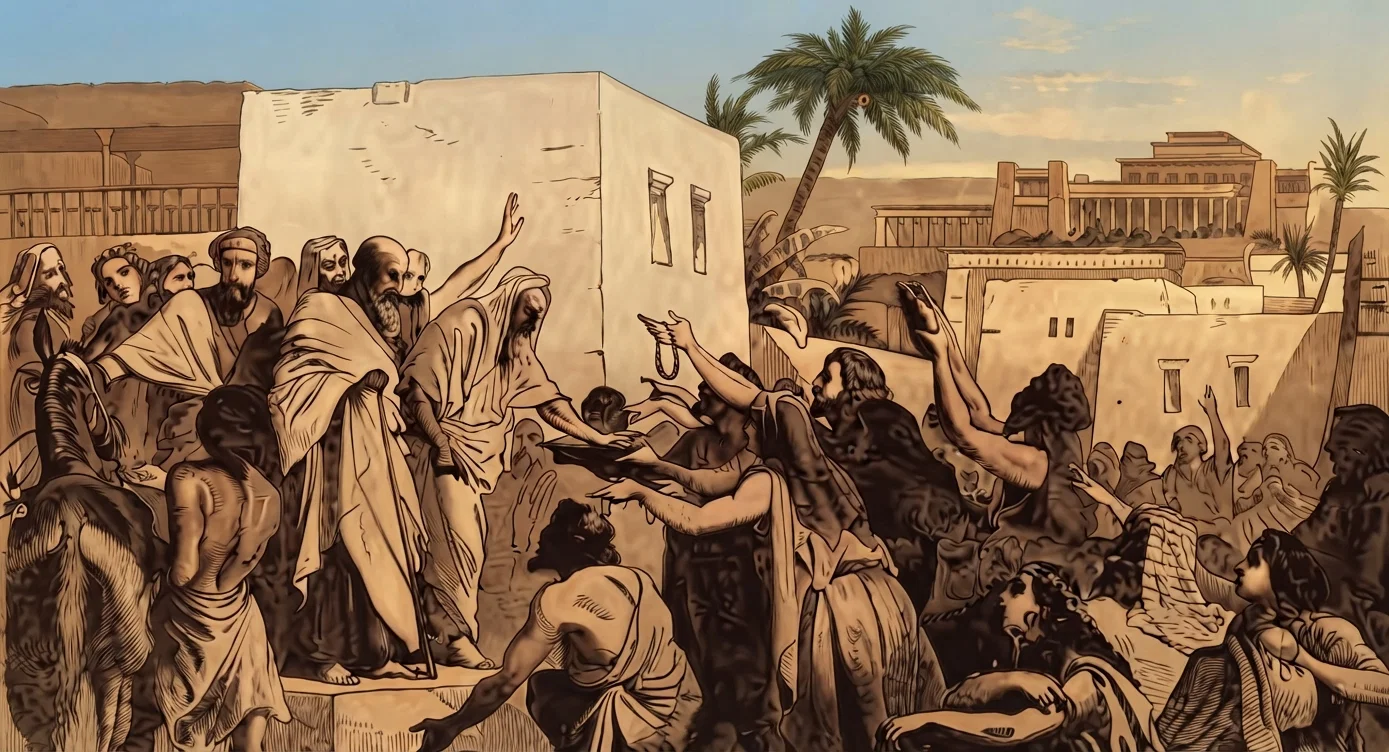
Bringing Gifts for the Rebuilding of the Temple
The general religious propaganda was such as to teach all that the king could not be a genuine son of Cyrus.
The Usurper Slain
At last the seven princes of the empire, headed by Darius, son of Hystaspes, who had a direct title to the Persian crown, determined upon an investigation. Darius and his fellows organized a select band, and were on the eve of assaulting the palace when Gomates took the alarm and fled. He was pursued into Media, where he had taken refuge in a fort. Darius and his followers boldly entered, surrounded the imposter, and slew him. A number of his adherents who had sought refuge with him shared in his fate. The head of the usurper, with the indisputable proof of his pernicious career written in the stumps of his ears, was cut off and borne away by the insurgents, who exhibited it everywhere as at once the cause and the justification of their bloody deed.
There was a general uprising in which the magian religion received a terrible defeat. Until nightfall there was a massacre of every magus that any one might meet, but the destruction of life was not renewed on the morrow. The anniversary of Gomates's death became a solemn festival, during which none of the magian caste dared venture forth under penalty of losing his life.
Darius Reigning
Gomates had ruled only a few months when Darius became the successor to the throne. During these months the Jews had refrained from their work upon the temple.
It was a time of discouragement for them. They did not know, they could not tell, how long the work would cease. It was a time of test, a time for the exercise of faith, but really in God's providence it was the best thing that could happen. For now such a thoro overruling of all these things comes in as to further the work and to make up and more than make up for all the time that they have lost.
As soon as Darius assumes the rule, the Samaritans again try to secure the continuation of this injunction. Then God begins to speak through the prophets Haggai and Zechariah, and the children of Israel begin their work again by pure faith in obedience to the word of God. The moment that God's people thus by faith began the work, the representatives of the Persian government, the adversaries of the Jews, at once came up to investigate the matter. They wanted to know who it was who had commanded them to build this house and to make the walls, and they took down the names of the men that were responsible for the building. But those faithful men were not afraid. God had given them faith to proceed.
Helped by the Prophets
The wonderful prophecies of Haggai and Zechariah had begotten in them courage; and so the fact that they are about to be reported to the Persian king, does not disturb them. They refuse to cease the work, and they allow their enemies to go back with an evil report to the Persian king. In Ezra 5:1, we read:
"Then the prophets, Haggai the prophet, and Zechariah the son of Iddo, prophesied unto the Jews that were in Judah and Jerusalem in the name of the God of Israel, even unto them."
When the prophets gave their word, the leaders rose up in prompt obedience and began the work. We will now study the prophecy in detail.
— ★★ —
— ★★ —
Live So None Believe Them
By Plato
WHEN men speak ill of thee, so live that nobody will believe them.— Plato.
— ★★ —
— ★★ —
Just One Word
WHAT can it matter in a little while
That for a day
We met and gave a word, a touch, a smile,
Upon the way?
What will it matter whether hearts were brave
And lives were true,
That you gave me the sympathy I crave,
As I gave you?
A human life?
Are souls as lightly swayed as rushes are
These trifles! Can it be they make or mar
By love or strife?
Yea, yea! A look the fainting heart may break
Or make it whole;
And just one word, if said for love's sweet sake,
May save a soul.
— Anon.