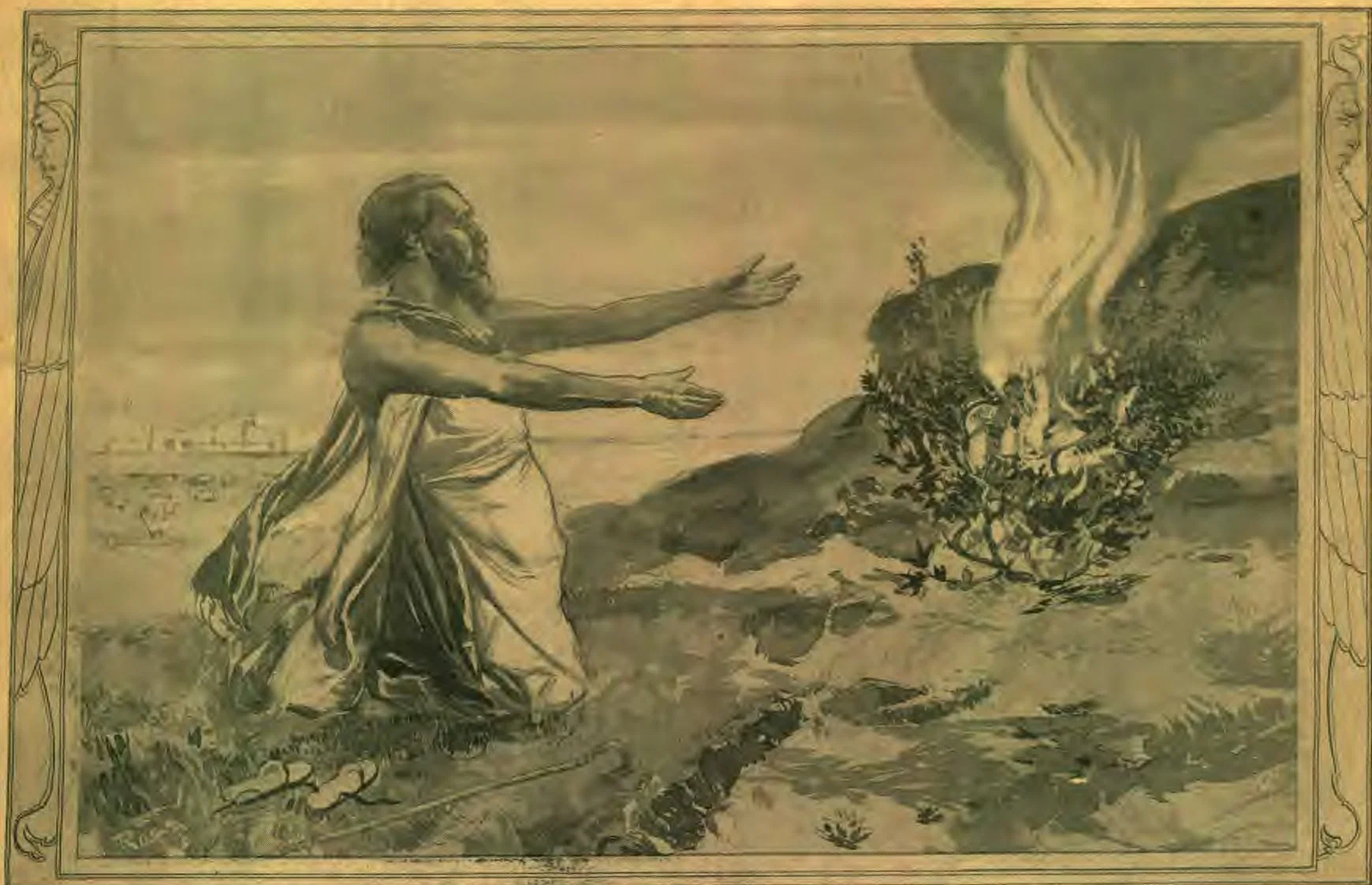
THE life of Moses stands conspicuously in the foreground of the biographic pictures of notable men. Confronted at his birth by a law that demanded his immediate death, he became at once the special object of providential care. Loving, God-fearing parents were the instruments through whom was devised a way of preserving the child from the tyranny of the king. The story of the ark of bulrushes, the adoption by the king's daughter, and early instruction by a faithful mother before being taken into the king's family, are familiar to all Bible readers. Beyond this the record gives us no detail until Moses was forty years old. We are told in a general way that he "was learned in all the wisdom of the Egyptians, and was mighty in words and in deeds." Acts 7:22.
But at the age of forty years another bit of detail is given. This is told three times, namely, in Ex. 2:11-22, in Acts 7:23 and onward, and in Heb. 11:24-26. In the latter place it is said that "by faith Moses, when he was come to years, refused to be called the son of Pharaoh's daughter; choosing rather to suffer affliction with the people of God, than to enjoy the pleasures of sin for a season; esteeming the reproach of Christ greater riches than the treasures in Egypt; for he had respect unto the recompense of the reward." Stephen tells us, in Acts 7:23, that "when he was full forty years old, it came into his heart to visit his brethren the children of Israel." The record in Exodus 2 says that when he was grown, "he went out unto his brethren, and looked on their burdens." The details recorded show that this refers to the same time mentioned by Stephen and in the letter to the Hebrews.
While visiting his brethren, "he spied an Egyptian smiting an Hebrew, one of his brethren. And he looked this way and that way, and when he saw that there was no man, he slew the Egyptian, and hid him in the sand. And when he went out the second day, behold, two men of the Hebrews strove together; and he said to him that did the wrong, Wherefore smitest thou thy fellow? And he said, Who made thee a prince and a judge over us? intendest thou to kill me, as thou killest the Egyptian? And Moses feared, and said, Surely this thing is known. Now when Pharaoh heard this thing, he sought to slay Moses. But Moses fled from the face of Pharaoh, and dwelt in the land of Midian."
"And the angel of the Lord appeared unto him in a flame of fire out of the midst of a bush."
This brief detail calls for reflection, as, like all that was "written aforetime," it was "written for our learning." Rom. 15:4. Stephen says that Moses "supposed his brethren would have understood how that God by his hand would deliver them; but they understood not." From this it is evident that Moses understood it, and had given up his heirship to the throne for that very purpose. He had learned this while being instructed by his mother in his boyhood, while she was employed as his governess by the queen's daughter. He had remembered this, and had faith in it, deeming the further education he received in "the wisdom of the Egyptians" as peculiarly fitting him for the great work. From this point of
Moses’s Training in Midian
view his military skill would be especially valued by him. Going to his brethren as he did, and beginning his mission as he did, prepared even to smite with carnal weapons, shows his self-confidence, his trust in his own wisdom and skill. While he had faith in the righteousness of his cause—the freedom of God's people—he adopted the method of physical force. That his method was wrong was shown by the sudden fear that came over him when he was confronted with the probability of losing his life. When he returned to the task forty years later, he was not afraid to go right into the presence of the king. The reason of this change is a lesson of itself, to be studied by the reader at his leisure.
ARRIVING in Midian, Moses entered practically upon the second forty years' period of his life. Concerning position in this life, he went to the bottom and began anew. He hired out as a shepherd, and afterward married the daughter of his employer. Like Jacob, he tended the flocks of his father-in-law; but there is no record of his getting rich in this world's wealth. That he acquired a new spirit, however, is evident, for it is said of him that he was "very meek, above all the men which were upon the face of the earth." This was the result of his "industrial school" training under the hand of the Lord in the land of Midian. Thus was he fitted for that great work for which the Lord designed him from his birth, and for which "all the wisdom of the Egyptians"—scientific, social, political, and military—could not fit him.
AT the end of this long term of instruction and humble experience in spiritual things, the record proceeds: "Now Moses kept the flock of Jethro his father-in-law, the priest of Midian; and he led the flock to the back side of the desert, and came to the mountain of God, even to Horeb. And the angel of the Lord appeared unto him in a flame of fire out of the midst of a bush; and he looked, and, behold, the bush burned with fire, and the bush was not consumed."
WHEN the Lord saw that Moses turned aside to examine the bush more closely, He called to him and said, "Draw not nigh hither; put off thy shoes from off thy feet, for the place whereon thou standest is holy ground." Then He added, "I am the God of thy father, the God of Abraham, the God of Isaac, and the God of Jacob." Then Moses "hid his face; for he was afraid to look upon God." Then the Lord spoke to Moses concerning the afflictions of His people in Egypt, and declared that He was now ready to deliver them, saying, "Come now therefore, and I will send thee unto Pharaoh, that thou mayest bring forth My people the children of Israel out of Egypt."
MOSES was not so confident of his ability now as he was in his younger days, and especially as he remembered how the people of Israel themselves did not recognize him as their deliverer. Now he asks, "Who am I, that I should go unto Pharaoh, and that I should bring forth the children of Israel out of Egypt?" It was not until God had assured him of all needed assistance that Moses would consent to undertake the great work that had so long waited for his personal preparation.
Is it not possible that the work of deliverance "the second time" (Isa. 11:10-16) is being delayed because those who are appointed to the service have not yet the personal preparation,—the meekness, the humility, the self-denial, the self-distrust, and the implicit confidence in God's leadership,—that is essential to successful effort?
THE burning bush practically began the third period of forty years in the life of Moses; and here is illustrated the notable difference between the world's education and the wisdom which God imparts to the meek and humble mind, as a preparation for successful work in His cause.
G.
THE ENMITY OF SATAN.
By Mrs. E. G. White
IN Nazareth Christ made the announcement that His work was to restore and uplift, to bring peace and happiness. He came to this world to represent the Father, and He revealed His divine power by giving life to the dead, by restoring the sick and suffering to soundness and health. He was in this world as the tree of life.
Satan is at war with Christ, the divine Restorer. His agents are leagued against the Saviour's work of elevating and ennobling man. The first death in our world was caused through the working out of Satan's principles; and ever since that time, Christ and His followers and Satan and his followers have been two distinct parties. Satan is ever seeking to imbue men with his own spirit and attributes, and those whose hearts are not subdued by the grace of Christ will be guided by the same spirit that decoyed the angels from the heavenly courts. Those who break the law of Jehovah and try to compel their fellowmen to obey man-made laws are in the service of Satan.
In Christ's words to the Pharisees and lawyers, and their conduct toward Him, are presented the distinguishing features of false religion. "He said, Woe unto you also, ye lawyers! for ye lade men with burdens grievous to be borne, and ye yourselves touch not the burdens with one of your fingers. Woe unto you! for ye build the sepulchers of the prophets, and your fathers killed them. Truly ye bear witness that ye allow the deeds of your fathers; for they indeed killed them, and ye build their sepulchers. Therefore also said the wisdom of God, I will send them prophets and apostles, and some of them they shall slay and persecute; that the blood of all the prophets, which was shed from the foundation of the world, may be required of this generation; from the blood of Abel unto the blood of Zecharias, which perished between the altar and the temple; verily I say unto you, It shall be required of this generation. . . . And as He said these things unto them, the scribes and the Pharisees began to urge Him vehemently, and to provoke Him to speak of many things, laying wait for Him, and seeking to catch something out of His mouth, that they might accuse Him."
On another occasion Jesus said to the Jews: "If ye continue in My word, then are ye My disciples indeed; and ye shall know the truth, and the truth shall make you free. They answered Him, We be Abraham's seed, and were never in bondage to any man; how sayest thou, Ye shall be made free? Jesus answered them, Verily, verily, I say unto you, Whosoever committeth sin is the servant of sin. And the servant abideth not in the house forever, but the Son abideth ever. If the Son therefore shall make you free, ye shall be free indeed. I know that ye are Abraham's seed; but ye seek to kill Me, because My word hath no place in you."
What stern truth is here spoken! How many there are who boast that they are not in bondage to any one, when they are bound to the most cruel of all tyrants! They have placed themselves under Satan's training, and they treat God's people as he directs them to. How many there are who hear the word of truth, but hate the message and the messenger, because the truth disturbs them in their deceptive practises!
"I speak that which I have seen with My Father," Christ continued; "and ye do that which ye have seen with your Father." Two classes are plainly brought to view in these words,--the children of light, who obey the truth, and the children of darkness, who reject the truth.
In their bigotry and self-righteousness the Jewish teachers answered Jesus, "Abraham is our Father." "If ye were Abraham's children," Christ said, "ye would do the works of Abraham. But now ye seek to kill Me, a man that hath told you the truth, which I have heard of God; this did not Abraham. Ye do the deeds of your father."
Urged on by the accusing spirit of him whose advocates they were, the Jews answered, "We be not born of fornication; we have one Father, even God." How many there are who, like the Jews, call God their Father, and yet hate with intense hatred the word of truth!
"If God were your Father," Jesus said, "ye would love Me; for I proceeded forth and came from God; neither came I of Myself, but He sent Me. Why do ye not understand My speech? even because ye can not hear My word. Ye are of your father the devil, and the lusts of your father ye will do. He was a murderer from the beginning, and abode not in the truth, because there is no truth in him. When he speaketh a lie, he speaketh of his own; for he is a liar, and the father of it." "Then took they up stones to cast at Him; but Jesus hid Himself, and went out of the temple, going through the midst of them, and so passed by."
The converting, transforming grace of God changes the spirit and attributes of him who accepts the truth. He is imbued with the Spirit of Christ. Satan sees this, and he is filled with hatred against Christ and His servant. But there is no enmity between Satan and the human agent who has become so deluded that he wars against God and His holy law; for this is the very work in which Satan has been engaged since his fall.
God's people can expect nothing less than persecution; for their Master was persecuted, and He says to them: "The servant is not greater than his Lord. If they have persecuted Me, they will also persecute you; if they have kept My saying, they will keep yours also." "These things have I spoken unto you, that ye should not be offended. They shall put you out of the synagogs; yea, the time cometh, that whosoever killeth you will think that he doeth God service. And these things will they do unto you, because they have not known the Father, nor Me."
As Christ was being tried, Pilate placed Him side by side with Barabbas, saying to the people, "Whom will ye that I release unto you?" There they stood,--Christ the Son of God, and Barabbas the thief and murderer, bearing in his countenance the marks of Satan's attributes.
The priests and rulers persuaded the people to choose Barabbas, and in answer to Pilate's question the hoarse cry was raised, "Release unto us Barabbas." "What shall I do then with Jesus which is called Christ?" Pilate asked, and again, like the bellowing of wild beasts, the cry went forth, "Crucify Him, crucify Him." And all heaven heard the cry.
A messenger had been sent to Pilate by his3wife, with the warning, "Have thou nothing to do with that just man; for I have suffered many things this day in a dream because of Him." But Pilate did not heed the heaven-sent message. Instead, he used Christ's trial as an occasion of making friends with Herod. A corrupt confederacy was formed between the two rulers.
And when Pilate saw that he could prevail nothing against the multitude, he released Barabbas unto them, and delivered Jesus, when he had scourged Him, to be crucified.
Be astonished, O heaven, and be everlastingly ashamed, O inhabitants of earth! With sorrow and indignation the angels heard the choice made by the people and the sentence passed upon Christ. But they could not interfere; for in the great controversy between good and evil, Satan must be given every opportunity to develop his true character, that the heavenly universe, and the race for whom Christ was giving His life, might see the righteousness of God's purposes. Those under the control of the enemy must be allowed to reveal the principles of his government.
Those who see and obey the light of truth will be harassed and oppressed; for enmity will ever exist between Christ and Satan. If God had not interfered with Satan's evil working, men would have leagued against good in an alliance to dethrone God. Satan caused the fall of part of the heavenly angels by rebelling against God's law, and he is the instigator of every injustice done to God's children. He inspires his agents to do all they can to hurt Christ by bruising the bodies of His children. But God is present at every tribunal before which His children are called to stand. He marks how men condemn His servants and silence their voices. He records every act of injustice, every act of oppression. As the blood of Abel cried to Him from the ground, so the prayers of His servants who are imprisoned in dungeons or linked with the vile in chain-gangs, rise to Him. The cruelty done to God's servants is recorded as done to Christ in the person of His saints, and the time is coming when God Himself will avenge their wrongs.
John writes: "I heard another voice from heaven, saying, Come out of her, my people, that ye be not partakers of her sins, and that ye receive not of her plagues. For her sins have reached unto heaven, and God hath remembered her iniquities. Reward her even as she rewarded you, and double unto her double according to her works; in the cup which she hath filled fill to her double." "And I looked, and, lo, a Lamb stood on the Mount Sion, and with Him an hundred and forty and four thousand, having His Father's name written in their foreheads. And I heard a voice from heaven, as the voice of many waters, and as the voice of a great thunder; and I heard the voice of harpers harping with their harps; and they sung as it were a new song before the throne, and before the four beasts, and the elders; and no man could learn that song but the hundred and forty and four thousand. . . . These were redeemed from among men, being the first-fruits unto God and to the Lamb. And in their mouth was found no guile; for they are without fault before the throne of God."
MRS. E. G. WHITE.
WHY THE ELECT ARE NOT DECEIVED.
By W. S. Sadler
FOR there shall arise false Christs, and false prophets, and shall show great signs and wonders; insomuch that, if it were possible, they shall deceive the very elect.” Matt. 24:24.
The Saviour tells us that in the last days marvelous signs and great wonders will be seen, and that these things will have such deceptive power that if it were possible the very elect would be deceived. We find that the prophet John calls attention to this same wonder-working power in the book of Revelation. “And he doeth great wonders, so that he maketh fire come down from heaven on the earth in the sight of men.” Rev. 13:13. “For they are the spirits of devils, working miracles, which go forth unto the kings of the earth and of the whole world, to gather them to the battle of that great day of God Almighty.” Rev. 16:14.
These scriptures clearly show that, to all human appearance, the devil will have power to work miracles in the last days, and that in the last phase of this last-day wonder-working power even fire will be brought down from heaven. We must remember that angels were deceived in heaven, and that, with Satan’s six thousand years’ experience of perversion and deception, it is very clear that the elect must be in possession of superior discernment and discrimination in order to escape these deceptions. How, then, may we know that we shall be free from the deceptive influences of these signs and lying wonders?
This is the promise: “And ye shall know the truth, and the truth shall make you free.” John 8:32. The people of God must be searching for truth instead of watching for signs and miracles. Signs and wonders the devil will be able to produce, but truth, divine truth, has no connection with the powers of darkness. This is an age when people are looking for the miraculous. Even many professed Christians are asking now, what Herod asked of old, “Show us a miracle.” Elijah’s fidelity to God was vindicated by the miracle of bringing fire down from heaven, but in these last days Satan will reproduce this miracle for the accomplishment of some deceptive purpose.
Satan’s deceptions in these last days will be so subtle, his miracles so marvelous and so nearly approaching the manifestations of the workings of God recorded in the Bible, that, if it were possible, as noted in the warning of Christ, even the very elect would be deceived. But, thank God, it will not be possible, for the elect know the truth, love the truth, and obey the truth, and the promise is, “Ye shall know the truth, and the truth shall make you free.”
It is the ability to discern truth by the flavor of the divine spirit that is in the truth, that renders the elect unsusceptible to the influence and deceptions of this last-day, master miracle-working power. The one great miracle which the elect of God should be eagerly seeking for is that miracle of transformation,—a transformation of character. True, other miracles will follow according to the promises of the Gospel commission. Satan can work apparent miracles, but this transformation of character from the sinful to the sinless is a work wrought only by the power of God.
Satan is well acquainted with many of the plans in the eternal purpose of God, and it is this knowledge which makes it possible for him to construct such deceptive counterfeits and to so successfully carry them out before the eyes of the world.
Dear reader, we must come to that place in our experience where the love of truth will be the thing uppermost in our minds and hearts. We must come to that place where we will be able to deny any one or all of our senses in favor of principles which we know to be true. Truth, and only truth, can save from the deceptions that will be abroad in the closing of this world’s history. Miracles are not to go before as an evidence of truth, but to follow after as a confirmation of the truth that went before. The miracle which God works in transforming the hearts of sinners, in bringing them out of darkness into the marvelous light of His truth, in breaking asunder the bands of the prisoners of sin, and setting free the captives of the arch-deceiver,—this great miracle of conversion is little appreciated by the world to-day, while at the same time we find the majority of even professed Christians eagerly calling for miracles, and expectantly watching for signs and wonders.
We shall only be saved from the deception of false miracles by having acquired a knowledge of the flavor of divine truth. This knowledge of the flavor of truth we get by accepting truth in the heart, by living truth in the life, by making truth our rule of action, by being sanctified by the truth. Having once acquired a knowledge of the flavor of truth, let us deny even our own eyes and hearing, and hold fast to those principles which the Spirit of God has borne witness to as truth. Truth, dear reader, and truth only, will save us from being deceived by the sophistries of the arch-deceiver.
W. S. SADLER.
Duty Beyond Feelings
"It is no excuse to declare that we do not feel like performing a task. It may be our duty to feel like doing it."
Kindness Converts Sinners
By F. W. Faber
KINDNESS has converted more sinners than either zeal, eloquence, or learning.—F. W. Faber.
FORCING MEN TO SIN.
SAID the Protestant princes at the Diet of Spires, referring to religious disputes, "In such difficult matters we must act, not with the sword, but with the sure Word of God; for as Saint Paul says, 'What is not of faith is sin.' If therefore we constrain Christians to do what they believe unjust, instead of leading them by God's Word to acknowledge what is good, we force them to sin, and we incur a terrible responsibility." If all Christians and all men in authority understood this truth, and would act upon it, there would never again be religious persecution.—Bible Echo.
CONTENTED, YET NOT SATISFIED.
By Editor
CONTENTMENT is a Christian duty; satisfaction is not. Being contented is accepting one's present assigned place of toil and influence as in the ordering of God's providence. Being satisfied is taking it for granted that God has nothing better in store for one in the opening future. It is proper to be contented for the moment, but not to be satisfied for all time to come. As Robertson says, "Man's destiny is not to be dissatisfied, but forever unsatisfied." Let us therefore be ever unsatisfied while ever contented."—S. S. Times.
Busy Men in God’s Work
WHENEVER God asks you to do anything for him, do not reply, I am too busy. God and truth do not wait for lazy men, nor for idlers. He is always seeking for busy men; indeed, they are the only ones who accomplish anything worth the while, whether for God or man. The history of all God's work is filled with evidences of this truth. Men are called to greater duty because they are doing that which is less. "Thou hast been faithful over a few things," is the only ground on which any one may expect to be called to rule over many things.—Sabbath Recorder.
The Need for Earnestness
“It must astonish the angels to see how few people there are who get in earnest.”
“It must astonish the angels to see how few people there are who get in earnest.”
The Origin of Evil and the Change of the Sabbath
By H. C. Giles
A Vitally-Important Question.
PROBABLY no point of Bible truth has been more prominently before the public for the last quarter of a century than the question of the day which Christians are bound to observe as the Sabbath. Altho the Bible plainly asserts that the seventh day was constituted the Sabbath of the Lord at creation (Gen. 2:2, 3; Ex. 20:8–11), the fact still remains that a transference of the Sabbath from the seventh to the first day of the week, at some time and by some authority, has apparently taken place; for not only the world at large, but the mass of Christian people as well, observe not the seventh but the first day of the week, while those who regard the literal teaching of the Scripture, and rest on the "Sabbath day according to the commandment," are strikingly in the minority.
Many, on the strength of this fact alone, have felt free to dismiss the matter without further thought or investigation, and have thus sought to excuse themselves in the violation of a considerable portion of plain Scripture teaching. Such an important item of religious belief and practise, it is argued, as a change in the Sabbath institution, would not have been suffered by an overruling Providence to occur. It is not reasonable to suppose, say the advocates of the Sunday sabbath, that the great body of Christians at any time could have been induced to alter their practise in the vital principle of religion without sufficient reason for so doing. Had it been possible, say they, for a few in any age to fall into an error so grave as a change of the Sabbath, they would have been promptly and deservedly rebuked by the church leaders, and the defect would have been remedied before the church to any extent had been estranged from truth by the misconception. This point will be considered later in the light of the Scriptures.
In our world, where all the once fair and glorious handiwork of God has been marred by sin, we can not accept the maxim, "Whatever is, is right." Everywhere is visible the sad desolation wrought by an invading foe. Wrong by usage is not transformed into right. Evil, tho time-honored, loses none of its cruel deformity. Sin, tho popular and pleasant as the fruit of the forbidden tree to our first parents in Eden, brings fatal ruin none the less surely. An error that resembles truth is made only the more dangerous, and is, consequently, the more carefully to be avoided, because of such resemblance. God's immutable Word must ever be the standard by which all doctrines shall be measured; the Bible, and the Bible only, is the Christian's guide to eternal life.
That the Sabbath has been changed from the seventh to the first day of the week, is self-evident; but let us seriously consider "by what authority" the change occurred. Let us look closely and see "whose is the image and superscription" which the Sunday sabbath bears. To examine the origin of evil and its development in our world, to learn what bearing it may have on the question of the change of the Sabbath, is the object of this series of articles, and upon this investigation, with the Bible before us, the reader is kindly invited to go with us in next week's paper.