THE Spirit of God which moved upon the face of the waters was the Holy Spirit, whose existence is thus made known to us in the very beginning of the Bible. The Holy Spirit united with the Father and the Son to create the world, as he still unites with them to save each soul,—three glorious persons in one only God over all, blessed forever.
We are here taught that, although soon after, the plants, the animals, and man, with all the wonderful works of creation, sprang from the earth and the waters, yet it was not the earth and the waters which produced them by any virtue or power in them,—it was the creating Spirit who prepared them, and caused them to spring forth.
How beautiful and significant is the expression, “The Spirit of God moved upon the face of the waters.” The Hebrew word translated “moved” refers to the movement of the wings of a bird as it hovers over the nest.
What more beautiful emblem could be found in all nature to signify the life-giving creative power, than that of a bird hovering in silence over the lifeless egg from which a beautiful and graceful creature will soon burst forth—bright and gay as the peacock, pure as the swan, dazzling our eyes with its beauty, like the humming-bird, or charming our ears with sweet sounds, like the nightingale?—L. Gaussen.
Jonah’s Punishment Proves a Blessing
“The Lord God has ‘a great fish’ for every Jonah who runs away from duty. But the fish saved the prophet, and the prophet saved the city! Our punishment for sin may prove a blessing to ourselves and others.”
Service for the Sick
As a practicing physician, the writer is often impressed with the lack of consideration given to details in dealing with the sick. Florence Nightingale is fond of relating her pleasurable sensations when flowers were first brought into her room, after a severe and protracted illness.
Those of us who are well can not appreciate the importance of trivial matters to an invalid. He who sees the flowers every day in the garden forgets how beautiful they are; but the convalescent, who has gazed at bare walls for weeks and weeks, sees a marvelous beauty in the things of nature. How often have we noticed the smile of pleasure at feeling the fresh air of out of doors blowing on the cheeks of the surgical patient for, perhaps, the first time since the operation.
With recovering health, the tray and the contents of its dishes become of great importance. A tray should be covered with the cleanest of cloths. Every dish should be scrupulously clean, and arranged in as dainty a fashion as possible. The serviette can be folded in various ways, but avoid sameness; a rosebud laid upon it will add much to the pleasure of the patient. In each dish there should be a small amount of food only. Thick slices of bread or toast, large dishes well filled with fruit or pudding—these are out of place on a tray. Nothing will more quickly take away the appetite than a lack of daintiness. It is always essential that hot dishes should be served hot, and cold dishes cold. Lukewarm soup or beverage is nauseating to most people.
A well-arranged tray should be beautiful to look upon, and its contents should be perfectly wholesome, and adapted to the wants of the patient. It must be served with a cheery smile and a kind word of encouragement.— Selected.
M. E. CADY
By M. E. Cady
Water
M. E. CADY
COULD we get along without water?—No! it is just as necessary as light, heat, and air. We could live for a short time without any one of these things except air; but this we must have in our lungs every moment, in order to sustain life. There is not a time when the lungs do not have some air in them.
A person could live for several hours, and even for several days, without water; but he would finally die. Plants will live for some time without water, but you have noticed that in a time of drought, the leaves curl up and wither; and if it continues, they die. In studying geography, we learn that three fourths of the earth's surface is covered with water.
The Creator causes the water in the seas and oceans to be lifted up and carried over the land surface. As it drops down upon the earth in the form of rain, it develops what we call brooks, creeks, and rivers. These flowing streams are empty into the ocean, so that the water returns again to its original place. The water travels in a circle. This truth is told us by the wise man when he says, “All the rivers run into the sea; yet the sea is not full; unto the place from whence the rivers come, thither they return again.”
What is the purpose of the Creator in having the water travel in this circle?—That the earth may be watered, so it will bring forth vegetation. This vegetation constitutes food for men and for the lower animals.
It is also necessary that water should be taken into the body, in order that it may be kept in a healthy condition. What becomes of this water? Does it build up the body? If not, what is its use? Physiologists, who have studied the subject carefully, tell us that water is not a food, and does not change its form while in the body. As nearly as can be ascertained, the use of water in the body is to keep it cleansed and lubricated. Nearly three fourths of the body consists of water. It enters into all the tissues and into the blood; in fact, it circulates through the entire body, carrying particles in it which are to be thrown off as waste matter. Water is taken in at the mouth, but it is thrown off at every point of the surface of the body.
If we carefully examine the skin, we shall find that it contains many little glands, or ducts for conveying the water to the surface. The water, when separated from the body by the process of sweating, or perspiring, is not pure, but is filled with poisonous matters that have been taken up by it, while on its journey through the body.
We see, therefore, that the business of water is to keep the body well cleansed, so that each part may do its work without interruption.
Water is also a valuable agent in restoring health. It is used by the skilled nurse, in many different kinds of baths. That which is good for us when we are in health is the best thing to restore us when we are ill. Let us see that we drink good, pure water; for impure water is the cause of many diseases. I will give you a simple test, by which you can determine whether the water you are drinking is fit for use: Place the water to be tested in a small, clean bottle; add a pinch of sugar. Leave the bottle uncorked in a warm place. If the water appears cloudy within two days, it is not fit to drink.
The Influence of Sunshine
By John Harvey Kellogg
J. H. KELLOGG, M. D.
SUNSHINE is the mightiest thing in the world. Scientists have advanced the idea that it is really the sunshine that turns the earth; that the impulse of the sun’s rays striking upon the earth is the cause of its rotation upon its axis. At any rate, it is certain that sunshine is the motive power which sets in operation nearly all the forces of life as well as many of the physical processes which are continually going on upon the face of the earth.
It is the sunshine that enables the little seed to sprout and germinate in the earth, and send up its stem into the air, and its rootlets into the soil, gathering from the air and the soil the elements out of which it builds its trunk, its flowers, its leaves, and its fruit. The sun shining upon the leaves of the plant sets up a process of digestion similar to that which takes place in the human13stomach—a process by which carbonic acid gas is taken in, and the carbon organized into woody structures, into starch and sugar, and the various elements which compose our foods.
If you visit the greenhouse, you will notice that the gardener goes about among the flowers from time to time, moving the plants, and turning them toward the sunlight; you will observe that the plants turn their faces toward the glass, so as to catch as much of the vitalizing influence of the sunshine as possible. The sunflower follows the sun over the arch of heaven all the day long, and catches its last rays at night. Indeed, the behavior of some flowers in reference to the sun is so precise that they constitute a floral clock, and it is possible by looking at the face of the plant to tell exactly what time of day it is.
It is the sunshine that paints the flower with scarlet, blue, and various other colors. These colors are simply a few extracts from the sunlight; for the sunbeams have all the colors in them; it is from this source also that the green leaf gets its color. In the same manner the cells of the skin are stimulated by the sunshine to make pigment, or coloring-matter, and thus the skin is said to be “tanned” by exposure to the sunlight. Freckles are caused by an unequal distribution of this coloring-matter, or pigment. This pigment does not come from the wind; it is not painted on, but is manufactured by the living, active cells in the skin, through the action of the sunlight. So the cells which make the muscles, nerves, etc.,—those which make bile in the liver, and in fact all the cells,—have their activity quickened under the influence of sunshine. Just as the little polyp is awakened by the sunshine, so the little cells of the skin and of the rest of the body are awakened by its influence.
Another interesting thing about sunshine is that it not only develops and stimulates human life, and animal and vegetable life, but it is destructive of parasitic life. There is one class of plants that do not flourish in sunshine,—the fungi, mushrooms, etc., which grow in the shade; they love the darkness, and grow under leaves, logs, and stones. You have observed that where a large tree overhangs the roof of a house or barn, a great mass of moss and other fungi is very apt to be found growing on the roof in the shadow of the tree. Mildew and mold are found on garments which have been hidden away in a dark room. Molds grow on the damp walls of a dark cellar, and on the under side of a board lying on moist ground. These are parasites which attack to destroy—and there are parasites which attack human beings.
All those germs which are fatal to human beings are destroyed by the sunshine. These germs get into the body, where they are hidden from the sunshine, and then attack us; but they can not live in the sunlight. If we spend a large part of the time out of doors, where the sun can shine upon us and through us, the germs can not flourish.
The sunshine illuminates our bodies just as the whole hand is illuminated by the electric light. When we stand out in the clear blaze of the sunshine, there is not a corner of the body that is not penetrated by it.
The Corner Cupboard
By J. R. Eastwood
The corner cupboard long ago Was in a nook I used to know, A farmhouse kitchen, neat and clean, Upon whose window-sill were seen— Fragrant in memory to-day— Some pots of fuschias gay.
That cupboard still remains to me A landmark in my history! For in my childhood, many a time, Upon my high chair I would climb, And, opening the door with care, Survey the household treasures there!
In an old teapot there was hid, Although I dare not lift the lid, A precious hoard,— a sum no doubt To my young mind past finding out,— Which, I have heard my mother say, Was kept against a rainy day.
Here, too, a Dresden shepherdess With dainty grace held back her dress, So full of pride she could not choose But gaze on her fine buckled shoes, Regardless of her shepherd swain Whose lofty look concealed his pain.
Mirrored upon a polished urn, It was a marvel to discern Two cheeks, a nose, a pair of eyes, Now dwindled, now of monstrous size, Yet big or little, faint or clear, My only portrait many a year!
The plates and saucers here displayed, The cups in shining rows arrayed, Tinted with leaf and blossom, told In pageantry of blue and gold Of state occasions, birthday joys, And tables packed with girls and boys!
Those hours long since have passed away, Yet in my memory they stay! And in the kitchen, neat and clean, Upon his chair a child is seen, Still pleased and eager as of yore The corner cupboard to explore!
— J. R. Eastwood.
How to Keep Well
By Eva Kinney Miller
It is so much easier to keep well than to get well. The world is full of people, both men and women, who, like the woman in the Bible, have suffered many things of many physicians. They run after patent medicines, they fill up sanitariums and infirmaries, they catch at Christian science, faith healing, and anything else that offers the least hope of relief from their ailments. Yet the majority of these people need never have been ill if they had only followed nature’s simple laws of health in the first place.
The body is a wonderful machine, so built as to do its work with the least possible wear and tear, and full provision has been made for the resisting of exposure and the repairing of accidents. The body will take care of itself, heal its own wounds and repair its own breaks, if given half a chance.
A few simple rules, learned when young and firmly adhered to through life, will keep one well in the face of ordinary hard work and mental strain, and recovery from accidental exposure and unexpected strains will be short and rapid.
The first of these rules is, Eat plain, simple, well-cooked food at regular hours. There are a hundred and one diseases which make people lifelong invalids, that are caused simply and solely by irregular habits of eating. Eating at irregular hours may overstrain the digestive organs, and bring on all kinds of ailments of the stomach. To get into the habit of eating just enough and no more, at regular hours, of plain food, in reasonable variety, is the way to steer clear of these troubles.
Cleanliness is an important factor in the protecting of the health. Like any other machine, the body needs to be kept clean in order to work well. The daily bath should not be neglected, but of almost equal importance are clean surroundings. Ventilation is another important matter. To sleep in impure or insufficient air will cramp the lungs, vitiate the blood, and generally unfit the body for its next day’s work, while continued sleeping in a poorly ventilated room will soon permanently weaken the lungs and heart, and make one the prey of almost any kind of germ. Have air in your sleeping-room, if you have to break a window to get it.
Exercise and rest must be alternated. The rule of giving eight hours to work, eight hours to eating and recreation, and eight hours to sleep is a good one. If you are robbed of one or two hours’ sleep one night, make it up the next day or the next.
Of course one must have daily exercise in the fresh air. Accustom yourself to all kinds of weather, and go out every day, rain or shine. Walking is a good exercise, provided it is not all on a level. Going up and down hills gives variety to the scenery, and calls different muscles into play. An occasional run is healthful. The bicycle is all right, provided it is not overdone, and the rider sits up straight, not curving the spine.
The method of dress must have its share of your sensible consideration. In winter it should be warm, but not too heavy, and in summer cool enough to be comfortable. Clothe all parts of the body with equal thickness, and hang all the weight from the shoulders, and you have the ideal healthful dress. The tight corsets, heavy skirts, and insufficient covering on arms and shoulders, have made many a woman an invalid, and must be discarded by those who value their health. I do not quite believe that tight corsets and heavy skirts hung from the hips have killed as many women as the tobacco and drink habits have men, but they have certainly gone a considerable way toward it.
Health can be cultivated. We should value our good health when we have it, be enthusiastic over it, and talk about it, that others may be helped by it. While you are young, lay the foundation which will give you strength to withstand the attacks disease may make upon you in later years.—Eva Kinney Miller, in Christian Work.
If I Knew
If I knew the box where the smiles are kept,
No matter how large the key,
Or strong the bolt, I would try so hard
'T would open, I know, for me.
Then over the land and the sea, broadcast,
I'd scatter the smiles to play,
That the children's faces might hold them fast
For many and many a day.
If I knew a box that was large enough
To hold all the frowns I meet,
I would like to gather them, every one,
From nursery, school, and street.
Then, folding and holding, I'd pack them in,
And, turning the monster key,
I'd hire a giant to drop the box
To the depths of the deep, deep sea.
— The American Jewess.
The Banana as a Food
THE banana, notwithstanding certain prejudices to the contrary, is among the most valuable and nutritious foods. Primitive man in tropical countries is said to have subsisted mainly upon this fruit, and the savage of the sea islands owes to it his physical power. The claim is made and supported by reliable authority, that bananas contain all the essential elements of nutrition, and that, if necessary, life can be sustained by an exclusive diet of this fruit. What has not been generally known is the fact that the banana is a developed tropical lily, from which by ages of cultivation the seeds have been eliminated, and the fruit greatly expanded.—Selected.
Simplicity of Diet
SIMPLICITY of diet is a much-needed reform in the world to-day.
Life and Customs of the Bolivians
By E. W. Thoman
E. W. THOMAN
The inhabitants of Bolivia are known as the most Catholic people in the world. They are in a state described in 2 Kings 17:32-34. They are regarded by the world as Christians, but most of them know no more about the true God, and Christ the Saviour, than did the Athenians who built an altar “to the unknown God.” They are what only Romanism can produce—ceremonialists, ostentatious, and fanatical ritualists. Popery has so bound them that they hardly dare think about their salvation for themselves. They look at the priest not as one “who opposeth and exalteth himself above all that is called God, or that is worshipped,” but as one who “as God sitteth in the temple of God, showing himself that he is God.”
By nature the Bolivians are a meek and long-suffering people. Were this not the case, they would not endure the tyranny of the priests as they do. True, they once cast out the Jesuits, but the other Romanist orders are still a terrible plague to these poor people. In Bolivia the so-called lower class live only to support the priest and the lawyer—another terrible plague.
Not having had many comforts, the people are satisfied with the bare necessities of life. Their food is of the cheapest that can be obtained. Meat, frozen potatoes (which they call “chuncho”), maize, barley, and some other kinds of grain, and in some places a little goat’s milk and cheese, form their principal diet. They are great lovers of “aji” (red pepper), and drink much “chicha” (a little beverage made of maize), especially on feast days. Men and women alike smoke tobacco. Another vice peculiar to the Bolivians is the use of coca, which is chewed like tobacco. The effect is nearly the same, but by long and continuous use it makes the mouth very black, and the teeth fall out or become black.
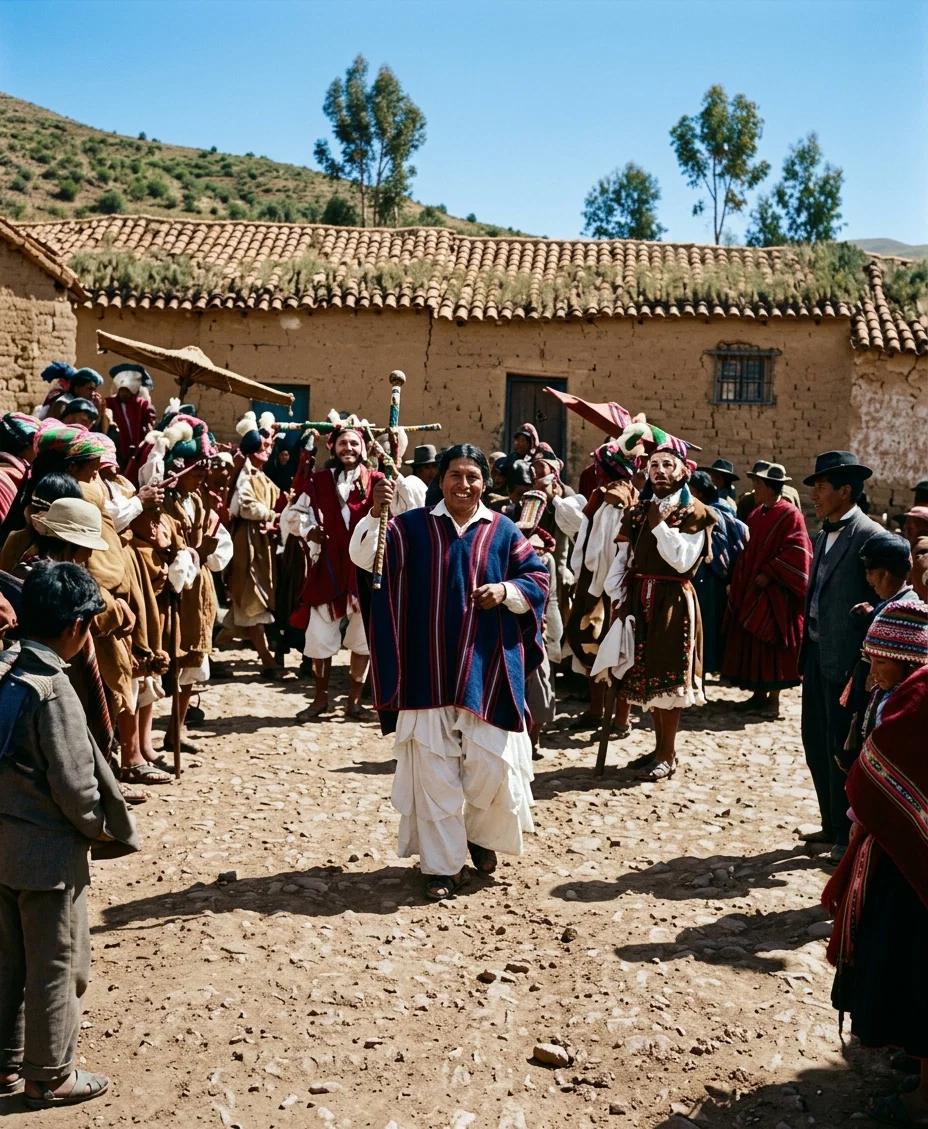
The dress of the native is peculiar, differing in various parts of the country. The cloth is home-made woolen goods. Many of them are beginning to wear sandals, and a few have shoes. The shoes of the women are of two kinds. The working class wear a low shoe with a single sole of equal thickness throughout. But those having more means use shoes with very high heels. The women’s dresses are generally short, reaching within about eight inches of the ground. On feast days they dress expensively, and appear very fantastic.
BOLIVIAN INDIANS IN GALA DRESS
The dwellings of the Indians are only huts of one room. Here they cook, eat, sleep, wash,—the latter is done but seldom. The walls of the huts are of sun-dried bricks; the roofs are of straw. The same hole in one side of the hut is generally used for door, window, and chimney. At night this opening is closed with a skin to keep out wind, rain, and cold. They make very little use of lamps or candles. Unless they are drinking, they go to bed early, and rise early. They are very lazy, however. As their needs are few, they are satisfied with little.
The Bolivians can hardly be said to have a business. They usually have very little to sell. Women with four or five pounds of potatoes will sit on the street plaster, or dust, as the case may be, all day, waiting for a customer. And so they do with other things. Many do not make five cents a day. On special market days some streets have three rows of merchant women their entire length—one in the center, and one on each side. These all sit on the ground, while the purchasers and others go between. What is sold by hundreds might be sold by twenty. They sell but little, and expect a large profit.
The Philippines
It is reported that the Philippines is truly a wonderful field. Nothing like it has been seen in the history of modern missionary effort. The eagerness of the people to hear the gospel is at once a delight and an embarrassment. The hunger for reading-matter, hymn books, etc., is actually pathetic. Bible portions can not be made as fast as they are wanted. Every page printed goes at cost price as soon as it is dry from the press.—Selected.
Self-Supporting Work in Porto Rico
By Mrs. A. M. Fischer
MRS. A. M. FISCHER
For the benefit of a number that have written, asking questions in regard to self-supporting work in our field, I wish to make the following statements:—
We have two seasons, the rainy and the dry. The rainy season begins about May, and closes in December, the rest of the year constituting the dry season. The temperature ranges from sixty degrees to ninety-eight degrees, but the sun, during the middle of the day, is very hot all the year round. It is well to bear in mind that we have the tropical sun to contend with. During the rainy season the nights in some parts of the island are very warm. This is largely due to the fact that many of the houses are built with few facilities for ventilation. To those who have been accustomed to plenty of fresh air, it is trying indeed to be shut in behind barred doors and windows, with only a few port-holes for ventilation. This is not true of all the houses, but of the majority.
While we have many things here with which to contend that we do not have in the States, yet the same things do not exist alike in two States in the Union. Those who are thinking of coming to Porto Rico must prepare themselves for anything.
Some have asked if their children could live here. I wish to say that children from the States seem to live here as well as they do there. People live and die in Porto Rico just as they do in the United States.
Now in regard to self-supporting work. In the first place, trucking, or gardening, is always open to the missionary. There is a good market for vegetables. Poultry raising is another enterprise that would pay well. The dairy business is a good one, as it is almost impossible to buy good butter here now. Land can be secured for thirty dollars an acre and upward, and is on the rise. Then the man who desires to branch out on a larger scale may export and import fruit. There is also an opening for broom factories, as broom corn grows rank. Bees also do well here.
In regard to the canvassing work, I will give the financial statement of a young Bible agent. In twenty-eight days he sold for cash thirty-three dollars' worth of Bibles. Nothing can be done by taking orders. All of the work must be by cash sales. This may seem small to many of our canvassers, but when we stop to consider that about seventy-five per cent of the people can not read or15write well enough to understand (aside from their own names, or perhaps a few words), we can readily see that some interest is being manifested in the Word of God.
The people are kind and hospitable, but quick to resent an injustice practiced upon them. To one who has become familiar enough with the language to make himself understood, they are very friendly and sociable. Of course we all know that when people can not understand each other, naturally there seems to be a restraint upon each one. In my experience with the people, both poor and rich, I find the kindliest of feelings existing, and a willingness to be very friendly. As I become better acquainted with their customs and their language, I find much of the prejudice, which existed at first, being overcome.
I am convinced that in order to do good work with them we must live among them. Not that it is necessary for us to adopt their customs, as many do, but to seek by our life and example to lift them up. I am not alone in this opinion. Others who have spent years here, working to benefit the people, spiritually and socially, say the same thing.
As our only object should be a missionary one, we should never for one moment swerve from principle and truth. Every word and act is being watched by the people. They are quick to see a point, and draw their conclusions accordingly. Do not let any one think that we have an inferior race of people with which to labor in presenting the truths for this time. It is true that they have been kept under Spanish Catholic rule for over four hundred years, and we know what Catholicism does for its people and countries when it has full control; but to the credit of the people I must say that many of them at heart have long resented this rule.
Some have written asking in regard to the number of Sabbath-keepers here. As far as I know, the workers here are the only ones that are keeping the Sabbath. There was a sister who came from Antigua and made her home in San Juan, but I have failed to find her through correspondence.
Practically no work had been done until our arrival in June, 1901. Only those of us who have been here can realize the need of faithful laborers. It seems too bad indeed that this field, lying so near our home field, has been deprived of the privilege of hearing the last warning message. Surely the blood of souls must rest upon our garments for neglecting this work so long.
May God help us to fill the place he designs us to, and may the words of the prophet Ezekiel not apply to us: "And I sought for a man among them, that should make up the hedge, and stand in the gap before me for the land, that I should not destroy it: but I found none." Eze. 22: 30.
Mayaguez, Porto Rico.
Outlook for Medical Missionary Work in Japan
By S. A. Lockwood
S. A. LOCKWOOD, M. D.
Most mission boards ceased some time ago to send medical missionaries to Japan, because there is now a large number of well-trained Japanese physicians, and this number is being augmented each year by the graduates of the medical department of the Imperial University and other well-equipped medical schools.
Some of the physicians who came here as missionaries years ago, are now in private practice among the foreigners, some have returned home, and some have devoted their time to other branches of missionary work.
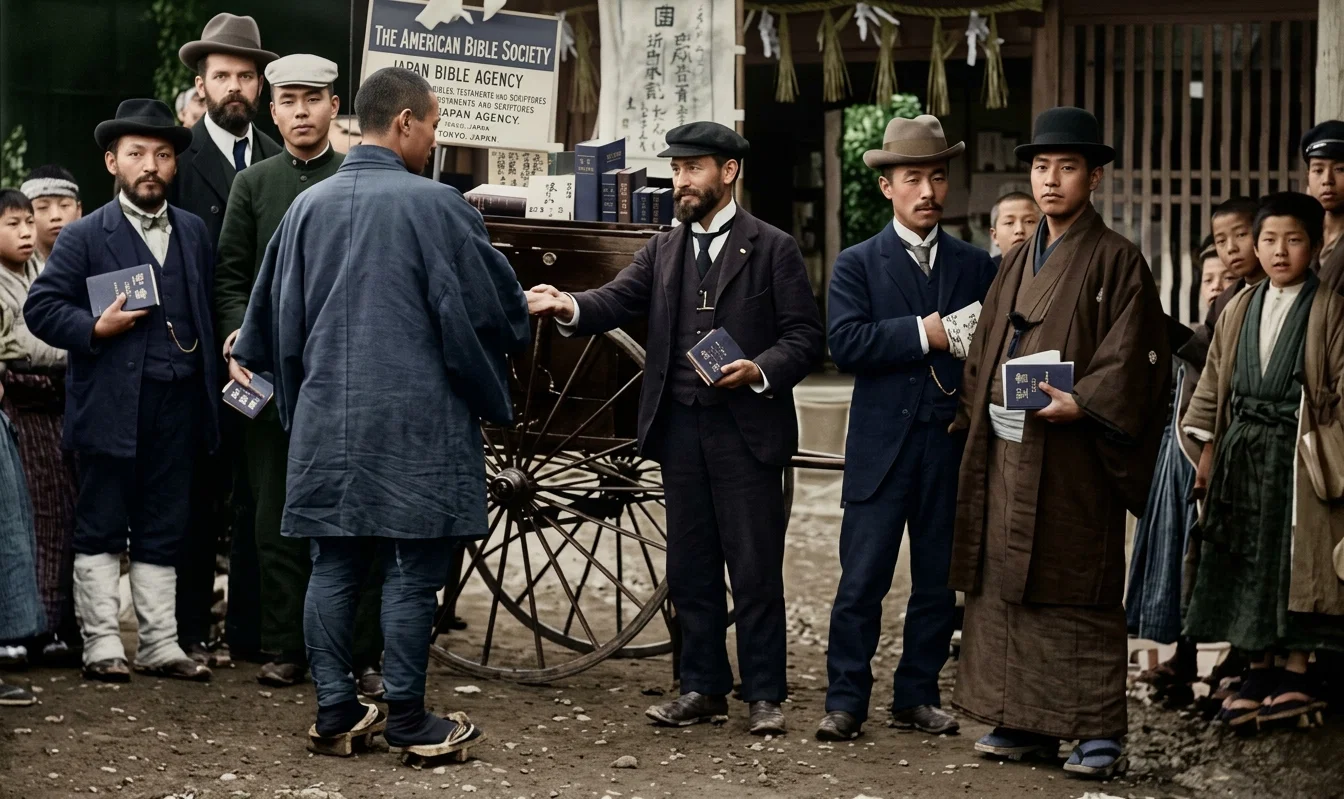
BIBLE-SELLING IN THE STREETS OF JAPAN
By permission of the American Bible Society
Nevertheless, we were convinced soon after our arrival in Japan that we had not been mistaken in supposing this to be a field where medical missionary work is greatly needed. To be sure, there are numerous hospitals in the large cities, and physicians not a few, but in the work which we came to represent, we find ourselves practically alone.
The W. C. T. U. is doing a good work, but as far as we are able to learn, the Japanese physicians are doing but little to educate the people concerning the evils resulting from the use of alcoholic beverages and tobacco, and other health-destroying habits. The Japanese government passed a law three years ago prohibiting the use of tobacco by minors. Yet many manage to evade this law, and when they become of age, there is scarcely a man or woman who does not use it. The dietetic habits of a large number of the people are such that it is a marvel the race still exists. It is not a marvel that seven tenths of the population suffer from digestive disorders.
When we consider that the majority of these people are yet in heathen darkness, can it be said that the day has passed in Japan for medical missionary work to be needed?
Where and how to begin work for these people whose language we did not understand were questions not easily answered. One thing above all others seemed necessary, and that was to acquire the language as soon as possible. The Lord has blessed us in this work, and though what we have done is only a beginning, we are of good courage that we shall be able to master it in time.
Tokyo being the Mecca for Japanese from all parts of the empire, it was thought best at first to begin our work here. Dr. Kumashiro, a member of our church, came from Nagasaki to work with us; but in spite of the fact that a diligent search was made throughout the city of Tokyo, no suitable place for establishing offices and treatment rooms could be secured. Twice we thought the matter almost settled, but the landlords refused at the last moment because no sick people were wanted on their premises.
In February letters began to come to us from some of the foreign residents of Kobe, four hundred miles southwest of Tokyo. There seemed to be so many persons there who were interested in sanitarium work, and who wished to consult us, that we visited the city, in company with Elder Field, early in March. We found the interest even greater than we had estimated it to be. Both among the missionaries and among the business people, there were many who were quite well acquainted with the good work done by the Battle Creek Sanitarium, and who expressed themselves in no uncertain terms concerning their desire to see established in Japan an institution where they could be treated in the same manner as at that institution.
Among others, we met a Methodist missionary who had but recently returned from a year's visit to his home in America. Now his health has failed, and he is again obliged to return to the United States. He told us that if he had not disposed of his household goods, he would place himself under our care, for he felt sure that we could help him. He said, “Why, doctor, there are scores of people here in Japan, in Korea, and in North China, who would be glad to come to you if you had a place to receive them.” “Succeed? — You can not help but succeed unless you are determined not to;” and similar remarks were heard from others.
Kobe is called the “Sanitarium of Japan” by many of the foreigners who have visited that place, and when we examined the natural advantages which it offers, it seemed that God had guided us to the place of his own choosing. It seemed incumbent upon us to do something16toward providing a place where we could answer the appeals being made by these people, and we began to search for a building. This time our search was not in vain. A good property near the northern edge of the city was placed at our disposal, if we wished it after the first of June, and after careful consideration it was thought best by all the brethren on the committee to lease this house and grounds for a time.
The house has been used as a private boarding-house during the last five years, and with a few changes it will be admirably adapted to our purpose. Besides having offices and treatment rooms, we shall be able to accommodate several patients in the building. Dr. Kumashiro and several Japanese nurses whom we have in training will go with us to Kobe, and through them we hope to accomplish something for the Japanese people, even before we know the language. We are thankful for these evidences that God is going before us, and our daily prayer is that we may be faithful light bearers in this dark land.
Andrew Murray
By Andrew Murray
CHRIST actually meant prayer to be the great power with which his church should do its work, and the neglect of prayer is the great reason the church has not greater power over the masses in Christian and in heathen countries. Nothing but intense, believing prayer can meet the intense spirit of worldliness, of which complaint is everywhere made. Intercession is the most perfect form of prayer: it is the prayer Christ ever liveth to pray on his throne. God’s giving is inseparably connected with our asking.—
Andrew Murray
Fetishism on the Congo
In parts of Central Africa there seems to be slight knowledge of a Supreme Being before whom men should bend in awe, and from whom they can expect protection and other blessings. But the African in those places has realized, in some small measure, his need of something to care for him when he is asleep, and to guard him against foes, some of which are beyond the range of his senses, and from surrounding dangers which he can not define. These feelings give rise to a host of protectors, made and sold by the medicine man or witch doctor; and to these helpful fetishes are added others by means of which the owner hopes to wreak his vengeance on enemies beyond the range of his weapons and ordinary powers.
Fetishism provides a substitute for God. It introduces another protector and helper, and this delusion of the evil one has been used by him to stop a craving that otherwise might have led to the true God; for it provided a false sense of rest and security, and seemingly left no need unsatisfied. A fetish is not an idol, nor is it the likeness or symbol of a god, but it is supposed to be either the abode or receptacle of an impersonal power, or of a something indefinable by the native mind, but which we would classify as a spirit. The fetish may be some natural object, as a rock or a tree. On the lower Congo one large rock is known as fetish rock. The fetish may be an insect, a reptile, or other creature. I was personally acquainted with a fetish goat. Crocodiles are frequently said to be fetishes, and they are generally such as have brought this distinction on themselves by their success as man-hunters.
The origin of fetishism is hidden in the remote past, but in the Congo region of Africa the system was strengthened and in some ways directed by Roman Catholic influence. Soon after the discovery of the Congo by Portuguese navigators in the fifteenth century, priests were sent to lead the heathen Congoese into the true light, and for many years they seemed to labor successfully, till they took upon themselves too great power. Then the native chiefs, finding that their places were being usurped, arranged to cut off the white man's work, root and branch, and when they had carried out their plan, the mission was at an end. Nothing was left of “the church” but ruined buildings, and uncertain memories stored in the minds of the destroyers. But fetishism, though triumphant, was greatly influenced by memory of customs introduced and things taught by the priests, although they and all their converts had perished.
Once I saw a rude portal of upright stakes and crosspiece joining them above, with a little bundle suspended from the center of the upper part. On close examination I found that the posts and top piece had been sprinkled with blood, and that the small parcel hanging above the path contained the head, feet, and some blood of a chicken. The purpose of the whole thing showed some shadowy connection with the teaching of the long past, for the incident took place before modern missions and teaching had influenced the natives. The rude doorway was put up by the medicine man over the principal entrance to a village. The sprinkled blood and the little bundle formed a charm, or fetish, to prevent the entrance of an evil, destroying power into their hamlet.
Near the coast the fetishes are frequently found in grotesque human form, rude images made chiefly of wood. In the interior these are infrequent, and in some places quite unknown. This probably has its origin in the worship of the images of the saints under the old priestly teaching. In another place a crucifix was found in use as a very powerful fetish.
There are yet other special fetishes that help in detecting thieves, and in pointing out those guilty of witchcraft. Others are tied on fruit trees and placed in gardens, having power of themselves to punish robbers. Should any of these fetishes seem to fail in the performance of its duty, the native does not consider the failure a proof of the uselessness of the system. He concludes that he has an enemy who by means of a still stronger fetish has brought this evil on him.
May God grant that soon the African may have his mind filled with the knowledge of a loving, all-powerful God, so that he with us may joyfully sing, “God is our refuge and strength, a very present help in trouble;” and then instead of desiring the destruction of his foes, he will love and pray for his enemies.