Copyright, Underwood & Underwood, New York. Easter afternoon on Fifth Avenue, New York, when the new spring styles are exhibited to crowds of admiring onlookers. The Resurrection and its meaning are forgotten.
LOOKING at it from a purely human standpoint, it would seem that if there is any place on earth where truly Christian ordinances ought to be kept in the right spirit, it is the Holy Land. But it is a sad fact that some of the most distressing scenes are enacted in connection with various religious festivals. This is especially true in two places, at two seasons of the year. The first of these seasons is that of Christmas, and the special place is Bethlehem, in what is called the Church of the Nativity. Of course one knows nothing about whether the church is in the right place or not; it may be and it may not be; the probabilities are that it is not. At any rate a church has been built there on the very place where Jesus is supposed to have lain when a child, and the particular spot marked by a star.
This church is held by three different denominations, the Greek Church, the Armenian Church, and the Roman Catholic. The rights of each, the place they are to occupy, the time, the duration, the manner of their services, even to the number of times they may burn incense, the portions of the walls, pillars, floors, etc., they may sweep, the hanging of their lamps, and all other details are prescribed by imperial decree from Constantinople, the Rev. H. J. Shentone tells us.
Nothing of this kind would be necessary were the devotees of these various churches Christians. It is because of the spirit of strife among them that a Mohammedan power must step in and keep the peace. Armed soldiers are continually on guard, and whenever any great festival or noted religious day calls for united worship, the conditions are nearly always deplorable, and many times disgraceful. Turkish soldiers, armed with rifles, stand guard night and day in the grotto of the manger, and a larger detachment of troops are present on Christmas and Easter to forcibly quell the disturbances between the rival sects.
Some portions of the buildings are cleaned only once a year, and a special order from Constantinople must be obtained. There is one window in the grotto that is never cleaned. Each sect has its designated localities, which once a year it may clean, but which no other may clean; while some bits of the wall are to be cleaned first by one sect and then by another. Whenever the cleaning days come, the governor of Jerusalem must be represented even in Bethlehem, and the mayor of the city must be there.
We are told that at one time there was a space, the right to clean which was in dispute, and when the signal to sweep was given, the priests of two parties rushed at the work, took each other by the throats; each party tried in every way it could to force the other from the place. Mohammedan soldiers had to separate them.
Years ago the Armenians succeeded in obtaining permission from the Turkish Government to hang a lamp chain in a certain portion of the church, and to the surprise of the governor of Jerusalem, whose duty it was to oversee the affair, the Greek ecclesiastics did not object. The chain was suspended and fastened in place, but when an Armenian priest wanted to place a lamp there the Greeks objected, and the Armenians have not been able to place the lamp there, for which the chain was hung, to this day. The chain still hangs, as Mr. Shentone remarks, “a memorial of Christian intrigue and violence.”
A few years ago, while one of the sects was cleaning the silver star that marks the spot where Jesus was supposed to have been born, in the crypt of the church, one of the nails that held the star in place was broken off; rival priests were at once on the scene. The soldier on guard gave notice of the momentous occurrence and the governor was summoned. The nail must be replaced. To the governor it was a simple thing to call in a blacksmith in the neighborhood to repair it, but when he appeared, he happened to be one of the sects, consequently was forbidden to do it lest a precedent might be established to the advantage of the sect to which he belonged. Finally the nail could not be replaced until a Gypsy, one who had no name or standing, was brought in to do it.
In the Holy City
So it is at Jerusalem. The same scenes are enacted there at the church of the Holy Sepulchre. Armed Turkish guards keep the peace between those who sing the songs of the birth, the crucifixion, and the resurrection of our Lord. It is an utter and wretched travesty of the Gospel.
On “Easter” day a procession may be seen on the Via Dolorosa or “The Sorrowful Way,” the way in which it was supposed that Christ went to the cross. Turkish soldiers must be on hand at such times, not to prevent violence on the part of outsiders, but to keep the peace between professed Christians.
O, if these churches could but learn the message which the Lord sent to His church on that resurrection morning: “HE IS NOT HERE; HE IS RISEN; HE GOETH BEFORE YOU INTO GALILEE; THERE SHALL YE SEE HIM,” they would be out in the great world living for Christ and winning others; yet not to the honoring of dead, empty places or forms, but to the worship of the living Christ and the bringing of His power to those who are sitting in darkness and death.
An Unbalanced Government
The Springfield Republican has a suggestive editorial on the future of the Presidency. It refers to the coördinate branches of this government, the Executive, the Legislative, and the Judicial; but it points out that for a number of years past the Executive branch of the government was in the ascendancy. It speaks of Mr. McKinley as a very popular President, and yet during the brilliant and erratic career of Mr. Roosevelt, Mr. McKinley’s administration had been put in the shade; that if there could be a few more who would exceed Mr. Roosevelt in popularity, the Executive branch would hold an influence altogether out of proportion to the other coördinate branches of the government, and would tend to the utter ruin of the Republic. In fact, it would be but a step from that to the empire. There were those who talked of making Mr. Roosevelt President for life. Strong personal administration tends greatly to popularity, much more so than the regular machinery of government through its different departments. Yet a strong, personal government either in church or state has its evils, evils which grow upon the people. Better the little slower methods of fuller consideration, wider, broader thought, and divided responsibility, than the dependence upon a strong centralized government which continually detracts from the circumference and tends ever to perpetuate weakness in initiative and discontent on the part of the governed.
Early Christianity and the Present.—
Prof. Thaddeus S. Fritz, superintendent of the Forward Movement of California, in speaking in Golden Gate Hall, San Francisco, March 21, stated that the Christianity of to-day did not agree with or represent the Christianity of Christ and the early Christians of the first century. Especially he said was this true as to healing and the economic life lived by the early followers of Christ. Is it not just as true as regards the moral life—the keeping of the commandments of God and the upholding of the standard of righteousness as manifest by the Founder of Christianity?
The Meaning and Outcome of the Great Battle-Ship Cruise
At a cost of more than ten million dollars the American fleet of sixteen battle-ships sailed around the world and came home without any noted accident or trouble.
It is hailed as a wonderful feat, and we presume that it was, altho they met no particularly rough weather, and they were welcomed by friends at every port where they stopped.
It has, however, stirred up the war spirit, the spirit of emulation, in all the great countries of the world. Americans, of course, feel that it is a great education to the sailors; but the fighters in other nations will feel that they must have as great a navy as America. The Frankfurter Zeitung declares: “This tour of the world has from its sheer success set the great nations into a sort of frenzy of emulation. Already we hear of a repetition of the experiment by a huge British squadron, which, of course, means that Germany must in time follow suit.” And the Berlin Post remarks that the next squadron that tours the globe will want to better the American record in the matter of time; while the Avanti of Rome declares that this maneuver “is proving the curse and scourge of mankind.”
The Berlin Kreuz Zeitung places all of the credit of the great achievement to Mr. Roosevelt; declares that “as Washington still lives as the first President and Lincoln as the martyr President, Roosevelt has immortalized himself as the battle-ship President.” To peace lovers it is not a very flattering title. And the Hamburger Nachrichten declares that Theodore Roosevelt “has benefited not his own nation alone, but all mankind,” seeing that “naval power is the true test of the greatness of a land.” What a sad commentary this is on the boasted civilization and advancement of Christianity. But this praise is echoed by a writer in the Leipzig Grenzboten, who anticipates a time when the Dreadnoughts of the fatherland will exceed 60, all less than 20 years old, all equipped with 13-inch guns only, and adds: “Mr. Roosevelt has brought that prospect nearer for ourselves, and to that extent we owe him a debt we can never repay.”
And the Süddeutsche Reichskorrespondenz adds that had it not been for the cruise of the sixteen units, “we might be satisfied with few ships.” Surely this is evidence enough, altho more might be given, to show the evil influence of this idolized voyage around the world.
Going in this direction the Paris Eclair estimates that in the year 1914 Great Britain “will rejoice in the possession of seventy-two battle-ships, each larger than the Dreadnought, Germany will have thirty-nine, France thirty, and the United States at least as many. Japan will then have twenty-one Dreadnoughts.” Thus they measure the extent of the influence exerted by the initiative of Mr. Roosevelt. “He has vindicated the 13-inch gun,” observes the Paris Figaro.
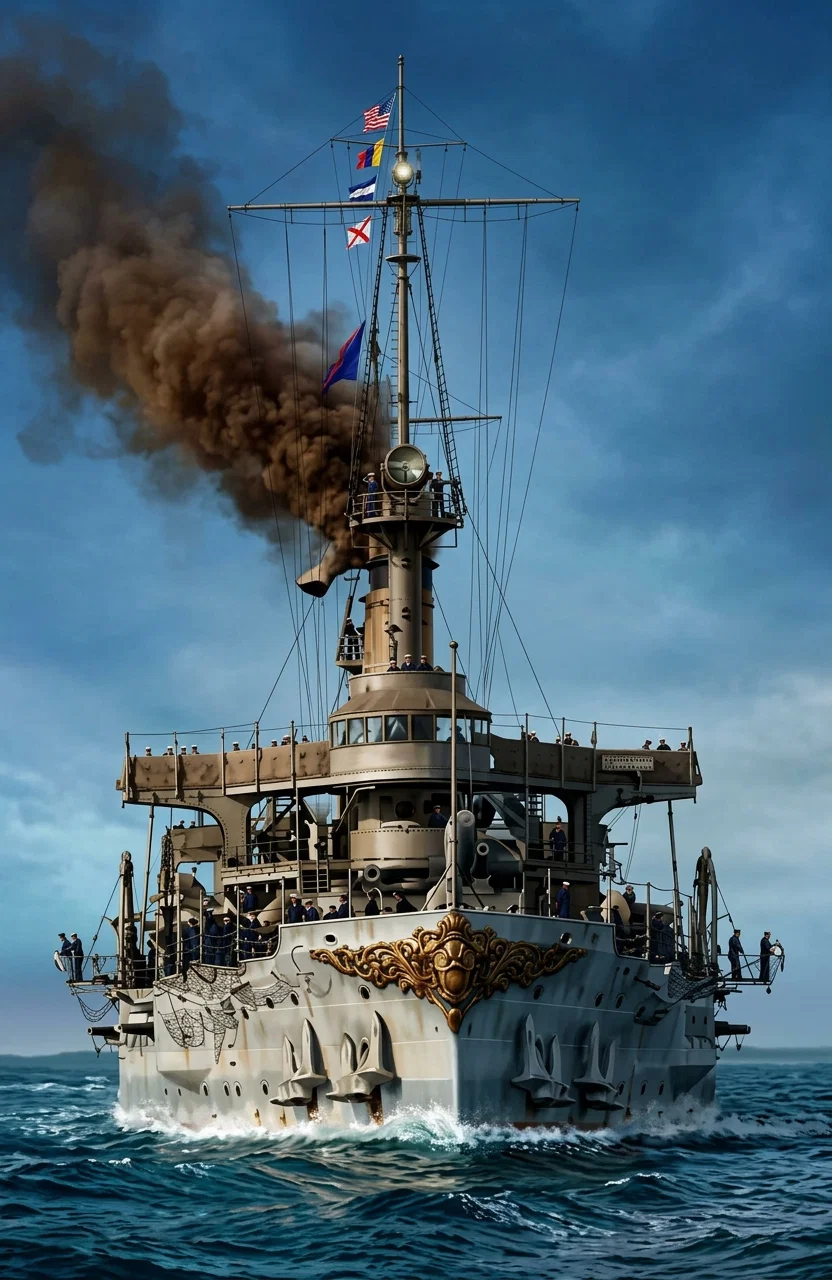
THE BATTLE-SHIP “CONNECTICUT”
This 16,000-ton monster will soon be not only a pygmy, but a back number, compared with the battle-ships now building.
The Unsupportable Burden
But on the other hand there are some newspapers which see the other side, and that is the awful financial burden. Remarks the Armee et Marine, of Paris, “How glibly the powers talk of sending a fleet around the world in the wake of the American squadron. But could they do it? Japan has not the seamanship; France has not the ships; Germany has not the money.” But there still remains some life-blood in the people, and the people can be bled. Just now the strife between England and Germany has become unbearable. Some of the strong men in the English ministry are for laying down the keels of six Dreadnoughts this year, while others are contending that it must be cut down to four. What kind of compromise will be worked out no one knows. There are those who contend that Germany is doing even more than this, but is keeping it to herself. An article in the Scientific American asks the question, “Which shall be the second sea power—America or Germany?” and goes on by statistics to show that while the United States is a little ahead of Germany at the present time, yet if the program is to be but two great battle-ships a year, Germany will soon be far in advance of America.
Are the Battle-Ships Vindicated?
There are those, who seem to know these things, who are really questioning whether the great battle-ship cruise is a success after all. We are reminded that the experiments along torpedo lines may demonstrate that the battle-ship is not so formidable as it may seem. The little torpedoes may find it exceedingly vulnerable, and may easily destroy the millions of dollars piled up in the huge steel monsters, as well as the thousands of men who man them.
And so the strife goes on, and the great burden grows heavier and heavier, and the backs of the people are bowed to the breaking. For it is not upon the great manufacturers or the wealthy people of the world that the burdens rest the heaviest. Many times they are among those that profit the most in adding to the burdens of their several countries. It is upon the shoulders and backs and prostrate forms of the great mass of the people that the burden rests and is resting heavier and heavier.
Take our own government for instance. The Spanish war year deficit was $89,000,000, only a trifle more than the last eight months’ deficit, which is $86,000,000. The deficit from the Spanish war was the largest in twenty years. The next largest was $69,800,000 for 1894, following the ’93 panic. The deficit of this entire year at the present rate will be greater than any since the Civil War.
Appropriation bills last Congress exceeded one billion dollars, and Chairman Tawney of the Committee on Appropriations gave warning that it was doubling the deficit. Last year it was $60,000,000. At the present rate, the present year will reach $130,000,000 by July 1, and we are told that Congress has again increased appropriations making the total $1,044,000,000; or an augmentation of $35,000,000. This is considered by some a “mere trifle,” and yet if the expenditure is to go on at this rate a great while, it will certainly not be a mere trifle for the great rich country of America; and we are told that one half of this expenditure is for war purposes. The burden is still heavier on the people of the Old World.
What is the cause of all this? It certainly is not found in the natural desire of man for war and death-making. It is the word of God which reveals the reason of it. That is found in Revelation 16: “Spirits of demons which go forth unto the kings of the whole world to gather them together unto the war of the great day of God the Almighty.” A mad desire for power and place is taking possession of men and nations. Blessed is he who is not drawn into the awful vortex.
National Spending and Militarism
Financial.— The Springfield Republican of March 11 points out that there will be a probable deficit in the national treasury of $200,000,000 next year, and quotes Chairman Tawney as saying that the tremendous expenditures of the government have been greatly reduced, and that if the past administration had had its way altogether the government would now be selling bonds to meet current outgoes. Militarism is the secret of it. From 1891 to 1898 army appropriations were about $24,000,000 a year, but since 1906, in a time of profound peace, they have been increased from about $70,000,000 to the $101,000,000 now appropriated. Naval appropriations increased only from about $24,000,000 in 1891 to $30,000,000 in 1897, but since the Spanish war, or even since 1903 they have increased from $78,800,000 to $136,900,000. The present appropriation, “on account of past wars and wars that may come and need not come,” as the Republican puts it, are as follows: Army, $101,197,470; fortifications, $8,170,111; military academy, $2,531,521; navy, $136,935,199; pensions, $160,908,000; and in addition to these are other appropriations chargeable to military expenditures aggregating $116,000,000, making a total yearly cost on account of militarism of $525,700,000, or more than one half of the total costs of the American Government.
Greater War Preparations
Since writing the article on the meaning of the great battle-ship cruise, news comes that England has been stirred to her very depth on learning that Germany is building ships at a rate which England supposed impossible. Wm. T. Stead in expressing it quotes the scripture: “There was silence in heaven for the space of half an hour;” but he says never had there been such silence in the House of Commons as when Premier Asquith closed his navy speech. It was a sudden awakening of the hare to the fact that the despised tortoise was forging ahead. And now the British ministry instead of feeling that it is impossible for them to obtain money for the building of four Dreadnaughts are meeting a general desire to compel them to build eight. Ministers feel that they have the liberty to begin four and to assume the authorization to order materials to build four more. And Mr. Stead declares that the talk is not fanfaronade, but a genuine, well-founded alarm, out of which will come a definite plan to adopt as a standard an irreducible minimum or formula of two ships for Germany’s one; and yet this faces them: that in 1912 the Germans will have seventeen battle-ships of the Dreadnaught class, and England, instead of having thirty-four will have only twenty-two. It is also admitted that Germany is ahead in gun mountings, and gun mountings dominate speed of construction. Germany can build as fast as the British. The question now will be for funds, and this burden will rest upon the backs of the people. It is now reported that Germany is laying down eight Dreadnaughts this year.
Diet and Anarchism in Bengal
There are some people who hold that the anarchism in Bengal, India, is partly the product of defective diet. One writer declares that “nearly all the prisoners I saw were certainly deficient in vitality. The diet of Bengalis of the student type is atrociously inadequate. Recent experiments have shown that the average Bengali of this class has 20 to 25 per cent fewer red corpuscles in his blood than the average country-bred European.” This doubtless might be true in the matter of discontent. It could be very easily seen that a half-starved people would be discontented, and discontent would of course furnish a very fruitful ground for the seeds of the anarchistic doctrines of the West.
Prince Hilkoff’s Railway Career
A noted Russian railway king, Prince Hilkoff, died in St. Petersburg, March 21. One of the interesting things connected with him is that he came to this country to learn the railway business, and hired out working at a bolt machine at a wage of $8.50 per week. His willingness and purpose in learning the details of the business made him a successful man. It is a pointer to young men.
A Malay Woman.
The East Indian Field
By J. E. Fulton
What a field for missionary effort! I would that I might describe it fitly so that you might understand its needs. I think there is no field so little understood. Of India and China we have heard much, for missionaries have been there for many, many years. Tourists also have traveled there and given accounts of the country and its people. But this field of which I speak is less known, and the least visited of any part of the globe. I especially refer to the Indian Archipelago. Why this is so, I can hardly imagine.
A Rickshaw.
It is a neglected land. But in another sense is it especially so. Little has been done here along missionary lines. This is the greatest shame of Christendom! Here millions of souls as capable as any of receiving and understanding the truths of the Gospel have been left alone. And while almost everywhere the people know nothing of the Gospel, yet people from Christian lands have been living here for generations. What a sad tale! A helpless and dying race, visited by intelligent men from European lands, and yet hardly a word spoken to them to tell them that there is a God above who loves them and that He had given His Son to die for them. And where they have as much as heard that there is a God that the white men worshiped, they must have thought Him God for the white men alone, for few of the white men hold anything in common with the poor natives. What can be done to bring them help, to save these poor people?
While on a voyage among these islands, we saw from our vessel rockets sent up from a ship in distress which proved to be some ten miles out of our course. But notwithstanding we were on a European mail steamer, the captain quickly put the ship about and steered in the direction of the signals. As we came nearer we saw in the moonlight some small islands, between two of which the captain slowly and cautiously took the steamer, and we saw here at the extreme point of one of the islands a light which we knew was the vessel in distress. Soon a boat came off toward us, and we learned that a large, four-masted bark had stranded, and the men asked our help. What anxiety all showed, both passengers and crew. “Were any lives lost?” was on every tongue. And all were anxious to know what could be done. Any one was willing to lend a helping hand.
We think of the many wrecks of manhood in these islands, stranded on the rocks of superstition and heathenism, and crying out in their need to us. Shall we turn a deaf ear to their cry? Shall no help be sent? Or shall the help be so insufficient that only a few are saved and most all have no opportunity?
O may the Holy Spirit in some way impress our dear brethren and sisters with the importunate needs, with the pathetic appeals for help sent forth by these teeming millions! You may to some extent content your minds that many of your fellow creatures in your homelands had at least an opportunity of receiving the light many, many times, but here all is darkness, with only a faint glimmer of day. Many years have passed since the light of the third angel’s message reached America. How many shall pass before the same opportunity shall be given for those who are here! Souls are just as precious here as there, and they are far more abundant.
“O where are the reapers?” May the spirit of love and of sacrifice that brought Christ from heaven electrify His church everywhere, kindling the sparks of holy zeal and devotion that characterized the first great Missionary, and also many of His followers. What enthusiasm was displayed by Heaven on our behalf! See royalty itself retire and lay aside its robes of purple, its scepter and its diadem, and issue forth in the lowly footsteps of the Redeemer into this dark, sin-cursed earth to rescue its rebellious inhabitants! And at such a cost, at such a sacrifice! What love, what self-sacrificing love! Is not this condescension beyond a parallel? And shall we not reciprocate! Would that our enthusiasm might be kindled to burn like Moses’ bush and yet not be consumed. How cheering it would be to Heaven after giving its mightiest Prince, to see among the redeemed race more of the sons and daughters filled with an undying enthusiasm for a life of self-sacrifice like that of their Master! And never till there is a larger measure of divine enthusiasm diffused in the homelands will we see done what must be done in these fields that are ripe already to harvest. “Now, just now, is the time to work in foreign fields.”
J. E. FULTON.
The Student Missionary Volunteer
By Earl N. Bergerstock
By Earl N. Bergerstock
HARK! I hear their voices calling,
Coming far across the wind,
Bidding me to leave the homeland,
Other scenes and faces find;
Strong the spell is cast upon me,
Sways my spirit to and fro,
For the voice of the unknown calls me;
It calls, and I must go.
Other hands would hold me ever,
Other voices bid me stay,
Fondest ties of life would bind me;
O the pain to say them nay!
Loving arms reach out to keep me,
Eyes with love-light all aglow,
But the voice of the unknown calls me;
It calls, and I must go.
Dearest hopes and fondest memories,
Each would hold me to my home,
And life's cares would be the sweetest,
Did I never need to roam;
But the homeland does not need me,
And the Message seems to grow,
As the voice of the unknown calls me;
It calls, and I must go.
To the land beyond the ocean,
E'en to Afric's farthest shore,
Where the millions sit in darkness;
Shall I take them light—and more?
Sit I idle? List the message:
Go to all the world, and lo!
The voice of the dying calls me,
It calls, and I must go.
Dying for the love of Jesus,
Blessed name so dear to me.
More like Thee, O Father, make me;
Lift me upward unto Thee.
Give me grace and give me power,
Ah, Thou wilt not say me no.
'Tis Thy voice, O God! that calls me,
It calls, and I must go.
“Here am I, send me,” O Saviour!
I will go where Thou dost lead,
To the millions, weeping, praying,
Where there is the greatest need;
To Thy voice my spirit answers;
I have chosen, Lord; I know
'Tis Thy voice, O God! that calls me,
And I answer: “I must go.”
To-day.
By Nixon Waterman
We shall reap such joys in the by and by
But what have we sown to-day?
We shall build us mansions in the sky,
But what have we built to-day?
'Tis sweet in idle dreams to bask,
But here and now do we do our task?
Yes, this is the thing our souls must ask:
What have we done to-day?
— Nixon Waterman.
The Resurrection Number
By Editor
OF THE SIGNS OF THE TIMES MONTHLY is ready for delivery. Besides articles on this subject, there are others; among them, one by Professor Rine, entitled “A Momentous Present-Day Movement,” and one by Geo. McCready Price on “Creation as a Proof of Inspiration.” In fact the list of important subjects is too long to print in this allotted space. All are good.
You will not regret ordering liberally, for use either in selling or for free distribution among friends.
We furnish helps for workers. Why not send a trial order for say 10, or 25? We feel certain other orders would follow.
Write us for further particulars. Order through your Tract Society, or the SIGNS OF THE TIMES, at Mountain View, Cal.
Something to Do Besides Pray
By Ola O. Eckels
A MANSION the Saviour has gone to prepare
For those who His precepts obey,
And if we could enter that mansion so fair,
We have something to do besides pray.
The One who created the earth and the sea
And gem-studded dome of the sky,
Is building these mansions for you and for me,
If we work while His day draweth nigh.
'Tis not every one who is saying, “Lord, Lord,”
Will enter at last to God's rest;
But those who observe His commandments and word
Will dwell in the home of the blest.
While prayer is the key to God's storehouse above,
That opens its door every day,
If we would have right to those mansions of love,
We have something to do besides pray.
OLA. O. ECKELS.
Our Work and Workers
A LITTLE church of eight members has been organized at Azusa, Cal., taking in also Glendora and Covina.
AT Rockport, Texas, a church of eleven members has been organized, largely of members from other companies.
FIVE members have been added to the church at Santa Cruz, Cal., through the labors of Miss Laura Morrison and Brother H. Shultz.
DURING the last nine months of 1908 more than 150 persons accepted the truth under instruction from the laborers of the Iowa Conference.
FOUR have been added to the number of believers in Victoria, B. C., since the beginning of the year through the labors of Brother F. H. Conway.
BROTHER J. A. MINNER writes from Fargo, Kan., that nine have signed the covenant to obey the commandments of the Lord. There is a deep interest, tho the opposition is strong.
AT Elida, N. M., Brother H. E. Giddings has been instrumental in bringing the knowledge of present truth to the people. Eleven signed the covenant and five more are obeying in part, waiting for further light.
A NEAT church building eight miles west of Durham, Kan., was dedicated free from debt, March 14. Brothers G. F. Haffner, J. Riffel, and Chas. Thompson conducted the services. The membership is largely German.
BROTHER F. H. DeVINNEY reports the organization of a church of thirty-one members at Schenectady, N. Y. Two short series of tent meetings were held in the city, and Brother C. DeWitt Sharp and Sister Emma Lawrence followed up the interest.
BRETHREN F. R. ROGERS and L. V. Crawford, laborers in Vicksburg, Miss., lost their homes by fire, March 4. Brother Rogers is superintendent of our mission school in that city. No one was injured excepting Brother Rogers, whose left hand was severely burned.
THE work in Nebraska during the year 1908 was very successful. The net increase in membership was 305. The total membership is 2,630. Offerings for foreign missions amounted to $14,785. Of this sum, $1,085 was raised by the young people, who are organized under the Missionary Volunteer movement. Twenty church schools are in operation.
Wanted for Missionary Work
By Mrs. E. J. Popplewell
LATE, clean copies of the SIGNS, Life Boat, Watchman, and Life and Health for depot work. Mrs. E. J. Popplewell, Darlington, Mo.
For Children and Young People
GOSPEL PRIMER
This book begins with an attractive alphabet, each letter of which is connected with some Bible scene. Following that the word method of reading is introduced, together with illustrated Bible stories. It contains 128 pages. Price in board binding, 35 cents; cloth, 60 cents. Published in German, Danish, Swedish, and Spanish at the same prices.
MAKING HOME HAPPY
A bright, cheery story in which good, wholesome lessons are taught. Contains 200 pages. Price, in cloth binding, 75 cents.
MAKING HOME PEACEFUL
A companion volume to “Making Home Happy,” by the same author. It tells more about Deacon Beardsley’s family and how an unhappy home was made peaceful. Cloth binding, 75 cents.
THOSE BIBLE READINGS
By the author of “Making Home Peaceful.” A series of practical, helpful, family talks on Bible subjects. The “Readings” in this volume are given in narrative form, and while especially interesting to the younger members of the family, they will hold the attention of every one. Beautifully bound in cloth, 75 cents.
CHRIST OUR SAVIOUR
A graphic account of the birth, death, resurrection, and ascension of Christ, interwoven with many interesting incidents in His life. Contains 182 pages. Price, board binding, 50 cents; cloth, 75 cents. Published in German, Danish, Swedish, and Spanish at the same prices.
UNCLE BEN’S COBBLESTONES
Familiar talks with boys and girls about such common things as air, water, sunshine, fire, smoke, glass, coal, salt, paper, matches, etc. Uncle Ben has a very pleasing way of telling about the origin and use of these things. Profusely illustrated. Contains 221 pages. Price, $1.00.
STEPS TO CHRIST
One of the most helpful books for young Christians ever written. It presents in a simple and practical manner the steps by which the sinner may find Christ and be made complete in Him. Contains 163 pages. Price in cloth, 60 cents. Published in German, Danish, Swedish, French, Dutch, Spanish, Finnish, Portuguese, Italian, Polish, and Bohemian at the same price.
HOUSE WE LIVE IN
Sets forth in an interesting and instructive manner all the wonders, uses, functions, etc., of the human body in all its various parts. The plan of the book is conversational—a mother talking with her children. It is a book for home reading and will be of great assistance to mothers in teaching their children how to care for themselves physically, and to avoid the evil effects of narcotics and stimulants. Contains 218 pages, nearly 150 illustrations. Cloth, $1.00.
BIBLES
The publishers of this paper carry a line of Oxford Bibles, a description of which will be gladly sent on request.
Address
PACIFIC PRESS PUBLISHING ASSN.
Mountain View, California.
61 Park St., N. 1109 E. 12th St.,
Portland, Ore. Kansas City, Mo.
Box 666, Regina, Sask., Canada.
LIBERTY
THE OFFICIAL ORGAN OF
THE RELIGIOUS LIBERTY BUREAU
An illustrated, 48-page, quarterly magazine, published as an exponent and advocate of true religious liberty; defending Christianity and the rights of conscience; upholding the Bible as the infallible word of God; recognizing the church and state as ordained of Heaven for specific and distinct purposes, but vigorously protesting against the alliance of the church with the state in the attempt to advance religion and to promote the state. Price 25 cents per year. Liberal terms to agents.
Address, LIBERTY, Takoma Park, D. C.
Daniel and the Revelation.
By Uriah Smith
By U. Smith. Revised edition. A history of the rise and fall of nations, being an exposition, verse by verse, of the important prophecies of Daniel and John, comparing Scripture predictions with historical facts. It follows in the track of no other commentary; but, guided by the obvious rule that the Bible should be its own interpreter, it aims to arrive at the exact meaning of the sacred writers in harmony with the great plan of redemption as presented throughout the Scriptures. The author has devoted over thirty years to the study of the Bible, and believes that the prophecies of Daniel and John were written for our admonition, and that the subjects they unfold are the coming themes for the religious world, destined to engage the attention of all thoughtful minds. Over 900 pages, with illustrations, beautifully bound. Cloth, marbled edges; $3.00. Address this office.