Your ShelfYour Projects

Signs of the Times, Vol. 27, No. 20.

THE INNER SANCTUARY AND ITS CONTENTS

Signs of the Times

May 15, 1901

Pacific Press Publishing Company · Oakland, California · May 15, 1901

THE INNER SANCTUARY AND ITS CONTENTS.
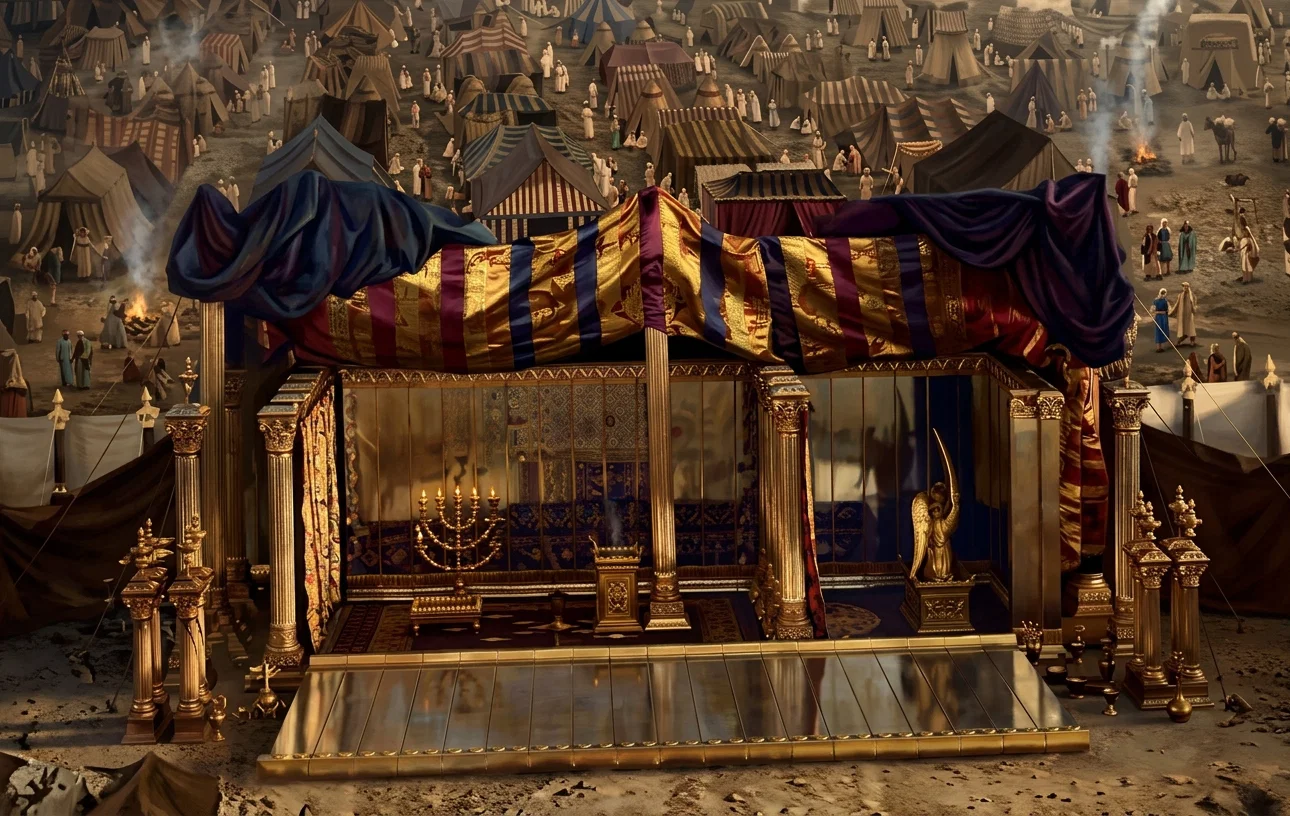
The Sanctuary, with Side Curtains Lifted So that its Interior Arrangement and Furnishings May Be Seen.
ON the way to consider at length the arrangements of the most holy apartment of the sanctuary, we may halt for a moment before the curtain which divides between that and the holy place. Just before the central division of this curtain, called the “second vail,” stood the altar of incense. It was built of wood, was eighteen inches square and three feet high, and was overlaid with gold. Ex. 30:1-6. Every morning when the lamps were trimmed and filled, and also at evening when the lamps were again cared for, an incense, finely compounded of sweet-smelling spices, was offered upon this altar by the high priest. Verses 7, 8.
The incense was offered by laying it on coals of fire held in a censer, which produced a cloud of fragrant smoke. Eze. 8:11. This was the daily method of approaching God in morning and evening worship. The cloud was to separate between Him and the priest while God was being addressed and blessed. Ps. 141:2. In time, however, because of the idolatry of Israel this service became meaningless so far as the worship of Jehovah was concerned, and word was sent to them that the performance of the act was as tho the one doing it blessed an idol. Isa. 66:3.
After the return from Babylonian captivity, the true service of God was largely restored, and this part of the ceremony recovered its lost significance; so that in the days of the priesthood of Zecharias, the people all united their prayers with the ascending smoke of incense. Luke 1:9, 10. That this was the original design of incense-offering is made clear from the fact that since Jesus became our High Priest in heaven, an angel has been seen to offer incense in the heavenly temple when presenting before God the prayers of His people. Rev. 8:3, 4.
As before learned, the “second vail” was drawn across the sanctuary to separate one-third of the building in the rear from its front part. The reason for having two apartments becomes apparent at once upon learning the use to which the rear, or inner apartment, was devoted. In this place was kept the sacred ark, which contained the law of God, the ten pillars of His eternal government. Deut. 10:4, 5. The lid of the ark, which also covered the Ten Commandments within it, was known as the mercy-seat, because it was constituted the throne of the God of mercy, and was the point from which heavenly commandments were spoken to the tribes of Israel. Ex. 25:21, 22. No common priest, daily ministering in the first apartment, was permitted to come into such a presence, hence the second vail. Heb. 9:3-7. Even the high priest could not enter the second apartment at will, but must time his visits there according to the heavenly regulation of the sanctuary service, under penalty of death. Lev. 16:2.
The entrance of the high priest into the most holy place was marked by the most solemn ceremony of the whole Hebrew year, as we shall have occasion to note in a later article. It is enough now to say that in his service there he appeared for all Israel, in the closing work of their yearly atonement, to sprinkle its blood before and upon the mercy-seat, in presence of the shekinah of God’s glory, which shone from between the cherubim on the golden throne of mercy. Ex. 25:18; Lev. 16:15.
Christ having passed into the heavens as our great High Priest, and become a minister before the ark of Ten Commandments there (Rev. 11:19), we may now enter the “holiest” place thru a newand living way, that is, thru the vail of His flesh, which has opened the door to the throne of mercy for all. Heb. 10:19-22.
Jesus having entered the holiest place of the heavenly sanctuary, there to make atonement for sin, He becomes our forerunner there, to prepare the way for us to be represented at the throne of mercy. Our hope, therefore, enters into that which is “within the vail,” even to Jesus, the eternal One; and so hope becomes to us a sure and steadfast anchor, because it is fastened there before the mercy-seat of God. Heb. 6:19, 20. It is because of this fact that we have boldness to come to the throne of grace, expecting mercy from Him who sits on the mercy-seat. Heb. 4:16.
If every professing Christian could realize his privileges under this arrangement, there would be more intelligent and cheerful service rendered to God. There would be less complaint of roughness, and less discouragement along the way. But all might know the full hope and even comfort of the Christian’s path, if they would study more the heavenly Guide-book. Without the knowledge it contains, every one must perish; and the enemy of souls will surely do his best to prevent any from gaining this knowledge, if in no other way, by loading them with care and anxiety concerning the things of this life. Matt. 13:22. Let all beware of Satan’s devices.
J. O. CORLISS.

HUMILITY

This is a grace that the human heart does not possess by nature, for the heart is proud, and desires the praise and glory of men.
The precious plant of humility is of divine origin, and only thrives where the sunshine and dews of God’s grace distil upon it. But it is highly prized by all the heavenly intelligences; for, like the sweet incense that by God’s direction Moses compounded, it has a fragrance peculiarly its own.
Humility is acquired by contact with sacred things, by learning of God. As he becomes acquainted with the wisdom, and power, and glory of the great Creator, man is enabled to see his own nothingness; and he will be led to exclaim, as did Job when the Lord revealed Himself to him, “Behold, I am vile.”
Some interesting and profitable thoughts are suggested by the history of Job. God said of him, “There is none like him in the earth, a perfect and an upright man, one that feareth God and escheweth evil.” But while Job was at the height of prosperity, God permitted him to be tried. He lost all that he had, property and children; his friends turned against him; his honor was laid in the dust. He complained, “They that are younger than I have me in derision, whose fathers I would have disdained to have set with the dogs of my flock.”
This experience was permitted to prove Job’s loyalty and integrity under all circumstances. But thru it all one precious grace was developing. Job had thought himself righteous; but the Lord addressed him: “Gird up now thy loins like a man; for I will demand of thee, and answer thou Me. Where wast thou when I laid the foundations of the earth? Declare, if thou hast understanding.” After mentioning other ways in which His power is shown, the Lord tells Job that if he has the same power, “Then will I confess unto thee that thine own right hand can save thee.” But Job’s heart has been humbled, and he exclaims: “I have heard of Thee by the hearing of the ear; but now mine eye seeth Thee. Wherefore I abhor myself, and repent in dust and ashes.” In the story of Job there is a good lesson for the self-sufficient.
Satan hates a grace so opposed to his nature as is humility, and he inspires his followers to hate it, and to exalt self. An incident that took place in the wilderness of wandering is a good illustration. God had chosen and qualified Moses to be the visible leader of His people; but some rebelled. They said, “All the congregation are holy, every one of them.” They thought Moses was exalting himself to be a prince over them, and to this they would not submit. The terrible retribution that overtook them ought to be a sufficient warning to all who listen to the suggestions of pride. This incident was written for our admonition, and we all have to learn the same lesson of submission to God’s will.
When Daniel was brought before the king to interpret his dream, He did not exalt self, but ascribed all the glory to God. “There is a God in heaven,” he said, “that revealeth secrets.” It was a test for his humility when the king “fell upon his face, and worshiped Daniel, and commanded that they should offer an oblation and sweet odors unto him.” But God had prepared His servant for this test, and so He is preparing His servants now for some of the severest tests that mortals have ever had to bear, tho they may be in a different line from those that came upon His prophet in Babylon.
It is important that we be clothed with humility; but this grace is often counterfeited, and how may we know the true from the false? The true has always the impress of its divine Author, “who, when He was reviled, reviled not again,” but committed His cause to “Him that judgeth righteously.”
In Gethsemane, when He could have resisted those who were sent to take Him, and could have called twelve legions of angels to His aid, He submitted to the jeers and insults of the mob, and even to death onthe cross, that He might exalt us to a seat with Him on His throne. “He humbled Himself, and became obedient unto death, even the death of the cross. Wherefore God also hath highly exalted Him, and given Him a name that is above every name.”
Shall we study the Pattern, and, adorned with His heavenly grace, find a welcome where all will vie in glorifying their Redeemer?
WM. TREADWELL.

COMFORT FROM HARD SAYINGS.

I WILL hear what God the Lord will speak; for He will speak peace unto His people.”
This is a universal truth, and worthy of all acceptation. God never speaks a word that is not laden with peace for all who will listen to it. In “every word that proceedeth out of the mouth of God” there is life. Therefore “blessed is the people that know the joyful sound.”
If we would but take this truth to our hearts, and keep it always in mind, it would smooth many a difficult passage. Instead of feeling that we have been rebuffed by some dark saying, we should consider it diligently to see what new phase of comfort it has for us.
When the Lord said to Jacob, “Let Me go, for the day breaketh,” what a loss the patriarch would have sustained if he had said disconsolately, “It is no use; I can’t get any satisfaction,” and had let go. When the Lord said, “Let go,” he held on the more firmly, and received more than he had asked for, or thought of getting.
But how could Jacob have the face or the heart to continue his hold on the Lord after such a peremptory, almost curt, command to let go? Because he was quick enough to perceive in it the promise of all that he desired. Consider the case for a moment. Jacob had wrestled all night with one whom he supposed was an enemy. As the day began to break, his antagonist touched his thigh, and it was immediately out of joint. By that Jacob knew that he had not been wrestling with a man, but with God in human form. He could not for a moment longer suppose that human power could avail anything, even if he had been able to stand so as to exert it any longer.
He could do nothing but cling to the Lord for support. But he knew that the One who with a touch of His finger could dislocate his thigh could sever his arm-clasp if He chose. But He did not choose. God can not deny Himself, and He is all love and compassion; therefore He can not turn away from any one who trusts Him. So Jacob saw in the words of the mighty God, “Let Me go,” the assurance that as long as he held on the Lord could not turn away from him. Jacob had the matter all in his own hands, and he improved the opportunity.
When Moses was pleading for Israel after their great sin at Sinai, God said, “Let Me alone, that My wrath may wax hot against them, and that I may consume them.” Ex. 32:10. But Moses was far from being discouraged by this seemingly stern command. He saw in the words the proof that God could not be angry with the sinful people as long as one pleaded in their behalf, even tho they themselves were not seeking His favor; so the petition was pressed with boldness, and the people were spared.
Think of Abraham pleading with God for Sodom. Not a request but was granted. At first Abraham asked only that the city might be saved if fifty righteous persons were found in it. To this the Lord readily agreed. Then, waxing bolder, Abraham reduced the number to forty-five, then to forty, to thirty, to twenty, and at last to ten, and at each successive step the Lord agreed to save the city if so many righteous persons were found in it. Then having come down to ten, Abraham left off interceding. He doubtless had in view the size of Lot’s family, his married daughters and their husbands, and supposed that his last request would suffice to save the city. From all that is given, there is no reason to suppose that God would have refused if Abraham had asked that the city be saved if five righteous persons were found in it, or if he had asked for the sake of Lot alone. But the point is that the mercy of God endures forever, and that He never has the heart to refuse any petition that is made in the boldness of faith.
If when God says, “Let Me alone,” there is such strong consolation, and such assurance that we shall receive all our heart’s desire, what confidence may we not have when He calls us to come to Him, and tells us to put Him in remembrance, and “give Him no rest.” Then “wait on the Lord, be of good courage, and He shall strengthen thine heart. Wait, I say, on the Lord.” E. J. WAGGONER.

THE REJECTION OF A FAITHFUL MESSAGE.

IN the sixth chapter of John is recorded the plain testimony which Christ bore to His followers. “It is the Spirit that quickeneth,” He said; “the flesh profiteth nothing: the words that I speak unto you, they are Spirit, and they are life. But there are some of you that believe not. For Jesus knew from the beginning who they were that believed not, and who should betray Him. And He said, Therefore said I unto you that no man can come unto Me, except it were given unto him of My Father.”
It was necessary that Christ should speak thus plainly in regard to His work. Those who claimed to be His disciples must be tested. They must be proved, and this before He should leave them, lest after His departure their apostasy should come as a surprise to the true disciples, and the trial be too severe for them. The Saviour saw that this test was necessary for the future safety of His church.
“There are some of you that believe not. . . . Therefore said I unto you that no man can come unto Me, except it were given unto him of My Father.” He desired to impress them with the fact that if they were not drawn to Him, it would be because they were not sensible of the greatness of the Father’s love for fallen human beings. “The natural man receiveth not the things of the Spirit of God; for they are foolishness unto him; neither can he know them, because they are spiritually discerned.” It is by a living, ever-increasing faith that the soul sees and appreciates the holiness of Christ. This is the glory that pure faith receives, and it awakens in the soul the decided action which demonstrates the power of God.
The plainly spoken truth did its work. By it many were offended. They showed by their actions that truth was unpalatable to them. Closing their eyes to the light, and their hearts to rebuke, they chose the praise of men rather than the admonition of God. They willingly misapprehended Christ’s words. “From that time,” we read, “many of His disciples went back, and walked no more with Him.”
With sorrowful heart the Saviour watched the result of His words, and saw that many were departing from Him. His compassion was unappreciated, His love unrequited, His mercy slighted, His salvation rejected; and He felt this keenly. It was such developments as this that made Him a man of sorrows, and acquainted with grief.
The news quickly spread that Christ Himself had declared that He was not the Messiah. This garbled statement changed the tide of popular feeling, and turned many away from Him. But Christ did not enter into controversy with those who had left Him. He did notseek to remove from their minds the impression which had resulted in their leaving. He did not try to explain away His words. Looking upon the twelve who remained, He asked, “Will ye also go away?” Peter responded by the inquiry, “Lord, to whom shall we go? Thou hast the words of eternal life. And we believe and are sure that Thou art that Christ, the Son of the living God.” “To whom shall we go?” Separated from Christ, where would they be? Should they leave His lessons of love and mercy for the unbelief and wickedness of the world?
Those who were reproved in love were offended, and turned from Christ in disdain, uniting with His enemies. They could not bear the test sent to save them from fatal deception.
To-day souls are being tested and tried, and many are passing over the same ground trodden by those who forsook Christ. When tested by the Word, they reject the divine Teacher. When rebuked because their lives are not in harmony with truth and righteousness, they turn from the Saviour; and their decision, like that of the offended disciples, is never reversed. They walk no more with Christ. Thus are the words fulfilled, “Whose fan is in His hand, and He will thoroly purge His floor, and gather His wheat into the garner.”
To those who are controlled by the Holy Spirit, Christ’s lessons appear complete in their harmony with His mission of love. Those who are partakers of the divine nature, will be melted into tenderness when the Spirit sends conviction of sin. They will see the great work that must be done for the soul before it is prepared to dwell in the presence of God. They will not be too self-sufficient to receive correction. And in their dealing with one another, they will manifest the pitying tenderness which Christ revealed in His words and works.
True, earnest, self-sacrificing Christians will understand more and more of the mystery of godliness. The Spirit of Christ abides with them. They are co-laborers with Christ, and to them the Saviour reveals His purposes. There is seen in them none of the surface-work which leaves the character dwarfed, feeble, and sickly. Daily they grow in grace and in the knowledge of God. They recognize the mercy which administers reproof and reaches out the hand to restrain evil. In word and deed they say, “Lord, to whom shall we go? Thou hast the words of eternal life.” MRS. E. G. WHITE.

CHRIST AND CÆSAR.

PART of Christ’s mission in this world was “to proclaim liberty to the captives, and the opening of the prison to them that are bound.” And this He did, not spiritually, merely, but literally; for no other influence in all the history of the world has liberated so many people from physical bondage as has the preaching of the Gospel of the Lord Jesus Christ.
When Christ came to earth it was “the midnight of the world.” Everywhere within the confines of the civilization that then existed, “the iron monarchy of Rome” ruled. Only the Roman citizen had rights, and even he enjoyed those rights, not because they were acknowledged as a natural endowment, but by favor of the Roman State.
All this was presently changed by the preaching of the Gospel. In His oft-quoted answer to the Pharisees, “Render therefore unto Cæsar the things that are Cæsar’s, and unto God the things that are God’s.” Jesus plainly showed that instead of possessing all power over the people, according to the Roman theory of the State, Cæsar’s was a government of limited powers; limited not indeed by a written constitution (for before this time constitutional government had perished in Rome), but by the law of “nature and of nature’s God.”
Some things belong to Cæsar, and some to God; and Cæsar may claim only his own. Godward the king himself is only a subject, in duty bound to render to God, equally with the humblest in his kingdom, that which is due to God; and accountable also to God for all abuse of his power.
This same doctrine was taught again in the court of the high priest. When smitten by one of the officers, Jesus said, “If I have spoken evil, bear witness of the evil; but if well, why smitest thou Me?” Here was a plain intimation that the high priest and his officers were amenable to the laws of justice.
Again, the same lesson of obligation to a higher Power is taught in Christ’s words to Pilate: “Jesus answered, Thou couldst have no power at all against Me, except it were given thee from above; therefore he that delivered Me unto thee hath the greater sin.” Pilate knew less of God and of His law than did the high priest; therefore his sin was not as great as that of Caiaphas, but it was sin nevertheless. Here, again, we find the truth plainly taught, that human power is not supreme; that it is limited by the law of justice, and that the ruler who goes beyond this is guilty of sin, for which he must answer in the Judgment. How unlike the pagan maxim, “The king can do no wrong.”
But it is pre-eminently in the Gospel commission that this principle is most plainly taught. It was the law of Rome that if any one introduced any new religion, he was to be put to death, if one of the common people; if of the higher rank, he was to suffer confiscation of goods and banishment. Christ, who knew all things, was not ignorant of this law; yet in the face of it He commanded His disciples, “Go ye into all the world, and preach the Gospel to every creature.” He knew they would suffer persecution; that they would be arrested, and imprisoned, and whipped, and that many of them would be put to death as violators of the Roman law; and yet, knowing all this, He said, “Go,” and “lo, I am with you alway, even unto the end of the world.”
Thus Christ not only sent forth His disciples to set at naught the laws of the proudest empire that the world had ever seen, but He went with them Himself by His Spirit; and again, as in the wilderness, “in all their affliction He was afflicted.”
And what was the result?—The Roman Empire was leavened by the Gospel. Not only were men made free spiritually, but thousands everywhere awoke to the fact that rights are natural endowments, and not a gift from the State. So pronounced was this influence that in less than three centuries freedom of conscience was proclaimed thruout the empire. The edict of Milan, issued in March, 313, is in part as follows:—
“We have resolved, among the first things, to ordain those matters by which reverence and worship to the Deity might be exhibited. That is, how we may grant likewise to the Christians, and to all, the free choice to follow that mode of worship which they may wish; . . . that to each one power may be granted to devote his mind to that worship which he may think adapted to himself; that the Deity may in all things exhibit to us His accustomed favor and kindness.
“It was just and consistent that we should write that this was our pleasure; that all exceptions respecting the Christians being completely removed, which were contained in the former epistle that we sent to your fidelity, and whatever measures were wholly sinister and foreign to our mildness, that these should be altogether annulled; and now that each one of the Christians may freely and without molestation pursue and follow that course and worship which he has proposed to himself; which, indeed, we have resolved to communicate most fully to your care and diligence, that you may know we have granted liberty and full freedom to the Christians to observe their own mode of worship; which, as your fidelity understands, is absolutely granted to them by us; the privilege is also granted to others to pursue that worship and religion that they wish. . . . That each may have the privilege to select and to worship whatever divinity he pleases. But this has been done by us that we might not appear in any manner to detract anything from any manner of religion, or any mode of worship.”
This edict was only a legitimate fruit of the work of Christ, and of the commission that He gave to His apostles. In conclusion, then, what was the Master’s attitude toward Cæsar, or the civil power? It was not one of hostility, for He headed no insurrection. He even forbade His followers to use force in His own defense. It was not one of insolent bravado and defiance. When on trial for His life His language was dignified and His answers respectful. Neither was it one of supine surrender. As we have seen, He reminded Pilate that there was a law to which even he was subject, Roman governor tho he was. Christ therefore held not only Himself as a man, but all men, even kings, as subject first of all to the Supreme Being and to the supreme law, and necessarily subject to human authority only in so far as such authority is in harmony with the law of justice. Thus the doctrine of Christ makes every man superior to all human governments or codes of laws, in this,—that every man who is true to God necessarily sits in judgment upon human governments and codes, to determine the lawfulness of the laws and the justice of the government. This was Christ’s attitude toward Cæsar—civil authority—and “as He is, so are we in this world.” C. P. BOLLMAN.

JEZEBEL

DOWN from the court of heaven the Son of God sent word to the church of Thyatira, containing both commendation and reproof. Thyatira stands in the midst of the seven churches addressed thru the book of Revelation. Its history parallels in time much of the papal work. This state of the church would therefore come in contact with the Papacy at many points, and it would need to guard very much against Papal intrigues.
The first count of reproof which the heavenly message gives against this church accuses it of permitting Jezebel to teach, and thru her teaching seduce the Lord’s servants. Rev. 2:20.
The mighty contest of those dark days, when written up, tells, among many other things, how the truth has been prevented from doing its proper work because of the influence of Papal and Jesuitical schools. These schools are in the Christian age, but they are the counterpart of what the schools established by Jezebel were to Israel in the days of Ahab and Jezebel. The woman Jezebel could have done but little by her personal work in turning or keeping Israel out of the paths of truth. It was her Zidonian schools which wrought the evil thing. By causing the sons of the prophets, the Lord’s instructed teachers for Israel, to be murdered, and in their stead installing the priests of Baal and the prophets or teachers of the Asherim, she succeededin turning the large majority of Israel into the way of idolatry.
Jezebel was not a passive person, but a zealous defender of the pagan worship, in which she had been brought up. Her father, Eth-Baal, was king of the Zidonians. His name signifies that the family were Baal zealots, or worshipers of Baal. Baal was everywhere among the heathen worshiped as the chief god of the sun. Not only did the Zidonians worship Baal, the sun-god, but they worshiped Ashtaroth, the goddess of the moon. From these chief gods were fledged a whole community of lesser gods; and priests were consecrated to them for the purpose of directing the ceremonies and propagating the doctrines of the demons worshiped thru these idols. At the time Elijah called Ahab to an account because of Baal worship, there were four hundred and fifty of Baal’s prophets, and four hundred prophets of the Asherim—the smaller idols, or gods of less note than Baal.
Baal worship was, in its beginning, intended as a means of communicating with, and doing honor to, the first deified man, who, it was taught, dispensed blessings after his death. The other idols were dedicated objects thru which the supposed spirits of other heroes were pacified and worshiped. The whole system was but an ancient form of Spiritualism. It is most likely that it was believed as fully then as Spiritualism is now believed by its devotees.
Those priests of Baal and of the other heroes,—the eight hundred and fifty,—were not a set of lazy fellows feeding at the king’s court, but were sent to the people thru all Israel to teach the people, and to propagate their heathen religion. These were distributed in the kingdom to suit the mind of Jezebel, who ruled over Israel thru Ahab and the priests. Therefore when Elijah asked Ahab to call these priests together, “Ahab sent unto all the children of Israel, and gathered the prophets together unto Mount Carmel.” 1 Kings 18:20.
Those prophets were supported in their work at government expense; so it is said “they ate at Jezebel’s table.” But Jezebel’s table was spread wherever her heathen teachers were required to work. This is the manner in which that woman Jezebel taught in Israel.
Omri, the father of Ahab, bought the site from Shemer, and built the city of Samaria, and Ahab built a house for Baal in the city, and reared up an altar for Baal in the house which he built. He then certainly worshiped Baal in that house, and offered sacrifices on the altar which he erected there. He also erected idols in Samaria for the other gods, and it is said, “He did very abominably in following idols, according to all things as did the Amorites, whom the Lord cast out before the children of Israel.” He did worse than all the kings which were before him, “whom Jezebel his wife stirred up.” 1 Kings 21:25, 26.
The kings of Israel who had preceded Ahab, from Jeroboam down, did nothing to encourage the schools of the prophets. But Ahab did far worse than they all. He married a woman whom he suffered to teach, and cause to be practised as the religion of the state, the most revolting idolatry. But not stopping with this wickedness, she went so far as to kill the Lord’s prophets and teachers, and overthrow their altars. This she did so fully that Elijah supposed himself to be the only one left in all the realm who had not worshiped Baal.
Now there is in the Christian age a Jezebel who teaches; and the church of Thyatira is blamed because she suffers this Jezebel to teach. But how is Thyatira to be blamed? Evidently the church is blamed because she suffered Jezebel to teach her precious charge, when the church of God should have done the teaching herself. This is a matter that can not be evaded. It is quite evident that the Lord does not ask the church to interfere with the schools of the world and hinder them in their work. Nor does the Lord wish His people to tear down the schools taught by the various religions in the world. But the Lord does hold His people responsible for the education of their own children and people.
It is suffering paganism to be taught to the Lord’s servants that He complains of. The teaching seduces them, and leads them to corruption. The people of the Lord are responsible because they allow it to be done. Now the Lord does not want His people to do without schools, but they must do their own teaching. Not only so, but they must not suffer the deadly influences of paganism to creep into their class-work or text-books. Had the Lord’s people always stood firm upon the principles of education, idolatry could never have gained a foothold in the world. Had Protestantism from the days of the Reformation heeded the Thyatiran message, which warns against the teaching of Jezebel, then would she have prepared the world for the coming of the Lord.
Should not the church of Laodicea, which is the church of the present day, avoid the great mistake of the Thyatirans? Who will recognize the work of Elijah for this time, and join with him as he labors among the Laodiceans? It is to the Laodiceans that Elijah now comes with his message, which is to turn the hearts of the fathers to the children and the hearts of the children to the fathers. Mal. 4:5, 6. When Elijah was here in person, his great work was that of overthrowing Jezebel and her system of teaching, and in their stead reinstalling the Lord’s prophets in their school work. Will he not do the same good work among the Laodiceans?
It was after his forty-two months of hiding in the wilderness that Elijah came forth to meet Ahab at Mount Carmel. A little later he regathered courage and came forth to victory more complete. He then set about the reorganization of the schools of Israel. When this was done, the Lord translated him to heaven. The challenge that Elijah made to the people was, “How long halt ye between two opinions? if the Lord be God, follow Him; but if Baal, then follow him.” 1 Kings 18:21. Is not the same question to the point to-day? Ahab to-day—the tool of Jezebel—says, “Follow her to whom I am married.” The Lord says, “Follow Me.” Whom shall we follow? Wm. COVERT.

BENIGHTED CHRISTENDOM.

Sometime ago the Century Magazine gave a description (by the editor) of the scenes of Easter time in Jerusalem, when the rivalries of the various sects wax the bitterest. There is so general a confounding of the religion of Greek, Latin, and Armenian Catholics with Christianity in the minds of most people that it is needful to point out that it is not Christianity at all. The confusion arises from the fact that popular notions of Christianity leave out the religion of Christ almost altogether, and substitute man-made religion for divine life.
Describing the state of mind of the partisans of “Christianity” in Jerusalem, the writer says that “doubt, suspicion, and murder in religion’s name are in the air now as they were of old.”
“Any of the sacred places themselves may be scenes of violence at any moment. Not long ago the Dalmatian Cavass in charge of some Russian tourists, who were visiting in the Grotto at Bethlehem, resented the interference of the sacristan monk who was clearing the way before the Latin procession, drew his revolver and shot him dead on the spot; after that, firing four shots wildly at the procession, he wounded a priest in the arm and rib.”
It is like the story of many an unprovoked murder, but the point is that had this man been treated as a murderer by the Moslem authorities, doubtless Russia, who is the protector of the Greek religion in the Ottoman Empire, would have come to the rescue. It is this kind of religion that the great churches of Christendom have exhibited to Mohammedans; and now Christendom rings with denunciation of the Turk, and multitudes of pulpits demand his extinction in the name of Christianity. The only conclusion possible is that the pulpits so doing know no more of the Gospel than their “fellow-religionists” of the East.

The “Holy Fire.”

“Now,” says the writer, “the time of miracle approaches.” For hours the crowd in the church has been fighting and yelling. “As a preliminary to this sacred manifestation there is a new, wild outburst of cries and screams.” Jerusalem worshipers beat with their fists the men from Jaffa to get their places. “The noise is frightful.” “Men standing on the shoulders of the crowd screech words of religious greeting,— This is the tomb of Christ, darting a finger at the tomb itself with every repetition.” Then when the patriarch within the tomb strikes a fire—which the ignorant believe comes down from heaven—and passes it out, the crowd, armed with candles, catch it and run. “On and on sounds the clangor and the shouting; men, women, and children are mad.” A kindly patriarch said the intelligent Greeks understood that the fire is produced by the patriarch, but that any one who should tell the frenzied rabble so “would be torn to pieces.”
“At the height of the frenzy, as the flame leaped thru the rotunda and lighted the encircling chapels, making more rich and glittering the altars, the gorgeous vestments, the whole ecclesiastical paraphernalia, the arms and uniforms of the troops, and the many-colored costumes of the mad and motley crowd, the thought flashed upon me. Was there ever anything in all Christendom so beautiful and so blasphemous?”
And when such blasphemy is made religion, and when religion itself, instead of inspiring kindliness and love, is the inspirer of every hateful feeling, and the cloak of violence and lawlessness, what must the end be? And now the same spirit is spreading in the West, and multitudes, whose profession of advanced Christianity should lead them to a desire to carry the Gospel to these benighted peoples, and to show to Mohammedans as well what the Christ-life actually is, are blindly encouraging war against Mohammedans in the sacred name of Jesus, and are persuaded that they have embarked in a righteous cause.—The Present Truth.

THE SONG OF THE WAR FIEND.

Ha! ha! ha! ha! for the feast of blood, For the carnival of gore, When men shall fight by day and night, And slay on sea and shore.
“Kill! kill! kill! kill!” is my order shrill, And the mind of man is mad; And the angel of Grace doth hide her face, And the soul of Peace is sad.
The powers of hell will aid me well, As I fiercely rise from sleep; Riches and skill shall obey my will, The harvest of Death to reap.
The joys that Peace in a hundred years Have earned, in a day I’ll take; I’ll gaily scream as the cannons gleam, And a million hearts shall break.
Yet what care I for the widow’s cry, Or the orphan’s feeble wail, When the ocean tide with blood is dyed, And the fire sweeps hill and dale?
And little I care for the mother’s prayer, When her son lies cold and stark; For deep is the death from the blasting breath When the war dogs wildly bark.
And glassy eyes shall gaze at the skies, Mute lips to heaven appeal, And the likeness of God be crushed to the sod, ’Neath the tramp of the war fiend’s heel.
Ha! ha! ha! ha! for the feast of blood, For the carnival of gore, When men shall fight by day and night, And slay on sea and shore.
—London Echo.
Continue reading: BE CAREFUL TO ENTERTAIN STRANGERS