Your ShelfYour Projects

Review and Herald, Vol. 82, No. 26.

How Many Have You Read?
Earlier text: Biennial Report of the Southern Union Conference

The Distribution of Our Literature

THE value of our literature as a means of bearing the message committed to us to carry to all nations can hardly be overestimated. That the art of printing and book-making has been especially brought forward in these last days for that very purpose, will not be questioned by any true-hearted Seventh-day Adventist.
Of its importance the prophet says: “Write the vision, make it plain upon tables that he may run that readeth it.” That is to say that, having read it where it is made plain, he may run with alacrity, energy, and intelligence to spread the good news and pass it on to others. The result is much more effectively attained by reading the message where it is made plain. It is pleasant to listen to the message, well spoken; it is profitable to preach it in thunder tones. But he knows it best who reads it. To those who are hungering for truth, our books, pamphlets, periodicals, and tracts are like a well-spread table to a hungry man. When once seen and tasted, it is eagerly devoured.
Our books are silent heralds of the truth,—silent, yet most effective implements in the hands of the Spirit of God to accomplish the work in the generation in which they are written.
The first requisite for selling books is to appreciate their value in the accomplishment of the work we are called to do. But I can have no true sense of the value of a book which I do not understand, and I can not understand that which I have not read. Jesus says, “Let him that readeth understand.” The same is true of our smaller literature. If we as workers do not acquaint ourselves with the literature which is placed upon the market to-day, and renew acquaintance with our older publications, we shall cease to be booksellers.
When may a minister sell books? — Whenever he is associated with people where he may have even a short conversation with them. Where may he sell books? — Wherever he is brought in contact with the people by visiting from house to house, and talking with them, endeavoring to make plain the way of life and salvation. He will interest them on some special subject; then is his opportunity to introduce a book that will enable his hearers to make thorough investigation on the point in question. If he is acquainted with our literature, the Spirit of God will bring to his remembrance the book that should be presented. A most favorable opportunity for selling literature is at the close of a discourse upon some point of present truth.
When riding on the train, having interested a seat mate in that which is burning on his own heart’s altar, he may sell him a book which will lead him on in the investigation that has been started. While waiting in the depot, resting in the hotel, almost anywhere and everywhere this work may be done, for “out of the abundance of the heart the mouth speaketh.” The literature left in the hand will emphasize the truth that has been introduced, and will lead to further investigation.
The minister who maintains such an attitude toward the distribution of our literature, and sets such an example, will impart to whole churches a desire to handle our literature, not from mercenary motives, but because of their wish to have a part in the work they see being done. Thus by example, much more than by exhortation, will our churches and individual members be led to participate in this most effective and inexpensive method of carrying the message to all the world. A retired canvasser who has entered the ministry because of a dislike for selling books will not impart that kind of inspiration. Both ministers and Bible workers need the experience gained in the canvassing work, as much as the accountant still has use for the multiplication table. He never gets beyond the place where first principles are necessary to success in the prosecution of his work.
There will never be seen the success in getting men and women to enter and push the canvassing work which the Lord designs, while the sentiment prevails that after workers enter the ministry or Bible work, they are no longer to distribute literature by selling it.
To assure success in any conference in getting out a good corps of canvassers, co-operation is required on the part of all the workers. No State agent can make a great success of the canvassing work without such co-operation and support. And it requires more than simply to speak favorably of the work which the State agent is doing, and to say that we want to see the canvassing work succeed. Such talk from those who do not engage in selling literature is like “sounding brass.” We can not impart what we do not have. If we have a real interest in selling books, papers, and other literature, it will be so manifest in our lives that it will give weight to our words. With a united effort on the part of ministers and other workers to set a right example in this matter, many will become interested in the canvassing work. Let short drills be conducted, not long months of school work, but a brief period, a few weeks devoted to study and practical experience intermingled,—say about one half of each day to be spent in practical work among the people, and the remainder of the time to be devoted to study and instruction. These drills may be conducted by the State agent, or by experienced agents where it becomes necessary to have more than one such drill conducted at the same time.
The day for selling our literature has not passed. The time for canvassing is not over. Our work along this line is by no means finished, nor will it be until the time comes that he who does not have the mark of the beast can no longer buy or sell. When that time is reached, we will give away the surplus of our literature.
With united effort on the part of all, with earnest and hearty co-operation of ministers, Bible workers, secretaries, State agents, and canvassers, we may sow the seed beside all waters, scatter the printed page like the leaves of autumn, gather the golden harvest, and soon, very soon, enter the haven of rest. C. McReynolds.

Bocas Del Toro, Republic of Panama

WE left Bocas March 27, on a little boat called the “Experience,” for a trip to St. Andrews and Old Providence islands. The captain, thinking to make the trip to St. Andrews in three days, provided food accordingly. In this he was mistaken, it requiring seven days. It was a despondent-looking company that sat about the table on the fifth day out, having nothing to eat but a little soup made of water thickened with flour and sweetened with sirup. But they were still more discouraged when, on the sixth day, the cook announced the fact that food and water were all gone. For two days the boat drifted about in a calm. The sun shone down upon us with all of its torrid nature.
Food and water were gone; there was no sign of land anywhere, and we did not know when a favorable wind would spring up to take us on our way. We cried unto Him whom the winds and the waves obey, and he heard our cry. On the morning of the seventh day, Mr. Knight climbed up the ropes, and sent down the joyful cry, “Land ahead!” It took us until ten o’clock that night to make the harbor of St. Andrews. Mr. Knight gave the captain money, and begged him to go ashore and get us something to eat. He came back with some bread.
Dry bread was a relish that night. We never knew before what it really was to be hungry. The next morning the officials came on board and examined our luggage. When we were allowed to go ashore, Brother and Sister R. T. Robinson took us into their comfortable home, and provided us with some breakfast, which we enjoyed very much, and which called forth exclamations of praise from our little boy, Harry.
We remained on the island a week, holding meetings every night. We then took Brother J. B. Stuyvesant with us, and sailed to Old Providence. This island is forty miles north by east of St. Andrews, and has about fifteen hundred inhabitants. The truth had never been preached here before. We held meetings every night for twenty-eight nights, besides many during the day in different parts of the island. We would receive a call to come here or there where a congregation would be in waiting for us. Taking our little organ, we would walk from two to six miles, over rocks and hills, to sing and speak for an hour or two to the people. The entire island was stirred. All acknowledged the truth of the message presented, yet but few would obey. In these tropical climates the people are very indifferent in regard to the future life. They feel that there is always the time in the future. Manana—to-morrow—is their byword. They never hurry, but take things easy. We know a good work was done there that will yet bring forth much fruit. Our hearts were made glad in seeing eight precious souls step out to obey God. We organized a Sabbath-school of fourteen members.
The Baptists have a strong foothold on both of these islands, and rule their people with a hand of iron. Still we find them living in sin everywhere we go. The Lord needs true soldiers of the cross now to hold up his banner of truth in these dark places of the earth.
VIEW ON THE PANAMA CANAL
Leaving the dear ones there, we returned to St. Andrews, where we remained one week, organizing a church of twenty-three. Fifteen were baptized, three joined by letter; the others had been baptized by Elder Hutchins several years ago. The last night of our meeting with them the church was crowded. Three more decided to obey, and desired to unite with the church. Brother Stuyvesant is doing good work on the island. The Lord is truly blessing his labors.
We returned to Bocas May 21. The next day Mr. Knight left for Colon, to assist in getting Brother Peckover settled in his new home.
Every day we are made to feel more and more glad that we are here. We truly enjoy our work. The devil tries very hard to get in his work, but we are glad to report that unity and love prevail among our brethren.
The Lord is blessing us with good health and courage. We are having delightful weather. The thermometer registers eighty-four. Remember the work in this dark corner of the great harvestfield.
MRS. I. G. KNIGHT.

Panama

CRISTOBAL, CANAL ZONE.—It became absolutely necessary for us to build, in order to have a place in which to live. We are now getting settled again, and hope soon to be pushing the battle to the very gates of the foe. However, the foe seems to have made a hard attack upon us in the last few days, with some apparent success; but we hope that all will come out right, and the cause of present truth here suffer no harm.
There are now two regular canvassers along the Panama Railway besides myself, so I trust we can sell a great many books. But we need Spanish publications, as well as English. We are doing what we can to learn the Spanish tongue, so as to be able to work for the Spaniards more successfully.
We are all quite well, though the heat affects my wife very much. Personally I never felt better, as long as I make good use of the umbrella and a cool hat. I trust you had good meetings at the conference. We are of good courage here.                                 C. E. Peckover.

St. Andrews Island

WE are thankful that the Lord opened the way for us to come to this place. The people surely need help. We found a little company who were waiting and praying for help. They thank God daily for our coming. They are much encouraged, and the Lord has blessed us. Five young people and one elderly lady have taken a stand for the truth. It would do your heart good to hear the prayers and testimonies of the young people. The burden of their thought seems to be quick preparation for service. They take part in all meetings, review Sabbath-school, and grasp every opportunity to learn. I trust that God will give us wisdom to lead and train them in order to make them workmen that need not to be ashamed, but thoroughly prepared for any good work.
We have three preaching services during the week. At the close of the Sabbath we all study the spirit of prophecy. We have a class in Spanish, which meets every Monday evening. There are seven of us. We have no teacher, but a very good Spanish grammar.
Elder Knight has written us that he will visit us soon. We hope to organize a church when he comes. Our school is doing well, as far as the work done is concerned; but we have only twenty pupils at present. There are many schools here now, as the Baptists have started a number.
We sell quite a few books. While many of the older people can not read, the children are learning rapidly, and can read for them. We have sold about five hundred copies of the Watchman in the four months we have been here.
Our health has been good so far, and we like the climate. We do not notice the heat so much as in the States. We see so much to do that it is a temptation to overwork. We must work the other parts of the island; but we can not get a house that we can depend on, so are making a tent. We are impatient to get command of the language so as to reach the Spanish-speaking people here.
The week of prayer was two weeks later with us than in the States. It was a blessed season. To avoid doing away with our regular Monday, Wednesday, and Thursday night studies, we decided to have our readings at 6 A. M. By the middle of the week we had the joy of seeing all the older students in our little school converted to God, and one back-slider reclaimed.
I had secured two places for holdingmeetings Sunday forenoons and Friday and evenings, but we were shut out of the latter place before we had a chance to hold a meeting, and were permitted to hold but one at the other place, owing to the owner's fear of the censure of the church officers. As we could get no other place for our meetings, a rumseller, who had about sold out his stock, invited us to hold service in his nearly empty store. We accepted his offer, and have had several services there, but the attendance is small. Our Sunday and Thursday evening meetings are not largely attended, but we have quite a little outside interest, and our little company is drinking in the blessed truths, and seems to be growing stronger and more determined to stand the storm. The Lord is surely working in our midst, and others are troubled and anxious about their souls.
The Lord sent a Jamaican brother here from Corn Island, en route to Bocas del Toro, and led him into contact with our Adventist tailor, who is always ready to turn his shop into a Bible school, and give a good reason for his blessed hope. After a few days' studies, he took his stand for the Sabbath, and is apparently growing rapidly. Our hearts are truly thankful for the Lord's leading and helping presence.
There is a good opening for a doctor here. There is not a good physician on the whole island. I wish some one might be led to this place.
Pray for us. We will help you all we can. Our little company here have adopted the weekly offering plan, and give well.
MR. AND MRS. J. B. STUYVESANT.

India

RAJAMUNDRY, MADRAS PRESIDENCY. — In accordance with the decision of our last general meeting in Calcutta, my wife and I, with Sister Orr, have been deputed for the present to labor in the Madras Presidency, with headquarters at Bangalore.
We left Calcutta January 15, proceeding directly to Bangalore. I left the party at Cuttack, to begin a canvassing tour through the Madras Presidency, in the interests of our London Good Health and Oriental Watchman.
I am glad that the India mission has been able to see its way to send Brethren Votaw and Hansen to labor in Burma. I trust that the result of their labors will soon prove sufficiently fruitful to warrant the mission in sending more workers to that country, which, I am sure, if a strong effort is put forth, especially among the Burmese, will prove by no means the least promising of our mission stations now established in the Orient.
Brother and Sister Votaw are taking up the study of the Burmese language, and I rejoice at the thought that the interesting and appreciative people of Burma will before long have an opportunity of hearing the third angel’s message in their own tongue. We are looking with much expectancy to the results of the General Conference, and trust that the Lord will touch the hearts of our brethren to still further strengthen the hands of the laborers in the India field.
There are many stations in both northern and southern India where permanent work could be opened to great advantage; hitherto only canvassing work has been done in these parts, no organized effort having been put forth to give the message to the people, especially in the language of the masses.
I have been having quite an interesting experience in canvassing for Good Health in the towns. I have thus far visited in the Madras Presidency especially among the high-caste Brahmans.
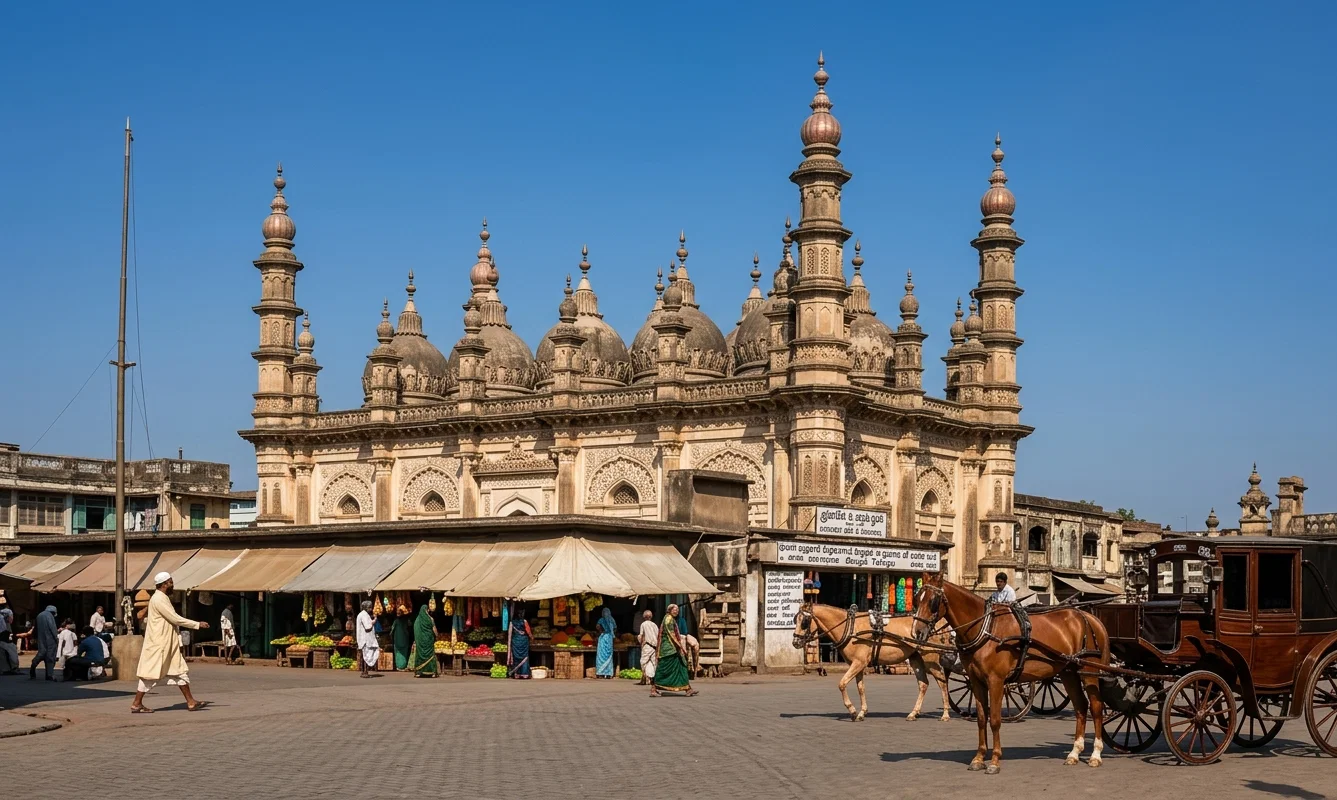
MOHAMMEDAN MOSQUE
MOHAMMEDAN MOSQUE
In the northern part of the presidency the language spoken is Telegu, while in the south it is Tamil. I have not yet had experience with the Tamil people. My work thus far among the educated Telegu Brahmans has convinced me that our health work would be much appreciated by these people, and would help to break down the prejudices which form such a barrier to the progress of Christianity among these people.
The Brahmans in southern India are strict vegetarians, and, unlike those of the northern provinces, do not even eat fish. As a class, these men are far more particular in regard to the observance of health principles, and the advice given in Good Health is eagerly sought and adopted, both as to diet and treatment, and somehow the little opportunity I have had thus far of working with these people has led me to the conclusion that if we had such an institution, it would doubtless have a good patronage.
When at Cocanada about ten days ago, I canvassed twenty lawyers, and secured eighteen subscriptions for the health journal. These gentlemen were so interested in our health work that they earnestly pressed me to give a public lecture at the Jajah’s college, on the principles of healthful living. This invitation I was constrained to accept, although pressed for time. Though the notice of the lecture was short, there were at least four hundred people who attended. This is proof that the subject is one which arouses interest among these people.
H. B. MEYERS.

Ten Years in Tennessee

Ten years ago I came to this State as a self-supporting worker. For about one year before coming here, the work of the Southern field was on my mind continually. I had no means with which to come here from Michigan, but I prayed to God, that, if it was his will for me to come south, the way might be opened; and he answered my prayer. Praise the Lord, I am still here canvassing, and expect to spend the rest of my life in the South, unless the Lord sees fit to call me elsewhere. I have enjoyed many rich blessings here, and can truly say from experience that God will certainly go with every one who goes out by faith to work for him. I first came to Nashville, Tenn., and remained there nearly four years, canvassing a large part of the time; I also worked in one of our missions for a while. At this place I had a severe sickness, and was brought to death's door; but the Lord spared my life, for which I am very thankful.
I have not been directly engaged in the canvassing work all the time, but my heart has been in the work, and I have found plenty to do in other lines. I have canvassed in a number of different towns, and in every place have found kind friends. I am now canvassing in Franklin. The Lord in a wonderful manner opened the way for me to come to this place, and I have never had more freedom in all the years I have canvassed, than the Lord is giving me at the present time. There are many places where canvassers are greatly needed here in the South; and, dear reader, if God is placing a burden on you to come this way, do not hesitate to follow the leadings of his Spirit.
I was in poor health when the Lord called me to the Southern field, but he has greatly strengthened me while working for him, and enabled me to place hundreds of our books in several places in this State. To his name be all the praise. Among some of the books I have sold here are “Great Controversy,” “Christ’s Object Lessons,” “Coming King,” “Steps to Christ,” “Christ Our Saviour,” “Our Paradise Home,” “Gospel Primer,” “Best Stories,” “Making Home Happy,” a few copies of “Desire of Ages,” and a number of Bibles. I have also taken quite a number of orders for The Signs of the Times, and have distributed thousands of pages of our literature in the form of tracts and papers. My courage was never better than now.
The work is onward in the South, and times are favorable for our work. Who will come and enter the harvest-field here? Some of the people are very hospitable to strangers, and are glad to get our books. From my experience in the work in the North and in the South, I see no reason why any one who can succeed elsewhere can not succeed here. True, there are some difficulties to meet here as well as everywhere, and one's faith is sometimes tested to the utmost, yet God has promised to be with us even unto the end.
Then let us go where the Lord calls us to labor in his vineyard, and with him as our leader, we shall have success. We may not always see great results from our work in this life, but God will bless the seed sown by faithful canvassers.
MRS. MINNIE HOYT PHILPOTT.
Franklin, Tenn.

British West Indies

ST. GEORGE, GRENADA.— We are in the midst of a most discouraging situation, but we were never of better courage. Grenada is, for various reasons, a difficult field, and therefore, is very interesting; for victory must come; and the harder the field, the more thrilling and interesting the achievement for the victory.
We have exhausted every means to find a suitable place for meetings, so we hold Sabbath-school and Bible readings in our home, until something better can be done. Only a few attend. We have increased our club of Watchman from two hundred to four hundred, and take fifty Good Health. My wife and I visit and canvass every day, holding readings and getting acquainted with the people. We hope to increase the Watchman order to at least five hundred. We find many kind, courteous, interested people among the scoffing multitude, and we are of good courage to keep on, for this message is bound to win. Most of my time I spend in the country, leaving the town for my wife to canvass.
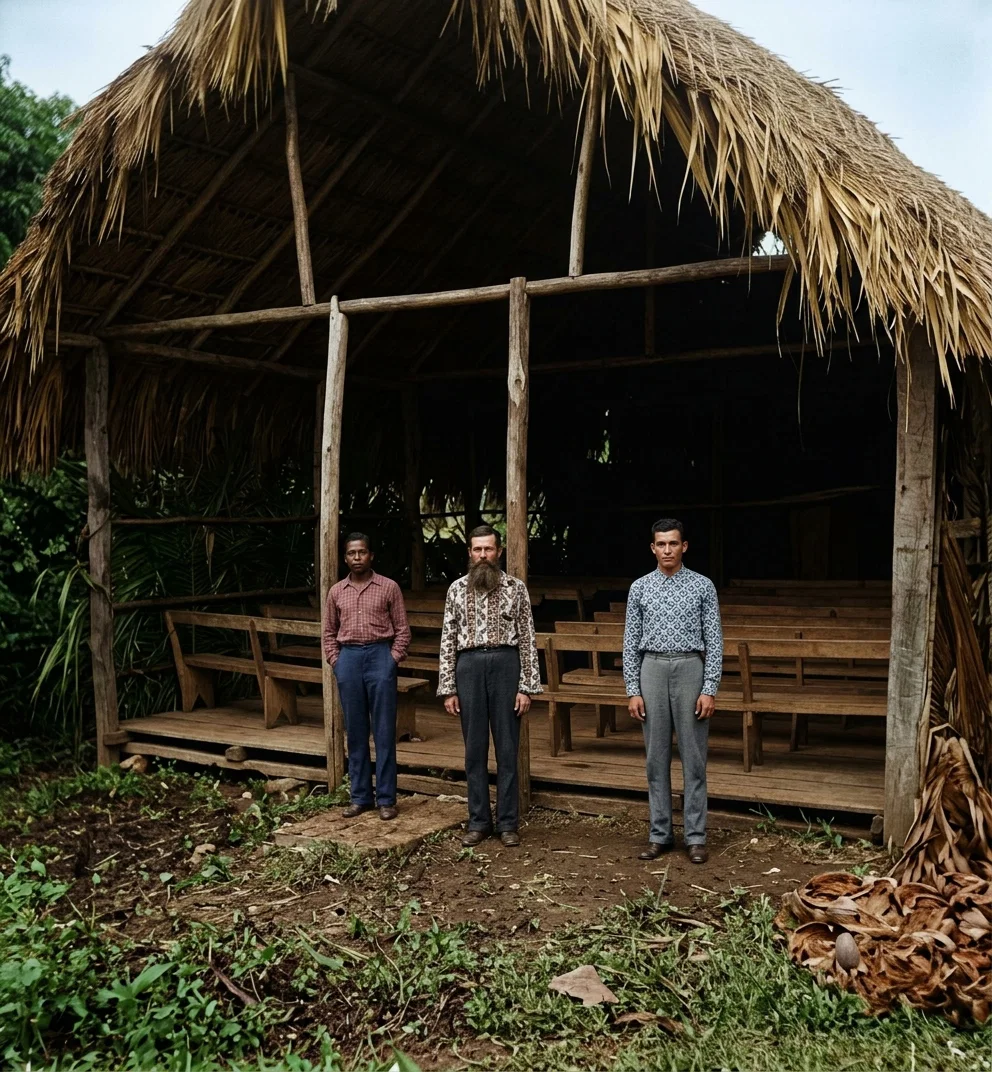
FIRST CHAPEL AT INDIAN WALK
Every Sunday afternoon we have an interesting outdoor meeting, two miles out. Several are apparently coming into the message there. My wife goes alone and conducts the meeting when I am away.
Several times lately I have walked twenty or twenty-five miles in a day, over the mountains, in the broiling sun, with a load of books and papers. And from ten to fifteen miles is my daily distance. Sometimes I make as many as two hundred calls, and sell from twenty to fifty papers or tracts. The vast majority of the people here do not have any money. Nearly all would buy if they had the means. My endurance is a marvel to the people, and, indeed, to myself. I do not know what weariness is, and often go all day with nothing to eat. The people take “tea” early in the morning, work all day, and have dinner late at night. So it is difficult to get anything during the day. In fact, I have more than once gone twenty-four hours with nothing to eat. It is even difficult to get fruit just now in most parts of the island. I used to think that one could pluck fruit anywhere by the way in the tropics, but there is not a place in the West Indies where you dare pluck a thing, even if you could find it. In fact, wherever we have been, they do not wait for things to get ripe before stripping the trees. Cocoa is twenty thousand bags short this year, and times are harder than ever before in the history of the island.
I spent last Sabbath with some new believers at the other end of the island. A good interest is manifested; I expect to hold a fortnight’s meetings there next month. I believe a company can be raised up, and a church built. Ground is offered free, by wealthy East Indians. They plead for a school, but we have no teacher and no means. They would support a teacher, however. If a force of efficient teachers could be sent into these fields, the work could be better and more quickly done, at far less expense than it is being done at present.
My wife and I go to Gongave to-morrow, to examine a house, with a view to moving there for a few months. There is a good interest in that place, and two Sabbath-keepers. So if the way opens, we shall leave the city and move into some country village for a few months, and then return here and storm the enemy’s earthworks again. We believe the Lord has a people in this island, and by his help we mean to find them.
The last week in March, I made a flying trip to Trinidad. Brother Enoch was there for a few days, and I wished to see him. It was a joy to meet our people again at Arima and El Mamo. The little church on which I worked so hard looked nice. They hope to dedicate it soon. The church was crowded on Sunday night. The work in Trinidad seems to be prospering. There is a good interest in spite of Satan’s efforts to scatter the work. The Indian Walk church is also nearly ready for dedication. The San Fernando church is going up, and I hope will be completed without delay.
We hope, by God’s help, to plant the truth so firmly in this island this year that Satan can never root it up. Then we shall be ready to go to Venezuela, or to any other place where the Lord may call us.
I am anxious to get to our eternal home. It seems to me that many of our people are content to stay in this world, wicked and dangerous as it is. If necessary, I can face death without fear; but I want to escape it, if I can. I hope the coming General Conference may be the last, and that it will bring such an outpouring of the Spirit that the whole denomination may report for service anywhere—not for a year or two, or till they feel sick or meet opposition, but till victory is achieved, or they fall at the post of duty—that is victory.
We follow the work in Washington with the most intense interest, and remember it daily in our family devotions. We rejoice in the advancement of the cause in all the earth. But if our people do not send help to Korea, China, Burma, and other fields where the Lord has so wonderfully opened the door for us, I fear for the results. And Spain, Portugal, Italy, Africa, and South America! When will our people awake, and give all of time, strength, and means? O the blessedness of giving all back to Him who died for us! We assure you that by God’s help we will hold this part of the advance line till victory is complete all along the line.
W. A. SWEANY.

Chile

V A L P A R A I S O.—We have just closed our general meeting in Valparaiso, and are all glad of the results. It was a peculiar meeting in many respects, but the Lord gave us the victory.
My wife has just written me that three men were there who live nine stations farther south than our home. They are Baptists, but have recently begun to keep the Sabbath. They said they represented three families, all the members of which are keeping the Sabbath. They had never seen an Adventist, but wished one of our workers to visit them. We made arrangements to have Brother Krieghoff visit them next Sabbath. You see, brethren, the calls for help are coming right along. My heart longs for a preparation to meet the needs of these earnest calls. F. H. WESTPHAL.

A Visit to Richmond, Maine

It was my privilege June 8-11 to attend the Maine general meeting held at Richmond, in the beautiful Kennebec Valley. This section is interesting on account of its reminiscences of the early days of the message, being the scene of Elder and Sister White's experiences and labors at that time.
At Topsham, not far away, many of the meetings were then held, and it was here that Sister White had some of themost important visions recorded in “Early Writings” and other publications. At the house of Sister Curtis, at Topsham in 1845, she held forth the large old-fashioned Bible weighing eighteen pounds; for a long time while under the powerful control of the Spirit, pointing out passages for the comfort and encouragement of the believers. It was during a general meeting held at Topsham in 1846 that she had the view of the planets and “gap in the sky,” related in “Rise and Progress,” which convinced Elder Joseph Bates that the visions of Sister White were from the Lord. She also had that year at Topsham, at the home of Brother Howland, the vision of the Heavenly Sanctuary, Time of Trouble and Deliverance of God's People, recorded in “Early Writings.” In 1849 at a meeting held at Topsham, Sister White made the remarkable prophecy in reference to the development of spiritualism to be found in “Early Writings.” And here Elder and Sister White set up housekeeping in deep poverty.
At Richmond we held our meetings in what was then the “old Reed meeting-house,” referred to in “Life Incidents,” where Elder White and others used to preach. I also enjoyed visiting what is now the home of Brother and Sister Webber at Richmond, a pleasantly situated and spacious rural homestead, with old-fashioned fireplace, where in those days Elder and Sister White found comfort and opportunity for writing.
The meeting-house, newly remodeled, is the meeting place of our little church in that community, which has been strengthened by some of our families who have moved there.
Many brethren and sisters came from other parts of the State to attend this gathering, and we had good meetings, blessed with the presence of the Lord. It was very impressive, now when this message has swollen to a “loud cry,” and is “returning East with power,” to stand and speak in this place which echoed to the first sounds of the third angel's message. As we looked back over the years of this generation, and saw how those first rays of light have spread to all the world, and as we reviewed the fulfilment of things foretold among us at that time, all hearts seemed confirmed anew in the testimony of Jesus.
Elder Bicknell, president of the conference, and Elders Goodrich and Hersum were present and spoke at the meetings.
LEE S. WHEELER.
Malden, Mass.

Ecuador

SINCE reporting to the REVIEW I have taken a trip up the Guayaquil and Quito Railroad, canvassing for books, taking orders principally for “Patriarchs” in Spanish. This was a pleasant change, after spending several months in Guayaquil.
My first work was in and about a small town called Milagro, where hundreds of people work during the summer season, gathering rice and sugarcane. All the land is owned by large landowners, so that a poor man, if he wants to work for himself, must pay a very high rent.
At that place, a rice miller, a German, invited me to stay at his house. He was a vegetarian, and I therefore gladly received the invitation.
At Naranjito, a little farther up the line, several Catholics attacked me with their arguments. One affirmed that my teaching was false, and that his Catholic Bible was the only true one. From his own Bible I showed him that his idea was wrong. Two gave me orders for “Patriarchs” at that store, and a laboring man bought “Steps to Christ.”
It is useless to solicit orders from the lower class, as they would seldom take their books. I always take a grip full of small books, and sell them as I go along.
My next stop was at Bucay, at the foot of the mountains. A Christian family who keeps a restaurant charged me nothing while there. One of them, a young lady, cried while she told her Christian experience—the only tears I have seen as yet here shed for Christ. This was worth all my trouble, and more. O if only our hearts could be kept melted with the love of Christ, that a change there would be in our own lives, and how many would see that we had been with him!
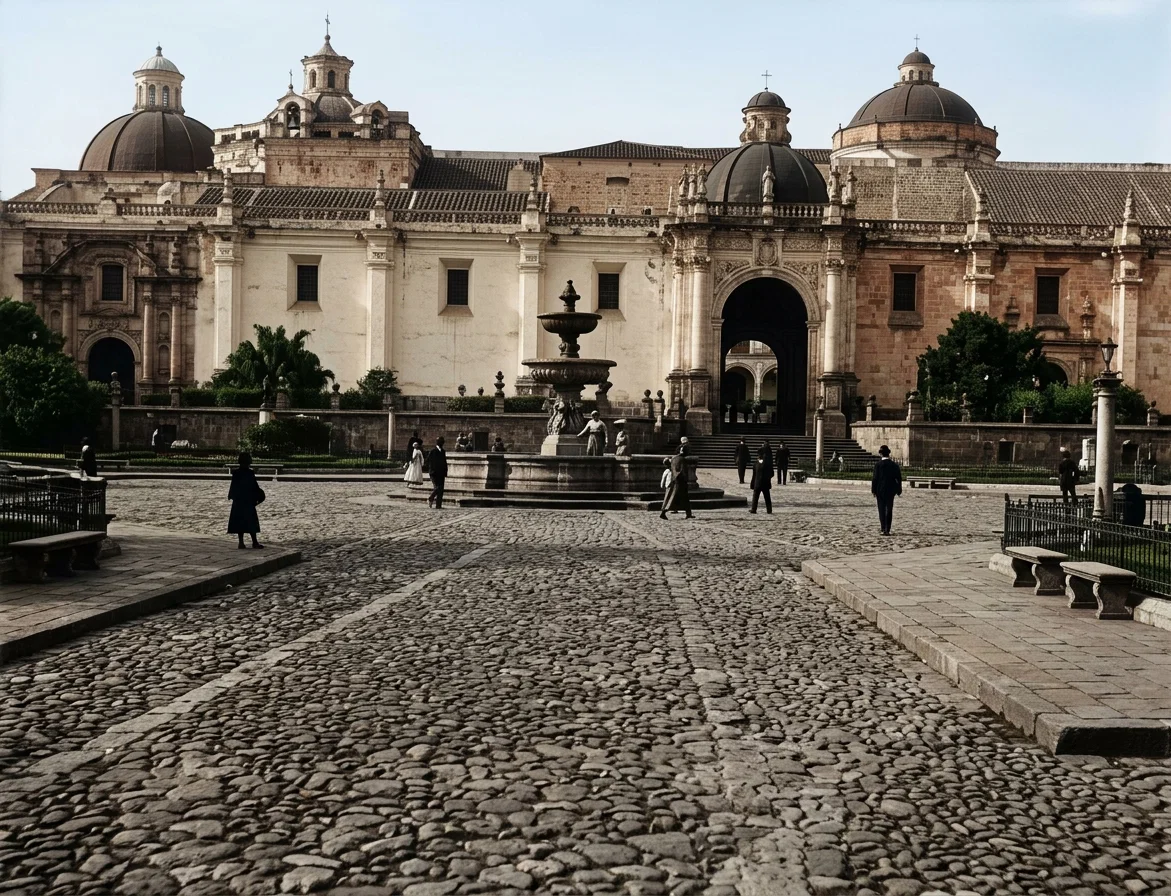
ONE OF ECUADOR'S CATHEDRALS
From Bucay to Huigra is the prettiest scenery I ever saw. The mountains are almost abrupt. The plants have leaves as large as a wash-tub. Flowers can be plucked from the car. There is such a growth of plants that the company occasionally sprinkles a poisonous liquid from the engine, to check this growth. Huigra is four thousand feet above the sea-level, and is supposed to have about the finest climate of Ecuador.
On asking for the general manager of the line, at Huigra, his secretary let me know positively that he could not be seen. As I passed his house, he came out, asked me to his office, paid me nine sucres for a book in advance, took me to his house, and showed me his splendid library.
The station-master treated me very kindly, also helped me to get more orders. While we were talking about the book, a young man of the laboring class drew near, asking that his name be put down for a book, at the same time giving me fifty cents to bind the bargain. He knew himself that his class is not to be trusted. Several colporteurs could work right along here, and have a choice of climate—warm, temperate, or cold. Every effort put forth to save others will be blessed by the Lord. I find this always true while out in the work.
In my last article I spoke of a club of about ten English Signs for this field, but as yet no one has responded. Only a few days ago a young man asked me if I had any more of those Signs, as he thought they were very good. He had to be refused, as there were none. Back numbers of the Life Boat, Signs, REVIEW, and Life and Health could be used to good advantage in this country among the scattered English-speaking people. As very little English reading-matter gets into this country, everything is read. Address the writer, at Guayaquil, Ecuador. T. H. DAVIS.
Continue reading: A “Memorial Church” in Nashville, Tennessee