Your ShelfYour Projects

Signs of the Times, Vol. 27, No. 26.

MOUNT HERMON

Signs of the Times

Jun 26, 1901

Pacific Press Publishing Company · Oakland, California · Jun 26, 1901

MOUNT HERMON.
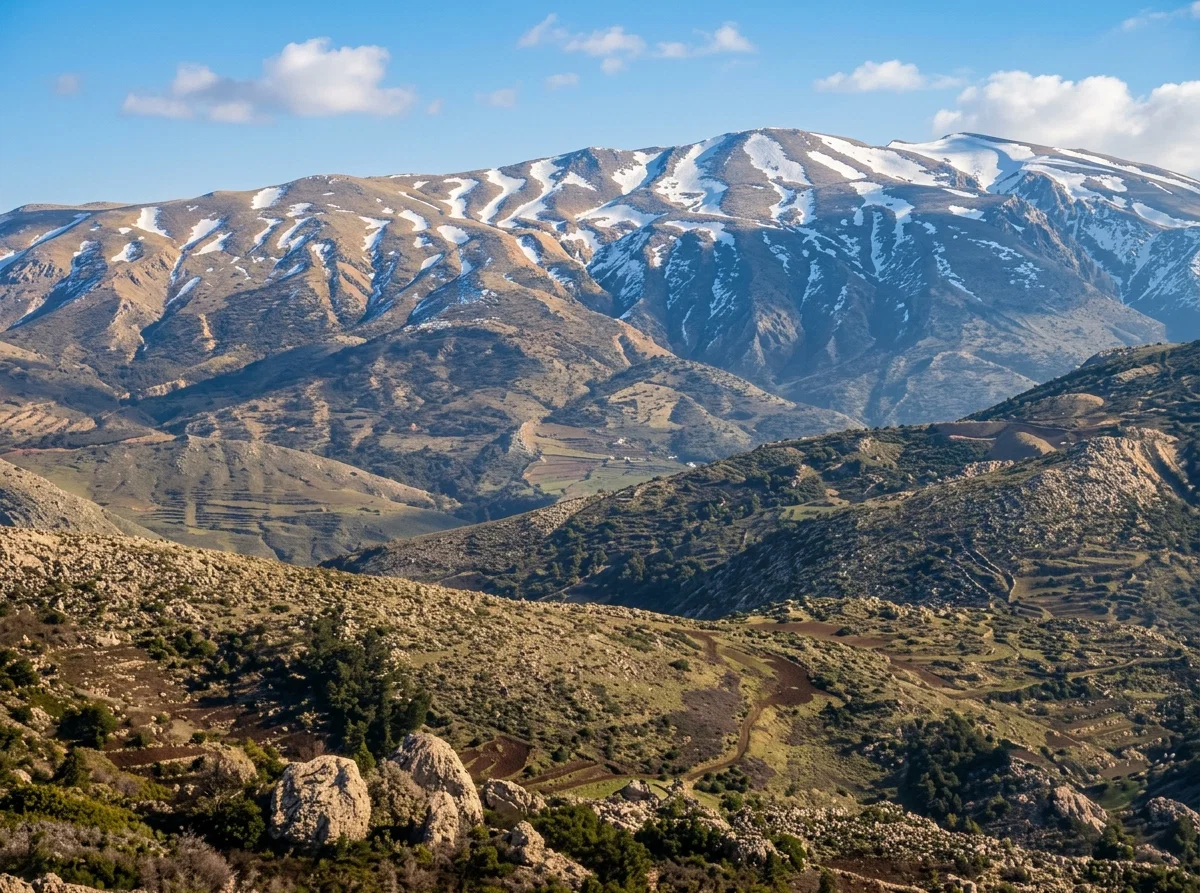
ON the east side of the Jordan Valley, at the southern extremity of the Anti-Libanus range, Mount Hermon lifts his hoary head into the air more than 9,000 feet above the level of the Mediterranean.
MOUNT HERMON.
MOUNT HERMON.
THIS lofty mountain, the highest in Palestine or its immediate vicinity, is situated on the northern border of the tribe of Dan. It was anciently a political center; for here converged the great ancient kingdoms of Syria—Bashan, Damascus, Phenicia, Israel.
HERMON is also “a grand central point in the geography of Syria and Palestine. From it radiate all the most noted rivers—the Jordan, whose fountains are fed by its eternal snows; the Abana and Pharpar, ‘rivers of Damascus;’ the Orontes, which swept past the walls of the classic and ‘Christian’ Antioch;” and the Leontes, tumbling over rocky precipices as it hastens thru its deep-cut channel to the sea.
“THE high mountains and the hills” were chosen by the ancient Canaanites as their places of worship; on these they erected temples and shrines to Baal, their sun-god. Mount Hermon and its vicinity abound in ruins of this character. On a rock that forms the crest of one of the peaks are curious and interesting ruins, including a small temple and fire-altar. These ruins are in a most picturesque location, on the brow of the mountain, overhanging a deep glen in which are the sources of the Pharpar. On the mountain and in its vicinity are the ruins of many other temples. These ruined temples indicate that Mount Hermon, the crown of “Lebanon toward the sun-rising,” was a center for the sun-worship of primeval Syria. “The glorious view obtained from it of the sun’s course, from his rising in the eastern desert to his setting in the great sea, would naturally mark it as the most fitting locality for his chief worship.”—Kitto, Cyclopedia of Biblical Literature.
MOUNT HERMON is not a single peak, but a cluster of mountains. From the central cone, which is itself divided by depressions into three distinct peaks, radiate a number of lofty ranges; but from a distance the mountain appears to form one great cone. So there is appropriateness in the psalmist’s words, “I remember Thee from the land of Jordan and the Hermons.” Ps. 42:6, R.V. One of its southern spurs is called Abu Nady, “the father of dew,” reminding us of the psalmist’s comparison, “As the dew of Hermon.” Ps. 133:3. A traveler says he encamped two nights at the base of this mountain; and “his tent was as completely saturated as if heavy rain had fallen.”
A NATURAL landmark of great beauty and interest is this loftymountain. In the clear air of Syria it can be seen from many places among the mountains and plains of Moab, Gilead, and Bashan, and from nearly every prominent point in Palestine, appearing as “a pale-blue, snow-capped peak, terminating the view on the northern horizon.” No doubt Moses saw Mount Hermon when from Mount Nebo, “that is over against Jericho,” “the Lord showed him all the land of Gilead, unto Dan.” Excellent views of the mountain are obtained from the plain of Esdraelon, on the borders of which Nazareth was located; and so to the Saviour it must have been a familiar object from His earliest years.
ONCE the Saviour visited Mount Hermon; for Caesarea Philippi, the northern limit of His journeying, nestles at the foot of one of its southern ridges, or, rather, is built on a broad terrace on the mountain-side, overlooking the rich plain of Huleh. It was near the close of His ministry that Jesus came here with His disciples. He was anxious about them. He knew the time was near when He should be offered up, the Sacrifice for the sins of the world; and notwithstanding all the instruction He had given them, they did not understand that His kingdom was not of this world. They still looked for Him to establish an earthly kingdom; how, then, would their faith stand the test that was so soon to come?
WHILE they were in this region of grand and picturesque scenery, the mountain with its rocky cliffs, its deep ravines, and its temple-crowned, snowy peaks in full view, Jesus had a memorable conversation with His disciples. “Whom,” He asked them, “do men say that I the Son of man am? And they said, Some say that Thou art John the Baptist; some, Elias; and others, Jeremias, or one of the prophets.” Then followed the important question, “But whom say ye that I am?” It was Peter who replied, “Thou art the Christ, the Son of the living God.” Christ indorsed Peter’s words, and declared, “Upon this rock I will build My church; and the gates of hell shall not prevail against it.” Matt. 16:13–18.
In this great political and religious center, evidences of power were all about Christ and His disciples. Above the town frowned the almost impregnable walls of the Castle of Banias, which from its rocky height for centuries commanded “the pass from the Huleh and the plain of Jordan over Hermon to Damascus and the East.” All around them were temples of Syrian, Greek, and Roman deities, each an evidence of Satan’s power to enslave the human mind with the fascinations of a false worship. There, too, stood the mountain, grander, stronger, and more enduring than any work of man. And there was “the Christ, the Son of the living God,” infinitely strong. Thru Him His church should be victorious over every enemy, human or Satanic. Would His disciples trust in Him when His cause seemed ruined?
THE faith of the disciples faltered in the test. It faltered; but it did not fail. Once, when some were offended, and leaving Him, Jesus had asked, “Will ye also go away?” And they had replied, “Lord, to whom shall we go? Thou hast the words of eternal life.” So it was now. To whom should they turn from Him whom they had believed and known to be “the Holy One of God”? John 6:67–69, R.V. Since that time the church founded on the Eternal Rock has had many fierce conflicts to pass thru; but its banner has never trailed in the dust, nor will it ever. The gates of hell shall not prevail.
“O Lord God of hosts, Who is a mighty One, like unto Thee, O Jah? And Thy faithfulness is round about Thee. Thou rulest the pride of the sea; When the waves thereof arise, Thou stillest them. Thou hast scattered Thine enemies with the arm of Thy strength. The heavens are Thine, the earth also is Thine; The world and the fulness thereof, Thou hast founded them. The north and south, Thou hast created them; Tabor and Hermon rejoice in Thy name.” Ps. 89:8–12, R.V.
E. J. BURNHAM.

SIN ALWAYS IN THE PLURAL NUMBER.

SIN never comes singly. There is no such thing as “just this once” about doing wrong. As the old proverb says, “Sin always has a sin on either arm.” The bad deed must support itself on this side and on that one by the false word. The foolish pride, which we half excuse, makes us commit the unkindness which we did not mean.
“Who knocks so loud? A little lonely sin! ‘Slip in,’ we answer, and all hell comes in.”
An old legend from the Jewish Talmud says that when Noah was taking the animals into the ark, the Lie came along, and wanted to be admitted, but it had no mate, and Noah said that all things must come in two by two; so the Lie went off, and found Vice, and asked her to come in also. Vice consented, but only on the condition that she should be given all the earnings of the Lie. And ever after what the Lie earneth Vice consumeth it. So is it always “a tangled web we weave,” when we begin the works of evil. There is only one safe rule—that is, “Avoid it, pass not by it, turn from it, and pass away!”—S. S. Times.

HURRYING HOME.

WE are sweeping along to the swing of time In the marvelous race of eternal years, Like the measured rune of a musical rhyme With its mingling sorrows and smiles and tears. 'Tis a grand old race we are sweeping thru, As the years go circling, one by one, From the hand of God out into the blue, Beyond the reach of the great white sun.
'Tis a pitiful race; for as days go by, There fall by our side, on the rugged road, The weak and the wilful, to droop and die 'Neath the crushing weight of a cruel load. The smart of the thorn is in their side; The bruise of the stone is a racking pain; Their woe is a badge which they can not hide; They fall as they struggle to rise again.
'Tis a wearisome race; for the load they bear Has bowed the back of the strongest men; And those who were anxious to do and dare Are whelmed in the ooze of a treacherous fen. The hours were long, and they labored late; The road was rough, and the mountain steep; A hand bore down like the hand of fate; They dropped by the wayside in troublous sleep.
'Tis a gladsome race; for they who cling To the hand of God up the rugged way Can rest refreshed, and rise and sing Thru the whole long span of the laboring day. Then the night comes down with its soft caress, And folds them in with a tender hand— A kiss on the brow and a prayer to bless, They peacefully enter the slumber-land.
'Tis a glorious race, and the goal in sight Is the city of God with its mansions fair; Thru all the dread of the darksome night Our Saviour was waiting and watching there. We are gathering home—'tis a glorious day; The harps are tuned for the welcoming song; We can almost hear, down the star-strewn way, The swelling tide of that choral throng.
Oakland, Cal.
C. M. Snow.

THE SIN-BEARER.

(See Sabbath-school Lesson, page 14.)
THE blood of bulls and goats can not take away sin. Heb. 10:4. All the offerings that man can make, all the services he can perform, can not wash white his sin-stained garments of character, nor change the nature he has received from his fathers. God gave no ceremonies or ordinances, He enjoined no offerings, to teach man that poor mortals could perform works of merit.
All the sacrifices ordained of God, all the services of the ancient sanctuary and temple, were and are to teach man that his salvation is wholly of God and His goodness. When man brought his lamb to the sanctuary, he was by faith to see in that lamb the slain Lamb of God. When the life of that lamb was taken, he was to see in that the life of the Son of God poured out for guilty man.
When the sinner brought his offering to the door of the sanctuary and placed his hand upon its head, confessing his sin, that offering stood for his sin. Sometimes the blood was borne into the sanctuary, sometimes the priests ate of the flesh; and it was borne in in their persons; but in one way or another the sin was remembered before God, in His very presence. The sinner must come in his representation into that presence. The offering, the substitute, must be a whole-hearted one, acceptable to and accepted by the great Judge.
All this ancient service was but an object-lesson of Christ and His service for the penitent in all ages. For “Him who knew no sin He [the Father] made to be sin on our behalf; that we might become the righteousness of God in Him.” 2 Cor. 5:21. We were sinners in ourselves, so identified with sin that we must suffer its finished product—death. He took our place. He died for oursins, because He could die for us no other way, we were so identified with sin. He became sin for us, yet never knew sin in His own life or purpose. Becoming our sin, He became our death, and we died with Him.
But He lives again, because He is righteous. “It was not possible that He should be holden of” the grave. Acts 2:24. Righteousness is life; and He who became personified sin and death for us, became personified righteousness and life for us. He therefore enters into the holy place, in the presence of God, pleading His own life in our behalf. He stands in His own person for us before the throne. His death stands for our death. His life of righteousness for our life, and in the very presence of God we stand acquitted, “accepted in the Beloved.”
In the presence of God that remembrance of sin goes on continually, and has since the first sin and the first sinner came in penitent faith before the Merciful One. So it will go on till the last sinner is separated from his sins, or chooses to eternity the sin. Then sin will be forever banished; it will be cleansed from the records in heaven and earth, and the universe will be free from its curse forever. It rests with us whether we shall share in that glorious fruition. The Lord is willing and able. STUDENT.

OUR GUIDE-BOOK.

WHEN a question was brought to Christ, the answer was, “Have ye not read?” “What saith the Scriptures?” Christ could have answered every perplexing question brought to Him, but He did not do this. He directed His questioners to the great storehouse of knowledge. He knew that He could not always be with them in human form, and He desired to teach them to make the Word their dependence. “Search the Scriptures,” He said. He referred them to His own inspired Word, that when tempted by the enemy they might meet him as He had done, saying, “It is written.” Thus the enemy could be repulsed; for he has no power over the one who relies on the testimony of God’s Word.
Of the Word of God the psalmist writes: “The entrance of Thy Word giveth light; it giveth understanding to the simple.” It is as a light shining in a dark place. As we search its pages, light enters the heart, illuminating the mind. By this light we see what we ought to be.
We see in the Word warnings and promises, with God behind them all. We are invited to search this Word for aid when brought into difficult places. If we do not consult the Guide-book at every step, inquiring, Is this the way of the Lord? our words and actions will be tainted by selfishness. We shall forget God, and walk in paths He has not chosen for us.
God’s Word is full of precious promises and helpful counsel. It is infallible; for God can not err. It has help for every circumstance and condition of life, and God looks on with sadness when His children turn from it to human aid.
As we receive physical strength from the food we eat, so we are to receive spiritual strength as we study the Word of God. It is as necessary that attention should be paid to the cry of the soul for spiritual food as that attention should be paid to the cry of a hungry child for temporal food. A neglect to supply the soul with the bread of life leaves it weak and strengthless, unable to do the will of God. The life of such a one is like the barren fig-tree, destitute of fruit.
He who converses with God thru the Scriptures will be ennobled and sanctified. As he reads the inspired record of the Saviour’s love, his heart is melted in tenderness and contrition. He is filled with a desire to be like the Master, to live a life of loving service.
Great light shone forth from the patriarchs and prophets. Glorious things were spoken of Zion, the city of God. Thus the Lord designs that the light shall shine forth thru His followers to-day. If the saints of the Old Testament bore such a bright testimony of loyalty, should not we to-day, who have the accumulated light of centuries, arise and shine? The glory of the prophecies sheds light on our pathway. Type has met antitype in the death of God’s Son. Christ has risen from the dead, proclaiming over the tomb, “I am the resurrection and the life.” He has sent His Spirit into our world to bring all things to our remembrance. By a miracle of His power He has preserved His written Word thru the ages. Shall we not, then, make this Word our constant study, learning from it God’s purpose for us?
The Bereans were commended as being more noble than those of Thessalonica, in that they received the Word with all readiness of mind, and searched the Scriptures daily. They did not search the Bible from curiosity, but that they might learn in regard to Christ. Daily they compared scripture with scripture, and as they searched, heavenly intelligences were beside them, enlightening their minds and impressing their hearts.
We are to open the Word of God with reverence, with a sincere desire to know the will of God concerning us. Then the heavenly angels will direct our search. God speaks to us out of His Word. We are in the audience-chamber of the Most High, in the very presence of God. Christ enters the heart. The Holy Spirit takes of the things of God and shows them to us. We see more clearly the greatness of God’s love and the fulness of His salvation. We appreciate more fully His gracious design to make us partners in the heavenly firm. We are drawn into full sympathy with the plans of God. His secret is with us, and He shows us His covenant.
The truth is likened to treasure hid in a field, “the which when a man hath found, he hideth, and for joy thereof goeth, and selleth all that he hath, and buyeth the field.” He desires to cultivate it, that he may obtain possession of its treasure. So we are to take the Word of God and search its pages, that we may find the treasures of truth. It is the Holy Spirit’s office to direct and reward this labor. The searcher finds lodes of precious ore, and he sinks the shaft still deeper for still more valuable treasure. The gold-fields of earth are not so closely interlaced with veins of precious ore as are the fields of revelation with veins of truth that bring to view the unsearchable riches of God. MRS. E. G. WHITE.

The Conditions of Heaven Unfavorable for Its Propagation or Repetition

THE END OF SIN'S DOMINION.—NO. 6.

The Conditions of Heaven Unfavorable for Its Propagation or Repetition.

Many excuse themselves in sinning under the pretext of unfavorable surroundings, or conditions which seem to make it impossible for them to resist temptation. It is a sad truth that multitudes of the human family are born and nurtured under the most sinful surroundings. The very atmosphere which they breathe is, in a spiritual sense, impregnated, surcharged with sin. Ample provision is made in the plan of salvation, so that such “may escape the corruption that is in the world,” and become pure in heart.
In the conditions, surroundings, and moral atmosphere of the redeemed, all things will be most favorable for the propagation of righteousness. Instead of misery and wo, as now, all will be happiness supreme. “I will rejoice in Jerusalem, and joy in My people,” says the Lord. “The loves and sympathies which God Himself has implanted in the soul, shall there find truest and sweetest exercise. The pure communion with holy beings, the harmonious social life with the blessed angels, and with the faithful ones of all ages, who have washed their robes and made them white in the blood of the Lamb, the sacred ties that bind together the whole family in heaven and earth,—these help to constitute the happiness of the redeemed,” and form a safeguard against the entrance of sin.
It is written concerning those of the children of men who do not put their trust in the Lord, but instead count Providence as blameworthy for their hard lot, “that when they shall be hungry, they shall fret themselves, and curse their king and their God, and look upward.” But in the happy estate of the redeemed there will be no hunger, no thirst, no discontent. All will have permanent homes. There will be no weariness, no tears, no insane asylums, no sickness, no death. These terms, all employed to express the results of sin, will be obsolete, and will not be needed in the vocabulary of the church triumphant, except, perchance, in referring to the great drama when sin reigned unto death.
In concluding our present study, let us recall the original and only cause of sin. Sin has many synonyms, but its true definition is, “transgression of the law” of God. When the Lord called His people out of the land of Egypt to serve Him under more favorable circumstances, He did not demand unreasoning obedience to His law, but rather appealed to a truth which was calculated to touch the deepest emotions of their hearts, and lead them to serve Him with joyfulness and gladness all the days of their lives. Consider their condition in Egypt. They were abject slaves, in the most cruel bondage; and kept in such ignorance that they were fast losing the knowledge of the true God, and had begun to worship the gods of their captors. They were deprived of that religious liberty for which millions have fought, and bled, and died. Their children were cruelly snatched from their arms and destroyed. They had no hope of better days, except in the promises of the God of Israel.
When the Lord had brought those strange plagues upon the Egyptians, by which His people were not afflicted; when He hadopened the Red Sea as a highway for the fugitive slaves, and had destroyed their enemies, both rider and horse; when He had sent bread from heaven for their hunger, and had given an exhibition of His power and majesty at Sinai, then, to preface His law, He presented this appeal, “I am the Lord thy God, which have brought thee out of the land of Egypt, out of the house of bondage.” Then followed the giving of the law, the doing of which was for their good always.
Now, just as certainly as the Lord saw the affliction of His people in Egypt, and heard their cry, and knew their sorrows, and sent a deliverer “to loose those that were appointed to death,” “to bring them unto a good land and a large, unto a land flowing with milk and honey,” so certainly has He sent a Deliverer in the person of His Son, to gather the true house of Israel, and deliver them from all bondage, both physical and spiritual, into the heavenly Canaan.
Not only during the sojourn of the literal house of Israel in the land of Egypt, but “in all ages the Saviour’s chosen have been educated and disciplined in the school of trial; . . . they were purified in the furnace of affliction. For Jesus’ sake they endured opposition, hatred, calumny. They followed Him thru conflicts sore; they endured self-denial, and experienced bitter disappointments. By their own painful experience they learned the evil of sin, its power, its guilt, its woe; and they look upon it with abhorrence. A sense of the infinite sacrifice made for its cure, humbles them in their own sight, and fills their hearts with gratitude and praise, which those who have never fallen can not appreciate. They love much because they have been forgiven much.”
“The heirs of God have come from garrets, from hovels, from dungeons, from scaffolds. . . . On earth they were destitute, afflicted, tormented. They are no longer feeble, afflicted, scattered, and oppressed. The days of pain and weeping are forever ended. The King of glory has wiped the tears from all faces; every cause of grief has been removed.”
In that day “they shall no more say, The Lord liveth, which brought up the children of Israel out of the land of Egypt; but, The Lord liveth, which brought up and which led the seed of the house of Israel out of the north country, and from all countries, . . . and they shall dwell in their own land.” This language might appropriately be used to preface the law of heaven, when all the redeemed are gathered home. What more could the Creator do to call forth from the ransomed, willing obedience to His law? As the glories and the bliss of heaven expand to the astonishment of the redeemed, while it will not be essential that they have the law of God in a written code as we now have it, yet the principles of that law will be engraved indelibly upon their hearts, and they will have no other gods before Jehovah. And having access to the visible presence of “Him who sitteth between the cherubim,” none will make graven images and bow down to them, nor cherish idols in their hearts. Neither will they take the name of the Lord in vain, as is all too frequently done in soulless prayer and in formal worship. The Lord says, “Before they call, I will answer, and while they are yet speaking, I will hear.” Instead of speaking the name of the Creator irreverently, they will recognize His majesty and greatness, and with adoring angels, bow before the throne crying, “Holy, holy, holy is the Lord of hosts.”
To illustrate the gladness and faithfulness of Sabbath-keeping in the world to come, let us suppose that all of God’s people in all the world were given the opportunity of attending one grand gathering, where the glory, and presence, and power of God could be manifested, even in greater degree than on the memorable day of Pentecost. Suppose, too, it was understood that all of their expenses would be defrayed, and all of their effects preserved in perfect safety during their absence from home. Certainly all would keep careful reckoning of the appointed date, and start in time to be present at the opening of the first meeting.
Weekly services will actually be held in the kingdom of glory, and will be attended by all of the redeemed; no matter how widely their routes of travel may diverge in the intervals between these convocations. Being then possessed of facilities of locomotion now utilized by angels in their ministry, and having the glorious prospect within their choice of meeting with Adam, Noah, Abraham, Elijah, John the Baptist, Paul, and all other worthies of the human family; and better than all else, of meeting with the angelic hosts, with Jesus the Saviour of men, and with God the Father, and of mingling their voices in such music as has never yet greeted mortal ears, they will not forget to count the days till the return of the Sabbath; and thus “it shall come to pass that . . . from one Sabbath to another, shall all flesh come to worship before Me, saith the Lord.” And the observance of the fourth commandment is to “remember the Sabbath day to keep it holy.”
The fifth commandment will be kept by supreme honor being bestowed upon the eternal Father, and due honors upon all others. As love will be the ruling power in each life, there will be no murder in the hearts of any, and consequently none in the overt act.
There will be no want there, and hence no temptation to steal from another, whether it be honor, or glory, or goods.
Where love reigns supreme, there can be no lying, but rather words of kindness, goodness, charity.
Each having all that heart can desire, and no possibility of coming days of dearth, and being wholly unselfish, there will be no enticement to covetousness.
To get a more comprehensive object-lesson of sin’s results, let us stop for a few moments, and listen in breathless silence. Then imagine all of the pain, all of the sorrow, all of the woe, all of the anguish with which humanity at this very moment is being racked, and let it all sweep over us in one overwhelming billow. Dear reader, are you not sick at heart at the thought of it? and don’t you feel an intense longing in your heart that you may get out of a sinful world into a sinless one?
Be of good courage, fellow-sojourner; for He will “not fail nor be discouraged, till He have set judgment in the earth,” and “affliction shall not rise up the second time.”
“I’m weary of staying; O, when shall I rest In that promised land of the good and the blest; Where sin can no longer her blandishments spread; Where tears and temptations forever are fled? “O Jesus, my Saviour, when shall I behold That morning long promised by prophets of old; When sin’s night of sorrow forever is past; And death’s silent captives are ransomed at last?” G. W. REASER.

REVIEW OF MR. GAMBLE'S BOOK.

“This or Nothing.”

I HAVE just finished reading the book entitled, “Sunday the True Sabbath of God,” by Samuel Walter Gamble. As I contemplate the work as a whole, I am forcibly impressed with its spirit of bitterness, which is manifest from the introduction to the finish. This alone shows the character of the book, and that it is not from above, but from beneath. “Beloved, believe not every spirit, but try the spirits whether they are of God; because many false prophets are gone out into the world.” 1 John 4:1.
This book attacks, especially, the Seventh-day Adventists. C. H. Fowler, in his introduction, accuses them of “giving way to the natural waywardness of the unregenerate heart, in robbing man of two-fifths of his natural expectation of life by taking away his divinely appointed day of rest, and increasing the power of temptation to the use of alcoholic stimulants to make up for lost rest.” On page 133 I read: “They are helping to drive to death, drink, and hell, hundreds of laboring men a week.” Again: “I feel assured that probably a half-dozen leaders among them will stoop to almost anything in order to carry their point.”—Page 134. On page 8 they are called “one of the greatest curses to the progress of Christianity.” These and other like statements need no other refutation than the teachings and practise of the people against whom they are made; but they reflect sadly on those who make them, and clearly show the spirit and character of their work.
It is well known that these people, the Adventists, are among the leading temperance-people of the world, and the strongest advocates for granting perfect liberty to all in keeping or not keeping any day, so far as human authority is concerned. Why, then, should such statements be made? It is sad indeed when professed teachers of the Gospel of Christ seem so indifferent to the truth in their arguments and charges. The last words on the first page of the introduction tell the whole story; they are, “It is this or nothing.” When Christ was on earth, the enemies of His work accused Him of causing people to break the Sabbath. Matt. 12:1–5. They also said, “Behold a Man gluttonous and a wine-bibber.” Matt. 11:19. These charges were false, but it was “this or nothing.”
Observe the same charges were made against Jesus that are now made against those who are attacked by this book. Jesus said: “The servant is not greater than his Lord. If they have persecuted Me, they will also persecute you.” John 15:20. If they would manifest such a spirit of persecution and hatred, and make such false charges against Christ, what can His disciples expect? If justice was denied a faultless one, we need not expect it to be shown toward His followers, who by nature are not perfect. But it is from the opposers of Jesus Christ that all thesepersecutions come, and all these false charges are from darkness, and not light.
If it is true, as this writer claims, that when people hear the arguments of these people, and do not obey them, they lose faith in Sunday and in their former teachers, give up their Christian profession, and by “hundreds a week” go into drunkenness and down to destruction, then without intending to do so he makes the strongest admission that the work he is opposing is the work of God; for if to reject is death, to accept is life. Faith is a gift of the Holy Spirit. 1 Cor. 12:9. And God never withdraws His Spirit because error has been rejected, but because of the rejection of truth. If one should hear heathen doctrines, and turn away from them, it would not cause him to lose his faith in God and in His Word and saving grace; it would not send him to drunkenness and death. Then what advocate of the Adventist faith ever made a stronger claim or better argument in its favor, than this author does when he says that those who reject its teachings go to death and ruin?
God’s Spirit is the spirit of truth, and is withdrawn when truth is rejected. It is ever so with the Gospel of Christ. To hear and reject is death; to hear and accept is life. Is this the fault of the Gospel? Is Christ to be blamed for the loss that comes to those who reject Him?—No, indeed. Neither are the Adventists to blame for the souls that lose their “rest-day,” “their faith,” and go to ruin because they reject what Adventists teach. In acceptance they would find rest, peace, faith, and life. A fearful responsibility rests on those who teach them to reject; to them come loss and wo. “Whosoever therefore shall break one of these least commandments, and shall teach men so, he shall be called the least in the kingdom of heaven.” Matt. 5:19. May the author under consideration, by the light of his own admission, see the error he is in. Truly it may be said, as was said of old, “Their rock is not as our Rock, even our enemies themselves being judges.” Deut. 32:31.
We might safely stop here our investigation of this work, the author having proved himself that his book is against the salvation of souls. But it may be well to examine some of the particular errors of the book. It admits that the Sabbath was given at the creation of the world, but claims that it was the same day of the week as our Sunday. This day the author thinks was observed for about eighteen hundred years, and then lost. He says the Israelites, while slaves in Egypt, kept the Egyptian Sabbath, Friday; but if one reads the account of their cruel bondage, he will scarcely conclude that the Egyptians gave them much time for Sabbath-keeping. One of Pharaoh’s complaints was that they were idle, and that Moses was the cause of their idleness. Doubtless this was true, as he taught them to stop work on the Sabbath.
At Sinai God gave the children of Israel annual sabbaths, which came on certain days of the month, and were to keep in memory events connected with their deliverance from Egypt. But contrary to Mr. Gamble, they had the weekly Sabbath before they reached Sinai. In Ex. 16:22–30 is given an account of some who broke the Sabbath, and it is said that that Sabbath was the seventh day. And it was not an Egyptian Sabbath; for verse 28 reads: “And the Lord said unto Moses, How long refuse ye to keep My commandments and My laws”—not Egyptian commandments, but “My commandments.” We are told in verse one that this was a month after the Israelites left Egypt. From ch. 19:1 we learn that on the third month and “same day” (that is, the same day of the month on which the people left Egypt) they reached the Wilderness of Sinai. Then Moses conversed with the Lord, and the people were given three days to prepare, before the law was spoken from Sinai. This shows that they had a knowledge of the seventh-day Sabbath, and were expected to keep it, before it was given from Sinai, and several hundred years after Mr. Gamble says it was lost.
About half of Mr. Gamble’s book is devoted to a discussion of the annual sabbaths, and showing, by the aid of a chart, that these sabbaths, being fixed to a certain day of the month, could not always come on the same day of the week. This conclusion was quite generally known long before the author “discovered” it, as he claims to have done. It rests on the simple fact that the days in a year or month are not divisible by the number of days in a week without a remainder. All this has no bearing on the question of a weekly Sabbath, and thus one half of the book may be set aside as wholly irrelevant. Its only use is to cause some to think the author has something, because he pays so much attention to it. If one stops and peers thru a crack in a wall, the passer-by will stop and look; and tho he moves on and sees nothing, he will think there must have been something there, or the other person would not continue looking. A list of these sabbaths, which came only once in a year, is given in Leviticus 23; and they are “beside the Sabbaths of the Lord.” Verse 38.
The author tries to connect man’s reckoning of first day with God’s reckoning of seventh day by saying that Adam’s first day was God’s seventh day. Of course Adam was created on the sixth day; but he says Adam did not see all that day, therefore he counts the seventh as his first day. According to this argument, if a child did not see all of the day on which it was born—and it probably would not—the next day would be its birthday.
The same Sabbath that was given in Eden was again mentioned and spoken by the Lord from Sinai. Ex. 20:8–11. Mr. Gamble is obliged to admit this, and then to save himself he says that the Decalog given there was not for the Israelites, but for the patriarchs. Think of it! for three days the people had been in great expectation, waiting to hear God speak to them. They are gathered at the mount, over which a heavy cloud rests. Suddenly there bursts upon the ear the loud, long blast of a trumpet; the mountain reels to and fro, and emits fire and smoke; the thunder rolls thru the heavens, peal after peal; above all, the voice of God is heard speaking the Ten Commandments. The people are afraid, and say to Moses, “Let not God speak with us, lest we die.” If Mr. Gamble had been there with his “discovery,” he might have said of the Decalog of Exodus 20, God’s spoken words, “The Lord is not giving this to you; this is for the patriarchs, who are dead”!
If a man were to admit in court to-day that he had violated a law, and that the law in question was the last act of the last legislature of that State, and then plead, “May it please the court, this law was not made for us; it was for Christopher Columbus and those who lived in his time,” that absurdity would fall as far below the one produced by Mr. Gamble as the finite mind is below the infinite.
W. M. HEALEY.
  • (Concluded next week.)

Selfishness, the Parent of Crime

Selfishness is the parent of crime. All crime and corruption, both in public and private life, finds its origin in self! self! Every drop of blood shed in battle, every tear coerced by poverty, every sigh for “lost happiness” in life, is a tribute—yes, a sacrifice—demanded in the worship of self. Two thousand years of Christianity have scarcely made an impression on the “old evil,” for it is a notorious and disgusting fact, that an appeal to man’s baser instincts brings a readier response than an appeal to his higher nature.

Conquering Self Through Christ

The grandest proverb that man's mind has yet produced is “Vincit, qui se vincit,” i. e., “He conquers who overcomes himself;” and the only way to conquer is by the merits of Christ Jesus our Lord, victorious thru a love mightier than self and death.

The Doom of Those Who Oppose Mammon

Whosoever preaches or practises against Mammon invites the prophet's doom—discredit, opprobrium, and a wounded spirit, if not a wounded body.

Prayer for the Soul-Fatigued

Prayer is a grand tonic for soul-fatigue. Life's greatest battle is a bloodless one— The silent strife of mental batteries— When Right dares Wrong, and only God looks on, As man, against himself, conquers or dies. Alamosa, Colo. FRED T. ELKIN.
Continue reading: THOUGHTS IN PASSING