THE Foreign Christian Missionary Society of the Disciples of Christ is sending a band of three missionaries to try to gain entrance into Tibet. The party consists of A. L. Sheldon and wife, of Kansas, and Dr. Susie C. Rignhart, of Canada. Dr. Rignhart and her husband explored a part of eastern Tibet several years ago, the husband losing his life in the undertaking.
EVERY once in a while I hear some one growl against foreign missions, because the money and the strength put into them are needed at home. I did it myself when I did not know better; God, forgive me. I know better now, and I will tell you how I found out. I became interested in a strong religious awakening in my own old city of Copenhagen, and I set about investigating it. It was then that I learned what others have learned before me, and what was the fact there—that for every dollar you give away to convert the heathen abroad, God gives you ten dollars’ worth of purpose to deal with your heathen at home. — Jacob A. Riis.
The Southern Union Conference
By N. W. Allee
AFTER an absence of nearly two years from this peculiarly interesting field, by recommendation of our last General Conference I returned, arriving at Nashville, Tenn., at the time of the council of the Southern Union Conference Committee early in May. There was quite noticeable improvement in the buildings and machinery of the Nashville publishing house during the time I was away from the field. I have been in this place nine months, and have watched the movements here with much interest, and wish to assure our brethren that I believe that the hand of God is evidently manifest in the work here. As to the need and importance of the publishing house in Nashville the Spirit of God has spoken, and his servants will act in harmony with the instruction. New machinery of the best quality is being placed in the buildings, and the equipment will be quite complete. This institution is rapidly gaining the confidence of the public as a thoroughly reliable firm financially, also as to the quality of work produced. This is encouraging to the friends here.
Since my return to the Southern Union Conference, I have labored in Kentucky, Tennessee, Georgia, Alabama, Mississippi, Louisiana, and Florida. Notwithstanding the difficulties to be met in this field, advancement is made, and the message is extending. Each branch of the work will receive encouragement, as there is evidently a determination on the part of the laborers to press together and seek for that unity that must prevail with the children of God. There is a growing interest in the educational work. The schools already established are being strengthened. Church schools and intermediate schools on the industrial basis are being started. The medical missionary work is having encouragement, and small sanitariums are being established in different sections of the South, the last one being at Nashville, Tenn. More vigorous efforts in evangelistic work will be made in new fields the coming summer.
The institute and session of the Southern Union Conference recently held at Nashville will have a large influence in shaping the future work in the South. The coming of Elder Haskell and his wife to connect with the interests here will greatly encourage and strengthen the work and the workers. We feel that this field is greatly favored by this addition of the aged and experienced laborers.
The circulation of our denominational literature by means of canvassing for the subscription books, also the selling of the smaller publications, including tracts and papers, is receiving much attention. It is being demonstrated that our weekly papers, neatly printed and put in attractive form, can be sold readily in the many cities of the South. There is a large field here, and millions of people who must hear the message, but the laborers are few. Hundreds more should be engaged in the work. Those having a burden to labor for souls, rather than to seek an easier and more lucrative position in life, can find plenty to engage them in this great field.
N. W. ALLEE.
British Central Africa
By Thomas H. Branch
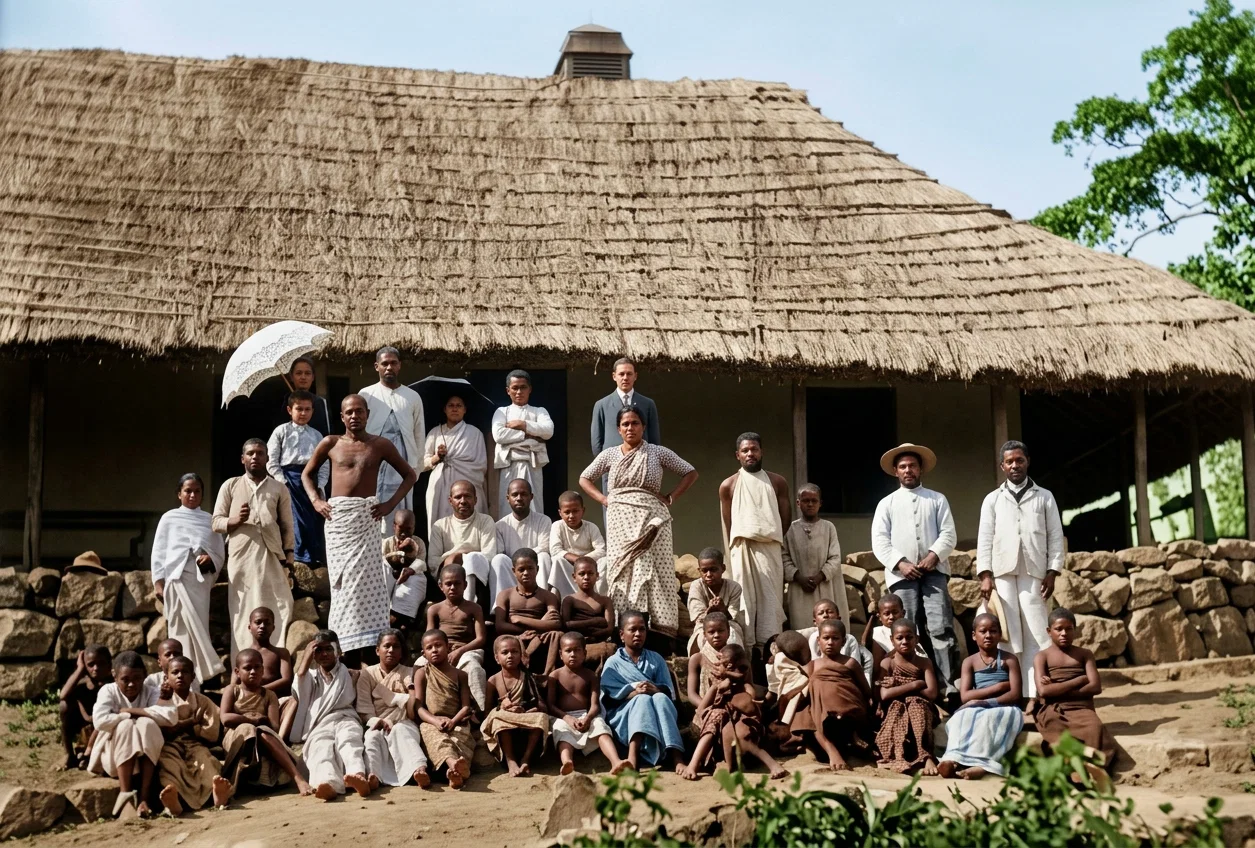
AN ASSEMBLY AT THE MISSION HOUSE
CULOLO.—God has blessed our labors here among this people. Many are willing and anxious to learn of Jesus and his love. They come from far distant villages to be taught how to read, that they may read God's Word for themselves. This they esteem as a great blessing, and are not only willing to walk long distances to be taught, but are willing to work and have the barest necessities of life, that they may gain this gift.
I believe that it is the providence of God that has sent us to them. They have a knowledge of their forefathers having been carried away long, long ago; and appreciate that we, of their own kindred, have returned to them with the knowledge of the true God, to teach them the better way to live, and to lead them to Christ. Men and boys come to study these things. Still there are thousands who have never heard of the message of salvation. The land is teeming with her millions in darkness—the darkness that Isa. 60:2 describes: ‘Darkness shall cover the earth, and gross darkness the people.’ Having eyes, they see not, and ears, but they hear not. Much needs to be done for them.
They must be taught how to till the soil, how to make and conduct their homes, as they have families; in short, they must be taught everything to make them men—such men as God would have them be. Families are needed to live among them as teachers. Young men and women are needed as instructors in the schools—young married couples are preferable. Those who come to this country should have one object in view, to raise the standard of the Lord, and build an altar to the glory of Jehovah.
This is a beautiful country, fertile and well watered, with luxuriant forests,—a well-favored land, bountifully supplied with all that is needed for the human family.
It will take a long time for a thorough work to be done, but the devotion of those who are Christians is very impressive, for they are indeed earnest, according to their knowledge. Some are much quicker to obtain knowledge than others. Last April I baptized five young men and one woman who were very earnest in the study of the Scriptures. They would sit in groups, studying the Word of God, and then come to ask for an explanation, as they make sure of a thing before making a decision. It would move one to greater diligence, to see with what carefulness they prepared the place for baptism.
My prayer is that God will send more workers into this part of the field. Brethren, pray for the work in Africa. We are of good courage to work as Christ directs.
THOMAS H. BRANCH.
New Jersey Conference Session
By H. W. Cottrell
THE second annual session of the New Jersey Conference was held at Trenton, N. J., Jan. 14-17, 1904. The churches were well represented, both by delegates and by visiting brethren and sisters. The business meetings of the session, as well as the other services, were characterized by the spiritual presence of the Lord.17
The conference changed its headquarters from Paterson to Camden, where its business can be executed to good advantage. The conference decided to establish a tract department, and thus hereafter manage its own book work, and direct its canvassers the same as other workers in its territory. It is certain that much more literature will be placed in the homes of the people when this department of the work is directed by the conference people who are located in the territory.
The last year has been a fruitful season in this conference, there having been an encouraging increase in church membership and tithes, as well as in general offerings.
The conference should sell about six hundred copies more of the book, “Christ’s Object Lessons,” in order to dispose of its quota. We arranged to distribute this work among the people, with the unanimous approval of the delegates. This will be a small task if all will take hold of the work with courage. The plan is to place these books in the homes of the people during the next few weeks. The talent most needed to complete this work, in this and other conferences which have not disposed of their quotas, is that of salesmen. The work should not be encumbered with too many generals. A very little effort by the multitude of our people, and the entire work would be completed.
Elder J. E. Jayne was re-elected president, and Mrs. J. W. Rambo, secretary and treasurer.
The brethren and sisters are of good courage in the Lord, and of strong faith in the speedy triumph of the message of truth.
H. W. COTTRELL.
The Training-School for Colored Students
THE idea of legitimate self-support is plainly enjoined upon us in the Word of God; and as people become civilized and Christianized, they advance rapidly in this virtue. Those who have active minds and strong bodies, and yet fall short of this, are lacking in that which should characterize the enlightened man, much more the Christian.
In all our Christian work, we find opportunities, yea, duties, of uplifting humanity,—of raising them to the highest level compatible with their abilities and circumstances. We should ever strive on until we become masters of circumstances.
The negro, as much as others, needs to learn this lesson of self-support, of self-reliance, self-government; he needs to develop his executive ability. To better train him in this respect, the Oakwood Industrial School inaugurated plans about a year ago whereby every student in its attendance should become impressed with the idea of earning everything he gets while at the school, except his tuition. It was thought that the tuition ought to be free, owing to the circumstances of many of these people, and also to the rates charged at other Southern schools devoted to this race. So now the student at this school either brings the cash to pay his living expenses, or works on the school farm until he can enter on a cash basis for at least one term. We urge, however, that every one before taking regular classes earn enough to take him through the entire school year. This does not debar these students from all class work; some evening classes are held, so that every one here may be doing some mental work all the time. These students also attend morning worship and evening chapel service. They are credited for their labor according to its value and their faithfulness and efficiency. All, whether paying their expenses with money or with labor, work fifteen hours a week, or two and one-half hours a day for six days of the week, during the school year. These plans sift the prospective students before they come here; we now get a better class of people; and the discipline is much less taxing upon the teachers.
When a student lacks clothing or supplies of any kind, and does not have the money to furnish himself with his necessities, he is allowed to work for the same at a proper rate, based upon the value of the needed articles. This we think a better training for usefulness in any capacity than the oft-repeated gifts made by some good but misguided people in many parts of this Southland.
The school, being dependent upon the denomination for its existence and support, is in great need of gifts of many kinds, but an individual here does not need them as a general rule. Donations of money, good second-hand clothing, dried fruit, etc., are much needed. Any money saved by these gifts of clothing and food, is carefully used in supplying much-needed facilities, repairs, and improvements. But, brethren and sisters, some things that have been sent here in the past have been of little or no value. Do not send anything that you would not wish to receive were you in our circumstances. Send things useful to a class of people from twelve to forty years of age, especially from about sixteen to forty. These people have self-respect enough to attire themselves neatly and becomingly; they will not wear any old article that may be picked out of the scrap bag or waste box. The school has had to pay freight on much such useless stuff. It is best to send things that are worth the freight, and then to prepay the freight. We are very thankful for many of the articles that have been sent here. By them the school has received many hours of work in reclaiming some of our waste land, etc.
Dear friends, we hope you will remember us in your prayers, and also in your liberal gifts. We need money and dried fruit the most. Let us hear from you. Address all communications concerning these matters to the Business Manager, Oakwood Industrial School, Huntsville, Ala.
East Michigan Conference
By M. Shepard
Mt. Clemens.— According to the arrangement of the conference committee, Elders B. F. Stureman and M. Shepard held a series of meetings with the Ithaca church, January 16-24. At the beginning, it seemed, as stated in Joel 2:2, first clause, “A day of darkness and of gloominess, a day of clouds and of thick darkness.” But as the trumpet was blown to call God’s people together, and the ministers were led of God to weep between the porch and the altar, saying, “Spare thy people, O Lord, and give not thine heritage to reproach,” then, as the morning spreads upon the mountains, removing the shadows of darkness, and waking the world to new life, so the Spirit of the blessed Master came in, things were set in order, and the glory of the Lord filled the tabernacle. Indeed, the land behind looked like a desolate wilderness, but the land before us as the garden of Eden, into which only the faithful and tried can enter. Let us strive to enter therein.
M. SHEPARD.
_The Jamaica Conference_
By J. A. Strickland
THE second annual session of the Jamaica Conference was held in the church at Kingston, January 1-6. The large attendance of brethren and sisters from all parts of the island at this time when the island is in such an impoverished condition, and is passing through such an experience of scarcity and suffering as her people have never known before, is a pleasing indication of the interest felt by our churches and companies in the precious message we represent. Perfect unity existed at all times in both the business meetings and the devotional services. I wish that our American brethren could have seen the love, faith, zeal, and intelligence manifested by our native brethren in all the deliberations and devotions of this conference. In spite of the devastation caused by the hurricane that swept Jamaica last year, progress was reported from every station.
Advance steps were planned, and we believe will be successfully carried out the coming year. A resolution was passed, which will call forth the energies of our people in the establishing of church schools throughout the island. The plan is for each church and company to create a school fund by selling our West India paper, the Caribbean Watchman, and the paper edition of “Daniel and the Revelation,” the profits derived from such sales to be donated as far as possible to the school fund. Whenever the school fund of a local church contains a sufficient amount to keep a teacher for six months, then one is to be supplied by the conference from a training-school that the conference expects soon to establish in Kingston.
The canvassing work received lengthy consideration. It was reorganized, and a general or island agent was appointed. Under the accepted regulations, we believe that this department will be able to show a gratifying increase of business at the next conference. The much-needed and long-talked-of treatment rooms were discussed, and it is expected that such an enterprise will be started during the next twelve months.
The past year eight church buildings were completed and dedicated. Two of the five churches destroyed by the hurricane have been rebuilt; the others are under course of construction. Number of baptized Sabbath-keepers in Jamaica, Jan. 1, 1903, 1,188; number added to church by baptism during the year, 174; loss during the year by death and apostasy, 12; number of baptized Sabbath-keepers, Jan. 1, 1904, 1,350. Tithe received by the conference treasurer during the year, $1,462.76; weekly offerings, $420.24; annual offerings, $128; total amount of tithe and offerings, $2,011.
Elder J. B. Beckner was re-elected president. Credentials were again given to Elders J. B. Beckner, J. A. Strickland, and W. Jay Tanner. Licenses were given to Brethren Hubert Fletcher, W. H. Randle, Methuselah Jones, and Frank Hall. Missionary licenses were given to Brethren Phillip Porter, Norman Johnstone, and Linton Rashford.18
The church was crowded to its fullest capacity at each evening service during the conference; and at the last service, Wednesday night, January 6, eight precious souls accepted the Lord Jesus. Thus Jamaica has ended its first year as a conference, and begun its second one. May the rich blessing of God continue to attend it until its work is finished, and probation closed.
J. A. STRICKLAND.
In Bonds for Christ
The following letter from Brother Baharian, addressed to Elder Curdy, tells the story of the progress of the message in the old field of Asia Minor, where the apostles once raised up churches and suffered for the cause of Christ:—
“CONSTANTINOPLE PRISON, Dec. 15, 1903.
“Dear Brother Curdy: November 20 I was called to the police court and detained. The second night thereafter I was examined about a letter I wrote three years ago, just after the decree of the Sublime Porte against us. In that letter, sent to one of our brethren, I had mentioned the prohibitive law against our work, and stated how we must now carry forward the task given us of God, and recommended the organization of tract societies for the distribution of our literature. I stated that the government can prohibit only our large meetings, and not the preaching of the message; that, if we are persecuted in one place, we should separate in smaller divisions, and meet in several places, and so on. The police secured this letter from one of our brethren who was spreading the message in Angora (Galatia), and who, for this crime, had been taken prisoner. The letter was then sent here.
“Understanding that we were still continuing our work, the president of police asked me many questions. I told him the truth. I said: ‘We obey the government, and must obey Jesus Christ, too. This prohibitive law is against the gospel, and we can not keep it.’ They tried hard to have me promise not to teach this religion, but I refused. The president was angry, and sent me back to prison.
“Next day my sister-in-law visited me. Through her I sent a petition to the minister of police, stating that my answer was already given five years ago: ‘I can not keep back from preaching the gospel.’ Three days later, at midnight, he called me again. After some conversation, he asked me to give bail that I would not preach. I replied: ‘This is impossible; I can not be disloyal to Jesus. It is better for me to be punished by you than for me to be punished at the judgment by him.’ He then said he would write this matter to the Sublime Porte. He sent me back to stay in prison until he receives an answer from the minister of the interior.
“I have sent a petition to the Sublime Porte, also, stating that we do not desire to be a separate nation, as others; but that we must preach the message, especially at this time when the end is so near, and the second advent of Jesus, and the hour of God's judgment is come. This message must be preached, that all may have opportunity to repent and have forgiveness of sin through the blood of Christ.
“The question has now come before the Porte for the fifth time. I have committed myself into the hands of our Father, and feel willing to bear anything that may happen. The minister would have me banished. This would also be good, if the Lord permits it. The answer from the Sublime Porte will hardly return within a month. Until then, I am detained. At present my place is good enough—the bedroom of the police. Every day I come in touch with many, and have interesting talks with them. A Bulgarian teacher is with me; though he is an infidel, he is studying the Bible. Pray for the cause. Let the name of Jesus be glorified. Salute the brethren. You may write this news to the REVIEW AND HERALD, that all may write in prayer.’
In sending the letter, Brother G. Dail, of Hamburg, Germany, adds:—
“The preceding letter has just been received here at Cologne. Feeling that it would be of general interest, I have copied it, and forward it for publication. We may read these things now; but there is a day coming when we shall more generally experience them in our lives. Nothing in this world is so urgent and so important as that we stretch our powers to the utmost, and put to good investment our abilities and our liberties and our means, in carrying the truth to all nations. What will be the value of our silver and gold, our houses and lands, our cattle and merchandise, when the true believers are cast into prison by the hundred, or driven from the cities, towns, and villages by the thousand? The year 1904 is the time for us to work; and we can never make a beginning any sooner than to-day. While some are imprisoned, and others are hunted like wild beasts, what are you doing now in the Master's vineyard? Solemn question! more solemn its reply.”
Another Forward Movement
By C. H. Jones
Change of Location of the Pacific Press Publishing Company
OVER twenty-five years ago the Pacific Press Publishing Company was incorporated and established its business at Oakland, Cal. Since that time there has been a wonderful growth, both in the business of the company and in the city itself. When the buildings were erected at the corner of Twelfth and Castro Streets, they seemed to be out in the country, as there were but very few houses within several blocks. But, as before stated, the place has grown, and now we find ourselves in the heart of a large city, with San Francisco just across the bay.
In the early stages of the work it seemed to be necessary to take in some commercial work in order to keep the employees busy and the machinery moving. This has served a good purpose by way of instruction and financial assistance, but several years ago it was seen that the commercial work was assuming such large proportions that it was interfering more or less with our denominational work. More than that, it was bringing into the office a spirit of worldliness and commercialism which was anything but desirable.
For over two years messages have been coming to the managers urging them to “cut away” commercial work, and move the office to some rural district, away from the demoralizing and corrupting influences of these large cities.
At the annual meeting of the stockholders held in Oakland, Cal., April 28, 1902, the following action was taken:—
“That we instruct the incoming board of directors to make a continuous effort to reduce commercial work, and develop the publication of religious, educational, and health literature.
“Also, that we recommend that the incoming board of directors dispose of the plant as a whole or in part, as Providence may open the way.
“We also recommend that, in case the plant is sold, a smaller plant be established in some rural district convenient for our denominational work, for the training and education of missionaries.”
The foregoing action was reaffirmed at the annual meeting of the stockholders held last year.
To some it may appear that we have been rather dilatory about heeding this instruction, but we wish to say that we have not been idle by any means. Since that action, negotiations have been entered into with various parties, but somehow,19in every instance, the way has been hedged up. Nevertheless we have tried to heed the instruction concerning the matter of curtailing commercial work and giving more attention to denominational business, with very satisfactory results. We are pleased to say that our denominational work is increasing right along, and the outlook is very encouraging.
Until quite recently we have felt that we could not move into the country until we sold this plant, buildings and all; but the way being hedged up, we finally decided to consider the advisability of moving the plant (machinery, etc.), and selling the buildings when we could.
We are in a splendid location, viewed simply from a business standpoint, and there is no question but that the buildings can be disposed of to advantage as soon as they are vacated.
As this question has been agitated, different places have been suggested by different ones, and all have received careful consideration. In making a move of this kind, several points must be taken into consideration:—
First, we were instructed to establish our plant in some rural district, away from the large cities with their temptations, surroundings, and trouble that is coming upon them.
Second, railroad facilities must be regarded; for at the present time we are using nearly two car-loads of paper a week. Our mail and express business is also quite heavy, and must be handled promptly. Banking privileges should also receive consideration.
Third, while we are looking out for the interests of the institution, we must also bear in mind the interests and welfare of our employees. We might find some place quite suitable for the factory so far as shipping facilities, etc., are concerned, but not at all desirable for our employees.
In the investigations that have been made, all these questions have been borne in mind, and the directors have finally decided to locate the plant at Mountain View, Cal. This is a small place about thirty-nine miles south of San Francisco, and eleven miles from San Jose, on the main line of the Southern Pacific Railroad running into San Francisco. It is a rural district, and a very desirable location not only for the plant, but also for our employees, as it is right in the fruit belt of the famous Santa Clara Valley, and land is quite reasonable.
The incorporated town of Mountain View has only about eight hundred inhabitants, but it is surrounded with small holdings of five, ten, fifteen, and twenty acre tracts, and settled up with a good class of people. Fruit of all kinds, and the finest varieties, are raised in this valley.
We have been very fortunate in securing for the factory a tract of five acres, fronting on the main line of the Southern Pacific Railroad, and near the station. The citizens of Mountain View have raised money to purchase this land, and put in a switch and side-track so that material can be loaded and unloaded right from the cars without hauling by team. This property has been donated to the Pacific Press Publishing Company. The citizens will also donate two hundred dollars to purchase a lot on which to build our church.
To further show the interest on the part of the citizens of Mountain View in this matter, we quote the following from a letter just received from the Board of Trade of that place:—
“Pacific Press Publishing Company,
Oakland, Cal.
“DEAR SIRS: The Board of Trade of Mountain View desires to express to you its pleasure in the knowledge of the fact that your publishing plant is to be removed to Mountain View in the near future, and that you are to become permanent residents of our thriving town. At its regular meeting held Thursday evening, January 21, the following resolutions were unanimously adopted:—
“Whereas, the Pacific Press Publishing Company, of Oakland, has decided to move its entire publishing plant to this city,—
“Be it Resolved, That we hereby extend to them a cordial welcome as members of our community, that we shall at all times be ready and willing to extend to them every courtesy and consideration, collectively and individually.
“That the secretary be instructed to mail a copy of these resolutions to the Pacific Press Publishing Company.”
“Respectfully yours,
“H. G. COPELAND, Secretary.”
Mountain View is near the lower end of San Francisco Bay, and there is a little inlet that runs up to within two miles of the city, capable of floating two hundred ton boats, thus giving us water competition. Fourteen passenger trains pass Mountain View each way every day, and ten of them stop.
We recognize the fact that this is a very important move, and that it means much to the institution; but it is right in line with the light that has been given, and we confidently believe that God will signally bless the effort. Indeed, we have already had remarkable evidences of his approval.
In moving to Mountain View, it is our purpose to eliminate commercial work, at least to a great extent, and give our whole time and attention to extending and building up our denominational business. In doing this, it can readily be seen that it will be absolutely necessary so to arrange matters that this business will be placed upon a paying basis.
Heretofore we have depended largely upon our commercial work to furnish the funds necessary for carrying on the denominational business, on which there was almost invariably a loss. This must now be changed; for we know that our brethren and sisters do not want to see the office running behind from year to year.
Plans have already been inaugurated with a view to placing the work on a paying basis, and we now ask for the hearty co-operation of our brethren and sisters and conference workers in helping to make them effective. And above all, we want your prayers and your counsel. The work is one, and we desire to unite our efforts with yours in trying to get this truth before the people in the shortest possible time. We believe that “the pillar of cloud is rising,” and it is time for God’s people to “move forward.”
In reference to the importance of moving our institutions out of the large cities, we quote the following from “Testimonies for the Church,” Vol. VII:—
“‘Out of the cities’ is my message. . . . The time is near when the large cities will be visited by the judgments of God. In a little while the cities will be terribly shaken. . . . The ungodly cities of our world are to be swept away by the besom of destruction.
“For years I have been given special light that we are not to center our work in the cities. The turmoil and confusion that fill these cities, the conditions brought about by the labor unions and the strikes, would prove a great hindrance to our work. Men are seeking to bring those in the different trades under bondage to certain unions. This is not God’s planning, but the planning of a power that we would in no wise acknowledge. God’s word is fulfilling; the wicked are binding themselves up in bundles ready to be burned.
“Light has been given me that the cities will be filled with confusion, violence, and crime, and that these things will increase till the end of this earth’s history.”
Already we see this prophecy being fulfilled in our land, and is it not time to heed the warning? We believe that our brethren and sisters everywhere will rejoice with us at the move which the Pacific Press is about to make.
Buildings must be erected, and we do not expect we shall be able to make the move till next July or August, but the work will be pushed forward as rapidly as possible.
C. H. JONES, General Manager.
In the India Mission Field
AFTER the late general meeting in Calcutta, the little band of workers went out into their vast field with hearts strengthened for service. Here is their report of distribution of labor, which we take from their little workers’ paper, Eastern Tidings. It shows how earnestly they are striving to cover as much territory as possible. Teaching, preaching, scattering the literature, praying, the band of workers go forth among the three hundred millions of India, Burma, and Ceylon:—
“In considering the needs of the field before us, we realized, perhaps as never before, that ‘the harvest truly is great, but the laborers are few.’ It is sad to contemplate that so few laborers can be found to work in a field where the need is so great.
“The following recommendations were made:—
“That Brother and Sister Meyers return to their field of labor in Burma.
“That Brother and Sister James take a canvassing tour through the North West and Punjab.
“That Brother and Sister Burgess take charge of the native training-school at Karmatar.
“That Sister Whiteis connect with Brother and Sister Burgess at Karmatar.
“That Sisters Orr and Jewett take a canvassing tour through the South, Madras, and Ceylon.
“That Sister Knight visit the North West and Punjab.
“That Sister Smith connect with the work in Burma.
“That Sister Fleming continue her work in Allahabad.
“That Brother Barlow continue his work at Simultala.
“That Brother Halder continue his work at Chinsura.
“That Brother Dewanji work with the Bengali population in the villages around Karmatar.
“That Brother Mitter continue his work in Calcutta.
“We earnestly pray that God may bless our little band of laborers as they go forth into the vineyard of the Master. The harvest time is near, and soon we may all bring our sheaves with rejoicing into the heavenly garner.”
The Truth on the Highways
By C. T. Jeffers
A NOTICE signed by the writer appeared in the REVIEW AND HERALD of December 17, last, stating that large quantities of our late English publications were wanted at Fruithurst, Ala. A liberal response was made to the request. Among others an elderly sister in Michigan sent a fifty-pound box, and wrote a letter from which the following extract is taken:—
“I noticed in the REVIEW AND HERALD of December 17, that large quantities of all our English publications were wanted at Fruithurst, Ala., and I hasten to send a supply that the church at —— has given me to distribute. I love this precious cause, and mean to do all I can to hasten the coming of the Lord in this generation. I am seventy-five years old, yet I hope to see my Saviour coming in the clouds of heaven.”
Thinking that perhaps those who responded so liberally would be interested in knowing what disposition was made of the literature they had sent, I will make a brief statement in regard to it. I live at the junction of two well-traveled roads, and I have put up a sort of rack by the side of each road, with an invitation to all to help themselves painted on each rack. I keep the racks filled with the papers. I put one copy each of the REVIEW AND HERALD, Signs of the Times, and Southern Watchman, and some tracts in a snug roll, and tie securely. Scarcely any one passes without taking a roll. The people seem hungry for the printed matter, and are interested in what it contains. My supply is fast diminishing. I will keep the racks filled as long as I am supplied. The field is large, and very many have never heard of the third angel’s message, and have but a vague idea of the near coming of the Lord. So, brethren and sisters, send papers and tracts that treat20on the Sabbath question, the near coming of the Lord, health and temperance reform, in fact, any and all the literature concerning the truth that you may have to spare, and let your prayers go with this reading matter, and I will put it in the hands of many people. It may be God will bless this work, and some souls will find the truth by this means. Address C. T. Jeffers, R. F. D. No. 1, Fruithurst, Ala.