Your ShelfYour Projects

Signs of the Times, Vol. 38, No. 11.

Important Articles in This Number

Signs of the Times

Mar 14, 1911

Pacific Press Publishing Association · Mountain View, California · Mar 14, 1911

Important Articles in This Number

The Law in the Christian Age Mrs. E. G. White 3
Protestantism Drifting, No. 1 George B. Thompson 4
Never Man Spake like This Man . . . . 5 Emma H. Adams
The First Four Trumpets (The Revelation Series) . . 6
Necessity of Christ's Second Coming . . . 8 George W Rine
Our London Letter . . 10
The Home . . 12
Missions . . 14
(For full Table of Contents see last page)

"IF YE WILL INQUIRE, INQUIRE YE."

This Inquirers' Department is conducted for the purpose of helping those who are studying the Bible. The answers are oftentimes only suggestive. They are never to be considered infallible, only as they agree with the infallible Word. The writer who may answer them does not consider that his opinion is infallible. He will simply give the best that he has, and plead with the inquirer to search the Word. Such questions only will be answered as, to the editors, seem to minister to the good of the readers and to the mission of the paper. We can not answer repeatedly in the same volume questions upon the same scripture. The name and address must accompany question, not for publication, but as an evidence of good faith, and that answer may be made by letter if deemed advisable. No letters are answered which do not contain the name of the writer. It is well always to enclose stamp for reply.

3373.—Forsaking All

Please explain Matt. 19:29; Mark 10:29, 30; Luke 18:29. Do these scriptures justify a man in forsaking his family for the cause of Christ?
God must be first. "Thou shalt love the Lord thy God with all thy heart, and with all thy soul, and with all thy strength, and with all thy mind." Luke 10:27, 28. Whatever comes between us and what we owe to God, must be left; but for a man to forsake his family and what he owes to them, he should have clear evidence that God has called him so to do. But the man who loves God as he should, will love his wife, and children, and family better than he possibly could if he did not love God. What God wants is that the whole family shall together follow Him. He who stayed with his newly-wed wife when God called was left. Luke 14:20. Note also verses 25 and 26. To the unselfish heart God's requirements are always reasonable.

3374.—Was Paul One of the Twelve?

Was the apostle Paul one of the twelve apostles? or was the choosing of Matthias approved of the Lord?
To the first question, no; to the last, yes. We do not see how one can read the inspired account of Acts 1:15-26 without believing that Matthias was one of the twelve. The record declares that Matthias was numbered with the eleven apostles. In chapter 6:2 he with the eleven is called "the twelve." Paul's conversion was some time after this. In Gal. 1:19 Paul calls the twelve the apostles. Yet Paul was as truly an apostle as any of the twelve. "Apostle" means one sent. Barnabas was an apostle, so also was Epaphroditus. See Acts 14:14; Phil. 2:25. "Messenger" means apostle, and comes from the Greek word apostolos. Jesus is also called "the Apostle." Heb. 3:1.

3375.—Shaking of the Powers of Heaven, Matt. 24:29

When does the shaking of the powers of the heavens take place? Is it before or after probation closes?
Compare Matt. 24:29 with Mark 13:25, 26; Luke 21:25-27; Joel 3:16; Rev. 6:14; 16:17, 18; Heb. 12:26. Note (1) that the shaking of the powers of heaven comes in direct connection with Christ's coming. There may be much or little time between the darkening of the sun and moon and the falling of the stars. The interval is covered by the flexible and indeterminate "and," but between the shaking of the powers of heaven and Christ's coming it is "and then," at that time. When the heavens are shaken, then Christ will come. (2) Joel tells us what causes the shaking. It is God's voice. (3) John tells us that the voice declares at the time of the seventh plague, "It is done." Heb. 12:26 shows that God's voice will shake both heaven and earth, even as the earth was shaken at Sinai. (4) Rev. 6:14, 15 indicates the same thing, and shows that when the heavens are shaken they will be rolled together like a scroll. After that there is no hope manifest among the children of earth. Verses 15-17. (5) In the plagues are "filled up the wrath of God." Rev. 15:1. There is no mixture of mercy in them. Man has rejected it all. Compare Ps. 75:8 with Rev. 14:9, 10. There has been the mixture of mercy throughout the ages, but under the plagues man will have rejected it utterly, they will not even repent of sin. (6) When that unmixed wrath is poured out, there goes forth from the great Judge the awful sentence that character is forever fixed. Zeph. 2:1-3; Rev. 22:11, 12. (7) The period of the outpouring of the plagues covers a prophetic day, or year. "Therefore shall her plagues come in one day." Rev. 18:8. This is "the day of the Lord's vengeance, and the year of recompenses for the controversy of Zion." Isa. 34:8. This year covers that little period of "quickly" just before the Lord comes. The shaking occurs in the very last of that awful first year after the close of probation. Read again Rev. 22:11, 12.

3376.—Death and Hell

Please explain Rev. 20:13. What does it mean about death and hell delivering up the dead? Is it the righteous only that are judged according to their work?
Verse 12 brings before us the judgment of the wicked dead. They all stand before God in the record of their work. Verses 13 to 15 relate to the execution of the judgment written according to their works. The righteous, those that have placed all upon Christ, and who have so died, or proved faithful to His coming, do not come into judgment. They are taken to heaven at the beginning of the thousand years. The word "hell" here means the grave or the abode of the dead. The power of death and the grave is forever broken. All have yielded to the mercies of our Lord Jesus Christ. Death and hell will be cast into the lake of fire, which will cleanse the world, and that will be the last of them. This is the second death, the death from which there is no resurrection, death in which death itself shall be forgotten.

3377.—The Tower of Babel

Can you inform me of the size of the tower of Babel?
If the Birs-Nimrod in ancient Borsippa is the ruins of the tower of Babel, it was two thousand feet around the base. Upon this were superposed seven stages. The first was 272 feet square and 26 feet high; the second, 230 feet square and 26 feet high; the third, 188 feet square and 26 feet high; the fourth, 146 feet square and 15 feet high. Above this was guesswork. It is thought, however, that it was 156 feet high. How much of this structure belonged to Nebuchadnezzar, who built the tower, is not known. The first stage was black, second orange, the third red. The other colors are guessed at. Others think that another ruin called Babil by the Arabs was the tower of Babel. It was 600 feet square at its base and probably 140 feet high. Birs-Nimrod, it seems to us, has the stronger claim.

3378.—Will It Come True?

When will Isa. 45:23 come true?
In the great judgment-day, when the glory of Christ in His followers shall be manifest. When the New Jerusalem, a pledge of the new earth, shall descend from God out of heaven, all will see that the Word of God is demonstrated to be true. Then all will be compelled to acknowledge Him, the righteous through love, the wicked through fear. See Phil. 2:9-11.

3379.—The Vision of the Chariots

Will you explain Zech. 6:1-8, especially the 8th verse?
This scripture was quite fully explained in the article "Out of Babylon to Zion," in the issue of September 6 of last year. In brief, these horsemen were explained to be God's messengers, sent out by Him to look after God's interests in the earth. They were war chariots, to wage battle and execute judgment. Each chariot is given a different field to watch over. Two go to the North, the general seat of all trouble; one to the South; and one passes over the great field to and fro. It represents God working among the powers of earth to bring deliverance to His people and help to Jerusalem. Rebellion in the provinces of Babylon and Media and war in Egypt were all quelled in order that the decree of Cyrus regarding the building of the temple might be carried out. The eighth verse shows that the trouble in the North which threatened God's work had been stayed. The book of Ezra should be read in connection with Zechariah and Haggai.

3380.—Joining Unions, Associations, etc.

Is it right for a Christian to join various worldly organizations?
It is not right for a Christian to join any association or organization by which he in any way compromises his faith or his freedom, or stultifies a good conscience. When one becomes a partner with those who are worldly and ungodly, he becomes a partaker of their deeds. The best rule to guide us is found in 2 Cor. 6:14-18. There are ways in which we may unite with our neighbors and fellow men to accomplish some object, but this must not compromise Christian freedom, faith, or practise.

3381.—J. Y.—Money for Foreign Missions.—

Money for foreign missions sent direct to the SIGNS OF THE TIMES, Mountain View, California, will be promptly forwarded. Designate the field or fields to which you wish your contribution to be sent. If left to us we will place it in fields which seem to us most needy.

3382.—E. C. W.—Thief on the Cross.—

See the article by Professor Rine in the SIGNS OF THE TIMES of March 7.
Schedule for Week Ending March 25, 1911

Schedule for Week Ending March 25, 1911

Sunday March 19 Psalms 12-17
Monday " 20 " 18-20
Tuesday " 21 " 21-25
Wednesday " 22 " 26-31
Thursday " 23 " 32-35
Friday " 24 " 36-38
Sabbath " 25 " 39-41
OUR reading for the week concludes the first book of the Psalms — numbers 12 to 41 inclusive. All these save one bear in their various titles "A Psalm of David." What an insight is given us of the shepherd-warrior-poet's experiences! Whether keeping his flock under the shining stars, or leading them to pastures green; whether fleeing from Saul, whom he in kindness ever spared, or surrounded by implacable and treacherous foes; whether among the folly and wickedness of men, or on the field of victory marvelously delivered from his enemies, we find his songs instructive, devout, helpful, elevating, worshipful.
How David mistrusted his own strength, and exalted the power of God! What confidence he manifests in God's might and goodness! How assured is he of the ultimate overthrow of all wickedness, and the triumph of all good! What a song of triumph, for instance, is Psalm 18! What a song of instruction and devotion is Psalm 19! How often have souls been cheered and comforted by Psalm 20! Wonderful lessons of trust and confidence in God are every one. In every one we may read somewhat of the experience of Christ, "great David's greater Son." How fully are Christ's sufferings prophetically depicted in Psalm 22! We do not need to mention Psalms 23, 24, 25, 27, 32, 33, 34, 37, 38, 40. Thank God for the songs of Israel. They meet great needs in every condition in life.

Question Corner

The Law in the Christian Age

By Mrs. E. G. White
AFTER the ascension of Christ, when His followers no longer enjoyed His personal presence and instruction, His disciples took up the work where He left it; and the words of truth, as they received them from Him who spoke as never man spoke, have come down to us clothed with divine power. Paul declared that he had taught the Ephesians "publicly, and from house to house, testifying both to the Jews, and also to the Greeks, repentance toward God, and faith toward our Lord Jesus Christ." Peter and the other apostles preached the same Gospel.
Why should the apostles teach repentance toward God?—Because the sinner is in trouble with the Father. He has transgressed the law; he must see his sin, and repent. What is his next work?—To look to Jesus, whose blood alone can cleanse from all sin. Faith in Christ is necessary; for there is no saving quality in law. The law condemns, but it can not pardon the transgressor. The sinner must depend on the merits of the blood of Christ. "Let him take hold of My strength," says our merciful Redeemer, "that he may make peace with Me; and he shall make peace with Me." Our Lord declared that he would love most to whom most was forgiven; and he only will feel that he needs forgiveness who sees himself as he is, defiled by sin, a transgressor of God's holy law. He who has the fullest conviction of the sacred claims of the law, will most clearly see the enormity of his offenses, and will feel that he is indeed forgiven much.

In Later Days

We are nearing the close of time; and a broader, clearer light than others have been favored with shines upon us. The mists are rolling away; and if we are humble students of the divine Word, its truths will be clearly revealed to us. But Satan and his host are warring against the commandments of God as never before. Every attempt is made to blind men's eyes to the truth. If it were possible, even the elect would be deceived. This is no common deception. Satan's great success consists in keeping men in ignorance of his devices; for then, through his subtlety, he can confuse the minds of the unwary, and, as it were, lead them blindfolded. He is close on the track of all who make profession of Bible truth. He is constantly planning their overthrow, and his temptations are soliciting them on every hand.
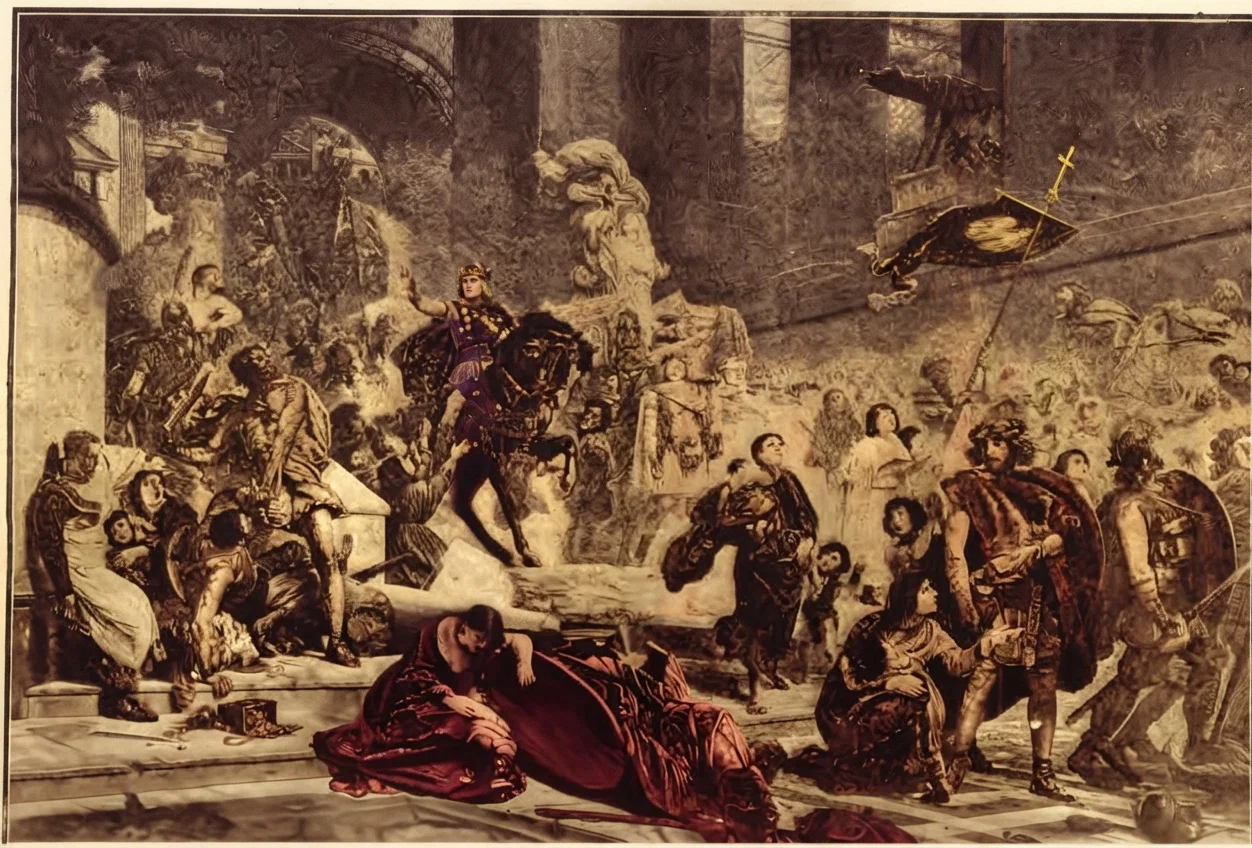
Capture and Sack of Rome by Alaric, King of the Goths, 410 A.D. (See page 6)
If there is one in a position to have a controlling influence over others, Satan works in a masterly manner to confuse that man's mind, and make right appear wrong, and wrong right. His suggestions are always designed to lessen the importance of God's requirements, and to set the mind at rest while the daily walk is contrary to the divine law, until finally the victim of his delusions flatters himself that he is walking with God, while he is all the time going contrary to His law.
Such persons think they have faith; but it is presumption. The great adversary has woven a snare for their feet; and when once they become entangled, he has no lack of agencies to involve them still more deeply in his toils. Thus the deception grows stronger and stronger until souls are involved in irretrievable ruin.

Every Soul Tempted

As Satan, the god of this world, tempted Christ in the wilderness, so he will tempt every son and daughter of Adam. Our faith will be proved, our motives and principles will be tested; and if we have not a daily, living experience in the truth, and a union with Christ, we shall be swept away from our steadfastness into the error of the wicked.

A Proved Armor

If we could always remember that Satan comes to us in disguise, his motives concealed, and he himself clad in garments of light, we would be on our guard, and would not fall a prey to his devices. A defense has been furnished us. Says the apostle, "Put on the whole armor of God, that ye may be able to stand against the wiles of the devil."
This is a safe armor, but it is not safer than we need; for the apostle continues, "We wrestle not against flesh and blood, but against principalities, against powers, against the rulers of the darkness of this world, against spiritual wickedness in high places." We should study the nature, character, and extent of this spiritual wickedness in high places, lest we become the dupes of the powers of darkness. But how difficult it is to awaken minds to realize the continual activity and great earnestness of our wily foe, notwithstanding the warnings and cautions of the Bible, and the experience of many who have been overthrown by his subtlety! The testimony loses its force; the warning passes out of the mind. Men cease to watch and pray; they do not solicit the aid of holy angels, who would lift up for them a standard against the enemy.
When this earth's history shall close, there will be only two divisions,—the righteousand the wicked. Every man, woman, and child will be found in one of these two armies. Jesus will be the leader of the righteous, and Satan of the opposing hosts. The angels who kept not their first estate, but left their own habitation, are rebels against the law of God, and enemies to all who love and obey His commandments; and all who are breaking, and teaching others to break, the law of God, the foundation of His government in heaven and on earth, are cooperating with these fallen angels in their work, and are marshaled under the same chief, who directs their operations in opposition to the government of God. These will seek to strengthen their forces by gathering as many as possible into their ranks; and they will annoy and harass, falsify and misrepresent, all whom they can not influence to join them in their work.
Some who are unacquainted with the Bible think that what the ministers tell them must be true. They do not, like the noble Bereans, search the Scriptures for themselves; but they accept the statements of those who have studied the Word of God, not to learn the truth, but to sustain false doctrines, to justify their own theories. Many times these false theories are a jumble of inconsistencies; and if men would use their reason, and take the Bible as it reads, they would see the absurdity of their positions. The plain “Thus saith the Lord,” would dispel their errors, as the mist is dispelled by the glories of the rising sun.
As Protestants, the Bible, and the Bible alone, is the foundation of our faith; but by many “the fathers” are quoted as authority. They do not come as humble learners in the school of Christ, saying: “Lord, what I know not, teach me. ‘Open Thou mine eyes, that I may behold wondrous things out of Thy law.’”
Says the wise man: “Let us hear the conclusion of the whole matter: Fear God, and keep His commandments: for this is the whole duty of man. For God shall bring every work into judgment, with every secret thing, whether it be good, or whether it be evil.” Men may close their eyes to the plainest truths in the Word of God, they may trample His law under their feet; but that law, instituted in the beginning, proclaimed from Sinai, and engraved on tables of stone, will judge them in the last day.

Protestantism Drifting

I. The Foundation

THE Bible and tradition are the confessed foundation of Catholicism. This is well expressed in the Douay, or Catholic translation of the Scriptures, in a note on 2 Tim. 3: 16, which reads:
But if we would have the whole rule of Christian faith and practise, we must not be content with those Scriptures, which Timothy knew from his infancy, that is, with the Old Testament ALONE: NOR YET WITH the NEW TESTAMENT WITHOUT TAKING ALONG WITH IT THE TRADITIONS OF THE APOSTLES, AND THE INTERPRETATIONS OF THE CHURCH, to which the apostles delivered both the Book, and the true meaning.
Through centuries of darkness this huge system held sway. The light of heaven was extinguished. The minds of men were shackled by ignorance and superstition. The Bible was suppressed, chained to dungeon walls. “Men forsook the precious perfume of faith, and bowed down before the empty vessel that had contained it. They sought other bonds of union, for faith in the heart no longer connected the members of the church. . . . The living church retired gradually within the lovely sanctuary of a few solitary hearts, an external church was substituted in its place, and all its forms were declared to be of divine appointment. Salvation no longer flowed from the Word, which was henceforth put out of sight. The priests affirmed that it was conveyed by means of the forms they had themselves invented, and that no one could attain it except by those channels.”
At this midnight hour the Reformation began, and Protestantism was born, declaring that the “Bible and the Bible only” is the rule of Christian faith and practise.

The Famous Protest

In the famous protest of the princes made at the Diet of Spires April 19, 1529, it was declared:
Moreover, the new edict declaring the ministers shall preach the Gospel, explaining it according to the writings accepted by the holy Christian church; we think that, for this regulation to have any value, we should first agree on what is meant by the true and holy church. Now seeing that there is great diversity of opinion in this respect; that there is no sure doctrine but such as is conformable to the Word of God; that the Lord forbids the teaching of any other doctrine; that each text of the Holy Scriptures ought to be explained by other and clearer texts; that this Holy Book is in all things necessary for the Christian, easy of understanding, and calculated to scatter the darkness,—we are resolved, with the grace of God, to maintain the pure and exclusive preaching of His Holy
Word, such as it is contained in the Biblical books of the Old and New Testament, without adding anything thereto that may be contrary to it. THIS WORD IS THE ONLY TRUTH; IT IS THE SURE RULE OF ALL DOCTRINE AND OF ALL LIFE, AND CAN NEVER FAIL OR DECEIVE US. He who builds on this foundation shall stand against all the powers of hell, whilst all the human vanities that are set up against it shall fall before the face of God.
This, D'Aubigné says, constitutes the “very essence of Protestantism.” Its foundation is the Bible without tradition; the Bible as it reads, without the private interpretation of priest or prelate or council, is the rock upon which true Protestantism is founded. And it never can have any other. When it ceases to stand on this foundation it ceases to be Protestantism. When once Protestantism accepts human philosophy, scientific speculations, and evolutionary hypotheses instead of the revealed truth of God's unerring Word, the edifice rests on the sand, instead of a rock, and must fall, and only ruins mark the spot where once stood the magnificent temple of the Most High God.
The Bible alone! What an adamant foundation! What an impregnable Gibraltar is this! The trituration of time has pulverized to dust proud, ambitious nations. As another has truly said, the proudest monuments of Rome's imperial greatness are to-day vast ruins. The destructive accidents of passing ages and the vengeance of barbarians have desolated her palaces and broken her sculptures. The palaces of the Caesars lie desolate, and the laws imposed upon the world then are buried in the dust of ages. The dynasty of the Caesars has sunk into oblivion, and her rulers are black with infamy. Other nations have passed from the map, and the most enduring structures reared by ambitious man have fallen into decay and long since have been forgotten. But the Word of God still lives, and is written in the hearts and minds of men and women scattered in every land and in every clime. Translated into hundreds of languages, printed in thousands of editions, and scattered by hundreds of millions of copies, the words of the King of Kings have indeed gone to the ends of the world. While the thirty thousand gods of the Roman pantheon are cast to the moles and bats to be worshiped no more forever, the Word of God stands fast forever, and the true God is enshrined in the hearts of millions of subjects in all lands. And it was on this immovable, eternal, imperishable, indestructible foundation Protestantism was planted by the Almighty.

Work of Unbelief

But unbelief is seeking to chisel away the foundation of faith; men are seeking to remove the pillars, dig up the foundation, and destroy the structure, and take from man his only hope—the Holy Scriptures—which in all the storms and distresses of life has been an anchor to the soul. Hastings well says:
While men who believed the Bible have been translating it into hundreds of languages, and printing it in every tongue for which the type-founder has ever cast a type; while they have given this book and the beginning of a literature to nearly a hundred nations and tribes who never had an alphabet or a written page before; while they have founded by their researches the science of comparative philology; while they have made more discoveries in geography than all other explorers; while they have penetrated the jungles of India and the depths of Africa; while they have opened the gates of Japan, and invaded the domains of the false prophet; while they have passed the Chinese wall, and traversed the icy heights of Tibet; while they have converted heathen, civilized cannibals, and carried art, literature, commerce, and education to the ends of the earth; these apostles of doubt and criticism and unbelief have nursed their theories, drawn their salaries, smoked their pipes and drunk their beer, and tried to prove the Bible a mass of fables.
Everything that can be shaken will be shaken, but some things which can not be shaken will remain. A story is told of a lunatic who, finding his way into a crowded church and grasping one of the pillars supporting the gallery, said, “I am going to pull the house down!” Timid women screamed and shouted; but an old minister calmed the tumult by crying out, “Let him try! let him try!” So there are men who are perfectly willing to have the critics try their hands at the Bible, and will abide the results. If they can grind it to powder let them do so; if they grind themselves to powder it will only be another instance of the rat gnawing the file.
But while infidelity has always trained its guns on the Word of God, there is at the present time a departure more marked than hitherto from the “faith once delivered to the saints,” on the part of professed Protestantism. The drift with the ebbing tide away from the foundation, is truly alarming, and is fraught with great significance. And it is this drift that we wish especially to call attention to in remaining articles of this series.
As we look out into the world we behold a sea of lost humanity. We look at professed Protestantism, and there is apparent a distressing dearth of spiritual power. Many churches are withering and dying. Their leaders are cold, worldly, formal, and lifeless. Real ministerial power is becoming a rare article. Men like Wesley, Whitefield, Moody, and others are growing fewer. There is much pomp and show, glittering generalities, expensive churches, fine organs, great singers, educated pastors who read sermons with precise and polished diction. But there is one universal lament that sinners are not moved as they once were. A few thousands are spent for the thousand million heathen, while millions are expended on the lusts of the flesh. Apostolic power has departed.
Something has happened, this is certain. We believe the explanation of the difficulty is found in the departure from the Word of God. That which gave the Reformation its power was not numbers, but its adherence to the “Bible and the Bible only.” When this is given up, and spiritual power is gone, the Gospel is still the power of God unto salvation for the believers.
In future articles we will mention some things that indicate a radical departure of Protestantism from its foundation of the “Bible and the Bible only.” We will do this not as a critic, but as a friend, deeply concerned and solicitous over the situation, and with a desire to awaken those who should be awakened to the condition, and check, to some extent, the tide that is fast drawing many away from the Word.

The Religion of the Bible

By George E. Tack
RELIGION, all beneficent and pure, A boon and solace for the dying race, I hail thee, bearer of God's truth and grace. Tho oft defamed, thy character secure Abides with God. Thy love is sweet and sure, And leadeth thee to scorn apart to dwell, In cloister dim or solitary cell. All vain their hopes who thus their lives immure.
So many creeds, so many ways to bliss, And still with blood of martyrs reeks the sod. Each false religion's voice but leads amiss, Like Eden's serpent, to the Babel crowd. But thou, Religion, dost consist in this,— The joyful doing of the words of God.

"Never Man Spake like This Man"

By Emma H. Adams

To be assured of the foundation upon which the officers made this least expected report to the chief priests and Pharisees, who had sent them to apprehend Christ,—present that day at the Feast of Tabernacles in Jerusalem, and teaching great facts and mighty truths to the people in the temple,—it is but necessary to read, with mind alert for light and food, the wonderful scriptures of John 5: 19-47; 6: 3-63; 7: 28-44.
The amazing, inspiring words of the sixth chapter were spoken in Capernaum, to a company of people from across the Sea of Tiberias. They had come from "nigh unto the place" where Christ had enacted the wonderful miracle of the loaves and fishes.
Discerning quickly the motives and impulses which led to their hasty trip across beautiful Galilee, Jesus, with noble candor, sent His first utterance to the very place in their being which most needed remedial treatment, saying, "Ye seek Me, not because ye saw the miracles, but because ye did eat of the loaves, and were filled."
That is, they had not been impressed so much by the gracious kindness, the tender pity, the great might, manifested in the miracle; by the fact that out of infinitesimal supply immense provision had been made; as by the comforting fact that when intensely hungry and far from supplies they had been fed generously and were satisfied.
But that hunger, that filling, had now brought them to Him who could assert, without possibility of refutation: "My Father giveth you the true bread from heaven. For the bread of God is He which cometh down from heaven, and giveth LIFE unto the world"—a greater thing than earth-produced loaves and fishes.
Then followed a talk to those across Galileans, to which the literature of mankind presents no equal; a talk exceeding all power of man in its inspiring super-earthly promises. Notice one or two: "I am the living bread which came down from heaven: if any man eat"—by faith—"of this bread, he shall live forever." "Whoso eateth My flesh, and drinketh My blood"—by faith—"hath eternal life; and I will raise him up at the last day." "Him that cometh to Me I will in no wise cast out." Surely, in all this, "never man spake like this man."
Four times in that unparalleled address does Christ, the Son of God, promise the hearers, without reservation or modification — and all other men from that day down — that all whom the Father has given Him, all who come to Him, all whobelieve in Him, all who eat His flesh and drink His blood, shall have eternal life, and He will raise them up at the last day.
Well might that audience have declared, as did those officers later in Jerusalem, "Never man spake like this man."
No one can study down, down into the profound intent of all those rare, hitherto unuttered, living words, words full of might, words that take hold of the very rootlets of man's being, without asserting with heart and soul, "Never man spake like this man."
No one can think out and out into the glorious possibilities they disclose, into the exalted development they foreshadow, into the beatific conditions of life they unveil, into the long eternity of gladdening service they suggest, the elevated companionship with Christ and with God they picture for redeemed men and women, but that they will cry out, "Never man spake like this man."
There have lived of our race many gifted, eloquent speakers and orators; men who have had original and impressive modes of expressing their ideas; men who have swayed audiences powerfully, stirring their emotions extremely, exciting fading hopes, arousing courage, clinching right purposes, awakening dormant action.
Yet, not one of these great orators has been able, of his own inherent power, to bestow "eternal life" upon those who should believe on him; not one could promise distinctly, absolutely, to raise such believers from their graves, restoring to them at that moment the "principle of life," which at death had "returned to God who gave it." Eccl. 12: 7; 3: 19-21. Not one of them ever "spake like this man."
Not one of them could announce to an audience, as did Jesus that day to that company at Capernaum, "He that believeth on Me hath everlasting life," "The words that I speak unto you, they are spirit, and they are life." "I am the bread of life: he that cometh to Me shall never hunger; and he that believeth on Me shall never thirst." "Never man spake like this man."
These are figurative statements of highest spiritual import. Christ's "living" words become to us spirit and life when we weave their true, deep intent into our daily deeds; when we let them influence the total trend of our thought; when they mold our wayward purposes into harmony with God's salutary will; when we make them a shapely cast for our complete personal character.
But what were the words of Christ that impressed the officers commissioned by the chief priests to bring Him before them, to account for the doctrine promulgated by Him?
We find the Saviour not now in Galilee, but in the temple at Jerusalem, about the middle day of the Feast of Tabernacles, actively, earnestly instructing the people.
It would seem, from the account given by John,—7: 15-17,—that the apostle must have omitted an important portion of the Saviour's discourse that day. Verse 15 shows that His subject, His full knowledge thereof, and His marked ability in treating (Continued on page 9)

"Never Man Spake like This Man"

(Continued from page 5)
it, astonished His hearers greatly, for they "marveled, saying, How knoweth this man learning [margin], having never learned?"
Replying to their criticisms and questions, Jesus said: "My doctrine is not Mine, but His that sent Me. If any man will Do His Will, he shall know of the doctrine, whether it be of God, or whether I speak of Myself."
The entire theme and tone of the teaching, as given, differ immensely from the exalted instruction imparted at Capernaum, and given in chapter six; yet, every sentence is weighted with cutting truth; carries the impression of unlimited power; displays tenderest sympathy for the race of which He was a part; dispenses to faulty people ever needed, ever practical advice; betrays no fear of human authority.
The Lord charges some of His hearers with going about to kill Him. Verse 32 discloses the reason. On a previous visit to Jerusalem (John 5: 16) He had healed a helpless man on the Sabbath day, at the Pool of Bethesda. For this infringement of tradition, and because of divided sentiment as to His authority, the Pharisees and chief priests sent officers to take Him.
Why did they not take Him? "His hour was not yet come." In God's plan for this earth, which holds most wonderful place in His universe, events occur on the day, at the hour, at the moment, appointed by Him, tho the appointments have been made centuries before.
After Christ's supreme test in the wilderness, after His baptism, He went into Galilee, crying, "The time is fulfilled." Moses led Israel out of Egypt the very day God had promised Abraham the event should occur. In John 17: 1, Jesus, lifting His eyes to heaven, said, "Father, the hour is come." In Rev. 22: 10, John was instructed to seal not the prophecy of that book, for the time was at hand. So not until His hour came, could any man lay hands on Him.
"In the last day, that great day of the feast," Jesus stood and uttered some remarkable sayings to the people, making Himself the distinct center of their application. John 7: 37, 38.
These sayings, together with His assertions, "Ye shall seek Me, and shall not find Me: and where I am, thither ye can not come;" "If any man thirst, let him come unto Me, and drink. He that believeth on Me, . . . from within him shall flow rivers of living water," are probably some of the words in the mind of the officers when they reported to the authorities, "Never man spake like this man."
And to-day, whoever reads and thinks deeply into these columns of mighty truths spoken by Christ on the many different occasions recorded by John, must admit, as did those officers, with absolute conviction, "Never man spake like this man."
Continue reading: An Alarm of War