Your ShelfYour Projects

Review and Herald, Vol. 87, No. 6.

Lost Chords
Earlier text: What Remains to Be Done

The Southeastern Union Conference

THE first biennial session of the Southeastern Union Conference since its organization into a separate union conference two years ago, was held Jan. 11-18, 1910, in the Seventh-day Adventist church in Atlanta, Ga. An encouraging number of delegates and laborers were present, representing the various conferences and institutions in the union conference. Also Elders A. G. Daniells, C. F. McVagh, A. J. Haysmer, Dr. W. A. Ruble, and the writer attended the meeting and shared with the workers in the burdens and blessings of the conference.
The reports rendered from the various conferences and institutions showed a good degree of progress, and that the formation of a separate union in this territory was a wise one. The tithe paid in the union in 1909 was about twenty-five thousand dollars, as compared with eighteen thousand dollars in the same territory two years ago. At that time the offerings to missions was about five cents a week for each member. In 1909 the amount given by the members in the field averaged about nine cents a week for each member. This compares favorably with some of our more wealthy conferences in the North. In the Georgia Conference the amount given for missions was sixteen cents a week per capita, and in Florida it was twelve cents. This indicates a deep interest in the progress of the work in fields outside their own territory. The book and periodical work showed encouraging growth, being about double in 1909 that of the sales of the previous years.
The business of the conference was marked with the utmost unity. Progressive plans of work were laid, and the outlook for the advancement of the work is very hopeful. Elder W. A. Westworth having gone to China to take charge of the work in that field, my brother, Elder Charles Thompson, who had been invited to take charge of the work when Elder Westworth left, was elected president, Brother R. T. Dowsett secretary and treasurer, and Helen Dowsett missionary secretary.
It seems to me that the openings for work in this Southland are especially encouraging at this time. Doors are open everywhere. The people seemingly show a greater willingness to listen to the message than in some other places. Now is the time to push the work in this field.
It is not more institutions that are needed so much as aggressive, evangelistic work to establish churches in the cities and villages. This field is in need of more experienced laborers. By supplying these, believers can be multiplied, and the work strengthened.
Omens of progress and business activity are seen here in the South. The cities are growing, factories are springing up, and the country is rapidly coming to the front. The outlook is favorable that the work in this field will soon become self-supporting, so far at least as the white population is concerned.
At the close of the conference, I visited Graysville, Tenn., for the first time, and was favorably impressed with the neat, comfortable institutions located there. The sanitarium in many ways has an ideal location, and should be filled with patients. I found an excellent class of students in the academy. About eighty are in attendance, omitting those from the primary grades. But they have room for more. If all our people in the territory within reach of these institutions rally to their support as they should, both of these training institutions can be filled with our young people to be trained for service. I enjoyed the privilege of speaking twice to the students. I trust that from this center many will go out to labor in the fields, both near and far off.
G. B. THOMPSON.

A Letter From India

AFTER brief stops at Nashville, Tenn., Washington, and New York, we set sail Oct. 14, 1909, for India, landing at Southampton, England, October 21. From there we went to London, where we stayed twenty-one days. Most of this time was spent in visiting the many things of interest found in the world's metropolis.
November 13 we took the boat for Bombay, India. It was a long but pleasant journey of three weeks. On our way we called at the famous rock of Gibraltar; Marseilles, France; Port Said, Egypt; and Aden, Arabia. The last place named is supposed to be the hottest place in the world. Europeans live there but a short time.
On landing at Bombay, December 3, we were met by Elders J. S. James, W. W. Miller, and G. F. Enoch, and Dr. H. C. Menkel. They seemed glad to see us, and gave our party a hearty welcome to the great field of India.
After staying a few days at the home of Elder Enoch in Poona, our party broke up, and we went to our several places of labor. Brother R. B. Thurber and family and Miss Estella Secrest went to Burma, Brother S. A. Wellman and family to North India, Brother A. G. Kelsey and wife stopped in West India, while Mrs. Lowry and I were sent to South India with Elder James. We are to labor among the Sabbath-keeping Tamils, of whom you have heard so much.
Upon our arrival at the place where we are to locate, a reception was given by the natives in our honor. To show their pleasure in having us come to their village, the band came out and marched in front of the bullock carts in which we were riding. The streets were crowded with people from all over the village, anxious to see the new man and woman from the other side of the world. As soon as we reached the house, they all came for the reception, bringing with them sugar, limes, and bananas, which were given to us as tokens of friendship and welcome. In their speeches of welcome they told of their history; how some fifty years ago they began to keep the Sabbath, and how glad they were that our people had come among them and had given them additional light.
Our hearts were certainly touched as we saw these simple souls, on the Sabbath, come to the house for their service, bringing with them money, rice, eggs, gee, etc., as offerings to the Lord. They are very strict, in a way, in keeping the Sabbath. They do no work of any kind, not even their cooking. If they can not save their food over from Friday or eat it uncooked, they simply wait until after sundown, then prepare their food. In their meetings they use the psalms for songs. Even the small children who are not old enough to wear clothing of any character, except a cotton thread around the waist, can repeat psalm after psalm without making a mistake.
We have a very peculiar situation here, and see great possibilities before us. These people are not Seventh-day Adventists. They must be trained so that they will be. There is a great work before us, and we need the wisdom of God that we may know how to work for these people and train them up for Jesus. We need the prayers of God's people.
MR. AND MRS. G. G. LOWRY.

Our Sanitariums

Our sanitariums occupy an important place in the work of the third angel’s message. The purpose of this message is to prepare a people for the second advent of Christ,—a people who will stand without fault before the throne of God. Great reforms will necessarily take place among them before Jesus appears. To teach these reforms and urge them upon men and women is the chief work committed to these institutions.
Those who have ruined their health through ignorant violation of nature’s laws may in these places learn how to co-operate with nature in an intelligent manner in health restoration. As thesimple remedies of nature are employed, God’s special blessing is added in answer to prayer, and healing takes place. We have seen marvelous cures wrought in our sanitariums in the past, and no doubt in the future even more of God’s power to heal will be manifest.
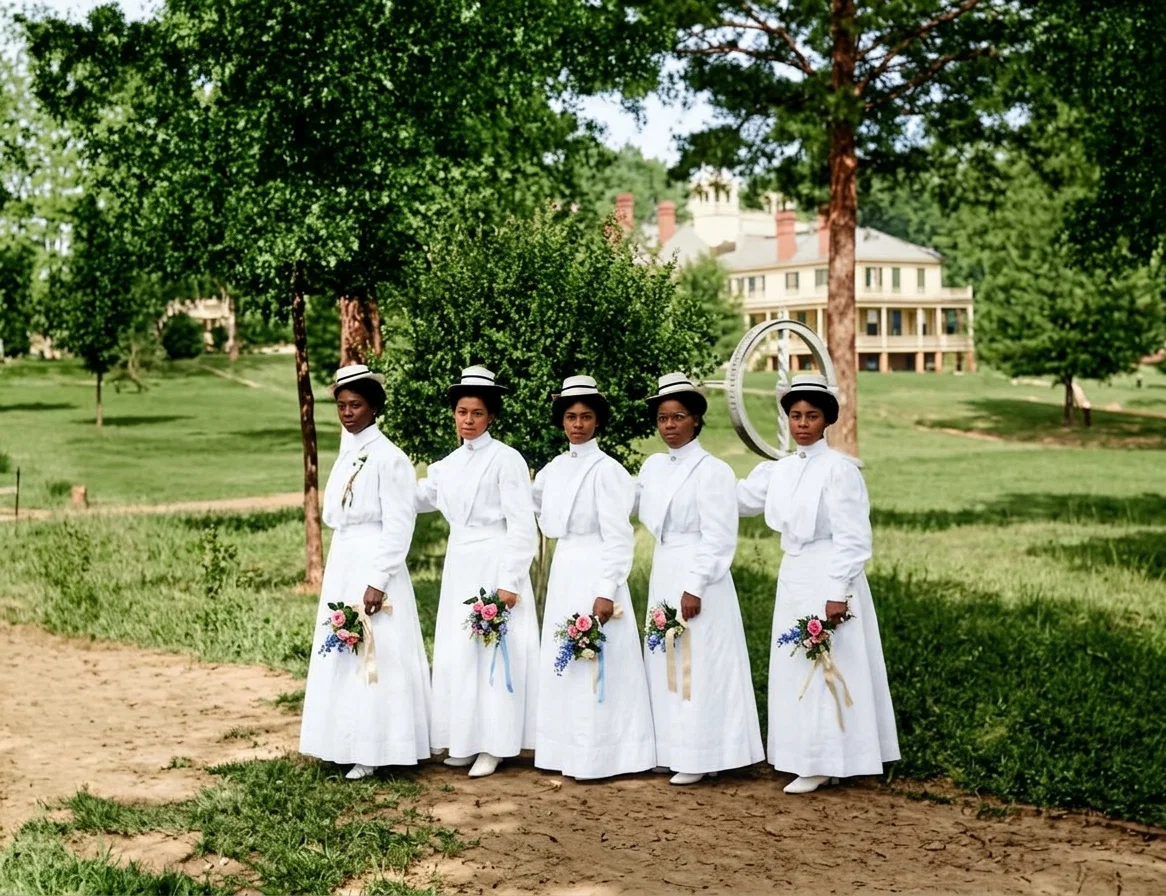
GRADUATE NURSES' CLASS OF OAKWOOD TRAINING-SCHOOL
During the past two weeks I have had the privilege of spending a short time in the sanitarium in Philadelphia, and also at the Melrose Sanitarium. Both of these institutions are enjoying God’s blessing. Dr. W. H. Smith, the medical superintendent of the Philadelphia Sanitarium, with his coworkers, is doing everything he can to make the work a success. I was pleased to see the interest taken by the doctor in religious work. The sanitarium was well filled with a good class of patients. We sincerely hope that God’s blessing may continue to rest upon those who are under the burden at this institution.
At the Melrose Sanitarium Dr. W. E. Bliss, Dr. U. L. Mann, and Dr. Estella Houser are doing their utmost to maintain the standard of true Christianity. They are grateful for the help of Elder G. B. Starr and wife, and of Brother White, the present manager.
I have appreciated very much the quiet atmosphere of this place. During the past two months the institution has had a good patronage. The surgical cases seem to do well after their operation. There is no doubt that God blesses the efforts of the godly surgeon, and that many of the rapid recoveries find their explanation here. Melrose Sanitarium is located in a beautiful spot. I see no reason why this place should not be filled with patients.
Let us direct those who are sick in body and mind to our sanitariums, where they can receive this double ministry. With a little effort on our part as a people, we could easily keep our sanitariums filled, and bring a blessing to those we send, and at the same time place our sanitariums where they can do much more for those who are not able to pay the full amount for treatments.
The sanitarium at Takoma Park has also had a fair patronage. The Drs. R. S. and O. P. Ingersoll, who now are in charge of the work there, are doing all in their power to make of the sanitarium all it should be. We can greatly encourage and help the faithful workers connected with this institution by recommending to the institution the sick we may meet. Let us pray for these instrumentalities, and for those bearing heavy responsibilities in connection with them.
D. H. KRESS, M. D.

Selling Tracts

It is encouraging to note the interest that is being awakened at the present time in the sale of our tracts and papers. I am satisfied that an excellent work can be done with them. A few words regarding some personal experiences in selling tracts may be of help to some who are doubting their ability to make such work a success.
Several years ago I devoted considerable time to tract selling. My work was chiefly done in a city of fifteen thousand inhabitants. The tracts were prepared in five-, ten-, and fifteen-cent packages; such tracts as “The Sufferings of Christ,” “The Coming of the Lord,” etc., being largely used.
After the first visit, I usually carried with me tracts on a variety of subjects. After talking with the readers, I selected such matter as seemed to me would best suit their needs. Several visits were often made to the same family, and sometimes tracts to the value of a dollar and a half would be sold to one person.
The greater part of my work was done in connection with tent-meetings. This afforded an excellent opportunity of becoming acquainted with the people, and of inviting them to the meetings.
My sales ranged all the way from fifty cents to three dollars a day. I am sure that such work can be made a success. Faithful work, with the Lord’s blessing and guidance, will bring success to the earnest worker. *

Oakwood Manual Training School

The blessing of God is attending our school the present year. We have a good enrolment of young colored people who are deeply interested in the progress of the message among their own people. Our attendance is composed of representatives from nearly all the Southern States, five from the islands, and one from Africa.
The students, with a few exceptions, are active Christians, possessing one desire only,—to go out, as soon as prepared, to engage in the closing work. Some are showing their ability and interest in this direction by organizing Sunday-schools in their neighborhood, and doing missionary work among families. This affords interesting and profitable experiences to the student, and at the same time creates a favorable sentiment in the community.
A mission school, with an enrolment of thirty, composed of children from the immediate vicinity, is also being conducted by two of the more advanced students. The good influence which the children thus carry into various homes will certainly be helpful.
The graduation exercises of our first nurses' class were held last September, and five faithful workers are now in the field (see picture) ministering to the sick. Two other classes are in training. In view of the success of this training work, under the supervision of Dr. A. I. Bascom, we greatly regret that failing health compelled her to resign her duties. We hope, however, to be successful in soon securing the services of another physician.
Sickness abounds on every hand in all the South. The colored people are in great need of light on the simple ways of healthful living, and we are confident that we have started none too soon in training those who are competent to go out and teach the principles of health reform, and give simple treatments to those who are suffering from disease.
As we look over the broad field and realize the great work yet to be accomplished in the South, and then think of the small number of workers comparatively which we have in training, we wonder, for the moment, how the work is to be accomplished. But we remember that God has untold resources, and we believe that many others will soon be in training.
In fact, even now, many more would gladly enter school, with a view of preparing themselves for the work of God, had they the means to meet their school expenses. As a rule, the colored people are poor, and often it means a sacrifice of the necessaries of life for parents to support a child in school, and too often it is entirely beyond their means to think of permitting a bright and consecrated son or daughter to seek a preparation for the work of God. We are often sorely perplexed when we receive touching appeals from a widowed mother or from poverty-stricken homes, asking that a promising child be admitted to the training-school.
In harmony with the counsel of the Lord, we have decided to solicit some financial help for some of these worthy students who give promise of soon developing into successful laborers.
We believe there are many who are interested in the South, and will be glad to assist. We have published a little leaflet, giving full information relative to the importance of this work and the plan for helping. We shall be glad to send this leaflet to those writing us. Our address is Box 414, Huntsville, Ala. We ask the interest and co-operation of all in this important undertaking.
W. J. BLAKE.

A Unique Method to Increase Church Attendance

THE Washington Post of Jan. 27, 1910, contains the following:—
“Indianapolis saloon-keepers who violate the closing laws hereafter will be compelled to keep their saloons closed until they can produce a letter from a preacher certifying that they have attended church on at least one Sunday morning and remained throughout the service. Such was the ruling of Mayor Samuel Lewis Shank in two cases today.”
The penalty inflicted upon Indianapolis saloon-keepers will doubtless have a tendency to increase church attendance on Sundays. This result is also being sought by prominent churchmen through the medium of Sunday legislation,as will be seen from the following words from Rev. S. V. Leech:—
“Give us good Sunday laws, well enforced by men in local authority, and our churches will be full of worshipers, and our young men and young women will be attracted to the divine service. A mighty combination of the churches of the United States could win from Congress, the State legislatures, and municipal councils all legislation essential to this splendid result.”—Homiletic Review, November, 1892.
There is no doubt but that the saloon-keeper will be glad to become a “devout” attendant of some religious service on Sunday, if he can by this means be permitted to carry on his wicked, soul-destroying business during the other six days of the week. When the saloon-keepers in this country become allies to the cause of Sunday legislation, it will certainly strengthen numerically their forces.
With a church attendance composed of people who are required to do so as a penalty for violating the law, one may seriously ask the question as to the sincerity of such a class of worshipers. Church attendance, to be of benefit to the individual, must be voluntary. All church attendance which is required by force or is promoted by pecuniary gain will be far worse than no attendance at all.
K. C. R.

Christian Liberty

Reports, Notes, and Comments Pertaining to the Current History of the Rights of Conscience
Conducted by the Religious Liberty Bureau
K. C. RUSSELL - - - Secretary W. A. COLCORD - - Corresponding Secretary

Some Important Principles Stated

UNDER the heading, “The Johnston Sunday Bill; Some Important Principles Stated,” the following succinctly put statements bearing on Sunday legislation, were sent to each member of the United States Senate on the morning of Jan. 27, 1910, the day the bill, with numerous amendments, passed the Senate:—
“1. The state can not compel its citizens to distinguish between Sunday and other days of the week without enacting religious legislation.
“2. It is the province of the state to prohibit incivility on all days of the week, but it can not rightly make an act uncivil on Sunday that is civil on other days of the week.
“3. Any proposed law that distinguishes between one class of citizens and another on account of their religious observances, is thereby proved to be a religious measure.
“4. Laws which in their practical application require many exemptions in order to prevent their interfering with the rights and liberties of men, constitute a dangerous kind of legislation.
“5. The state has no right to inflict upon any citizen a fine of one sixth of his time as a penalty for living up to his religious convictions.
“6. It is not within the province of the state to compel the citizens either to rest or to labor except as a punishment for crime.
“7. In matters of faith the majority has no power over the minority. The conscience of a single individual is as sacred as that of a whole community.
“8. No proper interpretation of the police power of the state can confer the right to make a distinction between days on religious grounds.
“9. The United States Congress has thus far had the honorable distinction among the lawmaking bodies of the nations of refusing to enact any law requiring of its citizens the observance of Sunday as a day of rest. Any change in this respect will be a backward step.
“10. He who attempts to choose for another in religious concerns and to enforce his choice upon that other, interferes with the natural and inalienable rights of man.
“11. Civil government was ordained to protect the rights and liberties of man. Sunday laws are enacted to protect a ‘day.’
“12. Every lover of genuine Christianity will oppose any effort to enforce a religious observance. The Christian religion is a religion of love and not of force.
“13. The Constitution prohibits Congress from making any religious law. Sunday laws are religious, and therefore unconstitutional.
“14. Congress decided rightly respecting Sunday legislation eighty years ago, when, in its famous Sunday Mail Reports, it said:—
“If the principle is once established that religion, or religious observance, shall be interwoven with our legislative acts, we must pursue it to its ultimatum. We shall, if consistent, provide for the erection of edifices for worship of the Creator, and for the support of Christian ministers, if we believe such measures will promote the interest of Christianity.”
“Our Constitution recognizes no other power than that of persuasion, for enforcing religious observance.”
“If Congress shall, by the authority of law, sanction the measure recommended, it would constitute a legislative decision of a religious controversy, in which even Christians themselves are at issue.”
“The Constitution regards the conscience of the Jew as sacred as that of the Christian; and gives no more authority to adopt a measure affecting the conscience of a solitary individual than that of a whole community.”
“RELIGIOUS LIBERTY ASSOCIATION.”

A Letter to Senator Johnston

ON the morning before the Johnston District Sunday bill passed the Senate, Jan. 27, 1910, the following letter was sent to Senator Johnston:
“Senator Joseph P. Johnston. Washington, D. C.
“DEAR SENATOR: In view of your oath to support the Constitution of the United States, of your profession of Christianity, of your being a member of the Methodist Church, and finally of the binding claims of the immutable law of God, how, may I ask with all due respect and kindly feelings toward you personally, can you favor or champion such a measure as Senate Bill No. 404?
“The Constitution prohibits Congress from passing any law respecting an establishment of religion or prohibiting the free exercise thereof. Sunday laws are the very badge and sign of religious establishments—of a union of church and state—and can only result in interfering with the free exercise of religion.
“The golden rule laid down by Jesus Christ forever bars the professed followers of Christ from using force in matters of faith and conscience. No one would himself wish to be coerced in such matters. What right, then, have we to use force in religious concernments on others?
“The standards of the Methodist Church prohibit the use of force or compulsion in matters of faith and religion. Note the following:—
“‘Condemn no man for not thinking as you think. Let every one enjoy the full and free liberty of thinking for himself. Let every man use his own judgment, since every man must give an account of himself to God. Abhor every approach, in any kind or degree, to the spirit of persecution. If you can not reason nor persuade a man into the truth, never attempt to force a man into it. If love will not compel him to come, leave him to God, the Judge of all.’—John Wesley.
“‘Dr. Adam Clarke: ‘No other kind of constraint [than prayers, counsels, entreaties, etc.] is ever recommended in the gospel of Christ. Every other kind of compulsion is antichristian, can only be submitted to by cowards and knaves, and can produce nothing but hypocrites. . . . The church which tolerates, encourages, and practises persecution, under the pretense of concern for the purity of the faith, and zeal for God’s glory, is not the church of Christ, and no man can be of such church without endangering his salvation.’—Notes on Luke 14:23.
“‘Jonathan Crowther: ‘Civil government has no right to command what is contrary to the commandments of God, even in what relates to the body, our fellow creatures, and the present world. Civil governors have no right at all to interfere between God and the souls of men. Civil government and religion are two things which ought to be totally separate from each other. Will the persons who want to prescribe to me what opinion I shall believe, and the form in which I shall worship God, undertake to answer for me at the day of judgment, and to insure my eternal salvation, provided I comply with their wishes? And if they should undertake this, can I with confidence and due security leave the matter in their hands?’—‘A True and Complete Portraiture of Methodism,’ 1811.
“‘Moreover, there stands the immutable, unchanged, and unchangeable law of God:—
“‘Remember the Sabbath day, to keep it holy. Six days shalt thou labor, and do all thy work: but the seventh day is the Sabbath of the Lord thy God: in it thou shalt not do any work, thou, nor thy son, nor thy daughter, thy man servant, nor thy maid servant, nor thy cattle, nor thy stranger that is within thy gates: for in six days the Lord made heaven and earth, the sea, and all that in them is, and rested the seventh day: wherefore the Lord blessed the Sabbath day, and hallowed it.’
“‘How are men going to answer to God if they assume to alter this law, set up by human laws another sabbath, and, under pains and penalties of fine and imprisonment, compel their fellow men to keep that? Will they be ready to assume the responsibility of the results, both temporal and eternal,—of the individual accountability to God,—of those affected by such laws?
“‘These questions, it appears to me, are worthy of the most careful consideration.
“Sincerely yours, “W. A. COLCORD, “Secretary Religious Liberty Bureau.”

Medical Missionary Work in Atlanta, Ga.

It has just been my privilege to spend a few days very pleasantly in the Atlanta Sanitarium. Medical missionary work was first begun in that large city several years ago by Dr. C. F. Curtis, who began work as a nurse. He and his wife did excellent work, and built up a large part of the medical constituency we have there now, and also aided in bringing into the message several of the best members of the church. The site of the present church building was donated as a token of gratitude for help received by one who had taken treatments.
The present sanitarium location, when chosen, was out in the country, but the city has grown so rapidly that now the institution is nearly surrounded by residences.
Up to two years ago Dr. Curtis was with the institution, having as a nurse carried on the work from the first. Finally, desiring to establish a similar work farther out in the country, he secured land and built accommodations for patients about ten miles from the city, where he is now carrying on a good work, caring for sick people, supporting a church-school, and keeping up a Sabbath-school, in addition to attending faithfully all services in the city church.
Dr. J. H. Neall is at present superintendent of the Atlanta Sanitarium. The sanitarium the past year has shown a good record. Dr. Neall has associated with him Mrs. Kenyon, a graduate nurse, and several undergraduate nurses. Elder R. T. Dowsett is business manager of the institution.
The Atlanta Sanitarium is located within a few steps of the large city park. This affords the patients excellent opportunity to get out into the woods, next to nature. The zoological garden, being in this park, furnishes diversion to the patients who desire to spend some time there.
In our efforts to establish sanitariums and other facilities for treating the colored people, as well as for training young people of that race as medical missionaries, we have endeavored to start such work in Atlanta. Property has been secured, together with a church building, accommodating also a church-school, in a good part of the city accessible to the colored population. The building to be used for treatment purposes is being fitted up as fast as possible, and when ready, will provide rooms for ten or a dozen patients, besides well-fitted-up treatment-rooms, a parlor, and kitchen.
I was much pleased with the prospect before the medical missionary work. Miss Knight is in charge of this enterprise and is accomplishing much good through the enthusiasm and consecration with which she is carrying on her work. A large company of very appreciative people gathered in this chapel Monday night, January 17, to listen to a stereopticon lecture on our medical missionary work in various parts of the world, by the writer.
This little sanitarium for the colored people is one of the institutions in behalf of which I have so often appealed to the various sanitarium families in this country, as well as to the young people's societies, for contributions. Can not we push this work along more rapidly, and thus make it possible for a larger number of these young people to be prepared for the medical missionary field?
Great good has resulted from the medical missionary work in Atlanta. It would be a great blessing to our cause if a similar work could be carried on in every city of the South.
W. A. R.

The Graysville Sanitarium

THE words, “A city that is set on an hill can not be hid,” come to one’s mind as one leaves the station in Graysville, and drives through the country with the sanitarium in full view ahead of him on the mountainside overlooking the valley beneath.
THE ATLANTA SANITARIUM
The surroundings of this institution are very picturesque. From this place one may look for miles over orchard-covered hills and fertile valleys dotted with farmhouses. Immediately in front, about half a mile away in the valley at the edge of the town, is the Southern Training School, with its dormitories, educating and sheltering one hundred fifty of our bright young people. It was my privilege to speak to them of the superior advantages of our schools in giving a true Christian education.
The grounds of the sanitarium comprise thirty acres of virgin forest. This is beautifully laid out, and is dotted with cottages, rustic seats, mountain brooks, foot-bridges, springs, and rugged rocks. One very interesting feature is a large natural cave in the mountain, extending into the earth hundreds of feet. In some places this cave is as much as twenty feet high. Here and there babbling brooks flow through it. Chambers lead off this way and that, filled with wonderful sculpture carved by the great architect, Nature, stalactites and stalagmites surpassing in perfection of outline and size those in the wonderful Cave of the Winds near Colorado Springs, Colo. Some of these are several feet in length, and often the two stalactites from above would, by extending down and meeting with stalagmites from below, form massive columns which seem to support the rugged roof above.
Here will be a congealed waterfall, there a fantastic formation of seeming frostwork, everywhere wonderful freaks of nature in this dark dungeon, which never sees a ray of natural light. And yet some of these figures are as spotless as the driven snow, beautiful illustrations of pure character, which the Great Architect can fashion in a sin-darkened world. Near the entrance to this cave a large stream of water issues from the rocks. This feeds an artificial lake, which has been constructed for the pleasure of the guests and patients of the sanitarium.
The institution consists of a main five-story building, and several cottages scattered through the natural wood lot, a part of the grounds. The four lower stories of the main building are surrounded by verandas, making it a very enjoyable place, especially in the summer. The basement accommodates the treatment-rooms for men and women. The first floor is occupied by dining-room, kitchen, offices, and parlor. The remaining floors accommodate the patients of the institution, there being rooms for from thirty to forty persons.
Dr. A. I. Lovell has been in charge of the Graysville Sanitarium now about eight months. The patronage is steadily increasing, and an excellent work is being done. A good practise is being worked up in the surrounding country on account of the success that has attended the practise of Dr. Lovell. Considerable surgery is being done, and this has proved entirely satisfactory. There seems to be a good prospect for the institution.
Dr. Lovell has associated with him his wife, who is a trained nurse, Mrs. Robinson as matron, and several undergraduate nurses in training.
Mr. and Mrs. L. A. Hansen, up to a few weeks ago, were connected with the institution, he as business manager, she as medical matron, but since he has been called to the field secretary work of the General Conference, to conduct the campaign with the “Ministry of Healing,” they have severed their connection with the sanitarium, and will reside in Washington, D. C.
One very pleasing feature is the religious spirit manifested. Every morning and evening nearly every helper in the institution is in attendance at family worship. Worship for the patients is also conducted, but at another hour. At the time of service at the church, which is a mile away in the village, either on Sabbath or at the Friday evening prayer-meeting, the sanitarium is almost depopulated of workers, all being at services except those required to be on duty.
With the support of our people in this vicinity and a continuation of the present consecrated effort in behalf of this work on the part of the helpers, there is no doubt but this little sanitarium set on a hill will continue to be a bright and shining light to the country around.
W. A. R.

Medical Missionary Department

Conducted by the Medical Department of the General Conference
W. A. RUBLE, M. D.      -     -     -      Secretary
Continue reading: Canvassers’ Summary for December, 1909