Your ShelfYour Projects

Signs of the Times, Vol. 23, No. 45.

Editorial

Signs of the Times

Nov 18, 1897

Pacific Press Publishing Company · Oakland, California · Nov 18, 1897

Editorial

True Thanksgiving.

Says the psalmist by the Spirit of God, "O give thanks unto the Lord, for he is good; for his mercy endureth forever." God is good, with the goodness of pure love. His goodness is not negative, but positive. He is all good, and good all the time; for "God is love."

The Giver of Good.

God is not only good, but he is the Good. He is the only one essentially good; for "there is none good but One, that is, God." Matt. 19:17. He is therefore the Source, the Author, of all good. From him all good gifts come. "Every good gift and every perfect gift is from above, and cometh down from the Father of lights, with whom is no variableness, neither shadow of turning." James 1:17. God is therefore not only the Giver of all good gifts, but all his gifts are good.

Unchangeable Good.

We meet with persons who do us good to-day and ill to-morrow. If perchance they would do us good on the morrow, they may be unable, because of a limitation of their powers. Then, again, circumstances or dispositions may change; but God never changes—"with whom can be no variation, neither shadow that is cast by turning." R. V. Men may fail, "yet he abideth faithful; he can not deny himself." 2 Tim. 2:13. Love can never be otherwise than love; Essential Good ever remains good. Surely God's constant goodness should be a cause of thanksgiving on the part of his children.

Our Blindness.

"But," says some poor soul, "what about the troubles which come upon us in the way of loss of health and property, and opportunity of labor, and the life of our loved ones? Is this evidence of God's goodness?" And we reply, No, not any of these things of themselves alone. If our life ended and began with the trouble, if there were no other manifestation of God to us, surely we would be of all men most miserable. God does not directly send the sickness, the financial trouble, the loss of work and wages, the death of loved ones: but God does permit them to come; and in them he brings disguised blessings; out of them he will by his own power bring good. In spite of the originator of the evil, God brings to us his goodness. It is only our blindness, our selfish sorrow, our unbelief, which hides from our eyes and shuts out of our hearts his blessed and mighty presence.

"Worketh All Things."

Despite the sin, God "worketh all things after the counsel of his own will." "Great is the Lord, and greatly to be praised; and his greatness is unsearchable." "Whatsoever the Lord pleased, that did he in heaven, and in earth, in the seas, and all deep places." "He telleth the number of the stars; he calleth them all by their names." "For that he is strong in power, not one faileth." (Eph. 1:11; Ps. 145:3; 135:6; 147:4; Isa. 40:26.) And of this same God his messenger declares: "And we know that to them that love God, God worketh all things with them for good, even to them that are called according to his purpose." Rom. 8:28, margin, R. V.

God's Purpose.

But God works according to his own purpose, according to his own good and righteous law, according to his own glorious Gospel of grace, and for the purpose of the "eternal salvation" of all and each who desire to be eternally saved in God's own way; for there is no other way by which men can be saved, save God's way. He, therefore, who refuses to be saved in God's way, wills not to be saved at all. He takes himself out of the channel of God's working. He places himself where he can neither see nor receive of God's goodness in the way God designed his goodness should be received.

Illustrations of His Goodness.

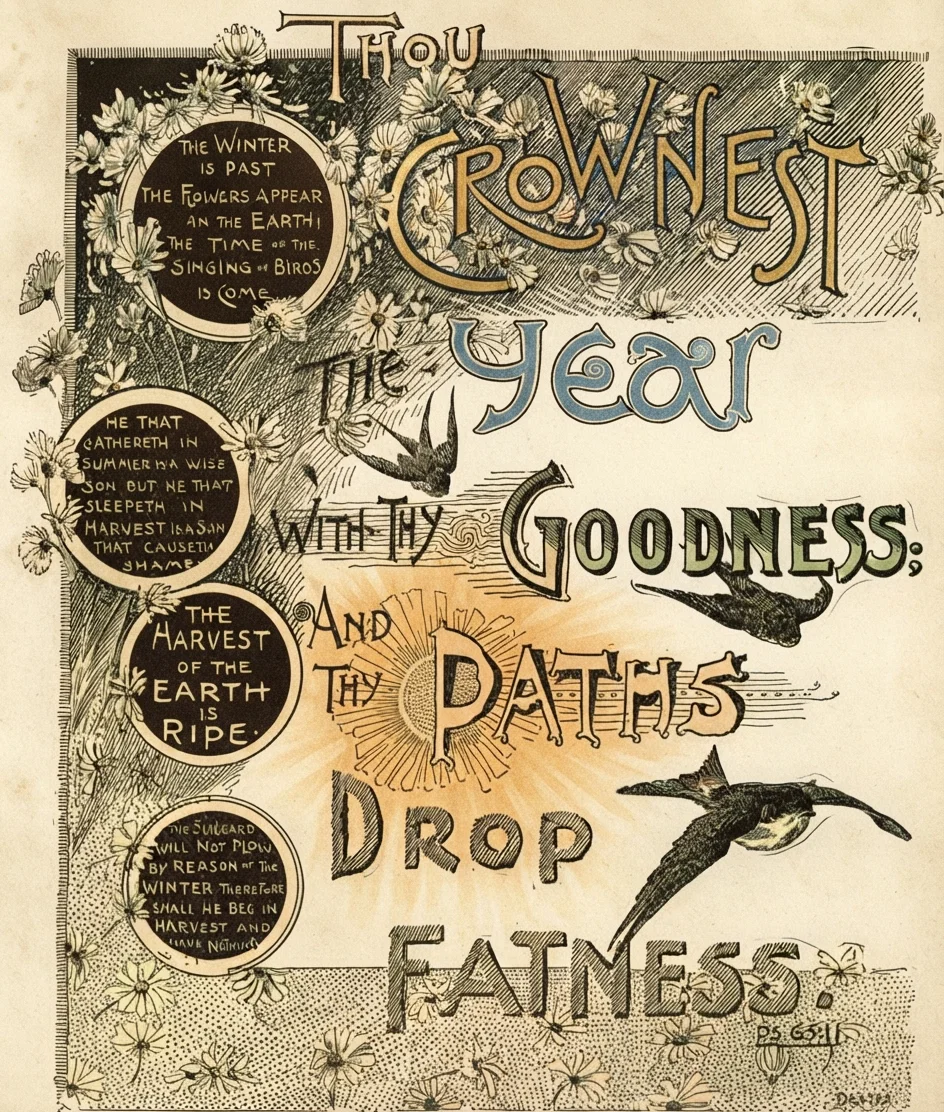
God gives us in nature many illustrations of his working and goodness. Among these is that of the year, with its varied seasons of winter, spring, autumn, summer. Winter seems to be the death of the year. The leafless trees, the dry, seemingly dead branches, the bleak moor lands, the withered stalks of plant and flower, the rivers, lakes, and ground locked in the icy embrace of the frost king, all speak eloquently of death. And this is especially so when nature covers all with a pure white shroud of unsullied snow. But the world is not buried, only wrapped in its winding-sheet, resting, waiting, for the morning of spring, the resurrection of the year,when the power of God in the warm winds, the life-giving showers, and the ever-ascending sun, loosens the icy fetters, sets the prisoners free, clothes the leafless branches with foliage and the barren fields with grass and flowers. The robe of death is folded away, and a garment of green bedecked with flowers robes the world. Spring is the sowing time of the year. He who would have abundant harvest must in spring sow bountifully.

The Summer

is the time of development of the growing plant and fruit and root. The oftentimes fierce storm, the daily fiercer heat, are both necessary. The roots strike deeper into the soil for moisture, and the fiber hardens and strengthens. Great fields bloom green and red with clover, or gold and green with butter-cups. Orchards are weighted with fruit. Acres of waving grain hang heavy-headed, storing, by the direction of God, from earth and air provender for the multitude.

And Then Comes Autumn,

the harvest-time of the year, when the multi-hued ripened fruitage is gathered in from forest and field, from orchard and vineyard, from shock and sheaf, for the sustenance of earth's millions. It is God's gift to the inhabitants of earth. He gives the sons and daughters of earth a part in its sowing, its culture, its harvest, that they may share in the rejoicing, and gather at every season faith in him, the great Husbandman.

Man's Selfishness.

How sad it is that men use these blessings of God for their own selfish purpose, with never a thought of the needs of their fellows! And this is most frequently the case on the part of the rich. The necessities of men, the foodstuffs of the earth, are stored, garnered, bonded, shut away, from the hungry, famishing multitudes; or prices are made so high to the buyer that thousands are kept in constant want, and so low to the seller that many are utterly ruined. The greed of grain grinds the 'brethren of a common Father down.' Millions of bushels of good food cereals go to feed the cursed stream of poison which runs from still and brewer's vat to wreck the reason and beggar the homes of millions more. But God sees and hears and knows, and he will repay.

The Lesson of the Year

is that God is working out good for the inhabitants of earth all through the round of seasons, in winter not less than summer, in spring not less than autumn. And while many will at this season of the year render formal thanks because a day has been set apart by civil officials for that purpose, and while many more will be truly thankful at this season, as God's gifts of the year are brought to their notice, the true child of God will be thankful at all times. While God crowns the year with his goodness, yet it is his goodness which wears the crown. He is an unchangeable God; and we should thank him in winter as well as in autumn.

How Shall We Thank Him?

Not simply in words. If in words alone we render thanks to God, our thanksgiving is the veriest mockery. We do not render thanks by gluttonous indulgence in roast turkey, cranberry pie, plum pudding, or pumpkin pie. That is but a low form of selfishness. He only is truly thankful who renders to God that which is his due. The truly thankful heart will say with the psalmist, 'What shall I render unto the Lord for all his benefits toward me?' and with his whole heart will he heed the exhortation, 'Give thanks unto the Lord; call upon his name; make known his deeds among the people.' The truly thankful will make known God's deeds by permitting the Lord to do them anew through him. He will deal his bread to the hungry, bring the poor that is cast out to his house, cover the naked, and seek out the poor and needy. Isa. 58:7. He will see the purchase of Christ's blood in suffering humanity, and he will render to God his gladness, his praise, his thanksgiving, by relieving their wants and woes. This is thanksgiving; and he who truly keeps God's thanksgiving will do it every day, in all places, and at all seasons. 'O give thanks unto the Lord, for he is good; for his mercy endureth forever.'

UNLETTERED LEARNING.

"And the Jews marveled, saying, How knoweth this man letters, having never learned?" John 7:15.
The Greek word here rendered 'letters' is the word meaning writings or Scriptures. A learned man, one well acquainted with books, is commonly called 'a man of letters,' or a literary man. Now there are many books, but only one that is so prominent as to be sufficiently designated by the term 'the Book,' and that is the Bible; for the word 'Bible' means simply book. So 'the writings,' when used in the Bible without qualification, mean the sacred writings, or the Scriptures. The text above quoted should therefore be rendered, as it is in some versions, 'How does this man know the Scriptures, never having learned?'
Like John the Baptist, Jesus never studied in the Jewish schools. John 'was in the deserts till the day of his showing unto Israel.' Luke 1:80. So Jesus dwelt at Nazareth, subject to his parents, a humble carpenter, until he came prominently before the people at his baptism. Yet no two teachers ever aroused greater interest among the people, or attracted more attention. People flocked to hear them, and hung on their words. The officers of the law said of Jesus, 'Never man spake like this man,' and the people were astonished at his teaching; 'for he taught them as one having authority, and not as the scribes.'
That Jesus had not studied in the schools of the doctors of the law,—the theological seminaries of that time,—is shown by the questions which the priests and elders put to him as he was teaching in the temple, 'By what authority doest thou these things? and who gave thee this authority?' Matt. 21:23. Yet he had wisdom, both in asking and in answering questions, that put to silence all the learned doctors, while his teaching was so simple that 'the common people heard him gladly,' because they could understand him; and the ability to put deep things into simple, easily-understood language is the mark of the greatest wisdom.
How did Jesus get this wonderful knowledge?—From the Word of God. All Jewish children were taught the Book of the Law, according to the command of the Lord by Moses: 'These words, which I command thee this day, shall be in thine heart; and thou shalt teach them diligently unto thy children, and shalt talk of them when thou sittest in thine house, and when thou walkest by the way, and when thou liest down, and when thou risest up.' Deut. 6:6, 7. Many parents of course did this carelessly, and, especially in later times, mingled with their instruction many idle traditions learned from the doctors; but those children who had faithful parents knew the Holy Scriptures from childhood. With the child Jesus this was no routine task, for he says, 'I delight to do thy will, O my God; yea, thy law is within my heart.' Ps. 40:8. The Holy Scriptures, studied in the humble house in Nazareth, and opened to his understanding by the Spirit of God, were the beginning and the sum of all the wisdom that Jesus had.
As with Jesus himself, so with those whom he chose to accompany him, and to send forth to preach,—they were men in humble station, not having studied in the theological schools. Their learning was derived from the Scriptures.
The rulers were astonished at the power and knowledge of these humble fishermen preachers, as they had been with Jesus. We are told that when the rulers 'saw the boldness of Peter and John, and perceived that they were unlearned and ignorant men, they marveled; and they took knowledge of them, that they had been with Jesus.' Acts 4:13. The word 'ignorant' is unfortunate, as applied to the apostles. 'Unlearned' they certainly were, according to the fine standards of the schools; but they were not ignorant. Why then do we have such a statement in the sacred record?—In reality we do not, and the occurrence of the word in our English version is an interesting illustration of the very point we are studying. Thus:—
The two words 'ignorant men,' in Acts 4:13, are from one Greek word, idiotai, the plural of idiotas. The reader will at once recognize in this our common word 'idiot,' and will at once conclude that the English rendering is much more mild than the Greek text. But wait a moment. The primary and ordinary meaning of this Greek word is, 'a private person,' one of the common people. But as certain public teachers began to style themselves philosophers, and to claim for themselves a monopoly of wisdom, so that a man must have a recommendation from them—a certificate that he had 'been through' the prescribed course—before he could have any standing as a scholar, it came about that all who had not such public recognition were considered ignorant. The fact that our translators adopted this secondary use of the Greek word instead of its real meaning, shows how much they were under the influence of the same spirit. The Danish and Norwegian versions have 'laymen' in the place of 'ignorant men,' and the German has 'men of inferior condition.'
Here is encouragement, and a lesson. The encouragement is that people in the most humble and despised walks of life may, by devoted study of the Word from a sincere desire to know and do God's will, acquire wisdom that will astonish even the worldly-wise. Deut. 4:5, 6. See also Prov. 2:1-9.
The lesson is that in the church of Christ there are no ranks and degrees—no class distinctions. The church, following in the steps of the schoolmen of heathen times, have made two classes,—clergy and laity,—that is the special, elect class, who have the keys of knowledge, and the people, who are to take what the clergy are pleased to dole out to them. But the Scriptures teach us that all in the primitive, true church were laymen, that is, they were simple, ordinary people, whose only distinction from others was that which the Holy Spirit gave them. Jesus, himself an ordinary laborer, chose fishermen and sent them forth to preach, and because they were thus sent forth they are called apostles. But they were laymen, and such they would be called to-day, if they were alive and in England or America. That those who teach the Word should form a special class, distinguished from other people by title, dress, etc., was not only not contemplated by the Lord, but was directly opposed.
It is true that 'there are diversities of gifts,' and all men have not the same work, yet all in the church are brethren, and the greatest among them is he who does the most service. Let, therefore, no one be puffed up in his own mind with the thought that as a preacher he is above others in the church, and let no one be discouraged because his state is lowly. It was Tyndale's declaration that he would 'make the boy that drives the plow in England to know more of the Scripture than the pope does.' That possibility is now before every plowboy, and he who truly improves it, altho his name be unknown outside of his neighborhood, has a place in the church infinitely higher than that of pope. E. J. W.

WHAT DO OUR CHILDREN READ?

NEXT to human associates nothing is more potent in molding the characters of the youth—our children—than what they read; and in many cases what they read is primary in its influence. There are indifferent parents and indifferent associates. Their influence is neither very good nor very bad. They live sort of selfishly honest lives, have a desire that their children shall grow up well, believe that they themselves did, and conclude of course that their children will. Their influence over their children is positive in neither a moral nor an immoral direction.
It is to this class (among which are many professed Christians) that these words are addressed. How many times do we see the children of such parents among the low, the vicious, the criminal? What is the cause?
In the first place, it is indifference on the part of parents. The training of their children, which should be the first thought, is generally the last consideration. More attention is often given by the farmer to his colts or calves than to his children. Oftentimes more attention is given by mothers to the peddling of neighborhood and church gossip than to their children. If the little inquiring mind comes with a question or a trial which might take a little time to answer or smooth away, which would prove a valuable lesson to the parent, he is told to "go out and play," or, "Do not bother me now." In such ways as these the indifferent parent turns the child away from what ought to be his true source of knowledge, to those which are generally questionable, and oftentimes fatally destructive. One evil is always wrought, the child loses confidence in the parent. And many times a greater evil is done in indirectly sending the child to those sources of information which fill the mind of the child with moral poison. In a few years the erstwhile little innocent boy is a mental and moral wreck, and parents, and acquaintances like-minded, wonder why it is so. But it is so, and so because of the selfish do-nothingness of parents.
In a city not far away one little girl—a mere baby—has been sentenced to a reform school; an older sister, yet a child, is in jail for shooting her lover, her trial for murder pending the recovery from an attempt at suicide at the time of the killing of the man. One incisive writer of the press well remarked that the girls were the victims of the indifference of parents.
We are living in a most intense age. All the world and all its classes are brought together by railway and telegraph and printing press; and yet it is possible for us to choose our associates and the associates of our children if we will give the subject the thought and the energy and the decision and the expense which its importance demands.
We should first of all see not only that our children do not have evil associates and companions, but good ones. And to insure this, we ourselves should associate with our children so fully, so absolutely, so confidentially, so helpfully, so companionably, so purely, that they would measure all others by us, and reject what did not meet their standard.
We should not only see that our children did not read bad books, light and trashy literature, of fiction and folly, of crime and brutalism, but we should provide them with good books and papers, useful, interesting, and such as would materially assist in good character building and usefulness in the chosen profession or vocation of life.
As the foundation book of all, take the Bible. Read it with them. Make it interesting to them by taking it into your own life. Encourage them to form a library for themselves. Books on the teaching of God in nature, in history, in science and art, are all useful.
Much more might be said. We feel intensely in earnest over the matter. We would that we could arouse parents everywhere to the infinitely important duty which God has laid upon them of the training of their children, important elements of which are their companions in persons and books.

IMPORTANT TYPES.

THE Bible is a Book of types. Of every disposition, of every character of good or evil, God has given us types in his holy Word. Every one who in past ages gave himself in the fear of God for his fellow-men, shadowed forth, however dimly, the coming Sacrifice and Saviour of the world. Every manifest judgment upon men or cities or nations, in consequence of their sin, prefigured the coming final judgment on the incorrigibly impenitent.
The first children of Adam, Cain and Abel, were types of faith and love and obedience on the part of Abel, and unbelief and hatred and disobedience on the part of Cain. And the Abels and the Cains have blessed and cursed the earth ever since.
The two sons of Isaac—Jacob and Esau—were types of men who have existed and yet exist everywhere, the one desiring the Lord's blessing even tho he gets it by fraud, the other selling his birthright for a mess of pottage which perishes with the using. Jacob represents a religious class, Esau those who have no faith, children of unbelief and disobedience.
Jacob in his twofold characteristics is a type of two classes. As Jacob, the supplanter, acquiring Esau's birthright by taking selfish advantage of his brother's supposed need, and Esau's blessing by fraud and deceit, he represents a class of religionists who hope by might or right, by hook or crook, by principle or policy, by right or expediency, to obtain the Lord's blessing, which to them is largely a matter of place or position, of loaves and fishes, of the temporal instead of the spiritual. To obtain this they sacrifice principle, take the unholy suggestions of the faithless, and unite with the world and the State, only to be utterly disappointed at last.
As Israel, the Prevailer with God, he represents another class, who humble themselves before God, make full restitution of what they have taken, place all in the Lord's hands, and wrestle long and earnestly if need be for the victory. To which class do you belong?
Babylon, the city and tower built by man's folly, which man named Bab-il, the gate of God, but which God named Babylon, Confusion, is a type of human substitution for God's way, the type of all those schemes of men by which under a pretense of worshiping God men exalt themselves to God's place by putting their own laws, traditions, and expediences, in the place of God's law, truth, and eternal principles of right. Every departure of the church to the world, every union of Church and State, every persecution of human souls for disagreeing with human opinion set up as God, finds its prototype in Babylon of old. By her fornication she hath “made all the earth drunken; the nations have drunken of her wine; therefore the nations are mad.” Jer. 51:7.
“The daughter of Babylon” represents the apostate and corrupt church of all ages, the church united with the powers of the world, trusting to political and State power instead of to the mighty power of God.
Jerusalem, the City of Peace, and the daughter of Jerusalem, represent the plan of God, and the people of God, of all ages, trusting in him and in him alone,—in her past often subverted, trodden down, despoiled, destroyed by enemies, yet through the power of God rising from her ashes, builded by his power, and finally triumphant.
Reader, to which of the above individual types do you conform? With which of the above opposite systems are you allied or identified. The decision you make means life or death.

What Ought to Be.

The Constitution of the United States declares that "the powers not delegated to the United States by the Constitution, nor prohibited by it to the States, are reserved to the States respectively, or to the people." The Federal Constitution does declare of the Federal Government that "Congress shall make no law respecting an establishment of religion, or prohibiting the free exercise thereof." It is therefore evident that the power to establish religion is reserved to the States and to the people; but as religion is a personal matter between the individual and God, the matter of its establishment or prohibition ought to be prohibited forever to the States, and reserved forever to the people as individuals. We wish it could be, for it is a right which ought to be recognized; but we have no hope that it will be, for divine prophecy indicates otherwise.

FAREWELL WORDS.

Words of Comfort.

WHILE he was still among them, Christ sought to give to his disciples all the encouragement possible; for they were to be sorely tried. "Let not your heart be troubled," he said; "ye believe in God, believe also in me. In my Father's house are many mansions; if it were not so, I would have told you. I go to prepare a place for you. And if I go and prepare a place for you, I will come again, and receive you unto myself; that where I am, there ye may be also. . . . Verily, verily, I say unto you, He that believeth on me, the works that I do shall he do also; and greater works than these shall he do; because I go unto my Father. And whatsoever ye shall ask in my name, that will I do, that the Father may be glorified in the Son. If ye shall ask anything in my name, I will do it. If ye love me, keep my commandments. And I will pray the Father, and he shall give you another Comforter, that he may abide with you forever; even the Spirit of truth; whom the world can not receive, because it seeth him not, neither knoweth him; but ye know him; for he dwelleth with you, and shall be in you."
Christ himself was the truth. The world would not listen to his pleadings. They would not accept him as their guide; therefore they could not discern unseen things; spiritual things were unknown to them. But his disciples had discerned in him the Way, the Truth, and the Life, and his promise to them was that they should have his abiding presence. They should have an experimental knowledge of the only true God, and Jesus Christ, whom he hath sent. He who had begun a good work in them would perform it unto the day of Jesus Christ.
The thought that their Teacher was going to leave them filled the disciples with sorrow; but Christ comforted them with the assurance that he was coming again to take them to the place he would prepare for them. He assured them that if he went not away, he could not provide them with an advocate; that if they only knew of the blessings that were to come because of his departure, they would not mourn; they would rejoice in the presence of the Holy Spirit, who was to be with them always. He told them that if he went not away, they could not do a greater work; but that, deprived of his personal presence, by faith they would see and know him, and by continuance in his love, by showing their appreciation of the truth in revealing to others what the truth is, by obeying his commandments and bearing a living, vital testimony, by doing his work that he would leave in their hands, carrying it forward to completion, they would become representatives of himself.
"I will not leave you comfortless," Christ continued; "I will come to you. Yet a little while, and the world seeth me no more; but ye see me; because I live, ye shall live also. At that day ye shall know that I am in my Father, and ye in me, and I in you. He that hath my commandments, and keepeth them, he it is that loveth me; and he that loveth me shall be loved of my Father, and I will love him, and will manifest myself to him."

Importance of Obedience.

Christ attaches a weight of importance to the obedience of his people to the commandments of God. They are to have an intelligent knowledge of them, and bring them into their daily life. But man can keep the commandments of God only as he is in Christ, and Christ in him. And while he is in Christ, having light on his commandments, it is not possible for him to disregard the least of them. None will keep the law of God unless they love Him who is the only-begotten of the Father. And, none the less surely, if they love him, will they express that love by steadfast, willing obedience. And all who love Christ will be loved of the Father, and he will manifest himself to them. In all their emergencies and perplexities they will have a helper in God.
But it was difficult even for the disciples to understand the words of Christ. That Christ should manifest himself to them, and yet be invisible to the world, was a mystery to them. They could not understand the words of Christ in a spiritual sense. They were thinking of the outward, visible manifestation. They could not take in the fact that they could have the presence of Christ with them, and yet he be unseen by the world. They had yet to learn that the inward spiritual life, all fragrant with the obedience of love, would give them the spiritual power they needed.
"Lord, how is it," questioned one of the disciples, "that thou wilt manifest thyself unto us, and not unto the world? Jesus answered and said unto him, If a man love me, he will keep my words; and my Father will love him, and we will come unto him, and make our abode with him. He that loveth me not keepeth not my sayings; and the word which ye hear is not mine, but the Father's which sent me. These things have I spoken unto you, being yet present with you. But the Comforter, which is the Holy Ghost, whom the Father will send in my name, he shall teach you all things, and bring all things to your remembrance, whatsoever I have said unto you."

Enlightenment by the Spirit.

Christ had sought to make the lessons which they did not understand as clear as possible to their befogged minds. But they had failed to understand them. Now he declared that the time was not far distant when every word which they could not grasp would be clearly comprehended as living truth. No more, he says, will you say, I can not comprehend. No longer will you see through a glass darkly. You shall comprehend with all saints what is the length and breadth and depth and height of the love of Christ, which passeth knowledge. Your Teacher, ascended to heaven, will advocate the cause of all who believe in him. He will plead that spiritual power may be given to you, that in the strength of One mightier than all the enemies of God and man, you may be able to overcome your spiritual foes. He asks you to trust in him, and commit yourself into his keeping.
The promise of the Comforter presented a rich truth to the disciples. It assured them that they should not lose their faith under the most trying circumstances. The Holy Spirit, sent in the name of Christ, was to be their Guide, teaching them all things, and bringing all things to their remembrance. This Comforter was to be the representative of Christ, their Advocate, who is constantly pleading in behalf of the fallen race.
He who knows the end from the beginning had provided for the attack of Satanic agencies; and he will fulfil his Word to the faithful in every age. That Word is sure and steadfast; not one jot or tittle of it can fail. The Holy Spirit is constantly at work, teaching, reminding, testifying, coming to the soul as a divine comforter, and convincing of sin as an appointed judge and guide. If men will keep under the protection of God, he will be to them as an impregnable fortress. He will give evidence that his Word can never fail. He will prove a light that shineth in a dark place until the day dawn; as the Sun of Righteousness he will arise with healing in his beams.
MRS. E. G. WHITE.

INTEMPERANCE.

How MANY men we meet on the journey of life who are daily pursuing the course of intemperance! How many forms of grace and beauty have been turned to ugliness! How many fathers, brothers, husbands, and sons have been ruined! How many wives' hearts have been broken! How many homes have been made desolate! How many souls have been lost! How many men there are who once walked the earth with a manly tread, whose lives were once marked with integrity, but today are ruined inebriates! If it were not for drink, they would be a comfort to their families and a credit to society. O, how dreadful is the path of intemperance! O, the want, misery, and wo that mark its every step!
The young man who begins by taking "an occasional glass" with a friend, never thinks he will become a reeling, bloated drunkard. But day by day the habit grows upon him; deeper and deeper he goes down into the depths of misery, till he has no power to retrace his steps, and at last death claims him, and he goes, like thousands of others, to face, in the great day of God, the drunkard's doom.
Young man, beware of the saloon. Beware of strong drink. It makes the strong man weak. It makes the wise man a fool. It kindles strife and hate. It whets the murderer's knife. It drains the purse. It brings disease and disgrace and death. It makes this world a hell. The only safety for any man, no matter how strong his resolution, is outside the saloon, is total abstinence.
Alice Leota Noyes. Corliss, Quebec, Canada.

RALLY TO THE STANDARD.

PRAISE the Lord, O my soul; yea, praise His holy name; His goodness laud; His grace extol; ye saints His love proclaim; Hold fast the faith; faint not; ne'er doubt, our trust is in the Lord; Think of His coming; sing and shout, all ye who keep His Word.
We know His coming will be soon, because His Word is sure; Jehovah's law—the faith of Christ—our watchwords safe and pure. Lift up the standard, keep the faith, shrink not, faint not, ne'er doubt. Ye watchmen now on Zion's walls, send the glad tidings out.
Restore the paths! Close up the breach! Push on the work each day! The God of heaven will blessing give, and be with you alway; His is the glory—His the power—the increase He will give— His sheep will know their Shepherd's voice, and look to Him and live.
MARY EVELYN WHITE. Birmingham, Ala.
Continue reading: LESSONS FROM THE LILY