Your ShelfYour Projects

Signs of the Times, Vol. 39, No. 15.

SIGNS OF THE TIMES

Signs of the Times

Apr 9, 1912

Pacific Press Publishing Association · Mountain View, California · Apr 9, 1912

SIGNS OF THE TIMES
"WATCHMAN, WHAT OF THE NIGHT? THE MORNING COMETH"

"IF YE WILL INQUIRE, INQUIRE YE."

This Inquirers' Department is conducted for the purpose of helping those who are studying the Bible. The answers are oftentimes only suggestive. They are never to be considered infallible, only as they agree with the infallible Word. The writer who may answer them does not consider that his opinion is infallible. He will simply give the best that he has, and plead with the inquirer to search the Word. Such questions only will be answered as, to the editors, seem to minister to the good of the readers and to the mission of the paper. We can not answer repeatedly in the same volume questions upon the same scripture. The name and address must accompany question, not for publication, but as an evidence of good faith, and that answer may be made by letter if deemed advisable. No letters are answered which do not contain the name of the writer. It is well always to enclose stamp for reply.

3713 — What Is the Sin Against the Holy Ghost?

Another person would like to know what is sinning against the Holy Ghost. C. S.
There is but one agency by which God reaches the heart of men, and that is the Holy Spirit. Read John 16:7, 8, of the Comforter, "And when He is come, He will reprove the world of sin, and of righteousness, and of judgment." The Spirit uses the law of God to convince men of sin. See Rom. 3:20; 4:15; 7:7. If men will heed the Spirit, and admit and confess the sin, God will forgive through the efficacy of the blood of Christ; but if men reject the pleading of that Spirit, there is no other agency more powerful which God has to bring men to Him. God will do everything in His power in appealing to men through His Word, and through heavenly angels, and through His children, entreating souls to come to Him; but if they reject His message, He can do no more. They may yield to Him, and then fall away and sin again, and still His Spirit pleads with them; and this may be done many times, and the Spirit will still plead, as long as the soul will listen; but when that time comes that man has rejected the Spirit's call, has no repentance of sin, no desire to return to God, then there is no way for God to reach him, and he has sinned against the Spirit of God. The sin against the Holy Ghost is unforgivable because it is unrepentable. Just as long as man feels sorrow for sin — not for its consequences, but for the sin itself — sorrow not because he is punished, but sorrow because he has sinned against a God who is so good — there is hope for him. Let him not be discouraged; let him know that the very Spirit that pleads with him to return, will enable him to return and find mercy. "As I live, saith the Lord God, I have no pleasure in the death of the wicked; but that the wicked turn from his way and live: turn ye, turn ye from your evil ways; for why will ye die?" Eze. 33:11. "Come now, and let us reason together, saith the Lord: tho your sins be as scarlet, they shall be as white as snow; tho they be red like crimson, they shall be as wool. If ye be willing and obedient, ye shall eat the good of the land: but if ye refuse and rebel, ye shall be devoured with the sword: for the mouth of the Lord hath spoken it." Isa. 1:18-20. The mercy and the kindness and the cleansing is on God's part. The rebellion and the refusing of that mercy is with us. There is no limit to the mercy of God to him who desires God's pardon. When we reach that place where there is no forgiveness, it is because we have placed ourselves where there is no repentance.

3715 — The Violent Take by Force

Please explain through your paper how we should understand Matt. 11:12.
"And from the days of John the Baptist until now the kingdom of heaven suffereth violence, and the violent take it by force." The margin reads, "is gotten by force," instead of "suffereth violence." In other words, it required very earnest striving, and breaking away from numerous traditions, as was manifest in the crowds that came to John to enter the kingdom of heaven. "Strive ye," said Jesus (literally, "agonize"), "to enter in." Luke expresses the same thought in chapter 16:16, "and every man presseth into it." That is, he puts forth mighty effort. It cost that to break away from all the traditions of the Jews, all the handicaps which they had put upon the religion of the Lord Jesus Christ. But those who were earnest and diligent were the ones that laid hold of the kingdom. Alford expresses it thus: "From the days of John the Baptist until now — that is, inclusively from the beginning of his preaching — the kingdom of heaven is pressed into, and violent persons — eager, ardent multitudes — seize on it." "We have abundant proof, from the multitudes who followed and out-went Him (Christ) and thronged the doors where He was, and would take Him by force to make Him a king." This is not particularly to commend the efforts of these very earnest persons, but to show how easily they might "go to Him who said, 'Come unto Me, all ye that labor and are heavy-laden, and I will give you rest.'"

3711—Ready for Baptism

Please explain when a convert is ready for baptism. I have searched, and can't find any place in regard to this but "Repent, and believe in the Lord Jesus Christ, and be baptized." M. L. M.
Is not this sufficient? That is what the eunuch did, as recorded in the 8th chapter of Acts. He found Christ as Philip preached to him and talked to him of the Lord Jesus, and, of course, told about baptism, and the command which Jesus gave as recorded in Matthew 28. It would seem, without question, Philip must have told all this; and then the eunuch, having accepted that, said, "See, here is water; what doth hinder me to be baptized?" And Philip answered, "If thou believest with all thine heart, thou mayest." And that took in everything; for, as recorded in Romans 10, "With the heart man believeth unto righteousness." A belief that is not unto righteousness stops short, it is not true belief; but the true belief believes that the righteousness of the Lord Jesus Christ covers our sins, and therefore repents of sin. So also in Acts 2:38, "Repent, and be baptized." That, of course, implies belief. Baptism is the marriage ceremony. See Rom. 7:4; Gal. 3:27: "For as many of you as have been baptized into Christ have put on Christ." Baptism does not imply perfection, any more than the marriage ceremony implies that the wife is perfect. She is to learn the ways of her husband, and learn how to blend her nature with his so as to reach the highest perfection. Likewise the individual who unites with the Lord Jesus Christ, is simply initiated into the Christian life at baptism, and from that time on is to learn the ways of the perfect Master, until the life is perfectly blended with the life of the Lord.

3712 — The Word "Fellowship"

What is the force of the word "fellowship" in Eph. 3:9? J. N. M.
This is fairly well stated in the Revised Version: "To make all men see what is the dispensation of the mystery." The "fellowship of the mystery" is the dispensation—the giving—of the mystery of God to the world. Rotherham's rendering: "And to bring to light what is the administration of the sacred secret." And yet that ministration, and that administration, is the fellowship of all the children of God; for as soon as one becomes a child of God, it is his duty to give that which has made him a child, to others; and so Paul tells us, in Rom. 1:14, "I am debtor both to the Greeks, and to the barbarians; both to the wise, and to the unwise." The same God that had bought him by His most precious blood, had bought the whole world; and therefore he was indebted to the whole world, through Christ. But the giving of that to the world was the divine and blessed fellowship of the mystery, in which all may have a part.

3714—Tithe and Debt

If a person who does not own any property, who works for wages only, owes $100, should he pay his tithe first, or his debt? Which? C.
His tithe, certainly. The scripture is, "The tithe is the Lord's." It would be like a man working a farm on shares. The owner is to receive one tenth for his land; the one who works the land, nine tenths. But the one who works the land owes $100. Should he take out the owner's tenth before he pays his debt, or should he use the owner's tenth to pay that debt? This is the question regarding the tithe. The tithe belongs to the Lord, and that should be paid first of all, then the debt. He who takes the tithe to pay other debts, is taking that which belongs to another to do it. There is a real, precious relationship to God in this tithe paying. One can feel that God will bless the means and multiply it, if the soul is faithful to his Creator. It can not be said that there is a twice paying of tithe on the $100, and the Lord does not ask that. If A receives $1,000 income, he should pay a tithe on that of $100. If he owes $100 of the $900 to B, B should pay tithe on that $100 just the same as if A had not paid tithe on the $1,000. What one man may do with his money has nothing to do with the other man. God holds each one responsible to Himself as a steward of time and means; for each one shall give account, not of his brother to God, but of himself.
God tests men in two ways,—in time and means. He gives man all his time and all his means that man has, but He reserves one seventh part of that time, the Sabbath, and asks man to devote it to Him, "holy unto the Lord." And in this sinful world, where souls need saving, He asks man to give one tenth of his income, that the work of saving souls may be carried on through the coöperation of saved souls.
We hope that this covers our inquirer's questions.

3716—"Thou Shalt Not Kill"

Please explain the sixth commandment: "Thou shalt not kill." David killed, and other supposed just men. L. H.
Yes, they did. It is not for us to judge their life in detail. God judges from motive. Sometimes they were His agents. They lived in a different age from what we do. They lived under a different régime. God's kingdom was a theocracy, and God Himself was King, and the Lord commanded men sometimes to execute His sentence. David had more than one wife; he ought not to have had; but after all, he may have lived up to the light that he did have much better than do men who have very much more light now. It is not for us to judge men, because we do not know just the light and the temptations which they had; and when we read the story of their lives, it is well for us to take into consideration all their environments, and the instruction which they received.

Sunday | April 14 | 1 Samuel 9, 10

Sunday | April 14 | 1 Samuel 9, 10
Monday | " 15 | " 11, 12
Tuesday | " 16 | " 13, 14
Wednesday | " 17 | " 15, 16
Thursday | " 18 | " 19
Friday | " 19 | " 29, 30, 31
Sabbath | " 20 | Psalms 27, 28, 29

The Close of Saul’s Reign

The readings of the first part of the week cover the remainder of the book of Samuel, with the exception of chapters 17, 18, and 20-28 inclusive. We have not omitted these because the narrative is not interesting and the lessons important. However, the great main lines of history are covered without them in the readings which we have. To the real Bible student these are important, as throwing floods of light and new suggestions on the way. But for our shorter course we omit them, as we do the entire book of 2 Samuel, because it is in the main embraced in Chronicles.
One comes with a great degree of sadness to the close of the reign of King Saul, which might have been so different. And one reads with continual admiration the course which David pursued as Saul sought to slay him, against whom David had never lifted his hand, but to whom he had ever been loyal. It would seem as if all our readers could learn from the striking lesson of this week that it is safe to commit our cause into the hands of God.
Great comfort and strength may be derived from our last reading of the week, Psalms 27, 28, and 29.

3717 — Death Preferable to Life

Why is death more desirable than life? Eccl. 7:1. A. K.
The text does not say that death is more desirable than life. It simply says that the day of death is better than the day of one's birth, that is, looking upon it just as the writer of Ecclesiastes at the time of that writing is looking upon it. If we look upon this life alone, in its vanity, in its sorrow, in its wretchedness, if we have no hope beyond, if we find nothing here but vanity and vexation of spirit, surely rest in death is better than all this trouble in life; and so many look upon it in this way, and therefore the suicides. If we will read Ecclesiastes through, we will find, when we come to the end, that there is a better thing than seeing simply vanity and vexation of spirit, and that is loving obedience to all the commands of God.

Daniel’s Prayer and the King’s Decree

3718 — A. O. asks for the explanation of Dan. 6: 10-13. See the article on this chapter in the "Signs of the Times" of January 30.

The Object of Christ's Sacrifice

By Mrs. E. G. White
CHRIST was sent to represent God in humanity. When He came to our world, His divinity was clothed with humanity, that humanity might touch humanity, and divinity lay hold of the throne of divinity. Thus moral power was brought to man. When God's Word is understood by us, we shall better understand the work and mission of Christ, and shall be able to trace out His working in behalf of humanity. For our sakes Christ became poor, that we through His poverty might be made rich. He descended in humiliation from depth to depth in our behalf until He reached the cross. He could go no farther in self-denial and self-sacrifice. It was impossible for divine condescension to reach a lower depth. This wonderful sacrifice moved all Heaven; and can we look upon it without our hearts breaking at the sight?
Christ came to communicate the life of God to humanity. He declared, "I live by the Father," My life and His being one. "For as the Father hath life in Himself; so hath He given to the Son to have life in Himself." "Whoso eateth My flesh, and drinketh My blood, hath eternal life; and I will raise him up at the last day. For My flesh is meat indeed, and My blood is drink indeed. He that eateth My flesh, and drinketh My blood, dwelleth in Me, and I in him. As the living Father hath sent Me, and I live by the Father: so he that eateth Me, even he shall live by Me."

Many of the Disciples Offended

These words offended many of the disciples. Because of the earthliness of their minds, His words were insufferable to them, and they misinterpreted their meaning. "This," they said, "is an hard saying; who can hear it?" Who can consent to any such talk? But Christ does not soften down His symbolical representation. All who desired, could trace out the truths concerning His person and office. "Doth this offend you?" He asks. "What and if ye shall see the Son of Man ascend up where He was before? It is the Spirit that quickeneth; the flesh profiteth nothing: the words that I speak unto you, they are spirit, and they are life."
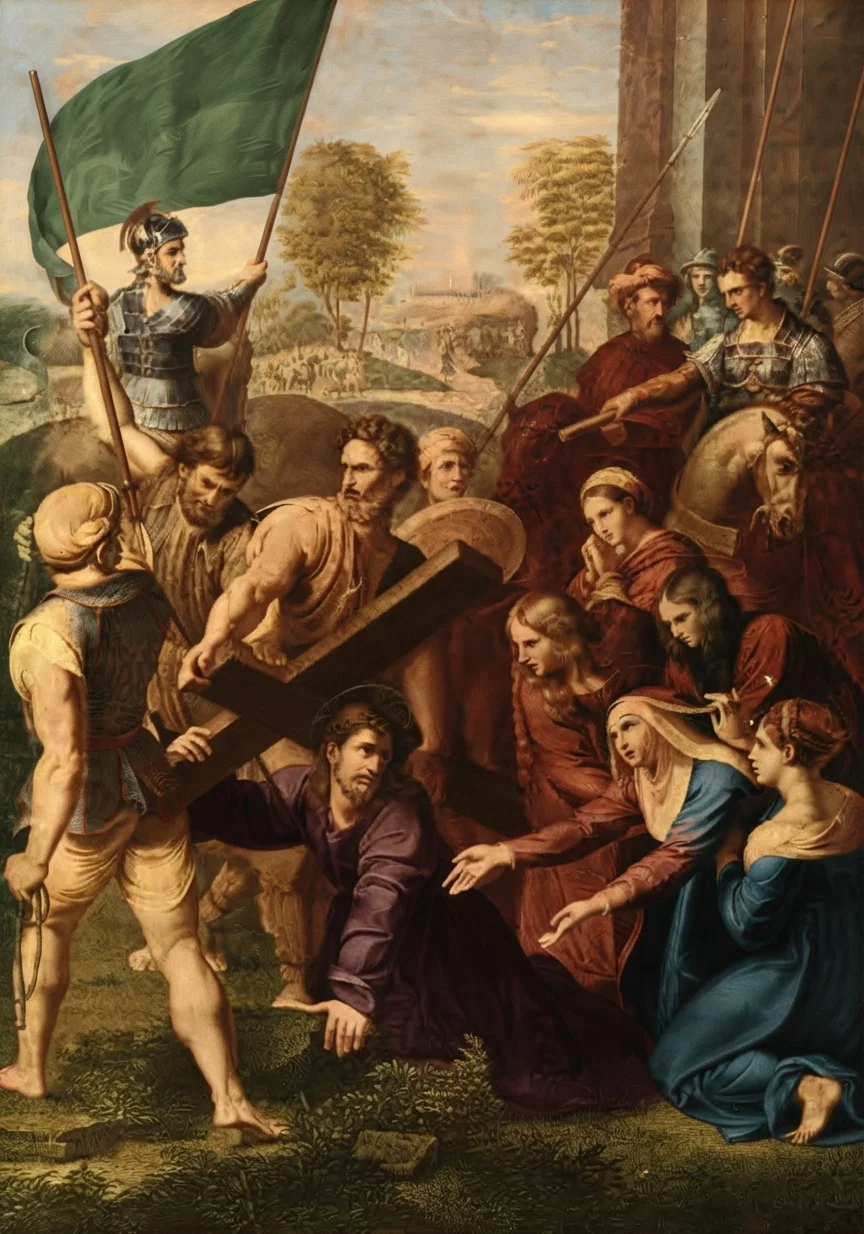
Raphael “This wonderful sacrifice moved all Heaven; and can we look upon it without our hearts breaking at the sight?”
In giving His flesh and His blood for the life of the world, Christ gives eternal life to all who will receive it in faith. No human being can be nourished by the food which another eats. Each must eat for himself. And so it is that in eating the words of Christ, each must receive for himself. Thus we eat the flesh and drink the blood of the Son of God. In obedience to His Word, we become partakers of the divine nature in the same way as our bodies are built up from the food we eat. Those who eat the flesh and drink the blood of the Son of God become one in spiritual life with Christ.
Christ will receive all who come unto Him by faith. Yet thousands are perishing in their sins, heedless and reckless in their disobedience of God's law. And many in their blindness become offended, because they are meeting a false standard. It is the loving and obedient heart that will come unto Christ; and His promise is, "Him that cometh to Me I will in no wise cast out."
Altho the sacramental service is not mentioned here, yet it is embodied in the figures presented. As the believer celebrates the ordinance in spirit and in truth that keeps before the mind the crucifixion of the Lord, he is eating the flesh and drinking the blood of the Son of God. Through faith these representations of Christ can be clearly understood. The Holy Spirit will prepare the mind and quicken the perceptive faculties to grasp the grand truths conveyed in them.

The Carnal Mind Interprets Too Literally

"From that time many of His disciples went back, and walked no more with Him." These men had joined themselves to Christ as learners. But their carnal mind interpreted literally the figure Christ presented. They were gross in their understanding. This we see in every age of the world. As long astime shall last, the wheat will be found among the tares, and the tares among the wheat. But "by their fruit," Christ declares, "ye shall know them."
The lesson that we are to learn is that whenever the counsel that God chooses to send is neglected, it will certainly place man in a position of distrust and suspicion. If he does not thoroly reform the defects in his character, if he does not die to self, he will separate farther and farther from righteousness and truth.
We need not be surprised if we pass through a similar experience. Men who do not make Christ their all and in all, but have a superficial faith, will not understand the words of Christ. Many unite themselves with Christ expecting to secure some temporal advantage, but the Gospel requirements offend them. Not having united with Christ to do the will of God, they have no spiritual life. Had they received His Word, they would have had understanding. Said Christ: "If any man will do His will, he shall know of the doctrine, whether it be of God, or whether I speak of Myself. He that speaketh of himself seeketh his own glory: but he that seeketh His glory that sent him, the same is true, and no unrighteousness is in him."

Not All Turn Away

But not all of those who had heard and believed in Christ were to turn away from Him. To His disciples Jesus said, "Will ye also go away?" Simon Peter answered: "Lord, to whom shall we go? Thou hast the words of eternal life. And we believe and are sure that Thou art that Christ, the Son of the living God. Jesus answered them, Have not I chosen you twelve, and one of you is a devil? He spake of Judas Iscariot the son of Simon: for he it was that should betray Him, being one of the twelve."
The desire of the disciples was to be with Christ. "To whom," said they, "shall we go?" Shall we go back to seek counsel of the formalist? We can not understand why so many go away. The thought arose in their minds that Christ had made a mistake in speaking words that would offend. These disaffected disciples, they thought, might have been held if Christ had not spoken so decidedly in regard to partaking of His flesh and blood. "But," said they, "shall we leave the great Teacher? The scribes and Pharisees have dealt most unfairly with Christ. Shall we teach the tradition of the elders? Shall we take sides with them in lifeless formalism, in teaching for doctrine the commandments of men?"
Christ yearned over His disciples. He longed to have them come into sacred relationship with Himself, and understand Him. To believe in Christ is something more than a mere sentiment. It is a living faith in a personal Saviour, who can and will ransom from sin. The Saviour foresaw that in the hour of temptation every one of His beloved disciples would be severely tested, and He told them that His words would be understood after His crucifixion, His resurrection, and His ascension. "The Holy Ghost," He said, will "bring all things to your remembrance, whatsoever I have said unto you." And He comforted them with these words: "Let not your heart be troubled: ye believe in God, believe also in Me. In My Father's house are many mansions: if it were not so, I would have told you. I go to prepare a place for you. And if I go and prepare a place for you, I will come again, and receive you unto Myself; that where I am, there ye may be also."

Every Faculty Should Be Called Forth

This assurance of our Saviour should be sufficient to teach us the importance of living the life of Christ in this world, that we may lay hold of the future immortal life. We should put every faculty of mind and heart to diligent effort proportionate to the value of the reward presented, even everlasting life. Our service for God is to decide our eternal destiny.
"He that spared not His own Son, but delivered Him up for us all, how shall He not with Him also freely give us all things?" And is it not wholly appropriate that the same question should come to us, when so great love has been expressed for us in the gift of Christ as our ransom,—How shall we not freely give Him all things? When such love has been expressed in our behalf, shall our love and gratitude be only as a ripple on the surface?
Of every Christian the Lord requires growth in efficiency and in capability in every sense. He has freely given even His own blood and suffering to secure our obedience. Do we strive to keep a vital connection with God, so that we shall realize our obligation? Do we feel that all we have is a loan from Jesus? It is not our own. We are stewards of His grace, placed in charge of His goods. Our talents must be used, not for self-serving, but in devoted, whole-hearted service for God. And it is only those who receive His Word, His life, who can do Him service from pure and loving hearts.

Signs of the Times

"Even as we have been approved of God to be entrusted with the Gospel, so we speak; not as pleasing men, but God, who proveth our hearts."

Man as Deceived

By Charles L. Taylor
MADE "in the image of God," upright and innocent in mind and morals, connected by faithful obedience with the great infinitude of everlasting life, man once enjoyed both the inflowing and the outflowing of the current of divine energy, and was a blessed candidate for immortality, which, as a benediction of Heaven's seal of approval, would be granted when probationary time should end, and when probationary trials should work out a finished and fixed character.
There came that baneful day, however, when man changed his relation to the original plan of life; when he changed mind and master.

Life Only by Obedience

Surely God had made it plain that man could hold his life only through obedience, and that disobedience would bring death. "In the day that thou eatest thereof thou shalt surely die,"—be deprived of life. These words were absolute and unequivocal, capable of no misunderstanding nor false interpretation.
There was but one way to accomplish a change in man's relationship to the life plan, and that was to undermine his confidence in the One who had spoken. If man could be led to doubt God Himself, then the command of God would become inoperative and nil. And as God's word of command was, in fact, the very life of His creatures, to doubt and deny that word would mean death.

The Line of Attack

This was the enemy's line of attack. All the venom and poison of disrespect and hateful scorn were wrapped up in the sinister question, "Yea, hath God said, Ye shall not eat of every tree of the garden?" Gen. 3:1. And when he had succeeded in leading the woman to partake of his unbelief, Satan openly and defiantly brought the charge that God had misled and deceived. "Ye shall not surely die," he declared; "for God doth know that in the day ye eat thereof, then your eyes shall be opened, and ye shall be as gods [literally, like God], knowing good and evil." Gen. 3:4, 5.
"Ye shall not surely die," said the tempter; or, as Young renders it, "Dying, ye do not die." Death is not death, was the thought suggested by the tempter. In reality, he gave our first parents to understand that within themselves, existing independently, there was an inherent life principle, a secret something, which made them immune to death's power. They were deceived into believing that they were akin to the divine, and therefore in possession of everlasting life and immortality, regardless of God.

The Message of Falsehood

The message of falsehood was received; but in the very act of receiving, man severed his connection with the Author of life, and thus lost from his experience the very thing which he expected to gain. In changing his leader, man changed his nature. In following satanic teaching, he became the tool of the satanic mind. Henceforth he would bear the impress of death rather than of life. For "to whom ye yield yourselves servants to obey, his servants ye are to whom ye obey; whether of sin unto death, or of obedience unto righteousness." Rom. 6:16.
It were well to repeat what has been previously stated: Life, eternal life, life in the absolute, inheres only in God, the Creator. The great life current did flow out from Him to His creatures, but it was ever and only His life, and was held by His children only in trust, and subject to withdrawal by Him at any time they proved disloyal.

His Character and Nature Both Changed

That a great change took place in man's character and nature is easily seen by reference to the Scripture story. First, he lost the beautiful garments of light and glory which had hitherto been his covering. Gen. 3:7. Second, he became estranged from God. Gen. 3:8-10. Third, when asked regarding his disobedience, he justified himself, and placed the responsibility of his failure and sin upon God. Gen. 3:11, 12. In short, depravity showed itself in his every movement. Righteousness was gone, sin had taken its place. Innocence, happiness, holiness, love, faithfulness, obedience, all had taken their flight.
The irrevocable sentence of death had already passed upon him. So soon as sin found a place in the experience, so soon all that was lasting and godlike was gone, and death reigned. Sin brought the inevitable consequences of mortality and decay.

The Power and Pleasure of Everlasting Life

Before sin entered, man's connection with God enabled him to know the power and the pleasure of everlasting life. After sin entered, his isolation from God left him to know only the horrible weakness and pains of everlasting death. Before sin came, access to the tree of God's power and energy perpetuated the gift of life with which his Creator had endowed him. Gen. 2:9, 16. After sin came, withdrawal of the tree and its life-giving properties made him at once the subject of corruption. Gen. 3:22-24. God had made him from dust (Gen. 2:7), and now to dust he must return (Gen. 3:19).
Over and over again, in different portions of the Scriptures, this story of the fall, this divine record of man's passage from life to death, is emphasized. "By one man sin entered into the world, and death by sin; and so death passed upon all men, for that all have sinned." Rom. 5:12. "The sting of death is sin." 1 Cor. 15:56. "By man [that is, by man's action] came death." 1 Cor. 15:21. "The wages of sin is death." Rom. 6:23. "Sin . . . bringeth forth death." James 1:15.

What Is Death?

Now death is the absence of life. He who is dead has ceased to be. Thought has ceased. Ps. 146:4. In death, there is a complete "cessation of all vital phenomena." Without a resurrection it would indeed be what men have declared it, "an eternal sleep." Such theological definitions as "death being merely separation from God," and "everlasting life in torment," and kindred phrases, find no support nor countenance in the Scriptures.
It was most terribly true, therefore, that man, deceived by sin, became the subject and entered into the kingdom of mortality, decay, death. Dying, he would die, perish, and pass into eternal oblivion. Considered apart from God, for him there was no future beyond the grave. Mortal life—a few short years of degeneracy and rebellion—was his all.

Not Left to Perish

But a kind and merciful Father left him not thus to perish. That day of sin, defeat, and darkness was lighted by the beaconfires of a blessed hope. That day God gave His Son. Gen. 3:15; John 3:16; Rev. 13:8. That day of irrevocable decree God interposed Himself in man's behalf, and the wonderful plan of salvation became operative,—that plan which enables God to be just, and yet the justifier of him who believes. Rom. 3:26.
Ages have passed since the fateful day when sin found entrance, but the blessed Gospel of life is still sweet and fresh and wholesome. The atmosphere of hope surrounds the earth. And while it is true that "all have sinned, and come short of the glory of God" (Rom. 3:23), and by nature are without God and without hope (Eph. 2:12), yet Heaven ceaselessly invites us to receive and ever stands ready to give the boon of life to every "prisoner of hope."
Dear reader, have you entered into covenant relation with God? Do you know the gift of life as God has proffered it through His Son? If not, quickly accept the divine invitation, and just now receive the sovereign gift.
[Mr. Taylor's article next week will be on the subject of man in death.—Ed.]
— ★★ —

My Beloved and My Friend

"This is my Beloved, and this is my Friend." Song of Songs 5:16.
By Llewellyn A. Morrison
I'm a sinner saved by grace, I was dark with sin, indeed, And the judgment for my doings And defilement did impend, When I heard of Christ, the Saviour, Who for me would intercede; So I called Him for my "Daysman" And my Friend.

Chorus

O, the fulness of the joy! O, the pureness of the love! O, the blessedness of pardon From the very throne above! Rest, delight, and peace unending, While the blessed moments roll! He is now my own Beloved, And there's glory in my soul.
How I grieved my Lord and Master, None may ever learn or know. I was vile and foul and hateful As could to the pit descend; But He cleansed and purified me— Made my sin as white as snow— When I called Him for my Comforter And Friend.
I am His. He comes beside me In the tumult of the day, Keeps me sweet and holds me steady Through its trials to the end; Fills my life with song and sunshine All along my pilgrim way, For He is my best Beloved And my Friend.
Continue reading: Steps in the Attainment of True Christianity