The Christian should clearly distinguish between faith and presumption; for one is of God and the other of Satan. One is that by which all the faithful in all ages have lived, while the other is the devil's counterfeit by which he has controlled and led millions to destruction. God's people cannot live without faith. But presumption, like all counterfeits, is so much like faith that many have been deceived by it. No one, however, need be deceived, for there is a plain difference.
“And Abel, he also brought of the firstlings of his flock and of the fat thereof. And the Lord had respect unto Abel and to his offering: but unto Cain and to his offering he had not respect.” Gen. 4:4, 5. It was not just a chance that Abel was pleasing in God's sight and Cain was not. God was not respecting persons. But Abel's offering was of the flock, an offering which typified the death of Christ upon the cross. It was an act of faith. “By faith Abel offered unto God a more excellent sacrifice than Cain, by which he obtained witness that he was righteous.” Heb. 11:4.
Cain's offering was of the fruit of the ground, and in it was no expression of faith in the Redeemer. God had communicated to Adam and his family the great plan of salvation, and had taught them how to worship him. Gen. 3:15. So Cain was following the word of God only in part. He brought an offering, it is true; but it was not the right kind. He was trying to serve God in his own way. The result was, his offering was rejected, and he became jealous of Abel. This jealousy grew into bitter hatred, and hatred into murder. Cain killed his own brother.
During the siege of Jerusalem, when Jeremiah was in prison, the Lord told him to redeem the field of Hanameel, his cousin. Why should he put his money into land at a time when the people were about to be taken captive and the city destroyed?—Because of the word of the Lord. Jeremiah was not presuming that this investment would be profitable to him in time to come; but he was acting on the word of God. The Lord had spoken, and though of himself Jeremiah could not fully understand this, he obeyed. And then God said to him: “And now therefore thus saith the Lord, the God of Israel, concerning this city, whereof ye say, It shall be delivered into the hand of the king of Babylon by the sword, and by the famine, and by the pestilence: behold, I will gather them out of all countries, whither I have driven them in mine anger, and in my fury, and in great wrath; and I will bring them again unto this place, and I will cause them to dwell safely.” Jer. 32:36, 37.
Abraham stands a notable example of faith. When he was living in Ur of the Chaldees, the Lord said to him, “Get thee out of thy country, and from thy kindred, and from thy father's house, unto a land that I will show thee.” Gen. 12:1. Abraham was a rich man, owning large flocks and herds. And to care for these he had a multitude of servants. In Ur, where he lived, there were no famines, but food grew in abundance for both his family and his cattle and sheep. But God said, Come out of this land, and I will show thee where to go. Human reason would have said, Yes, I will go if I can make a good living in that place; but I must first go and carefully investigate, to know the country's resources before moving. And, indeed, this would have been the wisest plan had not God, the Creator of heaven and earth, commanded Abraham to go out not knowing whither he went. God knows what Abraham needed, and he knew also the resources of the country where he would have Abraham live. Abraham believed that God would take care of him, and, acting in faith, moved out upon the word of God. And the result was that God blessed him exceedingly, and he became a great man. “By faith Abraham, when he was called to go out into a place which he should after receive for an inheritance, obeyed; and he went out, not knowing whither he went.” Heb. 11:8. Because of these expressions of faith, Abraham was called by God to be the “father of the faithful.”
On the other hand, King Saul failed to obey God. During his reign God sent to him the prophet Samuel with these words: “Now go and smite Amalek, and utterly destroy all that they have, and spare them not; but slay both man and woman, infant, and suckling, ox and sheep, camel and ass.” Saul went to war with the Amalekites. But instead of utterly destroying them, he saved the king alive, “and the best of the sheep, and of the oxen, and of the fatlings, and the lambs, and all that was good, and would not utterly destroy them: but everything that was vile and refuse, that they destroyed utterly.” The reason he gave for doing this was that “the people spared the best of the sheep and of the oxen, to sacrifice unto the Lord thy God.” But though it might seem like a worthy purpose to sacrifice unto God, they had transgressed his commandment. And God said to Saul: “Behold, to obey is better than sacrifice, and to hearken than the fat of rams. For rebellion is as the sin of witchcraft, and stubbornness is as iniquity and idolatry.” And the Lord added, “Because thou hast rejected the word of the Lord, he hath also rejected thee from being king.” Saul was not only rejected from being king, but because of his presumption the Spirit of God left him, and in this unhappy state he lived until he ended his life by his own hand. And so he died apart from God—a lost man. 1 Samuel 15. Another example of presumption, showing its terrible results, is that of11Judas.
Judas. Judas was one of the twelve. He had the blessed privilege of personal contact with the Saviour of the world. He, with the other disciples, listened daily to the gracious words of everlasting life spoken by Jesus himself. And yet Judas did not profit by all this. Pride and covetousness arose in his heart, and he sold his Lord for thirty pieces of silver. As Jesus had at different times manifested his power in wonderful ways, Judas thought that he would deliver himself from the mob that came to take him; thus Jesus would be saved and Judas would have the coveted money. But when Jesus permitted himself to be taken, and Judas realized what he had done, he ran into the judgment hall and threw down the money at the feet of the priest, and cried, in despair, “I have sinned in that I have betrayed the innocent blood.” Then he went out and hanged himself. Peter says that “falling headlong, he [Judas] burst asunder in the midst, and all his bowels gushed out.” Acts 1:18. Thus ended the life of Judas, whose actions were not of faith, but of presumption.
These are only a few of the many examples that illustrate either a life of faith or a life of presumption. And what lesson do they teach? Of the six men mentioned, Abel, Abraham, and Jeremiah followed the way of the Lord. They lived according to his word. Cain, Saul, and Judas followed their own feelings and desires, which led them to open rebellion against God, and finally to death, the last two taking their own lives.
The difference between faithful Abraham and presumptuous Saul is that Abraham obeyed God's word, while Saul did not. What, then, is the basis of faith? It is the word of God—that which he has given through his prophets, and which we have in the Bible and the Testimonies. “So then faith cometh by hearing, and hearing by the word of God.” Rom. 10:17. There are many professors today. They have a form of godliness, but they are not following Christ fully. Like Cain and Saul, they do only a part of what God has commanded,—that which they like to do,—and the rest they reject. No life can be a life of faith unless it is in obedience to the Word. Jesus said, “If ye love me, keep my commandments.” Jesus will accept nothing but strict obedience to his word. “Not every one that saith unto me, Lord, Lord, shall enter into the kingdom of heaven; but he that doeth the will of my Father which is in heaven.” Matt. 7:21. Read also verses 24-29.
Faith is founded on the Word, not on feeling, convenience, or the customs of men, and therefore leads to obedience and everlasting life. By it miracles were wrought, men received help from God through prayer, the persecuted proved faithful, sinners were made saints, believers followed God, not men. See Hebrews 11.
Presumption is founded on inclination, convenience, and customs of men, not on God's Word, and therefore leads to disobedience and death. “Whatsoever is not of faith is sin.” Rom. 14:23. “All manner of sin and blasphemy shall be forgiven unto men: but the blasphemy against the Holy Ghost shall not be forgiven unto men.” Matt. 12:31. Now it is acts of presumption that prepare the way for the unpardonable sin—the great transgression. “Keep back thy servant also from presumptuous sins; let them not have dominion over me: then shall I be upright, and I shall be innocent from the great transgression.” Ps. 19:13.
Iloilo, P. I.
Paul’s Sabbath Meetings at Corinth
By C. P. BOLLMAN
C. P. BOLLMAN
ONE of the mooted questions of the New Testament is the number of Sabbath meetings held by the apostle Paul at Corinth. Of course the apostle kept every Sabbath, whether in Corinth or elsewhere. We cannot imagine his doing otherwise. It is admitted quite generally that this was the uniform practice not only of Jewish believers, but of all Christians during the first three centuries, and it is certain that the great apostle to the Gentiles did not depart from this practice. Wherever he was on the Sabbath, we find him resorting to some place of worship, whether to a Jewish synagogue or to some quiet spot by the riverside “where prayer was wont to be made.”
In Corinth, Paul found a home and employment with Aquila and Priscilla his wife. They were Jews, as was Paul himself, and of the same occupation, for they were tent makers.
“And he reasoned in the synagogue every Sabbath, and persuaded the Jews and the Greeks.” Acts 18:4.
How long this continued we do not know, but we do know that for a time “every Sabbath” found the apostle at the synagogue reasoning with and persuading both Jews and Greeks. But by and by Silas and Timotheus reached Corinth, coming from Macedonia. This evidently brought on a crisis; for with the arrival of these brethren Paul seems to have become more bold, more aggressive, for he “was pressed in the spirit, and testified to the Jews that Jesus was Christ.” Verse 5.
One result of this plain preaching, as we learn from verses 6 and 7, was that he was driven from the synagogue and compelled to hold his meetings thereafter in the house of Justus, which “joined hard to the synagogue.” Here, as before, the apostle’s labors were not without fruit. “And Crispus, the chief ruler of the synagogue, believed on the Lord with all his house; and many of the Corinthians hearing believed, and were baptized.” Acts 18:8.
Indeed so great was the interest in Corinth that Paul “continued there a year and six months, teaching the word of God among them.” Verse 11. Some think, however, that not all this time was spent in the city of Corinth. “It is recorded,” says one writer, “that Paul labored a year and six months in Corinth. His efforts, however, were not exclusively confined to that city, but he availed himself of the easy communication by land and water with adjacent cities, and labored among them both by letter and by personal effort. He made Corinth his headquarters, and his long tarry and successful ministry there gave him influence abroad as well as at home. Several churches were thus raised up under the efforts of the apostle and his colaborers.”—“Sketches From the Life of Paul,” page 109.
This is all so reasonable that on reading it we wonder why we never thought of it before. When we stop to think, it is quite out of the question to imagine the apostle Paul settling down in a single spot for eighteen months, to preach only to a single congregation in a single quarter of a great city. Evidently his activity carried him far afield from the synagogue in which he first preached in Corinth, and from the house of Justus, to which those who desired to hear him were permitted to resort after the synagogue was closed against the apostle and his message.
Of course this view of Paul’s ministry at Corinth makes it impossible for us to “prove” that “the apostle held seventy-eight Sabbath meetings at Corinth.” He doubtless did hold that number of Sabbath meetings in either Corinth or its environs during his labors there, but we must remember that verse 4 speaks only of the comparatively short time during which Paul was permitted to teach in the synagogue. What he did thereafter as touching the Sabbath must be inferred from what we learn from other scriptures was his custom or manner. Our conclusion, therefore, must be that the exact number of Sabbath meetings held by the apostle in Corinth is not deducible from Acts 18:4, 11. Nothing is gained for truth by claiming for any text more than is clearly expressed or necessarily implied in it.
Family Worship
By GEO. O. STATES
GEO. O. STATES
Circumstances were such that I had to spend a week with a family that I had known about twenty-five years. They were professedly Christians, and were members of the leading church. During all the time I was with them, they always asked me to give thanks at the table, but not once did they read the Bible and conduct family worship. I was very much surprised, but said nothing, feeling that as they were active church members, they should have family worship or else ask me to conduct it.
While visiting them I dreamed that a fine-looking man appeared in my room and said, “Why, Elder States, are you going to visit this family for a week and not once have family worship?” I replied, “They are leading church workers, and should have their family worship or else ask me to conduct it.” The reply was, “Yes, but you are an old man, and a minister should be an ensample to the flock.”
I felt sad to think I had been there so long and never mentioned family worship, and before leaving I told them my12dream. The man said he had thought about it every night, and wished I would read a chapter and have prayer. The Spirit of the Lord came into that home as I knelt with them in worship. I felt that my talk made a strong impression on their minds.
I am sad indeed as I realize that there are homes among our people in which, in the rush of business, no time is taken to gather the children around the family altar night and morning and plead for the protection of heavenly angels. The servant of the Lord has given us the following testimony:—
“By sincere, earnest prayer parents should make a hedge about their children. They should pray with full faith that God will abide with them, and that holy angels will guard them and their children from Satan’s cruel power.
“In every family there should be a fixed time for morning and evening worship. How appropriate it is for parents to gather their children about them before the fast is broken, to thank the Heavenly Father for his protection during the night, and to ask him for his help and guidance and watch care during the day! How fitting, also, when evening comes, for parents and children to gather once more before him, and thank him for the blessings of the day that is past! The father, and, in his absence, the mother, should conduct the worship, selecting a portion of Scripture that is interesting and easily understood. The service should be short. . . .
“Fathers and mothers, make the hour of worship intensely interesting. There is no reason why this hour should not be the most pleasant and enjoyable of the day. A little thought given to preparation for it will enable you to make it full of interest and profit. From time to time let the service be varied. Questions may be asked on the portion of Scripture read, and a few earnest, timely remarks may be made. A song of praise may be sung. The prayer offered should be short and pointed. In simple, earnest words let the one who leads in prayer praise God for his goodness and ask him for help. As circumstances permit, let the children join in the reading and the prayer. Eternity alone will reveal the good with which such seasons of worship are fraught.”—Testimonies for the Church, Vol. VII, pages 43, 44.
Over sixty years ago my mother embraced the third angel’s message, being among the first in Michigan to do so. I cannot remember when she did not have family worship. My father for some years did not make any profession. Night and morning mother conducted family worship. Usually father remained and knelt with us; sometimes, however, when work was pressing, he did not. For some years that was the condition in our home. My mother would read a short portion of Scripture and explain what in those days we used to call “the present truth.” Matters went along in that way for some years. When my brother and I were old enough, mother encouraged us at night to pray.
I tell you, brethren and sisters, those prayers were more than a form, for the influence of the Holy Spirit was in every word. I shall never forget our family worship one night when father was present and took part, and I for the first time heard his voice in prayer. It was indeed a precious occasion, and as soon as mother could be with us children alone she told us, “Now, children, father is going to live the present truth, and we all want to help him all we can.” I have made many mistakes, and have not been so faithful in living the truth as I wish I had been, yet the influence of those hours at family worship has followed me in all the after years, and has been the means of holding me in all my wanderings. I am now near threescore and ten, and feel that I cannot labor as I once could; so I want you to read these thoughts over with care, and if you are not faithfully conducting family worship, turn over a new leaf and do so. The influences of our time lead to infidelity and skepticism, and the general current is downward, and our children and young people need every possible influence thrown around them to keep them from being carried away by the surrounding evils. If Jesus, while here in the flesh, prayed “with strong crying and tears,” so should we.
Spirit Worship in Africa
By C. ROBINSON
C. ROBINSON
RAILWAY TRAIN
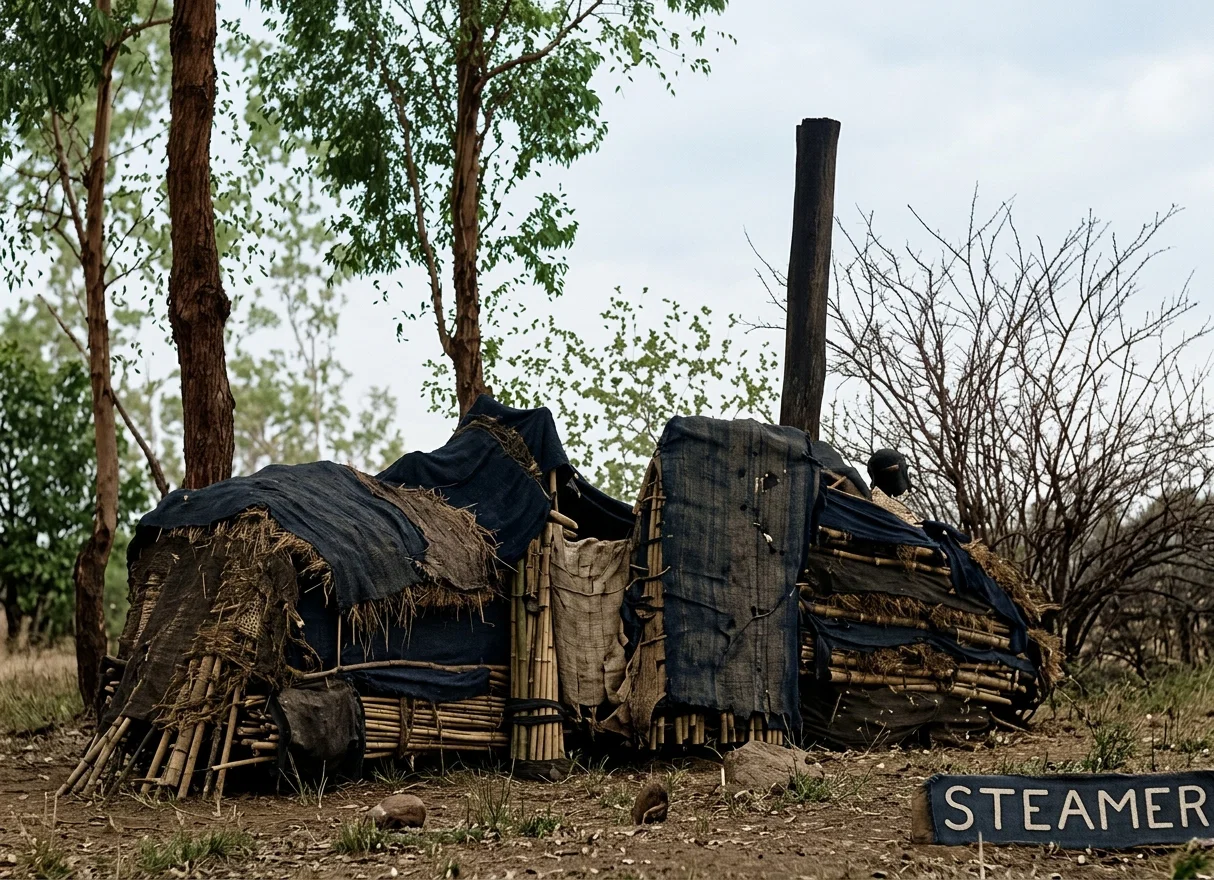
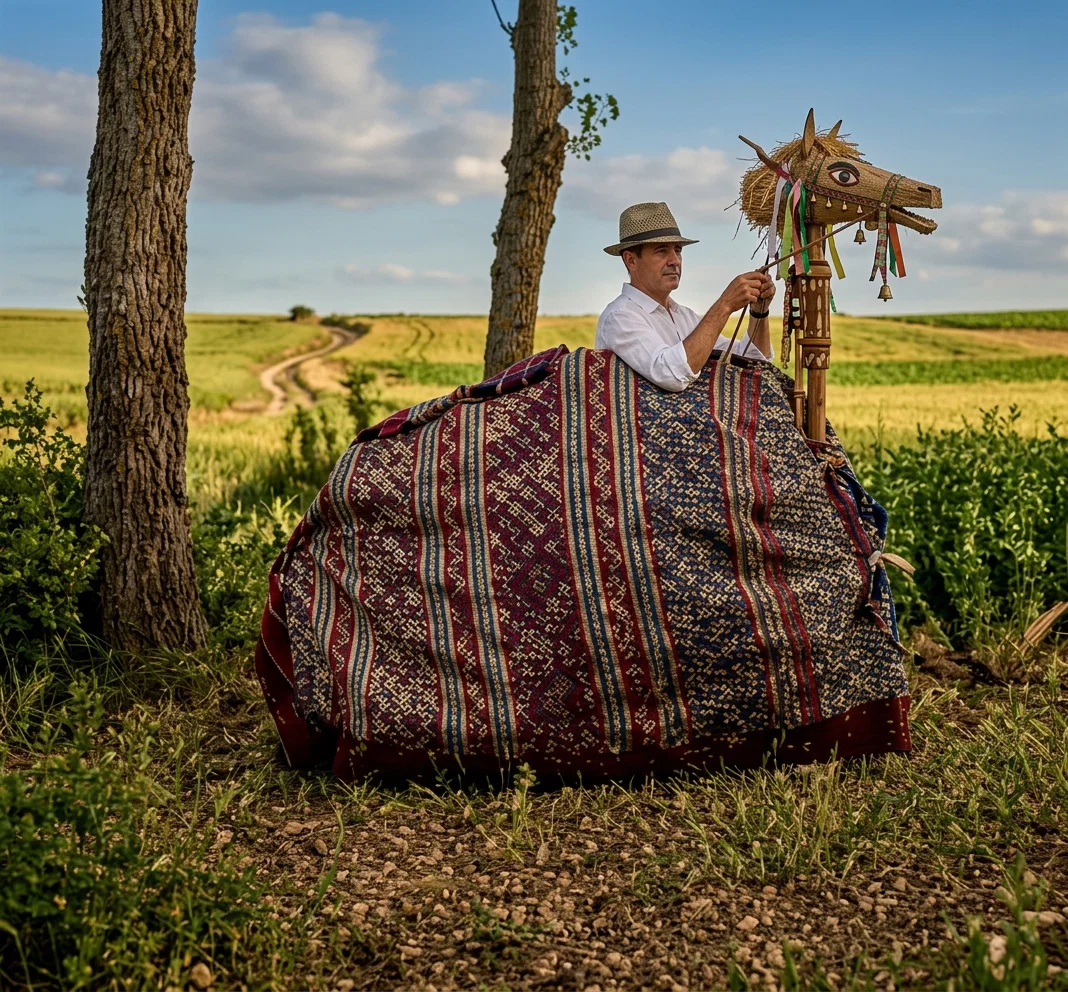
We were recently able to procure some rare photographs of native images, or gods. The natives of Nyasaland, as well as of nearly the whole of Africa, are spirit worshipers. Especially do they believe in ancestral worship. These ancestors are supposed to appear in the villages on special occasions, and they usually take the form of something of which the natives are very much afraid, as the buffalo, lion, zebra, horse, rhinoceros, “fire man,” and, since the advent of the white man, the motor car and railway train.
These apparitions are seen moving swiftly about the villages, and especially about the dance ground; and as they appear only after sundown, and no one but the attendants are allowed to go near them, they are still objects of terror even among some of the native Christians. This doctrine of ancestral worship is so deeply rooted in the minds of all natives that many of them can never thoroughly grasp the real meaning of salvation through Christ. And yet these images are very simple affairs, and of course are all fakes.
They are made of bamboo and grass, with dark cloth thrown over all. Seen in the daytime, they are very crude objects, but at night they seem altogether different. A native gets inside, lifts the image, and runs it up and down through the village, imitating the antics of the animal or whatever the image represents. He does this very cleverly and silently, and no sound of footsteps can be heard. So it seems supernatural and most fearful to the native mind. This is what the witch doctors desire, and they are careful that none but the initiated see the image by daylight.
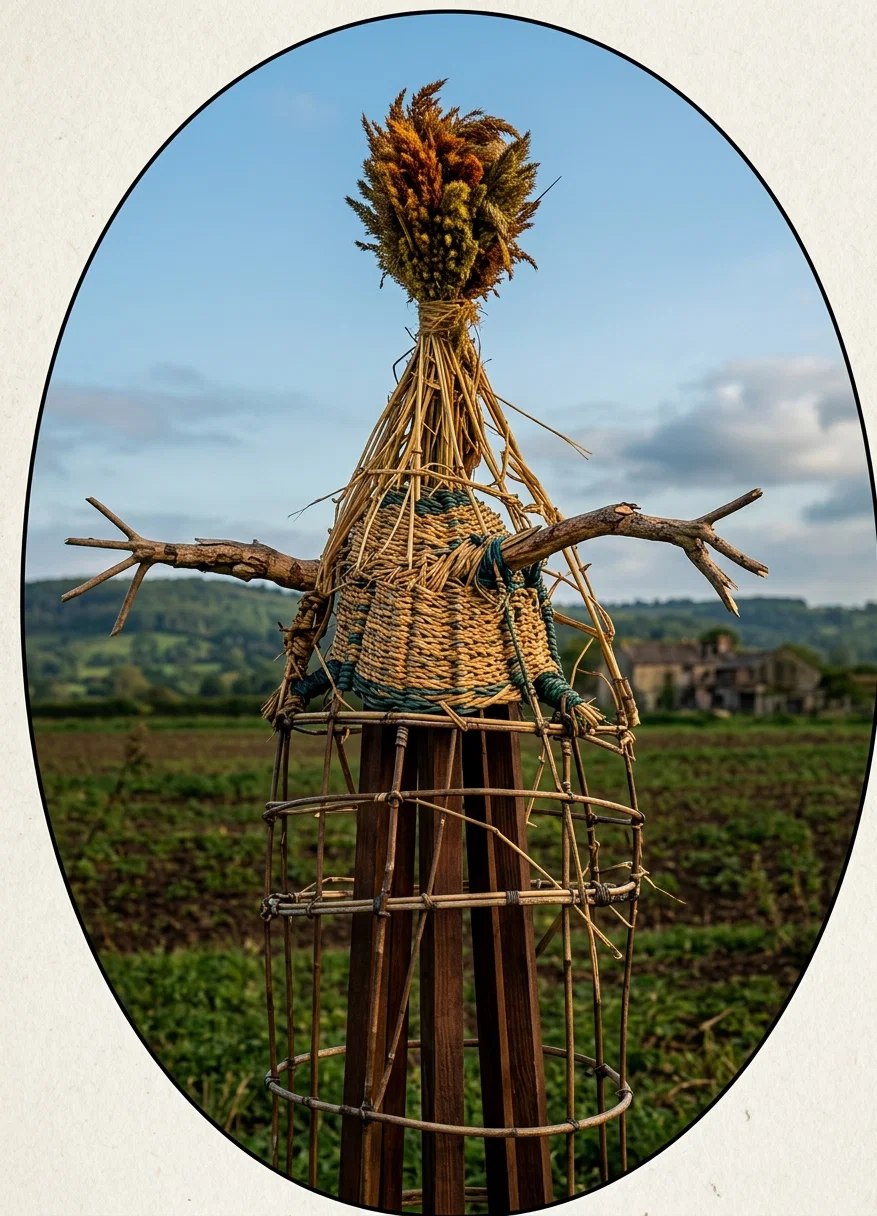
The “fire man” is made of bamboo with numerous pieces of dry bark string tied on so as to show the outlines of the body when lighted up. When everything is ready for the parade, all these strings are touched with a torch, and they smolder but do not blaze. A native gets inside and carries the “fire man” about, the motion causes the sparks to fly off all around, and nothing can be seen but the fiery outline of the body, there being no visible means of locomotion; so it is not at all strange that the natives believe in the supernatural.
More up-to-date is the railway train, or steamer, as the native calls it. The train whistles somewhere in the darkness, and then a huge, long, shadowy shape is seen coming through the village. The guard’s whistle sounds, and the train stops. The whistle sounds again, followed by the shrill hoot of the engine, and the train moves on. The spirits are enjoying a railway journey.13
These photographs were very difficult to get, as the images are always hidden when the white man is about; but I hope you can see what they represent, so that you may have some idea of the village life of the natives of this region. At every period of life these images (zin-yao) are in evidence. At birth, at various times during the life of a boy or girl, at marriage, death, and even after death, these rites and ceremonies have to be performed in order to worship or appease these spirits.
Surely it is time to do more for the people of Africa; and if our people at home could realize that this is truly the Dark Continent, they would go or give until it could truly be said that the people which sat in darkness have seen great light, “the light of the knowledge of the glory of God in the face of Jesus Christ.”
Progress in Spain
By FRANK S. BOND
FRANK S. BOND
I AM glad to be able to report some progress in God's work in this field during the present year. While we cannot boast of great numbers, still we are able to tell of some victories won.
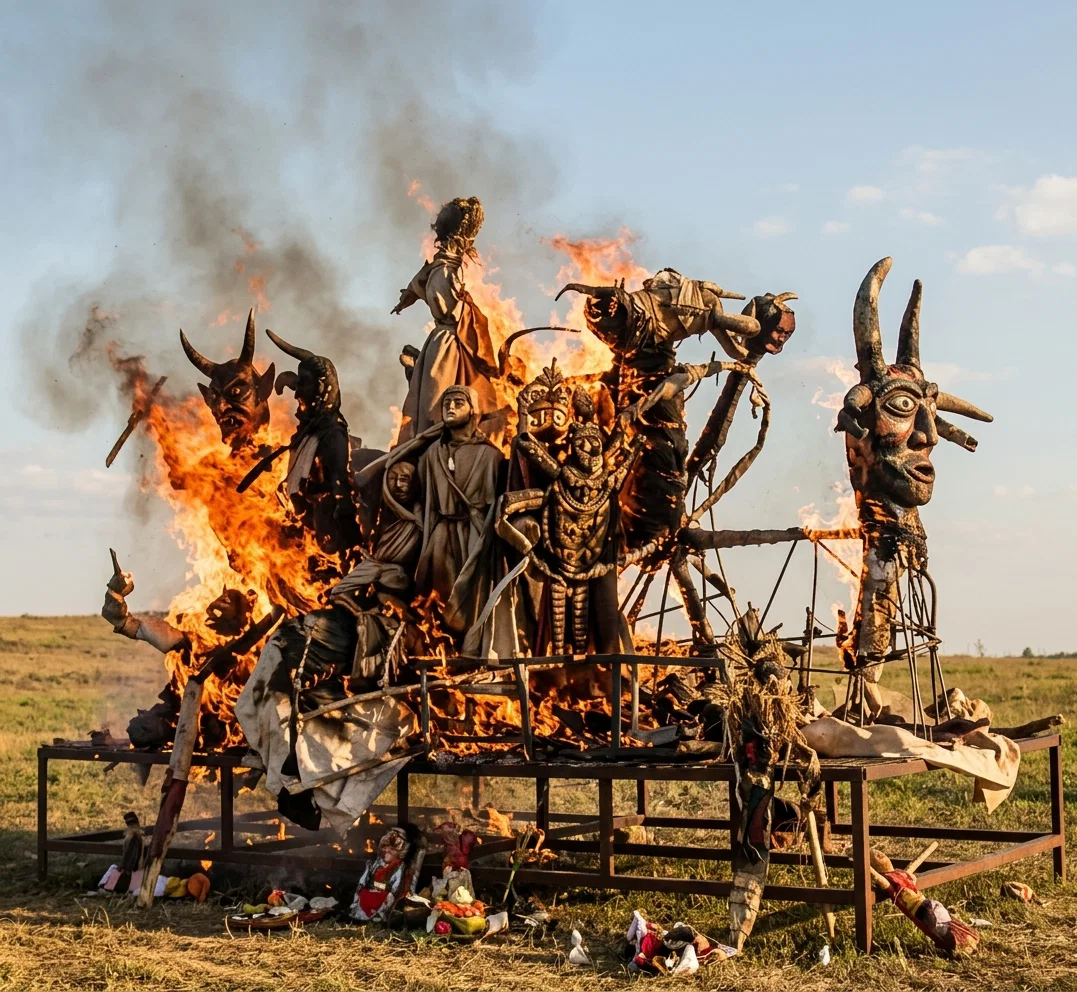
BURNING THE IDOLS
Our general meeting, which was held the latter part of August, was a real success. We were indeed thankful to be able to hold such a meeting. The laborers present from outside the field were Brethren Tieche and Dexter, and the blessing of God on their efforts was very manifest. It was a great pleasure to be able to associate in labor for a few days with these dear brethren.
On Sabbath afternoon, August 28, we retired into the country, where I had the privilege of baptizing nine believers. Before the baptism I spoke to the one hundred and fifty persons who were sitting or standing on the banks of the beautiful canal, with reference to the meaning of gospel baptism. Excellent attention was given. On Tuesday of the week following, two others were baptized. Of these eleven new converts, two were from the province of Saragossa, one from Valencia, one from Alicante, one from Tarrasa, and six from Barcelona.
Since the meeting at Barcelona, I have visited at Jerica and Baeza, and on the eighteenth of September baptized another believer at Baeza.
Still others in the province of Saragossa are awaiting baptism. Thus, little by little, the message of truth is gaining a foothold in different parts of the country. But in all these places we need faithful workers.
As the readers of the REVIEW are aware, we have been called to mourn the loss of another faithful worker, Brother E. F. Forga. Sister Forga has now returned to America. May God's people remember at the throne of grace the workers whose loved ones have fallen in death, and also pray that the Lord of the harvest send more laborers into this corner of his vineyard.
SPIRIT HORSE
In the month of July, Brother J. L. Brown and family left us for Cuba. [He has since gone to Salvador.] Brother Brown served as our general canvassing agent for four years, and the Lord blessed him abundantly. We pray that heaven's choicest blessing may attend him in his work in Central America.
Brother and Sister Harold Robinson are now being initiated into the strange customs of old Spain. We welcome them into our little circle of workers, and believe that success awaits them here.
Japanese Claimed for God
By P. A. Webber
P. A. WEBBER
Just before the Shanghai meeting our mission committee met, and decided that my wife and I were to move from Tokio to Kiushiu, the southern island of the Japanese group, to take charge of the work on that island. Accordingly, shortly after returning from the meeting, we came to this place. We secured a good Japanese house in a healthful location, and at the close of the rainy season pitched our tent and began a series of meetings.
This place is new soil for the third angel’s message, but by no means new to mission effort. Already eight other missions are operating here. In the tent effort much good gospel seed was sown, and the Spirit of God is working on the hearts of those who listened from night to night. Three have begun to keep the Sabbath, and we expect others will join them in its observance.
One of these believers is a man over fifty years of age. He has been a Christian for thirteen years, and had received baptism, but had never been able to find that which satisfied the longings of his soul. Now he says, “I am sure I was led to that tent by the influence of the Holy Spirit.” As he rejoices in his newfound faith, he often asks, “Why was it I did not know this when I first became a Christian?” In order to keep the Sabbath he will be required to discontinue a very profitable occupation; but he says he will do that willingly in order to keep God’s holy Sabbath and to prepare for Christ’s soon return. The outlook for a good harvest of souls in this place is very bright.
Flood Experiences in Kwang-Tung, China
By A. L. HAM
A. L. HAM
As others have written about the flood here in Canton, I shall confine myself in this report to telling about how it has affected some of our outstations.
A FIRE MAN
As soon as possible, I went to Im Po, where we have a chapel and a school. I found the workers and some of the members trying to repair the chapel and seats so that they could be used again. The water had been nine feet deep in the chapel. The school building was a little higher, so the water did not destroy much there.
When the water came into the city, the workers removed to the school; but soon found that they could not escape without boats or rafts, and these were very hard to find in such a time. They were rescued in due time, and taken to a high hill, about a mile from the city, which is used as a burying ground. Here, old and young, men, women, and children, were brought by boats and launches engaged in rescue work. Not much could be provided for them, and they were left to shift for themselves as the work went on. Hundreds of people were gathered there among the graves, without shelter from the rain or the burning rays of the sun.
The evangelist pointed out the spot where the villagers were massed together, and said that there, among the graves on every side, old people passed away in death, some who went there in good health became ill, and there babies were born into the world. The food which they were compelled to eat was14the poorest of Chinese rice and what they could find on the hill. Those who were Christians recalled what they had read in the Bible about the flood, and they imagined that the suffering must have been great when all the world was destroyed by water.
I saw many buildings that had fallen on account of the action of the water on them. Streets were covered with sand, trees, and bricks from fallen houses, and altogether the sight was pitiable. People were returning to their homes only to find them ruined and their things spoiled. Some of our people lost all they had, yet they assured me that they believed that the Lord would take care of them, and that they should have a home in the earth made new, where there would not be any destroying flood. One brother felt bad because he had planned on having one hundred dollars ride this year; but the water had spoiled his business, and he would not have very much.
Very little damage was done to our property, yet there will be some repairs needed. We feel thankful to God that he has protected his children in this great danger, and many feel that he has especially cared for them under great adversity.
Indoor Amusement for Children
By VINA SHERWOOD-ADAMS
VINA SHERWOOD-ADAMS
The season will soon arrive when we must furnish more indoor amusement for the little folks. Our little boy so enjoyed playing in an outdoor sand pile that a year ago this fall, before the ground had frozen, he and I went to a near-by sand hill, and filled a box with sand. After sifting out the coarse gravel, leaves, etc., the sand was spread out in thin layers, and baked at a high temperature to destroy all germs and insect eggs. The sifted sand then half filled a box twelve by fifteen inches in size. This box was set in a warm corner of the kitchen, and placed on a piece of old carpet, doubled so it extended some distance from three sides of the box, to catch any sand which might fall on the floor. The carpet could be quickly lifted, and the sand shaken back into the box; moreover, it made a warmer spot for play.
Some might think it untidy to have sand in the house, but our grandmothers did not think so. My grandmother was a very tidy housekeeper, and I remember how, as a child, I enjoyed walking on her floors; for after scrubbing them, she sprinkled them with white sand. They certainly were much more sanitary than the dusty carpeted floors we still find in so many homes today.
To avoid the sand dust flying about the room, it should be kept moist enough to pack readily. Each morning it will be too damp and cold for a small child to handle safely, but a little hot water stirred into it will make it quite safe. A large spoon, a small sieve, a funnel, and two or three milk bottles or jars of heavy glass will furnish happy occupation for a child many hours each day. A towel should hang conveniently near, with which the children may dust off what sand clings to their hands when through playing.
Our indoor sand box was made especially for the baby of eighteen months, but all the children enjoyed it, and it often proved a source of amusement for the neighbors' boys and girls up to eleven years of age.
While we are speaking of indoor sand boxes, I should like to mention the delights to be found in an outdoor sand pile. Ours is about three feet deep at the highest point. It was made by taking wide boards and forming a large box, or pen, about nine by fifteen feet in size. Into this a load or two of sand was placed. Of course a smaller inclosure would answer. All summer long the children played in this sand pile, often whole forenoons at a time. The older children dug caves; made bridges; formed landscapes of mountains, lakes, and rivers, using real water; built cities; planned whole counties of farms, gardens, and forests, together with the necessary farm buildings. Small wheelbarrows, wagons, and shovels made the play more real. It was a pleasure, at the close of several hours' play, to look over some of the ideas the children had developed with the sand. I used to wonder if they would not some day complain that they were tired of the old sand pile; but no, just as long as the ground remained unfrozen, they and their little friends were busy and happy.
Boys and girls alike enjoy the sand box. The smaller children sift the sand into bottles and cans, or play cook. Often they do the hauling of the sand, while the older ones do the more complicated tasks.
Although I could not always be out to play with them, the sand pile was situated15at such an angle that I could overlook it, and hear their chatter through the open window. In this way I could give some of the neighbor children the enjoyment of our sand pile and still know, while about my housework, that the moral tone of our play spot was what it should be.
If you wish an educational game of interest to children from two to four years of age, allow me to suggest the “Meteor,” which consists of hard, fast-colored balls with a black laying board pierced with holes. A book of designs is also furnished as a guide, but the children will largely use their imagination in forming designs from the brilliantly colored balls. The “Meteor” games range in price from twenty-five cents to five dollars, but the fifty-cent size is interesting for any child.
Again, I will suggest the value of modeline, which has been described in former articles, not only for its use as an indoor amusement, but as an educational factor as well.
Native Work in the Free State
By J. R. CAMPBELL
J. R. CAMPBELL
I RECENTLY made a trip into the Free State, going as far as Lady Grey. I found the outlook for the native work very encouraging. At every farm which I visited I found the brethren anxious to have the message given to their native help, and some are doing all in their power to see that these natives have an opportunity to know and accept the truth. And the Lord is blessing their efforts with fruit.
At Brother Cloete's farm, there is a native man called Hans, who, if a friend comes to see him, will preach the truth day and night if his guest will listen.
Pray for the native work in Basutoland and the Free State.
Nothing Is in Vain
By Columbian
NOTHING is in vain:
Not a flower blooms to die
'Neath the shade or open sky,
But is found by some lone eye:
It will bloom again;
For the thoughts of God shall be
Lasting as eternity.
Not a sweet-voiced bird
Lives and sings and flies away
But some heart is gladdened; nay,
Not the music of a day
Passes all unheard;
For there is an ear that hears
All the music of the years.
Not a kindly deed
That a loving hand has wrought,
Not a soul-born word, to naught
By the cankering years is brought;
Not a truthful creed
In forgetfulness long lies,
It must grow where falsehood dies.