“The body is dead, . . . but the spirit is life.” So said the apostle Paul, and his pregnant words may be applied to the principles of health. Take the divine life away from these principles, and they become dull, arbitrary rules, a veritable yoke of bondage, an instrument of death instead of the minister of life.
The life of the health principles is Christ. The true motive for building up the strength and beauty of the body, is in order that it may be the fit temple of the Holy Spirit. The glory of God should be the uppermost thought in the mind of every intelligent creature. Now, the glory of God is His perfect character, of which His law, both natural and moral, is a revelation. Therefore the desire to glorify God impels one to seek to know and strictly obey the physical laws governing the health and well-being of the body.
Quibbling over small matters is one way to take the life out of these great principles. Prescribing for others precisely the same rules as you have adopted for yourself is another way of losing the life and attractiveness of true health reform. Remember that principles are living things. If they are to thrive, they must have fit soil, and an abundant11supply of the divine sunshine. Moreover, they must be allowed to grow and adapt themselves to the circumstances, just like any other living thing. As soon as you have put a limit to the size of a given tree, you have pronounced its death sentence, for a tree can not live without growing. Just so, when you precisely define a divine principle, it becomes in your hands a dead thing. You may embalm and adorn it so that it may appear beautiful to the eye; but the action is wanting. The saving power is not there, and the thing is practically worthless.
It is a very hard thing to live by rules; but it is a most easy and natural thing to live in accordance with divine, living, and life-giving principles. Health reform, while apparently pertaining especially to the physical organism, is essentially a spiritual matter. We put away fleshly lusts, not only as health-destroying, but also because they war against the soul. In fact, rightly considered, the interests of body and soul are identical. Correct physical habits and a pure diet help to build up a pure body, which is the only fit instrument of a pure soul.
Because health principles are spiritual, we need the aid of the spirit in order properly to comprehend them. On a casual examination, many things may appear inconsistent; but prayerful, earnest, persevering study will reveal only beauty and harmony. That which Christians especially need to realize in these days, is the close connection between physical and spiritual things, and the obligation resting upon all to glorify God in their body as well as in spirit.
M. E. OLSEN.
THE WEB OF LIFE.
FULL soon the web of life is spun— The thread is snapped; the work is done; And, rising from the whirring loom, We pass within the larger room From out the weary din of life, To where peace overcometh strife; And in the Master's presence sweet Lay down our little tasks complete.
But still we'll note, with throbs of pain, Where tangled threads made effort vain Remembering how grief's heavy seal Was set, our errors to reveal; And sadly own, through tear-filled eyes, That careless hands could ne'er devise A plan to guide the shuttle right, Upon life's loom, from morn till night.
So when, the weaver's heart to cheer, The Master Workman draweth near With words of counsel to advise, And patient fingers, skilful, wise, He draws the tangled threads apart, And lays them straight and smooth athwart The bar—then listens, that a call For help may ne'er unheeded fall.
But when the web at length is spun, The thread snapped off, the work all done, The weaver bears it from the loom, Where, in the sunlit, larger room, The Master sits, all tasks to scan, And judge the workers, man by man— Full joy 'twill be, if we but hear The Lord's “Well done!” fall sweet and clear.
—Selected.
GOING WITHOUT BREAKFAST.
By George F. Pentecost
[George F. Pentecost, in Science of Health.]
BELOVED, I wish above all things that thou mayest prosper and be in health, even as thy soul prospereth.” 3 John 2.
Spiritual prosperity and health is the highest earthly blessing; but John, writing to his well-beloved Gaius, prays that it may be matched by the prosperity and health of the body.
Bodily health is desired by the worldly for the sake of earthly gain and prosperity.
The Christian ought to desire health for the higher reason that so he can serve God more efficiently.
The body is “the temple of the Holy Ghost.” 1 Cor. 6:19. To defile the body with sin, to neglect it, to cause it to suffer in health or strength, is an offense against our salvation and the honor of God.
To deliberately undermine health and strength by persisting in a false way of living, is a sin of great enormity.
Drunkenness or gluttony are offenses against soul and body, which no self-respecting person ought for a moment to allow. Yet thousands of good men and women are guilty of excess and bad methods in eating and drinking that border upon these two disgusting and harmful sins.
“The life of the flesh is in the blood.” Lev. 17:11. If pure, rich blood not only preserves the health of the body and prolongs life, but contributes to moral, intellectual, and spiritual health, we should hail with gladness any discovery that will enable us to purify and enrich our blood.
Dr. E. H. Dewey declares that digestion is best promoted, and food so assimilated as to afford the largest amount of nourishment and the greatest quantity of rich blood, by giving the stomach a long rest, during each twenty-four hours, from evening until the noon of the next day, by going without breakfast, and so doing improve health, if well; prevent the incoming of disease; assist nature to recover from any unavoidable attack of sickness; strengthen the whole body, and build up the soul and spirit. I have tried this way of living, and it works well.
For forty years I had been the victim of sick headaches. I tried every remedy and expedient recommended by physicians and friends; dieting, not eating heartily, going without coffee, various kinds of exercise, sodas, bromides, Turkish baths, massage, and not eating certain foods, but these only gave me temporary relief. The bilious sick headache, with its excruciating pain, would return, and collapse my power of work for from one to four days.
At last I learned that a friend and every member of his family, an invalid wife, a delicate daughter, two splendid young collegians, and a boy of twelve, had all given up their breakfast, and were all greatly improved mentally and physically.
Afterward, meeting others who had not been ill but were a hundred per cent better for going without breakfast, I resolved to go without mine. For a day or two I suffered from slight headaches from what seemed the want of food, but I soon found that they were the dying pains of a bad habit.
After a week I never thought of wanting breakfast, and though in the breakfast rooms of friends where every tempting luxury was spread before me, I did not desire food at all. The results are:—
1. I have not had the slightest suggestion of a sick headache since I gave up my breakfast.
2. I have lost a large portion of surplus fat.
3. My skin is improving in texture. My complexion has cleared. The tendency to flushness in the head has disappeared.
4. I experience no more tendency to fullness and unpleasantness after eating.
5. I do not eat as much as I used, but have better digestion. My food does not lie so long in my stomach, and that useful organ has gone out of the gas-producing business.
6. I am conscious of a lighter and more elastic spring. I can walk with quickness and for longer distances without any tired feeling.
7. I go to my study and my pulpit without any sense of loss of strength, mentally or physically, but with a freshness and vigor which is delightful.
One by one, of their own accord, every member of my family has given up breakfast, and all are better for it.
I could fill pages of interesting detail resulting from the adopting of this rule, growing out of my simple expositions.
Restful sleep is not hunger producing.
The breakfast does not furnish strength for the same morning’s work.
In no case does food give strength until converted into blood.
We all do our work on the blood extracted from the food of other days.
“The proof of the pudding is in the eating.” It will not do any one any harm to go without breakfast for three months, and it is almost certain that any one so doing will need no further argument.
THE SEA-SERPENT.
On Nov. 22 the Hydrographic Office of the Navy Department at Washington received a report of Henry H. Neligan, one of the regular observers of marine events designated by the chief hydrographer. It was mailed in Liverpool, where he arrived on Nov. 10 on the steamship Irada, of which he is third officer. The following is his report:—
Oct. 26, 1901.—At 11 A. M. to-day, in latitude 27 degrees 26 minutes N. and longitude 90 degrees 18 minutes W., passed a large sea-serpent appearing about 100 feet long. The head had a blunt, square nose, and was ejecting water to the height of two or three feet from its nostrils. The animal, or fish, had three distinct sets of fins and a tail lying across like a porpoise. On its back was a series of humps like a camel. It was heading about east (true) and moving slowly.
HENRY H. NELIGAN, Third Officer Steamship Irada.
The latitude and longitude mentioned are in the Gulf of Mexico about one hundred and twenty miles southwest of the mouth of the Mississippi. The word “true” in the report means that the monster was heading exactly east, and not easterly by magnetic compass. The responsibility of Mr. Neligan is vouched for by the officers of the hydrographer’s office. These officers believe in the existence of the sea-serpent. That monsters existed on land in prehistoric times all admit, and it is believed that their disappearance has been due to constantly changing climatic conditions, but there has been no practical change in the sea. One of the hydrographic officers states that he has seen small sea-serpents in the Indian Ocean, and has always believed that larger species existed.
Years ago we accepted the existence of the sea-serpent, on the testimony of a captain of such sobriety, taciturnity, and general sense, and whose account of what he had seen was so circumstantial, that it seemed impossible for him to have been deceived.—Christian Advocate, Dec. 26, 1901.
We can Teach you MUSIC AT HOME DURING SPARE MOMENTS
The illustrations furnished with each study of instructions are beautifully photographed, making the system extremely interesting and thorough.
It is not necessary that you should have any previous knowledge of music to become a pupil of our School. If you are anxious to learn any of the following branches of
A postal card will bring you full information. Testimonials will be furnished if requested.
Address Department E
Mozart School of Music
DAYTON, OHIO
For Young Christians
“STEPS to CHRIST” is a remarkable book in many respects, but chiefly so because of its practical helpfulness to those beginning the Christian life. It takes up the various steps, the little things, which come before “Rejoicing in the Lord,” which is the title of the last chapter, in a way that appeals to the heart as do few other volumes.
It has enjoyed a sale of over 100,000 copies in its English editions, and is also issued in fifteen foreign languages as well.
Cloth, price 50 cents, net.
PACIFIC PRESS PUBLISHING CO.
OAKLAND, CAL.
11 W. 20th Street, New York 18 W. 5th Street, Kansas City, Mo
Spanish Shelled Peanuts for Sale
We have just received a carload of fine, new-crop, Spanish, shelled peanuts direct from the grower, and persons using this variety of peanuts would do well to write us before purchasing.
St. Helena Sanitarium Food Co.
ST. HELENA, CALIFORNIA
PURE FOOD MAKES PURE BLOOD
PURE FOOD MILL
A mill that enables your cook to do the work of these mills on one combination mill, is up-to-date and economical. It grinds grains, makes nut butter, cuts up meats, figs, dates, pulverizes coffee, drugs, salt, etc.
Price $4.00
For circulars, terms, etc., address WILL T. DAWSON, Battle Creek, Mich.
117 Manchester Street
AN HISTORIC BUILDING.
The Mosque of St. Sophia was not a mosque when it was erected, but a Christian basilica. Justinian was at the head of the great Byzantine Empire, and he planned this grand edifice to emphasize the idea of “the triumph of the kingdom of Jesus Christ over the heathen world.” He chose a sightly spot, overlooking the Bosphorus and the Sea of Marmora. Several successive churches had occupied this site, the first of which was built by Constantine the Great, the real founder of the beautiful city of the Golden Horn.
The building was begun in A. D. 532. Ten thousand workmen were engaged on it, working under a hundred masters; and when it was completed, it had cost the imperial treasury about $5,000,000. Altho of Gothic architecture, the beauty of its external appearance is marred by its lack of symmetry. But within one is impressed by “the bold span of the arches, and the still bolder sweep of the dome;” and the “eye is at once bewildered and charmed by the rich, if not altogether harmonious, variety of decoration, from the many-colored pillars down to the mosaics and inscriptions on the walls. The dome is raised at the center 180 feet above the ground, and has a diameter of 107 feet; the curve is so slight that the depth is only 46 feet, and around the rim it is relieved by a row of forty windows.” The whole interior was lined with costly marbles; for Justinian, in emphasizing the idea of Christ’s supremacy over the heathen world, “tore from the temples of Jupiter, and Venus, and Diana, and Baal, and Astarte, and Isis, and Osiris, through all the region of the Eastern Mediterranean, their finest marbles and most noble columns. And the gracious majesty of that venerable monument to the overthrow of paganism still draws visitors from all parts of the world.”
Mahomet II. captured Constantinople in 1453, and St. Sophia has since been a Mohammedan mosque. Dr. Dwight, in “Constantinople and Its Problems,” one of Revell’s new books, thus describes a visit to this historic building:—
Being an unbeliever, one has to go into the unused galleries; entering the mosque by the narrow dark passage and cavernous side gateway assigned to women in Greek times; and to other inferior classes in these days. A winding way, which is an inclined plane, leads up and up to the gallery above. At last the dim light of the vaulted passage suddenly brightens, and another turn of the way brings to view a lofty, splendid marble gateway that is full of light. Not that there is a lamp there. The light is in the atmosphere.
Sixty feet beyond the gateway is a group of noble columns joined by many a gracious sweep of arch. Beyond them is the blazing glory of light which has penetrated to the end of the winding passage. No lamps are to be seen; nothing but the penetrating golden glow, against which columns, arches, and parapet are black as ink. It is like coming out of the depths of a mountain cavern, to see through its yawning mouth the noontide glory of June, where sky and clouds alone as yet limit the view. In an instant, of course, the sense of perspective returns. The black columns, and parapet, and arches are not black. Their shaded surface is rich with delicate traceries and mellow tints, and there is the glitter of gold where the glow from beyond strikes the under edge of the arches; and upon the darkness of the opposite gallery other columns and other arches stand forth, bathed in a dead gold color, while the columns and arches of the foreground are seen to stretch away in unnumbered succession.
The shock of the first impression of an infinite glory, holds one on the threshold of the marble portal. The second more sentient glance draws one quickly to the parapet of the wide gallery, that the mystery may be solved of the glory of light without visible source, and of the columns and arches that do not confine one within walls. Far below are hundreds of tiny lamps hanging in huge clusters in invisible connection with the dome, which is equally far above the level of the gallery. In long lines upon the cornices, and even around the base of the dome, hundreds and thousands of tiny lamps glitter before the eyes. The ruling tint of the walls and of the wonderful dome above is the dull gold of mosaics a thousand years old; exactly the color of the light from the little lamps. Thus it comes to pass that the impression from the dark gateway is of softly gleaming light unlimited in depth.
Dr. Dwight thus gives the lesson of this wonderful structure with a singular and impressive history:—
The name of Mohammed gleaming in letters of gold by the side of the name of God above the place where the Christian altar used to be, testifies to the failure and downfall of oriental Christianity in that place, and makes that ancient cathedral monument to warn men of the doom awaiting political Christianity everywhere. Knowing by experience, ourselves, the blinding splendor of the temptation, when the devil insidiously offers to satisfy all cravings of selfishness in return for some small concession—the kingdoms of the earth in return for admission that the glory of such possession will content our cravings—we may not judge too harshly the fall of the early church into this snare. But thus it was that this [Greek] church, after celebrating in the fourth century the triumph of Christianity over the pagan world, became itself, in the tenth century, an object-lesson in the capacity of the old pagan covetousness and lust for power to deaden disinterested devotion to Jesus Christ, so that in the fifteenth century the Lord “removed its candlestick out of its place.”
AGRICULTURE IN BRAZIL.
By W. H. Thurston
[From Mission Board Correspondence.]
BRAZIL is pre-eminently an agricultural country; yet its agriculture differs from that of the United States as much in its methods as in its products.
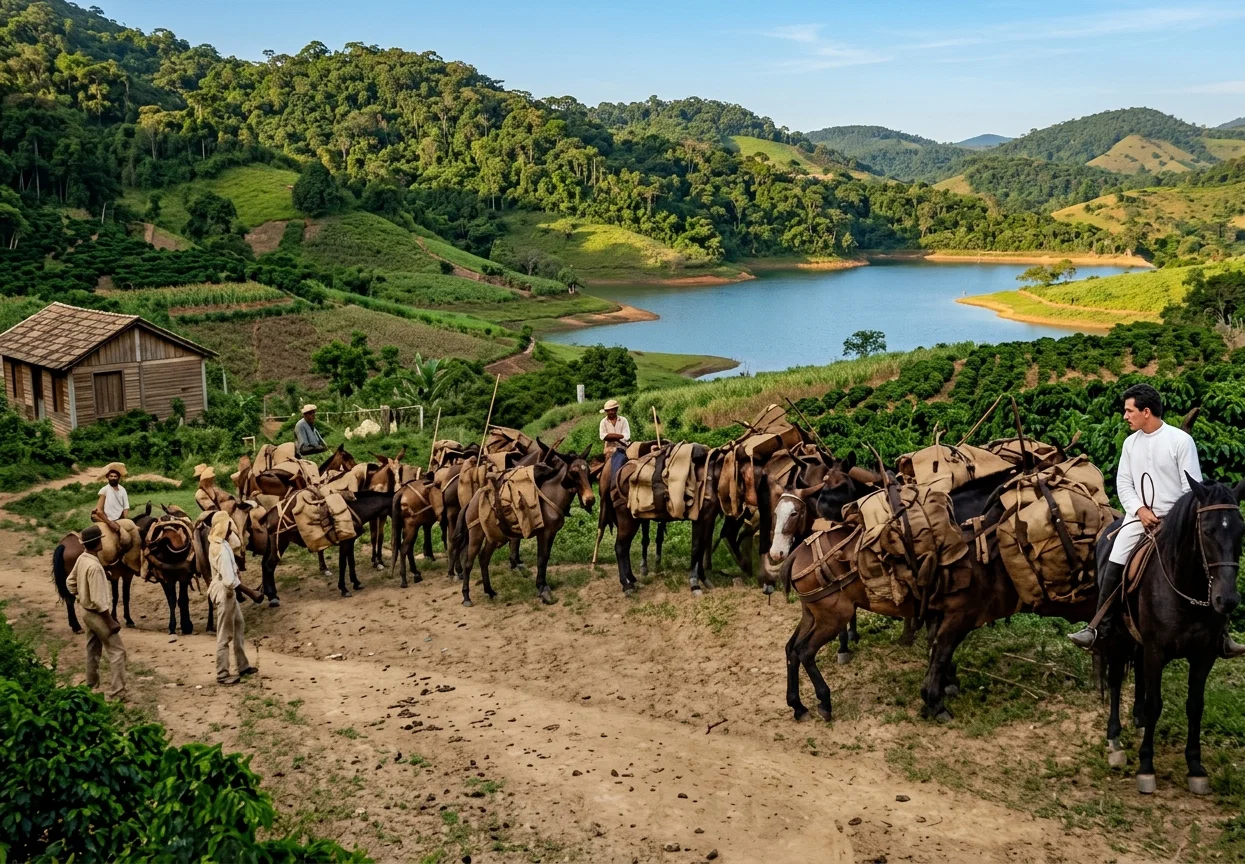
In many places the surface of the land is so abruptly broken that it does not generally admit of the use of the plow and other more modern implements. Yet there are important areas where these implements are being used to advantage, and there is considerable increase in their employment. As a rule, the hoe is the main implement for field-culture, and it is twice as heavy and large as the field-hoe in common use in the United States. It is more like a grub-hoe, and weighs from two to three pounds. Farming implements are imported from England and the United States.
A Pack-train in Brazil.
Coffee is the leading crop, and is raised successfully in every State except the two or three most southerly ones. The coffee tree is from eight to twelve feet high, according to age and the richness of soil, and is one of the most beautiful of productive plants. Its foliage is abundant, and of a rich dark-green color, the tapering leaves being about five inches in length and two inches in width in the widest part. Its abundant blossoms are of a delicate white color, and in shape and size resemble the lilac flower.
The coffee tree begins to yield when it is three years old. Between the rows of newly planted trees, corn, rice, and beans are grown till the coffee plants are in bearing condition.
The coffee berry grows on slender branches, with scarcely any more stem than that of the acorn. When ready for gathering, it has a brownish-red color. The tree is very pretty when the long twigs are loaded with red berries and the green foliage.
The skin of the berry is somewhat tougher than a grape-skin, and on cutting it open a sweet, juicy pulp is found to surround the two coffee-beans within, each enclosed in its separate husk or shell.
The coffee berry is gathered by hand, dried, shucked, and shipped all over the world as one of man's chief but harmful luxuries. The steamer on which I sailed from Rio to New York last year had13on board 30,000 sacks of coffee. It is estimated that about 500,000,000 pounds of coffee are exported from Brazil to the United States annually.
Formerly coffee was principally grown by slave labor on large plantations, many of them situated on sides of high hills and even upon mountains. When slavery was abolished, many of the slaves still remained on the plantations, where little homes have been provided for them.
Corn is grown successfully in all parts of the country, and forms one of the principal crops. The accompanying picture represents a company of farmers bringing coffee, corn, farina, and general produce from the interior down to market.
Soon after the American Civil War, several Southern planters, slave-holders, went from the South to Brazil, and took up the same occupation there. A few families followed on a little later, and they located about three hundred miles southwest of Rio de Janeiro in the State of Sao Paulo. There are perhaps forty or fifty families in that section now, and the most of them are farming more or less as we farm in America, only after methods somewhat Brazilianized. Most of them have good homes, and are doing very well. They use mules on the farm, and oxen on the carts for transportation.
Sao Paulo is a good State, and it is being rapidly developed. They have railways and wagon-roads, and the soil and climate are good. Some of our good farmer brethren would do well to move there, and live the truth among the people. Who will go?
W. H. THURSTON.
THE LESSON OF HISTORY.
By J. A. Edgerton
“How far away is the Temple of Fame?”
Said a youth at the dawn of day;
And he toiled and dreamed of a deathless name;
But the hours went by, and the evening came,
That left him feeble and old and lame,
To plod on his cheerless way.
The youth who had failed could never guess
The reason his quest was vain;
But he sought no other to help or bless;
He followed the glittering prize, Success,
Up the narrow pathway of Selfishness,
And this had been his bane.
“How far away is the Temple of Good?”
Said a youth at the dawn of day;
And he strove, in a spirit of brotherhood,
To help and succor, as best he could,
The poor and unfortunate multitude
On their hard and dreary way.
He likewise strove with adversity,
To climb to the heights above;
But his dream was ever of men made free,
Of better days in the time to be,
And self was buried in sympathy—
He followed the path of Love.
He was careless alike of praise or blame;
But after his work was done,
An angel of glory from heaven came
And wrote on high his immortal name,
Proclaiming this truth, that the Temple of Fame
And Temple of Good are one.
For this is the lesson that history
Has taught since the world began:
That those whose memories never die,
That shine like stars in our human sky,
And brighter grow as the years roll by,
Are men who have lived for man.
—J. A. Edgerton.
OUR WORK AND WORKERS.
THE annual session of Montana Conference will be held at Butte, commencing March 16.
DURING the past year twenty-nine members were added to the church in Black Hills, S. D.
JANUARY 4 a Sabbath-school of nineteen members was organized at Arvilla, S. D., by Brother J. W. Christian.
THE brethren in Vancouver, B. C., are preparing to build a house of worship. They have been offered a present of a lot on which to build.
THE last evening of the recent conference at Nashville, Tenn., Brethren W. R. Burrow and B. Hagle were ordained to the Gospel ministry.
A GENERAL meeting is to be held at Pipestone, Minn., February 18 to 23. The new house of worship at that place will be dedicated during this meeting.
TWO LABORERS, Brethren R. D. Quinn and W. A. Gosmer, report the addition of two brethren to the faith at Stevensville, Mont., one of whom is a school teacher.
ON the 19th ult., the company of believers at Franklin, Ky., were organized into a church, and trustees were elected to hold the church property. The building is nearing completion.
THE minister of the M. E. Church at Oklahoma City, O. T., recently recommended “Christ’s Object Lessons” from his pulpit. The book is worthy of commendation in every pulpit. If you have not yet bought a copy, do not delay any longer. It costs only $1.25, and is worth more than its weight in gold.
REPORTING to the Workers’ Record from St. Louis, Mo., Brother R. C. Porter says that a sister has purchased a very desirable church building on the corner of Newstead Avenue and Delmar Boulevard, and presented it to the Missouri Conference. The cost was $6,000. Another sister presented an excellent organ.
THE Wisconsin conference committee, in consultation with Prof. E. A. Sutherland, of the educational committee of the General Conference, are considering the matter of a German school in that State. The Oshkosh Northwesterner would like to see it established in that city, and recently gave considerable space to a discussion of the proposition.
A CLIPPING from the Advertiser, published at Kimberley, South Africa, has this notice of one of our health institutions: “The Diamond Fields Benevolent Home has for some time derived the greater part of its income from the baths. The Home was originated to furnish a temporary stopping place for needy and unemployed men. Here they were supplied with food and furnished with a lodging, and up to the commencement of the siege a wood-yard was kept going, in which those who were in distress could earn a little money to pay their way. As facilities have now been furnished elsewhere for cheap food and lodging, the management thought it best to enter into a new field of charitable enterprise, and the present profits are devoted to medical missionary work, such as visiting the sick, giving treatment, and supplying their many needs. Those who visit this establishment not only benefit themselves, but at the same time assist those who are helpless and in pain.”
FROM the Mirror, published in Port of Spain, island of Trinidad, we learn that the foundation stone of a new seventh-day Adventist church was laid in that city on the 9th ult. In the absence of Brother A. J. Haysmer, superintendent of missions in the West Indies, who had been detained on account of quarantine, Brother W. G. Kneeland, of San Fernando, assisted by Brother G. F. Enoch, conducted the services. A goodly company of brethren and sisters from that city and other places were present, as also a large number of people from every other denomination represented in the community.
IN the New York Indicator, Mrs. Etta Dwight tells of a humble woman’s work in DeRuyter. She had been advised by Mrs. G. A. Irwin to hold regular seasons of prayer with some of her neighbors, but at first was afraid to make the start. But as the fear increased, she determined to go ahead. She began with her nearest neighbor, who in time became very happy in keeping the true Sabbath, and her husband afterward united with her. They studied the Word and prayed together regularly, and finally asked the elders of the church to join them. Now seven souls have given themselves to God, and five have made a new start.
THE Industrial Educator publishes a letter to Brother W. A. McCutcheon, president of Texas Conference, from a Baptist brother representing a small church at Laredo, asking for information as to the necessary steps for becoming a Seventh-day Adventist church. Brother McCutcheon had also received a letter from another party, recommending other Spanish persons who had become interested in the truth. As no special work has been done in that place by our brethren, and these people are Spanish, there is evidence that the Spirit of the Lord has been at work in an unusual manner to impress us with the necessity of pushing forward in the matter of Spanish literature and advanced labor for our Spanish neighbors.