In Vol. II of “Testimonies for the Church,” page 404, is printed this statement from a personal testimony on the subject of meat eating:—
“Could you know just the nature of the meat you eat, could you see the animals when living from which the flesh is taken when dead, you would turn with loathing: from your flesh-meats. The very animals whose flesh you eat, are frequently so diseased, that, if left alone, they would die of themselves; but while the breath of life is in them, they are killed and brought to market. You take directly into your system humors and poisons of the worst kind, and yet you realize it not.”
Let the reader keep this statement in mind and note how fully it tallies with the following testimony which has been elicited by governmental investigation of the conditions under which the meat-packing industry is conducted.
Since the first article of this series was written, public attention has been called to this subject by a bill which is now before Congress providing for a competent inspection of meat prepared for food at the large packing plants. Accompanying this bill is a report, as yet only partially made public, of Messrs. Charles P. Neill and James B. Reynolds, who recently made an investigation of the packing plants at Chicago at the instance of President Roosevelt. This report has been brought before Speaker Cannon of the House of Representatives, who, says the New York Times, is “horrified by the revelations.” It is from this testimony as printed in the Times that we take the quotations which follow.
These commissioners, it is stated, “investigated the plants of Armour & Co., Nelson Morris & Co., Swift & Co., Schwartzschild & Sulzberger, the Hammond Company, the Cudahy Company, the Standard Slaughtering Company, and numerous other concerns of more or less importance.” The commissioners, it is further stated, “spent two or three weeks in Chicago, during which time its members interviewed persons of all classes who were in the stock-yards and who were engaged in the packing-houses. The commission was assisted in its work by Dr. W. K. Jaques, formerly the head of the Chicago inspection service, and who was forced out of office because he insisted that his inspectors should inject kerosene into all condemned meat.”
Some Sources of Lard
“It has been frequently stated in published criticisms of stock-yard conditions,” says the Times, “that the carcasses of hogs which had died of cholera in shipment, or which had been smothered in transit, were loaded in box cars and shipped to Globe, Ind., to be rendered into lard. The commission traced this story carefully and found that the carcasses were rendered into hog grease, which was sold without any restriction or precaution. They got positive evidence that portions of this grease were regularly sent to France to be used in the making of a grade of sardine oil. They investigated the use which the packers made of the filth which they gathered from Bubbly Creek, an arm of the Chicago River, which is practically an open sewer near Globe. They could not learn whether this grease was rendered into lard, but they did find that it was used for some purpose or another. They found that the carcasses of hogs which had been condemned for cholera were regularly rendered into lard.”
Conditions “Disgraceful Beyond Description”
“It was in dealing with the sanitary conditions in the packing-house district that the commission found conditions which warrant the use of the most vigorous language. It declares that the unsanitary conditions of the packing-houses there were disgraceful beyond description. It says that the plants were dark and dingy, and that they resembled huge meat factories rather than slaughterhouses. That is to say, the commission says that the packing-house people regard meat in the same light they might regard dry goods, and not as an exceedingly perishable article of food.
“The commission found that there were sections of the packing-houses to which fresh air could not possibly penetrate. Large numbers of the workmen never see daylight in the winter except on Sunday. The commission found, particularly at Armour & Co.’s and at Nelson Morris & Co.’s, that the pillars of the buildings were caked with flesh, and that the pillars had apparently never been washed since the construction of the buildings. The commission discovered that the workmen follow the example set by their employers.
“They are mostly ignorant foreigners or negroes who have no knowledge of the sanitary requirements, and care nothing about the quality or the cleanliness of the food which they prepare. Some of them are suffering from tuberculosis. In these packing-houses the meat is dragged about upon the floors, spat upon and walked upon. In the pickling rooms in some of the plants it is the custom to empty the contents of the vats upon the floors and to shovel up the meat. And the packing-houses swarm with rats.”
“Preserved” and “Made-Over” Meats
“The commission found that the use of preservatives is universal; that spoiled meats are ‘doctored;’ that smoked meats are imitated by means of artificial coloring and preserved with borax and still more dangerous chemicals. The commission found also that many of the packing-house products bear false labels, and that imitations are made with the help of aniline dyes.
“In many cases the commission discovered when meats spoil they are subjected to various processes and worked over again for public sale. The commission declares in regard to all these practises that a most sweeping reform is needed to conserve the public health.”
Is it any wonder that General Miles, when he saw the stuff that was being furnished by these packing companies for food for his soldiers, raised the cry about “embalmed beef,” which caused such a stir some years ago?
Here is a statement by H. Adolph12Smith, an expert who made an investigation of Packingtown conditions for the London Lancet:—
“Conditions in the Chicago Stockyards are worthy of medieval barbarism, and are a disgrace to American civilization. The system of the Chicago packers is as unsanitary as it would have been if modern bacteriology had never been discovered. Packers pay no attention to the fact that meat is a perishable substance, and that such things as germs are bound to get into it. Instead, they treat meat as if it was dry goods. Even when they condemn meat the inspectors have no right to see that it is destroyed, and they are barred from those portions of the packing-houses where the by-products of meat are prepared—where the canning, salting, pickling, sausage making, and lard rendering are done.”
“Nice Fresh Hams”
“In Armour’s establishment I saw with my own eyes the doctoring of hams that were so putrified that I could not force myself to remain near them. The hams were on a working table, and a man with a foot pump, which worked on the principle of a gigantic hypodermic needle, filled them with a chemical which killed the odor.
“Skinned hams are taken from hams so old that nobody could eat the skin. Without the skins there is a sale for them. Then the skins are taken and ground up in a big mortar, flavored with spices, and sold as headcheese.”
The next statement will interest those who are fond of “potted chicken” and similar high-priced delicacies:—
“Potted chicken consists of the meat of unborn calves and cows’ udders. They never have any chickens at all in Packingtown except cold-storage chickens, and these are sold whole.
“Armour & Co.’s recipe for potted hams, as verified by two former superintendents, is to take the nubs of smoked beef, moldy and full of maggots, and grind it in great hoppers with ham trimmings.”
The same thing is stated by another man, a traveling salesman who was for seven years in the employ of Swift & Co. He says:—
“As to canned goods, it is an open question what they are made of. In all the time I was with Swift & Co., I never saw any chicken except in cold storage, and I am certain there is none used in making potted chicken and such. The cows’ udders are most generally used for this purpose, being colored with a composition of iron to take away the white effect. . . . They also use unborn calves for this same purpose.”
A former salesman in the employ of Swift & Co., makes this affidavit:—
Affidavit of a Salesman
“For eight months I was employed as a salesman of Swift & Co., and studied the packing-house business in Chicago. Previous to that time I had been in the butcher business all my life, and I was an expert judge of meat. My attention was immediately attracted to the quality of the cattle which were killed by Swift & Co., and canned by Libby, McNeil & Libby. Numbers of these cattle were sold emaciated, when they were hardly able to drag themselves along. Many of them were old cows with calves.
“While I never personally witnessed it, it was the common belief among the men in the place that the carcasses of unborn calves went to make veal loaf. I personally investigated the process of preparing the so-called ‘boiled’ hams. They were not boiled, but steamed, as this added greatly to their weight. The inside of these hams would be hard and absolutely raw. I have seen sausages hung in vats to be dyed red, for the same reason. The process of smoking took a great deal of time and caused a great deal of loss of weight.
“As a result of what I witnessed in Packingtown I have never since eaten canned or potted meat, or any sausage except that which I knew was not made in the large packing establishments, and I can state positively that no marketman who is familiar with the methods of Swift & Co., would taste any of their canned goods.”
Human Flesh in Sausage
Mr. Upton Sinclair, author of “The Jungle,” a book dealing with conditions at Packingtown, said to the commissioners:—
“I charged that dead hogs were shipped from Chicago packing-houses to Globe, Ind., and there rendered into lard. These were hogs that died in shipment from cholera or from smothering. Hogs are cannibals, and when one dies from cholera the others are all infected by eating the dead. The president’s commissioners learned that these dead hogs were not rendered into lard, but were transformed into what is known as unrendered hog’s grease, which is sold all over the world, for every purpose conceivable. Some of it, under contract, goes to France, and comes back to this country as sardine oil.
“I also charged that human beings fell into the lard rendering vats in Chicago establishments, and were rendered into lard which was sold. I presented, through a representative, the facts in one specific case, but the commissioners held that it was not sufficiently proved. There was another case in which two men fell into a vat, and the flesh from their legs was boiled off and rendered into lard. This lard was sold.
“There is no such thing as stopping a sausage machine when one of the operators loses a finger or even a hand. The member goes in human flesh and comes out sausage. Instances of this kind are so common that they cause not the slightest comment. The operators are all uncleanly, and many of them afflicted with tuberculosis. They spit on the meat in preference to spitting on the floor. I have seen this time and again myself.”
Mr. Sinclair also presented a letter he recently received from a friend in Brooklyn, N. Y., containing the following:—
“Here is a statement I can vouch for: An acquaintance of ours (a relative of a nurse we had in our family when living in Hartford, Conn.) found, perhaps three years or so ago, the little finger of a child in a can of corned beef she was opening. After reading your book, I can see that such occurrences might be numerous, and that (while nothing could seem more horrible) even more unexpected ingredients are now and then if not continually mixed with the prepared food sent out from Packingtown.”
(To be concluded)
Why the Morning Air Is Healthful
Most people at some time in their lives probably have risen early enough to experience the bracing effect given by filling the lungs while the dew is still on the grass. So far as analysis goes, the composition of early morning air is not different from the air at any other time. It is well to remember, however, that during the passing of the night to day and of day to night several physical changes take place.
There is a fall of temperature at sunset, and a rise again at dawn, and, consequently, moisture is alternately being thrown out and taken up again, and it is well known that change of state is accompanied by electrical phenomena, and by certain chemical manifestations also. The formation of dew has probably, therefore, far more profound effects than merely the moistening of objects with water.
Dew is vitalizing, not entirely because it is water, but because it possesses an invigorating action, due partly at any rate, to the fact that it is saturated with oxygen, and it has been stated that during its formation peroxide and hydrogen and some ozone are developed. It is not improbable that the peculiarly attractive and refreshing quality which marks the early morning air has its origin in this way.
Certain is it that the bracing property of the early morning air wears off as the day advances, and it is easy to conceive this loss of freshness is due to the oxygen, ozone, peroxide of hydrogen—which ever it may be—being used up.
The difficulty of inducing grass to flourish under a tree in full leaf is well known, and is generally explained by saying that the tree absorbs the flourishing constituents of the soil, or that it keeps the sunlight away from the grass, and protects it from the rain. It is doubtful whether any of these explanations are true, the real reason most probably being that the vitalizing dew can not form upon the grass under a tree, whereas as a rule both rain and light can reach it. Dew is probably essential to the well-being of both plants and animals to a greater extent than is known.
—Illustrated Times.
Sanitarium Work in India
By R. S. Ingersoll
R. S. INGERSOLL, M. D.
As there has been very little mention of the sanitarium work in India, it has occurred to me that it might be of interest to the readers of the REVIEW to have a brief outline of our work here during the past few years. The first medical work that was started in India was by Dr. O. G. Place who, with his wife, came to India in February, 1897. He had been preceded a month or so by three nurses, two ladies and one gentleman.
It was a question of the best way to undertake the new work in India, for the circumstances, customs, and habits of the people are so different from what they are in America that one has to work differently for them. However it was thought best to begin work among the native people and so a room was fitted up and arrangements were made for giving treatments to them. After some months it was seen that the better class of the native people would have no confidence in the work unless the Europeans did. Accordingly rooms were secured in the European portion of the city (the first location having been in the native quarter) and practise was begun among them. This was evidently a move in the right direction for the salaries of the workers and the expenses of appliances for treatments, without any financial returns, would have been a very heavy drain upon the finance of the Mission Board if they were continued indefinitely. From this time there has been a gradual growth in the work.
In 1899 my wife and I, together with other workers for India, came to assist Dr. Place in his work. On our arrival a building was rented and arrangements were made for taking in patients. We had our first major operation four days afterward. It was successful, and the influence of it helped to establish the confidence of the people.
On Jan. 12, 1902 we took our stand for self-support, and since that time have been able to conduct our work without any assistance from the Mission Board excepting about one thousand dollars which has been loaned us. This we had to ask for when we moved from our former house at No. 51 Park Street to our present location, No. 50 Park Street, year before last. At this time we also incurred other obligations which we are gradually paying off, and we hope to be able to clear those other obligations during the current year.
It has been satisfactory to note the growth of our work in spite of our many shortcomings. The move that was made by Dr. Place to establish the sanitarium work among the European people was no doubt a move in the right direction, as we have had a considerable patronage from the well-to-do native population. They have come to appreciate the treatments given, and send their friends to us for help. At the present time the majority of ladies who come for treatments only, are educated native ladies, belonging to the Bramosamadge community.
As we have the confidence of the influential native people, it would not now be a difficult matter to open up a charitable dispensary among the poor natives, if we had the means and help with which to do so.
It is our prayer, that we may be in that humble position where the Lord may rely on us for faithful work. We have also had the satisfaction of seeing a few of our patients come fully into the truth as the result of our work, and also a large number have acknowledged the truths which we hold to be correct, but, on account of the difficulties in the way of their stepping out and taking a decided stand for the same, they have not done so. The difficulties standing in the way of a person who has to depend upon his own labor to earn his living, are great when he takes a stand for the Sabbath, the keeping of the Sabbath clashing as it does with the customs of business. Only the Lord knows what will be the result of these influences, and I often think that when the great crisis comes and the work is drawn practically to its close, we may be surprised by seeing some of these very people taking a decided stand for the truth. It seems also that it has been in the providence of the Lord to leave the working of these Oriental countries until the last on account of the peculiar difficulties which exist. We have had many difficulties to contend with, and there are no doubt many for us in the future, yet we are of good courage and trusting the Lord to fight our battles for us. He has told us to cast all our care upon him, for he careth for us. I know this is true, and I believe it is the desire of every worker in this field to do that very thing. May the Lord keep us humble and ever in the love of truth, giving us courage to press on to the end.
Calcutta.
He Will Guide
By Ida Pilquist
MRS. IDA PILQUIST
ALL things work together for good to them that love the Lord. Our lady teacher in the girls' school received the sad news, the other day, that her husband, who had been on a visit to his aged mother, had suddenly become very ill on his way home. At once she hired a sedan-chair, and started on the journey to meet her husband. It was about noon, and the cold heavy wind that was blowing made traveling very unpleasant. It was impossible for her to reach her destination before dark, as the distance was more than eleven miles.
Being unable to reach her husband till late at night, she could do nothing but stop at a wayside inn. There she was not able to get even as much as a little boiled water to drink, as the inn keeper was still celebrating the new year, and consequently no fire was built.
Hungry, cold, and weary, anxious for her husband, disappointed because she had not been able to be of any help to him in his sad condition, now downhearted as she was, she felt a great need of the Friend who is ever present in every time of trouble. Therefore she prostrated herself on the damp and dirty mud floor, in the poor wayside inn, and besought the Heavenly Father to have mercy on her husband, and for the sake of Jesus to save his life.
While she was praying, another traveler staying there peeped through the door, and saw the old lady on the floor. Not knowing what was the matter, he stepped in, and said: “Old venerable sister, you must have fainted, and have no strength to rise again. I will help you.” At the same time he gently helped her to rise. Although disturbed in her supplication in this way, she did not become troubled, but told the kind stranger that it was not as he supposed, but that she was asking the Heavenly Father to have mercy on her husband, who was lying sick some miles away. Very much surprised, the stranger inquired who the Heavenly Father was, and where she had heard of him, declaring that he had never heard of any Heavenly Father.
Eagerly he listened to all that Mrs. Ting, the teacher, told him about the dear Heavenly Father and his beloved Son, through whose merit we have the privilege of going to the Father at any time and in any place. He was very much delighted to hear that we can communicate with the true God in our homes, on the road, in the field, and under all circumstances, at any time, both day and night, all the year round. “O,” he exclaimed, “I wish that I also could pray to him who is our Father in heaven, but I do not know how to pray, or what to say, venerable sister. Kindly teach me to pray, for I am in earnest.” “Indeed I will,” said Mrs. Ting, and so called on her son, who had followed her on the journey, to fetch some paper and ink, and write out three prayers—one for morning, one for evening, and one to14use at meal-times. Then the stranger started at once to read his prayers, and before he went to bed, he was able to repeat them all from memory. Mrs. Ting also invited him to come to the mission station as soon as he had some errand to the city, and so learn more of the precious truth she had accepted.
The next day Mrs. Ting and her son joined the sick husband and father, and through prayer and proper treatment he was able to start anew on his homeward way. The following Sabbath morning Mrs. Ting came with her face beaming with joy and gratitude to the Heavenly Father, who so kindly helped them home in safety. On the Sabbath morning a very heavy snow-storm came on, and she said, “God kept back the snow yesterday, in order that I might be able to reach home with my husband, and also be able to keep the Lord's day.”
She also told me how the pocket Bible, which she had taken with her in spite of her hurry when she left home, comforted her, especially the words of Matt. 24:13: “But he that shall endure unto the end, the same shall be saved.” Now she had also the joy of being with us to celebrate the blessed Sabbath, and with us meditate on the words of God, and thereby learn more of the great lesson of how he will guide us, and that “all things work together for good to them that love God, to them who are the called according to his purpose.”
Losan, Honan, China.
Christ Is Hungry for Souls
“Christ is hungry for souls.”
The Work in Rarotonga
By A. H. Piper
A. H. PIPER
The work in Rarotonga is onward. Since the new year, a training-school has been established at Mizpah, a beautiful location about four miles and a half from the chief village, Avarua, where the government offices and business houses are found, and about a mile from the nearest village, Arorangi. Here, away from the influences of village life, and only those who have lived in the South Sea Islands know the evil effects of such life, we shall endeavor to train our native youth to be Christians; and those who show a changed life will be further trained so that they will be qualified to carry this last message of mercy to their own people, and not only to their own people, but also to the inhabitants of many of the islands of the Pacific, for upon us rests the burden of carrying the message to the islands of the Pacific. During the past two months, our boys under Brother Carey have been busy planting beans, taro-tarowa, kumera, bananas, and other foods; and land that two months ago had standing bush on it has now taken on quite a garden-like appearance. Already we see improvement in several of the youth attending the school, and we know thereby that a work of grace has begun in their hearts. The boys, led by Brother Carey, have placed two printed Bible readings in every home on the island.
Our native brethren appreciate the monthly letter sent to them from the office of the union conference in Sydney, Australia. Last Sabbath morning, when we read the last letter received, two of our brethren remained behind the rest at the close of the meeting to talk with us about the work. Both felt impressed that they ought to devote their lives to it. One of them had been so impressed many times, and the other, a new Sabbath-keeper awaiting baptism, said he had a desire to become a worker and go to New Guinea if the Lord wanted him to go. After we had talked quite a while, I asked them if they did not wish to go home and have something to eat. “Yes,” one replied, “we are a little hungry, but we want to talk about the work,” and they continued to do so until the people began to assemble for the afternoon meeting, when we had a season of prayer, after which I drove on to my afternoon appointment. This appointment was with a crippled native woman and her son; this woman was our first Sabbath-keeper in Rarotonga. As we studied together and realized that we had but a short time left in which to warn the people of the soon-coming dissolution of all things, she told me that when other natives come to see her, she tells them about the second coming of Christ. Truly this poor woman, who can not leave her home, and has to have all her food brought to her, is doing what she can. You see, brethren, by these incidents, that upon our dark-skinned brethren is being rolled the burden that lies so near to our own hearts.
Our readers will remember the story that we wrote some months ago of an old native woman’s desire that her children should become missionaries, and to that end had prayed many years, and then her oldest grandchild gave his heart to the Lord last week-of-prayer season, and the old woman brought him to us asking us to train him while she went back home to work with the younger children. Her work and prayers have again been rewarded, at least in a measure. Another grandson wished to attend our school, but his parents objected on account of his grandmother’s increasing infirmities. The good old soul was determined that the boy should go, and worked to that end. She would not be the means of keeping the boy from preparing himself for future usefulness. Then those opposing the boy’s going to school said to her, “If you send all your grandchildren to be trained as missionaries and keep none by your side, who will bury you when you die?” The grandmother said, referring to Luke 9:59, 60, “You, you dead people.”
Her oldest grandson, who, as before mentioned, came to us last week-of-prayer season, is doing well, and we have great hopes for him. At present he is doing most of the native cooking of the school for the children, and his parents, who are not Adventists, wrote to us asking if we had made a servant of their son to ourselves and to the school children and youth. We called the boy in and asked him if he was tired of cooking. He said, “No, I like it; why do you ask?” Then we read to him his parents’ letter. Tears came to his eyes, and he said that it was not right for his parents to write to us like that. Then he, later in the day, wrote to his parents, and the following is a free translation of what he wrote:
“Why have you written to us as you have done? I am not at all pleased with what you have done. I want to become a servant of Jesus Christ. I want to cook in this place or any other. Why are you angry with us? Why have you sent your anger to us? Why do you listen to what others say? You have humbled me before my superiors. This I have to say to you, Do you pray to God in order that you might be happy again. It belongs to mama and myself to cook the food, and we are happy in our work. Have I not become a servant to mama, and has she not become a servant to me? Have I not become a servant to all the children, and have not they become servants to me? Do not the boys help me, and for this reason are we not all of one heart? We are not divided. This I have to say to you, Let your hearts be happy, and not angry. Look you to Phil. 2:7, 8, look and see the character of a servant. O this your anger, it is not happiness, it is not humbleness of mind! Look you to Matt. 5:5. That is all.”
Struggling Toward the Light\nin Rome
By Chas. T. Everson
CHAS. T. EVERSON
ONE Sabbath morning a bright young man stepped into our hall and made some inquiries concerning our belief. As he seemed much in earnest we invited him to come and study the truth with us. He was pleased to avail himself of the offer, and began a thorough study of the message. The more he studied the truth the more the conviction fastened itself upon him that we have the message for these days.
He has lived his whole life in a strongly clerical atmosphere, as there has been a pope and a number of cardinals in his family. Consequently there is a continual procession of priests and monks visiting at his home. Some of his relatives are also monks in official positions. He has had, therefore, the opportunity of visiting very extensively among the monasteries of Rome, and has become well initiated especially in the secrets of the Dominicans, the monks of the Inquisition. It happened, therefore, that one evening while entering our meeting hall he was seen by two Dominican monks who quickly reported the matter to the head of the order at Rome, who was the confessor of the young man, and on very intimate terms with him. Immediately the next morning he was summoned to come to the convent to appear before this head of the monks who severely upbraided him, and told him never to come into his presence again unless he ceased to attend the heretical meetings. The young man calmly replied that if he did not wish to see him any more he would not come,15and then bade him good day and left.
After some time the head Dominican bethought himself, recalled him, and told him that he could visit the monastery the same as ever. For seeing that harsh treatment did not have the desired effect with him he tried milder measures. However he was more closely watched afterward as they are afraid that while studying the Protestant religion he will reveal many of their secrets of which he is well informed. They also watch him very closely to see whether he attends our meetings, and therefore every time he enters the hall he looks carefully around to see that there are no monks close at hand.
He continues to come to the meetings just the same, and studies with me at the house, and is fully convinced of the truth. Besides the fight that the monks are waging he has terrible struggles at home with his family, for they are much against his embracing the truth.
He had a great difficulty in giving up his belief in Mary as he said that he had prayed to her and she had given him definite answers to his prayers. But I showed him that Mary, together with the rest of the dead, is sleeping peacefully in her grave, and therefore has no power to help or intercede for us. He told me that he had promised Mary if she would grant him a certain favor he would repeat a certain prayer to her every night for eight years; and as the favor which he sought was realized by him, he wished to fulfil his vow. But when he came to study the truth he abandoned this promise, but still the thought of this vow troubled him. I had a long talk with him about it, and at the conclusion he said he would banish all thoughts of Mary from his mind. And after that evening he has had no more trouble about Mary worship.
A little over a week ago he told me he had that day burned all his Catholic images, books, and pictures. He said that he had thought of bringing them to me that I might burn them for him, but then he decided, as he expressed it, that he would not make me an iconoclast for him. He is thoroughly in earnest about the truth, and when he is counseled to abandon anything that will hinder his progress in the message he does it quickly and willingly. I hope that the readers of the REVIEW will remember before the throne of grace the souls that are struggling upward toward the light in the midst of the gross darkness of the papacy.
Rome.
Moving to Cuba
By E. W. Snyder
It is not our purpose to encourage our brethren indiscriminately to move to this field; but, lest some who are already planning to come, as well as other interested ones, should gain erroneous ideas of the existing conditions here, which might lead to disappointment, and possible discouragement, we desire to give some facts through this medium. We are encouraged to learn that many are heeding the voice of the spirit of prophecy, and are leaving the large cities. A few of these have already purchased homes in Cuba, while others are preparing to come this way, with the same object in view. To all who come with the motive of lifting in giving the message to this people, Cuba offers a welcome, and we are sure they will have the blessing of the Lord.
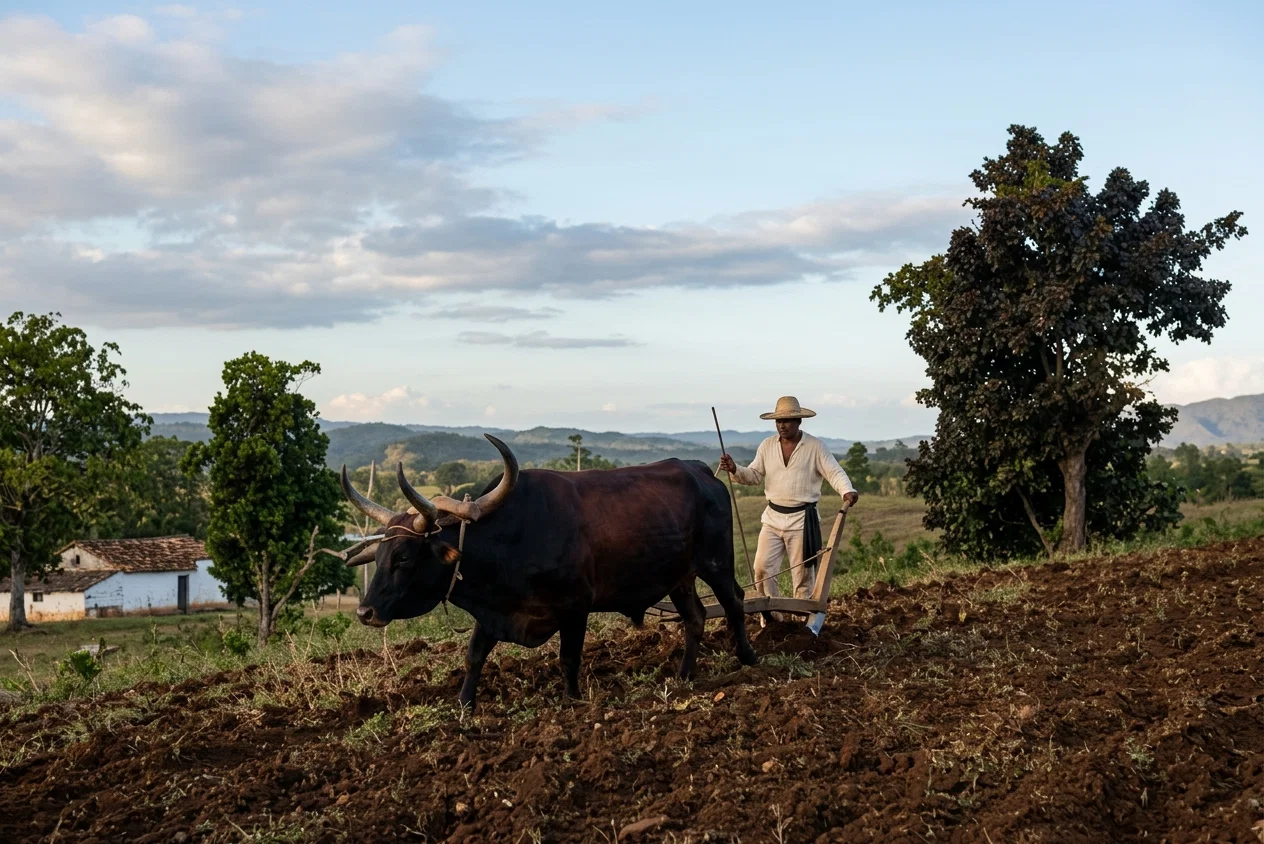
PLOWING IN CUBA
The idea generally prevails that Cuba is immensely rich and productive, and that, at the touch of the hoe or spade, the earth smiles in an abundant harvest. We would say right here, however, to any who may expect to get rich at once, that he will be quite liable to be disappointed. As a rule, the first impressions of the agricultural possibilities on the stranger are not favorable. In a land of such proverbial fertility, he looks for a well-settled country, with fine, cultivated fields, and a show of farm-buildings, with other evidences of prosperity. He is disappointed when riding out of Havana on the main pike road, to note the absence of all the above, with only now and then a cane field, and here and there the ruins of a sugar-mill, destroyed during the late war, or a blockhouse, standing as grim sentinels and reminders of the happy days of the past.
Apart from the devastating results of the late war, which left almost no inhabitants in parts to till the fields, the policy of Spanish rule in Cuba seems to have been directly at enmity with agricultural progress, outside of the cultivation of sugar and tobacco—products that never came in competition with those of Spain. The fact that the Cuban farmer was fined heavily if he planted more than one grape-vine, or if he passed the limit of oranges or other fruits which brought him into competition with the products of the home country, would illustrate how this policy worked. In view of such a policy, can we wonder that the poor Cuban is centuries behind in his civilization and mode of tilling the soil?
There will be those coming to this country who will expect to work the soil as they do at home; and we have met those who expected to be able to spade up the earth at once, and in three months' time have a harvest. To this class we would say that to our knowledge only the inferior, sandy lands of Pinar del Rio render this mode of tillage possible, and, strange to say, these lands are giving good results when fertilized properly. The most fertile lands, however, are the old plantations, which, as a rule, are of a deceptive soil. These, through having been uncultivated for years, naturally cost more to subdue and get in a workable condition. However, the natural fertility, rendering fertilization unnecessary, together with abundant harvests, gives these lands the preference over others.
To be successful here, our brethren must not give up in discouragement at conditions they did not look for. A spirit of adaptation, patience, and an inclination to receive advice from others who are better informed, will, in most cases, overcome the difficulties which are largely only apparent, not real.
To any one who will not follow the above course, and who is not willing to adapt himself to conditions identical16with those of the pioneer days of thirty years ago in the West and Northwest, we would say, Do not come to Cuba to farm, unless your means permit you to take up improved land near the capital, at a comparatively high price. But with all sincerity, we can say that there is probably no country of limited territory that offers better prospects to the settler of limited means than does Cuba. Thousands have recognized this fact, and proof of it is seen in the influx of American settlers and capital. The fact that the area of fertile lands is limited, the whole country having only the area of Pennsylvania, has caused the fertile lands to advance in price, and a further advance is expected, as they are rapidly taken up.
In view of the fact that the cause in Latin-American fields never has derived its financial support from the natives, but rather from the various outside elements coming in, we may also expect no great financial results here in Cuba; therefore, the coming of our brethren who will give strength financially, as well as otherwise to the cause in this needy field, will be most desirable; and if they come mainly because the work needs them, they will have the Lord's blessing.
The following figures, taken from the United States official weather report issued at Camaguey, Cuba, will indicate that no fear of the summer heat here need be entertained: Extreme maximum temperature recorded for six years, 98°; extreme minimum temperature, 47°. Only on the following dates did the temperature exceed 95° during six years' time:—
June 1, 1901, 96°; Sept. 1, 1900, 96°; July 30, 1899, 97°; Aug. 24, 1899, 98°.
The mean temperature for the four hottest months of the year was as follows:—
June, average temperature, three years, 80°; July, average temperature, six years, 80°; August, average temperature, six years, 81°; September, average temperature, six years, 80°.
Before coming to this field, all will find it to their advantage to correspond with us. Any information possible to obtain will be cheerfully given, if letter is accompanied by a stamp.