Majestic, sublime, round the great wheel of Time,
The earth thru the ages rolls on;
From shadow to light, from the star-sprinkled night
To the gold and the roses of dawn;
But the hordes of mankind to the spectacle blind,
With faces bowed down to the dust,
Creep on to their graves as the manacled slaves
Of selfishness, hatred, and lust.
They turn from the dream of the glories that gleam
In the deific light of the stars,
And cease to aspire as they kneel in the mire
At the altars of Mammon and Mars.
The miracles wrought in the kingdom of thought,
The wealth of the empire of art,
The magical spell of the passions that dwell
In the innermost realms of the heart,
The beauties that beam over forest and stream,
The grandeur of mountain and sea,
The path of the soul to an immortal goal,
The vision of glories to be,
The music, the light, and the dream infinite,
Our greed and our hatred are bars
That shut them all out, while we turn us about
To the worship of Mammon and Mars.
In liberty's morn was our century born,
Foretelling an era of right;
We're straying away from the light of that day
To the gloom of the old feudal night.
Our fathers began at the freedom of man,
But we have forgotten it all;
We seek our recourse in the doctrine of force,
The gospel of powder and ball.
In newly-blown pride we are pushing aside
The Christ with His wounds and His scars,
We turn from the cross to the worship of dross
At the altar of Mammon and Mars.
—J. A. Edgerton.
With Our Inquirers
By Editor
"If ye will inquire, inquire ye."
[All questions to this department will be answered which to the editors will seem to minister to the good of the readers and to the mission of the paper. The same question can not be answered repeatedly in the same volume. The name and address must accompany question, not for publication, but as an evidence of good faith, and that answer may be made by letter if deemed advisable. It is well always to enclose a stamp for reply.]
2308.—Use of Vinegar
In question No. 2114 it asks if it is wrong to use vinegar for seasoning, and the answer is, "It is." I wish to inquire if there is any Scripture authority for such an answer. If so, where is it found?
There is a reason given in that answer as to whether vinegar should be used, and that was that there is no use for it except in a chemical way. It is an unnatural acid, and a substitute was suggested for seasoning. Lemons contain a natural acid. There are those who could use vinegar without harm. The excretory organs, the physical exercise, the abundance of good health, would eliminate from the body the unnatural acid so the system would not feel it. Still it is a task upon the system which there is no use of placing upon it. We know of no scripture which says, Thou shalt not use vinegar. We know of none that says, Thou shalt not use absinth. We know of none which says, Thou shalt not use tobacco. And a thousand other wrong things could be placed in the same category. The word of God deals with great principles, and one of the principles is, "Whether therefore ye eat, or drink, or whatsoever ye do, do all to the glory of God." If it will glorify God to use vinegar and these other things, use them. If it will give us strong physical powers, clear minds, sweet breaths, better digestion, use them. One of the great questions which ever ought to be before us in the use of these things for which our appetites long is, Are we doing this to glorify God, or are we doing it because a perverted appetite demands it? This we know, there are thousands of people who do not use vinegar, who have no need of it in any way, and who have excellent health all the time. There are also many who have been injured by it. Our correspondent must settle the question between himself and the Lord.
2311.—Wearing of Flowers and Plumes
Is it wrong to wear flowers and plumes on hats?
We know no better instruction as to proper dress than that given in 1 Timothy 2 or 1 Peter 3. We do not see how one is especially adorned, as the apostle declares they should be, by wearing artificial flowers. So far as plumes or feathers are concerned, on the ground of mercy and humanity alone Christian women ought never to wear them. Some of the most beautiful of birds which God has given to enlighten and beautify and make sweet this old earth have been almost utterly wiped out of existence in order to meet the demands of fashion. This is especially true of the white heron and also others of the most beautiful of birds. The birds are slaughtered by the thousands and
millions to meet the demands. It is a wonder that Christian women do not set themselves against it everywhere and say, We will wear nothing whatever that has meant cruelty to any of these beautiful creatures which the Lord has made. There are societies which are doing noble work in this direction, the Audubon Society and the Society for the Prevention of Cruelty to Animals. May the Lord bless them. May all our Christian readers work with them to do away with a fashion that adds nothing to feminine beauty.
2307.—"Thou Shalt Not Kill."
Please harmonize Deut. 5:17 with other passages bearing on the same, especially where the Lord gives instruction that certain persons should be stoned to death.
J. W. M.
"Thou shalt not kill" is a command which the Lord brings to every individual soul. That is the duty of the individual. On the other hand, governments must have some way of protecting the lives and property of their subjects; and nearly all the governments on the face of the earth have decided that the taker of life shall be put to death, or the one who commits a crime tending to utterly subvert the government and by that means destroy many, should also suffer capital punishment. Sometimes these laws may have been too severe, doubtless many of them have. Now and then governments have thought best to abolish capital punishment. That is the case with some at the present time. The Lord saw fit in the government of Israel to say that certain things should be punished with death; in His own wisdom He saw that if certain crimes were allowed to be carried on, the whole nation would be destroyed by the influence of evil-doers. For instance, those who thought that His Sabbath was of no account transgressed the Sabbath; as a result of this the people went into idolatry, and idolatry meant the eternal destruction of many. In God's wisdom it is better that the one who subverts the whole nation should perish rather than that the nation should be destroyed. It was one of the laws that one who taught idolatry and who led the people away after other gods should suffer capital punishment. He desired that such cases should be examples to those who were younger, that they might turn from such demoralizing practises. Of course these commands of the Lord became dead letters in later ages, and His whole people went into idolatry, with the result that crimes of every kind came in. Some were destroyed even in the idolatrous ceremonies themselves, sacrificing to the sun-god and to Moloch, while every iniquity prevailed. It was to restrain evil-doers that these laws were given of the Lord, and for the same purpose that governments have enacted them; but it is ever the duty of the individual, "Thou shalt not kill."
2310.—Unclean Beasts.
Please explain Leviticus 11, regarding clean and unclean beasts, and the prohibition which says that these should not even be touched. If so, would it not be wrong to even touch a horse or a hog?
I. M.
If our inquirer will read the chapter carefully again, he will see that it is not the living which should not be touched, but the dead ones, “their carcass shall ye not touch,” “ye shall have their carcasses in abomination.” We know of no scriptures which say that we should not touch the horse or ass or any of these beasts that were used commonly as beasts of burden. God prohibited certain beasts as food because they were not good food. If one of them died, of course it would be duty to bury or remove it. Provision was made for that; one who found it necessary to handle dead bodies of unclean beasts was to wash himself and change his garments and be unclean until the evening. All these ceremonial laws were to impress upon that people that they should be a holy people unto the Lord. Read the entire chapter.
2312.—To the World in This Generation
What do you mean when you speak of preaching the Gospel to all the world in this generation? Explain clearly which generation.
I. M.
It means the generation of people who are living upon the earth at this time. Some of the very old may die; of course many others may die; but those in general who are living and in active work will see the Gospel go to all the world in their lifetime. It is questionable whether there is a country on the face of the earth which has not already received the Gospel to some extent, but it will go with far greater power, as indicated by the angel of Revelation 18. The earth shall be lighted with its glory and then Christ shall come.
A READER
2313.—The Seat of Papal Authority.
How do we understand the seat of papal authority to be moved to Jerusalem since we have learned from Dan. 11:45 that it is the Turkish power that is to plant his palaces between the seas?
A READER
Have we learned this? It has been taught, it is true, that the king of the north is the Turkish power, but that is yet to be demonstrated. Did not the power which conquered the king of the north then become the king of the north? And if Rome conquered the king of the north, did not Rome itself become the king of the north? Again, the true King of the north is God, “whose throne is in the sides of the north.” The pseudo king of the north is Satan, Lucifer, the fallen day-star, who said, “I will ascend into heaven, I will exalt my throne above the stars of God; I will sit also upon the mount of the congregation, in the sides of the north; I will ascend above the heights of the clouds; I will be like the Most High.” Isa. 14:13, 14. In Rev. 12:9, Satan is called the dragon. Rev. 13:2 says that the dragon gave the beast his power and seat and great authority. In verse 4 the dragon gave power unto the beast, and the beast power is the representative of Satan here upon earth. Evidently the beast power then is the earthly king of the north.
Against the beast power the great Threefold Message warns us. Rev. 14:9-11. That warning is world-wide. It does not warn us against the Turkish power or the Mohammedan power, which is rapidly waning. It seems to the writer that there is every evidence to believe that the beast power will set up his throne in Jerusalem and there be made the arbiter of nations in religious matters. There are others who hold this to be the Turkish power. It is well for us to study the prophecy as an open prophecy still. God has greater, clearer light, we are sure, on some of the unfulfilled prophecies of His word. Simply because many good persons have believed the king of the north of Dan. 11:45 to be the Turk is no evidence that it is. Good men and good students have believed that Dan. 11:36-39 refers to France, but 2 Thess. 2:3, 4 very clearly shows that it refers to what is there called the man of sin, the son of perdition.
Necessary Sabbath Work
2314.—F. E. L.—The question as to how much work shall be done and what work is necessary on the Sabbath must be left to the conscience of the individual. The Lord does not forbid necessary work or works of mercy. It would seem that housekeepers should make the work just as light on that day as possible, in the cooking of food, washing of dishes, making of beds, etc. Sometimes that work seems absolutely necessary. That they must settle with their own consciences and God.
Healing the Sick.
AMONG the evidences of unbelief in Biblical Christianity is the rejection of the miraculous. There are many professed Christian ministers who do not believe in the incarnation, the vicarious atonement, the resurrection. With disbelief of these, goes belief in miracles. Logically, with these goes belief in the entire Scripture record of the life and work of Jesus. For if these are not true, when so expressly stated, why should we believe any part of the record? We are told in effect that Jesus may have been a good man, but He was greatly deceived as to His own mission, as were also His disciples. The unbelief is not generally expressed as baldly, but it means this if it means anything.
CHRISTIANITY itself is a great miracle, working above and beyond all natural laws, or it is nothing. It is not evolution; it is creation; and when there is evolution manifest in it, it is the evolution of creation, of divine life, of infinite power. It is, as D'Aubigne expresses it, "a heavenly life brought down to man." It is thus that the Master declares His mission: "I came that they may have life, and may have it abundantly." John 10:10, A.R.V. This life was indeed a heavenly life. It was not the natural life-flow of the physical man. It was not the life fed on the food of the world. It was and is spiritual, the life of God, eternal life; for "he that believeth on the Son hath eternal life; but he that obeyeth not the Son shall not see life." John 3:36. Therefore the apostles were given a mission of life. It was a Gospel of life they were to give; words of life they were to speak. So declared the shining messenger of God to the disciples he released from prison: "Go ye, and stand and speak in the temple to the people all the words of this Life." Acts 5:20.
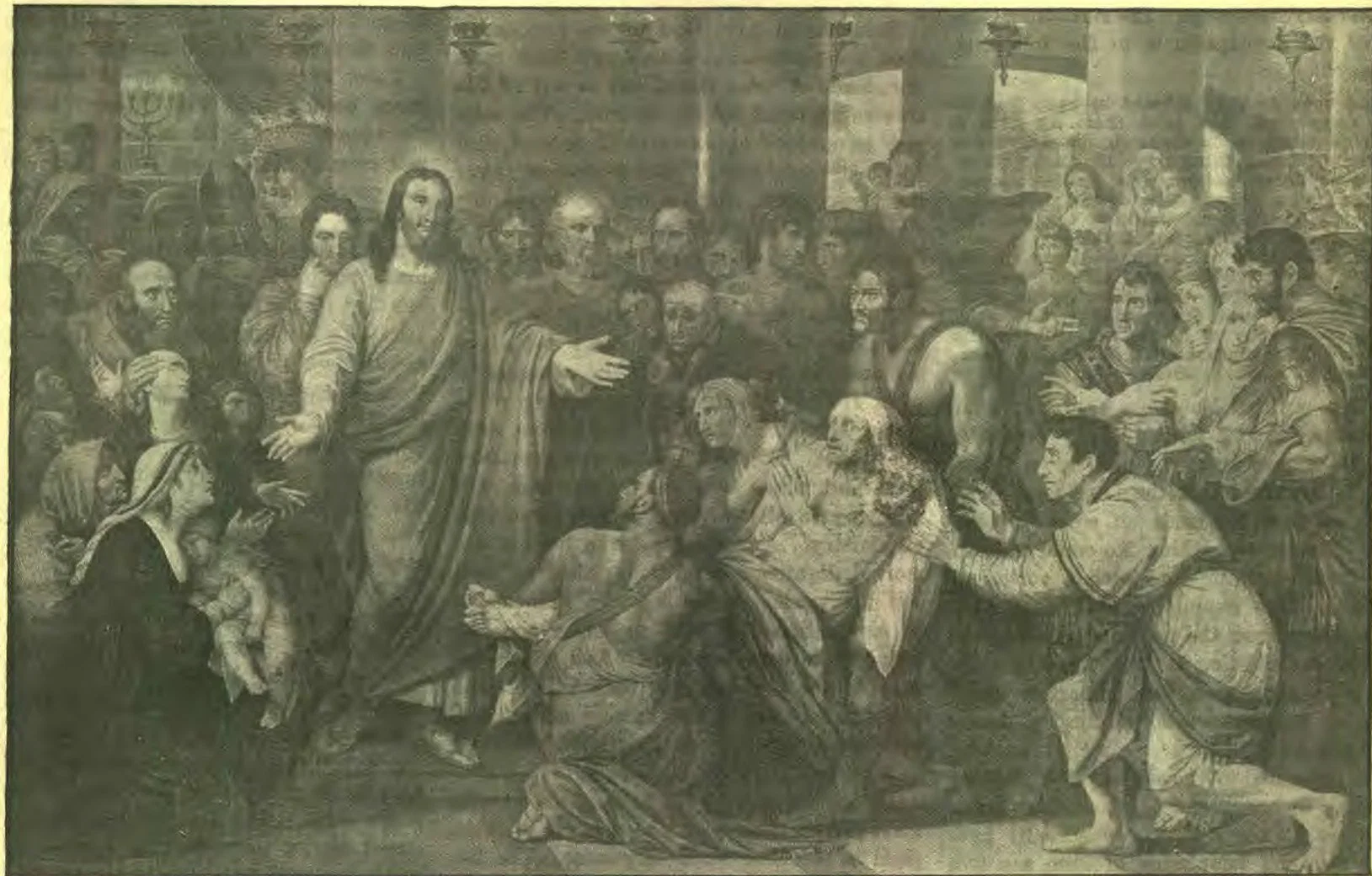
Benjamin West. Christ Healing the Sick.
AND hence the miracles, the healings. How many times we are told of the wonders, the signs, the miracles, the powers, Christ wrought. From the beginning of His blessed mission to the close is one constant record of miraculous ministry. Here is an instance: "And when even was come, they brought unto Him many possessed with demons; and He cast out the spirits with a word, and healed all that were sick." Matt. 8:16. Again: "And Jesus went about in all Galilee, teaching in their synagogs, and preaching the Gospel of the kingdom, and healing all manner of disease and all manner of sickness among the people." Matt. 4:23. "And the report of Him went forth into all Syria; and they brought unto Him all that were sick, holden with divers diseases and torments, possessed with demons, and epileptic, and palsied; and He healed them." Verse 24. "And Jesus went about all the cities and the villages, . . . healing all manner of disease and all manner of sickness." Matt. 9:35. On "a great multitude" "He had compassion," "and healed their sick." Matt. 14:14. "There came unto Him great multitudes, having with them the lame, blind, dumb, maimed, and many others, and they cast them down at His feet; and He healed them." Matt. 15:30. "Great multitudes followed Him; and He healed them there." AND there are many other instances, all given to show the power of the word of God. Many, many miracles He wrought which are not left on record; but those which are recorded "are written that ye may believe that Jesus is the Christ, the Son of God; and that believing4ye may have life in His name." John 20:31.
THESE miracles, these healings, were not wrought by some process of "mental treatment," by some effort to induce the patient to believe that he was not sick, not palsied, did not have the leprosy, was not blind. All these were actual conditions and were so treated. It was no illusion that this one was blind, or that one maimed, or another one palsied or leprous. They were sad and sober facts. But the word of the Master healed them. He did not do it by medical treatment, by baths, or massage, or applications of any kind, but by the word, by the touch, which imparted the divine life. While physicians and nurses may do noble work for God in instruction, treatment, and nursing, let us not draw level comparisons between their work and that of the Great Physician. They use remedies, blessed indeed of God, which help nature to repair broken tissues and restore health; but Christ Jesus healed by the touch, by the word. The "power of an endless life" thrilled the afflicted one with divine creative energy and immediately he was healed.
To His disciples He gave the same power, and the same results followed. Why do we not see more of it to-day? Let us confess it frankly,—lack of power among His people. Should they seek for that healing power? —No, not of itself. They should seek first for His creative power to do the greatest of all miracles,—put away sin and regenerate the soul,—and then they can be trusted with all lesser gifts. "Seek ye first the kingdom of God, and His righteousness." Believe into Him as a Saviour from sin and bodily ills, but first of all as the Saviour from sin.
They refused to have God in their knowledge." And having thus "refused" God, He "gave them up unto a reprobate mind." The fact that the Lord gave them up shows that He made an effort to save them. He did everything He could to keep them from plunging into such a vortex of iniquity. But having refused God and broken away from the restraining influences that He was exerting to draw them into the ways of righteousness, they impart to themselves an intense momentum in the downward course of sin. They have had to know about God in order to refuse to have Him in their knowledge. But knowing about God, and actually having a personal knowledge of Him are two very different and opposite things. The one who merely knows about God may be very intelligent concerning all the history of religion, and may consider himself a very wise and well-educated person, but to actually know God thru the workings of His Spirit in the mind and heart is the only thing that will keep men from falling into the iniquities that are described in this first chapter of Romans.
THE study in Romans in last week's paper presented a part of the description of the iniquities into which the wicked plunge when they refuse to retain God in their knowledge. The remaining portion of the description is in the following verses:
“And even as they refused to have God in their knowledge, God gave them up unto a reprobate mind, to do those things which are not fitting; being filled with all unrighteousness, wickedness, covetousness, maliciousness; full of envy, murder, strife, deceit, malignity, whisperers, backbiters, hateful to God, insolent, haughty, boastful, inventors of evil things, disobedient to parents, without understanding, covenant-breakers, without natural affection, unmerciful: who, knowing the ordinance of God, that they that practise such things are worthy of death, not only do the same, but also consent with them that practise them.” Rom. 1:28-32.
“They refused to have God in their knowledge.” And having thus “refused” God, He “gave them up unto a reprobate mind.” The fact that the Lord gave them up shows that He made an effort to save them. He did everything He could to keep them from plunging into such a vortex of iniquity. But having refused God and broken away from the restraining influences that He was exerting to draw them into the ways of righteousness, they impart to themselves an intense momentum in the downward course of sin.
They have had to know about God in order to refuse to have Him in their knowledge. But knowing about God, and actually having a personal knowledge of Him are two very different and opposite things. The one who merely knows about God may be very intelligent concerning all the history of religion, and may consider himself a very wise and well-educated person, but to actually know God thru the workings of His Spirit in the mind and heart is the only thing that will keep men from falling into the iniquities that are described in this first chapter of Romans.
The man who goes into the out-and-out idolatry of heathenism thru refusing God does not separate himself any more surely from the Fountain of righteousness than the one who refuses to know God and still clings to the embellishments and outward adornments of civilization. Refusing to know God does not necessarily deprive men of the knowledge that this world affords. It does not necessarily separate them from outward gentility; it separates them from the one Source of life and power that will enable them to lead clean, strong, righteous lives.
Refusing to have God in the knowledge does not necessarily drive away from man the shame of being found out in any of the sins enumerated by the apostle. The man may to outward appearances be genteel, and “a good, moral man.” But he does not have the power that enables him to stand for righteousness and purity in all things when he is alone and he knows that no human eye sees him or knows what he is doing.
All these things being true, it is clear, then, that we need not look alone in barbarous and idolatrous lands for the examples of what the apostle describes as taking place among those who shut God away from their knowledge. The man who lives in a heathen land and shuts God away from him will plunge into all the vices and superstitions of idolatry. And the man who lives under more enlightened conditions takes to himself the veneer of the outward refinements of civilization, while at the same time he indulges its debasing vices. And whichever may be the environment, they will become morally degenerate, not because of that environment, but because they have “refused to have God in their knowledge.”
In another one of his letters, the apostle Paul gives a catalog of sins that are to cause peril in the time when they exist. The list is the following:
“But know this, that in the last days grievous times shall come. For men shall be lovers of self, lovers of money, boastful, haughty, railers, disobedient to parents, unthankful, unholy, without natural affection, implacable, slanderers, without self-control, fierce, no lovers of good, traitors, headstrong, puffed up, lovers of pleasure rather than lovers of God; holding a form of godliness, but having denied the power thereof: from these also turn away.” 2 Tim. 3:1-5.
One of the first things that Paul tells us will make the last days “grievous” is self-love and the love of money. In the verses from Romans at the head of this article he tells of those, who, refusing the knowledge of God, become covetous. Covetousness and self-love and the love of money are the same thing expressed differently. Other things that he mentions that will make the last days “grievous,” are the facts that men will be “boastful, haughty,” “disobedient to parents,” “without natural affection,” and all these things are given in his Roman letter in practically identical words as the sins that men commit when they refuse to have God in their knowledge. And while the rest of the list that he gives in his letter to Timothy is not given in identical words in his letter to the Romans, yet the sins described are much the same.
Now since these sins come to those who “refuse” to have God in their knowledge, and since they are to make “grievous,” or, as in the Authorized Version, “perilous” times of the last days, it follows that the mass of mankind will reject God. They will refuse to have Him as their guide and teacher.
The text in Timothy shows that they will not refuse to make a profession of Christianity, for the apostle says they are “holding a form of godliness.” They cling to the form of godliness while they are practising all the things that he enumerates in his long list of sins. But while they hold the form of godliness, the apostle explicitly declares that they have “denied the power thereof.”
Then we have before us in these scriptures, quoted from two different letters of the apostle Paul, a list of the sins that men will commit who depart from God. In his list quoted from Romans he described the depths of degradation into which the heathen world threw itself—the heathen world that made no pretense of acknowledging Jehovah, but on the contrary had openly spurned Him. In his list quoted from Timothy, the apostle tells of the same depths into which those will go who hold to the form of godliness, but who do not have its life and power. Thus it will be seen that holding the forms of Christianity without having its life, produces the same results exactly in men that are produced by out-and-out idolatry and heathenism.
These two scriptures from Romans and Timothy make a striking presentation of a great truth. Formalism in religion, even tho that religion be called Christian, lowers a man into the same depths of moral degradation as does the worship of idols. With the formalist there may appear a little more outside gentility, but the inner character is the same. And it is the degradation produced among those making a profession of godliness that the apostle shows us is to make the last days perilous and grievous.
The foregoing scriptures do not present the theories of men; they give the estimate that God Himself places upon things. It is well for us to give them careful study and consideration.
T.
Christ’s Promised Return
“This same Jesus, which is taken up from you into heaven,” said the angels, “shall so come in like manner as ye have seen Him go into heaven.” Acts 1:11.
The Manner of Christ’s Coming
“As the lightning cometh out of the east, and shineth even unto the west; so shall also the coming of the Son of Man be.” Matt. 24:27.