There is something infinitely better and more satisfying than the possession of silver and gold; though from the way many barter honor, and even life itself, for riches, it is known that not every one has a true estimate of its value.
Listen, and learn what is better: “Happy is the man that findeth wisdom, and the man that getteth understanding. For the merchandise of it is better than the merchandise of silver, and the gain thereof than fine gold. She is more precious than rubies: and all the things thou canst desire are not to be compared unto her. Length of days is in her right hand; and in her left hand riches and honor.”
Parents, entrusted with little ones to train for a noble, useful life, is not the knowledge of how to teach and how to deal with your children from day to day of more value than silver or gold? That such a responsibility is yours, should be an incentive for right conduct in your own lives, and for the acquisition of such knowledge as shall enable you to teach your children in character building and in all wholesome and right ways. The following helpful words from that excellent work “Ministry of Healing,” will prove of benefit to all who will heed them;—
“Study health subjects, and put your knowledge to a practical use. Teach your children to reason from cause to effect. Teach them that if they desire health and happiness, they must obey the laws of nature. Though you may not see so rapid improvement as you desire; be not discouraged, but patiently and perseveringly continue your work.
“Teach your children from the cradle to practise self-denial and self-control. Teach them to enjoy the beauties of nature, and in useful employments to exercise systematically all the powers of body and mind. Bring them up to have sound constitutions and good morals, to have sunny dispositions and sweet tempers. Impress upon their tender minds the truth that God does not design that we should live for present gratification merely, but for our ultimate good. Teach them that to yield to temptation is weak and wicked; to resist, noble and manly. These lessons will be as seed sown in good soil, and they will bear fruit that will make your hearts glad. Above all things else, let parents surround their children with an atmosphere of cheerfulness, courtesy, and love. A home where love dwells, and where it is expressed in looks, in words, and in acts, is a place where angels delight to manifest their presence.”
Washington, D. C.
Why Some Children are Childish
If we want children to tell the truth, we must tell the truth to them. If we want them to behave seriously, we must behave seriously toward them. Two women sat in a railroad station with two little girls. “How does the man know when the train is ready, and when the train that is ready is going?” asked one of the little girls, as the man who called out the trains from a platform in the corner of the station began to shout through his megaphone. “Oh, he knows by instinct, or by revelation,” said one of the women. That was a lie, and a lie bound to have large and evil educational results, alike on the child’s confidence in truth and in others as tellers of the truth, and on the child’s thoughts about revelation. Then the other woman began to nag the children. She exchanged their hats, greatly to their distress, pulled them about playfully, and otherwise affronted their childish but just ideals of propriety. Under her educating influence, one of the children soon began to be as childish as the woman was, and threw one of the woman’s possessions on the floor. That brought things to an end, and the woman reproved the child for what the child would not have done except for the woman’s example and influence. There is a great deal of latent foolishness in children. But from whom do they inherit it? Doubtless some of it will work out in any case, but if grown people would be a little less foolish, the children would stand more chance of growing up as wise and sensible children.—Sunday School Times.
For the Housewife
Do not make a bugbear of company. Treat your chance guest as you would wish to be treated in like emergency. The “dish of welcome” is better than the most elaborate menu without it, and an embarrassed hostess seldom makes a satisfied guest. One is not supposed to visit you for the sake of the food set before her. Give the best you have, cordially, cheerfully, and if your guest is worth the trouble, she will appreciate the situation.
“A feast or a famine” describes some housekeeping failures; too much of one thing with too little of another; and this is generally due to the lack of harmony between the views of the one who plans to provide the table and the one who pays the bills. A certain amount should be appropriated for table expenses, be it little or much, and by this means, the housewife will always know how to proportion her buying.
During the hot months try all the laboring-saving appliances you can manage. Try to get the heaviest cooking done early in the morning, and arrange matters so that the house will not have to be heated up for the dinner preparation, whether the dinner is at twelve or at six. Many things are just as good cold or reheated as though just out of the oven, and these can be prepared in the cool of the morning. Do not have pies or puddings, if you can have fresh fruits. Salads can, in many instances, take the place of the accustomed meats, and it would be better for both the health and the pocketbook to ignore the butcher.
For hot weather drinks there is nothing better than those made of cold water and fruit juices. Acid fruit juices are best with which to quench thirst. Fruit punches are easily made, if the housewife remembers to bottle plenty of fruit juices when canning the fruits.—Selected.
Don’t Forget in Summer
To give pure cold water to the baby two or three times a day.
To shade the baby’s eyes from strong light, especially from full sunlight.
To avoid saffron tea for bleaching the baby, for it has a tendency to produce scrofulous sores.
To apply hot cloths to the little feet and stomach for colic, and leave the peppermint in the bottle.
To use good common sense continually and in large doses; and the baby will be a joy and comfort to the household, no matter how trying the weather.
The Work in Wales
By W. H. Meredith
Annual Report to the British Union Conference
W. H. MEREDITH
ANOTHER year has passed, and we have much cause for thankfulness to God for his tender care and great blessings. There have been perplexities and trials. The enemy has not been idle. But through it all we can report a forward move, and, far from being a failure, our work has taken a deeper hold, and with God's help we are confident it will develop more rapidly than ever.
THE BIBLE VAN AND THE WORKERS
The following words of encouragement taken from the “Ministry of Healing” and quoted in the REVIEW AND HERALD have been a source of great help to us:— “Many who sincerely consecrate themselves to God's service are surprised and disappointed to find themselves as never before, confronted by obstacles, and beset by trials and perplexities. It is because God is leading them that these things come upon them. Trials and obstacles are the Lord's chosen methods of discipline and his appointed conditions of success. The fact that we are called upon to endure trials shows that the Lord Jesus sees in us something precious, which he desires to develop. If he saw in us nothing whereby he might glorify his name, he would not spend time in refining us. He does not cast worthless stones into the furnace. It is the valuable ore that he refines.”
“The potter takes the clay, and molds it according to his will. He kneads it and works it, he tears it apart, and presses it together. He wets and then dries it. He lets it lie for a while without touching it. When it is perfectly pliable, he continues the work of making of it a vessel. He forms it into shape, and on the wheel turns and polishes it. He dries it in the sun, and bakes it in the oven. Thus it becomes a vessel fit for use. So the great Master Worker desires to mold and fashion us. And as the clay is in the hands of the potter, so are we to be in his hands. We are not to try to do the work of the potter. Our part is to yield ourselves to be molded by the Master Worker.”
“Beloved, think it not strange concerning the fiery trial which is to try you, as though some strange thing happened unto you: but rejoice, inasmuch as ye are partakers of Christ's sufferings; that, when his glory shall be revealed, ye may be glad also with exceeding joy.” 1 Peter 4: 12, 13. So our trials and perplexities tell us that Jesus sees something in us worth developing, and he is doing the work of refining in his own good way.
Our hearts rejoice in his goodness, in his tender compassion and long-suffering to usward.
If ever a year was filled with signs of the near coming of our Lord, we feel that it is the one just passed. The distress among the nations speaks volumes of the proximity of the strife, unrest, rebellion, anarchy, and the trouble between capital and labor, which fill the world, cry aloud to every student of prophecy, telling plainly of the awful cataclysm ready to break upon us. The workings of the enemy in causing division in the ranks of the church, leading men to arise, speaking perverse things, to draw away disciples after them, are omens of the time of trouble such as never was since there was a nation, telling us plainly to “look up, and lift up our heads; for our redemption draweth nigh.” As we look over the field, we are led to exclaim, O Lord, how long, how long must the people dwell in darkness?
The Welsh revival has certainly left our field worse than before. Ministers of the other denominations are saying that this is so. Confusion and division, heavy debts as the result of building large chapels, prevail all around, and all kinds of schemes are planned to meet these difficulties. We have the message that alone can save, and yet how slowly we move! We have only just begun to touch the edge of our field. Truly the harvest is great, and the laborers are few.
Our work as yet is chiefly confined to two counties, Monmouthshire and Glamorganshire, although our canvassers have gone into nearly all the others, Pembrokeshire, Carmarthen, Radnor, and Breconshire especially. The total population of the Wales Mission is 1,864,696. The population of Glamorgan and Monmouth alone is 1,158,248. This leaves 706,448 for the other eleven counties.
We have churches in Cardiff, Pontypridd, Newport, and Abertillery, and companies in Blaenavon, Abergavenny, Aberdare, Barry, and Swansea. Aggressive work has been carried on during the year in Abergavenny, Blaenavon, Blainau and Cardiff.
Considering the membership of our field, we note that we have lost by death two, by apostasy eleven, and by transfer five, a total of eighteen. Our present membership is one hundred and eighty-five as against one hundred and seventy last year. Besides these we have about twenty who are preparing for baptism, which shows a total increase of over forty Sabbath-keepers.
Our Sabbath-schools also are prospering, and during the year we have organized two new schools, making our present membership two hundred and seventeen. Our offerings to missions have increased accordingly. The tithe report for the year ending June 30, 1906, showed the receipts to be fourteen hundred and ninety dollars, or an increase of two hundred and nineteen dollars.
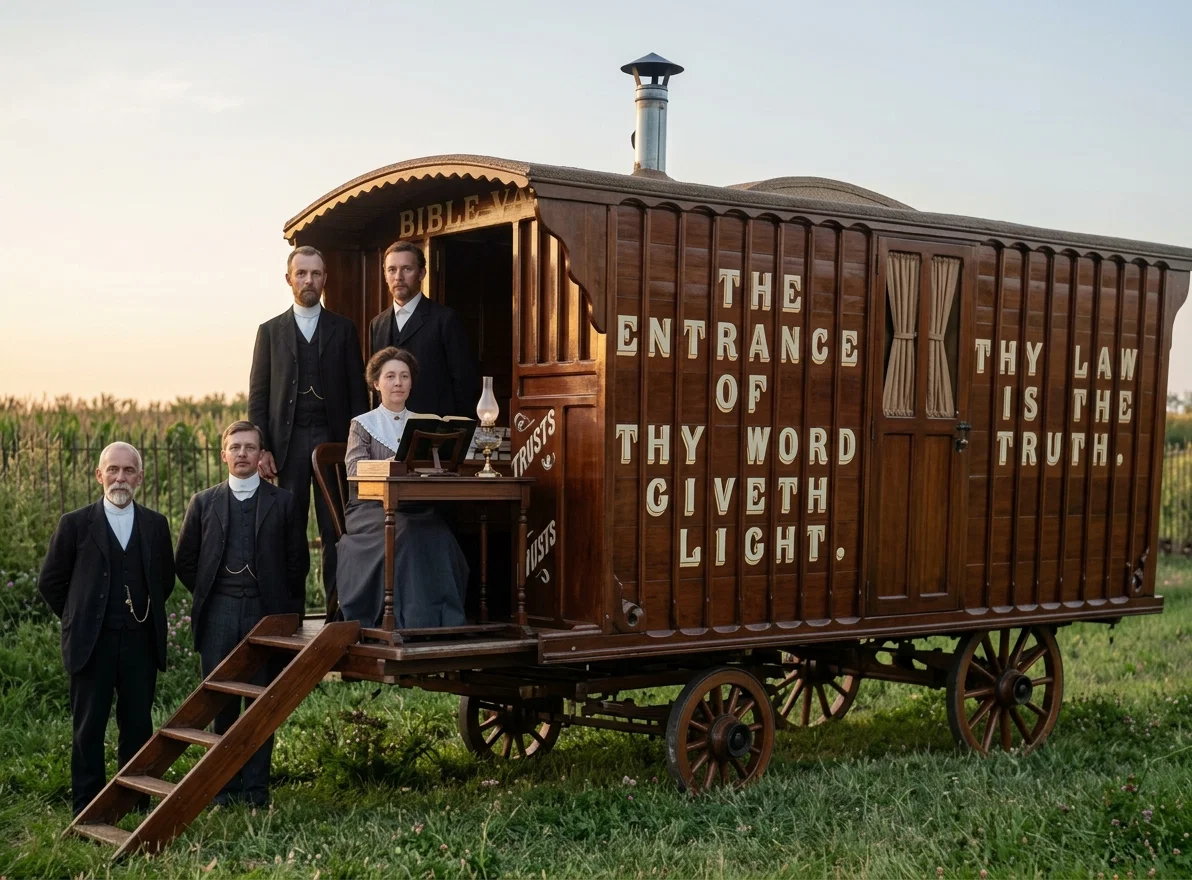
We have placed a Bible van in the field, in charge of Brother and Sister G. W. Bailey, which we hope will be a means of reaching many with present truth.
One young man who accepted the truth a few months ago, has been working with his brother, who is a Baptist minister, with the result that the brother has decided to obey, and throw in his lot with the remnant people. This brother will need our prayers, for he is preparing to preach the truth in his church, and do all in his power to save his people.
We have a Young People's Society in Cardiff, where we hope to develop some who will be of good service to the church, and also for other fields of labor. They hold regular meetings each week, and have a missionary meeting once a month. One of their number reads a paper on some subject of interest, and they study different phases of the truth. During the few months of their existence as a Young People's Society they have bought and given away twenty-five thousand tracts, sold some hundreds of papers, written missionary letters, taken part in Christian Help work, and given as they could to those in need.
Our canvassers are few, and seem to have worked with small books at least for the greater part of their time; so the value of books sold is not very high; but a great work has been done with tracts and periodicals, and when the gathering time comes, we shall see14much fruit from these precious seeds sown by the faithful canvassers. There is scarcely a home in south Wales that has not had the opportunity of purchasing our books and tracts.
We believe this message with every fiber of our being. We are glad to hear of its advance in the earth. We are ready to do our little to help it on. We have no sympathy with those who would break away from the pillars of faith given to us by the great Master Builder. We believe the foundations are sure, and the more we know of them, the more we love them. We are looking for the triumph of this people. We are looking for it in this generation. We pray that God will help us to be faithful, and prepare us for the outpouring of his Spirit, which will finish the work. We need it for our work in Wales, for while the Lord has blessed us, we still crave greater blessing, greater wisdom, and power to do the work commissioned to us. Soon may the truth reach the uttermost parts of the earth; soon may the faithful be gathered out of every kindred, nation, tongue, and people; and in that glad day may you all, and many from Cymru's land, be found among the faithful, is our earnest prayer.
China Preparing for the Final Battle
By J. N. Anderson
J. N. ANDERSON
THIS is an intensely military as well as a commercial age. Despite all protestations of international comity and good will, and the many efforts to effect permanent peace among the world powers, the war spirit is mightily working in the hearts and minds of men in all the nations of the world. Nations which heretofore have stood aloof from the present-day militarism, are fast being drawn into this mad race. The following appeal by a body of missionaries in China shows not only the trend of the Chinese race in this direction, but also points out very clearly the baleful results that are sure to ensue. The strong and decidedly Scriptural position taken by this missionary society is well worth serious study and close imitation by all missionaries or Christian workers whether in China or elsewhere:—
AN APPEAL ISSUED BY THE COMMITTEE OF MISSIONARIES OF THE FRIENDS FOREIGN MISSION ASSOCIATION, HELD AT CHENTU, MAY, 1906
“Believing that all war is contrary to the spirit of Christ, we view with grave concern the wave of militarism which is spreading over the Chinese empire at the present time. While we are well aware that all our fellow missionaries may not be able to go as far as we do in this protest against war, we still feel that this matter is one to which the missionary body should give a much more careful attention than heretofore; and we would urge all those who are working with us for the kingdom of God in China, to prayerfully consider the subject, in the light of the present movement and the revealed will of God.
“We are in this land as the representatives of the Prince of Peace, and with a gospel heralded with the message, ‘Peace on earth and good will to men.’ We come, moreover, to one of the most essentially peaceable nations in the world. Chinese greatness is built, in no sense, upon the feats of arms, nor is her genius a military one. Moreover, the true strength of any nation depends, not upon her efficiency from a military standpoint, but rather in the acceptance and carrying out of the principles of Jesus Christ. The awful curse that this spirit of militarism is to Europe to-day is sufficiently obvious to any one who has studied the economic situation. If China, too, is to enter into this military race, as indeed she seems to be doing, we believe that it will be a great setback to her religious and moral welfare.
THE MISSION HEADQUARTERS AT CANTON, CHINA
“When we consider the facts, we are compelled to ask the question as to whether it is right that we should, even in the smallest degree, identify ourselves with this military spirit. In a large proportion of the mission schools and colleges in China, there is, we believe, some form of military drill. We yield to none in our desire that the physical side of a boy's nature should be thoroughly developed. If, however, we introduce the use of weapons, real or imitation, we at once indicate that our objective is rather to train men to fight. To us it seems that to do this is not only not within our province, as missionaries, but is at once linking up the propagation of the gospel with an element directly opposed to the spirit of our Master, and we can not but feel that in this way a step is taken toward defeating the very object of our coming to China. Our earnest desire is that the missionary body may present a united front on this question, and use its whole influence in favor of that peace and concord between men and nations which is of the very essence of the gospel of Christ.
“Signed on behalf of the Committee of Missionaries,
“R. J. Davidson.
“Secretary.”
Canton, China.
Among the Islands
By Mrs. B. J. Cady
MRS. B. J. CADY
We recently made a visit to the opposite end of the island upon which we are just now living. A white man, whom we often met in Tahiti and Raiatea, had invited us to visit him when we should come to Huahine, so we improved our first opportunity of doing so. This man's son came in their boat one day to bring cotton, and we went back with him. When we started from town, we thought we had quite a boat load of people and luggage; but when we had gone part way, we drew up toward land and stopped.
The former king was one of our party. He has a great deal of land in various places on the island. We have been told that in olden times, whenever the king placed his feet upon the ground, that land would henceforth be his property. The king did not walk, but was carried about by strong men, and when he saw a piece of land he would like for his own, he would ask to be set down there. They say that this is the reason why the royal family in each island owns so much land.
Well, we stopped at a place which belonged to this king, and the people living on the place brought four immense baskets full of breadfruit and emptied them into the boat, and also two large bunches of the same tied together. We had thought before that the boat was full, but room was readily found for the extra cargo. Then a man climbed a cocoanut tree, and got a number of green nuts and husked them, and brought them15into the boat.
After getting started again, the king took the nuts, one at a time, broke a hole in the end, and passed one to each of us to drink. Nearly every one learns to like the water of the young cocoanuts, and it has this advantage, it is sure to be pure. The meat of the green nuts is very palatable, and more digestible than that of the ripe cocoanuts.
We were out about six hours before we reached our destination. After we had sailed for some distance, we came to the narrow pass between the two islands, where the wind was shut off by the hills. The water was very shallow in this pass, so the boys pushed the boat along by means of long poles until we got out on the other side of the island; then they had to row, as the wind was ahead.
We enjoyed the scenery, for Huahine is a very pretty island. Its scenery varies from that of Raiatea, for its surface is much more uneven and the coast line more irregular. It was a bright moonlight evening, and we enjoyed our boat ride.
When we reached the house of our friend, it was already eight o'clock, and we soon began to feel sleepy. But our host had not had an opportunity of visiting with white people for several months, and he felt like talking, so we did not retire till after midnight. Though our hostess was not able to provide us with soft beds to sleep on, and we had to sleep on the floor right in the living-room, we were tired enough to sleep well. The children had a very large pet hog that was allowed to run about in the back yard. In the middle of the night it would climb up on the veranda, and stand in the door grunting. As we were sleeping on the floor near the open door, I felt afraid it would come into the house, and called Mr. Cady to get up and drive it away. After being driven away the second time, it concluded to go under the house to sleep for the rest of the night, but it came back again another night. I learned afterward that it was in the habit of sleeping on the veranda floor, and that it had just come up there to sleep, and probably would not have come into the house at all.
We had a pleasant and, we trust, a profitable visit with this family. The man is not religious, and has never taken an interest in spiritual things, but we tried to help him to see the importance of preparing for the future life, and hope that some seed may sink into his heart and bear fruit. His wife is a native woman, and they have a fine family of eight children. The wife is an industrious woman, and the children have been taught to do their share of the household duties. Fish is one of their principal articles of diet, and the children spend much of their time out in the boat or the canoes fishing.
On Sunday we went to visit another white man whose home was about two miles away. He is an aged man, and badly afflicted with dropsy. His wife, who died a few years ago, accepted the Sabbath truth, and was faithful to the light that she had until her death.
We also attended church in the native village near by, and in the evening Mr. Cady held a meeting there, illustrating his talk with some stereopticon views. A brother of the king recently died and was buried beside the church, as that is the home district of that family. His widow is now giving new names in his memory to all the leading natives of the island. It is a custom among them, when a person dies, to give names to the relatives to commemorate some incident in connection with the dead friend. Then the people are called by these new names. Because of this, a native always has a goodly number of names. The people of the island are also all in mourning for the prince who died, though they are not required to wear black continually. If they have one black dress and wear it occasionally, that is all they consider necessary. The men wear a band of black crape around the sleeve of their coat, and sometimes have a band of crape on the hat. The women want black hats also for mourning, and as they have no material here for making black hats in the natural color, they take any hat and paint it with black stain, which does very well.
When we were ready to come home, our kind friends brought us back in their boat around the opposite side of the island from which we had gone. All our journey was made in the lagoon, where the large waves of the ocean were shut out by the coral reef. In only one place we had to pass very near an opening in the reef, and though it was for only a short distance that our boat was rocked by the swells from the open sea, it made us feel quite uncomfortable for a while.
We passed by Mount Tapu (sacred), which looms up behind the village of Maeva. This mountain stands out alone, away from the other mountains, and is shaped differently from all other mountains of this island. The people have an old legend, saying that their heathen god Oro brought it over from the island of Moora, which is a hundred miles away, and planted it here ages ago.
We are always glad to get back into the place we call home, even though it may be only a temporary one and affording but few conveniences. We have a hearty invitation from this family to visit them again, and though it is inconvenient to go so far in a small boat, we hope to go again sometime.
Progress in the South Pacific
Fiji
Malachi, our Fijian brother who has been in attendance at the Avondale school for some time, left on the steamship “Suva,” July 11, for Fiji, where he will connect with our training-school at Buresala. Malachi made good progress at Avondale, and also gained a valuable experience in various industrial lines carried on at the school that will prove very helpful in our school work in Fiji.
Tonga Islands
Sister Thorpe, of Tonga, writes: “Our school membership ran down to fourteen natives for several weeks, owing to the opening of the new European school, and to the building and opening of the Catholic school, and also to the starting of a church-school by the Free Church, which is free to all students. But the tide has turned again, and our school numbers twenty-four, with prospects of more. Some of the children who left us, returned, saying that there was no school like Miss Boyd’s school. We are thankful to the Lord for his goodness and remembrance of his work in this place.”
Rarotonga
Brother M. W. Carey writes of the week of prayer (held in our midsummer) in the Raratongan school:—
‘The Sabbath before the week of prayer I made an appeal to the children to ‘surrender their hearts to the Lord. One, who was the worst boy in the school, responded. I thought of the plan of getting the Christian students to work for the unconverted. So I took the only two professed Christians and unfolded the plan. Every night during the week of prayer, we three met for prayer and counsel. The readings were conducted every morning in Maori by Brother Piper.
“On the fourth evening after worship, the student previously mentioned asked me if he could speak to the other children. He related his experience since his conversion, telling his trials as well as his victories; how he had told an untruth to Sister Piper, and how the Lord gave him strength to confess it to me, and then to Sister Piper. He then asked them to give their hearts to Jesus. The Holy Spirit carried his words home, and I could see that a deep impression was made. I then spoke for a while, urging them to surrender in this the accepted time, when our study period was turned into a prayer-meeting. Every one at this time surrendered his heart to Jesus.”
—Australasian Union Record.
Mission Work in Singapore
“THE only thing we lack out here,” writes Brother G. F. Jones, from Singapore, Malay Straits, “is time to sit down coolly and write. Dreadful enemies are all around us, following up and spying every one we visit. They do not give us time to breathe freely in our work. We no sooner catch one than he is stolen again. Several powerful missions are united against us to crush us. They are anxious. But we are slowly growing, and by and by a good many will step out. We are of good courage.”
Growth Through Faith and Patience
By Isaac O. Rankin
God will not be hurried. The building of a Christlike character is not work for a day. Experience can not be acquired without experiment. It is not innocence God has in view for us, but growth by overcoming. Patience must have her perfect work. Triumph now would be premature and petty; but the way of faith and patience is the way that leads to victory, which shall be part and parcel of the final glorious triumph of the Son of man.—Isaac O. Rankin.
Southern California Camp-Meeting
By G. W. Reaser
The general camp-meeting for southern California was held in the city of Los Angeles, according to appointment, August 16-26. The attendance was much larger than at any previous meeting held by our people in this conference. The last census of the Southern California Conference showed a membership of sixteen hundred and seven. By actual count there were thirteen hundred and seventy-four persons present in the Sabbath-school the last Sabbath of the meeting, and a conservative estimate of the total number of our people who were present during at least a portion of the camp-meeting was fifteen hundred.
The camp was well prepared when the people arrived, and the weather was ideal for tent life. The preaching of the definite message for this time was much appreciated by our people, and met with a hearty response.
The laborers from outside the conference were Elders S. N. Haskell, Geo. B. Thompson, H. W. Cottrell, W. C. White, and F. I. Richardson. Brethren W. H. Covell and H. H. Hall were also present a portion of the time, and gave attention to the book work.
Five new churches were organized in the conference during the year, with a total membership of about two hundred and fifty souls.
It was voted by the conference in session that southern California take immediate steps to establish a mission station in the State of Sinaloa, Mexico. A large number of our young people volunteered to consecrate their lives for missionary service, and to go wherever the Lord may lead. Six or more of these will soon be located in distant fields.
After a statement of our conference finances had been submitted, it was voted to place $5,000 of our surplus tithe in the hands of our Mission Board, to be used in establishing a mission station in Uganda, Central Africa, and a mountain station in India. We had previously given $2,000 of our first tithe to assist our people in central California, who suffered so severely from the earthquake, and $578.72 of our second tithe had previously been forwarded to the Mission Board. Besides these amounts, $4,594.86 in various offerings had been sent to fields outside of our conference, making a total of $12,173.58 given by our people in southern California through the channel of the conference, to carry the glad tidings of the soon coming of our King to the regions beyond. To the Pacific Union Conference was sent $4,846.26, making a grand total of $17,019.84.
The indebtedness of the various departments of our conference, including the conference proper, the Los Angeles Food Company, Fernando Academy, and the tract society, was reduced about twenty-eight thousand dollars during the year, besides keeping up all current expenses in these departments, and erecting a two-story conference warehouse, and the investment of above eight hundred dollars in much-needed tents.
The financial statement of Glendale Sanitarium showed a substantial net gain, after making liberal allowance for depreciation in buildings and furnishings. Loma Linda and Paradise Valley Sanitariums each showed some financial loss in their first year's work, but we hope for better results in the future.
The total first tithe received by our conference treasurer during the year ending June 30, 1906, was $30,136.87. Total second tithe received for the same period was $6,964.72.
During the meetings calls were made for donations for Loma Linda Sanitarium and Fernando Academy, with the result that cash and subscriptions were received for the former to the amount of $12,500, and for the latter to the amount of $4,250. Besides these free-will offerings on the part of the people, sixty-five dollars was donated for the purchase of an organ for our missionaries in the Philippines; 750 subscriptions were taken for Liberty, and above 2,000 copies of a special number of Bible Training School were sold by Sisters McDonald and Lackey, who are in this manner raising a fund of $1,000 for our new evangelistic school at Loma Linda. A strong conviction seemed to prevail in the meeting that our earnest and united efforts should be to liquidate our indebtedness as rapidly as possible.
For the first time since the adoption of the second tithe plan by our conference, we had a substantial surplus at the close of the year. After paying our fourteen church-school teachers and our faculty at Fernando in full for the past year, we still had a surplus of $1,209.60. Of this amount our conference committee set apart $200 to assist the poorer members of our conference in attending the camp-meeting. This was certainly carrying out the principle in the use of the second tithe in ancient Israel.
It was voted to discontinue the practise of holding two sessions of our conference each year, and also to abandon the keeping of our restaurant open on the Sabbath at our camp-meetings hereafter.
No feature of our excellent camp-meeting was more encouraging to the writer than the results attained in the winning of souls. On the last Sabbath of this feast of tabernacles, when an invitation was given to those who were burdened with sin to accept Jesus Christ as their personal Saviour, fully two hundred responded to the call. Of these seventy have thus far been baptized, and others were referred to their home churches for baptism.
The faithful work done by those in charge of the young people and children on the camp-ground was a factor in the accomplishment of this result.
We have reason to believe that our people in southern California were never of better courage in the work of the Lord than at this present time.
May he who gave his only begotten Son that we might enjoy his presence and overflowing life evermore, and he who expressed his ardent desire by enduring the cross of Calvary that we might share his own glory, quicken our hearts in self-renouncing service, fill us with his own Spirit of energy and love, that we may nobly perform our part as messengers of heaven in finishing the last gospel work that will ever be committed to men or to angels.