ALL my ingenuity was called into play recently when I found myself with a convalescent boy on my hands. He was recovering from typhoid fever, and had to be diverted to keep him from fretting and doing things to tire him.
I finally remembered what pleasure I had always had from opera glasses, so I brought them out. The back of the house was near a park, and on bright days we used to sit on the back porch, and watch the birds and squirrels in the trees. I looked up stories about them and their habits, and read or told them to him. On afternoons when he did not feel like going out, I placed him at the living room window; and here he watched the people, horses, and cars through the big end of the lenses, which converted them into inhabitants of Lilliput.
When he was well, he continued his study of the birds; and I often heard him telling other boys things he had learned about birds, and enlisting sympathy and protection in their behalf.—The Mother’s Magazine.
Dedication of Danish-Norwegian Church in Chicago
By P. E. Brodersen
THE first Seventh-day Adventist minister to raise up a company of believers in Chicago was Elder J. G. Matteson. At the invitation of some Scandinavians he came to Chicago in the year 1870. His first meetings were without results, but on his next visit quite a number embraced the faith, and a Scandinavian church was organized in the year 1871. This was the first Seventh-day Adventist Church in Chicago.
In the fall of 1871, this congregation erected a small chapel on Erie and Elizabeth Streets. Four brethren, though in very limited circumstances, each gave $250, and others contributed smaller sums. The wives of two of these brethren, who were among the charter members of the church, are still living, and are members of the present organization. The brethren built the church themselves, doing most of the work on Sundays.
In 1873 and 1874 some work was done by the English Adventists in Chicago. For some time the English and Scandinavians were united in one church organization, but later the English brethren effected a separate church organization, and held their services in the afternoon, while the Scandinavians met in the forenoon. For some time Prof. W. W. Prescott was superintendent of this our first English Sabbath school in Chicago, while he pursued his studies in that city. Later this English organization moved into rented quarters on Lake Street. At the present time this church, known as the West Side English Church, meets for Sabbath services in the newly dedicated Humboldt Park Scandinavian house of worship.
Among the early laborers whose work was signally blessed by God in this field, may be mentioned Elders Lewis Johnson, J. F. Hansen, and H. Steen and Brother Z. Sherrig. Others have since carried on the work, which has grown and advanced. In the year 1900 the church was divided into two congregations, one division remaining to worship in its chapel on Erie Street, the other locating farther north and west, where there had grown up a large Scandinavian settlement. However, the Scandinavian populace was rapidly leaving the community about Erie Street, and the Italians and other southern Europeans were rapidly moving in, so that the congregation which remained in the chapel on Erie Street continued to decrease in numbers; and it seemed futile to undertake public work for the Scandinavians in that neighborhood. The Scandinavian Lutherans, Methodists, Baptists, and others disposed of their churches there, and moved out to Humboldt Park and beyond. In view of this situation, the two Danish-Norwegian churches united again about three years ago, and met for worship in a church building on Rockwell Street, near North Avenue. The old church building on Erie Street was purchased, under the direction of Elder O. A. Olsen, by the Northern Illinois Conference, for the use of the Italians and other foreigners. The property on Rockwell Street has been sold to the Salvation Army, and with this money and other funds collected, the present building has been erected, of which we shall speak briefly.
The Architecture of the New Building
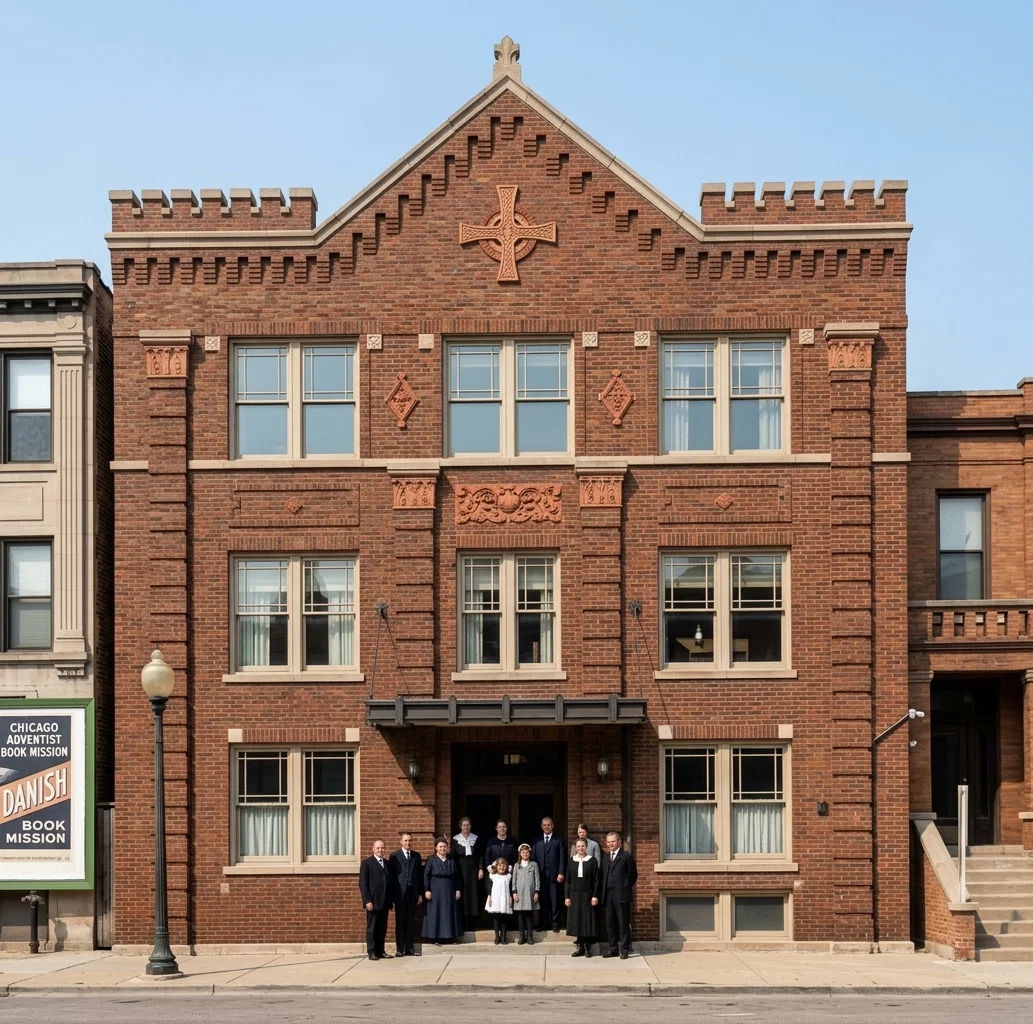
Inasmuch as many of those who have seen the building have thought the plans followed quite ideal for a city church, we will give a brief description of this building.
First may be mentioned that the site chosen is a strong Scandinavian center, a prominent place facing a beautiful park. The building measures approximately one hundred feet in depth by thirty-seven feet in width, with a basement under nearly the whole building. In the rear of the basement, which is, by the way, only two feet underground and nearly six aboveground, is a three-room janitor’s flat. The flat is designed to net $12 to $15 a month toward the salary of the janitor. Directly above the janitor’s flat is the church schoolroom. The auditorium proper is a light, airy room, seating about 250 persons. In the front end of the building, on the right-hand side of the vestibule as one enters, is a vestry, which opens into the auditorium with folding doors. This vestry furnishes seats for about fifty, thus increasing the total capacity of the church to 300. On the opposite side of the vestibule is an office room; above this a room which may be rented to one or two Bible or missionary workers, at $5 or $6 a month; and in the third story, in the front of the building, is a five-room living apartment, which rents for $20 a month. Thus there is a net income of $37 to $41 a month on the building. This income means a great deal to a city church, not only in helping to carry the running expenses of the church, but in helping to carry on aggressive city work.
DANISH-NORWEGIAN CHURCH, CHICAGO
The Financial Standing
The building lot cost, with purchasing expenses, nearly $3,700; the building, auditorium, and school—furnished and the flats fitted up, everything complete—about $13,500 more, making a total cost of approximately $17,500. About $16,000 of this had already been paid at the time of the dedication, and about $500 was raised on this occasion. Plans were then laid to pay the remaining indebtedness. So it can be said that the building was dedicated very nearly free from debt. This is as it should be, and we are thankful to God and to friends who made it possible.
The Dedication
The dedicatory services were begun Friday evening, October 1, and concluded the following Sunday evening. On Sunday afternoon Elder W. A. Westworth, the president of the local conference, delivered the sermon, setting forth in a clear and concise way the truths for which this people stand.17
Elder L. H. Christian, the president of the Lake Union Conference, gave a brief history of the church, and rendered a financial statement. Quite a large number of other ministers were present, and took part in the services. In all these services, the main burden of the speakers was, first, a dedication of self, then of the church, to the Lord’s service.
The Outlook
There are more than 130,000 Danes and Norwegians in Chicago. Less than 25,000 of these are affiliated with any church whatever. This spring Elder Lewis Halsvick came to Chicago to take charge of the Danish-Norwegian work, and he, with his colaborers and the church, is entering heart and soul into the work. P. E. BRODERSSEN.
What Are We Sowing?
“WE are sowing, ever sowing,
In the paths where others move,
And the harvest that shall follow,
Shall a bane or blessing prove.
“Are we sowing thorns and thistles,
That shall pierce the traveler's feet,
Or the seeds of love and mercy,
That shall make existence sweet?
“What, O what shall be the harvest
When our sowing is complete?
Sowing pain or sowing pleasure,
Sowing tares or golden wheat?”
Tennessee River Conference
By W. R. ELLIOTT
I AM glad to report that the work in Tennessee is making progress in almost every department. There are continual evidences that God is with us, and that his prospering hand is over all the work in this field.
A strong tent effort was held in Paducah, Ky., last summer, with the result that sufficient new members were brought in to enable us to organize a church there with a membership of sixteen. Others have since joined them, bringing up the membership to about twenty. It is planned to erect a house of worship there.
Two new churches have been added to our list this year, one at Paducah, and one near Ashland City. In nearly all the field, gains have been made, so that our membership in this conference shows a very substantial increase over that of last year. The tithe shows a slight falling off from last year, due, no doubt, in part at least, to the conditions brought about by the war.
We are trying to raise our share of the Twenty-cent-a-week Fund this year, and there is prospect that we shall do as well as last year. There has been a very encouraging increase in the Sabbath school offerings, and these are proving quite a factor in raising this fund. The Harvest Ingathering shows a very encouraging gain over last year. We are ahead of all previous records, and hope that we shall be able to raise our quota of this fund by the end of the year. We have on hand already $687, and will do our best to get the remainder by the end of the month.
The work for the colored people shows some advancement. A number have been brought into the truth, and in Nashville, Jackson, and Memphis there is an interest to hear the message. Memphis especially is a needy field, and there is a demand there for a strong colored laborer. The colored brethren in that place have labored under many disadvantages and discouragements, but we are planning to place a worker there early next year, and hope to build up a strong constituency, and also to erect a good church building, to which they can invite their neighbors to worship with them.
The Tennessee River Conference is not a large, strong, or wealthy organization, but we are making strenuous effort to accomplish the work which the Lord has given us to do. Pray for the work in the Southland. W. R. ELLIOTT.
West German Department
By G. F. HAFFNER
THE work in the western department has made some progress during the last two years, both in membership and in the amount of tithe and offerings. While we cannot give an accurate report, as some of the churches have not reported during 1915, we can say that, according to the reports of the workers and the churches, about 500 members have been added during the last two years. The report stands as follows:—
In 1913: number of churches, 87; members, 3,192; tithe, $47,036; offerings for missions, $15,487.91; Sabbath school membership, 3,515; Sabbath school offerings, $8,013.40. In 1914: churches, 109; membership, 3,704; tithe, $75,015.96; offerings for missions, $28,982.13; Sabbath schools, 120; membership, 4,272; Sabbath school offerings, $11,779.46.
This makes an average for 1914 on the Twenty-cent-a-week Fund of 21 cents a member, and an average tithe of $20.24 a member.
We have 29 ordained ministers and 9 licensed ministers. Our workers are all of good courage, and most of them have had success in their work.
Our German Seminary is doing a good work. We have an increase in attendance this year over that of last year. The enrollment is not far from 150. Our aim was to get 200 this year, but we shall not reach that number, although we feel that we must have that number in order to make the school self-supporting. We are putting forth a strenuous effort to raise money enough to pay off all the indebtedness before this school year closes. G. F. HAFFNER.
Special Reasons for Thanksgiving
FROM a report of a thanksgiving address given by Elder F. M. Burg to the faculty and students of the Loma Linda College of Medical Evangelists, we take the following paragraphs:—
“We have great cause for thanksgiving and gladness in what we have heard from the brethren during the council just closed, concerning the progress of the work of God in the great, populous countries of the Far East. We surely have heard enough to inspire in us an unwavering faith that God has set his hand to the finishing of his work, and that ‘this generation shall not pass, till all these things be fulfilled.’ The work of God is speeding forth on the right hand and on the left; the stakes are being strengthened, and the cords lengthened.
“A more vigorous and aggressive evangelization activity in the home field, embracing all workers, from the ministry to the humblest layman, is bringing results in accessions to the faith and in consecration of means to the work of God. So the stakes are being strengthened.18The cords are being lengthened by our expanding policy for the work abroad, throwing the lines of our soul-saving efforts farther and farther out into the benighted regions of heathenism; sending more men and women to the front for service, with money following them for their support and to provide them with needed facilities. In these and all other evidences of the soon coming of our Redeemer, we have great reasons for rejoicing and thanksgiving. Our workers attending the council from foreign countries have brought reports to us that must greatly strengthen our faith in the speedy finishing of the work of God, and also arouse in us a stronger purpose to go forward with this advancing cause until it ends in triumph.
“This council has also given us reasons for rejoicing and thanksgiving, by clearing the atmosphere surrounding the Loma Linda Medical College of the depressing element of uncertainty that has been a real trial of faith to both the teachers and the students. It may be said, however, that this trial of our faith has proved to be more precious than gold. Having endured the test, our faith in God and in his promises is stronger than it was before. God has spoken good, through the spirit of prophecy, concerning the institution that is planted here. This fiery trial that has tried us is not a strange thing. We should appreciate the magnitude of the problem which presents itself to those who are responsible for the financial obligations that are involved in maintaining and providing our school with the equipment necessary to assure its success.
“Reflection on our part will help us to understand the reasons for their conservative and careful deliberation while counseling together as to the policy that should be adopted and followed. However, man’s extremity is God’s opportunity. So, at the opportune time, light came to the servants of God from that source which has in all the history of our work given clear vision to men of faith. The Testimonies of the Spirit of God pointed the way for us to go. Our brethren said, ‘We will follow the light that has come concerning this school, and go forward in obedience to all that the Lord has said.’ For all this we are profoundly thankful. And now the word may be passed to our young men and young women everywhere who are looking forward to a medical education as a better preparation for service in the Master’s great field, that Loma Linda College of Medical Evangelists is to live, with the cooperation and support of this denomination, and with provisions made for it that will enable the school to accomplish everything that was intended in its planting.
“What has been done,—the decision to follow God and go forward,—together with the great financial problem involved in it, demands, in connection with our expression of gratitude today, a new and deeper consecration to God, that we may share with our brethren in the burdens that the maintenance and the building up of the institution involve; and also, and above everything else, that the one object in the planting of the school may be fully realized—the going out from its halls to the beckoning mission fields, of many young men and young women prepared by consecration and by the training they may receive here, to bring relief to the sick and suffering, and to point them to the Saviour of men and prepare them for his soon coming.
“This added responsibility comes alike to both students and teachers: more diligence, more praying, more hard work for the teachers; the same, with earnest cooperation, for the students. Thus working together here, with the active cooperation of our brethren who have been here in council, and with the blessing of God, we shall see good days for the Loma Linda College, and a large place for it in the closing work of God. And beyond all the struggles, the toil, and the patient waiting, we shall share the joys of Christ when he sees the travail of his soul, and, with him, we shall be satisfied. Our joy will be complete then, and our expression of praise and thanksgiving will have no end. ‘Praise God, from whom all blessings flow.’”
Southern Oregon
By T. G. Bunch
OUR little corps of workers in the Southern Oregon Conference is working hard, and the Lord is helping us to keep pace with the onward sweep of the message. During the first three quarters of 1915, eighty-two persons were baptized, and a number added on confession of faith. Although the Pacific Coast is passing through hard times because of the slump in the lumber industry, the tithe has increased a little over the same period last year.
Good reports are coming in from all parts of the conference regarding the Harvest Ingathering campaign, and indications are that we shall far exceed all previous records. Not quite so many papers are being ordered as last year, but better use is being made of them. We are finding many who are interested in our work and are watching the progress of this movement.
Oregon is at present stirred over the enforcement of Sunday laws, and we are planning to take advantage of the opportunity to enlighten the people on this subject by a religious liberty campaign. Theaters are offered us free, and each meeting announced on the screen.
We are of good courage, and expect this message soon to triumph, and are determined to triumph with it.
T. G. BUNCH.
Mississippi
By John R. Staton
ON October 12, I came to this conference to act as field secretary. We have many things in this State for which we are thankful. As we have open weather most of the year, our colporteurs can put in full time. I can truthfully say I like the people and the conditions here.
Our brethren and sisters are loyal to the support of the work. They give of their means, and many of them make great sacrifices to help carry this message. Since I came to this State, I have been out helping several of our boys deliver their books. Some of them had ninety per cent deliveries.
The people are open-hearted. They have money, and are willing to buy our books. But we need more colporteurs to help carry this message.
The needs of the South have long been presented to our people. In a little time from this it will be too late to do the Lord's bidding. The Lord said that the harvest is great, but the laborers are few. Dear brethren, let us not sleep while souls all around us are being lost.
JOHN R. STATON.
Pennsylvania
By J. S. WASHBURN.
PHILADELPHIA.—Our tent meetings closed October 10. In some respects this has been the most interesting tent meeting I ever held. I have seen a larger number take their stand for the truth, but we never had so large a list of interested families to work with at the close of the meeting—over 250.
Our contributions for expenses were $423.60, the largest I have ever known in a series of tent meetings. Our expenses were $408.80, leaving a balance of $14.80 on the right side of the account.
Eighteen signed the covenant to “keep the commandments of God, and the faith of Jesus,” and a number who have not signed the covenant are keeping the Sabbath. Among the former is a public-school teacher; also a physician of high standing, with a large office practice, his wife also taking her stand with him. This physician has already given over $200 to the work, $100 of this amount being given to the mission funds. The Lord seemed to have prepared him to accept every point of truth before he saw the announcement of our meetings in one of the great city papers. It surely pays to use the papers.
J. S. WASHBURN.
“And the Reapers Shall Joyfully Sing”
By JOSEF W. HALL
“It is God who worketh in you both to will and to work, for his good pleasure.” The person in whom God is working will himself be working, in every manner possible and through every means which presents itself. One of the perhaps small yet important ways in which we may work for God’s good pleasure is to take an active part in the Harvest Ingathering campaign. This is a joyous work, for never, in truth, do we find such pleasure as when we work for his good pleasure.
It seems to me that each year the people are more willing to give. Most are glad to help, and some are even anxious to do so, when the needs of the mission fields are concisely set before them.
The other day I was on my way to visit a small company for the purpose of getting them to take an active part in the campaign, when a lady saw the paper I held in my hand. “I’ll give you ten cents for that paper,” she said to me. Of course it was a bargain.
I had only one other paper with me, and as I passed along the street I stopped to show it to the old justice of the peace, who was out working in his yard. “Surely!” he said, “I’ll give you all I’ve got,” and he emptied a pocket of nickels and dimes. I started on, when he called out, “Hold on, I’ve got some more here.” He gave me all except the pennies. He said it was against his principles to give pennies to God’s work. I told him that I fervently wished there were more like him, and, thanking him heartily, passed on.
Two days later my wife and I took a brother and sister living in a suburb of a city their share of the Harvest Ingathering Signs. As they were unable to use the papers, we borrowed their horse and buggy to use in soliciting from their neighbors. At every house we visited, we received a willing and often an enthusiastic cash offering, except one, where we received a pledge. From the ten papers we received three dollars, and a subscription to the Signs weekly. At one place where the mother had no money in the house, the little boy of about seven years was so touched by the picture of “Child Life in Mission Lands” that he ran and got his penny bank, and emptied it in my hands.
This was a community of poor working people, who had many church and missionary calls of their own. But they saw a life and an energy about our work which was inspiring to them, and they felt privileged to have a part in it.
JOSEF W. HALL.
“Fewer but Better-Trained Physicians”
UNDER the above title the Journal of the American Medical Association gives the following editorial, which presents some suggestions of interest to many of our readers:—
“Fifteen years ago a noted educator, who was thoroughly familiar with the conditions underlying medical education, tersely remarked, ‘We do not need more doctors, we need more doctor.’ The statistics published last week show that this need is being attained. Fifteen years ago this country had one hundred and sixty-two medical colleges, which was over half of the world’s supply. Although some were well-equipped and well-conducted, a large proportion were owned by individuals or by joint stock corporations, and were conducted for profit. In some instances, a professorship could be secured by any physician who bought a certain amount of stock; for a smaller amount he would secure a lectureship. Since these institutions were organized for profit, it was important to secure large classes so the income from fees would be correspondingly increased. Glowing advertisements, follow-up letters, and paid solicitors were freely used; thus enrollments were swelled to mammoth proportions. No wonder that the actual number of students fifteen years ago reached the amazing total of 28,142, and that there were 5,747 graduates.”
“In the fifteen years there has, indeed, been a marked reduction; there are nearly fifty per cent fewer medical colleges; there are nearly forty per cent fewer medical students and medical graduates. Medical colleges sans teachers, sans laboratories, and sans ideals have given way to well-equipped medical colleges having fair entrance standards, skilled teachers, modern laboratories, and an abundance of clinical material. The sum total of colleges is decreased; the number of better ones has been greatly increased.
“Instead of a great army of students, many having not even a grammar school education, and enticed from more fitting occupations by glowing advertisements and ‘easy’ requirements, we now have about half the number; but practically all have had a preliminary training which enables them better to understand the more complex problems of modern medicine. As to the opportunities before the properly equipped medical student, these have not been diminished, but have been decidedly improved. The tables published last week show that there could be a further reduction in the number of colleges and still allow a greatly increased student enrollment. And the students would be further benefited by the change, since a greater19proportion would be in the better-equipped colleges.
“As to the reduction in the number of graduates, surely this country needed ‘fewer doctors, but more doctor’! For the public welfare it is certainly better to have a hundred well-trained graduates from modern high-grade schools than a thousand from the old-time variety of run-for-profit institutions. There is no danger that there will be a dearth of physicians. The annual number of graduates is still nearly double the loss of physicians by death; and even if it were less than the annual loss, it would be many years before a dearth would result, because of the seriously overcrowded condition of the profession. There is now one physician to from 600 to 650 people, as compared with one to from 1,500 to 2,500 in the leading nations in Europe. Even with this amazing contrast, we have not included in the figures for this country the hordes of so-called ‘drugless practitioners,’ Christian Scientists, osteopaths, chiropractors, naprapaths, etc., who are scarcely found in other countries.”
Medical Missionary Department
W. A. RUBLE, M. D. - - General Secretary
L. A. HANSEN - - Assistant Secretary
H. W. MILLER, M. D. - - N. Am. Div. Secretary
The Promise Fulfilled to the Colporteur
By W. W. EASTMAN
“And we know that all things work together for good to them that love God, to them who are the called according to his purpose.” Rom. 8:28. This scripture is well illustrated by the experience of one of our seventeen-year-old boys while earning a scholarship by canvassing for one of our large books last summer.
He stayed overnight with a family, but had not succeeded in getting their order. The next morning his horse was missing. The man with whom he had stayed lent him a horse with which to hunt his, but could let him have it for only half an hour. When the half hour was up, his horse was not found. He then secured a horse from a neighbor, with the understanding that he might keep it until he found his. During this time the colporteur prayed earnestly for help and guidance that his work might not be hindered.
He had gone but a short distance after securing the second horse, when he found his own standing by the roadside, apparently waiting for him.
He had left his prospectus with the man from whom he had secured the second horse, and when he returned he found that the man had been looking it over and had decided that he wanted a book.
The young man then returned for his buggy to the place where he had stayed overnight. He was told that a family on whom he had called the day before but had not obtained their order, had called up by telephone, and said that they had decided they wanted one of those books. This had a favorable effect on the family with whom he had spent the night, and led them to decide to take one also. Thus the hour and a half that he thought he had lost while hunting his horse, turned to his favor in the sale of three books. But this was not all. He had learned a lesson of faith. While Satan sought to hinder the work, the Lord turned it to his favor, and he was enabled to grasp anew the meaning of the scripture, “All things work together for good to them that love God, to them who are the called according to his purpose.”
W. W. EASTMAN.
Korea
It is remarkable how our system of holding colporteurs’ institutes and of conducting the colporteur work is being successfully adopted by our brethren throughout the world. In the early history of our subscription book work, it was thought that this could be done successfully only in America. In Great Britain the brethren said, “This may do for the Yankees, but we are British, and do not sell books that way;” but it was soon found that this system was just as workable in Great Britain as in America.
COLPORTEURS ATTENDING INSTITUTE AT SEOUL, KOREA
In the Far East our brethren are finding that the subscription method and the plan of instructing our colporteurs in institute work are just as successful there as in the homeland.
Under date of September 2, Brother H. A. Oberg, who is editor of our Korean paper and has charge of our colporteur work in that field, wrote:—
“From July 21 to August 7 we held a colporteurs’ institute here in Seoul, having twenty-eight colporteurs in attendance. We had regular canvasses on ‘Thoughts on Daniel,’ and also on ‘Thoughts on Revelation,’ for our men to learn. During the institute we developed plans which will place the work in these fields on a better footing. We had a map of Korea with large dots representing our companies of believers. In the southern part of the field, our newest section, the majority of dots represented interests that were awakened by the canvassers and later developed by the evangelists. Truly the canvassing work is doing that which it was ordained to do.
“We are now working on the October number of our paper, which will be a special number for the fair which is to be held here September 11 to October 31, in commemoration of the annexation of Korea five years ago. We are publishing a ten-thousand edition, and hope to carry on an aggressive campaign with our literature at this time. I am inclosing a snapshot of the colporteurs who attended our institute.”
How God Leads
By N. Z. Town
ELDER H. H. VOTAW gives the following experience. It illustrates how God is leading souls to the truth through our good books:—
“Nineteen years ago, in the city of Toronto, Canada, a lady purchased two copies of ‘Daniel and the Revelation,’ one for her mother, the other for herself. Later she removed to British Columbia, and after a time to Columbus, Ohio. Having enjoyed the book she had bought, she took pleasure in lending it to her acquaintances. Eventually some one failed to return it. Not knowing where she could procure another copy, she wrote to her mother and asked to borrow her book. Not only did she again study the prophecies, but her eldest son became interested in them. During the course of our recent tent meetings, some one told us that a young man, then in the employ of the Western Union Telegraph Company, had shown an interest in Bible themes. A canvasser called on him and sold him a copy of ‘Bible Readings.’ Less than a month elapsed before the young man came to the service one Sabbath morning and announced himself a Sabbath keeper. Conversation with him revealed the fact that he understood the Bible teaching concerning all the main points of doctrine which we hold.
“Last Sabbath he and his mother, the lady mentioned at the beginning, were baptized. Today the young man begins his first week as a canvasser. He hopes to earn a scholarship. Those who know him expect his earnestness and zeal to be blessed of God in helping many souls.”
N. Z. TOWN.
Keep Steady
By John M. Morse
Keep steady, young man, keep steady;
Nor waver when put to the test.
When Satan assails, be ready,
Defeat him by doing your best.
With plausible words he advances;
With cunning he strengthens his
chances;
He does all his planning with care;
He's wily and wicked. Beware!
Resist all his sly approaches—
Yield never an inch to the foe.
Whenever that foe encroaches,
Resort to a resolute No!
With flattery, cunning, he plies you;
With sympathy, artful, he tries you;
His wiles he keeps well out of sight;
He comes as an “angel of light.”
Let truth be your watchword ever,
Let right be the law of your life.
With these for your guides, you never
Will suffer defeat in the strife.
Give battle to vices that tempt you.
Your virtues can never exempt you.
Temptations will come, but be strong;
Give battle to all that is wrong.
— John M. Morse.
Publishing Department
N. Z. TOWN - - - General Secretary
W. W. EASTMAN - - - N. Am. Div. Secretary
The Coming Conflict
By Edith M. Graham
DAY by day, in most parts of the United States, we live peacefully, keeping the Sabbath unmolested, working on Sunday much as we have a mind to do. Our neighbors are friendly, prejudice seems to have died down, and the general aspect appears peaceful.
Appearances are, however, deceptive. Just now a general and extremely strong Sunday law movement is on. Plans are being laid and forces organized for the strongest possible effort to get a Sunday law through the present Congress, and to get similar laws passed in every State.
What do these things mean to us as a people? They mean that we are in the final conflict, and that we have very little time left in which to work. Now, then, is the time to work, and there is no more effective method of work than the circulation of literature.
We have three excellent magazines, each of which should be largely circulated. Two, the Signs Magazine and the Watchman, deal with the signs of the times as related to the message. The other, Liberty, opposes and exposes the present efforts to substitute state control for religious liberty. All are on vital topics of the utmost importance to the public, but how can the Holy Spirit use them to convict and convert souls unless willing hands and earnest hearts will take them to the people? Success is attending our magazine work, as the following experiences will show:—
One sister recently sold five hundred magazines in nineteen and one-half hours. A brother started out, and on the first day sold few; the second and third days his sales were still few; but on the fourth day he sold seventy copies. Persistence always brings success, if it is coupled with consecration and a burden for souls.
Another sister averages one thousand magazines a month. A middle-aged sister has, by perseverance and tact, built up a regular list of three hundred subscribers, who take the magazine month by month. Another finds she can sell from twenty-five to one hundred on Sunday mornings.
A sister took a little boy with her, and he sold twenty-two magazines in one day, saying, “I love to sell these magazines.”
A student took some magazines when he went on a vacation, with the result that he sold four hundred and forty papers in thirty-five hours. One brother sells magazines in all his spare moments, at hotels on Saturday nights, at railroad stations, anywhere and everywhere. He says: “Thus far I have never failed to sell a magazine to every one I have approached at the stations. It is wonderful how these magazines sell. I can give no other reason than that the Lord sells them. I cannot understand why an army of our people are not hastening out with these message-filled magazines.”
One worker recently sold thirty copies in two hours, while waiting for a train. A minister who sells magazines in any spare time he has, sold four hundred copies in one month. A stenographer in one of our tract society offices sells an average of one hundred magazines each month, between office hours.
In these experiences, I have merely mentioned the number of magazines sold by different ones. Eternity alone will tell the results of this work. These magazine sellers will meet souls who have been brought into this truth through their efforts, of whom they never heard in this life. But even now our magazine workers are seeing fruits from their labors, for hearts are being turned to the Lord through these papers.
There is ample room for others to engage in this work, and a pressing need that they should do so, just now, when people want to read Seventh-day Adventist literature. In the war-stricken countries every man is rallying to aid his country. Shall earthly governments receive more loyal support than the God of heaven and earth? Who will enter the army corps of magazine sellers?