Your ShelfYour Projects

Review and Herald, Vol. 82, No. 38.

The Ruins of Baalbec

Review and Herald

Sep 21, 1905

Review and Herald Publishing Association · Washington, D. C. · Sep 21, 1905

The Ruins of Baalbec
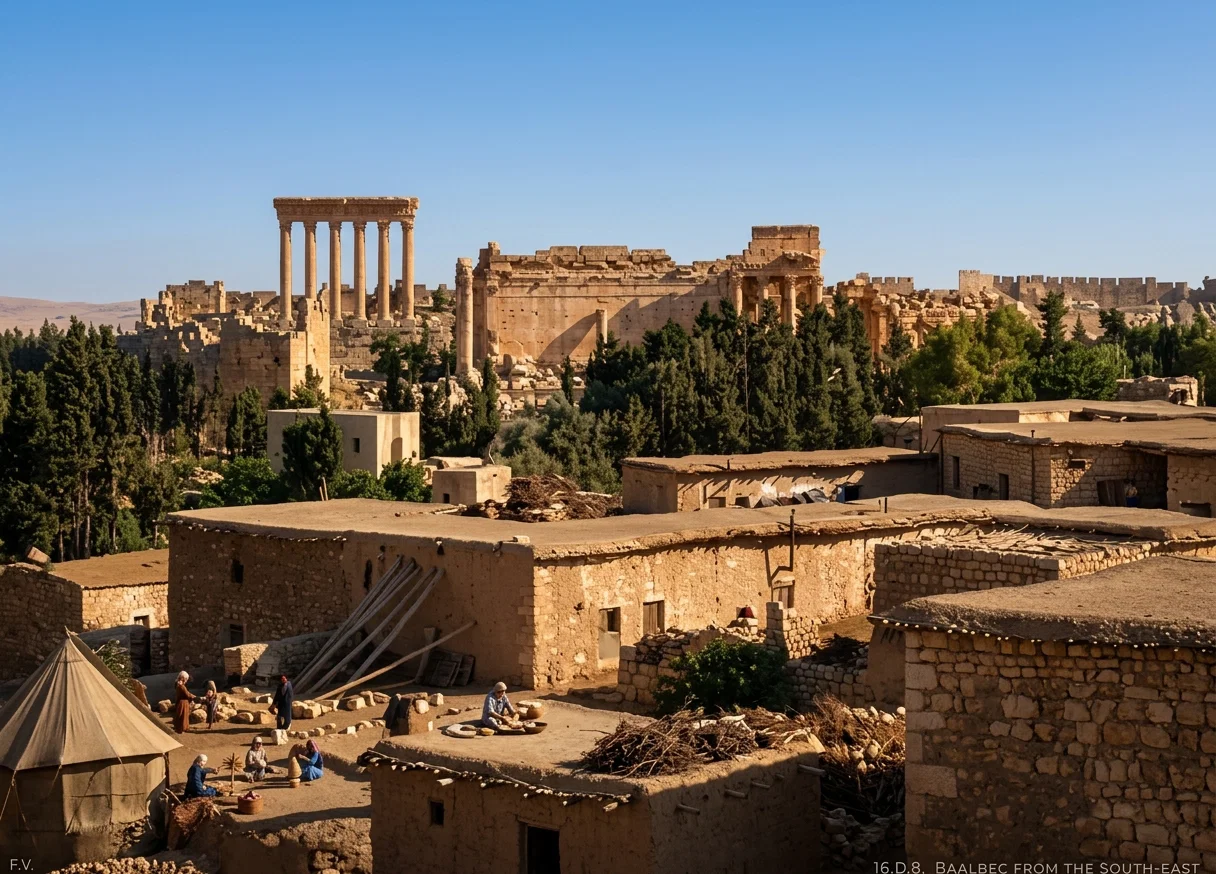
BAALBEC
BAALBEC
A GENERAL view is here given of the famous ruins which are an object of interest to all travelers in Syria, and for which alone Baalbec is now noted. Baalbec was formerly one of the chief cities of Syria, having much the same natural advantages of situation as those enjoyed by Damascus, which lies to the southeastward of it only thirty-five miles away. The city was situated on the lowest declivity of the anti-Libanus range, having an altitude of 4,500 feet above the sea. It flourished down to the time of the Moslem invasion of Syria, being taken by them after the capture of Damascus. It was a later siege and capture, however, by the caliph of Damascus, which gave a fatal blow to its prosperity. By this conqueror the city was sacked and dismantled, and most of its inhabitants put to death, 748 A. D. It continued, however, to be a place of military importance, and was an object of dispute for several centuries between the caliphs of Egypt and various Syrian dynasties. In the twelfth century it suffered severely from several earthquakes.
The ancient walls of the city are about four miles in compass; but the existing town is described as being, with the exception of some of its Saracenic fortifications and its two mosques, "a cluster of mean-looking buildings, which serve only to bring out into greater prominence the grandeur of the neighboring ruins." These ruins "consist of three temples, usually known as the Great Temple (and it well deserves the name), the Temple of Jupiter, Apollo, or the Sun, and the Circular Temple. The Great Temple, which would seem at one period to have been a kind of pantheon, is situated on a magnificent platform, which raises it high above the level of the ground, and extends from east to west a distance of about 1,100 feet." The portico of this temple extended 260 feet from north to south. A portion of the temple called the Great Quadrangle covered an area of between three and four acres. The Sun Temple and Circular Temple were smaller structures, but the Sun Temple is in a much better state of preservation.

THE PRECIOUS SEED AND THE SOWERS

“He that goeth forth and weepeth, bearing precious seed, shall doubtless come again with rejoicing, bringing his sheaves with him.”
The fall season is again before us, and on all sides will soon be heard people sneezing. It is therefore a good time to introduce Dr. Heald’s booklet on “Colds: Their Cause, Prevention, and Cure.” Anybody can sell it. Everybody—except the person who never has a cold—should have it. Subscription book discount to agents. Order from your conference tract society, or from Review and Herald Publishing Assn., Washington, D. C., or Battle Creek, Mich.
Missionary reading by the pound is something new. But this is the convenient way in which the series of “Signs of the Times Leaflets” is put up. These leaflets are sixteen in number, and cover the vital points of the message; one pound assorted comprises about twenty of each leaflet. The price is 50 cents, and it is the plan that every member shall circulate at least one pound of these leaflets, or its equivalent in other message-filled tracts, during this fall campaign. This work is to follow the effort for the REVIEW, and to be done in connection with and following the circulation of the special issues of the Signs, Watchman, and Life and Health. Be sure to order your supplies of papers and tracts early. Order from your tract society, or from any of our publishing houses.
The long winter evenings will soon be here. Most of our young people will doubtless do a great deal of reading. Systematic reading is the kind that accomplishes the most good. Perhaps you would like a suggestion. The Empire Series, comprising “Empires of the Bible,” “Empires of Prophecy,” and “Ecclesiastical Empire,” furnishes the best systematic reading course in history that could be desired. These books cover the entire history of the world. Tedious details are carefully omitted, and all important events are taken up from a Bible standpoint. If doubts arise in your mind as to the guiding hand of God in the history of nations, a careful study of these volumes will firmly establish your faith, and you will be led to say, as did Daniel, “The Most High ruleth in the kingdom of men, and giveth it to whomsoever he will.”
“My Garden Neighbors,” Dr. L. A. Reed’s new book, is now ready, and ought to be in every home. It will tell you many things that you do not know about birds, insects, and animals, and will give you a desire to study nature at first hand and to discover some of her secrets for yourself. The first story in the book tells how the sparrows learned to do what the scientists say it is impossible for sparrows to accomplish. The author quotes the words of a great scientist, and then tells of two sparrows which actually learned to do what the wise men say they are incapable of doing. It is a true story, and one of deep interest. You will enjoy reading it. You will also want to read of the trials and triumphs of a crippled sparrow, of the bluebird, of the wise cat, of the young eagle driven from the nest by his mother, of how little birds are taught to fly, to sing, and to hunt for food, of the frog that was not insignificant. All these and many more will be found in “My Garden Neighbors.” 256 pages, illustrated; price, $1. Order of your tract society, or of Review and Herald Publishing Association, Washington, D. C.
“What shall I sing?” is often the question with young vocalists. A simple melody with inspiring words always makes the greatest impression. Such an one is Mrs. Fischer’s arrangement of “Nearer, my God, to thee”—not the old familiar melody, but one that is fully as sweet for a solo. Send to the publishers of this paper for a copy. Price, post-paid, 35 cents. The proceeds from its sale go to the needy Southern and Spanish fields.
“There are to be used by the Young People’s Society of San Francisco,” says a letter just received, ordering one hundred and twenty copies of Life and Health. The use of this health journal by all our Young People’s Societies would be splendid missionary work, and would open the way for the use of other publications. The October number is a specially good one for use in the missionary campaign. The price in quantities is as usual, $2.50 a hundred, or 2½ cents each for 25 or more copies to one address. Send orders to your conference tract society, our nearest publishing house, or to Life and Health, Washington, D. C.
The following is another illustration of the influence and power of our literature, and should impress every lover of the truth with his duty to help extend its circulation: “I am a member of the Congregational church at Seal Harbor, Maine, and have been keeping the Sabbath for about six months. My attention was called to this important question by reading a book called ‘Bible Readings.’ Then a friend sent me a copy of The Signs of the Times. Since that time I have studied God’s Word for light, and I believe with all my heart that we have been keeping the wrong day for the Sabbath. I believe, also, that Christ is soon coming again, and feel that I want to do something to help others to know the truth, and I know of no better way than by the written word. Please pray that God may give me grace to stand, though I stand all alone. There are none here who seem to care about this way.”
“Story of the Seer of Patmos” is now ready for delivery. This book is a study of the book of Revelation, by an old pioneer in the message, Elder S. N. Haskell. It has been the privilege of many of our people at some time in their life to attend one or more of Elder Haskell’s Bible studies, and all these will know how interesting and profitable he always makes such occasions. To have a book treating on Revelation by such a devout Bible student is, therefore, a great privilege. The text of the entire book of Revelation is printed on the margins, and accompanying it are thousands of Scripture references elucidating the text, and in addition to all these the running comment of the author on each chapter. “Seer of Patmos” contains 424 pages, and is bound in half cloth. “Story of Daniel,” is a companion volume to “Story of the Seer of Patmos,” and is a complete study in a new way of that wonderful book of prophecy. Infidelity can not stand before a thorough understanding of the “history in advance” which the book of Daniel furnishes. Every family ought to have both “Story of Daniel” and “Seer of Patmos,” as they treat on two of the most important books of the Bible. Price of each, $1.

Editorial

A Time of Test

It is evident that the times to which we have looked forward for many years are now here. This is the time of peril and of test. The very atmosphere seems to be charged with questioning and unbelief, and the whole tendency is to repudiate all that has been regarded as established beyond doubt, including the fundamental truths of Christianity. We need not expect that we shall be exempt from the assaults of the enemy merely because we have heard and accepted the special message of present truth, or that no effort will be made to fill our minds with skepticism and doubt. We are in the time when Satan is to work “with all power and signs and lying wonders, and with all deceit of unrighteousness for them that perish,” and when he will “lead astray, if possible, even the elect.” We may therefore be sure that we shall be tested upon every phase of present truth, and that doubts and questionings concerning the fundamental features of this movement will be urged upon us. In view of these things we earnestly exhort each one to a prayerful study of the Scriptures, and especially those portions of the Word of God which foretell the condition of things in this last generation, and which provide the proper setting for the saving gospel message to be given to the world at this time. “Those who endeavor to obey all the commandments of God will be opposed and derided. They can stand only in God. In order to endure the trial before them, they must understand the will of God as revealed in his Word; they can honor him only as they have a right conception of his character, government, and purposes, and act in accordance with them. None but those who have fortified the mind with the truths of the Bible will stand through the last great conflict.” We must not follow men, even those who have brought us to the knowledge of the truth, when they begin to depart from those principles which they have themselves advocated and to follow the lead of the doubters. In this time of test we must be true to the foundation principles of truth as given to us in the Word of God, and as brought together in the third angel’s message—the final message to the world. “Let no man deceive you by any means.”

The Message of Preparation

THE Maine camp-meeting was held in the suburbs of Lewiston, and good reports were printed in the Lewiston Journal, a leading daily paper of the State. The editor of the REVIEW, who attended this meeting, spoke one evening on The Message of Preparation for the Advent of Our Lord, and the following outline of the discourse was printed in the next day’s issue of the Journal:—
“This is the day of God’s preparation, and the time has come to make ready a people who shall be able to stand when our Lord shall appear in glory.
“As a message was sent to the world before the first advent ‘to make ready for the Lord a people prepared for him,’ so in this generation a message is being proclaimed to the world which both gives warning that ‘the great day of the Lord is near’ and prepares a people to meet the coming Saviour in peace.
“John the Baptist was the forerunner of Jesus at the first advent. Concerning him his father Zacharias prophesied: ‘Thou shalt go before the face of the Lord to make ready his ways; to give knowledge of salvation unto his people in the remission of their sins.’ And when he came, he ‘preached the baptism of repentance unto the remission of sins.’ In doing this he was fulfilling the prophecy of Isaiah, as he himself declared in these words: ‘I am the voice of one crying in the wilderness, Make straight the way of the Lord, as said Isaiah the prophet.’
“To prepare the way of the Lord is therefore to lead the people to confess and forsake sin, and to point out the way of salvation from sin. It means to accept of the gospel of Christ as given in the Scriptures, and to bring forth the fruits of it in a godly life.
“God’s message to the last generation is therefore a message of reform based upon his word and faith in the work of Christ in behalf of sinners.
“That there is a demand for such a message is evident when we consider how evil is on the increase, and how the Scriptures and the atoning work of Christ are being superseded by human philosophy and various methods of self-salvation.
“The so-called ‘new theology’ is robbing the world of the Christ of the Scriptures, and is undermining faith in God’s provision for saving from sin. There has been such a modern apostasy from the simple gospel as preached by Luther and his associates in the Reformation of the sixteenth century that Dr. Charles A. Briggs, of New York City, has recently declared that ‘the common doctrine of the present Protestant theologians would not be recognized by any of the Reformers.’
“This certainly marks a great falling away from ‘the faith which was once delivered unto the saints,’ and indicates the need of some movement which shall maintain the original Biblical platform of Christianity. Such a movement has arisen in this generation, and is represented by the people who are holding this camp-meeting. It is a fulfilment of the prophecies which designate the special features of the gospel teaching which will be needed to meet the demands of the time.
“These prophecies are so explicit in their delineation of the last days, and foretell the signs of the Saviour’s coming with such exactness that we may know when ‘he is near, even at the doors,’ although ‘of that day and hour knoweth no one, not even the angels of heaven.’ As both John the Baptist and Jesus announced that ‘the kingdom of heaven is at hand,’ so in this time we may declare that ‘the time is fulfilled, and the kingdom of God is at hand: repent ye, and believe in the gospel.’
“This is ‘the everlasting gospel’ of salvation through faith in Christ, but it includes now faith in the coming Christ, and it means such a fulness of deliverance from sin as will prepare for translation from earth to heaven without seeing death. This complete gospel calls for the repudiation of traditions and creeds, and all practises based upon them, and a return to apostolic faith and practise. It exalts the law of God, not as a means of salvation, but as a witness to the quality of that righteousnessby faith which is the central truth of the gospel. And this gospel of the coming Saviour is the message of preparation for the second advent of our Lord.”

What Diplomatic Relations With Rome Would Mean to This Country

The abolition of the concordat and the separation of church and state in France, is one of the most noteworthy events in recent years. The foremost figure in the movement which brought about this result, is the ex-premier of France, Emile Combes. A statement set up from this eminent individual, of the reasons for this action on the part of the French republic, is naturally, therefore, of particular interest. We give, accordingly, some paragraphs from a contribution by ex-Premier Combes on this subject to The World To-Day, the editor of which refers to it as being one of the most “important papers published within recent years.”
The query may arise in many minds as to just what harm would result from the establishment of diplomatic relations between the United States and the Vatican,—a thing for which Rome has been and is now persistently and patiently working. Ex-Premier Combes answers this query by his statement of the practical workings of such a system in the republic of France. The papacy is not, as regards the territory of the United States, a foreign power. It is a power existing in the United States, but of a different order from it, being a spiritual and not a political power. The two powers can exist harmoniously in the same territory only by virtue of keeping within wholly separate spheres of action; the church must be kept separate from the state. But diplomatic relations are set up only between powers which are acting within a common sphere. The setting up of diplomatic relations with the Vatican would mean that this government had consented to negotiate with a power existing in the United States, yet independent of it; in other words, to allow within its own territory a power concerning itself with the affairs of state, yet independent of the state; for one power does not have diplomatic relations with another power subordinate to itself. The head of the papacy is in Italy, but its body extends around the world. That such action on the part of this republic would be suicidal is a truth too evident to require demonstration. Ex-Premier Combes says:—
The moment the state decided to enter into negotiations with the Catholic Church, it implicitly recognized the latter as a power relatively independent of itself, and therefore deemed co-operation necessary for its labors in the field of social progress. A monarchical government could submit to such a conception without acting in opposition to its principles. . . . A republican government, however, could not do so without denying the fundamental principles of its constitution. The republic remains merely a word, void of meaning, unless it stands for the sovereignty of the nation. But when we speak of the nation’s sovereignty, we must necessarily put aside all suppositions in regard to any authority whatever dealing with it on a footing of equality, dictating terms to it and accepting them by contract only in the guise of compensations.
Should the United States government consent to treat with the papacy, it would set up in its own territory a power independent of itself, a power claiming the right to exercise political as well as spiritual authority, and even to be above and to possess rightful authority over all other political powers. It would establish by its side a power not only ready to exercise equal sovereignty, but even claiming superior sovereignty to itself. The principle of church and state union, to which the papacy so firmly holds, has its full potency only when the state is subordinate to, and controlled by, the church. This is Rome’s ideal, so fully attained in the past, and constantly kept in view at the present time.
The hand of Rome would then be everywhere in the affairs of the state, co-operating with the state in whatever was for Rome’s interests, but stoutly opposing the state when those interests were deemed in jeopardy. The sovereignty of the state would, erelong, be set aside and treated with contempt. This is precisely what the papacy has done in those countries, such as Spain and Austria, which have diplomatic relations with her. This is what she was doing in France, and this is what forced upon that republic the necessity of breaking loose from its relations with Rome. On this point ex-Premier Combes says:—
Not one law submitted to our legislative bodies during the last thirty years has, during the parliamentary debates, escaped the assault of the entire clerical clique, and failed to be represented to the faithful as being the work of the evil one. . . . It really seems as if the clergy had passed the word to free itself from all its legal obligations, for it eagerly seized every opportunity for disavowing them, adding to these disavowals the most insulting language directed at the republic. . . . They had so thoroughly acquired a taste for deriding and insulting the domestic policy of the republic that they unhappily soon came to treat the foreign policy of the country with the same license. The whole civilized world has been in a position to appreciate the highly appropriate manner in which the journey of the president of the republic through Italy was managed. The visit of the chief of the French government to the Italian ruler was called for by the most elementary principles of courtesy as well as by the reciprocal interests of both nations. Yet the pope has pretended to regard it as an infraction of his dignity. Asserting his fictitious rights to sovereignty, he has denounced the president of the French republic to the Catholic powers of Europe as a criminal guilty of lese-majeste.
The ex-premier further says:—
That the church, while united to the state by a covenant conferring on its representatives a legal authority, as well as all the advantages of public functionaries, should attempt to destroy, in the name of its own teachings, the doctrines of the state, vilifying them and ruining them in the minds of those who listen to its organs, constitutes one of those stupefying anomalies which it is the duty of the republican party at once to bring to an end. Still, this is the part played by the Catholic clergy for thirty years past.
Rome desires diplomatic relations with civil governments with a view wholly to the advancement of her own interests. She makes just that use of those relations where they are established. The whole history of the French republic’s relations with Rome since its establishment thirty years ago, had taught him, M. Combes says, “without any possible doubt, that the Vatican was fully resolved to preserve only the material and moral advantages which the concordat offered to the Catholic Church, but that it had forever repudiated the political obligations as well as those to the community, which form the equivalent demanded by the state. Indeed,” he adds, “how could his mind have retained the least uncertainty on this subject, when he had read in the unalterable constitution, solemnly promulgated by Pope Pius IX, in virtue of his papal infallibility, and amid the applause of an ecumenical council, the enumeration of the rights belonging by grant of the Divinity to the successor of St. Peter, in contradiction to the blasphemous pretensions of modern governments? That constitution, well known under the name of the Syllabus, speaks loud and distinct enough to prevent a sincere mind from being in danger of mistaking its wording.” M. Combes quotes from the doctrines of the Syllabus: “That the Roman Church, as the superior of all governments, is a perfect organization, by right and in all respects independent of civil power;” also other like provisions, citing references where these doctrines are set forth.
Any intelligent person is prepared with these facts before him, to understand the significance of Rome’s guarded and politic but persistent efforts to establish diplomatic relations with the government of the United States.        L. A. S.

The Awakened East

THE issue of the Russo-Japanese war has brought the world a long step nearer the great Armageddon of the nations. In Asia half the world has been for centuries lying inert and sleeping, so far as a place among the military nations is concerned. They counted little in great world events. Now there is a change. In our day this great mass of peoples and tribes has been rousing from the sleep of centuries. Writing of this change in Asia, a writer in the Deutsche Revue says:—
The Japanese successes, first at sea, then by land, struck this enervated world like a cannon stroke, and Siam, which is led by British sentiment; India, which is under England’s dominion; the Malay Islands, Java and Sumatra, the Anamites of Anam, Tonquin, and Cochin China, pricked up their ears. Five hundred East Indians at once set out to attend the lectures at the Japanese universities; Siam concluded a compact of amity, of whose provisions Europe has remained ignorant, with Japan; in Singapore, Batavia, Surabaya, Saigon, Hanoi, and Hai-phong the Chinese secret societies have redoubled their precautionary measures and their activity; China has opened its doors to Japanese traders, Japanese officials, and Japanese military instructors.
A change of great import has taken place. As this writer says, “All the Asiatic peoples now recognize that the axis of the Asiatic world has been shifted.” The vast heathen East is not to come up to the great Armageddon asleep, blindly led into conflict. The prophecy of Joel shows that there is to be a waking up of the people, and the heathen are to come up in multitudes to the valley of concision, or cutting off. Truly when Asia is aroused, there will be multitudes, multitudes in the valley of decision; for Asia is half the world.
The kings of the East are to come up to Armageddon. That final crash of the world comes just after the close of probation. Now, just before probation ceases, we see the populous East awakened from its long sleep. It has stirred all Asia to see one of its brown peoples turning back a European power. China is rousing. Hundreds of its young men are being sent to Japan, Germany, and other parts for military training. The populous East has caught the fever of Western militarism. History is rapidly in the making. Prophecy is fulfilling. We must press in among these awakened peoples with the advent warning. W. A. S.

Awake Out of Sleep

“Now it is high time to awake out of sleep.”

Worry

The world is full of worry. Its marks are chiseled in the furrowed brows of millions. Did you ever worry? “O yes,” I hear you say, “many, many times.” A good soul said to me once, “This terrible burden of worry is killing me; I fret nearly all the time.”
How sad this is! yet it is the experience of many. But, reader, let me ask you a question: Did it ever do you any good to worry? After you have tossed feverishly on your bed through the weary hours of the night, giving no sleep to your eyelids, did it help the matter any? Was the difficulty removed? or did you have to face the thing again at the dawn of day? Was the cause of worry in any way changed from what it would have been had you laid off your burden, and taken a refreshing sleep during the night? Why worry, then, if it does not help matters any? While it does no good, it does do untold injury, mentally, morally, and physically.
“O,” but you say, “I can’t help it. I try not to worry, but it is impossible for me to keep from it.” This is a strange confession for a Christian to be compelled to make. Suppose you hear your neighbor swear, and you ask him to refrain from taking his Master’s name in vain. He replies, “O, I can’t help it; I do not want to blaspheme, but it is impossible for me to keep from it.”
“But,” you say, “do you think it is as wicked to worry as to swear?”—No; but both are wrong. And the abiding Christ who enables the unregenerate man to overcome his profanity, will enable you to rest in him, and cease your unbelieving worry; for it is a burden born of unbelief.
“But,” says one, “I did not know it was wicked to worry.” Well, it is. The Lord did not worry when on earth. He sat up whole nights to pray, but never to fret. And here I am reminded that if we prayed more, we should worry less. “The wicked are like the troubled sea, when it can not rest, whose waters cast up mire and dirt. There is no peace, saith my God, to the wicked.” Isa. 57:20, 21. The wicked are in a continual state of ferment, and can not rest; they are like the troubled sea. Why should the child of God be like the children of the wicked one?
How can you cease to worry?—Believe the Lord. Lay off the load upon him. “All your anxiety throwing upon him, because he is concerned about you.” 1 Peter 5:7, Rotherham’s Translation. The Lord is the great Shepherd of the sheep. It is his work, and joy as well, to care for the sheep. He understands how to do this, and is able to do whatsoever he pleases. He knows fully the prowess of him who goes about as a roaring lion, and has pledged his life to guard his flock from his ravages. Can you not let him do it? Like the high priest who carried on his bosom the breastplate, he has you on his heart. He cares for you. He carries in his hands, feet, and side, wounds received in working out your deliverance. He is a Father; you are his child, and he loves you. How would a parent feel to see one of his children worrying all day, and tossing sleeplessly on his couch through the night, for fear father would not supply all his needs, and guard his precious life from the cruel things of sin in the world around him? Yet many treat their kind, compassionate Heavenly Father like this. Why do it longer?
“I will hear what the Lord will speak; for he will speak peace unto his people, and to his saints.” His word received into the heart brings peace; the stormy passions subside, and the anxious fears are dispelled. He spoke once to the tempestuous Sea of Galilee, and there was “a great calm.” “Come unto me, all ye that labor and are heavy laden, and I will give you rest. Take my yoke upon you, and learn of me; for I am meek and lowly in heart: and ye shall find rest unto your souls. For my yoke is easy, and my burden is light.” Matt. 11:28-30. There is rest in Christ. What needless burdens we carry because we do not trust him! We need to lay, by faith, our anxiety upon him, and take, in return, the rest which he alone can impart.
G. B. THOMPSON.

Note and Comment

THE subject of the establishment of diplomatic relations between the papacy and the United States is one that has for years been persistently kept before the American people. At every opportune occasion Rome brings the subject forward, and hints at the possibility of a papal nuncio at Washington, and an American ambassador at the Vatican, though always disclaiming any intention of overriding the American principle of the separation of church and state. The negotiations between the United States and the Vatican arising from the conquest of the Philippines, gave a great impetus to this project and hope of the papacy, and every use is being made of the intimacy which has resulted between these civil and spiritual powers, to foster the plan, and accustom, if not reconcile, the American people to the idea; Rome trusting that in time, with skilful diplomacy on her part, the opportunity will come to make a direct move for the setting up of diplomatic relations. Notice how, as shown in the following press telegram dated at Boston, August 19, Rome is endeavoring to move in this direction without showing hostility to established American principles, or arousing the suspicions of the people as to her real intentions (italics ours):—
A Rome special cable to-night says that Pope Pius X is planning to show his appreciation of the development of his church in the United States by appointing, if possible, a papal nuncio to Washington, raising the apostolic delegationnow there to a nunciature of the first class, like those of Vienna, Madrid, and Munich, with a titular invested with the rights and dignity of apostolic nuncio.
The question is complicated, however, and the matter is not entirely settled, for according to church traditions nuncios are never sent to foreign countries unless officially credited to the government, and unless the same government keeps an ambassador accorded to the Vatican.
Although not long ago the United States sent a special agent charged with the arrangement of church matters in the Philippines, it is admitted that it would be practically impossible for the United States to maintain an ambassador at the Vatican.
At the same time it is felt by the church officials that Washington already recognizes in the apostolic delegate there the supreme representative of the Vatican in America, and the question is likely to be solved by the creation of a regular nunciature at Washington, which will act in the name of the supreme head of the church in all matters affecting both church and the United States government, while not being a diplomatic embassy.
After the substance of the thing Rome is after is obtained, it will be a simple matter to change the name.

Insurance Investigation Disclosures

LIKE the inquiry which was started some years ago by General Miles’s charge that the army was being supplied with “embalmed beef” by the meat packing companies, which led to startling disclosures of deceptions practised upon the public by meat dealers in general, the inquiry which the Equitable disclosures have set going into the insurance business in this country is showing that that company is by no means the only one whose practises entitle it to a discreditable notoriety. An inquiry into the affairs of the New York Life Insurance Company, conducted by the State superintendent of insurance, September 12, furnished sensational material for the newspapers of the following day. The Washington Post devotes a column and over to the testimony produced, under the heading “Deception in Deal; New York Life’s $800,000 Sale and Purchase; Securities Sold One Day were Bought Back the Next but One. Startling Disclosures Wrung from Treasurer Randolph before Executive Investigating Committee,” etc. The following from the New York Sun of September 9 gives testimony relating to the same company:—
The third meeting of the Armstrong insurance committee brought to light the fact that the New York Life Insurance Company has at various times transferred blocks of securities, aggregating several millions of dollars, to the New York Security and Trust Company, now known as the New York Trust Company, to enable it to conceal the ownership of these stocks in its annual schedule of assets.
The transaction took the form on the trust company’s books of a loan to the New York Life Insurance Company, the loan being secured by notes drawn by employees in the New York Life with the stock as collateral security. One of the employees, who drew a note running to the trust company, was a messenger who received a salary of $600 a year. His note was for $1,500,000, and was accepted by the trust company.
All this and much more of the same kind that is filling the columns of the papers must be interesting reading to those whose money is invested in these enterprises.

Religious Freedom in Ecuador

Preparatory to the proclamation of the last gospel message, which is to go to every country in the world, religious freedom is to a greater or less degree permeating the last strongholds of intolerance. The following paragraphs from an editorial in the Northwestern Christian Advocate show that great progress is being made in this direction in a land which was but lately a citadel of the papacy—Ecuador. Ecuador, like France, has recently abolished her concordat with Rome. The last Ecuadorean congress enacted a law “concerning religions,” among the provisions of which are the following:—
ARTICLE 1.—The state permits the exercise of every religion which is not contrary to its laws nor to morality.
ARTICLE 2.—An attack on a religion or the persons of its ministers, in the exercise of a worship permitted in the republic, shall be punished conformably to the provisions of the police law.
ARTICLE 3.—The ministers of whatever religion shall be established in the country, in order to enter upon the enjoyment of the guaranties which the constitution and the present law authorize, shall be obliged to bring to the knowledge of the executive the regulations which are observed, or to be observed, in their religious practises.
ARTICLE 4.—Religious beliefs shall be no obstacle to the exercise of civil and religious duties; but the ministers of a religion or those who partake of an ecclesiastical character shall not be competent to exercise public charges which proceed directly from popular election.
Article 8, Section III, “Concerning Religious Committees,” reads thus:—
All the convents and monasteries shall be subject to the examination and supervision of the boards of health and hygiene and of the police authorities, under the terms of the law on the subject, after the ecclesiastical authority has been previously advised.
Article 26, Chapter IV, states: “The concordat ceases to exist, and all laws contrary to the present law are hereby abrogated.”
The Protestant religion and worship will henceforth be protected in Ecuador under the following provisions of the new law:—
ARTICLE 23.—The police shall be obliged to protect every class of civil and religious associations; but they shall prevent and dissolve those whose object is to disturb the public peace or commit any an infraction thereof; or if it is presumed that the individuals who compose them will be armed or will cause a conflict. Likewise the police shall be obliged to see that the exercise of every form of worship and its ceremonies are respected, in conformity with the constitution of the republic.
ARTICLE 24.—Those who ridicule any religious act or the outward manifestations of any worship, shall be punished by a fine of from five to twenty-five sucres.
ARTICLE 25.—They shall be punished by a fine of from ten to one hundred sucres and imprisonment for from three to thirty days:—
1. Who in any way assail the ceremonies of a worship which shall not have been prohibited by the regulations of worship.
2. Who interfere with the work of a minister of religion in the exercise of his worship.
3. Who by violence, disorder, or scandal, impede or disturb the exercise of a form of worship.
All this is very satisfactory to Protestants; but we have yet to note on the part of papal spokesmen, who claim so much for the Catholic Church in respect to the defense of religious liberty, any statement commending this action in behalf of religious freedom by the congress of Ecuador.
Continue reading: The Misuse of Money