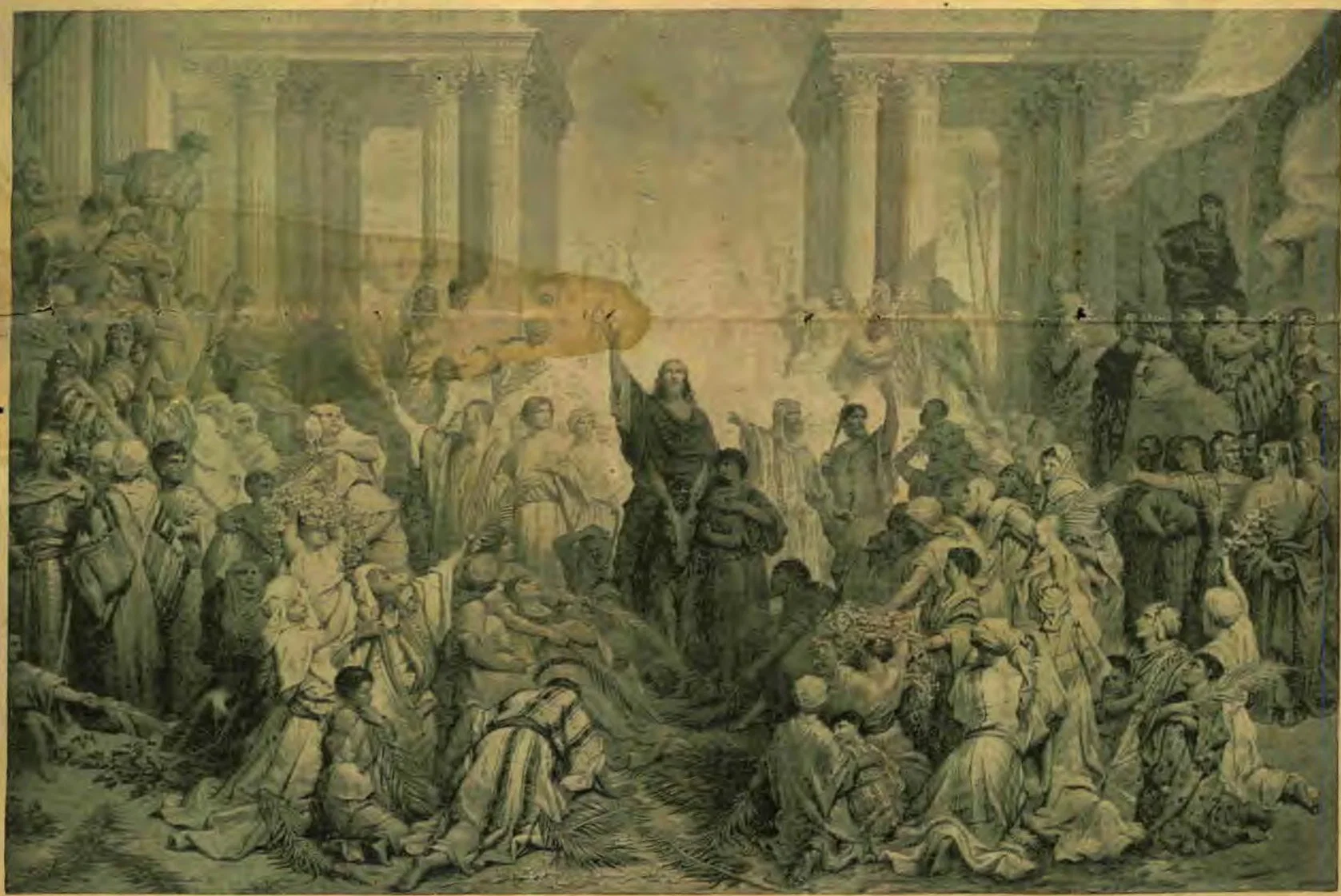
THIS remarkable scene illustrated in our cut is described in Luke 19:24–44; John 12:12–16; Matt. 21:1–16. It occurred shortly before Christ's sufferings and death. The people rejoiced, and manifested their joy by spreading their garments in the way, cutting off branches of the trees and strewing them in like manner, and by praising God for the mighty works which they had seen.
THE TRIUMPHAL ENTRY INTO JERUSALEM.
They had witnessed the wonderful miracles that Jesus had wrought. They had seen the sick healed, the lepers cleansed, the eyes of the blind opened, and the dead raised. Even the children joined in the anthems of praise to God for the gracious manifestations of divine power in behalf of suffering humanity.
MANY had become convinced that Jesus was indeed the promised Messiah, and Israel's King, the Son of David, and so they exclaimed, "Blessed be the King that cometh in the name of the Lord;" "Hosanna: blessed is the King of Israel that cometh in the name of the Lord;" "Hosanna to the son of David."
They thought the appointed time had come for Jesus to be made king of Israel, and deliver them from Roman rule, and hence the royal demonstrations which greeted Him on this stirring occasion. The multitudes caught up the joyful strain and were inspired to swell the cry, "Blessed is the King of Israel."
BUT, as is always the case when a memorable event takes place, and stirring scenes are enacted in connection with the Lord's work, there were Pharisees present who were not pleased with the rejoicing and enthusiasm of the people. Their "sense of propriety" was shocked. Their cold formalism and self-righteousness were not in accord with the shouts of victory and the songs of praise which came from grateful hearts and joyous lips, and so they said to Jesus, "Master, rebuke Thy disciples." Jesus answered, "I tell you that, if these should hold their peace, the stones would immediately cry out." Why was it so necessary for the disciples of Christ to praise God and welcome Jesus as they did on that eventful day?
"ALL this was done, that it might be fulfilled which was spoken by the prophet, saying, Tell ye the daughter of Sion, Behold, thy King cometh unto thee, meek, and sitting upon an ass, and a colt the foal of an ass." Matt. 21:4, 5. See Zech. 9:9. This prophecy, written more than 400 years before, must be fulfilled. If God's people failed to improve their blessed privilege in fulfilling His word and doing His will, then "the stones would immediately cry out,"—they would give the message and do the work.
The same thought was expressed by John the Baptist when he addressed God's professed people. He said, "And think not to say within yourselves, We have Abraham to our father; for I say unto you, that God is able of these stones to raise up children unto Abraham."
THE lesson for us from this scripture is that if we fail to do the work which God wants us to do, if we prove unfaithful to the sacred trust He commits to us, or if we, through selfishness, pride, prejudice, or any wrong motive, do not discern the Lord's work, and faithfully perform2it, others will be raised up to do it, for it must be done.
When men become Abraham's children by faith in Christ, they are not secure in the enjoyment of the blessing of Abraham unless they also do the works of Abraham, that is, obey God. John 8:39, 40. Thus faith is made perfect, and is proved to be true, saving faith. James 2:14–23.
IT is an interesting fact that the disciples did not understand, at the time, that they were fulfilling the word of the Lord on that occasion. "But when Jesus was glorified, then remembered they that these things were written of Him, and that they had done these things unto Him." John 12:16. This illustrates the important fact that God sometimes uses agencies in doing His work and accomplishing His purposes when the agents do not know that such is the case. If the disciples had been as far from God as the Pharisees, so far that He could not use them to fulfil His Word, then the inanimate stones would have proclaimed the praises of the world's Redeemer, and welcomed Israel's King. Cyrus fulfilled one of God's purposes, altho he knew not the Lord. Isa. 45:1–6. Surely He "worketh all things after the counsel of His own will." Eph. 1:11. What a privilege it should be to render willing and loving service to One whose power and wisdom are infinite, and who is pledged to guard and save us from all our foes!
AS THE mighty throng approached Jerusalem from the Mount of Olives, with Jesus as the center of attraction, and the One upon whom so many looked for deliverance from the Roman yoke, "He beheld the city, and wept over it." Luke 19:41. What a scene! The people rejoiced, but Jesus wept. Why should Jesus weep when the multitudes were praising God, and He was receiving royal honors? He understood the situation, but they did not. With prophetic eye He saw Gethsemane, the betrayal, the arrest, the trial, the scenes of Calvary, and the terrible destruction that awaited Jerusalem. But He wept not for Himself. He sorrowed for an unrepentant and rebellious people, who would so soon reject Him as their Saviour and King, saying, "Away with Him, crucify Him. . . . We have no king but Cæsar." John 19:15.
WITH a sad heart, Jesus said, "If thou hadst known, even thou, at least in this thy day, the things which belong unto thy peace! but now they are hid from thine eyes." Luke 19:42. "O Jerusalem, Jerusalem, thou that killest the prophets, and stonest them which are sent unto thee, how often would I have gathered thy children together, even as a hen gathereth her chickens under her wings, and ye would not!" Matt. 23:37. His heart yearned over that people for whom He had labored and sacrificed, and for whom He was about to give His life. How touching and pathetic His plea, and how sad His lamentation! What a lesson for us! Jesus is the same, yesterday, to-day, and forever.
He has the same tender love, the same deep interest, the same earnest solicitude for us now as He had for the people then. He graciously invites us to come to Him and receive His blessing, His rest, His peace, His love, and His life. Matt. 11:28–30; Rev. 3:20; 22:17. Shall we not accept His loving invitation, and find shelter under the shadow of His wings? Let us not wait till the things which belong to our peace are hid from our eyes, and our house is left unto us desolate. "Now is the accepted time; behold, now is the day of salvation."
THE Saviour states the reason why that people did not know the things which belonged to their peace, and why destruction would come upon them. He said, "Because thou knewest not the time of thy visitation." Luke 19:42–44. Why did they not know? Were they responsible for not knowing?—Most assuredly they were, for they might have known. They had the same evidence that Simeon and Anna had (Luke 2:25–38); and the same that John the Baptist and the apostles had. Jesus declares to them, "Ye will not come to Me, that ye might have life." John 5:40. Then He asked them a question which revealed the plague spot of their hearts (and also of a large class to-day): "How can ye believe, which receive honor one of another, and seek not the honor that cometh from God only"? Verse 44. But the evidence that Jesus was the promised Messiah was so strong that many of the chief rulers even believed on Him; "but because of the Pharisees they did not confess Him, lest they should be put out of the synagogue; for they loved the praise of men more than the praise of God." John 12:42, 43.
God forbid that we should seek honor one of another, and love the praise of men more than the praise of God, and so be blinded to our spiritual and eternal interests, and fail to know the things which belong to our peace, or the time of our visitation. God's Word is given us as a lamp to our feet, and a light to our path. Ps. 119:105. We do well to take heed unto the more sure word of prophecy, "as unto a light that shineth in a dark place." 2 Peter 1:19. Had the Jewish people understood what the prophets had written, they would have known the time of their visitation, but as they did not understand the prophetic word, they fulfilled it in condemning Christ. See Acts 13:27.
Jesus said to them concerning the prophecies of Daniel, which referred especially to Him and His work, "Whoso readeth, let him understand." Matt. 24:15. May we so yield our hearts to the mild scepter of Prince Immanuel that He may open our understanding, that we may understand the Scriptures. Luke 24:45. Then we will know the things that belong to our peace in this our day, and we will be prepared to do His will and work.
M. H. BROWN.
OUR PERFECT EXAMPLE.
By John Ap G. Williams
“WHAT the law could not do, in that it was weak through the flesh, God sending His own Son in the likeness of sinful flesh, and for sin, condemned sin in the flesh; that the righteousness of the law might be fulfilled in us, who walk not after the flesh, but after the Spirit.” Rom. 8:3, 4.
“Forasmuch then as the children are partakers of flesh and blood, He also Himself likewise took part of the same; that through death He might destroy him that had the power of death, that is, the devil.” Heb. 2:14.
These scriptures faithfully portray our loving Saviour’s perfect work in rescuing fallen humanity. And as His life is our only perfect example, it is well that we should often examine it as it is revealed before us. Jesus being baptized and praying, the heaven was opened and the Holy Ghost descended in a bodily shape, like a dove, upon Him, the same Holy Spirit which descends invisibly upon all His truly regenerate followers, and a voice came from heaven which said, “Thou art My beloved Son; in Thee I am well pleased.” Luke 3:21, 22.
By His own sheep the same voice (by faith) is heard, saying, “Behold, what manner of love the Father hath bestowed upon us, that we should be called the sons of God.” 1 John 3:1. Again, when Jesus entered on His ministry, He said, “The Spirit of the Lord is upon Me, because He hath anointed Me to preach the Gospel.” Luke 4:18. Now if it was necessary for Jesus, who is our only perfect Example, to receive this inspiration of the Father before entering upon His sacred ministry, is it not a greater necessity for every follower who has been commissioned to do this same work in His stead? 1 Cor. 5:20.
Not only do we find this essential, but our loving Saviour assures us that all power is given Him in heaven and on earth, and that we shall be sustained by this power even to the end of the world. Matt. 28:18–20.
The one condition of obtaining spiritual wisdom is perfect obedience. Here it is, precept and promise, “If any man willeth to do His will, he shall know of the teaching.” John 7:17, R.V. The loving Saviour has meted out to us the same degree of power and love as was bestowed upon Himself by the Father. And in consideration of this, He looks to us, His representatives, to follow His example, and glorify Him in our lives, as He glorified the Father. He says, “As the Father hath loved Me, so have I loved you; continue ye in My love.” Then He shows us how this is made possible: “If ye keep My commandments, ye shall abide in My love.” Then the manner in which they are to be kept is also made plain: “Even as I have kept My Father’s commandments, and abide in His love.” John 15:9, 10.
Here is the divine object lesson. And by this perfect love manifested by obedience, there is brought about an inseparable union between God the Father, His beloved Son, our Saviour Jesus Christ, and His trusting children. Hear the Saviour’s own description: “If a man love Me, he will keep My words; and My Father will love Him, and We will come unto Him, and make Our abode with Him.” John 14:23.
I heard a person once say, “We can not continue in this union, because our adversary, the devil, as a roaring lion, walketh about seeking whom he may devour.” True, we can not of ourselves. But we hear that the apostle Paul was buffeted by the messenger of Satan, and when he besought the Lord, the answer came, “My grace is sufficient for you.” 2 Cor. 12:7–9. And we hear again, through the same apostle, that the union is inseparable, unless the separation is voluntarily sanctioned by the recipient of grace. Rom. 8:37–39.
Jesus comforted His disciples just before His ascension with these words: “In My Father’s house are many mansions; if it were not so, I would have told you. I go to prepare a place for you. And if I go and prepare a place for you, I will come again, and receive you unto Myself; that where I am, there ye may be also.” John 14:2, 3. Every faithful follower of Jesus will be acting his part in preparing souls for these “eternal mansions of glory,” and this is the question He is asking us to-day: “Who then is a faithful and wise servant, whom his Lord hath made ruler over His household, to give them meat in due season? Blessed is that servant, whom his Lord when He cometh shall find so doing.” Matt. 24:45, 46.
JOHN AP G. WILLIAMS.
Realizing Our Depth in Sin
WE can never realize our depth in sin until we try to realize what we might have been in the Father's house, if we had only stayed at home with Him.—Phipps.
A Place in His Heart
THERE is a place in His heart for each of us where none but we individually can enter.—MacDonald.
OUR TALENTS.
By Ellen G. White
"The kingdom of heaven is as a man traveling into a far country, who called his own servants, and delivered unto them his goods. And unto one he gave five talents, to another two, and to another one; to every man according to his several ability; and straightway took his journey.
"Then he that had received the five talents went and traded with the same, and made them other five talents. And likewise he that had received two, he also gained other two. But he that had received one went and digged in the earth, and hid his lord's money.
"After a long time the lord of those servants cometh, and reckoneth with them. And so he that had received five talents came and brought other five talents, saying, Lord, thou deliveredst unto me five talents; behold, I have gained beside them five talents more. His lord said unto him, Well done, thou good and faithful servant; thou hast been faithful over a few things, I will make thee ruler over many things; enter thou into the joy of thy lord.
"He also that had received two talents came and said, Lord, thou deliveredst unto me two talents; behold, I have gained two other talents beside them. His lord said unto him, Well done, good and faithful servant; thou hast been faithful over a few things, I will make thee ruler over many things; enter thou into the joy of thy lord."
The man intrusted with the one talent manifested an avaricious spirit. He claimed to have great discernment—such discernment as many pride themselves in possessing to-day,—a distrust of those who are doing service for God, a jealousy of God. He thought that his lord possessed a spirit like his own. But it was he that possessed the ungenerous, unjust attributes, not his lord, who in mercy and love had intrusted the talent to him. His words plainly showed that he knew not his lord. The principle which led him to rob his master of the improvement of his talent, made him ungenerous, and led him to covet that which was not his own.
This man cast down his intrusted gift, saying, "Lord, I knew thee that thou art an hard man, reaping where thou hast not sown, and gathering where thou hast not strawed; and I was afraid, and went and hid thy talent in the earth; lo, there thou hast that is thine.
"His lord answered and said unto him, Thou wicked and slothful servant, thou knewest that I reap where I sowed not, and gather where I have not strawed; thou oughtest therefore to have put my money to the exchangers, and then at my coming I should have received mine own with usury. Take therefore the talent from him, and give it unto him which hath ten talents. For unto every one that hath shall be given, and he shall have abundance; but from him that hath not shall be taken away even that which he hath. And cast ye the unprofitable servant into outer darkness; there shall be weeping and gnashing of teeth."
The lesson of this parable is applicable in our day. From the lowest and most obscure, to those placed in highest positions of responsibility, we are God's property. We are all intrusted with the goods of heaven,—talents of intellect, wealth, reason,—and we are not to regard lightly any of these gifts. They are the Lord's capital, to be used, sanctified, and returned to the Lord improved by use. To every man God has given his work, and all will have to stand before the judgment-seat of Christ to give an account of what they have done for their Master.
Every gift of God is to be used, and by use to accumulate. Every faculty of the mind, every gift of grace that Heaven has provided for the human agent, is to be freely imparted to others in refining, elevating, ennobling works. God has given the faculty of thought to be used as a sacred treasure; the wise improvement of the powers of the mind will increase our ability to represent the character of Christ to the world. With all the mind, the heart, the soul, the strength, the intrusted gifts of God are to be used for the blessing of others. We are to grow in grace and in the knowledge of Jesus Christ.
This work of improvement is an individual work, and the proper use of our powers will constitute us laborers together with God. We are to use our faculties faithfully, doing our best to benefit those of our own household. And this influence will be felt outside the home circle. By the members of the family it will be communicated to all with whom they are brought in contact.
There must be no burying of our talents in the earth, to corrode through inaction. A persistent indulgence of self, a refusal to exercise our God-given abilities, will insure our eternal separation from God, the loss of an eternity of bliss. These gifts are bestowed upon us in accordance with our ability to use them, and the wise improvement of each will prove a blessing to us, and will bring glory to God. Every gift gratefully received is a link in the chain which binds us to heaven.
The gifts of him who honestly trades with his Lord's goods will be increased; but from him who does not, will be taken away even that which he has. Through failing to put to the best use the intrusted endowments of Heaven, he loses that which might have multiplied in his hands.
Spiritual idleness means spiritual unfaithfulness. Could every idler in the market-place understand the penalty of slothfulness, he would be up and doing. The Word declares that he which is unfaithful in that which is least is unfaithful also in much. All his work bears the impression of unfaithfulness. None will be pleased to meet their unfaithfulness in the judgment; for the "wrath of God is revealed from heaven against all ungodliness and unrighteousness of men, who hold the truth in unrighteousness; because that which may be known of God is manifest in them; for God hath showed it unto them. For the invisible things of Him from the creation of the world are clearly seen, being understood by the things that are made, even His eternal power and godhead; so that they are without excuse; because that, when they knew God, they glorified Him not as God, neither were thankful; but became vain in their imaginations, and their foolish heart was darkened." These words represent the case of the servant who hid his Lord's treasure, in the place of using it to the glory of God.
The more we have of this world's goods, the greater will be our accountability to God. Let the question be asked sincerely, heartily, What do I with my Lord's intrusted talents? There are those who have great light, great opportunities; they realize the Master's kindly affections, and are stirred to make returns. But other influences come in. The demands of the family are absorbing. Will these teach their children that they can not be faithful stewards, and still gratify their intemperate desires to dress like the worldling? Will they spend time and means in self-gratification to such an extent that there is nothing left for the poor or the cause of God? Will they suffer wife or children to lead them into false or forbidden paths? Will they open the door to selfish indulgence, and shut the heart to the call for means for the Lord's treasury? Will they tie up their means in houses and lands, or keep their means buried in the earth, so that it can never rise to heaven in gifts and offerings to accumulate there?
How many will be disappointed in the day of final reckoning! "When the Son of man shall come in His glory, and all the holy angels with Him, then shall He sit upon the throne of His glory; and before Him shall be gathered all nations; and He shall separate them one from another, as a shepherd divideth his sheep from the goats; and He shall set the sheep on His right hand, but the goats on the left.
"Then shall the King say unto them on His right hand, Come, ye blessed of My Father, inherit the kingdom prepared for you from the foundation of the world; for I was an hungered, and ye gave Me meat; I was thirsty, and ye gave Me drink; I was a stranger, and ye took Me in; naked, and ye clothed Me; I was sick, and ye visited Me; I was in prison, and ye came unto Me. Then shall the righteous answer Him, saying, Lord, when saw we Thee an hungered, and fed Thee? or thirsty, and gave Thee drink? When saw we Thee a stranger, and took Thee in? or naked, and clothed Thee? or when saw we Thee sick, or in prison, and came unto Thee? And the King shall answer and say unto them, Verily I say unto you, Inasmuch as ye have done it unto one of the least of these My brethren, ye have done it unto Me.
"Then shall He say also unto them on His left hand, Depart from Me, ye cursed, into everlasting fire, prepared for the devil and his angels; for I was an hungered, and ye gave Me no meat; I was thirsty, and ye gave Me no drink; I was a stranger, and ye took Me not in; naked, and ye clothed Me not; sick, and in prison, and ye visited Me not. Then shall they also answer Him, saying, Lord, when saw we Thee an hungered, or athirst, or a stranger, or naked, or sick, or in prison, and did not minister unto Thee? Then shall He answer them, saying, Verily I say unto you, Inasmuch as ye did it not to one of the least of these, ye did it not to Me. And these shall go away into everlasting punishment; but the righteous into life eternal."
MRS. E. G. WHITE.
I WILL SING OF THY MERCIES, O MY GOD!
By I. Deeley
"Count my mercies," did you say?
Each as it comes from day to day?
Say, count the sands on ocean shore,
And stars which shine forevermore;
Number the hairs on every head,
And count the sparrows daily fed,
The blades of grass on glen and glade,
With all things else His hands have made.
Then write their totals if you can,
Or measure with a human span;
And if you fail, as sure you will,
Pause, let your busy brain be still:
My mercies come so thick, so fast!
Then what of all now gone and past?
Like autumn leaves they're strewn around
My path, till scarce a spot is found
Of room to place or time to count—
Unnumbered still the vast amount.
O wondrous love! They all outvie
My passing moments as they fly.
In wakeful hours or hours of sleep
Their rapid onward pace they keep,
Nor shall eternal ages know
A time when mercies cease to flow.
I. DEELEY.
Vienna, N. Y.
When Love Works
"WHEN love works, it never looks at the clock."
THE CAUSES OF SUNDAY OBSERVANCE.
By F. M. W.
It is a law of physics that every effect has a producing cause, and while this is true in the physical world, it is just as true in the realm of moral ethics. What conditions working in the Christian church led up to the adoption of the first day of the week as the rest day of the majority of the human family instead of the one Sabbath ordained by the Lord? In a general way, the cause can be denominated sin; the conditions leading up to this step, as those of departure from God, love of the world, and popularity. Every student of church history knows that the purity of the apostolic church did not long remain unsullied. Paul states that the mystery of iniquity was at work even in his day. And he predicted that it would soon develop into the man of sin, who would work havoc with the truth of God. 2 Thess. 2:7. And in Paul's parting exhortation to the elders of the church at Ephesus he tells them that of their own number should men arise speaking perverse things, to draw away disciples after them. Acts 20.
Even in the end of the first century the Christian church began to depart from the simplicity of the faith and to cater to the ideas and prejudices of the heathen world around them; and by the end of the second century this departure from original purity was indeed marked. Christianity began to wear the garb of heathenism. The conversion of the heathen became more superficial, and as these men united with the church of God, they brought with them many customs and practises of their former heathen worship. Ministerial parity became a thing of the past. The ministers of the larger churches took to themselves influence and prestige which their larger following gave. Such churches as Rome, Alexandria, and others became centers of influence and direction for many smaller congregations within their sphere of influence. Thus it was that the distinctions between the ministers in charge of these various centers and the less prominent churches became more and more marked.
Upon the so-called conversion of Constantine, in the beginning of the fourth century, a new and strange impetus was given to the Christian faith, and the Christian religion became the religion of the empire. Then began the scheming of the various bishops and presbyters for recognition at the court of Constantine. Rome had for centuries been the mistress of the world, and as in the affairs of State her authority had been acknowledged, it seemed a natural step that her authority should also be conceded in spiritual matters, especially as the emperor recognized the claims of the church at Rome, and gave to its opinions superior weight and authority above others.
The popularity of the Christian religion in the empire only served to bring to its standard more subjects of the heathen faith. Scores united with the Christian church more in the hope of temporal gain than of spiritual advantage. And the church itself, having lost its fine sense of the character of Christianity, eagerly held out every inducement to augment its membership from the ranks of its heathen neighbors. Customs, festivals, and practises were modified, given Christian names, and incorporated into the practise of the church. Prominent among these came the Sunday festival. This day was dedicated to the worship of the sun, and upon it were held heathen feasts in honor of that deity. That the Christian church might not appear 'causelessly peevish' and deter the conversion of their heathen neighbors, it saw fit to take this day observed by the heathen world and incorporate it into the practise of the church as a Christian institution, not in honor of the natural sun but of the Sun of Righteousness. And as it happened that this day was the one upon which Christ rose from the dead, it was set apart in honor of His resurrection.
Another reason which prompted this change was that odium, then as now, attached to the Jewish nation. And the so-called Christian church, that it might in no sense be classed with the Jews, the more readily embraced this change. In the Western church the Sunday sabbath was held as a joyous festival in contradistinction to the Lord's Sabbath, which was appointed as a fast day. And in the love men have for feasting instead of fasting, this distinction between the two days was not without its effect in disposing them to this innovation.
But this change was not accomplished in a moment. The entrance of sin is always insidious, and error creeps gradually into the church of God. Thus it was with the change in the practise of the early church in regard to the Sabbath. The seventh-day Sabbath, says the historian, was observed for several centuries after Christ, and, indeed, after first-day observance was inaugurated, the observance of the two days ran parallel for some time. But the popularity of the church and the prejudices of its unconverted members from heathenism gradually gave to the first day the prominence, and the seventh-day observance sank out of sight.
In proof of these statements we have not cited specific historical references. These might be quoted by the score. But every intelligent student of church history will willingly admit the correctness of the above statements.
Thus we see that the Sunday sabbath was wholly a product of the union of professed Christianity and heathenism. It has no foundation in the Word of God. It was changed by the authority of the church, and that too at a time when the church was far separated from the Lord, and was not directed by His Spirit, nor walking in the light. To an institution originating in this way, should we give honor to-day? How does its sacred character compare with the day the Lord blessed and set apart for the use of His children in all ages? Bible or tradition—which is the authority for the Christian? Will you, dear reader, obey the ordinance of the Lord, or the commandment of men?
F. M. W.
"SEEK THE LORD GOD AFTER THE DUE ORDER."
By Mrs. J. B. Goldsborough
How many of the professing children of God seek Him "after the due order"? David says, "For because ye did it not at the first, the Lord our God made a breach upon us, for that we sought Him not after the due order." 1 Chron. 15:13. What is the required "order" for the present time?
I hope to provoke others to investigate the matter by asking, Do we fellowship the Holy Spirit as the representative of Christ should be fellowshiped? Do we take Him to our heart as tenderly and as lovingly as we would our Saviour? If not, we grieve Him; for He is the Spirit of love. Are our ears open to hear what He says to each of us individually, or do we think He only speaks collectively? Does He not speak to each one when He says, "He that hath an ear to hear let him hear what the Spirit saith unto the churches"? Are we filled with affectionate adoration for His great goodness in bringing things to our remembrance that comfort our souls and witness to our salvation?
O, may we all have the abiding presence of the Holy Spirit, "that we may be able to comfort them who are in trouble by the comfort wherewith we ourselves are comforted of God"!
Mrs. J. B. GOLDSBOROUGH.
DISARMAMENT.
Put up the sword! The voice of Christ once more
Speaks, in the pauses of the cannon's roar,
O'er fields of corn by fiery sickles reaped
And left dry ashes; o'er trenches heaped
With nameless dead; o'er cities starving slow
Under a rain of fire; through wards of wo
Down which a groaning diapason runs
From tortured brothers, husbands, lovers, sons,
Of desolate women in their far-off homes,
Waiting to hear the step that never comes.
O men and brothers, let that voice be heard!
War fails; try peace; put up the useless sword.
—John G. Whittier.
THE CITY OF GOD.
WHEN going to a strange country it is natural that we should desire to learn all that we can of that place. It is certain that man has never seen, nor even with his fondest anticipations has he grasped the realities of the city of God, the city of the great King. On this subject Isaiah says, "For since the beginning of the world men have not heard, nor perceived by the ear, neither hath the eye seen, O God, beside Thee, what He hath prepared for him that waiteth for Him." Isa. 64:4. Paul adds in 1 Cor. 2:9, "Neither have entered into the heart of man, the things which God hath prepared for them that love Him."
If this is so, then can we know anything about them? The next verse tells us that "God hath revealed them unto us by His Spirit." God counsels us to study what the Spirit has said of this place, and then, tho far exceeding the farthest stretch of man's unaided imagination, yet He will illumine and unfold the different scenes. The river, the tree of life, streets of gold, gates of pearl, wall of jasper, all will be familiar, tho the vastness, the surpassing glory, the perfection of beauty, can only be seen to conceive of them fully. "Thine eyes shall see the King in His beauty; they shall behold the land that is very far off." Isa. 33:17.
God does encourage us to study the description of the place: "Walk about Zion, and go round about her; tell the towers thereof. Mark ye well her bulwarks, consider her palaces; that ye may tell it to the generation following." Ps. 48:12, 13. The Word plainly states that the city of God is a real city, that real beings dwell there, that "thine eyes" shall see it. God says of the place, "The city lieth four-square;" it "had a wall great and high, and had twelve gates." These gates were placed three on each side of the city. Its size around was "twelve thousand furlongs." With four sides to this city, one side would be one-fourth of this, which would be three thousand furlongs, or three hundred and seventy-five miles, on either side. See Rev. 21:10-21. Who can conceive of a city so large?
Leaving the measurement of the city, its walls, gates, etc., we will look at the river, the temple, and the tree of life. Rev. 22:1, 2 says: "And he showed me a pure river of water of life, clear as crystal, proceeding out of the throne of God and of the Lamb. In the midst of the street of it, and on either side of the river, was there the tree of life, which bare twelve manner of fruits, and yielded her fruit every month; and the leaves of the tree were for the healing of the nations." Ezekiel, speaking of this, says, "And by the river upon the bank thereof, on this side and on that side, shall grow all trees for meat, whose leaf shall not fade, neither shall the fruit thereof be consumed; it shall bring forth new fruit according to his months, because their waters