Your ShelfYour Projects

Signs of the Times, Vol. 36, No. 32.

OUR BIBLE BAND

Signs of the Times

Aug 18, 1909

Pacific Press Publishing Association · Mountain View, California · Aug 18, 1909

OUR BIBLE BAND

Schedule for the Week Ending Aug. 28, 1909.

Day Date Morning Evening
Su. Aug. 22 Ps. 110 to 112 1 Cor. 5
Mo. Aug. 23 113 to 115 6
Tu. Aug. 24 116 to 118 7:1-19
We. Aug. 25 119:1-88 7:20-40
Th. Aug. 26 119:89-176 8
Fr. Aug. 27 120 to 122 9
Sa. Aug. 28 123 to 125 10:1-18

Suggestive Notes.

Our morning readings include Psalms 110 to 125. It is utterly impossible, as it has been all the way through, in one little note to give any adequate synopsis of the truths contained in these morning readings. This is especially true of the inspired songs of Zion. Many of them are so full, so expressive of the human needs, human longings, human insufficiency, and the all-sufficiency of God. Some of them are prophetic, like the 110th Psalm, of our Lord Jesus Christ. Some of them honor God's law and show its immutability and perpetuity, as Psalms 111 and 119. Some of them contrast the true God as the Maker of the heavens and the earth with the false gods who have no power, as Psalm 115. Others are songs of thanksgiving and praise for deliverance, as Psalm 116. All of them are uplifting and inspiring. Psalm 119 was probably written by Daniel. One knowing his history can not read the psalm without seeing his experiences manifest in almost every verse of it.
Our evening readings begin with 1 Corinthians 5 and close with the eighteenth verse of the 10th chapter. The 5th chapter reproves the Corinthian church for horrible and detestable sins which are cherished among them, over which they have no sorrow of heart. This thought is carried on into the 6th chapter. Their former condition is pointed out and the wonderful goodness of God in saving them from that. Chapter 7 carries the thought of consecration before God into the married life, a thing especially needed then because of the customs of the heathen on every side, and needed now because of the tendency to looseness on all moral questions. The climax on the matter of true physical consecration is shown in the illustration of the race, in chapter 9. A warning against turning back to the things of the flesh is strongly given in the first part of chapter 10, in the recalling of some striking incidents in the history of Israel.

Question Corner

[To Our Inquirers.—(1) The name and address of all who ask questions must accompany questions, not necessarily for publication, in token of good faith, and that we may reply by letter if thought best. All communications will be considered confidential if so desired, and no name will be published unless requested. But we have no time to give to anonymous or unsigned epistles or articles. (2) Let the questions be to the point. Do not say, “Explain Josh. 7:1-8,” but state the thing upon which help is desired. (3) Questions can not be answered immediately in this department. Sometimes it will mean a month or more of waiting. We can not reply to the same question frequently. Read answers to other questions; you may find reply to yours. (4) Members of the Bible Band will kindly enclose stamp if answer is desired by letter. Others will please enclose ten cents. This does not begin to meet expenses oftentimes. (5) “Foolish . . . questions avoid.”]

2911.—What Days?

Please explain Gal. 4:7-11. To what days does the apostle refer? S.
The passage is not difficult to understand if we will study the context. It will be seen from the eighth verse that the Galatians were at one time heathen, they were in bondage to them that “by nature are no gods.” In Lev. 19:26 we learn that the Lord forbade indulging in the customs of the heathen. “Neither shall ye use enchantment, nor observe times.” See also Deut. 19:10.
The heathen had their days dedicated to their gods. Sunday was the day dedicated to the sun, Monday to the moon, and so with all the days of the week. The months also were named in some cases after the gods, as January for Janus, the two-faced god. Those idolatrous feasts were many times scenes of the greatest license; they were essentially bestial and low. They were carried on throughout all heathen lands. Therefore, when the Galatians turned from the Lord Jesus Christ to self-justification, they naturally fell right back to the observance of the heathen days and times. For the apostle declares: “But now that ye have come to know God, or rather to be known by God, how turn ye back again to the weak and beggarly rudiments, whereunto ye desire to be in bondage over again?” What were those weak and beggarly rudiments? It was “bondage to them that by nature are no gods,” and it constituted evidence that they observed days and months and seasons and years; that is, the heathen days and times and months and seasons, hoping for salvation in them.
Are we to understand from this that God would have us observe no time?—No, because He has Himself given us one time that should be observed; His great worship-day, the Sabbath, the seventh day.

2912.—Jesus and the Sabbath Commandment.

Why did Jesus not mention the Sabbath commandment when He enumerated the others? F. J. S.
In the first place, our Lord nowhere enumerates the Ten Commandments. He gave some of them, as in the nineteenth chapter of Matthew. He quotes those, to show to the young man that he was not really keeping the commandments after all. The young man had declared that “all these have I kept from my youth up,” but Jesus showed him by the principle upon which the commandments quoted were based and the application of that principle, that the young man really had not kept the commandments at all. He had outwardly observed them. His life was blameless, probably, so far as a negative example was concerned, yet he was wealthy and the poor were all around him, and he had not given to their needs. But in that enumeration of commandments, we do not have any one of the first four precepts of the Decalogue, and we nowhere in the teachings of Christ have any reference to the second commandment of the Decalogue. Extra judicial oaths are forbidden, but the third commandment is not quoted.
Why should we demand that our Lord should restate the Ten Commandments? He expressly tells us, “Think not that I am come to destroy the law, or the prophets: I am not come to destroy, but to fulfil.” Matt. 5:17. There would be no change in God’s government. God’s moral law is perfect, and Christ came to restore men to allegiance to God. That was His sole purpose. He declares, “I and My Father are one.” Again: “I came not to do Mine own will, but the will of Him that sent Me.” God’s will is expressed in His law. Ps. 40:7, 8, and Jesus declares that those who say, “Lord, Lord,” and do not the will of God, will have no part in God’s kingdom. To them the Lord will say: “Depart from Me, ye that work iniquity.” “I never knew you.” “Iniquity” is lawlessness; doing things contrary to God’s law. All the teaching of our Lord, in precept and example, in His sacrifice upon the cross, taught the immutability, the inviolability, the absolute necessity and eternal perpetuity of the law of God in every jot and tittle, for He declares: “It is easier for heaven and earth to pass than for one tittle of the law to fail.”
The change from the old dispensation to the new dispensation, as they are sometimes called, was not the change in God’s purpose or the change in God’s plan. It was simply a greater development of that plan. The old object-lesson offerings which pointed forward to Christ, ceased because the shadow reached the substance; but the government of God underwent no change. Faith was demanded before Christ came, faith in the Sacrifice and Redeemer to come; faith was demanded when He came, faith in the Sacrifice who was there with them. Obedience was demanded before He came, the obedience of faith to all God’s commandments; obedience was demanded after He came, the obedience of faith, the following in His footsteps.
There was no more change in the constitution or fundamental laws of God’s government when Christ came than there is when one administration is succeeded by another in the United States Government. Had Mr. Bryan been elected instead of Mr. Taft, the Constitutional laws of this government would have been the same. The administration might have been different, but this would have had no effect whatever upon the Constitution. Every word and act of Christ’s life confirms the Sabbath commandment with the others.

2913.—Breath of Life.

Is “breath of life” in Gen. 2:7 and Gen. 6:17 the same in the Hebrew? H. W. L.
The word “life” in both cases comes from the Hebrew word chay, pronounced khahee, from the root word chayah, meaning “to live,” “to keep alive,” and so translated “life,” “live,” “quicken,” “recover,” etc. The word “breath,” however, comes from a different word in Gen. 2:7 and in Gen. 6:17. “Breath” in Gen. 2:7 comes from n’shamah, from nasham, meaning “to blow,” and is defined as “wind,” or “vital breath,” and rendered in the words “blast,” “breath,” “inspiration,” “soul,” “spirit.” “Breath” in Gen. 6:17 comes from the Hebrew ruwach, and that from a primitive root meaning “to blow,” or “breathing,” and is rendered by the words “air,” “blast,” “breath,” “spirit,” and so on. The meanings are really similar, so there is but very little difference between the two expressions. The translators and revisers evidently considered the words similar in meaning, because they rendered in both places “breath of life.” In the first instance it refers to men, and in the second all flesh whether man or beast, simply the breath of life from God.

2914.—The Weekly and Yearly Sabbaths.

Kindly explain the difference between the yearly sabbaths and feast-days and the weekly Sabbaths? G. A.
The Sabbath of Jehovah is eternal. It is a memorial of God’s creative power and love. Gen. 2:1-3; Ex. 20:8-11. It comes to sinful man as a sign of God’s power to sanctify and save. Eze. 20:12. As it was through Christ the Lord that God created the world, as it was Christ who wrought and rested (John 1:1-3; Col. 1:16; 1 Cor. 8:6), so the Sabbath is, therefore, the Lord’s Day (compare Mark 2:27, 28; Isa. 58:13; Ex. 20:8-11; Rev. 1:10). That Sabbath will exist forever. Isa. 66:22, 23.
The yearly feast-days and sabbaths all came in because of sin. They were of the nature of types and prophecies pointing forward to Christ. They are all enumerated in Leviticus 23 and were connected with the great feasts of the Passover, the First-fruits, the Feast of Trumpets, and the Atonement. All these met their fulfilment in Christ Jesus, and are distinct from the weekly Sabbath. The weekly Sabbath was always the seventh day of the week, in constant succession; the yearly sabbaths might fall on any day of the week. The Lord distinguishes between the two by the expression, “besides the Sabbaths of Jehovah” (Lev. 23:38), and by the very nature of the institutions.

2915.—Afflictions of Christ.—A. K.

Col. 1:24 intimates wherein the afflictions of Christ were behind. Our Lord identifies Himself with His church, and what touches His church, touches Him. He is the Head, His church is the body, and all the afflictions which His church suffers He suffers. The afflictions that were behind, which Paul helped to fill up, were the afflictions that would come upon the church of Christ following the sufferings of our Lord. His church are partakers with Him in suffering; but if we suffer with Him, we shall also reign with Him.

2916.—Articles on Spiritism.

Have you the papers containing the series of articles on “The Spirit World and the Future Life” by Prof. George W. Rine for sale? W. F. K.
The articles by Professor Rine have been placed in pamphlet form, and will soon be announced in the SIGNS for sale, and the price will be given.

The Value of Trial

By Mrs. E. G. White
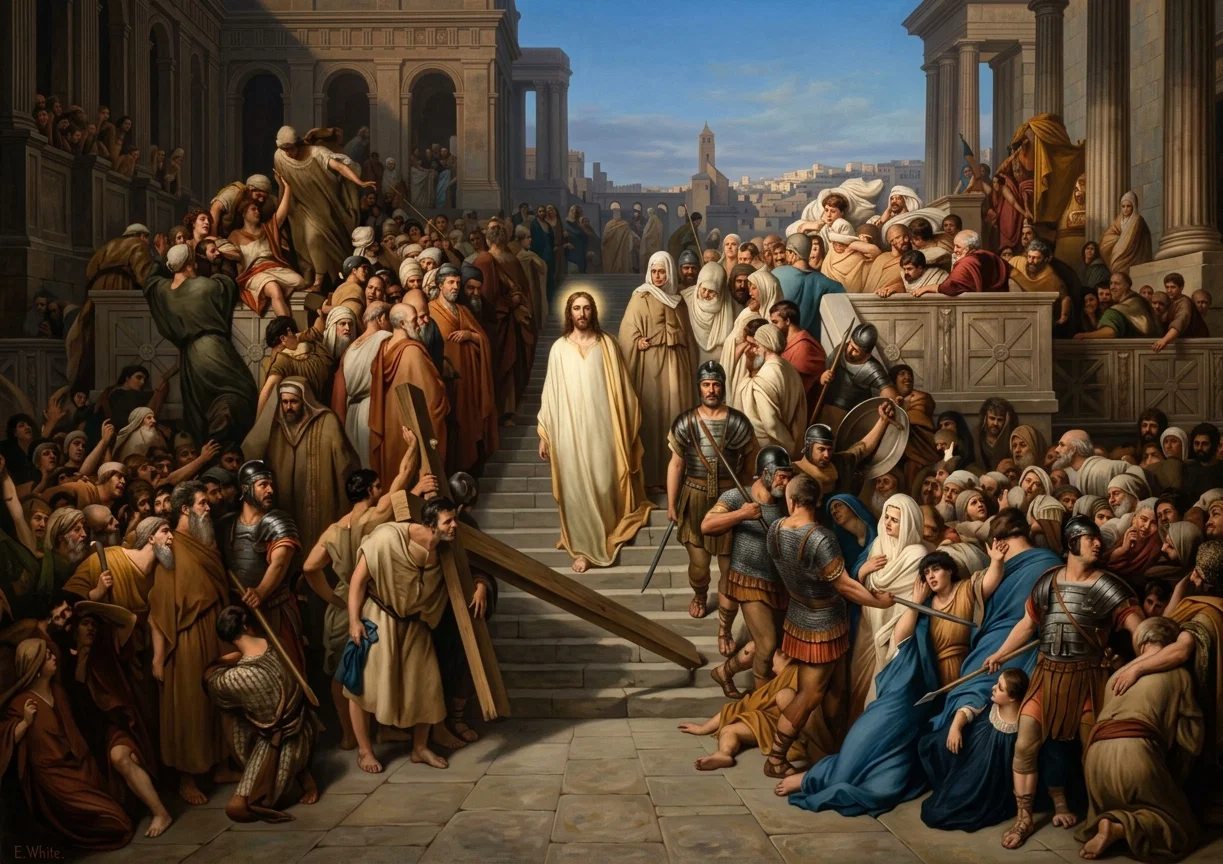
ON THE WAY TO THE CROSS
“What sustained the Son of God in His hour of betrayal and trial?”
ON THE WAY TO THE CROSS “What sustained the Son of God in His hour of betrayal and trial?”
The furnace fires are not to destroy, but to refine, ennoble, sanctify. Without trial we would not feel so much our need of God and His help; and we would become proud and self-sufficient. In the trials that come to us we should see the evidences that the Lord's eye is upon us, and that He means to draw us to Himself. It is not the whole, but the wounded, who need a physician; it is those who are pressed almost beyond the point of endurance who need a Helper.
The fact that we are called upon to endure trial, proves that the Lord sees something in us very precious, which He desires to develop. If He saw in us nothing whereby He might glorify His name, He would not spend time in refining us. We do not take special pains in pruning brambles. Christ does not cast worthless stones into His furnace. It is valuable ore that He tests.
The blacksmith puts the iron and steel into the fire that he may know what manner of metal they are. The Lord allows His chosen ones to be placed in the furnace of affliction, in order that He may see what temper they are of, and whether He can mold and fashion them for His work.

God the Purifier

It may be that much work needs to be done in your character-building, that you are a rough stone which must be squared and polished before it can fill a place in God's temple. You need not be surprised if, with chisel and hammer, God cuts away the sharp corners of your character, until you are prepared to fill the place He has for you. No human being can accomplish this work. Only by God can it be done. And be assured that He will not strike one useless blow. His every blow is struck in love, for your eternal happiness. He knows your infirmities, and works to restore, not to destroy.
When trials arise that seem unexplainable, we should not allow our peace to be spoiled. However unjustly we may be treated, let not passion arise. By indulging a spirit of retaliation, we injure ourselves. We destroy our own confidence in God, and grieve the Holy Spirit. There is by our side a witness, a heavenly messenger, who will lift up for us a standard against the enemy. He will shut us in with the bright beams of the Sun of Righteousness. Beyond this, Satan can not penetrate. He can not pass this shield of holy light.
While the work is progressing in wickedness, none of us need flatter ourselves that we shall have no difficulties. But it is these very difficulties that bring us into the audience-chamber of the Most High. We may seek counsel of One who is infinite in wisdom. Through conflict the spiritual life is strengthened. Trials well borne will develop steadfastness of character, and precious spiritual graces. The perfect fruit of faith, meekness, and love often matures best amid storm-clouds and darkness.

Paul's Experience

Paul was a man who knew what it meant to be a partaker of Christ's sufferings. Hislife was one of constant activity, notwithstanding he was subject to many infirmities. He was constantly followed by the hatred and malice of the Jews. They were exceedingly bitter against him, and did all in their power to hinder him in his work. Yet we hear his voice sounding down along the line to our time, “Our light affliction, which is but for a moment, worketh for us a far more exceeding and eternal weight of glory; while we look not at the things which are seen: for the things which are seen are temporal; but the things which are not seen are eternal.” “I reckon that the sufferings of this present time are not worthy to be compared with the glory which shall be revealed to us.” None too highly does Paul estimate the privileges and advantages of the Christian life.
Paul says further, “As many as are led by the Spirit of God, they are the sons of God. For ye have not received the spirit of bondage again to fear; but ye have received the spirit of adoption, whereby we cry, Abba, Father.” One of the lessons that we are to learn in the school of Christ is that the Lord's love for us is far greater than that of our earthly parents. We are to have unquestioning faith and perfect confidence in Him. “The Spirit itself beareth witness with our spirit, that we are the children of God; and if children, then heirs; heirs of God, and joint heirs with Christ; if so be that we suffer with Him, that we may be also glorified together.”

Visions of the Future

There are revealed in these last days visions of future glory, scenes pictured by the hand of God; and these should be dear to His church. What sustained the Son of God in His hour of betrayal and trial?—He saw of the travail of His soul, and was satisfied. He caught a view of the expanse of eternity, and saw the happiness of those who, through His humiliation, should receive pardon and everlasting life. He was wounded for their transgressions, bruised for their iniquities. The chastisement of their peace was upon Him, and with His stripes they were healed. His ear caught the shout of the redeemed. He heard the ransomed ones singing the song of Moses and the Lamb.
We must have a vision of the future, and of the blessedness of heaven. Stand on the threshold of eternity and hear the gracious welcome given to those who in this life have cooperated with Christ, regarding it as a privilege and honor to suffer for His sake. As they unite with the angels, they cast their crowns at the feet of the Redeemer, exclaiming, “Worthy is the Lamb that was slain to receive power, and riches, and wisdom, and strength, and honor, and glory, and blessing. . . . Honor and glory, and power, be unto Him that sitteth upon the throne, and unto the Lamb forever and ever.”
“I beheld, and, lo, a great multitude, which no man could number, of all nations, and kindreds, and people, and tongues, stood before the throne, and before the Lamb, clothed with white robes, and palms in their hands; and cried with a loud voice, saying, Salvation to our God which sitteth upon the throne, and unto the Lamb.”
“These are they which came out of great tribulation, and have washed their robes, and made them white in the blood of the Lamb. Therefore are they before the throne of God, and serve Him day and night in His temple: and He that sitteth on the throne shall dwell among them. They shall hunger no more, neither thirst any more; neither shall the sun light on them, nor any heat. For the Lamb which is in the midst of the throne shall feed them, and shall lead them unto living fountains of waters: and God shall wipe away all tears from their eyes.” “And there shall be no more death, neither sorrow, nor crying, neither shall there be any more pain: for the former things are passed away.”

The Sabbath Through the Ages

IV. The Sabbath Marked by the Manna

By Charles L. Taylor
The journey to the promised land has begun. In quick succession the judgments of God have fallen upon “all the gods of Egypt,” and as Israel have beheld the mighty rebuke administered to sun-worship and its tyranny, their faith has grown, their affections have weaned from idolatry, and they have learned in part to trust and obey Him “who only doeth wondrous things.” “By faith” they have passed through the Red Sea, the pursuing army of Egypt has been overwhelmed, and now has arrived the time when, without fear, they may “sacrifice unto Jehovah” and prove their loyalty to Him.
With God’s people, there have come from Egypt “a mixed multitude.” In this multitude there were not only those who were actuated by faith in the God of Israel, but also a far greater number who desired only to escape from the plague, or who followed in the wake of the moving multitude, merely from excitement and curiosity. But whether Israelite, Egyptian, or other nationality, they are all in the company which is moving on toward Canaan, and to them God brings His test.
Was it true that the Egyptian yoke had been broken that it might be possible for God’s people to honor Him in the observance of the Sabbath and thus be kept in living connection with Him as their creator and preserver?—Yes, surely. Over and over the stubborn king had been commanded, “Let My people go that they may serve Me;” and, as we have seen, the particular service which was at once called for was resting from brick-making on the Sabbath day. And now that the day of liberty has dawned, the law in general and the Sabbath in particular, are brought in as the necessary divine institution to fit them for their great calling.
Almost the first words of assurance given to the journeying host were these: “If thou wilt diligently hearken to the voice of the Lord thy God, and wilt do that which is right in His sight, and wilt give ear to His commandments, and keep all His statutes, I will put none of these diseases upon thee, which I have brought upon the Egyptians.” Ex. 15:26. God’s commandments are to be the greatest rule of life and test of character, the great bulwark against sin and resultant disease.
On the fifteenth day of the second month, only thirty days after leaving Egypt, the word of the Lord came, saying, “Behold, I will rain bread from heaven for you; and the people shall go out and gather a certain rate every day, that I may prove them, whether they will walk in My law, or no.” Ex. 16:4. Here we have from the Lord Himself a specific test proposed, and not only a test but the test by which to prove the loyalty and righteousness of the people. This is a most important matter, because from it we may learn what Jehovah considers the crucial truth of His wonderful law.
The manna fell, and with it the people were given specific directions regarding its gathering and use. And, strange as it may seem to some, every detail of the plan was in a measure directly connected with the duty of Sabbath-keeping.
A careful reading of Exodus 16 will reveal the following facts: First, the manna fell every day of the week, except the seventh; secondly, each day of the week, except the sixth (the day before the Sabbath), the people were to gather only what was needed for one day’s use; thirdly, on the sixth day, however, they were to gather a double portion, thus providing for the Sabbath day itself; fourthly, any manna not used during the first six days would not keep, but bred corruption; fifthly, the manna kept over from the sixth day was specially preserved throughout the twenty-four hours of the Sabbath; sixthly, no manna fell on the seventh day; seventhly, all the work of baking and cooking was to be completed before the Sabbath began.
Brief tho the record may be, it is sufficiently complete to demonstrate the utter impossibility on man’s part of making even the slightest change in the requirements of Jehovah without incurring absolute failure. The whole plan was so divine and so miraculous that upon each detail hinged every other, thus demanding that all stand or fall together.
Let us assume a desire in some individual to make a change in his day of worship. Believing that “one day in seven” is all that is really required, and also wishing to be in harmony with the great world around him, he elects to keep as holy time the first day of the week instead of the seventh. No sooner, however, does he begin to carry out his plan than he learns how futile are his efforts. On the seventh day, when he should have a double portion of manna for his rest-day, there is no manna to be found and so he must fast. On the first day when the manna does fall, he can not gather without violating the word not to gather during holy time. The effort to save up food from some other day for his first-day sabbath is worse than wasted, for when he comes to use it, he findsit a loathsome mass of worms. The plan of God calls for seventh-day worship and no other.
By three distinct miracles each week and during the long period of the wilderness march of forty years, the Lord pointed out the definite day of the Sabbath. Three absolute miracles every week!—A double supply given on the sixth day, none on the seventh day, and the extra portion of the sixth day preserved for the seventh day.
For some reason there were to be found in the days of Israel, even as now, some who did not see the truth of God’s command. “And it came to pass, that there went out some of the people on the seventh day for to gather, and they found none.” How strange it is that men will not believe God really means what He says, that He is divinely particular! But He took note of the sin, and through His servant He sent the pointed message, “How long refuse ye to keep My commandments and My laws?” Dear reader, let it never be forgotten that Sabbath-keeping is Heaven’s great test of the true commandment-keeping. Men may reason that they are obeying God while still refusing to honor His rest-day; but it is just as true now as in the long ago that he who refuses the Sabbath of God’s appointment refuses to keep the law, and is a transgressor. “For whosoever shall keep the whole law, and yet offend in one point, he is guilty of all.” James 2:10.
“How long refuse ye?” said the Lord. This was not Israel’s first introduction to the great truth of the Sabbath. Certainly it was revealed to them in Egypt and was made the issue of their deliverance; but that was not all. As we have seen, it had come down with an unbroken record from the very gates of Eden. And it had come as “the holy Sabbath.” Not a day, not any day, not one day; it was the day,—“the seventh day, which is the Sabbath.” Ex. 16:26. By 6,240 miracles—three each week for forty years—that little word “the” was emphasized by the Creator and driven home to the consciences of men.
Now all those things happened unto them, but they are written for us. 1 Cor. 10:11. The lesson is plain. The unbroken week with its definite holy day under the care of the everlasting Creator, has been brought down to us. What will we do with the responsibility?
“Remember the Sabbath day, to keep it holy.”

The Church

VII. The True Church Preeminently a Witness in the Last Days

By C. S. Longacre
The last church which the Lord will call out of “Babylon the Great,” and out of the world, is preeminently set forth in the Scriptures as “a glorious church, not having spot, or wrinkle, or any such thing; but that it should be holy and without blemish.” Eph. 5:27.
Three methods are mentioned in the Bible by which this “glorious church,” clothed with the gifts, fair as the moon, clear as the sun, and “terrible as an army with banners,” is to be developed just before the Lord comes.
The first method given is that the Lord will “sanctify and cleanse it with the washing of water by the word, that He might present it to Himself a glorious church.” Eph. 5:26, 27. This last church is to be “truly sanctified through the truth,” and is to be “made perfect in one,”—the same oneness that exists between the Father and the Son. As the angel pointed out the last church to John in holy vision on Patmos, he said: “Here is the patience of the saints: here are they that keep the commandments of God, and the faith of Jesus.” Rev. 14:12. “And in their mouth was found no guile: for they are without fault before the throne of God.” Rev. 14:5. The reason why this church is without fault before God is because she does her whole duty, as the Scriptures say: “Fear God, and keep His commandments: for this is the whole duty of man.” Eccl. 12:13. This church, then, will keep all of God’s commandments,—not nine only; “for whosoever shall keep the whole law, and yet offend in one point, he is guilty of all.” James 2:10. While this last church keeps the commandments of God perfectly, it also appropriates “the faith of Jesus,” for justification, “for the remission of sins that are past.” Thus the last church becomes preeminently a faithful witness to the truth, the whole truth, and nothing but “the truth as it is in Jesus.”
The devil has been swinging the church into one or the other of two extremes; first, that of all works and no faith, then again all faith and no works. But the Apocalyptic picture of the last and true church is the happy medium which takes in both “the commandments of God and the faith of Jesus.”
The second method used as a means of producing a pure church in the last days, is the sifting process which the Lord will employ. “Saith the Lord, For, lo, I will command, and I will sift the house of Israel among all nations, like as corn is sifted in a sieve, yet shall not the least grain fall upon the earth.” But “all the sinners of My people shall die.” This is in the time of the restoration, as is shown by the following scripture: “In that day will I raise up the tabernacle of David that is fallen, and close up the breaches thereof; and I will raise up his ruins, and I will build it as in the days of old.” Amos 9:9-11. After this shaking and sifting and separating of the chaff from the wheat in the church, so that the Lord’s garner will contain only pure wheat, “then shall ye return, and discern between the righteous and the wicked, between him that serveth God and him that serveth Him not.” Mal. 3:18. Again it is shown how the Lord will prepare His true church so they “may abide the day of His coming”—“He shall sit as a refiner and purifier of silver: and shall purify” the ministers and purge the people. Mal. 3:2, 3. The Lord will sit and watch the purifying of His church in the furnace of affliction and tribulation, until He sees His own image reflected in His chosen ones, then they will be able to stand in His glorious presence at the last great day of consummation.
These will be translated. They are to be sealed with “the seal of the living God.” “These are they that have come out of great tribulation.” “It is even the time of Jacob’s trouble, but he shall be saved out of it.” “These were redeemed from among men,” not “from the power of the grave.” These “had gotten the victory over the beast, and over his image, and over his mark.” These had received the outpouring of “the latter rain,” and had “great power; and the earth was lightened with the glory of the ‘everlasting Gospel,’ which they preached ‘unto them that dwell on the earth, and to every nation, and kindred, and tongue and people.’”
The third method by which the Lord seeks to perfect His remnant church is by reproofs and warnings sent to them by the prophets; hence the admonition given by Paul: “Despise not prophesyings,” and “Quench not the Spirit.” 1 Thess. 5:19, 20, 23. The last church was to “come behind in no gift; waiting for the coming of our Lord Jesus Christ,” and “the testimony of Christ” was to be confirmed in them. 1 Cor. 1:6, 7. It is explicitly stated that this applies to the remnant church (Rev. 12:17), where it says that Satan was wroth with the church, “and went to make war with the remnant of her seed, which keep the commandments of God, and have the testimony of Jesus Christ.” “For the testimony of Jesus is the spirit of prophecy.” Rev. 19:10. Thus, the Bible clearly teaches that the remnant church which keeps “the commandments of God,” is again to have the gift of prophecy restored to it.
On account of apostasy among the Jews before Christ’s first advent, they were left over four hundred years without a prophet. On account of apostasy in the Christian church, this gift was again withdrawn, but before Christ’s second advent a messenger is to be raised up again who is to prepare the way of the Lord, and “go before Him in the spirit and power of Elias . . . to make ready a people prepared for the Lord.”
“Where there is no vision, the people perish.” Prov. 29:18. “And by a prophet the Lord brought Israel out of Egypt, and by a prophet was he preserved.” Hosea 12:13. O, that the church of the living God might know that the day of their visitation has come. “Believe in the Lord your God, so shall ye be established; believe His prophets, so shall ye prosper.” 2 Chron. 20:20.

God Speaks of Life and Death

WHEN there was only life, God spoke of death; when there was always death, God spoke of life.
Continue reading: The Potter and the Vessel