It is a startling statement, but vouched for by Dr. Ashbel P. Grinnell, of New York City, who has made a statistical study of patent medicines, that more alcohol is consumed in this country in patent medicines than is dispensed in a legal way by licensed liquor venders, barring the sale of ales and beer. This statement will give the reader some idea of the tremendous obstacle the patent-medicine business throws in the pathway of temperance reform.
At the head of proprietary nostrums in this country, in point of prominence, stands “Pe-ru-na.” “It has,” says Collier’s, “taken the place once held by ‘Green’s Nervura,’ and by ‘Paine’s Celery Compound,’ and for the same reason which made them popular. The name of that reason is alcohol. Peruna is a stimulant pure and simple, and it is the more dangerous in that it sails under the false colors of a benign purpose.”
One Dollar for Eight Cents’ Worth
Probably there are few persons who would pay one dollar a bottle for Peruna if they knew they could easily manufacture it for themselves at a cost of about eight cents a quart. Mr. Adams, our authority, says on this subject, in Collier’s:— “Any one wishing to make Peruna for home consumption may do so by mixing half a pint of cologne spirits [the commercial term for alcohol], 90 proof, with a pint and a half of water, adding thereto a little cubebs for flavor and a little burned sugar for color. It will cost, in small quantities, perhaps seven or eight cents a quart. Manufactured in bulk, so a former Peruna agent estimates, its cost, including bottle and wrapper, is about eight and one-half cents. Its price is one dollar.” To take advantage of the enormous sale and extensive advertising of this nostrum, a number of counterfeits of it have been put upon the market. It is one instance in which the counterfeit is as good as the genuine.
What Peruna Cures
Peruna, says the advertisement, is not a cure-all. What does it cure? We quote further from Mr. Adams:— “What does Peruna cure?—Catarrh. That is the modest claim for it; nothing but catarrh. To be sure, a careful study of its literature will suggest its value as a tonic and a preventive of lassitude. But its reputation rests upon catarrh. What is catarrh?—Whatever ails you. No matter what you’ve got, you will be not only enabled, but compelled, after reading Dr. Hartman’s Peruna book, ‘The Ills of Life,’ to diagnose your illness as catarrh, and to realize that Peruna alone will save you. Pneumonia is catarrh of the lungs; so is consumption. Dyspepsia is catarrh of the stomach. Enteritis is catarrh of the intestines. Appendicitis—surgeons, please note before operating—is catarrh of the appendix. Bright’s disease is catarrh of the kidneys. Heart-disease is catarrh of the heart. Canker sores are catarrh of the mouth. Measles is, perhaps, catarrh of the skin, since ‘a teaspoonful of Peruna thrice daily or oftener is an effectual cure’ (‘The Ills of Life’). Similarly, malaria, one may guess, is catarrh of the mosquito that bit you. Other diseases not specifically placed in the catarrhal class, but yielding to Peruna (in the book), are colic, mumps, convulsions, neuralgia, women’s complaints, and rheumatism. Yet ‘Peruna is not a cure-all,’ virtuously disclaims Dr. Hartman, and grasps at a golden opportunity by advertising his nostrum as a preventive against yellow fever. “That alcohol and water, with a little coloring matter and one half of one per cent of mild drugs, will cure all or any of the ills listed above, is too ridiculous to need refutation. Nor does Dr. Hartman man himself personally make that claim for his product. He stated to me specifically and repeatedly that no drug or combination of drugs, with the possible exception of quinin for malaria, will cure disease. His claim is that the belief of the patient in Peruna, fostered as it is by the printed testimony, and aided by the ‘gentle stimulation,’ produces good results.”
You pay eight cents for the “medicine” in a bottle of Peruna, and ninety-two cents for faith-cure.
But faith-cure is not always helpful to recovery. As Mr. Adams says: “It is well established that in certain classes of diseases the opposite is true. A considerable proportion of tuberculosis cases show a history of the Peruna type of medicines taken in the early stages, with the result of diminishing the patient’s resistant power, and much of the typhoid in the Middle West is complicated by the victim’s ‘keeping up’ on this stimulus long after he should have been under a doctor’s care.”
Peruna and Intemperance
The one thing which Peruna does often really “cure” is sobriety. A well-known authority on drug addictions says: “A number of physicians have called my attention to the use of Peruna, both preceding and following alcohol and drug addictions. . . . I have in the last two years met four cases of persons who drank Peruna in large quantities to intoxication. This was given to them originally as a tonic. They were treated under my care as simple alcoholics.”
The United States government has prohibited the sale of Peruna to the Indians. Instructions were sent on this point by the Department of the Interior to Indian agents in August of last year. A paragraph from these instructions reads:— “In connection with this investigation, please give particular attention to the proprietary medicines and other compounds which the traders keep in stock, with special reference to the liability of their misuse by Indians on account of the alcohol which they contain. The sale of Peruna, which is on the lists of several traders, is hereby absolutely prohibited. As a medicine, something else may be substituted; as an intoxicant, it has been found too tempting and effective. Anything of the sort under another name which is found to lead to intoxication you will please report to this office.”
Reports have been received, investigated, and verified, of persons getting delirium tremens from Peruna intoxication.
Peruna and allied compounds are freely sold in prohibition States and “no-license” towns. A druggist in one such town in the South gives this testimony:— “Peruna is bought by all the druggists in this section by the gross. I have seen persons thoroughly intoxicated from taking Peruna. The common remark in this place when a drunken party is particularly obstreperous is that he is on a12‘Peruna drunk.’ It is a notorious fact that a great many do use Peruna to get the alcoholic effect, and they certainly do get it good and strong. Now, there are other so-called remedies used for the same purpose, namely, Gensenica, Kidney Specific, Jamaica Ginger, Hostetter’s Bitters, etc.”
“So well recognized is this use of the nostrum,” says Mr. Adams, “that a number of the Southern newspapers advertise a cure for the ‘Peruna habit,’ which is probably worse than the habit, as is usually the case with these ‘cures.’ In southern Ohio and in the mountain districts of West Virginia the ‘Peruna jag’ is a standard form of intoxication.”
In reply to the question, Why should any one who wants to get drunk drink Peruna when he can get whisky? Mr. Adams says:— “There are two reasons: one of which is that in many places the ‘medicine’ can be obtained, and the liquor can not. Maine, for instance, being a prohibition State, does a big business in patent medicines. So does Kansas. So do most of the no-license counties in the South, though a few have recently thrown out these disguised ‘boozes.’ Indian Territory and Oklahoma, as we have seen, have done so because of Poor Lo’s predilection toward curing himself of depression with these remedies, and for a time, at least, Peruna was shipped in in unlabeled boxes.
“United States District Attorney Mellette of the Western District of Indian Territory writes: ‘Vast quantities of Peruna are shipped into this country, and I have caused a number of persons to be indicted for selling the same, and a few of them have been convicted or have entered pleas of guilty. I could give you hundreds of specific cases of “Peruna drunk” among the Indians. It is a common beverage among them, used for the purposes of intoxication.’”
“The other reason why Peruna or some other of its class is often the agency of drunkenness, instead of whisky, is that the drinker of Peruna doesn’t want to get drunk; at least she doesn’t know that she wants to get drunk. I use the feminine pronoun advisedly, because the remedies of this class are largely supported by women. Lydia Pinkham’s variety of drink depends for its popularity chiefly upon its alcohol. Paine’s Celery Compound relieves depression and lack of vitality on the same principle that a cocktail does, and with the same necessity for repetition. I knew an estimable lady from the Middle West who visited her dissipated brother in New York—dissipated from her point of view, because she was a pillar of the W. C. T. U., and he frequently took a cocktail before dinner and came back with it on his breath, whereupon she would weep over him as one lost to hope. One day in a mood of brutal exasperation, when he hadn’t had his drink and was able to discern the flavor of her grief, he turned upon her: ‘I’ll tell you what’s the matter with you,’ he said. ‘You’re drunk—maudlin drunk!’”
“She promptly and properly went into hysterics. The physician who attended diagnosed the case more politely, but to the same effect, and ascertained that she had consumed something like half a bottle of Kilmer’s Swamp Root that afternoon. Now, Swamp Root is a very creditable ‘booze,’ but much weaker in alcohol than most of its class. The brother was greatly amused, until he discovered to his alarm that his drink-abhoring sister couldn’t get along without her patent-medicine bottle! She was in a fair way, quite innocently, of becoming a drunkard.”
(To be continued)
When I Am a Man
By Lizzie De Armond
When I am a man, I'll not worry and scold, Or 'growl if the weather is too hot or too cold; I'll not use tobacco, nor drink wine or beer, And of anything bad I'll be glad to keep clear. I'll try for the good of others to plan, And be a brave soldier, when I'm a man.
When I'm a man, I'll let little boys Have fun if they do make plenty of noise; I'll feed the poor people who stop at my door, And give of my money to help sick or sore, I'll strive to be honest, and do what I can To make the world better, when I'm a man.
Said grandma, “Why wait till you're grown? Right away Begin your new methods, begin them to-day; You may never be old, nor rich, nor great, And many a blessing you'll lose while you wait; Strive to be and to do just the best that you can, And life will be sweeter when you are a man.”
— Lizzie De Armond.
The Folly of Fretting
By A. A. Lason
THE personal sin of fretting is almost as extensive as any other evil. It is not universal, but very general. It is as vain and useless a habit as one can harbor. Nothing so warps man's nature, sours his disposition, breaks up the friendly relationship in the domestic circle. It is a direct violation of the law of God. It is sinful in the beginning, in its progress, and sinful continually. The divine direction is, “Fret not thyself in anywise to do evil.” David's knowledge of human nature was as large as it was exact. Scolding is confined to no age nor clime. Some bad streak in one's constitution, a little mishap, or a score of causes, may stir and stimulate this irritable disposition. Such a spirit in the family, in the school, or in the church, may become contagious, and result in great injury. It may be quelled and conquered. When we see its manifestation in time to take a second thought, a determined silence is sure to ward off the most fiery outburst. It is difficult for a quarrel to continue long without opposing agents. Nothing so surprises an angry person as kind words. Let them be few and spoken in a loving manner.—A. A. Lason.
Say Something Good
Pick out the folks you like the least, and watch ’em for a while;
They never waste a kindly word, they never waste a smile;
They criticize their fellow men at every chance they get,
They never found a human just to suit their fancy yet.
From them I guess you’d learn some things if they were pointed out—
Some things that every one of us should know a lot about.
When some one “knocks” a brother, pass around the loving cup—
Say something good about him, if you have to make it up.
It’s safe to say that every man God made holds trace of good
That he would fain exhibit to his fellows if he could;
The kindly deeds in many a soul are hibernating there,
Awaiting the encouragement of other souls that dare
To show the best that’s in them; and a universal move
Would start the whole world running in a hopeful, helpful groove.
Say something sweet to paralyze the “knocker” on the spot—
Speak kindly of his victim if you know the man or not.
The eyes that peek and peer to find the worst a brother holds,
The tongue that speaks in bitterness, that frets and fumes and scolds;
The hands that bruise the fallen, though their strength was made to raise
The weaklings who have stumbled at the parting of the ways—
All these should be forgiven, for they “know not what they do;”
Their hindrance makes the greater work for wiser ones like you;
So, when they scourge a wretched one who’s drained sin’s bitter cup,
Say something good about him, if you have to make it up.
— Selected.
Alcohol Not a Food
Dr. N. S. Davis says when alcohol is taken into the human stomach, it is rapidly absorbed, carried directly into the blood; consequently it undergoes no digestion or assimilative change in the digestive organs, and is not converted into elements capable of contributing to the growth or repair of the organized structure of the human body. It has been many times detected as alcohol unchanged in the blood, liver, brain, lungs, kidneys, and all the other structures of the body.
Chemistry shows us that alcohol is not a tissue builder, containing none of the elements from which the tissues are made. Its use in health can not be of any value. It is true the grains from which it is made contain gluten, fibrin, etc.,—elements of great importance in the development of the human system,—but in the production of alcohol a chemic change is produced, so that there is nothing which the tissues of the body can appropriate to their use; consequently, from a physiologic standpoint, we are forced to admit that its use in health, even in small doses, is deleterious. Take, for example, a sensitive, intellectual young man. Note the deleterious changes which the habitual use of alcohol causes in him. The blood becomes impure, as evidenced by the red nose, and pimples and blotches on the face; his nervous system becomes deranged, as evidenced by his coarse language, irritable disposition, and high temper, often abusive to the mother to whom in former years he gave most reverential and respectful attention. To the wife whom he once adored and would have given his life to protect, he becomes cold, harsh, and abusive, often treating her with contempt. The children, once his pride, he neglects or often robs, and to his best friends he even becomes insulting. Will some advocate of the “social glass” explain to us the physiologic and beneficial effects of alcohol upon the brain in this case?—Australasian Union Record.
In the Philippine Islands
By E. H. Gates
E. H. GATES
AFTER a very pleasant voyage of twenty days from Sydney, Australia, I arrived in Manila, December 1. At the wharf I was met by Brother R. Caldwell, who has been canvassing in this place for three months. Previously to his work here he had successfully labored in Singapore, Malay Peninsula, and Bangkok, Siam. As the Philippine Islands are now a part of the territory of the United States, and as they are a part of the missionary territory of the Australasian Union Conference, our people in these two countries will have a special interest in learning the condition of things in this interesting field.
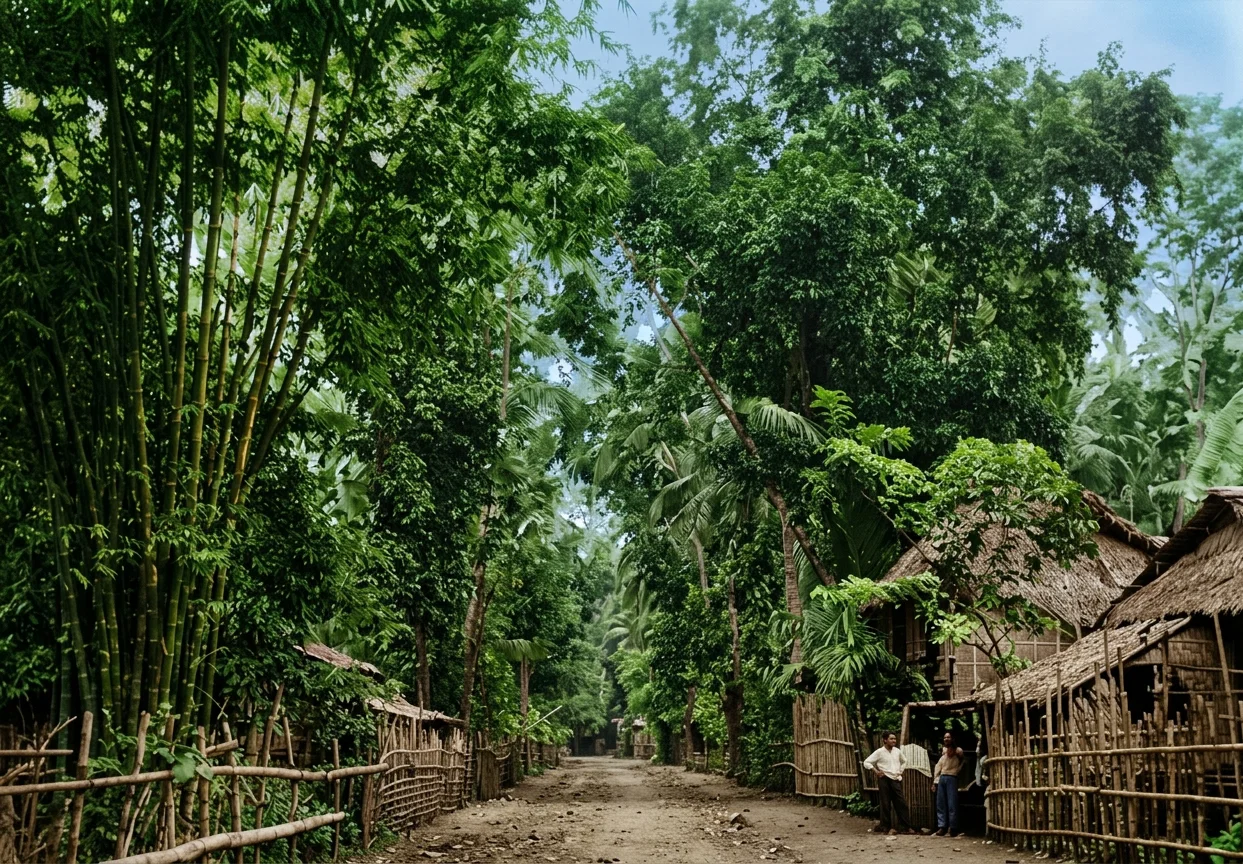
A SCENE NEAR MANILA
This great archipelago lies southeast of China, Manila, the capital, being about six hundred and thirty miles from Hong-kong, and is bounded on the north and west by the China Sea, on the south by the Celebes Sea and Borneo, and on the east by the Pacific Ocean. Its northern boundary is at twenty-one degrees twenty-two minutes north latitude, and its southern at four degrees forty-five minutes north. It lies between the meridians one hundred and sixteen and one hundred and twenty-seven degrees east of Greenwich, a total of 1,152 miles north and south, and 682 miles east and west. The general outlines of the group are those of a triangle, with the base to the south. The large island of Luzon, 480 miles long, is in the northern part, while Mindanao, the second in size, lies in the southeastern part of the group. Between these two lie a number of smaller islands called the Visayas. Extending from near the western end of Mindanao almost to Borneo are the numerous islands of the Sulu Archipelago. Reaching from near the northern point of Borneo in a northeastern direction, and forming a part of the western side of the triangle, is the long narrow island of Palawan, or Paragua, as the Spaniards called it. Between this and the others mentioned is the Sulu Sea. As showing the immense size of the land area of the group, it is only necessary to say that it is seven thousand square miles larger than the combined area of England, Ireland, Scotland, and Wales. Luzon alone is equal to the combined areas of Denmark, Belgium, and Holland; and Mindanao has an area almost equal to Portugal. The Philippines are larger than the States of New York, New Jersey, Pennsylvania, and Delaware. The present population of the group is not far from eight million. Notwithstanding the fact that it is nearly four hundred years since the Spanish flag was raised in the Philippines, some of even the smaller islands have not been surveyed nor thoroughly explored, and the interior of some of the larger ones is entirely unknown.
The people of the Philippines divide themselves naturally into three grand divisions: First, the pagan tribes of the mountains. Upon these the Catholic faith and Spanish civilization made but little impression. Of these tribes may be mentioned the Negritos, who are the aborigines of the northern islands; the Indonesians, who are the aboriginal tribes of Mindanao; the Igorrotes of Luzon, who are the finest of the wild tribes; and a number of smaller tribes that I will not take time to describe or name. Second, the seven tribes, all of Malay origin—the Visayan, Bicol, Tagalo, Pampango, Pangasinan, Ilocano, and the Ibang—who accepted Spanish rule, adopted Spanish civilization, in part at least, and were converted to the Catholic faith. Third, the Mohammedan Malays called Moros, who occupy parts of Mindanao and the Sulu Archipelago.
With the exception of the Negritos, there is good evidence that all these tribes came originally from the Malay Peninsula, and ethnologists believe that their coming here was six hundred or seven hundred years ago. Of the civilized tribes the Tagalos are the most numerous and the most intelligent. At some time before their migration to these islands they had come in contact with Hindu civilization, which, prior to the Christian era, had flourished in Java and the Malay Peninsula, and built the wonderful temples that are yet to be seen in the tropical jungles of Java. When the Spanish came to these islands, the Tagalos had a knowledge of some of the arts of civilization, and even cannon were made by them. Though the educated Tagalo speaks Spanish, the tribe retains its mother tongue, and has quite a literature, even newspapers being published in that language. This tribe is the most numerous of the native people.
The natives of the Sulu Archipelago are all Mohammedans. For centuries their names were a terror to the islands for a thousand miles north and south of their stronghold at Jolo, which was the religious and commercial center of the race. They were fierce fighters and pirates, and though their progress was checked by the Spaniards, they were never reduced to obedience to the Spanish crown.
In addition to the peoples already noticed, there are many thousands of Chinese in the islands. Generally they are the small traders of the towns. There are also many half-castes scattered through the provinces, mestizos, they are called.
History
In the early part of the sixteenth century, Portuguese sailors found their way to the Malay Peninsula, and there learned of the famed “spice islands,” but knew not where to find them. After the discovery of the Pacific Ocean by Balboa in 1513, Ferdinand Magellan went to the king of Spain and offered to head an expedition in search of those islands. Sailing down the eastern side of South America, Magellan passed into the strait now known as the Strait of Magellan, found the Pacific Ocean, and with his little fleet of ships sailed across the great ocean, and in 1521 discovered the southern islands of the Philippine group. Magellan named these islands the San Lazaro Isles. The Spanish flag was raised, and the country claimed for Spain. The Spanish friars who accompanied the fleet at once began to teach the natives the Catholic religion, baptized the king of one of the smaller islands, also many of the people. Soon after this Magellan was killed in a battle which he was waging to assist one of the tribes against another. A monument has since been built on the spot where he was killed, and another one stands on the bank of the Pasig River here in Manila, to keep in memory his exploits. Several years later some of the small islands received the name of Las Islas Filipina, in honor of the crown prince of Spain, Philip by name, who afterward became Philip the Second. This was the King Philip who afterward perpetrated such horrible barbarities in his effort to overthrow the reformed religion in the Netherlands. From the time of Magellan’s voyage14until 1564, four separate attempts were made to secure a foothold in the Philippines, but without results. The next effort was made by General Legaspi, who took with him a Spanish friar named Urdaneta. Legaspi, with the help of his grandson, Salcedo, gradually established the power of Spain in the islands. He made Manila the capital of the whole group, and in 1572 died, leaving a great name. The friar Urdaneta, as captain of the spiritual forces of the expedition, did his part to bring the natives under the dominion of the Romish church. To-day there stands on the Luneta, a beautiful park in Manila, a monument on which are the figures of Legaspi and Urdaneta. The friar is holding aloft a cross, while Legaspi carries a great sword. This is a correct representation of the method of converting the natives of these islands. And the same idea has been carried out too faithfully in all of Rome’s missionary work in all these Eastern lands.
(To be continued)
W. R. SMITH
By W. R. Smith
From “the Hermit Nation”
W. R. SMITH
No doubt many readers of the REVIEW know of the Macedonian calls that have come from Korea within the last year, and will be glad to learn what is being done to answer them.
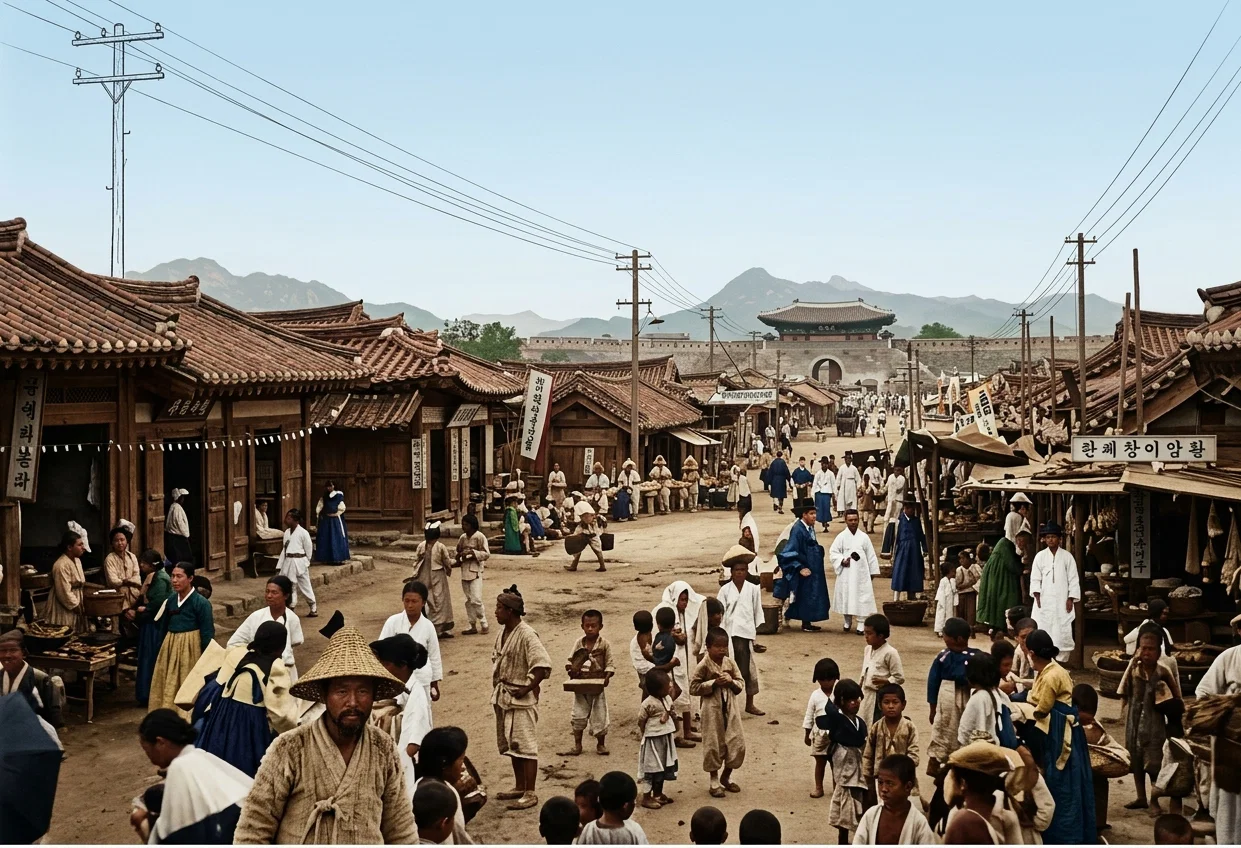
STREET SCENE, SEOUL
Buffeted, as she has been for centuries, by the great nations about her, and oppressed as the people have been by their own rulers, Korea has for many years been tottering upon her foundations, and seems to have now fallen into the arms of Japan, who will assume a protectorate over her.
The area of Korea proper is about eighty-one thousand square miles, and she has a population estimated all the way from six to fourteen millions. Seoul, the capital, is a walled city of about two hundred and fifty thousand inhabitants.
A little more than one year ago a Korean learned something of the third angel's message from one of the native laborers of Japan. What he learned was soon carried to some of his countrymen, a goodly number of whom gladly accepted it as truth, and began calling for some one to come and teach them more. As well as possible, these calls have been answered by the brethren of Japan, where the work is already upon a firm basis in several places. But an urgent need was felt for some one to locate permanently in Korea, learn the language, and thus by the Lord's blessing be enabled to give them the help so much needed.
It was in July that we were asked to come to Korea. We felt the call was from the Lord, and on the eighteenth of September, with our little Willena, on the steamship “Athenian,” in company with Dr. Perrine and Miss Young, who were going to Kobe, Japan, to work in the cause of the Master, we set sail for our new field of labor. After eighteen days of very rough weather, during part of which time we all, with the exception of Miss Young and our little child, experienced what it is to be very seasick, we anchored in the port of Yokohama, Japan. There we were met by Elder Field and his wife, who took us to their home in Tokyo, and kindly entertained us until we had rested a few days, when we again resumed our journey to Korea, stopping at the Kobe Sanitarium over Sabbath and Sunday, where we were again made glad to see the truth of God shining so brightly in the midst of this heathen darkness.
It was midnight, November 17, when we reached Seoul. The next day we moved into the house which we expected to shelter us at least for one year. The house is what was once a Korean mansion. It was owned for several years by missionaries, and remodeled by them, but is now in the heart of the town, and owned by the king. Through the kindness of one of the resident missionaries, we were allowed to move into this place and occupy part of it free of rent, the king fearing that it would be taken from him if it were not occupied by foreigners. We had been in the house three weeks when Mr. Underwood, the missionary, told us of a place owned by one of the princes, lying to the outer edge of town, in a much more healthful location. Owing to fear of violent seizure of the house, it could be had for a very small rental. We felt that the Lord was in a very marked way providing for our temporal wants, and rented the property for five dollars a month. There are a comfortable house, magnificent lawn, beautiful grounds, a small orchard, and garden.
Our one task is to acquire the use of the language. So we have employed a native teacher, and are spending our energies early and late to accomplish this end.
Swiftly the final message of the “commandments of God, and the faith of Jesus,” is speeding to every tongue and tribe. And from this land we expect to reap fruitage for the heavenly garner.
“Heard ye the voice from over the sea,
Not from the Flowery Land?
’Tis the Hermit Kingdom that calls to thee,
From the land of the ‘Morning Calm,’
‘Come over and help us.’ Heard ye the cry?
‘Come quickly. The harvest is white;
Say not, Four months, or by and by;’
Korea asks now for the light.”
Mission Notes
AMONG the new missionaries of the Church Missionary Society, six are assigned to the new mission in the Egyptian Sudan.
THE Society for the Propagation of the Gospel calls for six men for Japan. The money is ready, but the men are not yet found.
THERE are one hundred and twenty million women in India, and there are one hundred and eleven million women who can neither read nor write.
“Who can understand the dreadful
darkness
Of these realms of sin and death?
E'en the very air is scorched and tainted
With the dragon's putrid breath.
But across the widest, widest billows,
Love can reach to distant lands,
And beneath the deepest, darkest surges,
Prayer can hold a brother's hands.”
A GREEK woman employed in the American Hospital in Cesarea, Turkey, was stirred by a revival. She straightway asked leave to visit a woman whom she had injured, and to whom she had not spoken for ten years. When she trudged through the snow three or four miles to ask her “enemy's” forgiveness, her relatives were sure she had lost her mind. But the next day, when she came back to the hospital, she said, “We made peace, and the stone in my heart is gone.”
England
By E. E. Andross
LEICESTER.—The work is still going forward in the different parts of this field in a very satisfactory way. Our numbers are continually being increased, and our tithe is also increasing. I do not know of any exception to this, unless it be in Ireland. We are greatly in hope that we may be able to relieve the General Conference of any further financial burdens in the work in this field in the near future. If the present rate of progress continues, we shall be able to do this.
Our school is getting on very nicely. We have a good class of students, and many are working very hard to fit themselves for efficient service in the Lord’s work. E. E. ANDROSS.
Argentina
By N. Z. TOWN
BUENOS AYRES.—The Lord has blessed us in a remarkable manner in tithes and offerings this year. Never before have I seen such a spirit of willingness to help the work as was manifested in our general meeting. The psalmist says: “Thy people shall be willing in the day of thy power.” “Ye shall receive power, after that the Holy Ghost is come upon you.” It is gratifying to see that we have reached this time when the Lord is filling his people with the power of his Spirit.
The committee on plans presented one resolution recommending that we raise funds to provide a place for our press, as the room we have is altogether inadequate, and another, recommending that we raise funds to buy another large tent, as the one we have is getting rather worn. In the discussion of these recommendations the brethren did little talking, but what they said was accompanied with deeds. In a few minutes there was paid in and promised over twelve hundred dollars, paper, for the press building and to buy more type. And when the question of the tent fund came up, about four hundred and sixty dollars, paper, was paid and pledged. This was all voluntary, without any urging whatever. Since the close of the meeting, Brother Westphal has received in pledges about one hundred and fifty dollars for the press-building fund, and two hundred dollars for the tent fund.
And now we have another opportunity to give. Yesterday the news came from Chile that the building where our brethren had their depository, printing-press, and where Brother Steele lived, was burned to the ground. Brother Steele writes that the only thing he saved was his books of accounts. All his earthly possessions burned. In this extremity our brethren in Chile will need all the help our brethren are able to give them. Yesterday we sent out a circular to our people in this conference, telling them of the loss, and I believe many of them will help.
There is a good interest in Tala, where we had our general meeting. Brother Block, who is there, writes: “The work here is progressing well. In five families there are seven persons keeping the Sabbath. In the town itself it is difficult to do much canvassing. Both the priest and the pastor have forbidden the people to buy our books. But for all this, we have been able to do something.” N. Z. TOWN.
China
By Law Keem
CANTON.—We are now settled in a house by ourselves, and are quite comfortably situated. We have secured a good language teacher, and both of us will soon be better able to work among the people. They expect all men of any popularity to talk well in the Cantonese dialect, so I must study for a time, as well as Mrs. Law.
I realize that it requires much wisdom to deal rightly with these people, and also real, genuine love and sympathy. Those who come here must be filled with the true love for humanity that Christ had, or they will not accomplish the work he asks us to do. It takes real love to work for a people in such utter darkness and superstition. Our everyday life, as we mingle with them, and all our dealings with them, must show forth the love of Christ. We will do more to win them to Christianity in this way than by any amount of talking; for they are used to cuffs and knocks from everybody, even from most of the professed Christians.
Several men in a china store near us are very much interested in Christianity, and have asked if they might come to our house after they close the store in the evening, to talk on this subject and learn more about it. Of course this is just what we want them to do.
I have been asked to teach one day each week in the Chinese medical college in Canton, and shall begin next Wednesday. I also spend at least one hour each week talking to the boys in our Anglo-Chinese school, teaching them physiology, also gospel subjects. They seem to enjoy it, and take much interest in it. We are of the best courage, and are enjoying good health.
LAW KEEM, M. D.
Ontario
By A. O. Burrill
BOUCK'S HILL.—This place is near the St. Lawrence River, about fifty miles south of Ottawa. About fifteen years ago our aged Elder Wilcox came here from New York and delivered a few sermons, and two women began to observe the Sabbath. After a time their husbands joined them, and later still, some of their children, in one family all the children. Now there are ten adults keeping the Sabbath, and eleven grandchildren, most of whom are nearly old enough to decide for themselves. I found them believing the Bible and the spirit of prophecy. They were reading the REVIEW AND HERALD, the Signs, and the Messenger. Nearly all were paying tithe. One who had given up the Sabbath has returned to its observance. Someway I was impressed that the printed page had done much for them. I have for many years observed that those who read the REVIEW are the bone and sinew of this message. The Signs, for they were16taking a club, was doing some good work.
I had an attack of la grippe while there, but managed to speak to them twelve times in ten days. A partial organization was effected, and I promised to return to them June 7-11 to administer baptism and ordain church officers. They had been out with the petitions, gathering signatures and distributing tracts. They gave an order for ten dollars’ worth of tracts, also for a set of the bound “Testimonies” and several small ones, and for “Patriarchs and Prophets,” “Great Controversy,” “Desire of Ages,” “Empires of Prophecy,” “Ecclesiastical Empire,” “National Sunday Law,” and several other books. This is the largest order that I have taken at any one place this winter. I also took six subscriptions for the Watchman and two for the Messenger. This people believe in circulating reading-matter. They have some neighbors who are interested, and I expect they will soon begin to obey the Lord. We were much pleased to find so many who love this message. This company are three hundred miles from Toronto, in the eastern part of Ontario. There are but three small churches in this territory, in which are many thousands of people who do not know about this message. We need to pray that the Lord will send forth laborers into this great territory to scatter the seeds of truth.
Sister Spear reports one new Sabbath-keeper at Brampton, and Sister Boyce two new ones at Petrolia. The medical workers have been hard at work during January, as their reports show. During January the school debt was decreased one hundred dollars. The work goes slow, but we thank the Lord that it is moving.
A. O. BURRILL.
Ecuador
By GEO. W. CASEBEER
GUAYAQUIL.—We are well settled in Guayaquil, and have been doing what we could in the missionary work, besides studying the language. We can understand most of what the people are saying to us now, and can make ourselves understood, perhaps sometimes in a crude way.
Last evening I gave a Bible reading without an interpreter, to a young man. He seemed to enjoy it, and I am sure I did. The Lord is helping us in every way.
We expect to move to Riobamba, about one hundred and sixty miles interior, on the railroad, and spend the winter there, as that is the most unhealthful time here in Guayaquil. Then I am sure we can learn the language faster to get away from all English-speaking people.
Brother Davis is doing a good work here. I am glad the Lord has sent us to Ecuador. We see people on every hand who need just the message we have for them, and it must be that the Lord has many in Ecuador who will obey the message. GEO. W. CASEBEER,