Teach your boy to be accurate. If he is not taught accuracy in childhood, he will never learn it in manhood. Teach him to speak accurately on all subjects, and he will scorn to tell a lie.
Teach him the valuable lesson of consideration for the feelings of others. Teach him to disdain revenge. Impress him with this beautiful sentiment, “Write injuries in dust, but kindness in marble.”
Let your boy be boyish. A mannish boy, a boy who is a man before his time, is a disagreeable object.
Instill into your boy’s mind decision of character. The undecided boy is sure to become a namby-pamby man. He will be, as Dryden says, “everything by starts and nothing long.”
Teach your boy courtesy. “Manners make the man.” True politeness is rapidly becoming one of the “lost arts” in this country.
Do not give your boy expensive notions. Bring him up to be simple in his habits and pleasures.
Teach your boy to look upon labor as dignified, and idleness as disgraceful.
Teach your boy to be open and frank. If he has carelessly broken anything, and takes the full blame upon himself and makes no excuse about it, don’t punish him, but commend him for his honesty.
Teach your boy to be self-reliant. “Ability and necessity dwell near each other,” said Pythagoras. The wisest charity is to help a boy to help himself.
Teach your boy that there is no such thing as “luck.” Good pluck is good luck. Whole-hearted energy crowns men with honors.
Teach your boy that the use of tobacco is a filthy, costly, and unhealthful habit. The boy with a cigar in his mouth, a swagger in his walk, and impudence on his face, is going too fast. Stop him, father; stop him! The chances are ten to one that in a dishonored grave will soon lie the buried hopes of a father, the joys of a mother’s heart, and the pride of sisters fair.
Teach your boy to be strictly honest in all his dealings with his brothers and sisters. If he disregards their rights, he will grow up to disregard the rights of men. “As the twig is bent, the tree inclines.”
Put your boy on his honor. Trust his honor. Nothing will improve his character more. The boy who always requires looking after is in danger.
Treat your boy as a gentleman. If such treatment does not make him a gentleman, nothing else will.
Teach your boy that the best whisky sling is to sling the bottle or the concealed jug out of the window, and that the best throw of the dice is to throw the dice away.
Guard your boy’s companions. “He who goes with wolves soon learns to howl.” A boy readily copies all that he sees done, good or bad. A boy’s temper and habits will be formed on the model of those with whom he associates.
Above all, bring up your boy in “the nurture and admonition of the Lord.” Let yours be a religious home, and God’s blessing will descend upon it. It will give to the boy’s soul its “perfect flowering,” and make it “lustrous in the livery of divine knowledge.”—Selected.
Father and I Don’t Charge
By Albert Carey
ALBERT CAREY
My child of seven came to me with brush and comb to have his hair arranged one bright morning. “Have you a nickel?” I asked, laughing. “No,” he quickly replied. “You and I don’t charge.”
He well knew he never received any direct pay for his many little services to me, nor I for mine to him. Yet how truly are we each repaid for every act of loving labor for each other, and in far richer treasure than copper or silver or gold.
Is it not thus our Father deals with us? Does he charge for each item of his infinite care, so constantly bestowed that for a single instant we are not forgotten?—No; and should we think of dollars when asked to render some little service to him? Truly we shall receive our reward, but in values as far exceeding the coin of earth as heaven excels earth, and time eternity.
Nor will he forget his care for his children. His providences may lead through paths of affliction and times of distress, but only that we may the more certainly know his keeping power and sense his constant love, not only for ourselves, but for all the lost before whom he calls us constantly to witness for him.
Unkind Talk
By John Hall
KEEP clear of personalities in conversation. Talk of things, objects, thoughts. The smallest minds occupy themselves with persons. Do not needlessly report ill of others. As far as possible, dwell on the good side of human beings.
There are family tables where a constant process of depreciating, assigning motives, and cutting up character goes forward. They are not pleasant places. One who is healthy does not wish to dine at a dissecting table. There is evil enough in man, God knows. But it is not the mission of every young man and woman to detail and report it all. Keep the atmosphere as pure as possible, and fraught with gentleness and charity.—John Hall.
It Pays
“It pays to comfort weary hearts,
Oppressed with dull despair,
And leave in sorrow-darkened lives
One gleam of gladness there.
It pays to give a helping hand
To eager, earnest youth;
To note, with all their waywardness,
Their courage and their truth;
To strive with sympathy and love
Their confidence to win.
It pays to open wide the heart,
And let the sunshine in.”
Emmanuel Missionary College
By H. B. Lundquist
Bible Workers' and Ministerial Bands
Realizing that their future usefulness in God's service will be largely determined by wise improvement of present opportunities, the Bible workers' and ministerial bands, early in the school year, adopted service as their watchword.
Nor were the opportunities long delayed; for soon after, the West Michigan Conference accepted the services of eight members of the ministerial band for work during the week of prayer. If the churches visited by the young men received a blessing proportionate to the experience gained by them, the effort was worth while.
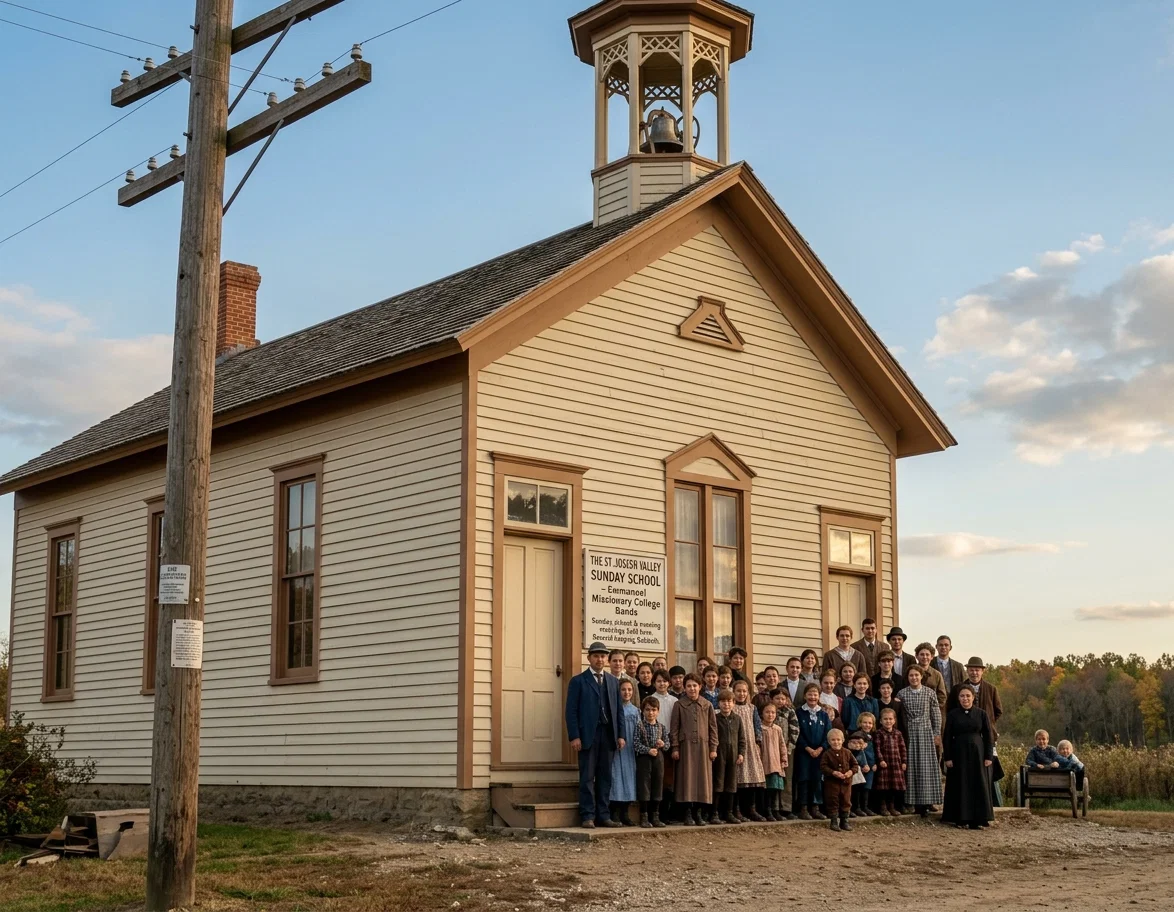
The anxiety of the band to engage in actual work was the means of securing a fine opening. Services were held Sunday evenings in a country church four miles distant from the college. Some who came from a distance to attend the meetings, were desirous of having services nearer home.
Acting on their invitation, a committee waited on the community, and learned that a Sunday school was wanted. A union Sunday school was started, with a membership of thirty-five, being in charge of a member of the ministerial band, assisted by a corps of Bible workers. The people were appreciative, receptive, and needy. The blessing of God attended the humble efforts of the workers, and soon fruits began to appear.
The Sunday school, something the people wanted, acted as an entering wedge for evening services. And in these meetings, too, God's Spirit blessed. Here, right at our very doors, were souls perishing for the truth, which they literally drank in. The attendance increased from thirty-five to forty-five, and finally one evening we counted eighty-two present, in a little country schoolhouse.
From almost the very first, a liberal use has been made of the weekly Signs of the Times, and not without very beneficial results.
A few personal cases will serve to illustrate the nature of the results of this effort. One brother, his wife, and children, recently baptized into another faith, became deeply interested. This brother, as he afterwards told us, sat up many times till midnight studying God's Word. A sister who had at one time been an Adventist in good standing, renewed her consecration, and began a successful effort to win her husband. A brother who had long since given up the battle, enlisted again, and gained the victory over the tobacco habit, which had long enslaved him. All these persons began to keep the Sabbath without one word having been preached on the subject. Others who have not yet publicly taken their stand for God's truth are enjoying the effects of its cleansing power, and are testifying thereto by changed lives.
Some follow-up work has also been done with interested families by the Bible workers' band. In one of these families the indications are bright for a harvest of souls. The people vie with one another in expressing their appreciation of our humble efforts.
All this makes us feel very grateful to our Heavenly Father for the privilege of sharing with him the joy of service. Surely God has put his hand to the work the second time, and will do a quick work in the earth. There is only a short time in which to labor, and then, if faithful, we shall share in the reward.
H. B. LUNDQUIST.
En Route to India
BROTHER GEORGE F. FURNIVAL, who recently went to India to take charge of the Mussoorie school, on reaching Calcutta, January 17, tells of some experiences along the way:—
THE ST. JOSEPH VALLEY SUNDAY SCHOOL
“My wife and I arrived in Calcutta about eight o'clock this morning. We had sixteen terrible days on the Pacific. I was on my back most of the time. Fred DeWinney met us at Yokohama, Friday, just before Sabbath, but thought it best for us to remain on board overnight, which we did. We went across Japan by land, catching the next boat at Nagasaki. We enjoyed these seventeen days spent with the workers, and in crossing Japan. Our work is certainly onward in that field, and all the workers are of good courage. Our compound just outside of Tokio is fine. The workers had moved into the new houses the week before our arrival there.
“In Shanghai we visited our workers, taking dinner with Brother and Sister Woodward the first day, and with Brother and Sister Porter the second day. They have a very fine station, and all were very busy. In Hongkong we had less than two days. We saw Brother and Sister Ham, and also Sister Thomas.
“We stayed on shore one night with Brother and Sister Detamore, in Singapore. The Lord is richly blessing the work there, and all the workers are more than happy.
“We expected to arrive in Calcutta in time for the general meeting, which we supposed would be held January 15-25. You can imagine our disappointment when Brother Comer told us the meeting was over, and that Elder Daniells had gone to Burma. However, we were glad to see Sister Daniells, and enjoyed some good visits with her.
“Our school opens in March, and we are very anxious to get up in the mountains and at work again.”
C. E. KNIGHT
By C. E. Knight
Ecuador
It has been about five months since I wrote my last report for this field, but as it has not yet appeared I conclude that in the irregularities of the mail service since the war began, the letter must have been lost.
My wife and I arrived in Quito from Argentina on June 27 of last year, and in a short time were able to begin public meetings and to make the acquaintance of a goodly number of persons. We have not found it difficult to become acquainted with the people in a social way, but they change their attitude as endeavors are made to acquaint them with the truth. We have had interesting conversations and Bible studies with many young people who have come to our meeting room, but evidently they were prompted largely by curiosity to know something of our belief, as they would cease coming after two or three visits. In the young people of Ecuador I see more hope for success in our work than in the older ones, as they apparently are more liberal in their views, and perhaps less attached to the prevailing Catholic religion.
The question of employment is a great hindrance for some in keeping the Sabbath; but notwithstanding this, six adults have manifested their faith by obedience. Two of these, the wife and the son of one of our colporteurs, were baptized in December. Two well-educated young men are now canvassing, and there is good reason for believing that they will develop into effective workers. Two others are a woman and her daughter. The daughter is a school-teacher. In this family are also a number of children.
I have just learned that a family in Ambato has begun to keep the Sabbath through the efforts of a brother living in that place. As the latter has been alone in the truth for a number of years, this is a great encouragement for him. With these hopeful cases the outlook has18brightened somewhat, and I expect that in the near future these new believers, with those in Quito, will be baptized.
Since the coming of Brother Enrique Mangold from Argentina the canvassing work is being pushed; several are now selling our books with fair success. But they have had trials and losses; as, for instance, recently two of them went to a small town to make a delivery of books, but because of an article written by a dissatisfied subscriber and published in a daily paper a month previously, they were taken before the police officials and were obliged to explain the nature of their work. They were able to deliver only two books, but were told that if they could get a recommendation from the Archbishop of Quito all would take their books. Necessarily they have been greatly inconvenienced, but we have no hope of any favor from the archbishop.
Recently another daily paper has twice published articles stating that the special war issue of our missionary paper is only a blind for introducing more literature of a dangerous character, and urged the clergy to be alert against such efforts. Under these conditions the work goes very slowly, and it is difficult to make any perceptible advance.
C. E. KNIGHT
Newspaper Work on the Pacific Coast
By Frank A. Coppin
THE way in which God has worked to confirm his truth in Fresno, Cal., has led many to begin the observance of the Sabbath. Newspaper articles concerning the third angel's message and the truths held by this people created a great interest in that city, where a protracted series of meetings has been held. Thus far ninety-eight have signed the covenant to keep the Sabbath. Fifty-five have been added to the church since the first of the year, fifty-four by baptism and one on former baptism.
During the Fresno camp meeting, nearly a year ago, the two daily newspapers of the place kindly reported the various meetings, and since the present effort began, have printed one hundred and twenty-two articles upon all phases of the truth, averaging about eight and one-half inches in length. The attendance has been good throughout the series, in spite of efforts of those not of our faith to hinder the work by starting counterefforts. These were unsuccessful.
One instance will show the interest of the public in the truths God has graciously committed to Seventh-day Adventists. A woman who had been reading the newspapers, and thus had become interested, called up the conference office by telephone, and asked that a Bible worker be sent to instruct her more fully. Arrangements were made, but for some reason the worker did not get in touch with the woman as soon as she expected, and she telephoned a second time, saying she was very anxious to hear more concerning this truth.
Newspapers throughout the Pacific Union Conference continually are publishing articles concerning our work and the message. The recent annual meeting of three California conferences, held jointly in Oakland, was given publicity by newspapers in all parts of the northern half of the State. The annual meeting of the Southern California Conference, which followed it, being held in Los Angeles, likewise was given wide notice. The public press seems anxious to get the news concerning our meetings and what we are doing.
The bookmen's convention in Mountain View was reported in many newspapers in this union. The rapid growth of the publishing work, especially in foreign lands, and the fact that Seventh-day Adventists are using their own textbooks in their colleges and church schools because they have no faith in evolution, Darwinism, or the higher criticism were given wide notice.
Seventh-day Adventists' opposition to efforts to secure the passage by Congress of a law to curtail freedom of the press was heralded through the southern Pacific Coast, and made a favorable impression. A San Francisco daily commented favorably in its editorial columns upon our stand, mentioning Seventh-day Adventists by name, but giving its opinion that there was no danger that in free America such an obnoxious bill would pass.
Recently a column article on the Seventh-day Adventist position regarding Turkey was printed in many papers in the Pacific Union Conference. Reports have come that it created great interest in the prophecies. No doubt many persons will be led to study their Bibles as they never have done before, as a result of the wide publicity which is being given to the stirring predictions of Daniel and the Revelation. Even the public opposition of those who would hurt and hinder the work, the Lord will use to forward it, for this is his promise. The truth is being carried rapidly through the newspapers wherever men can read, and the work will soon be finished and the people of God be gathered home.
FRANK A. COPPIN.
Review and Herald Book Department
By I. A. Ford
DURING the first four months of this year, our sales in this department, wholesale value, amounted to $33,422.33 as against $21,496.11 last year, or a gain of $11,926.22, or 55½ per cent. These are wholesale figures as taken from the treasurer's books. A few of the books which have entered into this are as follows:—
“Best Stories,” 1,713 copies.
“Bible Readings,” 5,209 copies.
“Bible Footlights,” 2,486 copies.
“The Coming King,” 886 copies.
“Daniel and the Revelation,” 1,154 copies.
“The Great Controversy,” 746 copies.
“Past, Present, and Future,” 1,410 copies.
“The World's Crisis,” 67,259 copies.
“The Shadow of the Bottle,” one week's sales, 2,936 copies.
These are only some of the leading books. The sales are increasing month by month. During the month of April there were sold 1,840 copies of “Bible Readings,” 140 of “The Desire of Ages,” 235 of “Daniel and the Revelation,” 367 of “The Great Controversy,” 9,338 of “The World's Crisis,” 2,936 of “The Shadow of the Bottle.”
We have never published anything else in book form that had such a large circulation in so short a time as “The World's Crisis” and “The Shadow of the Bottle.” These little books are being circulated by our ministers, Bible workers, and lay members. Although they are small and inexpensive, yet they contain a message of vital importance to every person at this time.
I. A. FORD.
Personal Work
By W. H. Sebastian
As the Christian physician sits at the bedside of his patient, acquainting himself with the patient's needs and ministering to them, thus making his work effective; so the Christian worker may gain the same results from his labor by talking, reading, and praying with individuals and families. This house-to-house work will prove to be the leaven of righteousness in the hearts of many who are visited. When the worker is purged of the “leaven of malice and wickedness” and possesses the unleavened bread of sincerity and truth, there will be a great work accomplished in the salvation of souls. The worker who is aglow with the spirit of Christ must of necessity reap a large fruitage, for power will attend his efforts, and hearts will break as he presents the truth of God.
To us as a church the message comes: “I say unto you, Lift up your eyes, and look on the fields; for they are white already to harvest.” John 4: 35. “Christ's example must be followed by those who claim to be his children. Relieve the physical necessities of your fellow men, and their gratitude will break down the barriers, and enable you to reach their hearts. Consider this matter earnestly. . . . The Lord has presented before me the work that is to be done in our cities. The believers in these cities are to work for God in the neighborhood of their homes. They are to labor quietly and in humility, carrying with them wherever they go the atmosphere of heaven. If they keep self out of sight, pointing always to Christ, the power of their influence will be felt. . . . Women as well as men can engage in the work of hiding the truth where it can work out and be made manifest. They can take their place in the work at this crisis, and the Lord will work through them. If they are imbued with a sense of their duty, and labor under the influence of the Spirit of God, they will have just the self-possession required for this time. The Saviour will reflect upon these self-sacrificing women the light of his countenance, and this will give them a power that will exceed that of men. They can do in families a work that men cannot do, a work that reaches the inner life. They can come close to the hearts of those whom men cannot reach. Their work is needed. Discreet and humble women can do a work in explaining the truth to the people in their homes. The Word of God thus explained will do its leavening work, and through its influence whole families will be converted. . . . In the home circle, at your neighbor's fireside, at the bedside of the sick, in a quiet way you may read the Scriptures, and speak a word for Jesus and the truth. Precious seed may thus be sown that will spring up, and bring forth fruit after many days.”—“Testimonies for the Church,” Vol. IX, pages 127-130.
W. H. SEBASTIAN.
Pacific Union Conference
By F. W. Paap
DURING the past six weeks the writer, accompanied by Brother Ernest Lloyd, home missionary secretary of this union, has been visiting the larger churches and institutions in the Pacific Union Conference. Up to the present, April 28, we have held forty-six public meetings, averaging over one a day for the entire time.
It was also a pleasure to the writer to meet our students at the various training centers. This cause is surely blessed in having such an army of bright, consecrated young men and women as are in our schools preparing for service in both the home and the foreign field.
Our one object has been to arouse our dear people everywhere to engage in personally20soul-winning work, and to place before them simple lines and methods of work. Many forceful and precious things have been presented to the churches both from the Word of God and from the Testimonies. More than ever before has the necessity of laboring disinterestedly and unceasingly for entering the lost been impressed upon us. We feel that every church should be encouraged to organize for permanent, systematic work. In order that all may work to the best advantage, special attention has been given to the importance of circulating our literature.
This work can never be finished without the cooperation of our church membership, hence the response on their part has been a cause for the profoundest gratitude. They are waiting to be set to work. They are “willing,” just as the Lord said they would be in the day of his power. We believe that the accomplishment of one hundred times more than we are now doing is possible only as this great army of capable men and women are definitely assigned their respective places in this fast-closing work.
While we were thus engaged, we found many opportunities to speak an encouraging word, or to give out some literature. It is well to be always ready to distribute the truth-laden page. Opportunities are with us every day. Brother Lloyd is an excellent example in this respect. If all were to do as he does, the earth would surely be filled with our doctrine. It is a good thing to cultivate the habit.
With good leadership, backed by strong sympathy on the part of all the presidents and field workers, the home missionary work in this union should produce results of the most gratifying nature. Let all be faithful in reporting the work done. This is important.
F. W. PAAP.
Sunday Legislation Defeated in North Carolina
By J. H. Behrens
THERE are at present no less than twelve Sunday laws on our statute books, covering almost every phase of human activity and having penalties for their transgression ranging all the way from one dollar to five hundred dollars, and as much as twelve months' imprisonment for their violation.
Notwithstanding this, the eastern and western conferences of the Methodist Church took action at their last official session in 1914 to petition the legislature to pass another Sunday law more stringent than the ones now in force, and appointed one of their regular ministers stationed at Raleigh to appear before the legislature in favor of such a measure.
No less than four bills were drafted and came up in various ways in connection with the last legislature. The origin of the first one was in a law office in Wilmington, at the request of one of the regular ministers of the place, and was forwarded to their representative at Raleigh and introduced by him in the house, and was known as House Bill 643.
This was a very drastic measure covering all trades, occupations, and business. The penalty for violation of this law was from ten to fifty dollars. The bill was referred to the committee; but before the hearing was held, a substitute was drafted. This was much milder than the original bill, having a number of exemptions and provisions allowing certain classes of labor, while other lines were restrained. Both these measures were reported unfavorably by the committee.
It was reported that the ministers felt very much disappointed at the failure of these bills in the house, so a third bill was introduced in the senate, known as Senate Bill 622. When the hearing was held before the committee, the arguments in favor of this proposed Sunday law were: “That the reverence and respect for the day be preserved;” “that the trepidations and sanctity of the Sabbath might be preserved;” “to make it possible for the young people to attend Sunday school;” “to save the day from the spirit of the European Sunday so dominant in the West and North and for which Europe is now suffering.” Having had opportunity to study the bill, I presented arguments against it, which were evidently new to most of those present, and which were received with marked attention.
A sermon preached the following Sunday by one of the pastors of Raleigh, who was the principal speaker for the bill before the committee, the Raleigh News and Observer reported as follows:—
“No man is forced to live in North Carolina; and if he doesn’t like the way we do things in this grand old commonwealth, let him seek greener pastures and seek his own level. No man has a right to tear down our standards of life and sanctity. If that be bigotry, make the most of it.”
“Love of money has caused men to invent ways and means by which they want to educate the people away from holy thinking and living to pleasure loving and self-gratification—parks with so-called sacred concerts, Sunday excursions taking people away from little Sunday schools to the Sunday picnics by the sea. . . . We do not want union of state and church, but we ask that the church in its difficult work be unhampered.”
I need not comment on the above quotation, as it speaks for itself very plainly, and voices the sentiment of all Sunday law advocates. We may be sure that when these reformers finally attain their desired object, those who observe another day as the Sabbath may prepare to “seek greener pastures.”
At the close of the hearing, a committee was appointed to make certain changes in the bill and report them to the senate. When it finally came forth from their hands, it had no less than nine exemptions, which in themselves branded it as class legislation. It was reported to the senate for its first hearing and was placed upon the calendar; but it received no further consideration, and consequently is dead.
It was evident from the arguments before the committee and from personal conversation with friends of the measure that almost anything would be acceptable, just so it was a Sunday law of some kind.
We wish to thank the Lord for the providential way in which the matter was disposed of, and also our brethren and sisters in the conference, who, by their prayers and by their letters of encouragement, shared in this good work. One thing is very evident, and that is that we must educate the minds of those who are in positions of responsibility in the principles of true liberty, both civil and religious. J. H. BEHRENS.
Why is the Pennsylvania Sunday Blue Laws Were Not Repealed
By A. R. Bell
We have been having some interesting experiences in Pennsylvania, and the end is not yet. At a mass meeting held to protest against arrests and prosecution for Sunday selling, a resolution was passed calling upon the legislature now in session to “repeal all statutes of a religious character.” A bill was introduced by Senator Horace W. Schantz, of Lehigh County, reading, in part, as follows: That “so much of the act passed the twenty-second day of April, one thousand seven hundred and ninety-four . . . as relates to the sale or delivery of the necessaries of life on the first day of the week, commonly called Sunday, be and the same is hereby repealed.”
This bill has stirred things. It came up for first reading, and was voted back into the committee for a hearing. Two weeks later Senator Magee, of Pittsburgh, who favored the bill, called it out of committee, and it passed second reading.
One senator told us: “I am going to vote to sustain the blue laws of Pennsylvania. They haven’t enough religion anyway. . . . I don’t care, gentlemen, what you say or what you think, I am going to vote as Dr. Mutchler asked me to vote.” Dr. Mutchler is the Lord’s Day Alliance secretary. He is in attendance at every session of the legislature of Pennsylvania. He comes the first day and stays until adjournment. Another senator told Brother Longacre if he didn’t like the way they did things in this country, to “get out of the country.” Another senator said to me: “I’m opposed to the bill. I’ll vote against any bill that will let the bars down on the Sabbath.” Another said: “I’m against the Schantz bill. I’ll never stand for any more Sabbath desecration than there is at present.”
Quite a number of senators agreed with us that we were right, and declared themselves as favoring the bill, but they said, “I cannot vote for it; my constituency would not stand for it.”
A statement was prepared, entitled “Why Senate Bill 255 Ought to Pass,” giving three reasons: first, for “legal reasons;” second, for “humanitarian reasons;” third, for “religious reasons.” A copy of this statement was mailed to the home address of each senator. Word was also immediately sent out to the members of the Religious Liberty Association to send in their petitions.
We felt that we could depend on at least twenty to vote in favor of the bill. We had talked with them, and they had expressed themselves as favoring the measure, and promised to vote for it. Others who were “on the fence” we felt would be influenced for good through the statement prepared and sent to them. But what was our surprise when the “yeas and nays” were called, to see one after another of these men who had promised to vote for the bill, vote “No.” And several senators who voted “Aye,” when they saw how the thing was going, asked to have their vote changed to “No.” There were only five senators who kept their word and voted for the bill.
The legislature refused local option because of its fear of the liquor interests; it put a Sunday bill in “cold storage,” and then refused to repeal a statute that custom and practice break every week, and which causes the people and officers of the law to lose respect and reverence for constituted authority.
A. R. BELL.
Religious Liberty Department
By C. S. Longacre
C. S. LONGACRE N. Am. Div. Secretary
Home Missionary Department
E. M. GRAHAM - - - - General Secretary
F. W. PAAP - - - N. Am. Div. Secretary
The Salt of the Earth
By E. E. Messinger
“Ye are the salt of the earth: but if the salt have lost his savor, wherewith shall it be salted? it is thenceforth good for nothing, but to be cast out, and to be trodden underfoot of men.” Matt. 5: 13.
The world has been likened to an immense storehouse, where an incalculable amount of provisions are stored; these provisions are represented as decaying for want of salt, which is close by, and which, if applied, would be the means of preserving the foodstuffs; but it must come into close contact with them.
The world is perishing for want of salt; because the gospel is not brought into contact, through its living believers, with the world, many are perishing, suffering, longing for its soothing grace and uplifting power. But who is to blame? Surely not the Originator of the gospel, for he emptied heaven that its work might be done,—a sacrifice we can never, in this world, appreciate in its fullness, for we have little knowledge of the glories of heaven. God was faithful. Evidently the salt has lost its savor, or else it has not been applied. A savorless salt is useless, and misuse makes salt savorless, useless.
“There are many families who could be a great blessing if they would take their belongings and settle in some town or country location where the standard of present truth has never been raised. Many should move into regions beyond, and become just what Christ has said that those who believe in him should be.
. . . The world needs the influence of every believer, as salt which has not lost its savor.”—Sowing Beside All Waters, page 37.
“There are thousands of places to be entered where the standard of truth has never been raised, where the proclamation of the truth has never been heard in America. And there are thousands who might enter the harvest field who are now religiously idle, and as a result, go crippling their way to heaven, expressing their doubt whether they are Christians. . . . Let those who truly love God step out from where there are large churches of Sabbath keepers.”—Id., pages 34, 35.
“God designs that his people shall be the light of the world, the salt of the earth. The plan of gathering together in large numbers, to compose a large church, has contracted their influence, and narrowed down their sphere of usefulness, and is literally putting their light under a bushel. . . . The plan of colonizing . . . is removing the light from places where God would have it shine.”—Id., page 7.
“The Southern field is right in the shadow of your own doors. . . . God calls for missionaries, and asks us to take up our neglected duties. Let farmers, financiers, builders, and those who are skilled in various arts and crafts, go to this field to improve lands, and to build humble cottages for themselves and their neighbors. It is essential . . . that families should settle in the South, and as missionary workers they can, by precept and example, be a living power. . . . In love for Christ, who died to save this poor, downtrodden people, in love for the souls of the perishing thousands, they are to labor for this worse than heathen country.”—Id., pages 62, 63.
These Testimonies, written many years ago, require our special consideration today. We no longer live in days of anticipation of coming conflicts, but are in the times of the last earthly struggles. What we do must be done quickly. We have more members and more large churches than ever before. God is calling for many of his people to move away from the organized churches, and bring the light to communities yet in darkness. Those speaking foreign languages will be able to do much in the many urban and rural foreign communities in this land. There are many places in the Northern and Western States where there are countless opportunities for believers to live and ‘show forth the praises of him who hath called us out of darkness into his marvelous light.’ Some might even emigrate to a foreign country, and there live for him.
But our attention is especially called to the peoples of the South. A “worse than heathen country,” it has long been neglected. Taking in Virginia, and other States Southern in spirit, the South contains about one fourth of the population of the United States. The bulk of the ten million Negroes in America is to be found here, not only in large numbers, but in a more helpless, harder-to-be-reached, more degraded, and less educated condition than in other parts of the land.
In most stirring language, believers have been appealed to to labor in self-denial and in their modest ways for the uplift of the Southerners. Some have responded; but “where there is one laborer, there should be one hundred.” Of the ten lepers, one returned in thankfulness. “But where are the nine?” is a question we shall have to answer by and by. Brethren, what shall we reply?
The South is a desperately needy field. People live in ignorance of common, everyday rules of health; consequently there is a large amount of disease on every hand. Many cannot read or write, and need to be taught in simple, childlike terms. There is not only a strong-as-death prejudice between white and colored, but also a powerful rank distinction among the white people themselves,—not an easy field, by any means, but one in which the true soldier of Christ can find plenty of work, and will strive to show forth his Master's truth. Millions in this field have never had the opportunity of accepting the truth. In many places the gospel canvasser has never been seen; in places for a hundred miles in any direction there is hardly an Adventist church, and an isolated member may be the only Adventist for fifty miles or more. I wish that some of our brethren in the Western and Northern States, where there are believers in almost every town, could take a tour through one of the destitute States of the South, noting the scarcity of believers and churches, and the great need.
Believers could accomplish much in new places where the truth has never been preached. Some could start a school; many could impart principles of health, and give simple treatments for the sick; large numbers might be helped by being taught how to keep house, cook, etc. Let the printed page be distributed by selling and free distribution; and let cottage meetings, Sabbath schools, and Sunday schools be held. Doing such work will be following in the steps of the One who “went about doing good,” and will not be without good results.
“Where are the reapers?” Can you not heed God's call for self-supporting workers to take up their cross and follow him? Souls are perishing; the evil one and his cohorts are using every opportunity to ensnare souls; the world's night is stealthily coming upon the doomed inhabitants of earth. Will you permit it to be said of you that in the critical moment you proved untrue? That your refusal to obey the King's summons caused some one to suffer, and finally to perish miserably? Let us labor now; “now is the accepted time.” “Labor not for the meat which perisheth, but for that meat which endureth unto everlasting life.” John 6: 27.