The headquarters of the Bengal Mission is in Calcutta. It was here our work in India began. Sister Georgia Burrus, now Sister Burgess, came to India in the spring of 1894. She settled in Calcutta, and began the study of the Bengali. In the latter part of the same year Elder D. A. Robinson and wife and Sister May Taylor, now Sister Quantock, reached India and settled in Calcutta, and in 1898 Brother and Sister W. A. Spicer joined them.
For years our principal work in India was confined to the province of Bengal. Our printing and medical work were started in Calcutta. From the first, until the establishment of the headquarters of the India Union Mission in Lucknow, Bengal was the training ground for the missionaries as they came to India.
In the early days of our work in Bengal a large church was built up in Calcutta.
From this church, workers have been selected and trained for efficient service. These workers are to be found in all parts of India, still doing good, faithful work.
The Bengal Mission is a very large and important center in India. Including Assam and a number of minor states, it has a population close to 70,000,000. Calcutta, with a population of a million and a quarter, is perhaps the most influential city in India. It is a great commercial and educational center. English education occupies a large place in school work in Calcutta. The opportunities for doing English work and coming in contact with progressive people from all parts of India are greater here than in any other city of the Indian Empire.
But while Bengal has benefited by the advantages that attend the headquarters of an enterprise, it has also suffered from the drawbacks that usually go with the headquarters. It is a fact that the local interests of the work usually suffer greater neglect at headquarters than in any other part of the field. The general officers are often obliged to carry local responsibilities; and as they are pressed with the burdens of the whole field, the local interests where the headquarters are stationed suffer. Again, continual drafts are being made on the working force close to headquarters to supply more distant fields. This keeps a continual change going on, which is a great disadvantage.
From my observations in the Bengal Mission, I judge that this field has not escaped the losses that attend these disadvantages. But in sending forth her workers to other fields, Bengal has been a blessing to the cause in all parts of India.
GROUP OF WORKERS IN BENGAL
I found an active, progressive evangelistic work being carried on in Calcutta. Elder J. M. Comer, assisted by Brother Walter Mead, has charge of the work for the Europeans. Brother Comer has been working in Calcutta three years, and has been encouraged by the addition of many members to the church.
Through changes and misfortunes of various kinds, the membership of this church was greatly reduced. Only a dozen or fifteen were left, but now there are between forty and fifty members, and new members are being added from month to month. Soon after the war broke out, Brethren Comer and Mead began a series of Sunday evening meetings in the Theater Royal. The attendance was very good. I had the privilege of speaking three times in this hall to large, appreciative audiences.
Another effort is being conducted in the city by Brethren A. G. Watson and P. C. Poley. They are working for the educated Indians. Many who attend their public meetings are young men attending the Calcutta University. I gave two addresses to the Indians. In my first I dealt with the relation of the present war to the old, never-ending Eastern Question. I spoke as plainly and as emphatically as I knew how regarding the prophecies of Daniel and the Revelation, and also regarding the destiny of Turkey. The vice chancellor of the university was present. At the close of the meeting he came forward and talked with me at some length about our position. I felt sure that our treatment of this great conflict from the standpoint of the Scriptures made a deep impression on these men. Another evening I spoke for their12temperance society, on the progress of prohibition in the United States, and of our position as a people on the temperance question. It seemed to me that judicious, patient effort, watered with tears, might reach these people, and establish some of them in the truth. The brethren are holding meetings, distributing literature, and visiting among Indian families the best they can, with the prayer and the hope that the Holy Spirit will turn some of them to the Saviour.
While in Calcutta I had the privilege of twice visiting the Bengali church. The meetings were held on the large veranda of Grandfather Mookerjee's home. Brother L. G. Mookerjee, who for a time attended the Foreign Mission Seminary, interpreted.
It was a pleasure to meet Grandfather Mookerjee and the members of his large family. He embraced the message and united with us in the early days of our work in Calcutta. One of his ancestors was among the very first baptized by William Carey. So the entire family has been under Christian influence for a hundred years. Quite a number of them are members of our church. At our first service, they handed me seventy rupees as an offering to missions in the European Division. They also presented me with a map of the province of Bengal, to keep me in remembrance, I take it, of the needs of this great mission.
In company with Brother and Sister Burgess, who now have charge of the Bengal Mission, I visited the Karmatar and Jagdispur stations. At Karmatar we have a good bungalow for our workers, a dispensary, and a school. These buildings are well located about a mile out of the town. Unfortunately, the work at Karmatar has been rather broken up for some time, so that but little was being done there at the time of my visit. Karmatar has been the center of much to encourage and of some things to sadden our workers. This is where our beloved Brother D. A. Robinson was cut off by smallpox in the closing days of 1899.
Brother Brown, who was working with him, died at the same time. I went to the burial place to look at their graves, and to spend a little time in reflection.
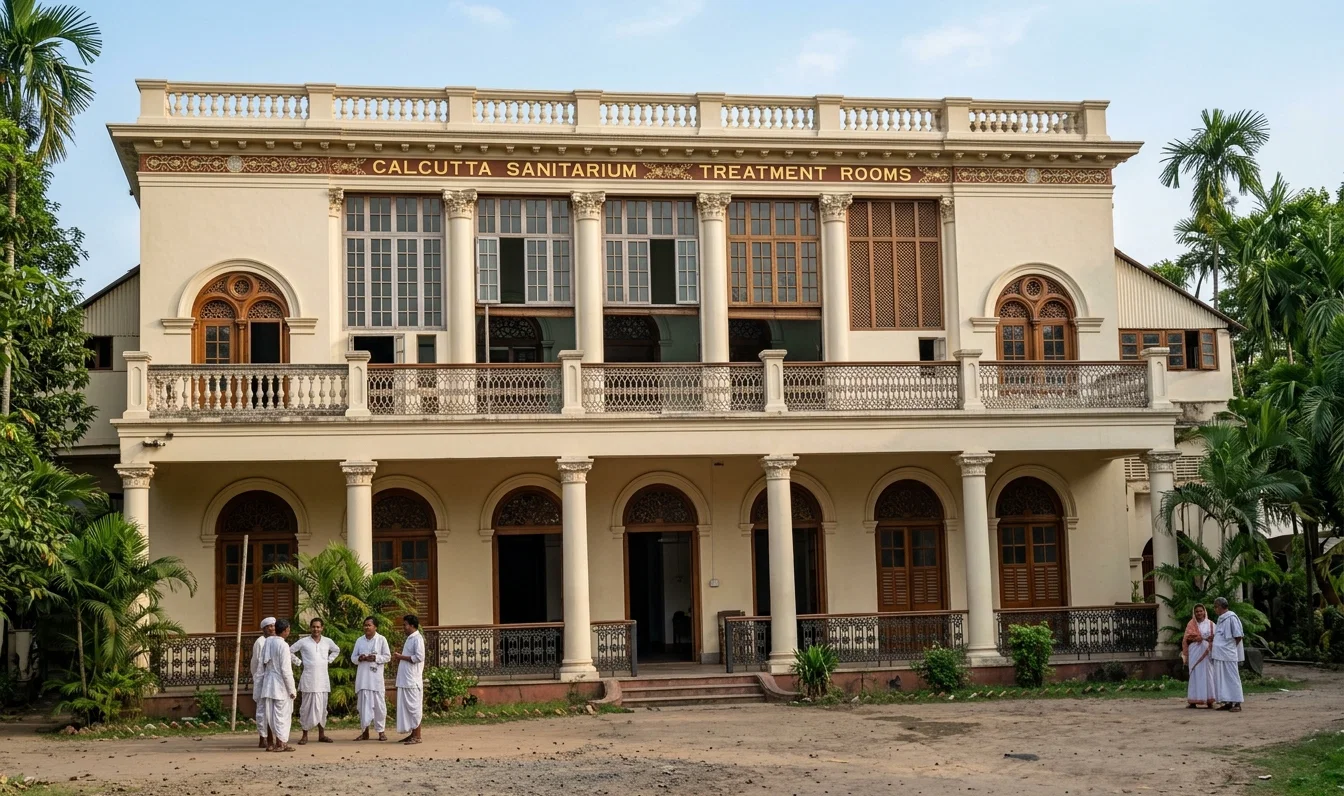
CALCUTTA SANITARIUM TREATMENT ROOMS
As I stood looking at the stone marking Brother Robinson's resting place and reflected on what I had seen in India, I could understand as never before our dear, devoted Sister Robinson's love and solicitude for India, which never left her until her thoughts and feelings were hushed in death. How I wished that the deep experiences of mixed joy and sorrow of missionaries could be transmuted to the hearts of all our people in the homeland. What a new vision would come to them! How much greater would be their zeal and solicitude for these fields! Then I asked myself, What can be done? What can I do to convey these experiences more clearly and fully to the hearts of our people? And I promised my Master to do my best.
Since the Calcutta conference it has been arranged for Brother and Sister L. G. Mookerjee to take charge of the Karmatar station and build up the work. This has been the training ground of many who have come to India, and now a good company should be established there.
At Jagdispur I found Brother and Sister Leech hard at work. They have both learned the Santali language so that they can work with the greatest freedom among the people of their station. They are conducting a small girls' school and operating a dispensary. As they are nurses, they find a great deal to do for the sick and suffering. The rented buildings they are occupying are altogether too small, and are quite unsuitable for their work. As this mission is in a good center and should be permanent, it will be necessary to erect suitable buildings. Arrangements have been made for the land, and appropriations should be made for the buildings as soon as the difficulties growing out of this war are removed. Brother and Sister Leech love their work, and are inclined to work beyond their endurance, especially during the hot months. While we all recognize the danger in this, yet it is hard to keep within bounds where there is so much to be done and so few to do it. And so everywhere we turn, it is the same story of great fields white for the harvest, but not enough laborers.
It was with great regret that I failed to visit the East Bengal Mission, but it seemed impossible to do this and finish the other work that was pressing. Brother and Sister Kellar have been located at Gopalgunje during the past year or more. They have met with difficulties and disappointments in the work. These often beset the missionary, and it requires courage and determination to surmount them. Often great difficulties are a prelude to great victories. From the reports given of that field, it presents great needs and equally as great opportunities for effective missionary work.
The Calcutta treatment rooms, under the management of Brother J. H. Reagan, are doing good work. The location is good. The building is a credit to the cause, and the plant is well equipped. As I spent some time in the institution, I had a good opportunity to see the actual work being done. It was gratifying to see such men as the chief justice, the leading lawyers, and prominent clergymen and business men of Calcutta regular patrons of the institution. Brother Reagan takes advantage of every opening to tell his patrons about our message and work. In this way many are given a very favorable impression of our work in India, and some are led to obey the truth. The treatment rooms are entirely self-supporting. The records show the following for the last year's work:—
Number of patients, 423; number of treatments, 1,831; cash received, $4,000; total expenses, $3,753; gain, $247.
Our treatment rooms in Mussoorie showed 189 patients, 1,721 treatments; cash received, $2,388; expenses, $2,000; gain, $388.
An excellent work is being done by these treatment rooms; and as they are self-supporting, we ought to establish as many of them as possible throughout India.
A. G. DANIELLS.
Note and Comment
“John’s Revelation Not Revelation”
THIS is a peculiar heading for an article written by a professed Christian worker and published in a professed Christian paper. The article in question was written by Dean W. J. Lhamon, of Drury College, and appeared in the Christian Evangelist of March 4. Dean Lhamon says this of the book of Revelation:—13The last book of the New Testament is not a revelation of church or world history. It does not foretell the far future in the way that is imagined of it. The history of the church of the past does not lie figured in it, nor of the church of the present, nor of the future. The present war may be an Armageddon. It certainly is sufficiently destructive and mournful, and that is about all that the word ever meant. But the book of Revelation has nothing to do with it. As to the future—God only knows how many millenniums, good and bad, await our grandchildren here. The book of Revelation gives no hint at all about it.
The book was a tract for its own times, not for ours.
What a contrast there is between this statement and the statement of the Scriptures of Truth. Regarding this inspired revelation the apostle declares:—
“The Revelation of Jesus Christ, which God gave him to show unto his servants, even the things which must shortly come to pass: and he sent and signified it by his angel unto his servant John; who bare witness of the word of God, and of the testimony of Jesus Christ, even of all things that he saw. Blessed is he that readeth, and they that hear the words of the prophecy, and keep the things that are written therein: for the time is at hand.”
Which testimony shall we accept, the testimony of man or the testimony of God? Certainly the child of God will not hesitate as to the choice of his authority.
In the West German Union
By L. R. Conradi
L. R. CONRADI
From January 28 until February 14, the seven conferences in the West German Union had their annual meetings. The union audit was held at the same time. Our arrangement was similar to that in the East German Union. Conferences were held in Hess, and in the Lower Rhenish and Central German fields. In the other conferences there were only general meetings. Throughout the West German Union the meetings were well attended, and a good spirit prevailed in all our deliberations. The evening lectures were held in crowded halls.
Our first meeting was in Frankfort-on-the-Main, with the Hessian Conference. Elder J. G. Oblaender, the union president, lives here. Last year there were 106 additions, bringing the membership up to 578; the increase was the fruit of the efforts of eight workers. The tithe showed an increase of 140 marks, and the donations an increase of 2,000 marks. In Frankfort proper there are two churches, with 222 members. At Wiesbaden there is a church with 120 members, and at Kassel a church of 98 members.
The evening after the Sabbath I proceeded to Dortmund, where Brother Wentland could have the meetings only in their own local hall. This was crowded to the utmost. The largest church in this field is at Hamm, with 91 members; while at Dortmund there is a church of 84. There were 115 additions in this field last year, and eight workers were employed. The membership now has increased to 662. The tithe showed an increase of 1,365 marks, and the offerings a decrease of 1,803 marks. As in some of the mines our people were offered the Sabbath free, quite a number of our brethren with large families moved to this field.
The next two days I spent in Cologne, where our meeting was held in the hall occupied by one of the local churches. There are three churches in Cologne, with 190 members. Ninety-seven were baptized during the year, and the conference now has 447 members. The tithe showed an increase of 843 marks, and the offerings of 917 marks.
The strongest conference in the West German Union, the Lower Rhenish, had its regular session at Essen, February 4-6. This conference is the cradle of the advent message in Germany, and one of its most promising fields. While quite a number of members have been gained, — 156 by fourteen workers, — yet the net gain was only 21, bringing up the membership to 1,131; but there were about seventy who immigrated to South America.
From Cologne I went to Erfurt, where the Central German Conference had its annual session during the next three days. This conference takes in the province of Saxony and all the Thuringian principalities, and since New Year's, Magdeburg is again within its borders. The population is about 7,000,000. Last year 165 were added to the church, increasing the membership to 1,020; and with Magdeburg, it is now 1,125. A division of this field had been decided upon, but in view of the present situation it was waived for the time being. Here the tithe increased last year 5,800 marks; the offerings, 149. Brother L. Mathe, who had formerly been president, has now taken the Lower Rhenish Conference, and Brother W. Prillwitz the Central German. Erfurt is one of the old cities of the Reformation, and the evening meetings were well attended. There are two churches in this city, with 144 members.
The next two days I spent in Hanover-Linden, in the North German Conference. We have here two churches, with 140 members. Thirteen workers gathered in 138 souls last year, increasing the membership to 790. The tithe and offerings showed an increase of 2,370 marks.
Our closing session of the West German Union was held with the union district, at Hamburg, the entire union committee being present, including Brother Klingbeil, of Belgium, and Brother Wibbens, of Holland. The union district, composed of Hamburg-Altona and all the country north to the Danish border, had, with eleven workers, 112 additions. The tithe showed a decrease of 23,850 marks, and the offerings of 2,802 marks. There are now in Hamburg-Altona four churches, with 586 members.
Brother Klingbeil reported many wonderful experiences of how the Lord has been caring for the work in Belgium during this trying time. We have seven workers in this field, and twenty-two members were added, raising the membership to 161. There was a decrease of 2,155 marks in the tithe and 510 marks in the offerings. There are three churches in Brussels, with 92 members. There are 25 members in Antwerp, and 12 in Liege.
In Holland ten workers reaped a harvest of 71 souls, increasing the membership to 348. The tithe and offerings increased 2,875 marks. The largest church is at The Hague, with 79 members.
The West German Union as a whole had employed an average of 96 workers, yielding a harvest of 982, or about one14hundred less than the year previous. The net gain was 531, bringing the membership of the union to 6,047, or after receiving Magdeburg, to 6,152. The tithe decreased from 352,000 marks to 325,000, the offerings from 90,650 marks to 88,600, making a total decrease of about 29,000 marks. The West German Union is in many ways the richest field on the Continent, and we are sure if all the people work together for the salvation of souls, we shall see still greater advancement.
All the conferences this year, after paying the first tithe to the union and the second tithe and the offerings to the missions, had a surplus, varying in the different conferences from 700 to 16,000 marks. The union, after giving 26,000 marks to help Belgium and Holland, still had a surplus of about 13,000 marks to turn over to the European Division for mission purposes.
In the West German Union there were 219 canvassers employed, against 229 the year previous. Their sales amounted to 224,000 marks, against 230,000 marks last year. But in Hamburg-Altona there was 17,000 marks' worth more of publications sold in 1914 than in 1913. I greatly enjoyed attending all these local conferences.
The World Will Not End Right Away
The apostle Peter declared that there should come in the last days those who would question the existence of any promise of the coming of Christ, declaring that all things would continue as they were from the beginning of the creation. The men who bring forward these claims in fulfillment of this prediction are legion. One of the latest is Professor Jaumann. According to the Times Union (Albany, N. Y.) of January 29, we are assured that “the world is not going to end right away.” This learned professor gives this lucid and scientific reason for the conclusion drawn:—
That since the radiation from the sun is stable, the intellectual and physical evolution of humanity will continue for immeasurable time, and eventually may reach heights hitherto unimagined.
Warning Against Church Federation
A WRITER in the Christian Standard of February 13, sounds a warning against the spirit of church federation now being advocated in many quarters:—
I want to say right here that church federation is absolutely not the Christian unity that Christ prayed for and the apostles taught. It does not even bear a resemblance to that unity spoken of in the New Testament so forcibly. Church federation is nothing more than denominational restraint; it is nothing more than sectarian domination.
The Work in Argentina
By J. W. Westphal
J. W. WESTPHAL
OUR work in this field is making some progress. There are eight or ten persons now awaiting baptism in the city of Rosario de Santa Fe. A year ago we had done practically nothing in this city; now we have a flourishing and growing church. Brother Nicolas Hansen is still carrying on the work in this place with vigor, and with every prospect of an increase in the membership of our company here. A few have begun to keep the Sabbath.
From our public effort in Buenos Aires, after holding meetings for two months in a very central position, we removed to a new location ten blocks away, and a number of interested ones continue coming to our meetings. The new hall has a seating capacity for about one hundred and sixty persons, and it is filled night after night, and usually more come than can find room. The class of people, generally speaking, is much better than we had in the other place, and the attendance is more regular.
A young man who has already begun to keep the Sabbath and is very zealous in the truth, has had an interesting experience. Ten or twelve years ago, in the northwestern part of the republic, a Protestant tent was pitched on his mother's lot. On account of opposition the tent was soon removed from the place, and the effort stopped. He was then only a boy, but was impressed with some of the Bible teachings that he heard. From that time until recently he heard nothing more about the Bible. He, with his mother and sister, came to live in this city about the time we started our effort here. One day a desire was aroused in his heart to go out and see if he could not find some place where the gospel was taught, and he made inquiries in regard to meetings. He was directed to a certain street in the city, and there sought during the whole day the Protestant meeting place, but without result. He returned the next day, continuing his search and making inquiries among the people. None seemed able to give him any information until some newsboys told him that meetings were being held on another street, which happened to be our place.
The result was that he came to our meetings, and is the first Sabbath keeper from our public effort. Thus we see how the Lord works upon hearts at the opportune time to bring them to the gospel message now due the world.
Hunan, China
S. G. WHITE
It is most encouraging to know that when heathen Chinese, who have never heard the name of Jehovah or of his Son, Jesus, receive from the missionary a tract or paper, for the first time, they intuitively recognize it as coming from a higher source than that to which they are accustomed. From early childhood they are taught to revere idols of wood and stone, and even to worship the earth they till and the water they carry and drink, because these contribute to their comfort and need.
A man who carries water and thus makes money wherewith to buy his rice, offers incense to the river god. You can see him on the river bank at certain seasons of the year, with a few burning sticks of incense stuck in the ground, firing off a few firecrackers to awaken the river god. Then on knees bowing low, he does obeisance to the supposed source of his blessings. Still, such souls can recognize the ray of light, and their inward soul desires to know the source from which it emanates, realizing that it leads out of darkness. They instantly know that the voice which has spoken to their hearts is no common voice. The reform wrought in the lives of those who accept the gospel and follow on to know God, is marvelous.
Here in Hunan, we are constantly receiving pleadings for help, and at our general meeting, held in Changsha in February, request upon request was presented, such as the following: “Send us a teacher who can lead us. We have at this place five [sometimes ten or more] who are living the light revealed and have a burning desire to advance in the divine light and life.” From one place came this word: “Inclosed find our note for $150. If you will send us a teacher and open a chapel here where we may hear the gospel, we will cash the note and contribute $850 more to help defray the expense.”
In China they have plenty of sounding brass and clanging cymbals, both literal and figurative. It is light bearers, hearts filled with the light of God’s love, for which they plead.
Mission Notes
ELDER L. V. FINSTER, who has charge of the Philippine Mission, is able to speak of the work of the mission in the following encouraging manner: “We are accomplishing much with our little press. We have exceeded what we expected to do. We have now finished printing 5,200 copies of ‘Kristong Paririto.’ The book has about 200 pages. The number of baptisms has also exceeded our highest expectations, 127 having been baptized in 1914. Our tithe increased from $657.77 in 1913 to $1,449.50 during 1914. We feel that this is very encouraging.”
FREDERICK LEE writes from Honan, China, February 24: “We are very busy now with our twenty-two stations in Honan. We believe our workers have gone out this spring to win many more souls than ever before. Many are the openings we have for new work. It is going ahead of us faster than we can secure and train men to fill the openings. A spirit of work is taking possession of our church members, and they are going among their neighbors telling them of the truth. We have organized missionary societies in all our churches, and at some of our outstations the Sabbath attendance has been doubled as the result. Pray for the work in Honan.”
FROM the prisoners’ camp at Malta, Egypt, Brother W. C. Ising, superintendent of one section of the Egyptian Mission, wrote on February 2: “Since leaving Alexandria I have received none of our papers, and I miss the REVIEW very much. Mrs. Ising says she forwards them, but it must be that the censor objects to their delivery. There is no change in our situation, and little to report within this short space. I am glad to hear that the work is onward in the States. This war is a terrible object lesson, and a reminder of the privileges we enjoy as God’s children, and which must enhance our yearnings for the time when the ‘former things are passed away.’”
BROTHER GEORGE KEOUGH writes from Upper Egypt: “At the end of the year I went to Beni Adi for the Lord’s Supper and baptism. Several days were spent in getting the church ready for these ordinances. Four persons were keeping the Sabbath, and desiring to become members. Only two of them were ready for baptism, so I baptized them on the last Sabbath of the year, and afterwards had the Lord’s Supper. We had a good time, and were thankful that two had been added to the church. Since then I have gone four times to a village near by, and have found the door open to preach in both the Coptic and the Presbyterian church. I have had several talks with many after the services, and explained to them the Sabbath. Some are exercised on this point, and it may be that the Lord will give us further fruit there.”
Going Home
By Margaret E. Sangster
Out of the chill and the shadow Into the thrill and the shine; Out of the dearth and the famine Into the fullness divine; Up from the strife and the battle (Oft with the shameful defeat), Up to the palm and the laurel, O, but the rest will be sweet!
Leaving the cloud and the tempest, Reaching the balm and the cheer, Finding the end of our sorrow, Finding the end of our fear; Seeing the face of the Master Yearned for in “distance and dream,” O, for that rapture of gladness! O, for that vision supreme!
Meeting the dear ones departed, Knowing them, clasping their hands, All the beloved and true-hearted, There in the fairest of lands! Sin evermore left behind us, Pain nevermore to distress; Changing the moan for the music, Living the Saviour to bless!
Out of the chill and the shadow Into the thrill and the shine; Out of the dearth and the famine Into the fullness divine; Out of the sigh and the silence Into the deep-swelling song; Out of the exile and bondage Into the home-gathered throng!
— Margaret E. Sangster.
Home Ideals — No. 1
By MRS. I. H. E.
WITHOUT ideals one cannot do better than he is doing. Ideality goes beyond what is, to what should be. It is one of the gifts of nature that makes the artist, the musician, the orator. Most persons are endowed with this gift to some degree, but not all to the same degree. Ideality is not only an inheritance, but it may be cultivated and trained. Like other faculties of the mind, it may be educated by study, observation, and meditation.
There is no place in the world where the gift of ideality can be of more service than in the home. Few of us will ever be able to visit the great art galleries of the world, to feast our eyes on the highest ideals of form and color, or to hear the masters of music. If by some happy chance, we enjoy these privileges, it is for but a relatively short time as compared with the time we spend in our homes. If we are permitted to hear some great violinist or pianist, or some sweet singer or famous orator, it is but for an hour; and then comes the daily round of homely duties.
Then why should not the mother, whose home is her kingdom, seek to make it a kingdom founded on high ideals? Whether we wish it to be so or not, whether we take conscious thought to that end or allow things to drift, our homes are what we make them. Then why should not we set ourselves the task of making them as beautiful and as ideal as home can be made? This does not necessarily require a well-appointed new house set in stately grounds, nor does it mean that the mother must be a slave to her house, her husband, and her children. In fact, an ideal home cannot exist with a fretful, worried, worn-out mistress at its head.
Most of us have seen at least one home that has remained in our minds a picture of what the ideal home should be. Such was the home of Aunt Anne in a little Ohio town. “It was a peaceful place,” said a niece who visited there long ago, with her mother and five thumping boys.
Seven guests—and five of them boys! Would that company disturb the serenity and calm of your home, mothers of today? Perhaps, but not of Aunt Anne’s. When the guests came down in the morning, the rooms were open and aired; a satisfying breakfast was on the table; and Aunt Anne, serene and dainty and unharried, dispensed an unstinted hospitality.
The work of the home was done by herself and a woman who had long lived with her; but so smoothly, apparently so easily, was it accomplished, that no feeling of unrest, of “strain” or anxiety, drove the angel of peace from its portals. Washing and ironing, mending and sweeping, dusting and arranging, mopping and scouring, cooking and baking,—including a daily replenishing of the cooky jar,—all had to be done and done again; and in all, Aunt Anne, quiet and deft, pleasant and serene, was the central figure.
“That was my ideal home,” said the niece; “no worry, no fuss, everything in its place, time for all that needed to be done!”
“But how did she manage it?” I asked; for it is easy to recognize an ideal and sometimes hard to compass it.
“I don’t know; she had a system.” Thus falling back on this overworked word, the subject dropped.
The ideal home rests on a foundation of many precious stones, among which system has its place. Others are love, law, religion, prayer, order, cleanliness, purity, kindness, honor. Some of these will be considered later in this department.
MRS. I. H. E.
MRS. C. L. STONE
By Mrs. C. L. Stone
Training in Habits of Order and Helpfulness — No. 2
MRS. C. L. STONE
“THE disposition and habits of youth will be very likely to be manifested in the matured man. You may bend a young tree to almost any form that you may choose; and if you let it remain and grow as you have bent it, it will be a deformed tree, and will ever tell of the injury and abuse received at your hand. You may after years of growth, try to straighten the tree, but all your efforts will prove unavailing. It will ever be a crooked tree. This is the case with the minds of youth. They should be carefully and tenderly trained in childhood. They may be trained in the right direction or the wrong, and they will in their future life pursue the course in which they were directed in youth. The habits formed in youth will grow with their growth and strengthen with their strength; and they will generally be the same in “afterlife, only continuing to grow stronger.”—“Christian Education,” page 13.
All are ready to admit that habits of order and helpfulness should be inculcated in earliest youth. Our perplexity lies in the method of obtaining this desirable result; the little devices which assist us in the everyday teaching of this great principle. It is certain that merely telling a child to be orderly in its habits and helpful in spirit will not bring the desired result, even though we tell him twenty times a day.
The keynote for all work well done is interest. I would write in letters large, this word upon the heart of him who deals with little children. We can accomplish wonders with the child so long as we hold his interest, but when it flags, we might as well cease our efforts, for we shall accomplish nothing. It lies largely with parents and teachers to inspire, to devise plans, to conceive motives which will appeal to the child.
In the case of the children and their missionary garden referred to in a previous article, their interest never flagged because that of the teacher did not flag. To watch the tiny plants grow and develop was a keen delight; to keep the soil well broken and free from weeds was as great a pleasure as any game on the playground. This was in a school where time was taken every day to foster the interest and encourage the enterprise, not by moralizing, and telling the children it was their duty to help the missionaries, but by feeding their interest upon fresh stories and new experiences. Once a missionary from the field gave a talk to them. How glad they were to say to her, “We have a garden, and we are working hard to get some money to send to you.”16
“True interest corresponds exactly to the hearty appetite of a healthy child for wholesome food,” says Dr. Charles McMurray. “It is awakened by the inherent quality of the subject, and not by a thin whitewash of agreeable devices. . . . Self-activity is the fundamental basis of a strong interest. It should not be forgotten, however, that this implies aims which the children themselves are working out. Parents are often astonished at the amount of drudgery and hard work which children will encounter in carrying out some project which they themselves have conceived, of building a tree house, or making a cave, or fixing up a playground. In practical life everywhere men will work their way through endless drudgery in order to achieve results which they have set up as desirable.”
If this kind of energy could be let loose for desirable ends, it would save parents and teachers a great deal of anxiety. The problem is how to release this energy along lines of desirable activity.
To Which Class Do We Belong?
By Mrs. Clara F. Coursen
MRS. CLARA F. COURSEN
FROM a historical sketch of the Vaudois, I quote the following:—
“A Catholic army on the plains of Piedmont, made up of adventurers without discipline, continued to advance, visiting its outrages upon Catholics and Protestants alike. The Catholic inhabitants of the country, knowing the rigid purity of morals of the Vaudois, and desiring to secure the maidenly chastity of their daughters from the brutal grossness of that lawless soldiery, did not hesitate to confide the honor of their families to the virtuous fidelity of the Vaudois cottagers. Accordingly, many of them took their trembling wives and children, and left them among these heroic mountaineers. It was surely wonderful to see these young Catholic women committed with confidence to the care of Protestants at the moment when Catholicism was marching in armies against them. But the confidence was not misplaced. . . . Incredible as the fact may appear, all historians of the time, Gillis, Richard, DeThou and Crespin, make mention of it; and it affords the most beautiful testimony which their adversaries could have rendered to the virtue and generosity of the Vaudois.”
Does your life and mine bear the same beautiful testimony? World conditions today are fast forming society into similar classes. A Methodist bishop of Savannah, Ga., describes it thus: “Rome in her darkest days never tolerated such systems of iniquity as are prevalent in our social circles today.” God's peculiar people should be modest in dress, unassuming in manner, and primitive in worship, a constant rebuke to the lawless and corrupt society of the present.
To which class do we belong? Do we represent a strong tower, into which the righteous run and are safe?