BRO. SMITH: Your remarks in the Review of March 18, on the "Two-horned Beast," have removed from my mind views similar to those of the sister to whom you reply. I thought this nation was to be divided in order to develop the two horns. I do not now believe this. But I am watching the progress of the present mighty rebellion with deep interest, as I believe that it is in some way connected with, or has a bearing upon, our future destiny as Sabbath-keepers.
But I have taken up my pen to lay before you a difficulty that lies in my mind on another subject. The difficulty certainly cannot be insurmountable, but I do not know how to overcome it, therefore ask for light.
In Lev. xxiii, commencing at verse 4, we find a series of typical feasts and sabbaths instituted. From verse 4 to 21 inclusive, the types and shadows evidently refer to the sacrifice, death, resurrection, ascension of Christ, and pouring out of the Holy Ghost at the Pentecost. From verse 23 to 32 we believe refers to the work of our High Priest, Jesus, in the most holy place in the heavenly sanctuary, from the tenth of the seventh month, 1844, until the consummation. The typical sabbaths and feast of ingathering of verse 33 and onward I believe will be fulfilled in the immortal state. Now the question with me is, How can those types and shadows relate to events at the close of this dispensation, and yet the shadows themselves cease to exist more than eighteen centuries ago? It has been a favorite illustration with our preachers that the shadow of a tree can be traced up to the tree. If this subject is clear to your mind, please let the light shine through the Review.
I remain as ever, your brother.
H. E. Carver.
Iowa City, Iowa.
REMARKS. The key to an understanding of the fulfillment of the ancient typical feasts and ceremonies, I think is found in two statements made by Paul. One occurs in Hebrews, and reads as follows: "For the law, having a shadow of good things to come, and not the very image of the things, can never with those sacrifices which they offered year by year continually make the comers thereunto perfect." Heb. x, 1. Paul shows by this language that the system of types and shadows is to be taken together as a whole. "The law," he says, as a whole, "having a shadow of good things to come." Hence we cannot take each individual type and consider it as something complete and distinct in itself, and trace it down till we reach the particular event in this dispensation which it typifies.
But the law, as a system—that whole dispensation, with its typical work—foreshadowed the good things of the gospel. The dividing line, then, must come between the dispensations. No part of the former dispensation can lap over into this. None of the shadows which went to make up that system can continue when that dispensation has given place to the new. The shadows there cease because the particular economy which gave them existence there closed; but in their appropriate places in this dispensation, will be found the antitypes of all those shadows which composed that system, by which this, taken collectively, was foreshadowed.
The other statement referred to, is Col. ii, 16, 17: "Let no man therefore judge you in meat or in drink, or in respect of an holy day, or of the new moon, or of the sabbath-days; which are a shadow of things to come, but the body is of Christ." It is the little word of, which is important, in this testimony, to our present purpose. "The body is of Christ;" that is to say, the body or antitype of all these ceremonies is connected with the work of Christ, and will be found in something pertaining to his ministration. As in the text first quoted, Paul shows that it was the law system, taken as a whole, that contained the shadow, he here shows that it is the ministration of Christ, taken as a whole, that contains the substance. And when the ministration of Christ commences, the typical dispensation has given place to the real, the shadow to the substance, and all things pertaining to the former must cease, or we should have two ministrations going on at the same time, which would be inadmissible.
There is no difficulty in the illustration which our preachers have used, that the shadow of a tree can be traced up to the tree itself, if we remember that each individual ceremony was not a separate and independent shadow of itself, to be traced to a distinct tree in this dispensation; but that that dispensation, as a whole, was the shadow, and this as a whole, the tree which cast it; and the shadow did reach down without interruption to the introduction of this dispensation, where the tree commenced.
The paschal lamb met its antitype in the death of the Son of God; the offering of the first-fruits in his resurrection; the feast of pentecost, fifty days thereafter in the outpouring of the Holy Spirit. The antitype of the day of atonement is now being fulfilled by Christ in the holy of holies of the heavenly sanctuary; while the antitype of the feast of ingathering, to be fulfilled in connection with the ingathering of the great harvest of the earth, the gathering together from the four winds of heaven of the redeemed hosts, is the grand result of Christ's intervention and work in behalf of man. Thus we see that all these feasts must meet their antitype in the ministration of Christ; or, the body of them, as the apostle says, is of Christ.
Perhaps in this connection a word should be added in reference to the Sabbath. When it has been claimed that the weekly Sabbath is a type of the future thousand years' rest, that claim has been met with the argument that a type must reach to its antitype, and that consequently, even on this ground the Sabbath should now be observed. And this argument is still good; for the Sabbath was instituted before ever the typical dispensation was ordained; it was never incorporated with that dispensation to the extent that it was dependent upon it for its existence; and its supposed antitype, the glorious seventh thousand years, has no connection with the ministration of Christ. It might be added that there is nothing in the antitypical work of the Saviour of which the weekly Sabbath can be shown to be typical, hence it does not belong to that class of feasts and sabbaths, the body of which is of Christ. If therefore the Sabbath is a type, it stands out as the only one of its kind, absolute, and independent, and must consequently exist till its direct antitype is reached. It is unnecessary to add here that the Sabbath is not a type, it having been instituted before the fall of man, when anything shadowy was not only uncalled for, but would have been inappropriate, and not in accordance with God's gracious and uniform rule in giving types, which is to foreshadow good things to come, not evil. U. S.
REPORT FROM BRO. WAGGONER.
By Ellet Joseph Waggoner
Sabbath and first-day, April 19, 20, I spent at Marshall, Mich. I found much darkness there, but most of them had a desire to be helped. Confessions were made, and union restored, except with the persistently unruly.
The last Sabbath in April I spent with the church in Salem, Ind. The meetings held with them in March had been productive of good, and I found them much better prepared for organization than I expected to. Those who were determined to move onward were united, and the disaffected and wavering were taking their appropriate positions. The covenant was adopted, Bro. C. C. Bodley was chosen and ordained elder, Bro. N. R. Rigby was chosen clerk, and Bro. J. L. Locke treasurer of the S. B. fund. It was also determined to ask permission to connect themselves with the nearest conference in Michigan. One was baptized, and the ordinances celebrated on Tuesday evening.
On Friday evening, May 2, I commenced meetings in the "Free church," in Sturgis, Mich. This church was built by the citizens, and though the trustees are Spiritualists, and therefore it is supposed by some to be dedicated to Spiritualism, it is open to all who wish to occupy it.
Bro. Palmer lives near Sturgis, and the repeated invitations he had received from all classes, professors and others, to get some one to lecture on our faith in Sturgis, and their promises to attend and hear, he supposed were given in good faith, and therefore I was induced to come and make the trial. But the congregations were small, except on Sunday evening, when it189was large and attentive. But as they suffered themselves to be drawn away by other meetings, we judged there was not sufficient interest to justify a continuance of the meetings, and so I closed last evening. Many of the professors seemed pleased with the idea of my attacking Spiritualism in such a strong hold as this, for they are very numerous here; yet the Spiritualists invited me to continue to occupy the house. The conduct of professors was in strong contrast with this; for, though I had plainly printed in my bills, "The Bible, and the Bible alone," one minister refused to read in the pulpit a notice of my meetings. I verily believe that if my advertisements had contained the motto, "The Bible, and the Methodist Discipline," he would not have objected to reading a notice before his congregation. I hope and trust that all Protestant principle is not yet crushed out of that people, and that they protest against such partisan bigotry when they understand its workings.
I expect to go from here to Vicksburgh, according to Bro. Hull's request. J. H. WAGGONER.
Sturgis, Mich., May 9, 1862.
THE TWO LAWS, AND TWO COVENANTS.
By Moses Hull
BY MOSES HULL.
(Concluded.)
In Heb. ix, Paul tells us what the first covenant is. In verse 1, he says: "Then verily the first covenant had also ordinances of divine service and a worldly sanctuary." He then gives a description of the vessels of the sanctuary, the ark, the ministration of the priests, &c., and finally says of that covenant, "Which stood only in meats and drinks, and divers washings and carnal ordinances, imposed on them until the time of reformation." This being true, there was not one of the ten commandments in the first covenant unless they came under the head of meats, drinks, divers washings and carnal ordinances.
Is it objected that, in verse 4, he speaks of the tables of the covenant? I answer these are not the tables of the first covenant. But of God's covenant, which was commanded to a thousand generations.
Paul proceeds, talking about the blood of the old and new covenants (not the ten commandments,) until we come to verses 16-24, when he says, "For where a testament [diatheke, covenant] is, there must also of necessity be the death of the testator. For a testament is of force after men are dead; otherwise it is of no strength while the testator liveth. Whereupon, neither the first testament was dedicated without blood; for when Moses had spoken every precept to all the people according to the law, he took the blood of calves and of goats with water, and scarlet wool, and hyssop, and sprinkled both the book and all the people, saying: This is the blood of the testament which God hath enjoined unto you. Moreover, he sprinkled with blood both the tabernacle, and all the vessels of the ministry. And almost all things are by the law purged with blood, and without shedding of blood is no remission. It was therefore necessary that the patterns of things in the heavens should be purified with these; but the heavenly things themselves with better sacrifices than these.
From the above quotation we learn,
1st. That a testament (or covenant) is of force after the death of the testator. This being true, if the ten commandments was the first covenant, they were not in force until after the death of the testator, be that whom or what it may. This also clearly refutes the position that the new covenant is not made in this dispensation; for if Christ is the testator, the covenant comes in force immediately after his death.
2d. The first covenant was dedicated with blood. But the ten commandments were not thus dedicated; hence they are no part of this covenant. The history of the dedication of the first covenant reads as follows: "And Moses wrote all the words of the Lord, and rose up early in the morning, and builded an altar under the hill, and twelve pillars, according to the twelve tribes of Israel. And he sent young men of the children of Israel, which offered burnt offerings, and sacrificed peace offerings of oxen unto the Lord. And Moses took half of the blood, and put it in basons; and half of the blood he sprinkled on the altar. And he took the book of the covenant and read in the audience of the people; and they said, all that the Lord hath said will we do, and be obedient. And Moses took the blood and sprinkled it on the people, and said Behold the blood of the covenant which the Lord hath made with you concerning all these words. Ex. xxiv, 4-8. In this history of the dedication of the first covenant, it is said that Moses "sprinkled both the book and all the people," but the tables are not so much as referred to.
4th. The first covenant provided blood which could not take away sin. But the ten commandments knew no blood. They offered no sacrifices.
5th. It was only typical of the new covenant which takes away, in fact, the sins which were only taken away in figure under the old. Heb. ix, 23, 24.
From the above facts we draw the conclusion that the first covenant was not something by which sin was made known, but was introduced as a remedy for sin, or, rather, as pointing to a remedy under the new, and antitypical covenant.
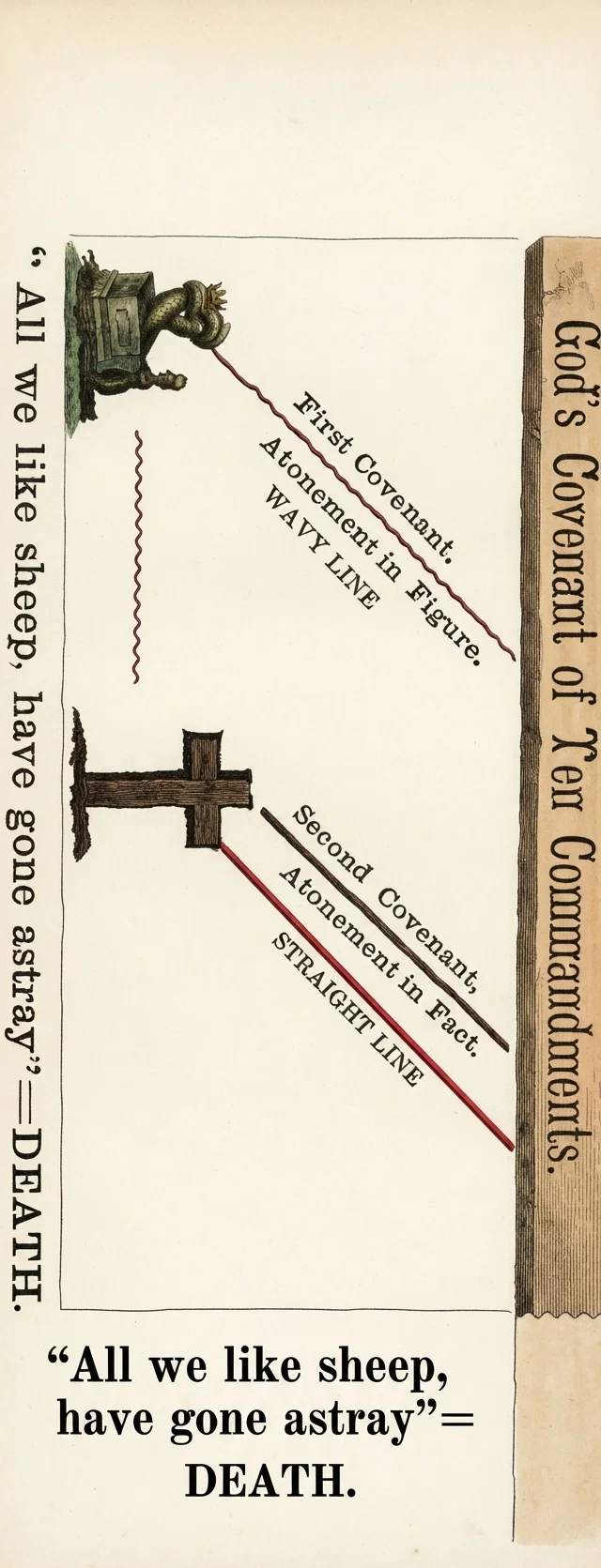
To present my views of this subject more fully before the reader, I introduce the following diagram.
PARADISE. { God's Covenant of Ten Commandments. PARADISE RESTORED. EXPLANATION.—The word, Paradise, at the left, represents the state of man before the fall. The words, Paradise Restored, at the right, represent the future redeemed state. The words, God's Covenant of Ten Commandments, ...
I regard God's covenant of ten commandments as embracing every moral principle, and as reaching from paradise, where the morning stars sang together, and the sons of God shouted for joy. Job. xxxviii, 7, to paradise restored, where every creature in heaven and earth and under the earth and such as are in the sea, will be heard praising God. Rev. v, 13.
But that happy state of things which existed when man was placed in Paradise did not continue. Man sinned and thus fell from that "high way of holiness." The prophet declares that "all we like sheep have gone astray." Isa. liii, 6. Now man needs a covenant to bring him back to allegiance, to place him again in "the old paths," as though he had never transgressed God's covenant of commandments. To this end a plan was provided embracing the new covenant; and until this could be brought about, a system of types and shadows, a faulty covenant, which could not take away sin, was introduced, to point the poor otherwise hopeless sinner to a covenant where God's law should be engraved upon his heart, and his sins be remembered no more.
We think the idea is now clearly before the reader that the first covenant is identical with the ceremonial law, and its priesthood. Now if the reader will turn to Heb. x, 1-9, he will find Paul speaking of the law and covenant in the same terms. In verse 9, he says, "he taketh away the first that he may establish the second." This first which is taken away is the first covenant. Now is it the ten commandments or any one of them that is taken away? Answer. See verses 5-10. Wherefore when he cometh into the world, he saith, sacrifice and offering thou wouldst not, but a body hast thou prepared me: In burnt offerings and sacrifices for sin thou hast had no pleasure. Then said I, Lo, I come (in the volume of the book it is written of me) to do thy will, O God. Above when he said sacrifice and offering and burnt offerings and offering for sin thou wouldst not, neither hadst pleasure therein; which are offered by the law. Then said he, Lo, I come to do thy will, O God. He taketh away the first, that he may establish the second."
This connection shows very clearly that it is the first order of sacrifice that is taken away in order to give place to the second.
That the Levitical priesthood was emphatically called a covenant, we prove by the following quotations from scripture. Num. xxv, 12, 13. "Wherefore say, behold, I give unto him my covenant of peace: and he shall have it, and his seed after him, even the covenant of an everlasting priesthood; because he was zealous for his God, and made an atonement for the children of Israel." Neh. xiii, 29, "Remember them, O my God, because they have defiled the priesthood, and the covenant of the priesthood, and of the Levites." See also Mal. ii, 4-10.
Now, kind reader, I shall relieve your patience. May you and I ever live in obedience to that law which is "holy, just and good." And through the blood of Jesus Christ the Mediator of the new covenant, which is applied on the mercy seat over the ark of God's covenant in the sanctuary in heaven, obtain remission for our past transgressions, and finally with the redeemed stand upon Mount Zion.
ORDER—AN EXAMPLE.
By A. S. Hutchins
THERE should be order in family devotion, as well as in public worship. It is impossible to conduct devotional exercises acceptably to God amid confusion and distraction, "for God is not the author of confusion, but of peace, as in all the churches of the saints." 1 Cor. xiv, 33. The churches of the saints are advancing toward order. Shall we not witness a move in this direction in the family circle?
We mark with admiration the order of the Saviour as he repeatedly fed the multitude. Before blessing and breaking bread he commanded them to be seated. They were not moving here and there in tumult and confusion, but all was190order and quietude, as he looked up to heaven and craved the blessing of God upon their scanty, yet more than plentiful, portion.
Might not a little reflection on the beautiful order of this example of the Son of God, help some Sabbath-keepers to require more order in their families and around their tables, as the blessing of heaven is asked upon their food? God is a God of order, and not of confusion. Should not the children of the remnant know this at a young age?
We were about to speak very plain, and say, dear brethren, that there is utterly a fault among some of you, that there is so little respect for the reading of the word of God, and to the season of prayer in your families. At the hour of family worship, a holy, sacred stillness should be observed. As the Scriptures are read, work should be laid aside, children seated, whispering, talking, and reading of other matter, &c., should all cease, and every heart be raised in devotion to the holy and reverend name of the Most High, through the entire exercise.
To the family that pays due respect to the word and worship of God, the hour of prayer is emphatically the best hour of the day. In the sunshine of heavenly order the Christian grows in grace, and in the knowledge of Christ Jesus; but in confusion he wilts and dies. Let us get clear out of Babylon. "Let all things be done decently and in order."
A. S. HUTCHINS.
GRAFTING CONTRARY TO NATURE.
By R. F. Cottrell
In natural grafting, or grafting in accordance with nature, we always expect that the fruit of the ingrafted branch will be like the fruit of the tree from which the scion is taken. But Paul, in Rom. xi, speaks of the Gentiles' being grafted into the stock of Israel, under the figure of grafting scions from the wild olive-tree into the good. This is said to be contrary to nature; because the branches that before bore wild olives, now, partaking of the root and fatness of the good olive, bear the same good fruit.
I was yesterday conversing with a sort of Adventist who took the ground that the Sabbath was never given to the Gentiles, but admitted that the Jews were under perpetual obligation to keep it. In the course of our conversation, wishing to enlighten my mind concerning the "age to come," he referred to Rom. xi, and the subject of grafting contrary to nature was mentioned. He agreed with me that in this kind of grafting the fruit of the scion was changed from what it was by nature to that of the stock into which it was ingrafted. Now, said I, you admit that Israel were under perpetual obligation to keep the Sabbath, and that they will keep it in the "age to come," therefore, when the Gentiles are grafted in, they must bear the same fruit with that Sabbath-keeping stock. He saw he was caught, and made no other response than a burst of laughter. R. F. Cottrell.
ADDRESS TO THE BRETHREN IN SOUTHERN IOWA.
By William H. Brinkenhoof
BRETHREN AND SISTERS IN THE LORD:—An all-wise Creator has in mercy toward us, spared our lives until the present time, and we have enjoyed the great privilege of beholding the light of present truth. The commandments of God and faith of Jesus, the last message of mercy, has dawned upon our minds, and enlightened our understanding. It is through the goodness of the Lord alone that we enjoy these things.
While we realize all these blessings, and reflect upon what God has done for us in days that are in the past, it would be but reasonable for us to expect that those who have been favored with these blessings, and who are looking for the soon coming of the Saviour, and claim to be his "peculiar people zealous of good works," would show forth in their lives all the manifestations of the Spirit of truth, the fruits of which are "love, joy, peace, longsuffering, gentleness, goodness, faith, meekness, temperance." Gal. v, 22, 23. It is the privilege of God's people, and their duty also, to grow in grace, and in the knowledge of our Lord and Saviour Jesus Christ, 2 Pet. iii, 18, and to let their light grow brighter and brighter unto the perfect day. We have also enjoyed the privilege of having the words of eternal life proclaimed unto us. The straight testimony has been given, and the testimony to the churches made known unto us. Yet notwithstanding all this, we are not making that progress in divine life, according to the means and opportunities given us. In some of the churches in Southern Iowa, who profess to keep the commandments of God and faith of Jesus, there is a great lack of love, spirituality, and humility; but in its stead a cold and lukewarm feeling is manifested, a lethargy and benumbing influence exercised, and an almost total disregard of the testimonies given for the church,—darkening influences spreading and causing divisions amongst us, and a negligence to clothe ourselves with the whole armor of God, Eph. vi, 13–18, and by this means allowing the enemy of souls to enter and wound us severely.
While we are in this condition, we are causing our brethren elsewhere to lose confidence in us, and to some extent, the Lord of hosts has withdrawn the influence of his holy Spirit from us. Now whose fault is all this? Manifestly our own. Of all sins committed, none are more flagrant than mercies abused, Heb. vi, 4–10, and none more deserving the severe judgments of heaven. God has done for us all that can be done, and in the language of Isaiah the prophet: "What could have been done more to my vineyard, that I have not done in it? wherefore when I looked that it should bring forth grapes, brought it forth wild grapes?" Isa. v, 4. We are in danger of being spued out of the mouth of the faithful and true witness, and when this is done whose condition can be more desolate than ours? 'Tis fearful indeed.
Dear brethren, if we ever expect to arise, and live in the message, now is the time for action. Let us cry mightily unto God, and turn unto him with our whole heart, and with fasting, and with weeping, and with mourning, and rend our hearts and not our garments, and turn unto the Lord our God; for he is gracious and merciful, slow to anger, and of great kindness, and repenteth him of the evil. Joel ii, 12, 13.
Brethren, in love allow me to urge upon you the following for your consideration:
1. We must humble ourselves under the mighty hand of God, pray to him earnestly, that he would look upon us a little longer, and let us try to arise and bring forth fruit. Hear the language of the Saviour: "Then said he unto the dresser of his vineyard, Behold, these three years I come seeking fruit on this fig-tree, and find none: cut it down; why cumbereth it the ground? And he answering said unto him, Lord, let it alone this year also, till I shall dig about it, and dung it: and if it bear fruit, well; and if not, then after that thou shalt cut it down." Luke xiii, 7–9.
Brethren, why do we reject the gifts? Do we believe the Bible to be the book of God? Yes, surely. Will it "thoroughly furnish us unto every good work?" It says so. If there is any doctrine clearly taught in the Bible, it is spiritual gifts, and consequently must be a good work. Has not this doctrine been most clearly set forth? It certainly has. But do you say, We believe them; we do not reject them by any means; we know that they should be in the church. A good profession truly; "but as the body without the spirit is dead, so faith without works is dead also." James ii, 26. Are we living out the testimony for the churches? "Oh, well," says one, "I believe in the gifts, but I am not so certain about the testimony." A poor subterfuge truly. Doubt the testimony; what is the matter with it? Did you ever find any thing in it contrary to God's word? you must answer, No, I have not.
Now brother, allow me to point out to you the difficulty.
If this testimony "prophesied smooth things," we could all receive it, but as it cries aloud, and spares not, we do not like it. In Rom. xiii, 14, we are commanded to "put on the Lord Jesus Christ, and make not provision for the flesh, to fulfill the lusts thereof." See also 1 Pet. ii, 11; Gal. v, 24. The testimony points out some of those fleshly appetites, and for this reason some do not like it. Let us see if this is not correct. We go to a brother and commence interrogating him on the subject. "Do you receive the testimony?" "Well, I cannot say that I do." "Do you abstain from all the fleshly habits of this age, pointed out in the word?" "No, not quite, I smoke some, chew a little tobacco, drink my coffee and tea," and the sister adds, "I wear small hoops!"
This shows at once why we do not want the testimony, as we cannot live it out, and at the same time bow to our fleshly appetites; and rather than mortify our members which are upon the earth, we sacrifice all that is good and pure. Oh, do not dishonor God any more; throw away that enemy to health, cleanliness, and holiness—tobacco. God says, "If any man defile the temple of God, him shall God destroy." We are shown what we must do, and let us live it out. This one case must suffice as an example of all those who are defiling themselves.
Brethren, this is one cause of our low condition. Now let me entreat you to cast aside all of your idols, and in the language of the poet—
"The dearest idol I have known,
Whate'er that idol be,
Help me to tear it from thy throne,
And worship only Thee."
If we do not put away these things, how can we be a part of that glorious church? Eph. v, 27. "That he might present it to himself a glorious church, not having spot, or wrinkle, or any such thing, but that it should be holy and without blemish."
Arise and cleanse yourselves as churches from this filthy habit. See that your leaders are free from this practice, and are living out the testimony, for they must be ensamples to the flock [1 Peter v, 3], and if they have not purified themselves by obeying the truth, they have no business to occupy such a station, for if the blind lead the blind both will fall into the ditch.
Brethren, let us purge ourselves, do our duty, and the Lord will bless us. Away with our coffee and tea. It destroys our health, and wastes the money that belongs to the Lord and his cause. Sisters, show to the world that you are the meek and lowly followers of the Saviour, and not of the fashions of the world. Let hoops and jewelry be cast aside, "and whose adorning let it not be that outward adorning of plaiting the hair, and of wearing of gold, or of putting on of apparel, but let it be the hidden man of the heart, in that which is not corruptible, even the ornament of a meek and quiet spirit, which is in the sight of God of great price." 1 Peter iii, 3, 4.
The subject of Systematic Benevolence must claim our attention briefly. In most of the churches it has been adopted; but instead of carrying it out it has dwindled down, and in some places died out. Brethren, I will not try to bring any testimony in favor of it, as you all have examined the subject, and know it to be right, and the only way by which an abundant supply of means can be raised to support the cause. Some complain a great deal about not having messengers visit them, and preach to them. But the ministers have but little faith in doing any good, as the testimony given would not be received, and their time and labor would be lost, and they compelled to hear the reproaches and bitter feelings of those whom they would gladly benefit. And some if asked to do something for the messenger's temporal welfare, (and they cannot live without their daily bread,) always find themselves too poor. Yet every difficulty is surmounted, when the carnal appetite requires food. Brethren, Jesus is soon coming, now is the time to do something for the cause; now is the time to lay up treasure in heaven; soon it will be too late; soon our cattle, horses, farms, and money out at interest, will do us no good. O brethren may a burden of souls rest upon you, and cause you to lend liberally to the Lord. Then do not reject systematic benevolence, it is the very thing we want, and if we prosper we must have it. Some of our churches are living it out, and the united testimony191is, that it is resulting in good.
Now, in conclusion, brethren, lay aside every weight and the sin which doth so easily beset you, and obey the testimony given, from the heart, and you will be active again. Yea, lively stones in the house of God. The Lord will bless, and our brethren will gain confidence in us as a people. The messengers will have no dead churches to work over, and souls will be converted to God. Amen.
WM. H. BRINKENHOOF.
WILL YOU BE THERE?
BEYOND this life of hopes and fears,
Beyond this world of grief and tears,
There is a region fair;
It knows no change and no decay,
No night, but one unending day.
O say, will you be there?
Its glorious gates are closed to sin;
Nought that defiles can enter in
To mar its beauty rare;
Upon that bright eternal shore,
Earth's bitter curse is known no more.
O say, will you be there?
No drooping form, no tearful eye,
No hoary head, no weary sigh;
No pain, no grief, no care;
But joys which mortals may not know,
Like a calm river, ever flow.
O say, will you be there?
Our Saviour, once a mortal child,
As mortal man, by man reviled,
There many crowns doth wear;
While thousand thousands swell the strain
Of glory to the Lamb once slain!
O say, will you be there?
Who shall be there? The lowly here—
All those who serve the Lord in fear,
The world's proud mockery dare;
Who by the Holy Spirit led,
Rejoice the narrow path to tread—
These, these shall all be there!
Those who have learned at Jesus' cross
All earthly gain to count but loss
So that his love they share,
Who, gazing on the crucified,
By faith can say, "for me He died—"
These, these shall all be there!
Will you be there? You shall, you must,
If hating sin in Christ you trust,
Who did that place prepare.
Still doth his voice sound sweetly "Come
I am the way—I'll lead you home—
With me you will be there!"