Your ShelfYour Projects

Signs of the Times, Vol. 28, No. 15.

TWO MANNER OF PEOPLE

Signs of the Times

Apr 9, 1902

Pacific Press Publishing Company · Oakland, California · Apr 9, 1902

“TWO MANNER OF PEOPLE.”
“IT is written, that Abraham had two sons, the one by a bondmaid, the other by a freewoman. . . . Which things are an allegory.” Gal. 4:22-24.
ISHMAEL, Abraham’s first-born, was the child, not of promise, but of doubt, and of impatience that the promise was so long delayed. Isaac was the child of promise, the pledge of Abraham’s faith and loyalty.
THE angel said of Ishmael, “He will be a wild man; his hand will be against every man, and every man’s hand against him.” This has been fulfilled in him and in his descendants.
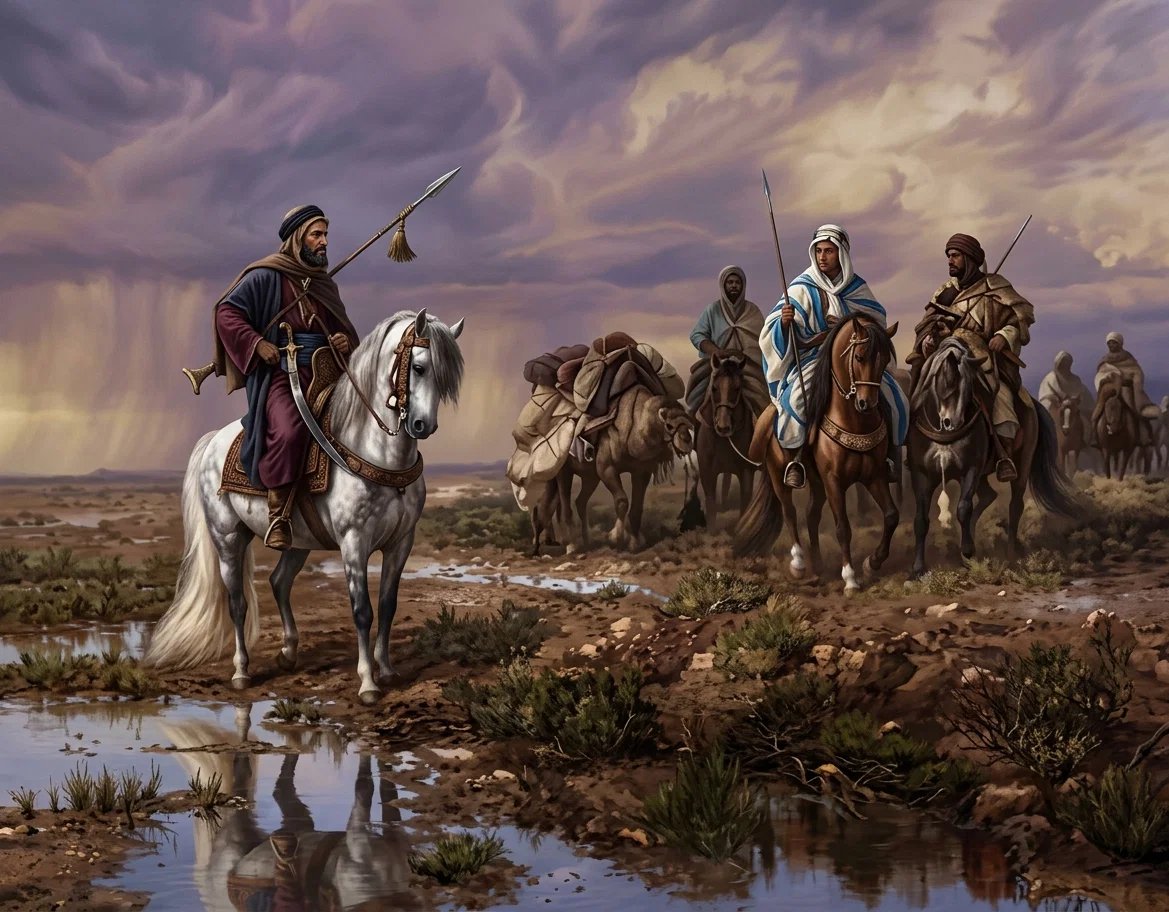
Arab Sheik Traveling: an Ishmaelite of To-day.
WE read: “And God was with the lad; and he grew, and dwelt in the wilderness, and became an archer. And he dwelt in the wilderness of Paran; and his mother took him a wife” out of Egypt. Ishmael joined the mixed races of Arabia, as did the sons of Keturah, and later, no doubt, the sons of Esau. He is reputed to have become very early a leader among these peoples. When Abraham was buried, Ishmael was nearly ninety, and no doubt in the height of his prosperity. As he stood with Isaac at his father’s tomb, with his armed retainers around him, there is no reason to suppose that the bold, adventurous desert prince felt any need to envy Isaac, the peaceful shepherd, even tho Isaac was heir to his father’s wealth, and head of the hundreds of “trained servants, born in his own house.”
EACH of Ishmael’s twelve sons became the head of a tribe. Descendants of his oldest son united with the Edomites in building up the Idumean kingdom and in making its capital city, the marvelous rock-hewn Petra. Other Ishmaelites also lived a settled life; but the great majority were nomads. Their encampments, or “movable villages of tents,” were found in all the desert region from the Euphrates westward. A large carrying trade across the desert was done by them, and their roving bands ravaged and plundered whenever an opportunity presented itself.
To THIS day the descendants of Ishmael roam the desert, “tribes of the wandering foot,” each under its own sheik. As of old, their bands are ready for commerce or for plunder. Would a caravan be complete without its Arabs? Would the traveler be safe in the territory of a sheik without an escort of his Arab lancers?
IN the family of Ishmael has originated a religion which is the embodiment of their own character. For the tribe of the Koreish, from which Mohammed sprang, is conceded to have descended from Ishmael, tho they were not of unmixed blood. Mohammedanism makes ample provision for “the works of the flesh,” and promises to the “faithful” a heaven in every way suited to the desires of the carnal heart. Among its votaries “the most scrupulous observance of outward duties is not unfrequently united with the grossest habitual immorality and crime.”
AND what a record this false religion of a great impostor has made in the social and political world. Bearing the standard of the “prophet,” the Saracenic hosts went forth on their career of conquest. They overran country after country, until nearly all of Southwestern Asia and Northern Africa and part of Southern Europe owned the sway of Islam. And to-day there are from 176,000,000 to 185,000,000 adherents of this faith which deadens the conscience, feeds a false hope, and paralyzes enterprise and progress. Like a mighty poisonous river has the tide of this worldly religion rolled on, carrying with it ruin to body and soul.

The Other People.

VERY different was the life of Isaac. He and his son Jacob served the true God, if not perfectly, yet sincerely, and God accepted them. The descendants of Jacob, the people of Israel, stumbled in the way of righteousness, and sometimes seemed to quit it altogether; and because they would not receive Christ, they are now rejected and dispersed; yet they have never reached the low level of the sons of Ishmael. And while they remained the people of God, the nation produced an army of holy men, among whom were prophets, priests, and kings. Through them God wrought in blessing, not for themselves alone, but for the world. Through them He has given us the Saviour and through them His Holy Word, for “salvation is of the Jews;” and these treasures of divine grace have brought untold blessings, both temporal and spiritual, to untold millions of the human race.
WHAT a mighty river of life and healing has thus rolled over the world, fraught with blessing “because their waters they issued out of the sanctuary.” The waters may be carried to earth’s thirsting millions by imperfect human agents; but their origin is heavenly. They proceed “out of the throne of God and of the Lamb.”
IS GOD, then, partial? Does He give blessings to some, and withhold them from others?—O, no! All in the families of Abraham and Isaac were taught the worship of the true God. For God said of Abraham, “I know him, that he will command his children and his household after him, and they shall keep the way of the Lord.” Note, too, how earnestly the patriarch pleaded, “O that Ishmael might live before Thee!” When Ishmael went out from the family of Abraham, we can well believe that he was followed by the prayers and counsels of his wise and loving father, as he certainly was by divine care and protection,for we read that “God was with the lad.”
ISHMAEL and Esau could have shared the favor of God as freely as did Isaac and Jacob, had they chosen so to do. They as well as Israel might have had a part in giving the Gospel message, if they would. But they loved this present world. Their hearts and hopes were centered on the things of time and sense, and they did not by faith grasp unseen realities. More than all, they loved sin, and hated righteousness. So they chose their portion in this world, and God gave them their choice,—a choice which left them in the bondage of sin and in the shadow of death.
“WHICH things are an allegory,” Paul says; and “they are written for our admonition, upon whom the ends of the world are come.” What use will we make of the lesson? Which of the “two manner of people” will we choose to be like?
“Why choose the evil, when the good, More lovely, more divinely fair, With heavenly graces aye imbued, Awaits the searcher everywhere? Why go the downward ways of sin ’Mid vain regrets and wild despair? Why quell the good each soul may win, Why lose all hopes of heaven here?”
E. J. BURNHAM.

THE CRUCIFIXION OF SELF.

The most hopeless, the most incurable of all sins is pride, self-sufficiency. This sin stands in the way of all advancement, all growth in grace. It has caused the ruin of thousands and thousands of souls. A man may be a great sinner, but if he realizes that he has sinned against God, if he repents and confesses his sin, and strives to make restitution for the past, he will receive forgiveness. God declares, “Him that cometh to Me I will in no wise cast out.” His promise to the contrite, repentant soul is, “Tho your sins be as scarlet, they shall be as white as snow; tho they be red like crimson, they shall be as wool.”
But when a man is so filled with self-sufficiency that he can not see his faults, how can he be cleansed from sin? “They that be whole need not a physician.” How can a man improve when he thinks his ways perfect? Self-sufficiency was the ruin of the leaders of Israel. They did not come to Christ, because they did not think they needed a Saviour. They refused to admit that they cherished sins which needed to be repented of and forsaken.
Many, many Christians are lacking in power because they are self-sufficient, because they do not feel the need of an abiding Christ. They suffer great loss; and the world, in need of their testimony, also suffers great loss. Lying in the darkness of error, the world needs the light which those who claim to love and serve God, should reflect. But many who stand as witnesses of the Saviour exalt self. Jesus is hidden by poor, selfish humanity. The world does not see the pure, holy example that should be a bright and shining light amid its darkness.
Some feel that in their Christian experience they have need of nothing more, that they are “rich and increased with goods.” Could they see themselves as God sees them, they would acknowledge that they are “wretched, and miserable, and poor, and blind, and naked.” To such the True Witness says, “I counsel thee to buy of Me gold tried in the fire,”—the gold of faith and love,—“that thou mayest be rich; and white raiment,”—the robe of Christ’s righteousness,—“that thou mayest be clothed, and that the shame of thy nakedness do not appear; and anoint thine eyes with eye-salve, that thou mayest see.”
Let no one who reads this description become discouraged and say, “If this is my condition, I can never be an acceptable witness for Christ.” Take the Word of God, and search its pages as never before, that you may learn what it means to be a Christian. You need not be discouraged; for the One who died to save you declares, “Ye shall receive power,”—power to overcome self and selfishness, power to reveal Christ as He is, full of grace and truth.
In order to work for God successfully, we must die to self, surrendering all to God. In words of great tenderness, Christ invites us, “Come unto Me, all ye that labor and are heavy laden, and I will give you rest.” When you respond to this invitation, when you learn what it means to find rest by lifting the cross and bearing it after the Lord, you will be true witnesses for Him. But until this lesson is learned, self will appear, and Jesus will be kept in the background.
Come to Christ, and His gentleness and love will break down the harsh, cold selfishness that prevents you from revealing Him to the world. Your hasty temper will be subdued, your pride expelled. Jesus will fill your heart with His gentleness, His patience, His love. Then you can lift Him up before sinners. Working for Him, you will lose all thought of self. For His dear sake you will be willing to endure shame and reproach.
The Lord says, “Only acknowledge thine iniquity, that thou hast transgressed against the Lord thy God.” “Then will I sprinkle clean water upon you, and ye shall be clean; from all your filthiness, and from all your idols, will I cleanse you.”
We must have a knowledge of ourselves, a knowledge that results in contrition, before we can find pardon and peace. It is only he who knows himself to be a sinner that Christ can save. We must know our true condition, or we shall not feel our need of Christ’s help. We must understand our danger, or we shall not flee to the refuge. We must feel the pain of our wounds, or we shall not desire healing.
Are you willing to cast down the idols you have cherished? Are you willing to let Jesus enter the heart to cleanse it from all that defiles? Are you at all times and under all circumstances, obtaining the mastery over yourself? Can you say, “For me to live is Christ,” I am His? Whatever I have, of time, or strength, or influence, all is His? Are you representing Him by your forbearance, your patience, your unselfishness? Are you learning to be like Him?
God’s word to us is, “Be ye therefore perfect, even as your Father which is in heaven is perfect.” He calls upon every one to crucify self. Those who respond grow strong in Him. They learn daily from Christ, and the more they learn, the greater is their desire to build up God’s kingdom by helping their fellow-men. The more enlightenment they have, the greater is their desire to enlighten others. The more they talk with God, the less they live to themselves. The greater their privileges, opportunities, and facilities for Christian work, the greater is the obligation they feel to work for others.
Human nature is ever struggling for expression. He who is made complete in Christ must first be emptied of pride, of self-sufficiency. Then there is silence in the soul, and God’s voice can be heard. Then the Spirit can find unobstructed entrance. Let God work in and through you. Then with Paul you can say, “I live; yet not I but Christ liveth in me.” But until self is laid on the altar, until we let the Holy Spirit mould and fashion us according to the divine similitude, we can not reach God’s ideal for us.
Christ said, “I am come that they might have life, and that they might ‘have it more abundantly.’” This life is what we must have in order to work for Christ, and we must have it “more abundantly.” God will breathe this life into every soul that dies to self. But entire self-renunciation is required. Unless this takes place, we carry with us that which destroys our happiness and usefulness.
The Lord needs men and women who carry with them into the daily life the light of a godly example, men and women whose words and actions show that Christ is abiding in the heart, teaching, leading, and guiding. He needs men and women of prayer, who, by wrestling alone with God, obtain the victory over self, and then go forth to impart to others that which they have received from the Source of power. God accepts those who crucify self, and makes them vessels unto honor. They are in His hands as clay in the hands of the potter, and He works His will through them. Such men and women receive spiritual power. Christ lives in them, and the power of His Spirit attends their efforts. They realize that they are to live in this world the life that Jesus lived,—a life free from all selfishness; and He enables them to bear witness for Him that draws souls to the cross of Calvary.
MRS. E. G. WHITE.

IS IT CHRISTIAN?

Can a Christian enlist in the army and be a soldier?
A Christian has yielded himself a servant of Christ. “Ye call Me Master and Lord; and ye say well, for so I am.” John 13:13. “One is your Master, even Christ.” Matt. 23:8. “Know ye not, that to whom ye present yourselves as servants unto obedience, his servants ye are whom ye obey?” Rom. 6:16, R. V.
Having become a servant of Christ, a man can not accept another master. “No servant can serve two masters; for either he will hate the one and love the other; or else he will hold to the one and despise the other.” Luke 16:13.
Notwithstanding these plain statements, some men think they can be Christians while as soldiers they are sworn servants of the government, and may at any time be ordered to the front and to fire upon the enemy. Indeed, they expect this when they enlist, tho it is in direct disobedience of the command of God, “Thou shalt not kill.” Ex. 20:13.
What is the soldier’s business? Is it not to fight and to war? But “the servant of the Lord must not strive, but be gentle unto all men.” 2 Tim. 2:24. And the Holy Spirit said through John the Baptist, “Do violence to no man.” Luke 3:14. Read these scriptures: “This is My commandment, That ye love one another as I have loved you.” John 15:12. “Love worketh no ill to his neighbor.” Rom. 13:10. “I say unto you, Love your enemies, bless them that curse you, do good to them that hate you, and pray for them which despitefully use you, and persecute you.” Matt. 5:44.
Reader, do you honestly think you can serve these two masters?
San Diego, Cal. GEO. E. HOLLISTER.

Character Must Be Achieved

“MEN may be born with fortune ready made, but character they have to achieve.”

RESTORATION from BABYLON

BY ALONZO TREVIER JONES

THE WORK OF HAGGAI AND ZECHARIAH.

EARLY in the year 521 B. C. Darius, the son of Hystaspes, of ancient Persian line, took the Medo-Persian throne by killing the false Smerdis and his chief adherents. Yet it was nearly a year and a half before work was resumed upon the temple of God in Jerusalem.
The people of God in Jerusalem and Judea had lost faith in God. They knew that the decree of the false Smerdis stopping the work, was secured by false representations; and they knew that the decree was illegal in itself, because of the fundamental principle of Medo-Persian law that no law of the Medes and Persians could be changed. Yet tho they knew that the usurper was dead, and tho they had in their hands the original decree of Cyrus which could not be lawfully reversed by any other Medo-Persian decree, still they did not have the faith to take up the work again. In their lack of faith they had imbibed the notion that the work was really dependent upon kings and their decrees, instead of upon God; that the Lord's part in the work was really secondary to that of kings and powers; that the kings' motions and decrees must come first, and then the Lord co-operate; instead of the Lord and His work being first, and then the kings co-operate.
Also as a consequence of their lack of faith, and so their neglect of the cause and work of God, there had come hard times in the land; the seasons were unfavorable; there was drought in the land; the crops of all kinds were short; what money was received went such a little way that it seemed more as if it had been lost than as if it had really been spent; what was bought with the money seemed to do so little good, that, whether it were food or clothing, it seemed almost as tho they had not had it at all.
In view of all these things, which were only the consequences of their loss of faith in God, in His cause, and in His present work in the world; and in the face of all that God had done, not only before their very eyes, but by their very selves; they actually reached and expressed in words the astonishing conclusion that, “The time is not come, the time that the Lord’s house should be built”!!
To correct these utterly mistaken thoughts, reasonings, and conclusions, the Lord sent to them the prophets Haggai and Zechariah to revive their faith in God; thus to open their eyes, that they might see things in their true light.
Haggai spoke first: The first day of the sixth month, in the second year of Darius—520 B.C.—the word of the Lord came to Zerubbabel the governor, and Joshua the high priest, saying: “Thus speaketh the Lord of hosts, saying, This people say, The time is not come, the time that the Lord’s house should be built. Is it time for you, O ye, to dwell in your ceiled houses, and this house lie waste?” “Now therefore thus saith the Lord of hosts: Consider your ways. Ye have sown much, and bring in little; ye eat, but ye have not enough; ye drink, but ye are not filled with drink; ye clothe you, but there is none warm; and he that earneth wages earneth wages to put it into a bag with holes. “Thus saith the Lord of hosts: Consider your ways. Go up to the mountain, and bring wood, and build the house; and I will take pleasure in it, and I will be glorified, saith the Lord. Ye looked for much, and, lo, it came to little; and when ye brought it home, I did blow upon it. Why? saith the Lord of hosts. Because of Mine house that is waste, and ye run every man unto his own house. Therefore the heaven over you is stayed from dew, and the earth is stayed from her fruit. And I called for a drought upon the land, and upon the mountains, and upon the corn, and upon the new wine, and upon the oil, and upon that which the ground bringeth forth, and upon men, and upon cattle, and upon all the labor of the hands.” Haggai 1.
This message of the Lord by His prophet was promptly received by all to whom it came. Zerubbabel the governor and Joshua the high priest, “with all the remnant of the people, obeyed the voice of the Lord their God, and the words of Haggai the prophet, as the Lord their God had sent him; and the people did fear before the Lord.
“Then spake Haggai, the Lord’s messenger in the Lord’s message unto the people, saying, I am with you, saith the Lord. And the Lord stirred up the spirit of Zerubbabel the son of Shealtiel, governor of Judah, and the spirit of Joshua the son of Josedech, the high priest, and the spirit of all the remnant of the people; and they came and did work in the house of the Lord of hosts, their God, in the four and twentieth day of the sixth month, in the second year of Darius the king.”
In the following month, “in the seventh month,” in the twenty-first day of the month, came again the word of the Lord by Haggai to Zerubbabel, and Joshua, and all the remnant of the people, saying:—
“Who is left among you that saw this house in her first glory? and how do ye see it now? is it not in your eyes in comparison of it as nothing? Yet now be strong, O Zerubbabel, saith the Lord; and be strong, O Joshua, son of Josedech, the high priest; and be strong, all ye people of the land, saith the Lord, and work: for I am with you, saith the Lord of hosts; according to the word that I covenanted with you when ye came out of Egypt, so My Spirit remaineth among you; fear ye not. For thus saith the Lord of hosts: Yet once, it is a little while, and I will shake the heavens, and the earth; and the sea, and the dry land; and I will shake all nations, and the Desire of all nations shall come; and I will fill this house with glory, saith the Lord of hosts. The silver is Mine, and the gold is Mine, saith the Lord of hosts. The glory of this latter house shall be greater than of the former, saith the Lord of hosts; and in this place will I give peace, saith the Lord of hosts.” Hag. 2: 3-9.
In the next month, “the eighth month in the second year of Darius,” the message of the Lord came to them by the prophet Zechariah, saying:—
“The Lord hath been sore displeased with your fathers. Therefore say thou unto them, Thus saith the Lord of hosts: Turn ye unto Me, saith the Lord of hosts, and I will turn unto you, saith the Lord of hosts. Be ye not as your fathers, unto whom the former prophets have cried, saying, Thus saith the Lord of hosts: Turn ye now from your evil ways, and from your evil doings; but they did not hear, nor hearken unto Me, saith the Lord. Your fathers, where are they? and the prophets, do they live for ever? But My words and My statutes, which I commanded My servants the prophets, did they not take hold of [overtake] your fathers? and they returned and said, Like as the Lord of hosts thought to do unto us, according to our ways, and according to our doings, so hath He dealt with us.” Zech. 1:2-6.
In the next month, “the ninth month,” the twenty-fourth day of the month, the message of the Lord came again by the prophet Haggai, in which He said:—
“Consider from this day and upward, from before a stone was laid upon a stone in the temple of the Lord: since those days were, when one came to an heap of twenty measures, there were but ten; when one came to the pressfat for to draw out fifty vessels out of the press, there were but twenty. I smote you with blasting, and with mildew, and with hail in all the labors of your hands; yet ye turned not to Me, saith the Lord. Consider now from this day and upward, from the four and twentieth day of the ninth month, even from the day that the foundation of the Lord’s temple was laid, consider it. Is the seed yet in the barn? yea, as yet the vine, and the fig tree, and the pomegranate, and the olive tree, hath not brought forth: from this day will I bless you.” Hag. 2: 15-19.
In the eleventh month and the twenty-fourth day of the month of that same year, the word of the Lord came again to the prophet Zechariah. He saw in a vision a man riding a bay horse, followed by bay, speckled, and white horses. They stood among myrtle trees in a valley. Zechariah asked what were these. The angel answered, “These are they whom the Lord hath sent to walk to and fro through the earth.” And they reported to the angel, in the hearing of the prophet, “We have walked to and fro through the earth, and, behold, all the earth sitteth still, and is at rest.” Then the angel said, “O Lord of hosts, how long wilt Thou not have mercy on Jerusalem and on the cities of Judah, against which Thou hast had indignation these threescore and ten years?”
Then the angel spoke to Zechariah, saying:—
“Cry thou, saying, Thus saith the Lord of hosts: I am jealous for Jerusalem and for Zion with a great jealousy. And I am very sore displeased with the heathen that are at ease; for I was but a little displeased, and they helped forward the affliction. Therefore thus saith the Lord, I am returned to Jerusalem with mercies; My house shall be built in it, saith the Lord of hosts, and a line shall be stretched forth upon Jerusalem. Cry yet, saying, Thus saith the Lord of hosts, My cities through prosperity shall yet be spread abroad; and the Lord shall yet comfort Zion, and shall yet choose Jerusalem.”
Next in the vision the prophet saw the four horns—powers—that had scattered Judah, Israel, and Jerusalem, and also four carpenters come to repair these desolations. And the angel said:—
“These are the horns which have scattered Judah, so that no man did lift up his head; but these [carpenters] are come to fray them, to cast out the horns of the Gentiles, which lifted up their horn over the land of Judah to scatter it.” Zech. 1:7-21.
Next in the vision he saw a man with a measuring line in his hand “to measure Jerusalem, to see what is the breadth thereof, and what is the length thereof.” Then the angel who talked with the prophet went forth and was met by another angel who said to him:—
“Run, speak to this young man [Zechariah], saying, Jerusalem shall be inhabited as towns without walls for the multitude of men and cattle therein; for I, saith the Lord, will be unto her a wall of fire round about, and will be the glory in the midst of her. “Ho, ho, come forth, and flee from the land of the north, saith the Lord; for I have spread you abroad as the four winds of the heaven, saith the Lord. Deliver thyself, O Zion, that dwellest with the daughter of Babylon. For thus saith the Lord of hosts, After the glory hath He sent me unto the nations which spoiled you; for he that toucheth you toucheth the apple of His eye. For, behold, I will shake Mine hand upon them, and they shall be a spoil to their servants; and ye shall know that the Lord of hosts hath sent me. “Sing and rejoice, O daughter of Zion; for, lo, I come, and I will dwell in the midst of thee, saith the Lord.And many nations shall be joined to the Lord in that day, and shall be My people: and I will dwell in the midst of thee, and thou shalt know that the Lord of hosts hath sent me unto thee. And the Lord shall inherit Judah His portion in the holy land, and shall choose Jerusalem again. Be silent, O all flesh, before the Lord: for He is raised up out of His holy habitation.” Chapter 2.
Next Zechariah saw in the vision “Joshua the high priest standing before the angel of the Lord, and Satan standing at his right hand to resist him. And the Lord said unto Satan, The Lord rebuke thee, O Satan; even the Lord that hath chosen Jerusalem rebuke thee: is not this a brand plucked out of the fire?”
Joshua was clothed with filthy garments, and stood before the angel. The angel said to others who stood by, “Take away the filthy garments from him.” And to Joshua he said, Behold, I have caused thine iniquity to pass from thee, and I will clothe thee with change of raiment.” And Zechariah said, “Let them set a fair miter upon his head.” So they set a fair miter on his head, and clothed him with the beautiful garments. Then said the angel to Joshua:—
“If thou wilt walk in My ways, and if thou wilt keep My charge, then thou shalt also judge My house, and shalt also keep My courts, and I will give thee places to walk among these that stand by. Hear now, O Joshua the high priest, thou and thy fellows that sit before thee; for they are men wondered at [a sign]: for, behold, I will bring forth My servant the BRANCH. For behold the stone that I have laid before Joshua: upon one stone shall be seven eyes: behold, I will engrave the graving thereof, saith the Lord of hosts, and I will remove the iniquity of that land in one day. In that day, saith the Lord of hosts, shall ye call every man his neighbor under the vine and under the fig tree.” Chapter 3.
Next in the vision there was shown to the prophet a candlestick all of gold, with a bowl upon the top of it, and seven lamps upon it, and seven pipes to the seven lamps; and an olive tree on each side of the bowl; this signifying to Zerubbabel that the building of the house of the Lord was “not by might, nor by power, but by My Spirit, saith the Lord of hosts. Who art thou, O great mountain? Before Zerubbabel thou shalt become a plain: and he shall bring forth the headstone thereof with shoutings, crying, Grace, grace unto it.” And in the vision the word of the Lord was spoken:—
“The hands of Zerubbabel have laid the foundation of this house; his hands shall also finish it; and thou shalt know that the Lord of hosts hath sent me unto you. For who hath despised the day of small things? for they shall rejoice, and shall see the plummet in the hand of Zerubbabel with those seven; they are the eyes of the Lord, which run to and fro through the whole earth.” Chapter 4.
Next in the vision the prophet saw a flying roll of the law of God; the length twenty cubits, and the breadth ten cubits; revealing the curse, because of the sins, that goeth forth over the face of the whole earth. After that the prophet saw go forth two women, having between them in an ephah “Wickedness,” “to build it an house in the land of Shinar; and it shall be established, and set there upon her own base.” Chapter 5.
Next in the vision the prophet saw going forth four chariots, each with horses; two toward the north, one toward the south, and the remaining one to and fro through the earth. And last he was instructed to take certain men by name, and have them make crowns of silver and gold, and set them upon the head of Joshua the high priest, and say:—
“Thus speaketh the Lord of hosts, saying, Behold the man whose name is the BRANCH; and He shall grow up out of His place, and He shall build the temple of the Lord; and He shall bear the glory, and shall sit and rule upon HIS throne, and He shall be a priest upon HIS throne: and the counsel of peace shall be between Them both.” Zech. 6: 12, 13.
Then the crowns were to be for a memorial in the temple of the Lord.
And the vision closed with the words of confirming promise upon all: “And this shall come to pass, if ye will diligently obey the voice of the Lord your God.” Chapter 6.
[The next article in the series is “The Samaritans Compelled to Help.”]

PETER AND CORNELIUS.

At every step God leads His witnesses into just the experience that is best for the accomplishment of His purpose. Peter encountered one phase at Lydda, and another, entirely different, at Joppa. But each of these was well designed to meet the needs of the locality in which it was found. While the apostle was tarrying at Joppa, God was preparing still another experience for him, well calculated to meet the needs of the people among whom he would go, and also to enlarge his own view of the scope of the Gospel.
Between forty and fifty miles north of Joppa, on the sea-coast, lay Cæsarea. In this city was a very devout man, a Roman officer, who, with all his family, revered God, and desired to know the truth. His sincerity was rewarded with a vision from God, in which he was first commended for his integrity, and was then told to send messengers to Joppa to bring Peter thence, who would be able to tell him something of great importance. Two trusty men, with a guard, were therefore despatched southward, with exact information as to the name and lodging-place of the man wanted, and the message to be borne to him.
But to insure the success of the mission of Cornelius’ servants, prior to their arrival God instructed Peter also about their coming. Just before they reached the town, Peter went as usual to the housetop to pray. While there he became very hungry, and desired to eat. He gave his order for food; but while it was being prepared in the room below, in vision he saw a great sheet descend from heaven, held together by the four corners, and filled with all kinds of living beasts, birds, and insects. While viewing this singular spectacle, a voice came distinctly to Peter, telling him to arise, “kill, and eat.” The thought of this was repulsive to Peter, who, as a Jew, had never eaten unclean meats, so he objected to the order. Three times, however, in the vision, this command to partake of the creatures seen in the sheet was repeated to the apostle. On returning to his normal state, Peter doubted as to the meaning of the vision; and while he was conjecturing about it, the messengers from Cornelius came to the house where Peter was. Just then the Spirit said to him, “Three men seek thee. Arise therefore, and get thee down, and go with them, doubting nothing; for I have sent them.”
Thus warned against hesitation, Peter met the men, and upon hearing their message, decided to return with them to the north. The next day Peter, with a select company from Joppa, set out with the messengers of Cornelius, and in due time arrived in Cæsarea, where mutual explanations between Peter and Cornelius made it evident that God had been preparing Cornelius to receive more truth, and working a change of mind in Peter that would enable him to carry advanced light to a Gentile.
Accordingly, Peter began teaching the company he found gathered by Cornelius in his own house. But the first thing he communicated to them was the new light that had come to his own mind,—that he should never again call any man “common or unclean.” Acts 10: 28. The vision of the sheet filled with all sorts of animals, both clean and unclean, had taught Peter the truth that “God is no respecter of persons.”
After thus prefacing his remarks, Peter went on to tell the simple story of the cross. Beginning with the preaching of John, he introduced Jesus, and the wonderful manifestation of the Spirit’s descent, witnessing to His Sonship, and anointing Him to the work for which He had come into the world. Then in a sentence or two were told the good deeds of His life, the cruel death He met at the hands of the Jews, and the proof of His resurrection by the power of God. Next came the rehearsal of the Gospel commission, by virtue of which the apostle himself was then proclaiming the good news that by the power of Jesus’ name every believer in Him should receive remission of sins.
As these gracious words fell from the apostle’s lips, the Holy Ghost rested on every one present, confirming the statements being made before them. The effect of this was not the same upon all present. The Gentiles rejoiced greatly, and spoke in new, and to them unknown languages, as they attempted to praise God. Those of Peter’s company—Jews by birth—were not thus moved. They did little else but stand in mute astonishment, as they witnessed the undoubted working of God’s power upon Gentiles. All their long-cherished theory, that the Gentiles were but dogs whom God could not deign to notice, was by this manifestation entirely dissipated, and so their conversion to an enlargement of vision was accomplished by the same means through which the Gentiles came to know Christ.
There is a moral in this study well worth the consideration of modern evangelists. In that case but a few moments were needed for the necessary work to be accomplished. The simple story of Christ’s pure life and tragic death, unadorned by anecdotes of death-bed scenes, was sufficient, and the Spirit could bear witness to it all in a way not known in our day. Yet the same conditions of sin and darkness are in the world, and ought to be just as fully met now as they were then. It is folly to reason that the Gospel is not now what it then was,—the power of God unto salvation; for that would virtually be to admit that now salvation power has been lost from the Gospel. Would it not be well, therefore, to inquire seriously as to the disparity between our time and that of the immediate disciples of Christ? We surely have the same truth that they had, and this is fortified by the same promise that it then carried. Where, then, is the difficulty?
J. O. CORLISS.

THE LOVE THAT SHIELDS.

He had fallen, the patriarch grand, Who had faced the world alone, In his tent, apart, in his shame he lay, None to make moan.
One came with mocking mien, With careless step passed by, To whisper with scorn the bitter tale Of misery.
With flout and jesting he; In silence, with heads bowed low, Two brothers ponder in pitying grief The father's woe.
With averted gaze they press To his side in tender ruth, His shield their love, his stay the strength Of their glorious youth.
O, blessed, tender type Of the Love Divine that came To the hopeless human soul to hide Its grief and shame.
O, wondrous lesson sent For our hearts, to censure given, Of the Love that pities, shields, uplifts, That wins to heaven.
N. S.
Continue reading: A Lay Discursus on the Soul