Your ShelfYour Projects

Signs of the Times, Vol. 31, No. 15.

SIGNS OF THE TIMES

Signs of the Times

Apr 12, 1905

Pacific Press Publishing Company · Mountain View, California · Apr 12, 1905

SIGNS OF THE TIMES

PUBLISHED WEEKLY
BY THE PACIFIC PRESS PUBLISHING CO.,
Villa Street, . . . Mountain View, California.
(Entered September 15, 1904, as second-class matter at the Mountain View, Cal., post-office, under act of Congress of March 3, 1879.)
H. H. HALL, . . . . BUSINESS MANAGER.

Terms of Subscription.

Per Year, post-paid . . . . . . . . . . . . . . . . . . . . . . . . . . . . . . . . . . . . . . . . . . . . . . . . . . . . . . . . . . . . . . . . . . . . . . . . . . . . . . . . . . $1.50 Six Months, 75 cts. Three Months, 40 cts. To Foreign Countries, per year, $1.75.

SPECIAL TERMS.

1. One new yearly subscription and one renewal, or two new yearly subscriptions, sent at one time, $2.50.
2. Two new yearly subscriptions and one renewal, or three new yearly subscriptions, sent at one time, $3.25.
3. Three new yearly subscriptions and one renewal, or four new yearly subscriptions, sent at one time, $4.00.
Sample copies sent on application.

TO OUR PATRONS.

Please be careful to write all names of persons and places plainly.
Send money by Post-office Money Order, Express Order, or Bank Draft on New York, Chicago, or San Francisco.
Orders and Drafts should be made payable to the Pacific Press Publishing Co.
Paper money or silver should be sent in a registered letter.
Registered mail is safe. Unregistered mail is at the risk of the sender.
Postage-stamps in five or ten cent denominations will be accepted for small amounts.
The address label on your paper will indicate the time to which your subscription is paid. In case of non-receipt of papers, or any other irregularity, please notify us immediately.
When subscriptions expire, no more papers are sent to the party except by special arrangement.
You are requested to watch the date on your label, and renew early, and save the loss of papers. We can not always furnish missing numbers.
When requesting change of address, be sure to give both old and new addresses.
Important.—If you order SIGNS, Our Little Friend, books, etc., at the same time, use a separate sheet of paper for each. If this request is complied with, it will materially assist in the prompt and accurate despatch of the business.
When writing to the editor, be sure to use a separate sheet of paper.

THE SIX LEADERS.

THE following states lead in the number of subscriptions to the SIGNS OF THE TIMES sent in last week:
California, Michigan, New York, Colorado, Pennsylvania, Oregon.

Readers’ Appreciation of Signs

EDITORS SIGNS OF THE TIMES, Mountain View, Cal.
I wish to thank you very much for the hope and inspiration your paper has given me. 'Tis a message from above.
God grant that you may continue to do great and good work for the Master. G. W. RIGhTER.

The Signs Is Better Than Ever

"The SIGNS is better" than ever. DANIEL NETTLETON, College View, Neb.

ANNIE NORDLIND

Celt, Mo., Feb. 22, 1905.
Pacific Press Pub. Co., Mountain View, Cal.
Dear Brethren:
Enclosed please find $1.13 for ten copies of Our Little Friend for one quarter.
The many little boys and girls in our Sabbath-school testify to the fact that the Little Friend is a welcome visitor. May the Lord bless you, and give you wisdom.

ANNIE NORDLIND

Weekly Children’s Paper

Dear SIGNS Reader, Would you not like to have this children's paper in your home weekly? Price 50 cents. PUBLISHERS.

Book Bargains

IN the removal from Oakland to Mountain View, a number of good books were slightly damaged in handling; others are a little shelf-worn. We have decided to close these out at once, and in order to do so have made the following very low prices, post-paid. The damage is hardly noticeable, and all are worth much more than the price asked:—

ENGLISH BOOKS

8 Prophecies of Jesus, Cloth, Marble Edge . . . $2 50 . . . $1 25 14 Prophecies of Jesus, Library . . . 3 00 . . . 1 45 7 Great Controversy, Plain Edge . . . 2 00 . . . 1 00 1 Great Controversy, Marble Edge . . . 2 50 . . . 1 25 1 Great Controversy, Half Morocco . . . 3 50 . . . 1 65 2 Great Controversy, Morocco . . . 4 50 . . . 2 00 4 Ladies' Guide, Cloth . . . 3 50 . . . 1 65 3 Home Hand Book, Cloth . . . 4 75 . . . 2 25 1 Home Hand Book, Library . . . 5 75 . . . 2 75 9 Heralds of the Morning, Gilt . . . 1 50 . . . 75 2 Heralds of the Morning, Marble . . . 1 25 . . . 85 10 Christ's Object Lessons . . . 1 25 . . . 65 2 Marvel of Nations, Gilt . . . 1 50 . . . 75 1 Lincoln and Douglas Debates, Cloth . . . 1 75 . . . 1 10 8 Vest Pocket Dictionaries, Cloth . . . 25 . . . 10 18 Vest Pocket Dictionaries, Leather . . . 50 . . . 25 5 Yosemite Valley, Paper . . . 75 . . . 35 1 Desire of Ages, Marble . . . 3 50 . . . 1 80 4 Desire of Ages, Plain, Cloth . . . 1 50 . . . 75 1 Desire of Ages, Plain, Leather . . . 2 00 . . . 1 00 3 Glad Tidings, Paper . . . 25 . . . 15 2 Best Stories, Board . . . 50 . . . 25 1 Best Stories, Cloth . . . 75 . . . 40 5 Christ Our Saviour, Board . . . 50 . . . 30 5 Christ Our Saviour, Cloth . . . 75 . . . 40 2 Christ Our Saviour, Presentation Edition . . . 1 25 . . . 65 1 Bible Readings, Marble . . . 2 00 . . . 1 00 1 Bible Readings, Gilt . . . 2 50 . . . 1 25

FOREIGN BOOKS

3 (German) Heralds of the Morning, Marble . . . 1 25 . . . 65 3 (German) Steps to Christ, Cloth . . . 60 . . . 40 1 (German) Christ Our Saviour, Board . . . 50 . . . 30 2 (German) Christ Our Saviour, Cloth . . . 75 . . . 40 2 (German) Best Stories, Board . . . 50 . . . 30 3 (German) Gospel Primer, Board . . . 25 . . . 15 1 (German) Gospel Primer, Cloth . . . 50 . . . 30 1 (German) Bible Readings, Library . . . 3 00 . . . 1 45 2 (Swedish) Christ Our Saviour, Board . . . 50 . . . 30 1 (Swedish) Prophecies of Jesus, Plain . . . 1 50 . . . 65 2 (Swedish) Bible Readings, Morocco . . . 4 25 . . . 1 90 5 (Swedish) Gospel Primer, Board . . . 25 . . . 15 5 (Swedish) Gospel Primer, Cloth . . . 50 . . . 30 3 (Swedish) Glorious Appearing, Board . . . 25 . . . 15 3 (Swedish) Glorious Appearing, Cloth . . . 40 . . . 25 3 (Swedish) Steps to Christ, Cloth . . . 60 . . . 40 1 (Danish) Steps to Christ, Cloth . . . 60 . . . 40 2 (Danish) Glorious Appearing, Board . . . 25 . . . 15 1 (Danish) Best Stories, Cloth . . . 75 . . . 40 3 (Danish) Gospel Primer, Board . . . 25 . . . 15 1 (Danish) Great Controversy, Morocco . . . 4 50 . . . 1 85 1 (Danish) Daniel and Revelation, Library . . . 3 00 . . . 1 45 2 (Danish) Early Writings, Cloth . . . 1 00 . . . 75

REFERENCE BOOKS

5 Sets Rawlinson's Ancient Monarchies, 5 vols., Cloth . . . 6 25 . . . 4 75 6 Sets Macaulay's Essays and Poems, 3 vols., Cloth . . . 3 25 . . . 1 85 3 Sets Mosheim's Church History, 4 vols., Cloth . . . . . . 3 50 7 Interlinear Greek Testament . . . 3 50 . . . 1 50

BIBLES AND TESTAMENTS

No. 934—Combination Bible—two Bibles in one; Old and Revised Versions on same page; references, teachers' helps, concordance, maps, self-pronouncing, good leather binding, leather lined, large type. Price reduced from $5.00 to . . . $2 50 No. 934 Art.—Same as above, with illustrations . . . 2 75 No. 8944—French Morocco, references and maps, divinity circuit, self-pronouncing, long primer type . . . 2 75 No. 8301—French Morocco, ruby type, gilt edge, concordance, helps, and maps, minion type . . . 1 45 No. 1—Marked New Testament, minion type, cloth bound, red edges; size, 3 5/8x5 5/8 inches . . . 15 No. 2—New Testament, minion type, red edge, 3 5/8x6 inches . . . 15 No. 3—New Testament, ruby type, gilt edge, leather binding; size, 3 1/2x4 1/2 inches . . . 30 No. 10—Red Letter Testament, gilt edge, cloth bound, 3 1/2x4 1/2 . . . 70 No. 11—Red Letter Testament, illustrated, clear type, cloth bound, gilt edge; size, 4 1/2x6 3/8 . . . 1 00

Pacific Press Publishing Company

MOUNTAIN VIEW, CAL.

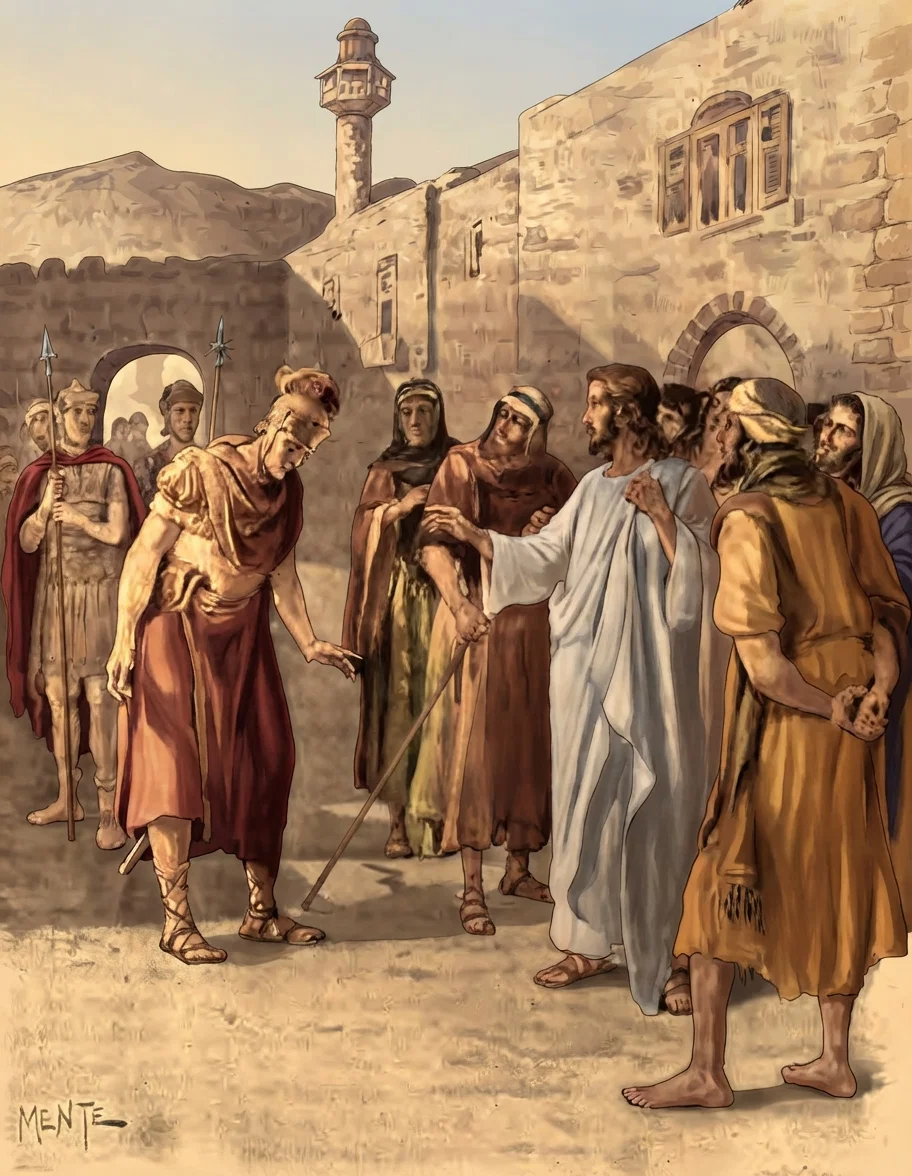
II. THE OMNIPRESENT WORD.

THE miracle recorded in the above scripture is often set down as the second of the miracles which Jesus wrought; but the record states that it is "the second sign that Jesus did, having come out of Judea into Galilee." It was the second miracle in that region. That He had wrought others is clearly indicated by John 2:23; 3:2; and 4:45. It is very evident that the thirty-six or more miracles which are recorded of our Lord are only representative ones, each containing some lesson peculiar to itself, and revealing some additional grace or power of the Master.
THE record of this miracle is very human on its material side. A Roman officer is at Cana whose son is sick at Capernaum. Evidently he had been summoned home by his son's sore sickness. The heart of the father is stricken with grief. The skill of physicians at Capernaum seems to have been taxed to the limit, without avail. The son is getting worse, and the father is almost in despair, when Jesus comes upon the scene.
THE fame of the mighty Wonder-worker had preceded Him. Many of the Galileans had been at the Passover at Jerusalem. They had seen the unrighteous buyers and sellers driven from the temple courts before the righteous indignation of the Galilean Prophet. They had seen and heard of the mighty signs performed. They recalled the transmutation of the water into wine at the marriage feast. And now the Master had come to Cana again. The Roman nobleman must have heard of these things, perhaps had indifferently regarded them as tales of a deceived people. To believe them he must himself witness them.
BUT now he is in sore need. How his national pride, his flimsy theories, fall before the specter of Death which hangs over his beloved son in that sick room at Capernaum! How frequently he who in health scoffs and jeers at religion, when sickness comes upon him, weeps and wails in his fear, and seeks the prayers of the very ones he has ridiculed. To the winds the Roman dignity and prejudice and philosophic unbelief is cast, and the proud Roman officer goes to Jesus, and beseeches Him to save his son, who is "at the point of death." Jesus reads the doubting heart of the father, and, in His goodness, opens it that the father may see. Therefore He said, perhaps using almost the aforetime words of the father: "Except ye see signs and wonders, ye will in nowise believe."
THERE was no outward manifestation of power, but the wonder-working word had probed to the depth the nobleman's mind. It had answered his lingering doubts by its revelation of his own feeling, and he turns to the Master almost vehemently, "Sir [or "Lord"], come down ere my child die." And the sympathetic heart of the Master of Life responds: "Go thy way; thy son liveth." The personal presence of the Master was not needed. His touch was not needed. No ceremony over the sick child was required. Jesus spoke, and the power of divinity was in His word, "Thy son liveth." And "the man believed the word,"—placed his own heart in harmony with it,—and went his way.
DOUBTLESS, in the beginning of his journey to Capernaum, the heart of that father must have been assailed with doubt. Not one soul delivered from bondage by the Master but must meet the attacks of the enemy. But He who had read his heart had said, "Thy son liveth." In that word he hopes against all the assaults of the enemy. He sees eager men approaching. In a little space he recognizes them as his own slaves. Their very manner gives him hope. They approach with the glad message, "Thy son liveth." Now the analytic mind will meet the doubts of the enemy, and he inquires when the boy began to amend,—he will even entertain a gradual work in the healing. The answer is that at the seventh hour (1:00 P.M.) "the fever left him," the very hour when Jesus said, "Thy son liveth; and himself believed, and his whole house."
"Go Thy Way; Thy Son Liveth."
JESUS is not personally present to heal our infirmities, but His word is ever potent. Let the fathers and mothers in Israel learn from this simple record that He hears earnest, importunate prayer. Are your children unconverted? Are they out of the ark of safety? Are they spiritually sick, with no human help or hope? Go to the Master. Put away the unbelief. Bow in His presence, and plead for His interposition to arrest the plague of sin which is eating away the life of your child. Plead, "Lord, help, ere my child eternallydie."
Will He hear? Did He hear the Roman officer of old? And He is "Jesus Christ the same yesterday, and to-day, and forever."

THE COMING FEDERATION.

EXTENSIVE plans are being laid, according to a press despatch of February 24, to the Washington Post, to hold a great interchurch conference on federation this autumn in Carnegie Hall, New York. Official delegates have been named by religious bodies with an aggregate membership of 20,000,000. "The conference is looked forward to by leaders in all bodies as the most important religious gathering this country has ever seen, since it will represent a co-operation of religious bodies which would have been impossible a few years ago." The object of the meeting, as set forth in the letter of its call, is political as well as religious:
We believe that the great Christian bodies in our country should stand together, and lead in the discussion of, and give an impulse to, all great movements that make for righteousness. We believe that questions like that of the saloon, marriage, and divorce, sabbath desecration, the social evil, child labor, relation of labor to capital, the bettering of the condition of the laboring classes, the moral and religious training of the young, the problem created by foreign immigration, and international arbitration—indeed, all great questions in which the voice of the churches should be heard—concern Christians of every name, and demand their united and concerted action, if the church is to lead effectively in the conquest of the world for Christ.
But, reader, the conquest of the world, or of a single heart even, for Christ, is not to be effected in that way. Federation in political matters is an evil sign, and spells spiritual declension. Thus has it ever been. The church of Jesus Christ makes only for righteousness when the whole aim is through the Gospel message to win souls to Christ.
An instance in the history of Israel of old furnishes a prophecy of the last days in Isaiah 8. God's professed people then thought that strength and stability could be secured by confederation of earthly forces. If Judah, Israel, and Syria could unite, what a promise this would be for safety, Ahaz thought. But the prophet warns:
"Associate yourselves, O ye people, and ye shall be broken in pieces; and give ear, all ye of far countries; gird yourselves, and ye shall be broken in pieces; gird yourselves, and ye shall be broken in pieces. Take counsel together, and it shall come to naught; speak the word, and it shall not stand; for God is with us." Verses 9, 10.
And such will be the end of every unholy alliance of the church of God, or every alliance on wrong principles, or for wrong or mistaken purposes. Sabbath or Sunday legislation is wrong, and will tend only to wrong.
The prophet continues, and gives God's instructions as to what not to do, and what to do:
"For the Lord spake thus to me with a strong hand, and instructed me that I should not walk in the way of this people, saying, Say ye not, A confederacy, to all them to whom this people shall say, A confederacy; neither fear ye their fear, nor be afraid.
"Sanctify the Lord of hosts Himself, and let Him be your fear, and let Him be your dread. And He shall be for a sanctuary; but for a stone of stumbling and for a rock of offense to both the houses of Israel, for a gin and for a snare to the inhabitants of Jerusalem. And many among them shall stumble, and fall, and be broken, and be snared, and be taken. Bind up the testimony, seal the law among My disciples." Verses 11-16.
Let the church of God set Him apart in the heart's holiest sanctuary; let her "fear God, and give glory to Him" (Rev. 14:6, 7); let her search out the sins, restore God's trodden-down truth, take her feet from His holy Sabbath (Isa. 58:13), and utterly reject all alliances which are not founded in the truth of His Word. Let all the churches unite, but then only in union of truth, in the union which Christ only can give, the union of the life and righteousness of God.

TWO RIPENING PROCESSES.

ON every hand is accumulating evidence that the wages of sin is death. Through sin death came into the world in all its varied forms. There are multitudes of immediate causes; but the cause of all causes is sin. The continual breaking of God's law gave us a broken character, a broken constitution; and upon this broken constitution earth's maladies are able to prey at will.
In years gone by, an occasional plague would sweep over the country or leave a windrow of its dead around the world, having found in some unsanitary locality a favorable breeding ground; but the great, dreaded malady of to-day—the great white plague—is local to almost all parts of the world, and other diseases which have been dominant only in certain localities are fast taking root, and making for themselves homes everywhere—planting their seeds for a great future harvest.
Great precautions are taken to-day in all lands against the spread of the most dreaded diseases; but consumption, bubonic plague, pneumonia, and the grip know no quarantine guards or have gone through them like a modern shell through an old-time frigate of the line. Insanity seems to have learned the passwords of all its enemies, and scuttles their defenses at will. For every foul seed thus sown a score come to harvest to carry on the devastating work.
All this is the fruit of sin. It is working out its weakening process in all parts of the earth. Amid the groans of the dying and the anguish of the sick, the fearful work of Satan is speeding to its end in the earth—and that end will come in the midst of the most terrible diseases. The work of sin is making fertile soil of the human family for the "noisome and grievous sores" that shall fall upon both man and beast, when the angels of God are pouring out the vials of His wrath upon an impenitent world. See Revelation 16. When that work of God is in progress, He reminds His children to watch, and to be ready for His coming (verse 15). It will be a sign to God's obedient children that He is at the door. It is blessed to know that even this strong, and increasingly strong, enemy can not triumph over the people of God at that time. The pestilence of those days will not be able to fasten itself upon them; for "He shall deliver them from the snare of the fowler, and from the noisome pestilence. . . . Thou shalt not be afraid . . . for the pestilence that walketh in darkness; nor for the destruction that wasteth at noonday. A thousand shall fall at thy side, and ten thousand at thy right hand; but it shall not come nigh thee." Psalm 91.
They who will stand in that day must also have passed through a ripening process; but it is a vastly different process—a vastly different experience—from that of which we have been speaking. The one class is ripening for ruin, the other is ripening for the kingdom through the grace and strength and special protection of Heaven. The one has followed its own ways; the other has been submissive and loyal to the expressed will of God, and has put no trust in the horses and chariots of self. Of these two ripening processes all will take their choice. They are doing it now—and the Judge is standing before the door. s.

RELIGION IN THE PUBLIC SCHOOLS.

WITH reference to this much-discussed subject, Bishop Satterlee, of the Episcopal Church, Washington, D. C., declares that it can not be kept down. "If we look at the history of England, France, Germany, and other European nations, and also America, we find it constantly coming up." He insists that "the Ten Commandments ought to be taught in the public schools," and says that "only the small minority of the American people will object to this teaching; for Hebrews, Gentiles, Protestants, and Romans all receive the Ten Commandments as the revealed law of God, without a shade of difference in belief among them."
Now we submit that any teacher, who should undertake to teach the Ten Commandments as construed by all these varying classes, would find several shades of difference, and that some of the differences amount to positive contradictions.
Another incongruous statement is, that "if the Ten Commandments are not taught in the schools, every child will grow up with the inevitable impression that on this account they must be less important than reading, writing, and arithmetic." This is incongruous because it implies that all these classes of religiousists are ignoring the teaching of these commandments in their churches and in their families.
When the family and the church entail their especial function of religious teaching upon the state, the state must have a recognized state religion, or undertake to teach all the conflicting religions that recognize the Ten Commandments in any form. In either event, it will be the state doing the work of the family and the church. Now, we would not detract an iota from the importance of the teaching of the Ten Commandments—it is all-important; and the pity is that leading churchmen are so willing to have the families and the churches shift the responsibility of it on the political state, of whose corruption there is such general complaint.
It is also clear that any people who are so careless of the Ten Commandments as to throw off onto the state their family and church duty to inculcate them, never will set the children a very marked example of commandment-keeping. And without this example, a perfunctory teaching of them by public school professors would have very little effect.
Furthermore, when the churches and professed Christian families get this all-important dutytransferred to the state, it will be easy and logical to transfer other religious responsibilities to the care of the same authority. And, as the state becomes laden with the religious function, it will be just as logical for the church to demand a controlling interest in state affairs, a demand that is already being made through the National Reform Association and the Bureau of Reforms at Washington, besides the demands by the Roman Catholics for support for their denominational schools among the Indians.
Yet Bishop Satterlee, and many others, maintain that "separation between church and state in this country is, and must be, irrevocable." He also declares that "the sense of justice is too strong in the American people ever to allow sectarian teaching to follow this concession, whereby the Jew would be made to feel he was being tyrannized over by the Christian."
It is already a fact, however, that in the states where the Fourth Commandment, according to the bishop’s construction, is upheld by the law, the Jew is made to feel that he is "being tyrannized over by the [professed] Christian." The appeal that "we should trust each other in a matter of this kind, regarding beliefs we all hold in common," has already been tested and found wanting. Men who want to have the government committed to their kind of religion, are not to be trusted very far by those who hold different views. More tyranny has grown out of the teaching of popular constructions of the Ten Commandments than out of any other source.
The Author of the Ten Commandments has laid more emphasis on the importance of teaching them than any man can do, yet He never has delegated that duty to the state, even under the theocracy of which He Himself was the head. Here is His direction in the matter:
"Thou shalt teach them diligently unto thy children, and shalt talk of them when thou sittest in thine house, and when thou walkest by the way, and when thou liest down, and when thou risest up. And thou shalt bind them for a sign upon thine hand, and they shall be as frontlets between thine eyes. And thou shalt write them upon the posts of thy house, and on thy gates." Deut. 6: 7-9; also, 11: 18-20.
Thus the Lord’s rule for teaching His law is for His recognized religious teachers to teach it to the people from His Word—not from men’s constructions; for parents to teach it to their children diligently; and for all His people to teach it, by precept and example, to the heathen. The Ten Commandments will not harm any public school; they will not harm anybody’s children, if taught as they are in the Word of God. But no state ever has done this, and no state ever will do it, in this world; for the reason that the people always have perverted the fourth commandment, and more or less of the others, before they began to ask the state to assume the duty of the family and of the church in the matter of teaching and enforcing religion. Then the state was asked to teach the perversions of a backslidden church, and not the pure Word of God. But no state, whose people have gone over to the traditions of men, can teach the Word of God in its purity; and no state, whose people have not so departed from God’s Word, ever will be asked to assume the teaching of religion at all. G.

D. K. R

1643.—"Lead Us Not into Temptation."
In your Question Corner of issue of February 8th you say respecting "Lead us not into temptation" that the idea is, "Do not let us go, Father, into temptation."
I can not seem to harmonize your answer to the party's question with truth.
I always thought the proper rendering for that expression is, "Leave us not in temptation."
If I am right a correction in your paper, I imagine, would be in order; if I am not right I wish to be corrected.
The Lord allows us to be tempted, but we do not wish to be left alone in it. He does not lead us into temptation.
Leave us not in temptation; but deliver us from evil.

D. K. R

The expression rendered "lead into" (eipherō) means to carry inward, and is rendered "bring" and "lead into." See Luke 5:18, 19, "bring in;" Acts 17:20, "bringest." No honest translation could give it the meaning of "Leave us not in temptation." The American Standard and regular Revised Versions, Rotherham, the Syriac, render, "And bring us not into temptation;" and so all we have examined. God is said to do sometimes what He permits to be done. There are those who court temptation. God can not keep such. The true spirit is, "Do not suffer me to be tempted; for I am weak." The prayer is an expression of the disposition we ought to cherish. Of course it is not the will of our God to leave one trusting child in temptation. 1 Cor. 10:13.

Habits and Longevity

Habits and Longevity.—Two men recently died, one at the age of 107 years, the other at 100. The first smoked and drank intoxicating liquors all his adult life; the second was an immoderate user of tobacco. Neither of them had been ill to speak of. Now all that this means is that these men had very strong constitutions, and survived, despite their wrong habits. Individual cases establish no rule. There are men who live most unhygienically, eat irregularly, gormandize at times, sleep and wake at all hours, are addicted to various vices, and yet live to very old age. No one for a moment believes that their wrong habits of life have contributed to this; rather, they have a strong constitution, able to withstand the destructive influences. Sometimes they labor hard, spend much time in the open air and sunshine, perspire freely, and drink much water. All these are large eliminators of poisons in the system. Others of weaker constitutions, but temperate lives, shut themselves away from air and sunlight, and die. Yet we know that right living is good for all. Many have given up the tobacco habit, and have recovered from many ills. Many have abjured tobacco and drink, and have become better in every way—physically, financially, mentally, morally. Almost invariably these are the results. But we know of no cases where one who was an abstainer was made better by indulgence in these things. And even those who lived long despite of wrong habits, would live fuller lives of cleanliness, purity, and fullness in God. We pity those in the bondage of these habits. Would God all were free. What a blessing it would be to the world.

Question Corner

1642.—Selling to Strangers. Deut. 14:21.
In Deut. 14:21 do you see a wrong principle involved where the people were commanded not to eat an animal that dieth of itself, etc., but were permitted to give it to the stranger or sell it unto an alien.
No; for no deception was used. They sold to the stranger what he was accustomed to use regularly. We recall an incident of school-boy days. A neighbor lost a yearling steer. When he was about to take its hide as the only thing of worth, and bury the carcass, an old German, a tenant in a house of the man who lost the steer, objected and insisted on buying it. He was told that it was unfit to eat, that it might poison him, etc., but he insisted on purchasing it, and it was sold to him. I have not been able to see that the man who sold it did a wrong to the old German. Nor did the Israelites if they sold it for what it actually was, as the scripture implies.

1644.—Did Jonah Die?

Will you please explain the second chapter of Jonah and Matt. 12:40? Was Jonah dead while in the whale's belly? It has become quite a discussion here. Some claim he was alive and others claim he was dead. W. N. G.
Does it not seem clear from Jonah's prayer that he did not die? Of course, in all reason he would have died, but God brought his life up from corruption. When his soul fainted, he remembered God, and the Lord heard him and answered. Matt. 12:40 refers not to the condition of Jonah, but to the time he was in the bowels of the sea monster, which might have been a whale, or some other “great fish.” We have no account in Jonah as to the time. It was in general three days, a day and night standing for continuous time, and three days and nights a general period of three days continuous from beginning to end, tho a part of the first and some of the last day may have been wanting. “The heart of the earth” may mean in the power of the prince of this world, who controlled the Roman power, even as Jonah was in the power of an agent of destruction.

1645.—Fathers and Children. Mal. 4:6.

What is the meaning of Mal. 4:6, the fathers to the children? A. C. B.
The message is a last-day message of which Elijah and John the Baptist were types. Under it God’s law will be restored, and the symbols of the sacrificial system will make the Gospel light shine clearer. A true, deep reformation will take place among those who heed the teachings of the message, which will take hold of the home life, reconciling and harmonizing—the hardest of all things to reconcile—family estrangements, jealousies, strife, and discord. Some good translations render “with” instead of “to.” For instance, Spurrell’s translation reads: “Behold, I send unto you Elijah the prophet, to precede the advent of the grand and the awful day of Jehovah; that He may convert the heart of the fathers together with the children and the heart of the children together with their fathers; lest I come and smite the earth with utter destruction.” God’s last great message must do thorough work.

1646.—Petitioning Congress.

Believing that the prophecy of Rev. 13:11, 18 means the setting up an image to the beast, by the passing of Sunday laws, and that this will be fulfilled, why send to our Congress petitions against such enactment? It seems to me that such work would be in vain.
Even tho we know evil is coming upon a land, it is the duty of God’s watchman to warn the people. See Ezekiel 33. Jeremiah knew that Jerusalem would be destroyed by Babylon, yet he ceased not to warn the king and the nation. The union of church and state, which forms an image to the beast in the light of the prophecy, is an evil thing; yet many esteem it good, and therefore will do all in their power to accomplish such union. Knowing this evil, is it not our duty to save such from it? Of course, such a union would in all probability result in the persecution of those who worshiped God instead of bowing to apostasy, but it is not to save men, or ourselves, from this persecution that we warn; for God will care for His own. Our protest is that we may save the men who would make such laws and who would thereby become persecutors, from allying themselves with the powers of evil. Therefore we petition, protest, remonstrate, plead, that souls may be saved and evil averted, or else the blood of souls will be found on our garments.

1647.—The Point of Test.

Was the point of test to our first parents upon appetite, or was it a desire to become like God? E. G. W.
The test was upon their faith—would they believe God, and learn by His Word the good, or would they believe the tempter and seek to become like God themselves. The strong desire to them was to become like God. The enemy entered through the avenue of appetite. The real test was on the matter of faith, “the obedience of faith.” The temptation came over ambitious desire through appetite.
Continue reading: Teaching in Church and Home