Your ShelfYour Projects

Signs of the Times, Vol. 33, No. 1.

A HAPPY NEW YEAR TO YOU

Signs of the Times

Jan 2, 1907

Pacific Press Publishing Company · Mountain View, California · Jan 2, 1907

"A HAPPY NEW YEAR TO YOU."

The artist pictures the dying Year With a form that's bowed and old, His crown is faded, its leaf is sere, And Death's dark robes enfold; But the New Year comes as a fresh-browed child, Bright-eyed and fair and true, And the artist pictures sweet Hope in him, And giveth the Year to you.
O better! Better! 'Tis God that gives. Erasing the bitter past, He covers it over with crystal snow, Ay! covers it deep and fast. Then under the radiant New Year's morn, Asparkle with gems like dew, He opens a Rose from the stem of thorn, And giveth Love's hope to you.
"A Happy New Year! A Happy New Year!" Cry a million voices sweet, And faint and far to the fine-trained ear, Comes an infinite pure repeat,— Echo on echoes sweet and high To the Throne beyond the blue. Do you hear the angels singing it down?— "A Happy New Year to you."
O, not a year like the years now past, Garnished with tears and sin. You've learned the lesson of trust at last; For the New Year's sweeping it in. You've learned the lesson of love benign, You are one with the Will so true, So life to its end will be made divine,— "A Happy New Year to you."
Yes, when the death-damp's on thy brow, Yes, when the race is done, When the "Finis" comes to the little "Now" And we close up volume one, Another Book will be opened then For the infinite great TO BE, And angels sing with the saved of men, "A Happy eternity."
FRANCES EUGENIA BOLTON.

"Sealskin"

It is not often that we select any one Bible and give it the prominence we are giving the one here shown, but our judgment on many years' experience in the Bible business is that it is worthy of it.
Actual Size 6 7/8 x 4 3/4 x 5/8.
It is printed on the celebrated Oxford India paper.
It is only 5/8 of an inch thick.
The type is clear-faced minion.
The chapter titles are in figures.
It contains references and twelve maps.
It is bound in genuine sealskin and is kid-lined.
It is sewn with silk and has silk head-bands and marker.
It is guaranteed to be absolutely perfect in every respect or your money will be promptly returned.
It is the lightest, thinnest, most beautiful, as well as the most durably-bound, Bible published.
In ordering, call for "Sealskin." It will be sent with charges prepaid, on receipt of $4.50.
PACIFIC PRESS PUBLISHING COMPANY, Mountain View, California.
285 Salmon St., Portland, Ore.
1109 East 12th St., Kansas City, Mo.

Signs of the End

Needless to say we are sending the hundred additional copies that this good work may continue.
The value of this number is most appreciated by those who have studied the article entitled, "Signs of the End" it contains. This is a word-picture, so to speak, of the conditions in the world at the present time, and a presentation of the great prophecies which make clear the meaning of these conditions.
Think for a moment of the possible results of its circulation.
For seventy-five cents you can supply twenty-five homes with this number.
For $1.50 fifty homes can be supplied.
For $2.50 one hundred homes may be blessed with the spiritual food it contains.

Help Circulate the Message

This issue will not be reprinted. A few more good orders will transfer the few hundreds of copies left from our shelves into the hands of those who are waiting for the message the paper contains. Do you wish to help in making this transfer at once?
Address either your tract society, or SIGNS OF THE TIMES, Mountain View, Cal.

SIGNS OF THE TIMES:

"Your kind letter of the 28th received. I am glad to state I have just sold the last one of the five hundred Special SIGNS sent to me. I find they sell readily, and most people note at first sight that it is a fine paper. I have had rich experiences in selling them, and I praise the Father for the grand privilege of thus spreading the precious truth. I wish I had a hundred or so more to sell here. I sold the five hundred papers in less than six days. You may send me a hundred more if you like."
"Please find enclosed twelve dollars and fifty cents for the five hundred you sent. Accept thanks for the tract list you enclosed."
"Yours truly,"

SALE OF SPECIAL "SIGNS."

It has been stated several times in this column that the special "Coming of the Lord" number of the SIGNS continues to sell readily.
We have many reports to this effect, and believe you will be interested especially in the following letter dated December 12. This is from a worker in a large Southern city:

BACKWARD, INWARD, FORWARD.

Some New Year's Thoughts

A LONG journey on a level plain is wearisome. It is more restful to climb steep hills occasionally, if for no other purpose than to look back from their elevation over the road already traversed, and to look forward to the things we must meet in our onward journey. Such an outlook is the close of the Old Year and the opening of the New.
THE only proper standard by which to judge of the past, the present, the future, is authentic history and present conditions, illumined by the truth of God's Word, which also sheds certain light on the future. The Author of that Word declares: "I am God, and there is none else; I am God, and there is none like Me; declaring the end from the beginning, and from ancient times things that are not yet done; saying, My counsel shall stand, and I will do all My pleasure." Isa. 46:9, 10. It is well to take God into our reckoning. If we follow our own standards, if we discern by the light of our own faint, flickering tapers, if we measure by the rules of the present age, ever boastful of its attainments in knowledge and righteousness, we shall go fearfully astray.

A Brief Review of the World.

IN the light of His Word and known events let us review the world and its events of the past year.
PHYSICALLY, the year has often recalled the words of Christ, "men's hearts failing them for fear, and for looking after those things which are coming on the earth." Luke 21:26. At the very beginning of the year the seismic ague seized the earth in Mexico, extending as far north as Missouri and Kansas. Floods followed, doing serious damage. A little later—still in the first month, northwestern South America was shaken, many villages destroyed by a shock lasting seven minutes, and two thousand were reported killed in Colombia and three hundred in Ecuador. The next great calamity was the months of fearful famine in Japan, and synchronous with this the fearful belching of Vesuvius, burying cities, towns, and villages, causing the loss of hundreds of lives, and millions of property. In that same short month of February the West Indies were twice visited with earthquakes, destructive to life and property, and cyclones and tidal waves swept Society Islands and the coast of Colombia. March witnessed successive earthquakes in Formosa, resulting in the loss of more than six thousand lives. Then followed the California calamity with its millions upon millions of loss from earthquake and fire, and deaths reaching not less than two thousand. North China was the next sufferer with great loss of property and life; famine followed in China, the Philippines, Russia. In August Chile's metropolis was shaken to the ground, and other towns ruined, the loss of life numbering from three thousand to five thousand. We will not pause to note the awful fires, cyclones, floods, shipwrecks, train wrecks, mine explosions, in which the aggregate loss of life numbered thousands, and the loss of property, untold. It has been a fearful year to the palsied earth.
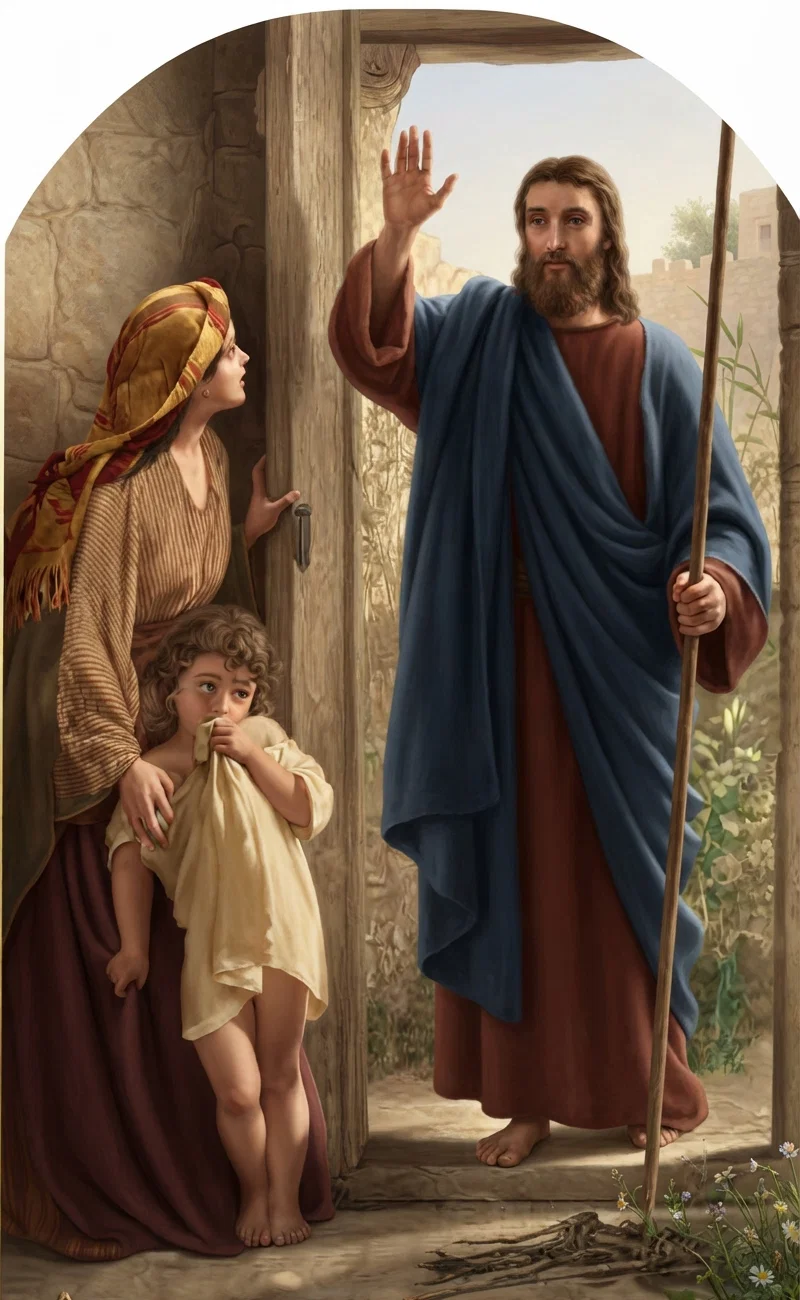
Peace to This House.
POLITICALLY the world has seen little change, but a great deal of unrest. The great Orient is making progress in warlike preparations with leaps and bounds, and is one of the unsolved problems to the Western nations. Russia has been in a state of perpetual unrest, seething with revolution, preying upon the very heart of the autocracy. The people are training rapidly, and it looks as tho the Romanoff dynasty was nearing its end. The Papacy, while strengthening its power in the United States and Germany, has lost influence in France, where she is in a life-and-death struggle with the State over her establishment, with the State, at this writing holding the upper hand. The Old Year closes his record with the national outlook as unsettled as ever, with great problems unsolved, with still greater looming in the offing.
PROGRESSIVE the year has been, measured by worldly standards, in research, education, discovery, invention. Financially, notably in the United States and Germany, there has been prosperity to certain classes and enormous increase of wealth to the nation at large. But prosperity intellectually and financially without corresponding increase of recognized obligation morally is of questionable worth.
MORALLY, the year can not be said to have made great advancement, unless increased revelation of wider spread moral turpitude is evidence of a better condition. So some are inclined to solace themselves. There has been revelation of graft, defalcations, crime,iniquity, vice, moral obliquity in high life and low till the country is flooded with the turbid, fetid tide, the moral sensitiveness of the people is blunted, and the mass have become indifferent. The condition is a fearful one, and the outlook is appalling. Efforts to punish suppress for a time some particular manifestation of criminal greed, changing the form but not the fact. They do not extirpate the ebullient fountain, the selfish, greedy, carnal heart of man.
RELIGIOUSLY, the year has been one for serious thought. It has been marked by no great revivals. The effort to federate the great Protestant churches has gone on apace. The Roman Catholic Church is making marked progress in federating all Catholic societies, lay and religious. But it is a notable fact that both of these efforts are for more influence upon political and public life, not for more power to reach souls for whom Christ died. It is a Gospel fact that the light of the world and the salt of the earth is the church of Jesus Christ; but her saving power lies not in social forms, political power, or social schemes. Advancement in spiritual life is not shown by increase in numbers, in wealth, in great institutions, in worldly and political influence. All these may be manifest, and are; but they are not evidences that the church knows more of Christ or possesses more of His power. Neither are federation and co-operation such evidence. There is a federation which counts as non-essential the plainest truths of God, and puts expediency of man above the truth of God. The only true union is individual life-union with Jesus Christ by faith through God's word. But true advancement in spiritual life is marked, has always been marked, by greater humility, greater self-denial, greater devotion and consecration; clearer separation from worldly aims, policies, principles, methods; more of the power of godliness in transforming men from the influences of selfishness to the likeness of Christ; and bringing forth in saved men the fruits of the Spirit instead of the works of the flesh.
EVIDENCES of progress in the spiritual life are manifest in greater regard for the word of God, greater reverence for His name, greater boldness in speaking His word, greater devotion to Christ Jesus and all the commandments of God. Less laudation of men and more prayer and praise to God, mark the growing church. But do we witness these evidences to-day! Nay, from the standard of God's word in Christ Jesus we know we do not. The very union the divided church is most earnestly seeking is for the purpose of securing political power to promote or protect institutions for which she has no Scripture warrant, or for which she lacks the Spirit's power to witness. The charity she seeks is that which will cloak the infidelity of higher critics rather than that which "rejoices not in iniquity, but rejoices in the truth." Thank God, there are many faithful souls in all the churches who are seeking, hungering, thirsting after God, and whom God is helping.

The Future.

WHAT the future has for us God's word has plainly delineated. Sad as it is to pen the sequel to all the present sad conditions, we dare not do otherwise. The inevitable logic of facts, the history of all the past, as well as the "more sure word of prophecy," show what is sure to follow the backsliding of the Church and her union with the world. She will seek more and more political power till the union of Church and State is again effected and all its concomitant persecutions of the Dark Ages are upon us; and the persecuted will be those who do God's will. The unparalleled corruption and extravagance of the nations betoken, as they always have, disintegration and destruction. Joel 2 and 3; Revelation 13, 14, 17, and 18; Matthew 24; Luke 21; 2 Timothy 3 and 4; and many other passages show that we are living in the last days, and that the Master's coming is near, "even at the doors."

The Present Duty.

ARE we discouraged?—Not at all. Are we pessimistic?—Verily not. God lives and reigns. Jesus Christ died for men, died for all, lives for all, pleads for all, opens His great storehouse of grace for all. The great question for each and every soul to ask is, How do I stand with respect to all these things? Am I a child of God? Have I been born again? Do I love Him with all my heart? Am I making progress spiritually, morally, heavenward? Let the light of God into the heart. He invites you to invite Him in. He sends His warning message to you, to all the world. It will do its work. It will gather to Him every willing, longing soul who hates sin and longs to be free; who loves righteousness, and longs for the righteousness of God. Upon them He will pour out His Spirit more abundantly than the church has ever known, not excepting the day of Pentecost. Few tho they be in number, unpopular in the world, the power of God will be with their message, for it is His message. And they will triumph gloriously over the beast and his image, his mark, and the number of his name, triumph gloriously in the Lord Jesus Christ.
READER, in the beginning of this New Year, 1907, open your heart and let the Saviour in, whatever others may do. He will come into your hearts with His message of peace, even as He sent His disciples of old. Let Him speak the message of peace and purity and power. Let His light shine through you to others. So 1907 will be to you, what we most earnestly wish, a HAPPY NEW YEAR.

God’s Diagnosis and Remedy

SOMETIME humanity will learn that God's diagnosis of its true condition is absolutely correct, and that all prescriptions of human theorizers, based on other conditions, are absolutely futile and worthless. Spiritual doctors, like some doctors of medicine, treat symptoms rather than conditions, and endeavor to cure by ameliorating effects rather than removing causes. God reveals humanity's true condition as without hope, alienated from the life of God, corrupt and corrupting. His remedy for it all is designed to meet just those conditions and cure them. He cleanses the fountain rather than endeavoring to filter the water; He uproots the deadly upas-tree of sin rather than seeking to destroy its fruit. He, and He only, can take the poor, wretched sinner and make him to the praise of the glory of His grace. All this to every soul in response to simple, childlike faith.

BARNACLES OR BALLAST—WHICH?

THERE are many good souls who are always worried and troubled over their burdens. Sometimes these burdens are infirmities of body, perhaps long and sore sickness. Sometimes it is having sickness in one's family. Sometimes on the part of a Christian man it is a wife who is not spiritual, who does not sympathize with him or his work for God, who demands unduly his attention and service, who in one way or another would lead him to compromise principle or violate conscience. And sometimes a wife is similarly circumstanced. Sometimes it is but the little untoward incidents of life that lead to self-sympathy and selfish mourning.
Now God suffers all these to come; and it rests with us as to whether they shall profit us or not. Shall they be to us barnacles or ballast? Shall we have them inside or outside? Shall they prove helpful or hindering?
"Behold, the ships!" they have their lessons. You have seen some noble craft carrying full sail or steam, with easy load, barely creeping along a smooth sea, making, perhaps, but three to five knots an hour. What is the matter? Her bottom is "foul;" she is covered with barnacles. Millions of little crustaceans, or shell-fish, have fastened themselves to that part of the ship below the water, forming great rough, irregular masses and protuberances which greatly impede her progress. That ship needs to go into dry-dock and be scraped and cleaned. It is poor seamanship to go on in that way, if possible to prevent it. And we would call it worse still if all that mass of barnacles was broken from the ship and piled on the deck till the ship became so top-heavy that she foundered in the first storm. Yet there are human craft that do that very thing.
Again, you see a clean, beautiful boat tie up to some wharf and take on tons and tons and tons of worthless rock, stowing them away in the deepest part of the hold. She sinks lower when she leaves the wharf than when she came, and you wonder why she loaded up with stone. The secret is revealed when she meets the severe storm at sea. Then she rides safely. That worthless stone is ballast, needed to keep her upright, or to enable her ever to right herself in time of storm.
It rests with us to say whether our burdens shall be barnacles or ballast, whether they shall hinder or help. It rests with us whether they shall, in self-sympathy or boastfulness, be exploited as great burdens and prove our destruction, or whether we shall let them come clear down into the secret places of our hearts, taking them as permitted of God, perhaps precious burdens sent of God, but, by His grace, always blessings, to keep us humble and upright; yea, lodestones through which the magnetism of His goodness draws us upward and onward to the eternal goal.
O, to learn the lesson, "We know that to them that love God, God worketh all things with them for good!" Shall the burden be barnacles or ballast?

1964.—When Do They Apply?

Do the following prophecies refer to the past, or are they yet to come? Dan. 2:34; Rev. 17:16; 18:8.
Dan. 2:34 is yet in the future. Christ's kingdom is not yet set up. We know there are those who say it was set up at the time of Pentecost, but this is mere assumption. He will not take His kingdom of glory until He closes His work as high priest and comes again. "When the Son of Man shall come in His glory, and all the holy angels with Him, then shall He sit on the throne of His glory." Matt. 25:31.
Rev. 17:16 is yet to be fulfilled, and will come at the time when God's judgments are falling upon the sinful world, when the kingdoms of earth, represented by the ten horns, are undeceived; when they see that all their hopes of earthly power are dashed in pieces, they will turn upon the deceiver and fulfil the prophecy there given. At that time also Rev. 18:8 will be fulfilled,—"Therefore in one day shall her plagues come, death, and mourning, and famine; and she shall be utterly burned with fire; for strong is the Lord God who judged her."

1965.—Hating Relatives. Luke 14: 26.

Please explain Luke 14:26.
Let Matt. 10:37 explain Luke 14:26, the latter text reading: "If any man cometh unto Me, and hateth not his own father, and mother, and wife, and children, and brethren, and sisters, yea, and his own life also, he can not be My disciple." Matt. 10:37 reads: "He that loveth father or mother more than Me is not worthy of Me; and he that loveth son or daughter more than Me is not worthy of Me." "Hate," as used in Luke 14:26, is to be understood in the sense of loving less; in other words, looking at it from a purely selfish standpoint, one is to love Christ with such ardency and devotion that if the Lord called him to break all earthly ties he would do it, and then the world would say that such a man hates his friends instead of loving them. In other words, God's interests should be first; so much so that no other interests should dominate it in any way. The truth is that he who loves God loves his brother also; and the man who truly loves God, whatever the Lord asks him to do and he does it, still loves his relatives and fellow man better than he ever could love them apart from God.

1966.—Garments and Wine-Skins. Mark 2: 21, 22.

Kindly explain what is meant by this parable in Mark 2:21, 22.
The passage reads: "No man seweth a piece of undressed cloth on an old garment; else that which should fill it up taketh from it, the new from the old, and a worse rent is made. And no man putteth new wine into old wine-skins; else the wine will burst the skins, and the wine perisheth, and the skins; but they put new wine into fresh wine-skins." This can be better understood by a knowledge of the terms used. "Undressed cloth" is unfulled cloth, cloth that has not been shrunken. Any one who understands what this means knows that in the shrinking and thickening and fulling of cloth it becomes smaller. Placed on an old garment with its weakened fabric, and the very fulling of the cloth would tear the worn garment and make the hole larger. Bottles anciently were skins of animals, sometimes drawn off whole with the exception of the head and legs; these were tied up and the wine was placed within the skin. If the wine fermented, the skins stretched. New wine was always put in new skins. If it were put in old skins, those which had become hard, the skins would not expand with the wine and would burst, and the wine would be spilled.
The teaching of Jesus was like the undressed cloth and the new wine, in that there was life and strength in it. The Pharisees were themselves like the old cloth and the old bottles. They could not receive Jesus' teachings. Their necessity was set forth by our Lord to Nicodemus, "Ye must be born again." Just as long as they remained in their then condition, the truth as preached by Christ could do them no good. Their own moral fabric was so weak that to place a patch of truth upon it would only make matters worse. Their souls had become so dry and hardened with formalism that to pour the new wine into them would cause them to break and perish. The new cloth must go upon new cloth, that which would respond to it; the new wine must go into new bottles, those which would expand with it. So the teaching of Christ must find men with minds new-created by giving themselves to God. This does not mean, however, that their cases were hopeless; they could have so fallen upon the Stone that they could have been made new.

1967.—Judging Not. Rom. 14: 2, 3.

Please explain Rom. 14:2, 3.
Read from the first verse from the American Revised Version: "Him that is weak in faith receive ye, yet not for decision of scruples. One man hath faith to eat all things; but he that is weak eateth herbs. Let not him that eateth set at nought him that eateth not; and let not him that eateth not judge him that eateth; for God hath received him." The whole sum and substance of these verses and of the whole chapter is that we are not each other's judges, that when God's children have accepted of the faith of the Lord Jesus, as set forth in the previous chapters,—in other words, when they have found the righteousness and peace and joy in the Holy Spirit that comes by believing in Him,—they are not to sit in judgment upon each other over minor matters. This does not preclude teaching a better way, but it does preclude a condemnation. The real core of the chapter is, "Let us not therefore judge one another any more; but judge ye this rather, that no man put a stumbling-block in his brother's way, or an occasion of falling." "For we shall all stand before the judgment seat of Christ." The rest of our querist's questions we must leave until another issue.

1968.—Election of Church Elder.

Give a brief outline of the work of electing and qualifying a church elder.
We state the simple custom as practised by those who follow simple methods, which is as follows: On such an occasion, an ordained minister should be present. The qualifications of an elder should be presented as set forth in 1 Tim. 3:1-5; Titus 1:5-9. It will not be possible to find any one person having all these qualities in perfection; some of them may be wanting, yet if the wisdom, good judgment, devotion to God, and spirit to know and do God's will is there, there is no reason why a good man meeting with these requirements generally should not be chosen, and chosen by the church. Such a one should be without reproach; he should be an honorable, square man in his business, temperate, sober-minded, orderly, given to hospitality, one able to instruct others; he should not be of a brawling nature, nor one yielding to a hasty temper; he should not be a covetous man; and, if possible to find one, one ruling well his own children. The church having selected such a one unanimously, the minister should call him forward before the people, set before the church and him the solemn duties and responsibilities resting upon each, and then set him apart to that sacred office by prayer and laying on of hands.

1969.—Higher Powers. Rom. 13: 1, 2.

Please explain Rom. 13:1, 2.
Rom. 13: 1, 2 reads: "Let every soul be in subjection to the higher powers; for there is no power but of God; and the powers that be are ordained of God. Therefore he that resisteth the power, withstandeth the ordinance of God; and they that withstand shall receive to themselves judgment." This department can not discuss this to the extent that it might be profitably considered. We would simply say that the powers here referred to are evidently rulers placed in authority; and those who are in authority are under God's providence, just the same as the Lord in Jer. 25:9 calls Nebuchadnezzar His "servant." As expressed in the fourth chapter of Daniel, "the Most High ruleth in the kingdom of men, and giveth it to whomsoever He will." But these "powers" are placed in authority, not to take God's place over the conscience, but to rule in things civil. Jesus said, "Render unto Cæsar the things that are Cæsar's, and unto God the things that are God's." The higher powers have to do only with those things which belong to Cæsar. So while the Lord declares in Jeremiah 25 that He has given His servant rule over the world, and the same thing is stated in Daniel 4, yet when Nebuchadnezzar arrogated to himself the power to control conscience and to command God's servants to worship the false deities of his own religion, the Lord justified them in refusing to do it. See Daniel 3. God requires His children to submit themselves to every ordinance of man for the Lord's sake; but when these ordinances conflict with one's duty to God, in the language of the apostle we can say, "We ought to obey God rather than men," and "whether it be right in the sight of God to harken unto you more than unto God, judge ye." See also 1 Peter 2:13-17. Notice also that this passage, very similar to that in Romans, closes with "fear God; honor the king." God must come first; after God, submit unto all ordinances of men for the Lord's sake.

1970.—From What Does the Roman Catholic Church Date Its History?

From the time of Christ. They claim that the church was founded by Peter. Christ set apart Peter in the text, "Thou art Peter, and upon this rock will I build My church." Of course, we know, and every one knows who has even a knowledge of the Scriptures and the Catholic Church at the present time, that the church of Rome differs fundamentally, emphatically, and widely from the New Testament church. Still, with her system, if she did not make that claim, she would have no foundation whatever. She was forced to make the claim in order to present any proof for her rightful existence.

1971.—The 144,000.

Is the 144,000 constituted of those who have died in the faith, together with the living? Are they resurrected before the general resurrection? Or is it just those that are alive when Christ comes?
To our minds they are those who are alive when Christ comes, with, perhaps, a few others who have been of special prominence and have had special experience in God's sealing work. As to an absolutely definite conclusion, we have none to present. The most important thing, isn't it, is to so serve God that we may safely leave with Him all questions as to the place of His servants hereafter.

THE GREAT SALVATION

GUARDIAN ANGELS.

Man's Helplessness and Need.

"The angel of the Lord encampeth round about them that fear Him, and delivereth them." Ps. 34:7.
WHAT is the necessity of angelic ministration? We are told that man, in the beginning, was created "a little lower than the angels," or "a little while inferior to the angels." Man's fall precipitated him to a plane physically, mentally, and morally much lower than that upon which he was placed by his Creator. This condition emphasizes the necessity for angelic ministration and protection. The utter helplessness of mortal man is only the strongest appeal to the Source of all strength for the companionship and guardianship of angels of might; for, if left to himself, he would sink to rise no more under the fierce assaults of the powers of darkness.
While angels are not on an equality with Christ, yet there is no occasion for discouragement to us in this fact, for they are ambassadors of the Government of Heaven, and as an ambassador of an earthly government has all of the strength of the nation which he represents vested in him, so, when God commissions an ambassador to come in behalf of His children from the courts of glory, He clothes him with all the strength sufficient for his mission. Therefore they are called "angels that excel in strength."

Examples of Power.

For our encouragement let us consider some examples of the work and strength of these ambassadors of the Great King. In the darkest hour of this world's history, when the lifeless form of the Son of God lay in Joseph's new tomb, with a strong guard of Roman soldiers keeping vigil, and doubtless a larger detachment of Satan's legions to hold Christ fast in the embrace of death, the moment having come for loosing the "pains of death," we are assured that A MAJESTIC ANGEL WAS SENT on lightning wing from heaven to the tomb, with the result that the soldiers "became as dead men," and the minions of Satan were scattered like chaff before the blast. The angel addressed the words of God to the lifeless form within the sepulcher, the life-current from God permeated every fiber of His being, and He came forth, victor over death and the grave, to live forevermore, and to impart eternal life to all who accept salvation through Him. Can we conceive of the power exercised by this ambassador?
During the earthly life of the Saviour, He had the constant companionship of angels, and when He was apprehended in the garden He assured His persecutors that even in that critical moment He could summon to His assistance more than twelve legions of angels. Does the Father grant to every trusting child the same protection that was vouchsafed to His Son?—We are assured that "the angel of the Lord encampeth round about them that fear Him, and delivereth them."
Take an example of the fulfilment of this promise. When Hezekiah was king of Judah, Sennacherib, king of Assyria, sent an army, whose numerical strength was above one hundred and eighty-five thousand valiant warriors, to besiege Hezekiah's capital city—Jerusalem. The commanding generals of the Assyrian army defied the armies of Israel and Jehovah the God of Israel, and exalted the strength of false gods, in whom they trusted; but Hezekiah inspired with courage the hearts of his fearful soldiers with these words: "Be strong and courageous, be not afraid nor dismayed for the king of Assyria, nor for all the multitude that is with him; for there be more with us than with him; with him is an arm of flesh but with Us Is the Lord Our God to Help Us, and to fight our battles. And the people rested themselves upon the words of Hezekiah, king of Judah."
When this godless and bloodthirsty army was preparing for the onslaught, Isaiah likened God's people to an innocent and gleeful maiden, standing safely and confidentially in the presence of a raging foe, and laughingly shaking her head in defiance of his fierce threats and violent demonstrations. The battle which followed was short but decisive. Against the Assyrian legions one angel only was sent from the army of Heaven. The history of the conflict is told in few words. Inspiration graphically describes the battle-scene. "The angel of the Lord went out, and smote in the camp of the Assyrians an hundred fourscore and five thousand." Byron portrays the scene thus:
"Like the leaves of the forest when summer is green, That host with their banners at sunset were seen; Like the leaves of the forest when autumn hath blown, That host on the morrow lay withered and strown. "For the angel of death spread his wings on the blast, And breathed in the face of the foe as he pass'd; And the eyes of the sleepers waxed deadly and chill, And their hearts but once heaved, and forever grew still!"
Truly, "the angel of the Lord encampeth round about them that fear Him, and delivereth them."

Deliverance of Daniel.

Daniel, the beloved of the Lord, was once in special need of angelic deliverance. A royal decree secured by his jealous fellow statesmen and signed by Darius, the king over the mighty realm of Medo-Persia, had unalterably consigned any one who would direct any petition to any god or man save the king, for a period of thirty days, to a den of hungry lions. Daniel knew that the decree was signed, but he prayed as "aforetime" to the God of Israel. Satan's agents, on the alert, saw the man of God engaged in becoming devotions. With inward joy inspired by their master, they hasten to the king, who sees too late his folly, and tries to deliver the most faithful man in all his realm. The demands of an unjust and unalterable law are pressed. The king yields; Daniel is precipitated into the den of ravenous beasts of prey.
The king, returning to his palace royal, spends the night fasting, without instruments of music. At this juncture we can imagine an unusual stir in heaven. Angels that excel in strength were eager to hasten to the assistance of faithful Daniel. Finally the word came from the throne, "Go." Away sped the messenger on wings of light. God's train always arrives on time. The angel's presence locks the mouths of the fierce lions, and makes the den more pleasant than the king's palace without such companionship.
At early dawn the king hastens to the mouth of the den and in lamentable voice calls to Daniel. A familiar voice calmly but joyfully greets his ears from the lair of the lions: "My God hath sent His angel, and hath shut the lion's mouths, that they have not hurt me." Again the promise is verified, "The angel of the Lord encampeth round about them that fear Him, and delivereth them." Satan is out-generated. His agents fall into their own snare. They are, by order of the king, cast into the den where Daniel had passed the night safely, "and the lions had the mastery of them, and brake all their bones in pieces or ever they came at the bottom of the den."

FORGETFULNESS THAT IS REMEMBERED.

SELF-REMEMBRANCE is a sure poison. It stunts our growth, and blocks our progress, and destroys our usefulness. And to be always thinking about ourselves is the surest way to help others to forget us.Some one has gone to the very heart of the matter in the saying: "Once in a great while a man forgets himself into immortality." For when a man cares more about every one else in the world than about himself, the world is not going to forget him. That is one reason why the name of Christ grows greater with every passing year. It is the Christ-way; and this recipe for immortality is only another way of saying that men may find life by losing it.—Sunday School Times.

WHY CARRY THINE OWN BURDEN?

WHY carry thine own burden Day by day? Why through the thickest shadows Take thy way? A Saviour is beside thee, A loving Friend would guide thee; Therefore, pray.
Why art thou made so hopeless By thy sin? The Lamb of God has borne it, Let Him win Thy faith in His salvation, Thy trust in His oblation, Peace within.
Why are the days so shadowed By thy care? Why do thy fears pursue thee Everywhere? The dread of each to-morrow, The pressure of all sorrow, Let Christ bear.
Why art thou so forgetful Of His might? Hast thou not learnt love's lesson Of delight? Thy sin and care and sadness Will vanish in the gladness Of His light. —Marianne Farningham.
Continue reading: THE LIFE OF THE NEW MAN