After nearly a week's stay at Singapore, I started, January 6, for Padang, west Sumatra, to visit Brother Munson. As there is no railroad across Sumatra, I had to cross Batavia, Java, opposite the southeast point of Sumatra, and then sail along the southwest coast of Sumatra to Padang.
Java, where I spent two days, is one of the most densely populated parts of the earth. This island is six hundred miles long, and probably does not average much more than one hundred wide, but it has a population of more than twenty-five millions. The natives are of the Malay race, and are mostly Mohammedans. This island, like many of the East Indies, is under the government of Holland.
From Batavia to Padang the passage was made in a Dutch steamer. I have had great difficulty in different parts of the world to get proper hygienic food, but never before such trouble as I had in these Eastern islands. There being no lodging-houses, I was obliged, when on shore, to put up at hotels. While these were very fine, and the accommodations high-priced, there was scarcely a thing that a hygienist cared to eat. A meat eater could get a variety; but take away the flesh food, and there was little left. My first difficulty was to make myself understood. Not being able to speak the language of the country, I had to take what was on the table, or go hungry. My next trouble was the time of meals. The heavy meal of the day, and the one that furnished the best variety from which to select, was the dinner, which was served between eight and nine in the evening. Of course I could not think of eating at that unreasonable hour. In the morning I had a good appetite; but of course the people who had the night before partaken freely of half a dozen kinds of meat, rice, pickles, and curry (which was like liquid fire), and had drunk two or three bottles of beer, had little or no appetite. For this reason the breakfast was but a mockery, there12being generally nothing on the table but that some exceedingly white bread, strong butter, some cold meat, a cup of tea, with perhaps occasionally some jam or jelly.
And even this poor trash was not served generally till eight or nine o'clock. Occasionally, however, I was able to get some soft-boiled eggs to help out.
The second meal, or tiffin, as it was called, was served from twelve to one. Of course the poor stomach had not finished its work of digesting the breakfast; but this meal must be taken now, or a person must wait till the next morning. Outside of the hotels, nothing could be obtained except at Chinese shops, and that was not to be even thought of. Many times I made my second meal of bananas, there being often no other fruit to be purchased. In all these Eastern countries food is prepared and eaten with most fiery condiments, the very taste of which drew from my eyes floods of tears. When I saw the wretched trash eaten by the people, I ceased to wonder that their poor, ill-nourished bodies clamored for stimulants — tea, coffee, and alcoholic liquors. And when I saw all their health-destroying habits, I ceased to wonder that the people were morally bad. And never before did I see as now the value of the blessed health reform which God has given to us.
After leaving Batavia, we sailed along the southwest coast of Sumatra, stopping at different points to discharge cargo. The general appearance of Sumatra is not unlike that of tropical islands in other parts of the world. The island is one thousand miles long, its greatest width being two hundred and fifty miles. The population is three million. The inhabitants are principally Malays and Bataks. The latter are wild and fierce pagans, and reside in Batakland, toward the north part of the island, and in the small islands off the west coast. I am told that German missionaries are doing good work among them. As the missions were in the interior, I was not able to visit them without heavy expense and much loss of time.
The Malays, who make up the great bulk of the population, are Mohammedans. Their religion was first introduced here in the beginning of the thirteenth century, and has since spread over a large part of the East Indies. Wherever there is a collection of Malays, there is a prayer-house, or, as the larger ones are called, a musjid, or mosque. The British and Foreign Bible Society is doing commendable work in placing the Holy Scriptures among them, but with little apparent result.
Very few Mohammedans ever accept Christianity. But after seeing the treatment they receive from professed Christians, I am not surprised at their slowness to receive it. In their estimation, Christianity is synonymous with idolatry, greed, cruelty, and bloodshed. But God's last message will find some adherents even from among this people. At one place I was told by an intelligent man that the Mohammedans have a tradition that when the Turks leave Constantinople, then Christ will come to earth again.
The products of Sumatra are varied. Of minerals, there are gold, tin, lead, coal, marble, and slate. Vast forests of valuable timber, including teak, are found. Gutta-percha, rattan, and capoc are exported in considerable quantities. Among the articles of consumption are rice, coffee, sugar, copra, tobacco, quinin, vanilla, pepper, ginger, nutmeg, and cloves. There are several native fruits which are peculiar to the East Indies, as the durian, angosteen, rambutan, pumbaloo, rambeh, jamboo, etc.
In the jungles, a little back from the coast, are found lions, tigers, elephants, rhinoceroses, tapirs, bears, orang-outangs, monkeys, wild pigs, and the kerban, also called water-buffalo, which is tamed and used by the natives to haul their two-wheeled wagons.
On this trip I was able to place literature in the hands of different ones, both Dutch and English. At one stopping-place a man accepted literature, which he placed in a reading-room, of which he had charge.
Cooranbong, N. S. W., Australia.
The Prussian Conference
By L. R. Conradi
L. R. CONRADI
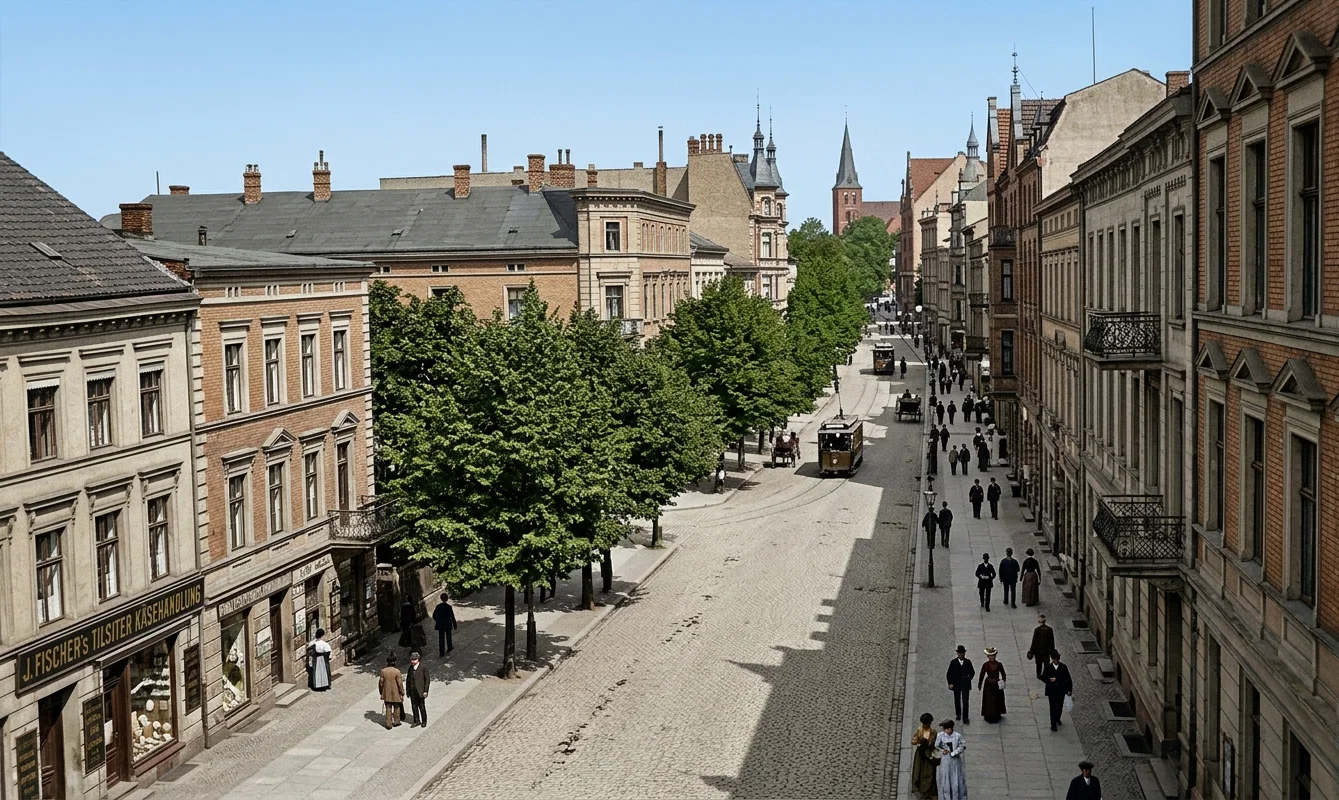
The last of our five German conferences was held in Tilsit, near the Russian border, January 25-29. Tilsit has about thirty-five thousand inhabitants.
HIGH STREET, TILSIT
The Prussian Conference has been organized only about fifteen months. It was formerly a part of the East German Conference. It comprises the two provinces, East and West Prussia: hence its name.
The first year of the Prussian Conference has indeed been a very promising one. With only seven workers, one of whom was an ordained minister, ninety-three were baptized, and twenty-two were taken in by vote, so that their present membership is four hundred and ninety-five. When we consider that these two provinces have a population of only three and one-half millions, we can easily see that they have proportionately the largest number of Sabbath-keepers to be found in any of the German Conferences.
Our meetings were held in public halls. We had a very fair representation from our churches throughout the field. Most of these churches are in the country.
Still, last year the church at Konigsburg, the leading city, with a population of about two hundred thousand, increased from thirty-five to seventy members.
There is a church also in Dansic, a city of one hundred and sixty thousand, with a membership of thirty-five. Eight companies and churches were received into the conference at this meeting.
Two of these, however, are made up of brethren who have moved from the Balkan States into some of the rural districts where the German government is settling immigrants. In order to counteract the Polish influence, the German government has bought a number of large estates of Polish noblemen, and is selling these estates to German settlers.
Our outside attendance here was the largest we have had in any of the winter meetings, as many as five hundred being present in the evening services. The halls were so crowded that many could not find room, and had to go home. Brethren Boettcher and Schuberth and I assisted in these services.
The delegates took a deep interest in the business of the conference. Everything moved forward in harmony. As this was a young conference, and the brethren were mostly farmers, and wages considerably lower than in other portions of Germany, some had feared that perhaps this conference would not be able to pay its two tithes to the German Union Conference as it had promised to do, but the Lord has so blessed the efforts put forth that they were able to pay the second tithe and settle with their workers and have about seventy dollars surplus in addition to the amount they had when they were separated from the East German Conference, and they are now increasing their corps of workers. When we called the attention of the brethren to the amount of money that would be needed to carry on the work the coming year, some offered a thousand dollars to tithe on their property, in order that the sum needed might be provided.
The tithe for 1904 was $2,629; the offerings were $539.
Elder Oblander was unanimously chosen president of the conference again, and besides him there are one Polish and one German licentiate, and also five Bible workers. Fourteen persons were baptized at this meeting, and three were received by vote. These, with some others who had been accepted as members earlier in the month, make thirty additions since January 1.
Considerable time was devoted to instructing our people, and dealing with the outside interest, for the business of the conference was speedily finished.13
Several workers remained to carry on the interest that had been awakened in Tilsit.
We feel grateful indeed that the Lord has so abundantly blessed our meetings in Holland and the five German Conferences, and it is our determination more earnestly to press forward with courage in his cause.
At present the German Union Committee is assembling at Friedensau, to audit the accounts of the mission field and the German Union workers, and to hold a general council.
Friedensau, Germany.
Honan, China
By A. C. Selmon
HSIANG CHENG HSIEN.—Yesterday we had a good illustration, taken from Chinese customs, to use as a text for our Sabbath meeting with the people. Day before yesterday was the fifteenth day of the twelfth Chinese month. On this day the people worship the old heavenly father. The one thus named corresponds to the true God, but they have a vague and distorted idea of him, as is shown by their mode of worship. When any disaster befalls the family, as sickness or business difficulties, then some member of the family must go to the idol temple and burn yellow paper and incense and imitation money made of paper. The idol is requested to protect the family. If disaster still continues to come, they beseech the old heavenly father for protection, and promise that if he protects them, they will give him a pig or a goat. These are the two animals that are most used.
On the morning of the fifteenth of the twelfth month, they fulfil their pledge by securing the animal and pouring wine into its ear. It cries out with pain, and when this happens, its soul is thought to leave the body and ascend to heaven.
In case disaster has befallen a poor man's family, and he has pledged a pig or goat, but when the appointed day comes, there is none to be used, there is a fear that the man may lose favor with the old heavenly father. So in order that heaven may know that the pledge has not been forgotten, the poor man secures a paper pig or goat, and this is burned, as a substitute for the real animal.
After the living animal has been offered in the way mentioned above, it is butchered, and the meat is eaten. The pig's head is put into a large bowl, and this is placed on the mantel, which stands in front of the ancestral tablets, in the main room of the house. Above the pig's head is placed an inscription, stating that this is an offering to the lord of heaven and earth.
The bowl is left on the mantel for a few days, during which time the essence of the offering is supposed to be taken by the spirit worshiped. After this the head is eaten, but the people state that it does not have a good relish, because the essence has been taken out.
This plan of worshiping God is of Satan's own devising, and has been followed from generation to generation, and serves to effectually shut out the true light and deceive the people as to the nature of the true God.
A. C. SELMON.
India
By W. O. James
SIMLA.—Mrs. James is now seeking to finish that work which was so well begun here by Sister Knight. Since we came, two have stepped out upon the promises, and desire to obey the commandments. These souls knew the truth, but needed just a little help to step over the line. One is a young lady who clerks in an English shop. It means something to her to obey; but she wrote a note telling her employer of her decision to keep the Sabbath, and stating that she would continue with him on other days, if he so desired. She is already contemplating entering some department of the Master's work.
To-morrow Mrs. James will present the Sabbath question to another young lady, a school-teacher, who has been studying with Sister Knight for some time. This is the testing point, and we are praying that she may, with joy, receive the sealing message.
We are staying with Sister Wilcox, who is seeking to place the truth before the highest class in Simla. We know that this is a great work to undertake, and that it requires the greatest caution and wisdom to do it aright. Pray for her and for the work in this place.
The Oriental Watchman has many friends, and I have many interesting experiences while presenting the paper. I succeeded in taking one hundred paid subscriptions during the last three weeks. Sometimes we must find out our weakness by going some time without success. But this is victory, if we learn the lesson.
Bombay is still waiting for workers.14
The lady who began keeping the Sabbath while we were there has since died of plague. We had not heard from her for some time, but are thankful she understood the message before being taken ill.
Since writing the above, Mrs. James held the study on the Sabbath question with the young lady already mentioned, and when she went back to see her the following Monday, was surprised to learn that the lady had kept the last Sabbath. The same day another reader wanted to know how the Sabbath should be kept; “for,” she said, “I believe that the seventh day is the Sabbath, and so does my husband.” This woman resisted the Sabbath for some time, and it was difficult to begin readings with her. But now she has a great desire to study the prophecies.
Two weeks ago I met a woman whose husband is now in the hospital as the result of a fall. She was selling her furniture to pay the doctor bills, but decided to take the Oriental Watchman for six months. I felt a burden for her, and last week we called upon her again, and my wife promised to study the Bible with her. She is an earnest Christian, and came to India as a missionary.
This morning I called to ask about her husband. I told her that Mrs. James expected to call the next day. She said, “Why can’t I stop to see her on my way home from the hospital?” I told her that she would be glad to have her call and have studies on her way home from the hospital. This saves time, when there are so many to be visited.
The woman came; she was much distressed, for her husband, although sent here as an ordained minister several years ago, seems to have lost his Christian experience. She said she could not study, but asked my wife to read her some promises. This was done. Mrs. James wished to present some study in a way that would be helpful; but nothing seemed to hold her attention, and they went from one thing to another until the Sabbath question came up. The woman had never thought of it before, but the Lord revealed it to her in a way that brought tears of joy to her eyes at seeing the truth.
She said, “Last Sunday I felt a deep conviction that I must give myself unreservedly into the Lord’s hands to do his will. He has sent me here for light. You have not persuaded me to take this stand.” She saw the Word in its true light, and rejoices in it. We have been praying for her especially, and it does not take the Lord long to convict honest hearts. May the Lord bless in the advancement of his truth, is our prayer.
W. O. JAMES.
Mission Notes
WHILE the Russian war-ships were passing through the Suez Canal, B. F. B. S. colporteurs were allowed on board, and during one day and one night sold to the sailors seven hundred copies of the Scriptures.
A MISSION worker in India used a strong illustration when he said to some Hindus, “Suppose a woman should dress a god in men’s clothes, and tell people it is her husband, how would the husband like it? But you do worse; you dress up a stick or a stone, and tell people that it is God!” Such an appeal, right from the mission field, helps one to make the work real to the mind.
“THE Paris Missionary Society faces a time of great stringency. In this year the churches of France must begin to provide the salaries of their own pastors, hitherto paid by the government, but no longer to be paid after the separation of church and state is voted. The problem of supplying the foreign missions when the churches are struggling to meet home expenses looms great on the horizon.”
IN Hinduism morality consists in outward observances and rules of eating and drinking. “A Brahman may be known to be a monster of wickedness,—a liar, thief, or adulterer,—but his sanctity as a Brahman remains unaffected by these crimes; but let that Brahman, even by accident, eat forbidden food or touch an unlawful object, and the curse of uncleanness at once falls upon him.”
CURIOUS are the happenings in missionary work in Japan. A missionary of the Church Missionary Society had gained permission to give a lantern lecture to wounded soldiers. When he reached the place provided by the officers for the meeting, he found it was a Buddhist temple. There, at one side of the high altar, and under the shadow of Buddha, he stood and preached Christ to a most attentive audience. The missionary had to tramp that night seven miles in the rain to reach his home, but his heart was light, for joy of having had the privilege of that talk to the friendly soldiers.
Ohio
By Florence Schuster
SPRINGFIELD.—A very successful series of meetings was recently conducted at this place by Elder E. J. Van Horn, continuing four weeks. The enemy came in like a flood, and would have crippled the work by bringing bodily infirmity upon Brother Van Horn, but, sustained by his own faith and the prayers of the church, he went boldly forward, and was able to continue constantly in the work.
Notwithstanding the fact, that much of the time the weather was very cold and wet, and the nights were dark, there was a good attendance of interested listeners. The method of making everything plain on tables “that those may run who read,” was followed in the preaching, and proved an excellent means of holding the attention of the people; and almost before we were aware of it, the message as found in Rev. 14:9-12 was preached, and some began to make decisions on the side of the truth. Many souls have been deeply stirred with the truth so clearly presented, and when such texts as Prov. 28:9 were read, they began asking themselves, “What shall I do to be saved?” and at the close of the sermon on “Obedience,” Sunday morning, April 7, there were buried with their Lord by baptism seven dear souls who had taken their stand to keep the commandments of God and the faith of Jesus. When the last meeting of the series came, the interest was not abated, and we feel that there is yet a large field for labor in this city.
FLORENCE SCHUSTER.
West Indies
By Philip Giddings; Louise P. Giddings
ROSEAU, DOMINICA.— We left British Guiana Dec. 21, 1904, and arrived at this place the twenty-ninth.
Sister Roskruge, one of two lone sisters, gave us a kind welcome, and we remained with her for six weeks, as we found some difficulty in procuring a place on account of Catholic prejudice. In the meantime we held meetings in her spacious hall (the upper part of her brother's store), and, better than our expectation, the people thronged the hall from night to night. Our Catholic neighbors who did not approve of us, attempted to break up our meetings by playing the piano, singing aloud, and calling out at us when praying, but finding us unmoved, they became quiet, and now we smile and exchange compliments.
Our program was as follows: Sunday afternoon, open-air preaching; Sunday night, preaching; Monday night, preaching; Tuesday night, women's Bible class by Mrs. Giddings; Wednesday night, men's Bible class; Thursday night, general Bible reading; Friday, short exhortation, prayer, praise, and an opportunity for any desiring to seek the Lord; Sabbath, the usual meetings of Sabbath-school, etc.
Our first open-air meetings were not without disturbance, but we prayed and preached. The behavior of those in attendance now is good. Intelligent natives say they are surprised at the good order maintained at the meetings.
Roseau contains between nine and ten thousand souls, mostly Catholics. The rest are Anglicans, Wesleyans, and Christian Mission.
Mrs. Giddings has opened a school in physiology, hygiene, and calisthenics. The Catholic editor who advertised it put in also favorable paragraphs of his own, and asked me to send him an article for publication. He said he gave us a hearty welcome to his country for the help they need. Now and then we meet Catholics who are broader than their teaching.
I called on a rich Catholic lady a few days ago to show a book. I saw in her home a copy of “Thoughts on Daniel and the Revelation;” and although she did not take my book, when she said, “God bless you in your work,” I was comforted.
This island at one time belonged to France. The French impress is still discernible. Although the people speak English, they have a dialect of broken French, called the patois, with which they are more familiar. Indeed, that is their native tongue. In some country places there are those who understand nothing else. Many of those who speak English, however, speak book English, and hence are more precise than the same class of people in English-speaking islands.
We are scattering our papers and books. Five have begun to obey. Remember us before the throne of grace.
PHILIP AND LOUISE P. GIDDINGS.
College View
By R. D. Quinn
THE revival and reformation begun here recently is still going forward in power. The last two evenings many have remained during the after meeting, to seek God for a new and living experience. Of this number nearly every one has surrendered all to God, many for the first time. Confession and restitution was made. One brother paid five hundred dollars tithe which he had been withholding, and others confessed that they had robbed God. The last two chapters of Malachi are meeting their fulfilment in our experience here.
For the last few days meetings have been held in the afternoon with the children attending the church-school. Yesterday afternoon nineteen in one room, between the ages of ten and sixteen, gave their hearts to God. Parents are meeting together in earnest prayer, and the hearts of the fathers are being turned toward the children, and the hearts of the children to their fathers.
That God has begun a definite work of deliverance for us is no longer a question in the minds of the churches that are passing through the experience. The news is spreading, and hope is reviving. Urgent calls are coming from many places for a similar work.
“And it shall come to pass, that whosoever shall call on the name of the Lord shall be delivered: for in Mount Zion and in Jerusalem shall be deliverance, as the Lord hath said, and in the remnant whom the Lord shall call.”
R. D. QUINN.
Minnesota
By Geo. L. Budd
SENJEN.—Since my report, Brother E. M. Chapman has joined me in the work here. I am glad to say that the work is onward, and several more have taken their stand on the side of truth. I have never labored in a place where the people seem more willing to take hold of all phases of the message. There are now seventeen keeping15the Sabbath secretly. We hope and pray that the Lord will give them courage to take their stand openly. We have now organized two Sabbath-schools, with a membership of forty-nine in all. We have found our meeting-place altogether too small, and so have decided to build a church. We already have part of the foundation laid, and hope to have it all finished soon. Considering all things, we have reason to praise the Lord, and take courage. GEO. L. BUDD.
Virginia
By C. B. Rule
HEBRON.—It was recently my privilege to hold meetings for several days with the brethren and sisters of the Hebron church. It was an occasion long to be remembered. Sins were confessed, and all promised to be faithful in the payment of tithe. Five willing souls were baptized; the Lord's supper was celebrated, and all were strengthened in the faith. C. B. RULE.
Newfoundland
IN sending in $3.40 for missions, gathered in by one of the holiday collecting cards sent out during the week of prayer, R. S. Roberts reports from the Long Point Lighthouse station:—
“The work in this cold corner of the earth is just beginning to mature, but we are expecting great things soon. Elder F. A. Tracy, of St. Johns, intends giving us a call early in the summer. There are quite a few people here who can see great truths in the advent doctrines, and it requires only an effort on the part of the mission to establish a good work here.”
Japan
By F. W. Field
TOKYO.—Brother Kuniya has recently heard from Brother Lim Ki Pan. He is very anxious for Brother Kuniya to visit them soon. He reports receipts from the little churches to the amount of yen 12.30. Sondol has been erecting a church building and schoolroom, so had nothing to offer. One family in Sondol has recently accepted the truth. Brother Song Fun Cho, from whom Brother Lim Ki Pan first learned the truth, has come to Chinnampo, and is now staying there. He brought a friend, who is studying the truth, and seems in a fair way to accept it. Still other young Koreans in San Francisco have accepted the truth, and they are working for their countrymen. The number of converts is not given.
F. W. FIELD.
Religious Liberty Meeting in Wisconsin
By William Covert
We held a very profitable meeting in the interest of religious liberty in Milwaukee, the evening of April 18. We rented a hall, and advertised quite freely, and succeeded in getting about one hundred and fifty persons to attend. The speakers were Elders H. W. Reed, J. B. Scott, N. P. Neilsen, H. R. Johnson, and the writer.
Good music was provided; the song “America” and other appropriate pieces were rendered, and were much appreciated by the audience.
Elder Reed gave a twenty-minute address on the natural rights of man, and concluded by showing that the United States is repeating the history of Rome; Elder Scott presented excellent thoughts in regard to the proper course to take in evangelizing the world; Elder Neilsen spoke of Christ and the Sabbath; Elder Johnson presented thoughts regarding the true source of power, and how Christians should be related to it; and the writer spoke on the logic of Sunday legislation, giving some positive statements in regard to what Christians should do to meet the great issue that is now confronting the church of Christ upon earth.
The people present seemed very glad of the privilege they enjoyed, and the information they received. We expect to hold many other meetings of like character in this State.
Wm. COVERT.
Among the Churches
By F. W. Spies
AFTER putting our new home in Castro in order, Brother Emil Holzle and the writer went to Curityba, to render the church there the assistance for which they had long been calling.
Leaving Castro on Monday, December 5, the next evening we arrived at Curityba. Aside from assisting the church in various ways, there was also an election of officers, at which the former officers were re-elected. The following evening we enjoyed a blessed season during the Lord's supper. The preaching during our stay at Curityba was almost all in the Portuguese tongue. The German brethren brought a sacrifice, to some extent, as some of them understood but little of what was said; yet they were glad to hear that the message of life was preached to their Brazilian neighbors.
In this respect there is an encouraging change coming over Curityba. During our brief stay we had the privilege of baptizing a Brazilian, and also an Italian sister; while several other Brazilians have recently begun the observance of the Sabbath, and still other interested ones were attending the meetings.
We arranged it so as to have two services, aside from the Sabbath-school, each Sabbath—one in German immediately following the Sabbath-school in the morning, and a Portuguese service in the afternoon.
After finishing our work at Curityba, we went to Itaqui, which is about twenty-five miles from the former place. Here there had been some keeping the Sabbath. Although the Presbyterian church in Brazil is divided over the question of Freemasonry, when it comes to opposing the commandments of God and those who teach them, they are a unit. So we have to see here again what base and low methods some employ, even of misrepresenting our teachings and principles. But, thanks to the Lord, who always causes the upright to see light, we could explain to those who had begun to waver, but who were still keeping the Sabbath, the questions misrepresented, among which were the spirit of prophecy and healthful living; and the very effort of the enemy to overthrow the faith of these souls resulted in making the truth clearer to them, and establishing them more firmly in it.
We returned to Curityba, and held two more meetings. Then, leaving the brethren much encouraged, we returned to Castro. We expect in a few days to start out again, to respond to some of the many calls for help. Surely the Lord is working here. May we ever be in a position where he can direct us. Pray for us and the work here.
F. W. Spies.
The British Field
By Ole Andres Olsen
WE are much cheered by the good reports that come to us from week to week through our good REVIEW. It is a source of joy to note the rapid progress of the work in the various countries of the world. Truly the message is rising, and everything goes to show that it will soon assume the proportion and power that will characterize the loud cry.
We who are at a distance are following the movements at Washington with intense interest. All the developments there go to demonstrate the timeliness of the removal of our denominational headquarters. Truly the Lord is leading, and his blessing is over the work in a marked manner.
The British field can join the chorus in praise and gratitude to God for blessings and progress in all branches of the work. The year 1904 saw most encouraging advancement. We have our difficulties and perplexities to meet, but, notwithstanding this, the Lord has greatly blessed and prospered the work in every department. During 1903, 147 souls were baptized; during 1904, 269, an increase of 122. Twelve churches were organized, the net increase in members being 184. The increase in tithe was £195 15s 7¼d, and offerings to missions £125 17s 10¾d.
Yet these figures can not convey the full truth of the situation. Already during the first quarter of the present year there has been a rapidly increasing interest and growth in the work far above that of last year for the corresponding period.
The Lord is greatly blessing our training college. The enrolment for the present year has passed the ninety mark. But it is not the numbers that we appreciate so much as the spirit of earnestness among the students, and the quality of work being done.
The blessing of the Lord is also very manifest in our publishing and book work. The circulation of Present Truth and Good Health is steadily increasing, while our churches are active in the circulation of tracts and small publications. Many are beginning to keep the Sabbath as the result of reading our literature.
Our sanitarium and health work is also being much blessed, not only in the matter of patronage in our institutions, but also in bringing people into the truth.
As at Washington, so here in England the Sabbath question is coming to the front. A number of articles have appeared in the dailies under the significant heading, “The Godless Sunday.” Preparations are in progress for a general campaign to be opened in the near future for the purpose of securing a better observance of Sunday, to be headed by the archbishops of Canterbury and York.16
We hail this movement with joy, as it will open the way for the Sabbath truth to be brought more prominently before the people of this kingdom. We are laying plans to take advantage of the coming agitation, and, with the assistance of all our brethren and sisters throughout the field, we hope to give our Sabbath literature a wide circulation. Thus we shall do much to hasten the coming and kingdom of our Lord and Saviour Jesus Christ.
O. A. OLSEN.
East Pennsylvania
By K. C. Russell
LANCASTER.—A series of special services was held with the newly organized church of Sabbath-keepers at Lancaster, Pa., April 19-23, during which their commodious church was dedicated to the Lord.
The services were conducted by Elders W. J. Fitzgerald and J. H. Schilling, and the writer. The attendance consisted of the local membership and citizens of Lancaster and Ephrata. While the attendance was not large, yet there was a deep interest manifested in the meeting throughout.
Those who are familiar with the circumstances which have attended the efforts put forth by the members of this company in securing their church building can not but believe that it has been a most signal manifestation of God's providence which has enabled them to obtain such a desirable building, located in a thriving city of over forty thousand inhabitants, and in the midst of one of the richest farming sections in the State.
It is less than a year since Elder Schilling opened a series of tent-meetings here, which resulted in bringing out a company of believers who now constitute a portion of the charter membership of this new church organization. Scarcely had this company become established in the truth before it was learned that a neat brick church, with a seating capacity of three hundred persons, could be obtained for the moderate sum of two thousand dollars; six hundred dollars has already been paid on this property, and arrangements have been made whereby the remainder can be met on easy terms.
We rejoice with the Eastern Pennsylvania Conference, and especially with the members of the Lancaster church, that they have been so successful in securing this church, which will be another standard for the third angel's message in the old Keystone State.
In addition to the effort in Lancaster, Elder Schilling has charge of the work in Reading, Allentown, and Lebanon, where members are being added to the church. K. C. RUSSELL.