Signs of the Times, Vol. 33, No. 18.

IN THIS ISSUE

Signs of the Times

May 1, 1907

Pacific Press Publishing Company · MOUNTAIN VIEW, CALIFORNIA · May 1, 1907

IN THIS ISSUE

WITH OUR INQUIRERS

Questions 2058 to 2066 . . . . . . . 2

BIBLE SYMPOSIUM

Where We Got Our Bible . . . . . . . 3 "Able to Make Us Wise unto Salvation" . . 4 The Inspired Book . . . . . . . . . . 5 Inspiration of the Holy Scriptures . . . . 5 The Incarnate Son of God . . . . . . . 6 A Two-edged Sword . . . . . . . . . . 7

EDITORIAL

The Power of the Word of God to Save . . 8 A Misinterpreted Mission . . . . . . . 8 The Extent of God's Purpose in Election . . 9 The Great Touchstone . . . . . . . . . 9

THE OUTLOOK

Great War Preparations . . . . . . . . 10 Earthquake in Mexico . . . . . . . . 11

HOME

Studies in the Christ-life . . . . . . 12

MISSIONS

Poverty and Prosperity of the Chinese . . 14 Work and Workers . . . . . . . . . . 15

POETRY

Nature and Revelation . . . . . . . . 5 Search the Scriptures . . . . . . . . 6 The Birth of Christ . . . . . . . . . 12

With Our Inquirers

"If ye will inquire, inquire ye." Isa. 21:12
[All questions to this department will be answered which to the editors will minister to the general good of the readers and to the mission of the paper. The same question can not be answered repeatedly in the same volume. The name and address must accompany question, not for publication, but as an evidence of good faith, and that answer may be made by letter if deemed advisable. It is well always to enclose a stamp for reply.]

2058.—Who Is My Neighbor and Brother?

Will you please tell us who is a Christian's neighbor, and also who is his brother?
E. L.
Looking at it in a geographical sense, as the world does, those who live near to us are our neighbors, whether we are Christians, or whatever we are. The etymology of the word means one who dwells near us. In the Christian sense it is not for us to ask, Who is our neighbor? that is, one who is really nigh us in spirit and sympathy. In order to determine this we must make ourselves judges. That is the question the young man asked Jesus. Jesus said, "Thou shalt love thy neighbor as thyself." The young man answered, "Who is my neighbor?" Read the answer in Luke 10:30-37, and notice also that when Jesus answered it, He did not tell the man who his neighbor was, but told the man to whom he ought to be neighbor. The priest ought spiritually to have been neighbor to the poor Jew who was stripped and beaten by thieves. The Levite ought to have been neighbor to him. The Samaritan was his only neighbor. It is not as to who is our neighbor, who really feels near to us in sympathy, but to whom should we be neighbor, to whom should we feel warm and sympathetic; and the answer is every one who needs our help. So Jesus asked, "Which of the three was neighbor unto him that fell among thieves?" And the lawyer said, "Him that showed mercy." Jesus said, "Go, and do thou likewise." Our earthly brother is each of the poor sinners of earth; our spiritual brother is he who is begotten of Christ Jesus. See Matt. 12:49, 50; I John 1:7; 3:1, 14; 4:20, 21.

2059.—Food in the Beginning.

In the light of Gen. 1:29 and Num. 11:5, did God in the beginning intend the use of such foods as lettuce, cabbage, onions, radishes, etc.?
E. K.
Evidently not. Gen. 1:29 seems clearly to indicate that man's original food was fruits and grains, but as sin developed, evidently the Lord saw that man needed other materials, and so we read in Gen. 9:3: "Every moving thing that liveth shall be food for you; as the green herb I have given you all. But the flesh with the life thereof, which is the blood thereof, shall ye not eat." Doubtless purer foods can be secured from fruits and grains than from almost any other materials, but the Lord has permitted the use of vegetables, and in many cases that seems to be necessary.

2060.—The Closing of the Seventy Weeks.

Does Acts 8:1-4 prove that the Gospel was given to the Gentiles in A.D. 34, as stated in the Sabbath-school Lesson Quarterly?
B. B. B.
It certainly proves this, that they that were scattered abroad from Jerusalem went everywhere preaching the word, not only to the Jews but certainly to the Samaritans. Doubtless it was given more fully to the Gentiles after that, but this shows just what God's design was. As a people, the Jews cut themselves off in the rejection of Christ by the martyrdom of Stephen. The disciples ought to have learned the lesson and gone out in the regions beyond. The Lord forced them to do this by permitting this persecution. Being scattered abroad by the persecution they went everywhere, witnessing for Him wherever they went. In His plan, slow tho they were in seeing it, the time was then fulfilled, as it seems to us the text clearly teaches. Acts 11:19 simply shows how slow the disciples were to comprehend the meaning of the commission which Christ had given them in the beginning. It even took a special vision of the Lord to show one of the leading apostles, Peter, that God designed that he should preach to the Gentiles as well as the Jews. The question itself in the Lesson Quarterly would have been better understood if it had pertained not to the preaching to the Gentiles but to the cutting off of the Jews, for that was to come at the end of the seventy weeks,—"Seventy weeks are marked off upon thy people." Of course, when that people were set aside as a special people of God, it was in God's plan that the Gospel should be carried directly to other nations. As a nation that people had cut themselves off from being the standard-bearers of God. Yes, there is a record of the Gospel carried to a Gentile. Our Saviour brought it to the Roman centurion in the healing of his servant, carried it to the Syro-Phenician in the healing of her daughter, and to the woman of Samaria at the well.

2061.—The Descent of the New Jerusalem.

Please state the order of events in connection with the second resurrection and the descent of the heavenly city.
H.
From a study of Zech. 14:4, 5 and Revelation 20 and 21 it seems very clear that first of all Christ comes, that is, at the end of the thousand years. As He is descending to the earth His voice wakes the wicked dead or those who have slept thru the thousand years. As His feet touch the Mount of Olives, that mount cleaves apart and becomes a very great plain or valley. This becomes the "camp of the saints." Later, while the saints are encamped on the now beautified plain, the city itself descends. Then the wicked plot and plan and marshal their forces and come against the camp of the saints and the beloved city. We know of no scriptures which are contrary to this order. It seems quite clear from the Bible that Jesus and the saints descend before the city descends. See tract "The Great Day of the Lord," price five cents.

2062.—Death of Jesus.

When Jesus died, did His soul go to God? If not, what part of Christ was with God in the creation of all things? In other words, did the immortal part of Christ die?
A. J. W.
It is utterly impossible for poor humanity to understand the incarnation of Christ Jesus. We can only accept the great facts which God gives us in His word and know that they are true because He has so revealed them. The One who was with the Father before the world was, was the eternal Son of God, spoken of in Micah 5 as the One "whose goings forth have been from of old, from everlasting," "from the days of eternity," called in John 1:1 "the Word." We there read also that "the Word was God" and "was in the beginning with God." That same chapter also tells that "the Word was made flesh and dwelt among us." The Son of God came down into the body of humanity, "emptied Himself," made in the likeness of sinful flesh, a brother man, so to speak. The prophecy of His sufferings in Isaiah 53 declares "He poured out His soul unto death." Verse 12. Jesus Himself said just before the crucifixion, "My soul is exceeding sorrowful, even unto death." Matt. 26:38. The glorified Christ Himself declared, "I am He that liveth, and was dead, and behold, I am alive forever more." Rev. 1:18. When He died on the cross, He committed not His soul, but His spirit, His life unto God, "Father, unto Thy hands I commend My spirit," My life. The term "immortal" part is not known to the word of God.

2063.—Questions on the Sanctuary.

Questions asked by the same writer on the sanctuary question, we have not space to answer in this department.
This, however, in brief. According to the type, when Christ entered upon His work of ministration above, the sanctuary was dedicated throughout. Consequently both holy and most holy places were dedicated, or anointed. 2. Every act of ministry which Christ performed was with reference to the culmination of all things; and the entire book of Hebrews deals with the ultimate culmination, looking forward to the end, speaking of that end as tho it were already accomplished. As an illustration, take verses 27, 28, of Hebrews 9, "It is appointed unto men once to die, and after that the judgment." Christ was offered as a sacrifice, and the next thing is His coming. All intervening things look forward to the last great event. The rending of the veil in the earthly sanctuary showed that the typical service was over forever, and nothing more; and the ministration in the heavenly place, the "holiest," or literally, the "holy places," began; for Christ was appointed high priest by the word of the oath, after the law, after He was perfected thru suffering. Heb. 7:28. Sometimes when referring to the type the details of His ministry are referred to, but when referring to the hope of the Christian, we are carried forward to the closing work of His ministry where the Christian's hope is consummated.

2064.—Sinning Against the Holy Spirit. Matt. 12:32.

Will there be any chance for those who have not sinned against the Holy Spirit in the world to come (Matt. 12:32), or will all who are lost have sinned against the Holy Spirit? If so, in what way?
A. L. M.
The mission of the Spirit is to convict the world of sin, of righteousness, and of judgment. John 16:8. No one is really convicted unless it is the Spirit that convicts him. When man rejects that Spirit he sins against the Spirit. The Lord comes, frequently, again and again, to souls who sin, and speaks in most pleading ways, sometimes by permitting affliction; but if the soul goes on rejecting the plea until the end, God has no other means of saving that soul; he has rejected the very agency which God has used for his salvation, and therefore must die. So it is true that every one who is lost has sinned against the Holy Spirit. He may not have committed blasphemy, as some of the Jews did. He need not carry it so far as have defiant, blaspheming men in all ages; nevertheless he does sin against all hope in rejecting God's means of salvation.

2065.—Baptized for the Dead; Leaves of the Tree of Life.

Please explain I Cor. 15:29; also Rev. 22:2, which says that the leaves of the tree shall be for the healing of the nations. I thought that when we reach heaven we would be free from sickness.
A SUBSCRIBER.
For a full reply to 1 Cor. 15:29, write Elder W. A. Alway, Blackfoot, Idaho. Rev. 22:2 may be understood in one of two ways: (1) Healing in the sense of service, and is so rendered by one scholar at least, "The leaves of the tree are for the service of the nations." Just how they use them is not within our understanding. It has been aptly remarked, however, that the later generations of men, upon whom sin has committed its ravages for centuries, will be smaller of stature than the early generations. The leaves of the tree will restore them to that same stature that God designed His sons should be.

2066.—Jesus in Infancy and Manhood.

Will you tell me thru the Question Department the difference between Jesus born of the virgin Mary and Jesus that rose from the dead?
H. S. W.
Simply this, the one was an infant, so far as humanity is concerned, untested, undeveloped; the other, Jesus the tested, the tried Son of God.

The Bible.—A Symposium

Where We Got Our Bible.

MORE and more, as the enemies in the church are casting the dust of higher criticism upon the Sacred Record, men are asking where our Bible came from. There is not space in this brief paper to discuss the merits or demerits of their human judgment. Its object is to tell the reader in brief and simple story some of the great, important facts about the Book we call the Bible.

The Meaning of "Bible."

The word "Bible" is an Anglicized Greek word, Biblos, meaning book. Altho the Bible is composed of many books, yet the term Biblos came to be applied to the collection of books, as one book, the Book of books, preeminently above all other books.
The Bible is divided into two parts: the larger part, called the Old Testament, or Covenant; the smaller and latter part, the New Testament, or Covenant. This division of the Book is not of inspiration; it is a division made by men, because of changes in times and people. The Biblical term frequently used is The Scriptures, and with the scriptures of the Old Testament, and doubtless some of the Gospels, Peter classes the epistles of Paul. 2 Peter 3:15, 16. Almost invariably the term, "the Scriptures," in the New Testament, refers to the Old Testament writings, as the New Testament was then being written.
The Old Testament contains thirty-nine books, some of them combined by the Jews so as to make twenty-two, the number of the letters in the Hebrew alphabet. A threefold division was made of the Old Testament, called in Luke 24:44, "the law of Moses, the prophets, and the Psalms." These parts were called by the Jews, the Law, the Prophets, and the Hagiographa (Writings).
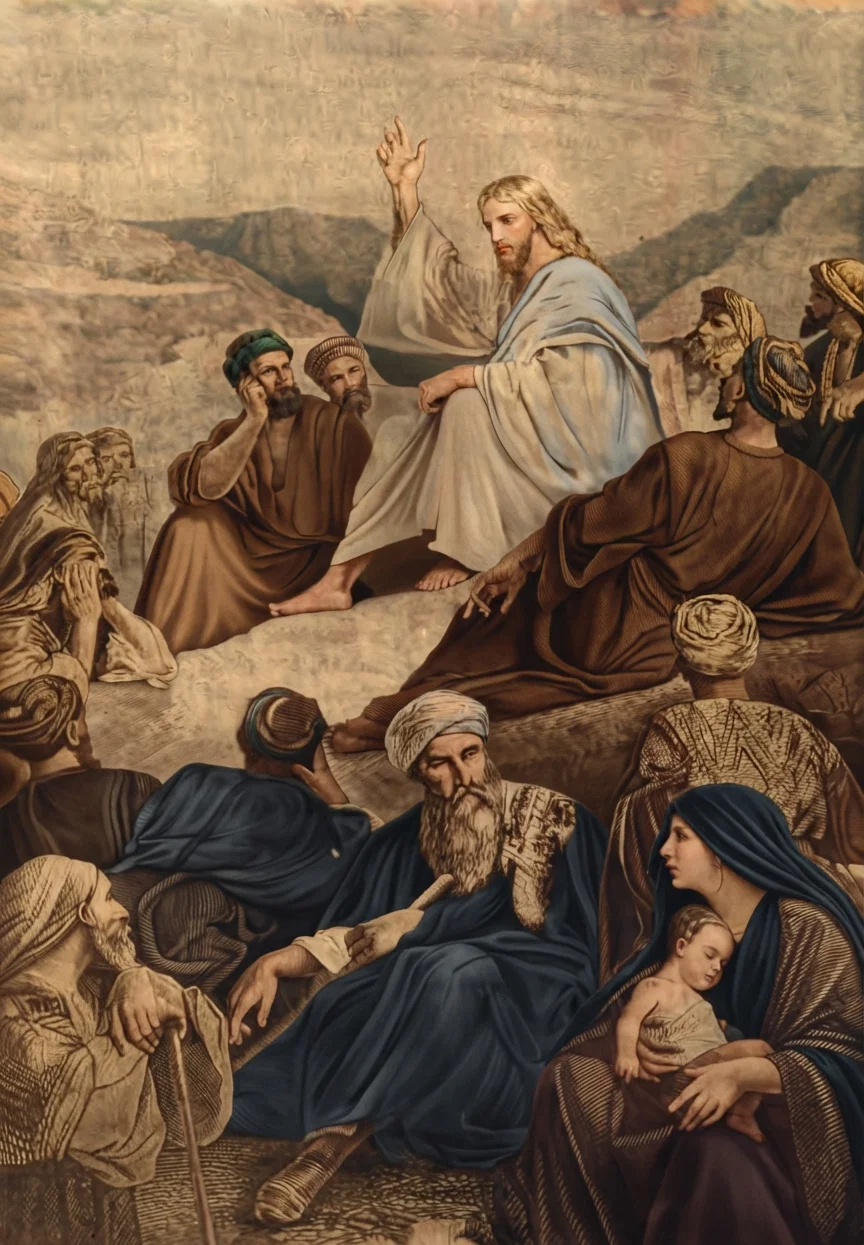
Bida. THE SERMON ON THE MOUNT.
The Law (the Pentateuch) consisted of the first five books of the Bible, or "books of Moses"—Genesis, Exodus, Leviticus, Numbers, Deuteronomy.
The Prophets, including also certain historical books, consist of Joshua, Judges, Samuel, first and second, Kings, first and second, Isaiah, Jeremiah, Ezekiel, and the twelve minor prophets as one book. Total number in "the Prophets," eight according to Jewish reckoning, twenty-one as given in the English.
The Writings (Hagiographa) consisted of Psalms, Proverbs, Job, Canticles, Ruth, Lamentations, Ecclesiastes, Esther, Daniel, Ezra, and Nehemiah, Chronicles, first and second, thirteen in all, or, as reckoned by the Jews in Palestine, eleven; in Alexandria, nine. The latter reckoned Ruth with Judges, and Lamentations with Jeremiah.
These thirty-nine books are not found in their chronological order, Jewish tradition and usage in reading in the synagog having its effect. The chronological order of the books of the Old Testament apart from the law and the historical books including Chronicles would be about as follows: Jonah, B.C. 860; Joel, Hosea, Amos, 800 to 780; Isaiah, Micah 780 to 740; Nahum, 713; Zephaniah, Jeremiah, Habakkuk, 630 to 620; Daniel, Ezekiel, Obadiah, Ezra, 600 to 536; Haggai, Zechariah, 520; Nehemiah, 446; Malachi, 390.

The Scripture Canon.

The word canon means primarily a straight staff, rule, or rod. Then a guide or model. Naturally it came to be applied to a normal principle, a rule of action; and as the Scriptures were considered the divine standard of action, the word canon was applied to them.Originally, before sin entered, man talked with God face to face, as in Eden. When sin entered, man could not endure God's glory, and the Lord sent His angels to talk with him. As man's heart became hardened more and more, God spoke His law from heaven, inscribed it upon two tables of stone, and gave it to His people. He gave it that man might know what sin was, and how far he had departed from the right standard. To further develop and explain the principles of this fundamental code, and to direct in worship and sacrifice, God gave other laws by Moses. These laws and the records of God's dealing with His children from the beginning, largely written by Moses, constitute the Pentateuch, or five book of Moses.
This became the standard by which all spiritual truth and conduct were judged. As prophet after prophet spoke and wrote, as new doctrines were promulgated, they were tested by the law. "To the law and to the testimony: if they speak not according to this word, it is because there is no light in them." Isa. 8:20. See also Deut. 13:1-5. God's law was the great test. And so it is recorded in the New Testament in the words of Jesus in that wonderful Sermon on the Mount, that it is the will or law (Ps. 40:7, 8) of God which is the test of character, and he who is not in harmony with that will is the doer of iniquity or lawlessness. Matt. 7:21-23. The Master is careful to let us know that His teaching does not contravene the law. Matt. 5:17-20. And among the last writings of the New Testament we read: "He that saith, I know Him [God], and keepeth not His commandments, is a liar, and the truth is not in him." 1 John 2:4.

The Compilation of the Old Testament Books.

The collection and arrangement of the Old Testament Scriptures was doubtless begun by Ezra, and continued by men of the Great Synagog who succeeded Ezra. The Old Testament Scriptures were endorsed and referred to by Jesus and His apostles as unquestionable authority. The Apocrypha, held by the Catholic Church, was never in the Hebrew canon. Altho the Jews exalted tradition and teachings of men till the word of God was made void in their hearts, they superstitiously preserved the Scriptures which condemned them.

The New Testament Canon.

The New Testament books were written in the very time of the apostles of Jesus Christ Himself. The possession of the gift of discernment of spirits in the church and their loyalty to the Scriptures and the law of God preserved the church from spurious writings.
The history of the collections of these writings is not as clear as their internal evidence. Peter speaks of Paul's epistles as tho there had been a collection made of them. Each church doubtless made collections for itself. The earliest uninspired record is attributed to Caius, a Roman presbyter in the last half of the second century. He recognizes all the books except Hebrews, James, the two epistles of Peter, and perhaps 3 John. The Peshito Syriac version of about this time includes Hebrews and James. There is a continued chain of evidence down to Tertullian, who uses the term New Testament for the first time, and calls the whole Bible "the instrument of both testaments."
The Church of Rome boasts that she has preserved the Scriptures. She did so precisely as the backslidden Jews did, thru superstition. The priceless manuscripts were hidden in monasteries and libraries, when they ought to have been seen in the life of the church. But these manuscripts were largely from the Greek, Syriac, and African churches. Rome once rejected the epistle to the Hebrews. Was she then infallible? She afterward accepted it. Was she then infallible also? Her claim to the authority of the Scriptures is utterly baseless. The commercial companies which send ships from England for the dark lands of earth, bearing brandy and Bibles, could with as good logic affirm that by their authority and wisdom and infallibility the heathen had received the word of God.
The Scriptures of truth tho given thru men are above men. All may prove false, as God's people proved false before Christ, as the church has apostatized since Christ, but God's wonderful providence has been over His word, and preserved it from pagan destruction without and atheistical philosophy and tradition within. ABDEL.

"Able to Make Us Wise unto Salvation"

By Mrs. E. G. White

How to Study the Bible.

"GIVEN by inspiration of God," "able to make us wise unto salvation," rendering "the man of God perfect, thoroly furnished unto all good works"—the Book of books has the highest claims to our reverent attention. Superficial study of the word of God can not meet the claims it has upon us, nor furnish us with the benefit that is promised. We should seek to learn the full meaning of the words of truth, and to drink deep the spirit of the holy oracles.
To read daily a certain number of chapters, or to commit to memory a stipulated amount of Scripture, without careful thought as to the meaning of the text, will profit but little. To study one passage until its significance is clear to the mind, and its relation to the plan of salvation is evident, is of more value than the perusal of many chapters with no definite purpose in view and no positive instruction gained.
We can not obtain wisdom from the word of God without giving earnest and prayerful attention to its study. It is true that some portions of Scripture are, indeed, too plain to be misunderstood; but there are many portions whose meaning can not be seen at a glance; for the truth does not lie upon the surface. In order to understand the meaning of such passages, scripture must be compared with scripture; there must be careful research and prayerful reflection. Such study will be richly repaid. As the miner discovers precious veins of metal concealed beneath the surface of the earth, so will he who perseveringly searches the word of God as for hid treasure find truths of the greatest value which are concealed from the careless seeker.
You must dig in the mine of truth till you find its greatest treasure, and by comparing scripture with scripture you may find the true meaning of the text. But if you do not make the sacred teachings of God's word the rule and guide of your life, the truth will be nothing to you. Truth is efficient only as it is carried out in practical life. If the word of God condemns some habit you have indulged, a feeling you have cherished, a spirit you have manifested, turn not from the word of God, but turn away from the evil of your doings, and let Jesus cleanse and sanctify your heart. Confess your faults, and forsake them wholly and determinedly, believing the promises of God, and showing your faith by your works. If the truths of the Bible are woven into practical life, they will bring the mind up from earthliness and debasement. Those who are conversant with the Scriptures will be men and women who exert an elevating influence.
In searching for Heaven-revealed truths, the Spirit of God is brought into close connection with the sincere searcher of the Scriptures. An understanding of the revealed will of God enlarges the mind, expands, elevates, and endows it with new vigor, by bringing its faculties into contact with stupendous truth. No study is better to give energy to the mind, to strengthen the intellect, than the study of the word of God. No other book is so potent in elevating the thoughts, in giving vigor to the faculties, as is the Bible, which contains the most ennobling truths. If God's word were studied as it should be, we would see breadth of mind, stability of purpose, nobility of character, such as are rarely seen in these times.

God’s Word and Human Tradition

WHEN God's word is by the fathers expounded, construed, and glossed, then, in my judgment, it is even as when one strains milk thru a coal sack, which must needs spoil and make the milk black. God's word of itself is pure, clean, bright, and clear; but thru the doctrines, books, and writings of the fathers, it is darkened, falsified, and spoiled. —Martin Luther, "Table Talk," p. 228.

Tradition and God’s Commandment

"Why do ye also transgress the commandment of God by your tradition?" Matt. 15:3.

The Inspired Book

By Asa Oscar Tait
THE sacred Scriptures constitute the one Book that is inspired by the same Being who created all the worlds that inhabit the infinity of space.
The worlds about us tell unmistakably of an infinite and all-wise Creator. These vast starry planets could not exist and move in such precise order, crossing and recrossing each other's tracks on such accurate schedules that never a collision can occur, without the guiding hand of the Infinite. There have been men of great intellects who have claimed to doubt the Bible, but there have been very few who have claimed to disbelieve that there is an infinite God who created, upheld, and guided the worlds.
Now just as truly as the worlds about us tell us of the Creator, just so surely does the Bible contain the evidence within itself that its Author is none other than Him whose throne directs the universe. "Every scripture inspired of God is also profitable for teaching, for reproof, for correction, for instruction which is in righteousness: that the man of God may be complete, furnished completely unto every good work." 2 Tim. 3:16, 17.
The Scripture is "inspired" of God. The word here translated "inspired" is derived from two Greek words which signify God-breathed. And one of these two words is the root from which spirit is obtained. Then the word of God has the breathing of His own Spirit, with all of its great significance, right in the very words themselves.
Is it any surprise, then, when we find that word saying of itself, "The word of God is living, and active, and sharper than any two-edged sword, and piercing even to the dividing of soul and spirit, of both joints and marrow, and quick to discern the thoughts and intents of the heart. And there is no creature that is not manifest in His sight; but all things are naked and laid open before the eyes of Him with whom we have to do." Heb. 4:12, 13.

A Living Word.

This text says that God's word is "living." It has actual life in it. And why should it not have, since it is the very life-breathing of Him who is the fountain of all life? The text also says that the word of God is "active." And certainly any one can see that it must act since it is clothed with life.
Then it must be clear that any one who actually knows from his own experience that the Bible is inspired has felt the force of the life and activity in that word. It is possible for men to have many theories in regard to the inspiration of the Bible, but only the one who has actually felt the activity and power of the life that is in the word of God has a real definite knowledge of the origin of the divine Book.
It is the desire to get the reader to go much deeper than to make assent in only a general way that the Bible is inspired. Perhaps your father and mother are Christians, and they have taught you that the Bible is the Book of God. You have believed this because they told you so, and have not experienced the sensation of actual spiritual power imparted to you thru that word. You have not touched the Life-spring, and felt the active force of the words of the Infinite.
You may say that you do not see how that mere words can have life and power in them. Actual power is an invisible, unseen force. For instance, no one has ever seen electricity; but for one in this time to say that there is no such thing would be very absurd. Because we have not seen the powerful current as it glides along or thru the wire with the speed of lightning, it does not prove that there is no such thing as electricity. Because we have not seen it, the fact can not be swept away that its currents are pulling street-cars and railway trains, and lighting our homes, our shops, and our streets.
But the individual who has had no experience with electricity can not realize its powers and possibilities as the one can who is making the subject a life study and a life work. Men who do not know the subject will advance theories about it, and may even make light of some of the things that the electrician may actually be doing. But this does not change the course of the one who has had actual experience. The skilful and educated workman with the electric fluid has a foundation of actual knowledge and experience that causes him to go right forward with confidence.
And so it is with him who has experienced the workings of the living, active, God-breathed words of the divine Book. His actual experiences have led him beyond mere theories about the inspiration of the Bible, and he is resting on a solid foundation of definite knowledge. He knows the inspiration that comes alone from the one Source of life and power. The currents of active life that are in the word have taken hold of his mind and directed his steps and sustained him in ways of righteousness.
Having had these experiences with the word of God, the person speaks and acts with the confidence that is based on definite knowledge. The God-breathed, the inspired word has taken a definite place in his mind. The fog of doubt and mysticism has been left behind. He is standing in the clear light of personal contact and personal acquaintance with God. Like his Master of old, he speaks as "one having authority, and not as the scribes."

Inspiration of the Holy Scriptures.

Evidences Appealing to All.

THAT the Bible bears the stamp of High Divinity, its study will demonstrate. It possesses many characteristics which serve to point to an authority higher than man. Unlike other books, it is written in a style which, while it appeals direct to the heart, stirring to action the emotions of the soul, likewise convinces the judgment of the wisdom and truthfulness of its utterances. Evidences both external and internal go to show that He who spake as never man spake has traced in the Holy Scriptures His own divine will concerning the children of men.
Of the many of what may be called external evidences that the Scriptures are of God, only a few can be mentioned in this brief space. For convenience, these may be enumerated as follows:
1. Its Unity.—There is no discord nor dissonance in its utterances. In its sixty-six great divisions, not one of its writers utters sentiments contrary to the teachings of his fellows. True these writers did not write on the same things in detail; each bears a Gospel message of his own. Some are historical in their work, others exegetical, and still others deal with futurity. In the work of all, many great questions of philosophy and morals are considered; but all of these principles, these utterances of many minds, form a beautiful and harmonious whole. This is all the more remarkable when we come to consider that these writers lived in different ages, in widely separated countries, and under greatly varying conditions so far as their civil, social, and religious environments were concerned. The fact that men scattered all along the stream of time from Moses, the writer of the Pentateuch, to John, who penned the Revelation, a period of nearly three thousand years, should write on such a variety of topics, preserving in all of their work such unity of sentiment and teaching, shows that one master Mind directed the utterances. The unity of the word points to God as its Author.
2. Its Simplicity and Sublimity.—The loftiest ideas are expressed in the simplest terms; the grandest truths are told with a simple directness that appeals to the heart; the lives of its characters are described without false coloring or prejudice. It has truly been said that the two sublimest utterances ever expressed are the words found in the first chapter of Genesis, "And God said, Let there be light; and there was light," andthe prayer of our Saviour on Calvary's cross, "Father, forgive them, for they know not what they do." The style employed thruout is worthy of a divine being. In it there is no cheapness. The language is simple and free from affectation. A simple, positive directness permeates the word which directs the thoughts of the reader to the Divine Being instead of to fallible man.
3. Its adaptability.—Altho written in part more than four thousand years ago, it is as applicable to the present inhabitants of the earth as when first bestowed upon man as a heritage. It is adapted to all ages, all conditions of society, all climates, all nationalities, high and low, rich and poor, learned and illiterate,—all of every nation under heaven may find instruction precisely suited to their needs.
4. Its Impartiality.—It has among men no heroes nor heroines whose misdeeds are glossed over. The sins of the noblest and best are pointed out. Unlike profane history, its writers exhibit no national prejudices. The sins of David, the king of Israel, are pointed out and rebuked. The faltering weakness of the wise man is faithfully portrayed. The sin of the one who talked to God face to face, as friend talks with friend, is not passed by in silence. In its impartial but faithful record, it stands without a peer in all the literature of the ages.
5. Its Mysteries.—Its depths are unsearchable; no amount of study can fathom its broadest meaning. David the shepherd, Amos the herdsman, and Peter the fisherman, have written truths so wonderful that the science and wisdom of all the ages have been unable to fathom their full significance. In these mysteries is enshrouded divinity. They reveal not the feeble intellect of man, but the mind of the great infinite One.
6. Its Predictions.—The prophecies of the Scriptures stand as unimpeachable evidence of its heaven-born origin. No man nor any company of men had ever mind so great, nor had they perceptions so clear, as to correctly forecast the future. None living to-day can predict with certainty the events of to-morrow. Not so with God. To Him the past and the future are as the present. He can declare the end from the beginning. Prophecies pertaining to the past have faithfully met their fulfilment; prophecy pertaining to present events is turning to history to-day. God only could look down the stream of time and predict with exactitude the rise and fall of nations, and the important changes in the history of the race, as are brought to view in the sacred writings.
7. Its Endurance.—"All flesh is as grass, and all the glory of man as the flower of grass. . . . But the word of the Lord endureth forever." God, the Author of the word, has put within it His own enduring nature. For ages it has stood the assault of bigoted fanatic and infidel zealot, but still it lives. Rome burned it; France crushed it in the dust; but the word of God's witness arose, as it were from its own ashes, to wield a more mighty influence than ever before. In it is the power of Infinity, and that power is eternal. "The word of the Lord endureth forever."
F. M. WILCOX.

NATURE AND REVELATION.

The quagmires and the treacherous sand, The brooks that quickly dry, The fig tree with its flaunting leaves, The millions born to die,— All tell of sin in trembling tones Like wailings from a harp, In discords wild and sharp Of sighs and groans and moans,
The glittering dew upon the grass, The moon and sunbeams bright, The mountain torrents as they flow, The starry rays of light,— Are shown by God's own Book to be But symbols of His love To point to realms above, To earth's long-promised jubilee.
ELIZA H. MORTON. No. Deering, Me.
Continue reading: The Incarnate Son of God