Your ShelfYour Projects

Signs of the Times, Vol. 41, No. 2.

The Supreme Crisis in Human History

Signs of the Times

Jan 20, 1914

Pacific Press Publishing Association · Mountain View, California · Jan 20, 1914

The Supreme Crisis in Human History

The Divinely Heroic Struggle in Gethsemane — The Fate of the Race Tremblingly Hanging on the Success of the Son of God — The Arch-Conspirator and His Fallen Confederates Battle Desperately
By MRS. E. G. WHITE
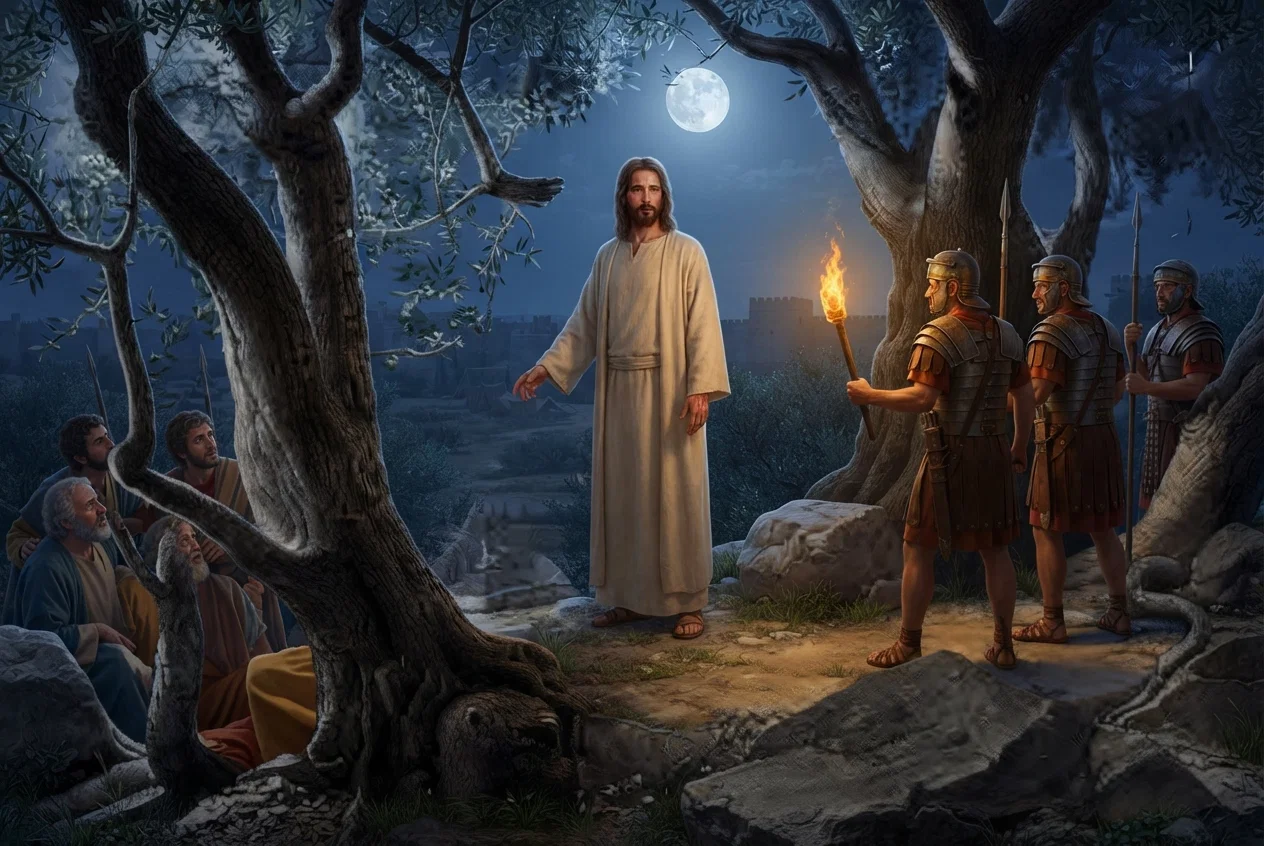
IN company with His disciples, the Saviour slowly made His way to the Garden of Gethsemane. The Passover moon, broad and full, shone from a cloudless sky. The city of pilgrims' tents was hushed into silence.
Jesus had been earnestly conversing with His disciples and instructing them, but as He neared Gethsemane He became strangely silent. He had often visited this spot for meditation and prayer, but never with a heart so full of sorrow as upon this night of His last agony. Throughout His life on earth, He had walked in the light of God's presence. When in conflict with men who were inspired with the very spirit of Satan, He could say, "He that hath sent Me is with Me: the Father hath not left Me alone; for I do always those things that please Him."

BEARING THE GUILT OF THE WORLD

But now He seemed to be shut out from the light of God's sustaining presence. Now He was numbered with the transgressors. The guilt of fallen humanity He must bear. Upon Him who knew no sin, must be laid the iniquity of us all. So dreadful does sin appear to Him, so great is the weight of guilt which He must bear, that He is tempted to fear it will shut Him out forever from His Father's love. Feeling how terrible is the wrath of God against transgression, He exclaims, "My soul is exceeding sorrowful, even unto death."
Near the entrance to the garden, Jesus left all but three of the disciples, bidding them pray for themselves and for Him. With Peter, James, and John, He entered its secluded recesses. These three disciples were Christ's closest companions. Often they had passed the night with Him in this retreat. On these occasions, after a season of watching and prayer, they would sleep undisturbed at a little distance from their Master, until He awoke them in the morning to go forth anew to labor. But now He desired them to spend the night with Him in prayer. Yet He could not bear that even they should witness the agony He was to endure. "Tarry ye here," He said, "and watch with Me."

SUFFERING FOR MAN'S SIN

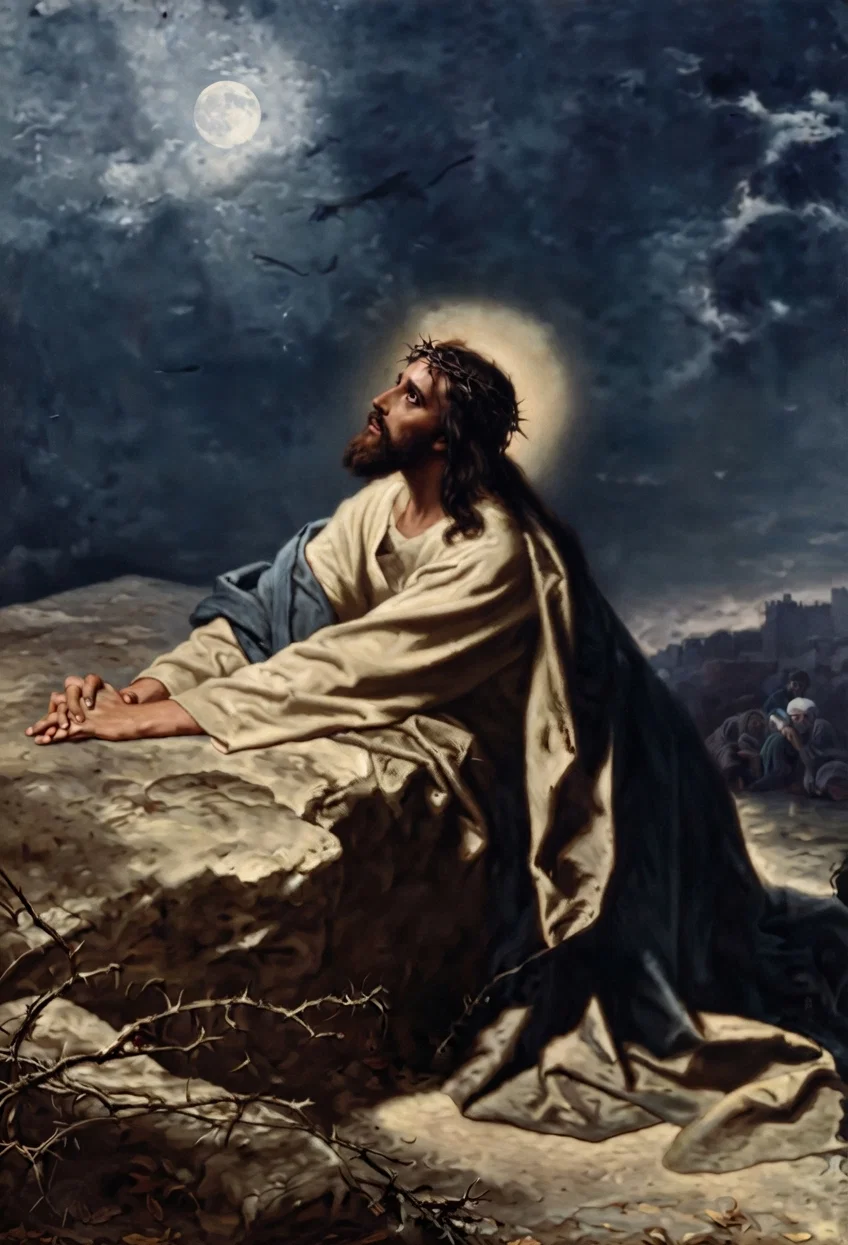
He went a little distance from them — not so far but that they could both see and hear Him — and fell prostrate upon the ground. He felt that by sin He was being separated from His Father. The gulf was so broad, so black, so deep, that His spirit shuddered before it. This agony He must not exert His divine power to escape. As man He must suffer the consequences of man's sin. As man He must endure the wrath of God against transgression.
As Christ felt His unity with the Father being broken up, He feared that in His human nature He would be unable to endure the coming conflict with the powers of darkness. In the wilderness of temptation, the destiny of the human race had been at stake. Christ was then conqueror. Now the tempter had come for the last fearful struggle. For this Satan had been preparing during the three years of Christ's ministry. Everything was at stake with the deceiver. If he failed here, his hope of mastery was lost; the kingdoms of the world would finally become Christ's; he himself would be overthrown and cast out. But if Christ could be overcome, the earth would become Satan's kingdom, and the human race would be forever in his power. With the issues of the conflict before Him, Christ's soul was filled with dread of separation from God. Satan told Him that if He became the surety for a sinful world, the separation would be eternal. He would be identified with Satan's kingdom, and would nevermore be one with God.

THE GUILT AND INGRATITUDE OF MEN

“Upon Him who knew no sin, must be laid the iniquity of us all.”
And what was to be gained by this sacrifice? How hopeless appeared the guilt and ingratitude of men! In its hardest features, Satan pressed the situation upon the Redeemer: "The people who claim to be above all others in temporal and spiritual advantages have rejected You. They are seeking to destroy You, the foundation, the center and seal, of the promises made to them as a peculiar people. One of Your own disciples, who has listened to Your instruction, and has been among the foremost in church activities, will betray You. One of Your most zealous followers will deny You. All will forsake You." Christ's whole being abhorred the thought. That those whom He had undertaken to save, those whom He loved so much, should unite in the plots of Satan — this pierced His soul. The conflict was terrible. Its measure was the guilt of His nation, of His accusers and betrayer, the guilt of a world lying in wickedness. The sins of men weighed heavily upon Christ, and the sense of God's wrath against sin was crushing out His life.

"NOT AS I WILL"

Behold Him contemplating the price to be paid for the human soul. In His agony He clings to the cold ground, as if to prevent Himself from being drawn farther from God. The chilling dew of night falls upon His prostrate form, but He heeds it not. From His pale lips comes the bitter cry, "O My Father, if it be possible, let this cup pass from Me." Yet even now He adds, "Nevertheless not as I will, but as Thou wilt."
The human heart longs for sympathy in suffering. Christ felt this longing, to the very depths of His being. In the supreme agony of His soul, He came to His disciples with a yearning desire to hear some words of comfort from those whom He had so often blessed and comforted and shielded in sorrow and distress. The One who had always had words of sympathy for them was now suffering superhuman agony, and He longed to know that they were praying for Him and for themselves. How dark seemed the malignity of sin! Terrible was the temptation to let the human race bear the consequences of its own guilt, while He stood innocent before God. If He could only know that His disciples understood and appreciated this, He would be strengthened.
“He came forth calm and serene. A heavenly peace rested upon His blood-stained face.”

WRESTLING WITH A SORROW BEYOND COMPREHENSION

Rising with painful effort, He staggered to the place where He had left His companions. But He "findeth them asleep." Had He found them praying, He would have been relieved. Had they been seeking refuge in God, that satanic agencies might not overcome them, He would have been comforted by their steadfast faith. But they had not heeded the repeated warning, "Watch and pray." At first they had been much troubled to see their Master, usually so calm and dignified, wrestling with a sorrow that was beyond comprehension. They had prayed as they heard the strong cries of the Sufferer. They did not intend to forsake their Lord, but they seemed paralyzed by a stupor which they might have shaken off if they had continued pleading with God. They did not realize the necessity of watchfulness and earnest prayer in order to withstand temptation.
The disciples awakened at the voice of Jesus, but they hardly knew Him, His face was so changed by anguish. Addressing Peter, Jesus said: "Simon, sleepest thou? couldest not thou watch one hour? Watch ye and pray, lest ye enter into temptation. The spirit truly is ready, but the flesh is weak."

NATURE WEPT AS HER AUTHOR WRESTLED

Again the Son of God was seized with superhuman agony; and fainting and exhausted, He staggered back to the place of His former struggle. His suffering was even greater than before. As the agony of soul came upon Him, "His sweat was as it were great drops of blood falling down to the ground." The cypress and the palm-trees were the silent witnesses of His anguish. From the leafy branches dropped heavy dew upon His stricken form, as if nature wept over its Author wrestling alone with the powers of darkness.
A short time before, Jesus had stood like a mighty cedar, withstanding the storm of opposition that spent its fury upon Him. Stubborn wills, and hearts filled with malice and subtlety, had striven in vain to confuse and overpower Him. He stood forth in divine majesty as the Son of God. Now He was like a reed beaten and bent by the angry storm. He had approached the consummation of His work a conqueror, having at each step gained the victory over the powers of darkness. As one already glorified, He had claimed oneness with God. In unfaltering accents He had poured out His songs of praise. He had spoken to His disciples in words of courage and tenderness. Now had come the hour of the power of darkness. Now His voice was heard on the still evening air, not in tones of triumph, but full of human anguish. The words of the Saviour were borne to the ears of the drowsy disciples, "O My Father, if this cup may not pass away from Me, except I drink it, Thy will be done."
The first impulse of the disciples was to go to Him; but He had bidden them tarry there, watching unto prayer. When Jesus came to them, He found them still sleeping. Again He had felt a longing for companionship, for some words from His disciples which would bring relief and break the spell of darkness that well-nigh overpowered Him. But their eyes were heavy, "neither wist they what to answer Him." His presence aroused them. They saw His face marked with the bloody sweat of agony, and they were filled with fear. His anguish of mind they could not understand. "His visage was so marred more than any man, and His form more than the sons of men."

WILL HE ENDURE THE STRUGGLE?

Turning away, Jesus sought again His retreat, and fell prostrate, overcome by the horror of a great darkness. The humanity of the Son of God trembled in that trying hour. He prayed not now for His disciples, that their faith might not fail, but for His own tempted, agonized soul. The awful moment had come, — that moment which was to decide the destiny of the world. The fate of humanity trembled in the balance. Christ might even now refuse to drink the cup apportioned to guilty man. It was not yet too late. He might wipe the bloody sweat from His brow, and leave man to perish in his iniquity. He might say, Let the transgressor receive the penalty of his sin, and I will go back to My Father. Will the Son of God drink the bitter cup of humiliation and agony? Will the innocent suffer the consequences of the curse of sin, to save the guilty? The words pass tremblingly from the pale lips of Jesus, "O My Father, if this cup may not pass away from Me, except I drink it, Thy will be done."
(Continued on page 6)

The Supreme Crisis in Human History

(Continued from page 2)
Three times has He uttered that prayer. Three times has humanity shrunk from the last, crowning sacrifice. But now the history of the human race comes up before the world's Redeemer. He sees that the transgressors of the law, if left to themselves, must perish. He sees the helplessness of man. He sees the power of sin. The woes and lamentations of a doomed world rise before Him. He beholds its impending fate, and His decision is made. He will save man at any cost to Himself. He accepts His baptism of blood, that through Him perishing millions may gain everlasting life. He has left the courts of heaven, where all is purity, happiness, and glory, to save the one lost sheep, the one world that has fallen by transgression. And He will not turn from His mission. He will become the propitiation of a race that has willed to sin. His prayer now breathes only submission: "If this cup may not pass away from Me, except I drink it, Thy will be done."

HEAVEN SILENT AS HE TROD THE WINE-PRESS ALONE

Having made the decision, He fell dying to the ground from which He had partially risen. Where now were His disciples, to place their hands tenderly beneath the head of their fainting Master, and bathe that brow, marred indeed more than the sons of men? The Saviour trod the wine-press alone, and of the people there was none with Him.
But God suffered with His Son. Angels beheld the Saviour's agony. They saw their Lord enclosed by legions of satanic forces, His nature weighed down with a shuddering, mysterious dread. There was silence in heaven. No harp was touched. Could mortals have viewed the amazement of the angelic host as in silent grief they watched the Father separating His beams of light, love, and glory from His beloved Son, they would better understand how offensive in His sight is sin.

BOTH UNFALLEN WORLDS AND FALLEN ANGELS AS SPECTATORS

The worlds unfallen and the heavenly angels had watched with intense interest as the conflict drew to its close. Satan and his confederacy of evil, the legions of apostasy, watched intently this great crisis in the work of redemption. The powers of good and evil waited to see what answer would come to Christ's thrice-repeated prayer. Angels had longed to bring relief to the divine Sufferer, but this might not be. No way of escape was found for the Son of God. In this awful crisis, when everything was at stake, when the mysterious cup trembled in the hand of the Sufferer, the heavens opened, a light shone forth amid the stormy darkness of the crisis hour, and the mighty angel who stands in God's presence, occupying the position from which Satan fell, came to the side of Christ. The angel came not to take the cup from Christ's hand, but to strengthen Him to drink it, with the assurance of the Father's love. He came to give power to the divine-human Suppliant. He pointed Him to the open heavens, telling Him of the souls that would be saved as the result of His sufferings. He assured Him that His Father is greater and more powerful than Satan, that His death would result in the utter discomfiture of Satan, and that the kingdom of this world would be given to the saints of the Most High. He told Him that He would see of the travail of His soul, and be satisfied, for He would see a multitude of the human race saved, eternally saved.
Christ's agony did not cease, but His depression and discouragement left Him. The storm had in no wise abated, but He who was its object was strengthened to meet its fury. He came forth calm and serene. A heavenly peace rested upon His blood-stained face. He had borne that which no human being could ever bear, for He had tasted the sufferings of death for every man.

Can the Fulfilment of Prophecy Be Defeated?

Isaiah the Prophet, Nearly Two Hundred Years Before the Birth of Cyrus, Foretold What His Work Would Be—Fiendish Efforts to Destroy the Baby Persian Prince—The Triumph of the Prophetic Word
By GEORGE W. REASER
A RECOGNIZED historian who lived in the early part of the next century following the reign of Cyrus the Great, relates a thrilling and impressive incident that bears the stamp of the miraculous in the preservation of the life of the one who was destined and foretold by Providence to be the reigning king of Persia at the exact time when the decree for the return of the Jews to Jerusalem must be issued. The incident, much condensed, runs as follows:
The grandfather of Cyrus, Astyages by name, had given his eldest daughter, Mandane, in marriage to a Persian prince named "Cambyses, whom he found descended of a good family, and of a peaceful disposition." Astyages was the king of the Medes, and the Persians were at that time in subjection to the Medes. The "higher" horn of Daniel's prophecy, representing the ascendancy of the Persians over the Medes, had not yet arisen. The special reason for forming this marital alliance with a Persian rather than a Mede was a dream, which left the impression on the mind of Astyages that the offspring of his daughter would be his rival for the kingdom.

THE KING REMINDED OF HIS DREAM

Mandane's first child, whom she named Cyrus, was born at the palace of her father. On seeing the infant, the king's dream flashed into his mind, and he became wickedly jealous lest the child with the royal blood of both the Medes and the Persians in his veins would, on reaching manhood, wrest the kingdom from him. To avert the possibility of losing his kingdom, he "sent for Harpagus, a kinsman of his, the most faithful of all the Medes, and the manager of all his affairs, and said to him: 'Harpagus, on no account fail to do the business I now charge you with. . . . Take the child that Mandane has given birth to, carry him to your house, and kill him.'" Harpagus received the child, but dreading the task imposed by the king, and being influenced by his wife, summoned his herdsman, who lived in the mountains not far distant, and charged him, under penalty, to cause the death of the child by exposing it to the elements.
On his return home with the infant Cyrus, the herdsman found that his own new-born babe had died. The child had not been interred, nor was the fact of its decease known to the neighbors. Under such circumstances, how natural it was that the herdsman's wife should plead that the living child be given her to nourish and rear, and that her own child, already beyond the possibility of suffering pain, after due exposure in the mountains, be taken to Harpagus, clad in the apparel in which Cyrus was sent to her home! Her husband yielded to her entreaties, with the hope that the substitution would not be detected.
All went well until Cyrus, reared by Cyno, the herdsman's wife, had attained the age of ten years, when a neighborhood difficulty which was finally appealed to the king, resulted in the discovery that his command to Harpagus had not been executed, and that the boy Cyrus still survived.
In punishment of Harpagus, Astyages put the former's son to death in a most horrible manner.

THE BOY-PRINCE CYRUS WAS SPARED

Then, considering what he should do to Cyrus, he summoned the Magi. Their answer was favorable to sparing the boy's life, to which the king replied, "I too, O Magi, am very much of the same opinion." The Magi then offered the advice to Astyages to send the boy out of his sight to his parents in Persia. When Astyages heard this, he was delighted, and after calling for Cyrus, said to him: "Child, I have been unjust to you, by reason of a vain dream, but you survive by your own destiny. Now go in happiness to Persia, and I will send an escort to attend you. When you arrive there, you will find a father and mother very different from the herdsman Mitradates and his wife."
Harpagus ever after cherished the spirit of revenge deep-hidden in his heart, awaiting opportunity for expression. His first measure was to influence the chief men of his nation secretly against Astyages, on the ground of his tyranny. Then "perceiving that Cyrus was growing to be his avenger, he contracted a friendship with him." Finally deciding that the opportune time had come, with great secrecy he sent a letter to Cyrus.
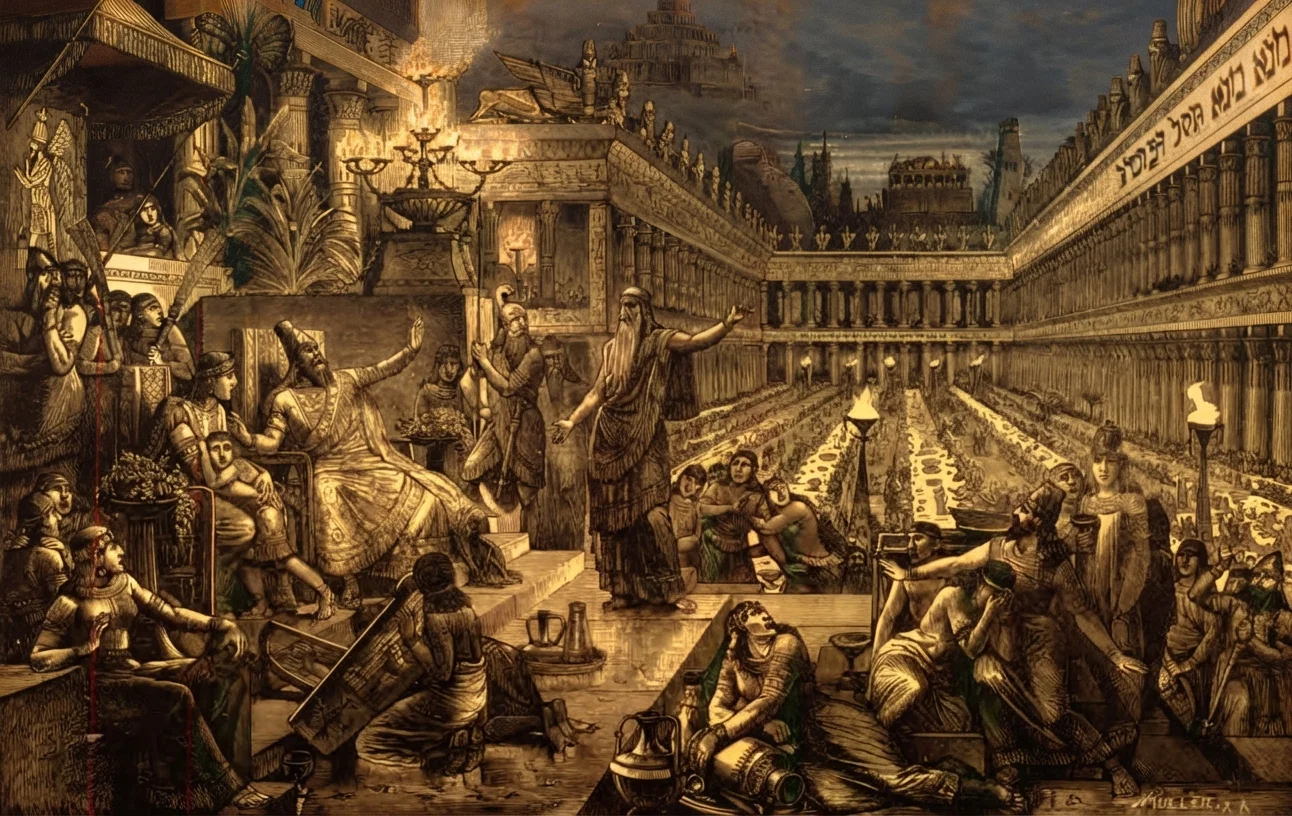
Belshazzar's feast, when "the handwriting on the wall" announced the overthrow of his kingdom, and Cyrus, in harmony with the prophetic Word, came to the throne of world empire.

SEEKING REVENGE

In the introduction of his letter, in which he proposed to co-operate with him in the overthrow of the Medes, Harpagus said: "Son of Cambyses, seeing the gods watch over you (for otherwise you could never have arrived at your present fortune), do you now avenge yourself of your murderer Astyages."
Having assembled his warriors, in his appeal to them to revolt from the rule of the Medes, Cyrus said in part, "Now, therefore, obey me, and be free; for I am persuaded I am born of divine Providence to undertake this work."
Acting upon the suggestion of Harpagus, and with his cooperation, Cyrus subjugated the Medes, and made Astyages a captive for the remainder of his life. Concerning the one whom the king of the Medes attempted to slay in his infancy, the historian says, "Cyrus therefore, having been thus born and educated, came to the throne, . . . and became master of all Asia."

THEY BELIEVED IT SUPERNATURAL

It should not escape our notice that Astyages, Harpagus, and Cyrus each recognized that a supernatural power had preserved the life of the last named, evidently that he might accomplish a special work. Prophecy foretold the special part that he was to play in the working out of Jehovah's eternal purpose for His people, and both sacred and profane history prove that he fulfilled his Heaven-appointed mission. We might call half a score of historians to the witness-stand, and all would bear the same testimony as to the work of this king.

CYRUS FINALLY CAME TO THE THRONE

Cyrus came to the throne of Babylon in the year 536 B.C. He found God's people in captivity; but the set time had come for their return to their own land, as the seventy years' captivity in Babylon began in B.C. 606, and must terminate in B.C. 536, or the word of the living God would be broken. Immediately a supernatural desire took control of the king to let God's people return to their own land, and the decree was issued.

THE BOLD PREDICTION OF ISAIAH

One hundred seventy-six years before Cyrus became the king of Medo-Persia, the prophet Isaiah had delivered Jehovah's message relative to this monarch in these words: "Thus saith the Lord to His anointed, to Cyrus, whose right hand I have holden, to subdue nations before him; . . . I will go before thee, and make the crooked places straight. . . . I have even called thee by thy name: I have surnamed thee, though thou hast not known Me." And again, "He is My shepherd, and shall perform all My pleasure: even saying to Jerusalem, Thou shalt be built; and to the temple, Thy foundation shall be laid." Isa. 45:1-4; 44:28. Compare with Ezra 1:1-4.
When we consider the fact that the historian who wrote the account of the miraculous preservation of the life of the infant Cyrus, was not in touch with the Jewish people, and that, being a heathen, he could have had no desire to substantiate the prophecy, in fact was doubtless wholly in ignorance of its existence; and again, when we recognize that among the millions of Persians upon the stage of action at that time, the historian's account falls upon the identical individual whom the Lord named in the prophecy, we are driven to the conclusion that in the birth of the child foretold, Satan saw and seized the opportunity to nullify the "testimony of Jesus," "the spirit of prophecy," even as he attempted to defeat the plan of salvation by destroying the infant Saviour. But in each instance, He whose omnipotent hand upholds the universe worked "all things after the counsel of His own will." The word of Jehovah can not be broken. Whoever attempts it, meets with ignominious defeat.

Man's Condition in Death

Life Depends on Organization — “Our Friend Lazarus Sleepeth”— The Resurrection Essential to Life Beyond

By CHARLES THOMPSON
THE question of man's condition in death is answered in the third chapter of Genesis. The Lord, speaking to Adam after he sinned, said, “In the sweat of thy face shalt thou eat bread, till thou return unto the ground; for out of it wast thou taken: for dust thou art, and unto dust shalt thou return." Gen. 3: 19.
When God created man, the record is, “And the Lord God formed man of the dust of the ground, and breathed into his nostrils the breath of life; and man became a living soul." Gen. 2: 7. The Scripture, speaking of man in death, says, “Then shall the dust return to the earth as it was: and the spirit shall return unto God who gave it." Eccl. 12: 7.

NO LIFE INDEPENDENT OF ORGANIZATION

From these statements it is clear that there is no life independent of organization. God organized man, and he became a living soul. Death disorganizes him, “and in that very day his thoughts perish." Ps. 146: 4. As the dust returns to the earth as it was, and the spirit returns to God who gave it, evidently if man is conscious after death, he was conscious before birth. Experience teaches us that this is not true, and the Scriptures also affirm that “there is no work, nor device, nor knowledge, nor wisdom, in the grave, whither thou goest." Eccl. 9: 10.
When the Saviour was upon earth, and was abiding for a time in Bethabara, where John first baptized, Mary and Martha, sisters of Lazarus, sent word to Him, saying, “He whom Thou lovest is sick." After two days, Jesus prepared to “go into Judea again." His disciples protested, but Jesus said, “Our friend Lazarus sleepeth." His disciples said, “Lord, if he sleep, he shall do well." “Then said Jesus unto them plainly, Lazarus is dead." John 11: 1-4.

ASLEEP IN DEATH

When Jesus said, “Lazarus sleepeth," He meant just what He did when He said, “Lazarus is dead." Therefore, Jesus plainly teaches the sleep of the dead, and every normal mind knows there is no consciousness in a sound sleep. Job testified that such is the condition of man in death: “His sons come to honor, and he knoweth it not; and they are brought low, but he perceiveth it not of them." Job 14: 21.
The apostle Paul, in his argument on the resurrection of the dead, says: “For if the dead rise not, then is not Christ raised: and if Christ be not raised, your faith is vain; ye are yet in your sins. Then they also which are fallen asleep in Christ are perished." 1 Cor. 15: 16-18. This clearly shows that the only hope of a future existence is through a resurrection of the dead. This is promised to all men: “For as in Adam all die, even so in Christ shall all be made alive." Verse 22. The next statement tells when this will be: “But every man in his own order: Christ the first-fruits; afterward they that are Christ's at His coming." Verse 23. This is why the second coming of Christ is spoken of as “that blessed hope." Titus 2: 13.
From these scriptures, we learn that man in death is absolutely unconscious, and will remain so until the resurrection at the second coming of Christ. Therefore we can join in the final response to the benediction of God's word, and exclaim, “Even so, come, Lord Jesus." Rev. 22: 20.

Christ's Methods

CHRIST has given to His people the work of soul saving. To fit them for this, He not only left His teachings, but His example.
He was ready to receive Nicodemus at night. They spent a pleasant evening together talking of the kingdom of God.
Traveling through the country, He began a conversation with a woman of questionable reputation. His conversation was so chaste, His bearing so earnest, that the effect on the woman was such that she said to her townsmen, "Come, see a man, which told me all things that ever I did: is not this the Christ?" And not a soul felt to jeer or ridicule. On the contrary, because of this saying, many believed on Him. They saw a great change in the woman's life. This led them to seek the one whose teaching could work such wonders.
By personal contact, their faith was confirmed. Many more believed on Him from seeing Him and listening to His teaching. A whole city was stirred, and a great revival held, resulting in the conversion of a multitude. All of this came from a conversation started with a single individual.
What a lesson is here for the Christian! In the passing stranger is the groundwork for a revival. Let the casual conversation be turned into a sermon. W. F. MARTIN.

Armageddon and the Close of Probation

RECKLESS one, have you in some manner heard that before the coming of the Lord Jesus in power and great glory, there is to be a great world battle, spoken of as the battle of Armageddon? And have you reasoned this way, away back in the secret chamber of your heart? "I will have a good time now. I will not concern myself seriously regarding the salvation of my soul. I expect to get ready sometime, but I'll watch the movements among nations, and when I think it is the proper time, then I will turn about and give myself to Christ."
But stop! When that "proper time" comes, it may be everlastingly too late. When Armageddon comes, the door of salvation will have been forever closed. Jesus will then have left the mercy-seat on high, so that there can then be no more remission of sins. It is not until He ceases to plead the merits of His own blood, that the nations are plunged into those awful scenes of war and strife that end in Armageddon. See Dan. 12: 1, 2.
Be wise, and hear what God says to you: "I have heard thee in a time accepted, and in the day of salvation have I succored thee: behold, now is the accepted time; behold, now is the day of salvation." Then delay not, but let Jesus into your heart now, today. T. E. BOWEN.

“Behold, Now Is the Accepted Time”

By EDNA A. CRABBE
As down the many years apace, We backward turn our thoughts, and trace Events gone by,—perhaps a deed,— Or plans we planned and failed to heed; See how unworthy we have been Of Jesus, who for us was slain; Who by the cross and pain did buy A home for all, beyond the sky. The resurrection morn shall come, And loved ones all He’ll gather home— Forevermore to live.
Our God to us His Son did give, That all who died in Him might live; Live in the mansions He prepares, Away from sorrow, sin, and cares. O, turn to God without delay, For Christ our Lord has cleared the way. Trust not unto a last prayer given, To save our souls and gain us heaven. For close, so close, we walk with death, How know ye when shall cease our breath And we die unforgiven?
Think of the many ones who give Their youth, the best that in them is, To Satan’s snares, and day by day Are led by reckless pleasure’s sway; Who think that when they come to die God then will hear their burdened cry. O, sinners, who are tempting fate, Turn to Jehovah ere too late. Then cease, O cease, to wait.
God’s love for us is never late; ’Tis ours, whose haggard footsteps wait. God’s angel now a message sings; O’er all the nations wide it rings, A warning that will be the last. Probation’s closing, closing fast. Then let us be among the throng Who for the end do work and long; Who deem God’s love of greater worth Than all the riches of the earth, Or worldly pleasures wrong.
When worldly lusts and passions cleave, O, soul, the Spirit thou dost grieve. Then, O, so gladly take the cross; Count gain, for carnal pleasure’s loss; For Christ hath better things for all Who heed His tender, loving call. O, sinner, sinner, do not wait A death-bed prayer, a death-bed fate. Think not there’s time before you die; End not this life with anguished cry— Too late! Too late! Too late!
Continue reading: Christ Existed Before His Birth in the Manger